Showing posts with label Fiona Staples. Show all posts

Friday, 29 May 2015

Deep Sequencing: Technocolour Character Design IN SPAAAACE!

Or a look at how the character design competition has been won by Saga,
by Brian K Vaughan and Fiona Staples; Image Comics


Saga is visually tons of fun. There is just an endlessly imaginative and playful approach to the design of characters, technology, and location that just comes to life on the page. Sometimes it feels like Team Saga is just mashing together different things, seemingly at random, to create this constantly surprising parade of space oddities. Which is totally fine! The way Saga looks it's downright delightful.

The thing is though, the more Saga I read, the more I'm beginning to see a method to some of the madness in character design.

Specifically, I am really interested in the design of the Robots in Saga.

There will be *SPOILERS* For Saga Vol. 4


The Robot Royals have always been one of my favourite fixtures of Saga. There is something great about television headed robots wearing very old-fashioned looking military uniforms that is just iconic and fun. I think the crux of why I like these designs so much has to do with the amount of anachronism on display: the contrast between the retro-future monitor-heads and the 1800s-style jackets, trousers, and cavalry boots is just kind of delightful. Even without any other information, they are kind of the best.


Probably the main Robot character so far has been Prince Robot IV. In many ways he is prototypical to the Robot Royalty as he is usually depicted as a sleek-monitor-headed man wearing some variation on the old-fashion military uniform. He has the added elements of a black stipe on the sides of his head and a pair of rabbit-ear antennas that help make him stand out. Additionally he has a cracked screen, a visible mark of the physical and psychological scars he has suffered over the series. And, like the facial scar this crack is a fun play on, this disfigurement is another identifying feature that further differentiates the prince from other Noble Robots. Collectively he manages to look unique and somewhat removed from the mainstream of Robot society.


Princess Robot, the wife of Prince Robot IV has a subtly different and very clever design. She still has the grey humanoid body and monitor head, but hers is tweaked in ways that emphasize her role as an aristocratic woman. Specifically the two knob like projections on the side of her head create the illusion of ears while her sleeker, elongated monitor has a more traditionally feminine shape. Together these elements create a similar silhouette as hair piled into an elaborate bun, a style synonymous with aristocracy and pomp. This makes Princess Robot both recognizable as a character and cements her role in the story as a Noble Robot.


The son of Prince Robot IV is also an interesting bit of character design. Unlike the adult Robots, the infant and imagined child princeling has a round monitor head. This gives the character an instantly childlike look, his monitor approximating the rounder, chubby features of young human kids. It instantly sets him apart from his adult counterparts and cements his status as a wee one. Clever stuff.

Also, how great is it that the Royal Robots have literal Blue Blood? 


Saga Vol. 4 introduces us to the first Robot commoner, Dengo. It seems that Robot society is wildly unequal and is split between a wealthy aristocracy and a wretched commoner class who live in squalor in the shadows of the royal wealth. This class distinction is reflected in the design of the character. Instead of having a sleek, modernist monitor-head, Dengo has a more old fashioned looking television that is boxy and has large analogue controls on the front of it. His face is also, in a choice that is really effective, a black-and-white screen, as opposed to the coloured screens of the Robot Royalty. As readers we can instantly tell the difference in class by their heads: Dengo has an old fashioned TV like someone in his economic situation might, while the Royals have nicer monitors like a richer person would. The allusions inherent in this character design choice are amazing.


But it's King Robot who has maybe the greatest character design in all of comics. The King of the Robots just has a giant, whopping, high definition widescreen TV for a head. A modern flatscreen so big that it is introduced on a double page spread even! Just let that sink in. The highest class, most important Robot has both the largest monitor head, but also the most modern and expensive one. It is obnoxiously clever character design that conveys how important, arrogant (big headed), and wealthy the character is all at a perfectly executed first glance! It's pretty much the best.

So shut it all down folks, comic character design is over. It's done. It can't get any better.

Long live King Robot!

Post by Michael Bround


Previously:

Wednesday, 27 May 2015

So I Read Saga Volume 4

A 250 word (or less) review of Saga Vol. 4
by Brian K Vaughan, Fiona Staples; Image Comics


This review is for an ongoing series and may contain *SPOILERS*. To read about the beginning of Saga go here.

Saga is a comic about building families and trying to sort out how to be an adult. I mean, it's also a Space Opera about fugitive lovers from opposite sides of a galaxy spanning war filled with imaginative and awesome Science Fantasy amazingness who against all odds have a kid. But really, it's about making a marriage work, raising a kid, and making that transition into being a grown-ass person. While I may not have goat horns and a magic sword, as someone who is in their late twenties whose education is finally turning into a career, who is recently married, and whose spouse is currently pregnant with our first spawn (which is amazing and existentially awesome and scary), Saga is just a story that profoundly resonates with me. Saga Vol. 4 specifically deals with the reality of what comes just after: protagonists Alana and Marko are married, have their kid, a career, and a functional family thing and now have to fight to hold onto it. To fight against the slowly brewing forces of Robot Class Warfare, Space Empires, violent Bounty Hunters, but mostly against ennui and temptation and the fact that reality is kind of an unromantic drag. Saga Vol. 4 is a fantastic roller-coaster filled with imagination and fun and also a fraught meditation on this stage of life I've suddenly found myself in. It's scary and arresting and perfect. Please let everything work out. Please.

Word count: 239

Post by Michael Bround


Previously:


Friday, 12 September 2014

Deep Sequencing: Space Lighthouses and Dramatic Turths

Or a look at how fiction captures truth in Saga Volume 3
by Brian K Vaughan and Fiona Staples; Image Comics


There is this idea of dramatic truth. The idea is that through fiction, which at its core is effectively entertaining lies, we can learn some true, transcendental thing about ourselves or the world. Regardless of whether this is accomplished through emulation or metaphor, fiction has the potential to exemplify aspects of our reality that we can see and feel and learn from. Even though the fiction in question might be completely, absurdly unrealistic, it can still be closer to some idealistic truth than a statement based on reality. In some ways the entertaining lies of our stories might be the best way to learn about ourselves, our relationships, or our world.

There is a scene in Saga Volume 3 that rings true to me in such a complete way that I want to share it with you.

Of course, this moment is built of considerable *SPOILERS* so proceed with that understanding.


I think I've mentioned it on the site a few times, but I've recently gotten married to the best person. Aside from calling her the best person, I have trouble articulating exactly what it is that makes her so special, why she is the person out of everyone I've met that I feel compelled to create a life with. I mean she is smart and hilarious and good looking and fun to be around and responsible in a way that I worry I will never be and patient in a way that I know that I am completely incapable of. She is an unbelievable dork and unpretentious in a way that is super attractive and which is constantly a mystery to me. But this really doesn't capture it: my spouse is so much more than a bunch of favourable check marks on a list, and really fails to catch that special spark that explains why I love her the way I do.

I just don't have the language to articulate it.


Saga, for the uninitiated, is about a pair of young lovers from opposite sides of an interplanetary war falling in love and starting a family. Alana is flightless, winged person from the planet Landfall while Mark is a magic horned person from the moon Wreath, which according to the politics of the galaxy is really not okay. As a result the pair are fugitives fleeing from monstrous forces sent by either side of the conflict: a robot royal prince, an amoral bounty hunter, and a jilted ex-fiancee. In Saga Vol. 3 our heroes Alana and Marko find a kind of home in the lighthouse of a famous writer, which is where the forces pursuing them eventually catch up to them. 

Chaos ensues! 

Bad things happen! 

And our pair of lovers and their infant daughter are cornered on the balcony of the lighthouse with no means of escape!

So Marko shoves his Alana and his daughter off the lighthouse balcony to their apparent demise!


And instead of falling to her death, Alana, who we had been told was flightless, manages to fly on her tiny wings saving herself, her daughter, and rescuing her husband Marko from his villainous Ex. 

It's a pretty badass, fist pumping moment! 

But it's what comes next that absolutely speaks to me:


When Alana lands and asks Marko how he knew she'd somehow manage to fly after he maybe threw her and their daughter to their deaths, he simply says that it's obvious that his wife can do anything.

And that perfectly encapsulates how I feel about my own wife; that is the magic, dramatic truth about what makes her so special, why I love her so much.

If I were to push her off the balcony of a space lighthouse with a hypothetical infant in her arms, she would find a way to fly. Because she is completely fucking unstoppable.

Saga is a great comic and I love my wife.

Previously:


Wednesday, 10 September 2014

So I Read Saga Volume 3

A 250 word (or less) review of Saga Vol. 3
By Brian K Vaughan and Fiona Staples; Image Comics.


Saga is a comic about lovers, from opposite sides of a Space War, who fell in love, had a kid, and try to build a family while on the run from bounty hunters and soldiers and ex-fiancees. While there is a lot of pretty cool lasers and swords space action, the comic is really about the construction of families: how two potentially very different people come together in love, drag in others, maybe make a new person, and build this special, de novo community. And then, against the ridiculously long odds of life, fight to maintain this delicate, most important thing. I fucking love this comic. I mean, with Brian K Vaughan's wizardry for story and Fiona Staples endlessly beautiful and emotive and funky art, Saga is amongst the most well crafted comics I read. But that's not why Saga Volume 3 fucking destroyed me. The reason why this comic, more so than earlier chapters, absolutely gutted me, is that I just got my butt married and have spent the months around reading this comic pondering about the construction of family-things and my own little community. And so, I think, I was perfectly primed for this beast to gore me. Which speaks to both the quality of the comic, of course, but also the deeply personal experience of fiction. But yeah, Jesus fucking wept guys, give Saga a try. I guarantee you'll enjoy it, and if you’re living in the same headspace as me, it might just kill you dead.


Word count: 250

Previously:

Wednesday, 6 November 2013

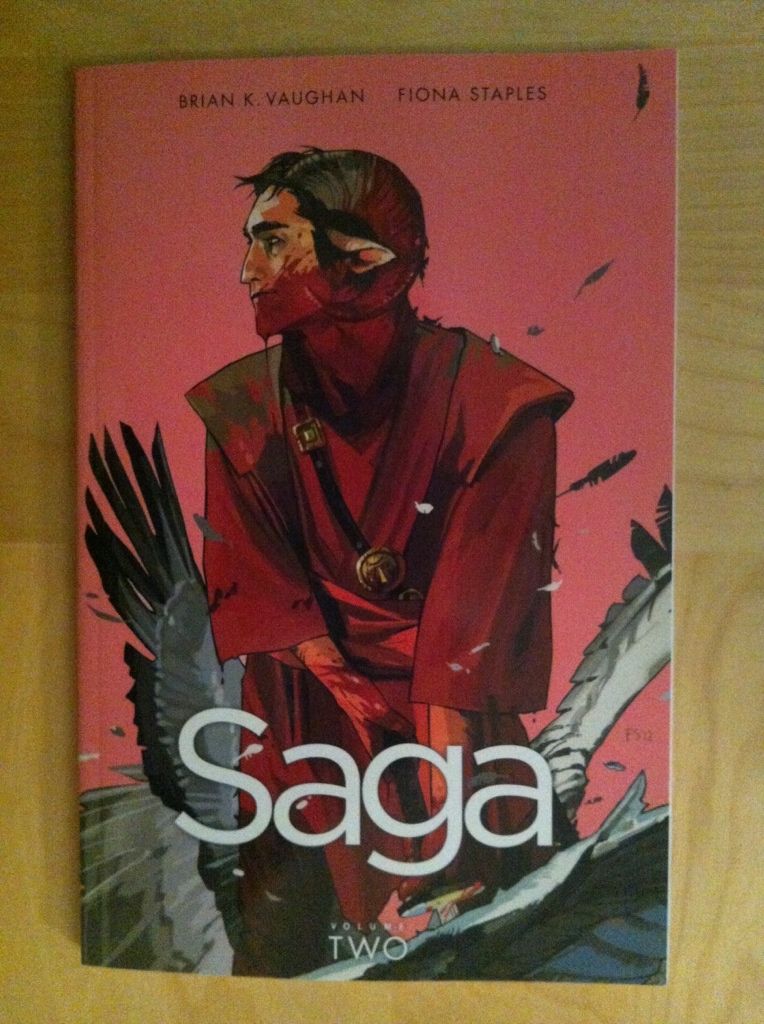
So I Read Saga Volume 2

A 250 word (or less) review of the second Saga collection
By Brian K Vaughan and Fiona Staples; Image Comics


This review will contain unavoidable *SPOILERS*. For a *SPOILER* free review of Saga please go here.


I love comic books. Absolutely love them. There are these moments of narrative clarity, pure  unadulterated story telling in comics that I just find joy inducing. It's kind of a difficult emotion to articulate, but if you want to see what sets off this primal glee, Saga Vol. 2 is an excellent example. Saga Vol. 2 continues the story of Marko and Alana, star crossed lovers from different extraterrestrial species on opposites sides of a war, and their baby Hazel as they try to maintain their freedom in a bombastic Space Opera setting. The current collection picks right up at the cliffhanger ending of Volume 1 and just keeps racing along with our heroes contending with the arrival of Markos’ parents, the predations of Freelance Bounty Hunter The Will, and the pursuit of Prince Robot IV. Saga Vol. 2 also continues the tradition of swagger, humour, surprise, action, and family drama that made the first collection of Saga such an infectious read. This comic still looks amazing, with its own distinctive and wicked awesome style. Basically, this comic has top-notch creators blasting out some of their best work. But even that doesn't really capture it... Saga Vol. 2, despite its excellent pedigree, manages to be more enjoyable than it should. I really love this comic. It's difficult to articulate exactly why, so just go read it.

Word Count: 226

Previously:

Friday, 21 June 2013

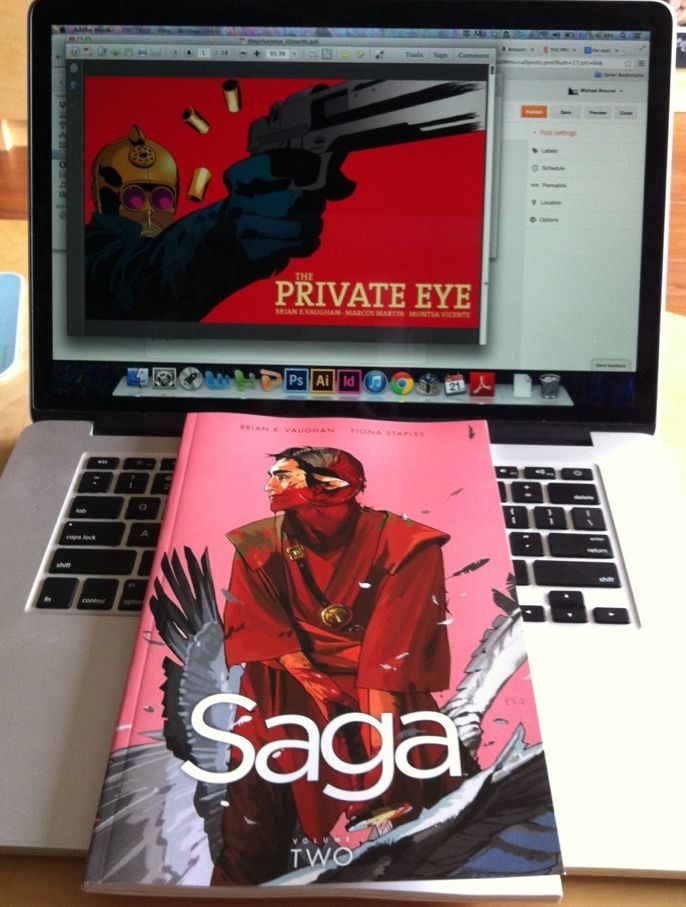
The Perplexing Case Of How I Got Saga Vol. 2 Before The Private Eye #2

Or some thoughts about the differences between completely independent digital comics publishing and print comics consumption.


I really like Brian K Vaughan comics. He is a very talented writer who collaborates with some great artists, and as a result, great comics happen. Currently, Brian K Vaughan is involved in two comics: Saga with artist Fiona Staples and The Private Eye with artist Marcos Martin. Both are gorgeous comics, with neat concepts, and are absolute obligate comics to read. They are also published, and therefore consumed, in completely different ways. 

Saga is a print comic being published by the creator-ownederish Image Comics and is being distributed in comic book and book stores both in a monthly magazine format as well as periodic trade paperback collected editions. The Private Eye, in contrast, is a purely creator owned affair being published monthly digitally and sold exclusively in a pay-what-you-want manner through the creators web storefront. From a consumer perspective, what this means is that we have to buy these comics in completely different ways. In my case the plan is to buy the collected Saga volumes as they arrive in stores and purchase The Private Eye digital files as they are made available online.

Or at least this is the theory.

In reality, it hasn't quite worked out that way. And I think this might be interesting.

My Saga consumption is more or less going to plan. I strategically avoid the Saga issues as they come out for budgetary reasons (while also fanatically evading Saga spoilers online) and then buy the trades on the weeks they came out. And it's easy to do. I am a weekly comic store customer: every single week I make a trip to my local comic book store and buy whichever of my ten-and-only-ten ongoing series comics have hit the stands as well as a trade for the week. It is a habitual process honed through the years and is now just a scheduled, expected part of my life. (And I am nothing if not a creature of habit.) Basically, Saga takes advantage of the existing comic book distribution system and is bootstrapped to our existent comic book fan behaviour. Which, is to say, it doesn't require us to do anything differently.

Where my consumption plans fall apart, a bit, is with The Private Eye. Despite very much wanting to buy The Private Eye as soon as it is published online, it took me more than a month to actually purchase the comic. This wasn't because I missed the announcement of The Private Eye #2, I follow an unhealthy amount of comics-related social media and noticed its release. The trouble is that getting The Private Eye #2 requires a non-habitual, special effort. Which, fair enough, is a fairly tiny one. But what I found was that I had difficulty prioritizing making the web transaction, when I thought of it I was always busy with work, or making dinner, or going to the comic book shop. Buying The Private Eye #2 became that thing-I-have-to-do-later that never actually gets done. 

I think there are essentially two reasons for this. The first is that by using a non-standard comics service, The Private Eye removes itself from habitual consumption habits. This requires people to effetively make a very small, special trip to their store which can be hard to remember and easy to put off. Procrastination is not a rational mode. The second reason I think I put off The Private Eye is a lack of reminders. The comics internet made a justifiable fuss when The Private Eye #2 was released,  and then went mostly silent about the comic. Moreover, neither Brian K Vaughan nor Marcos Martin maintain a social media presence. And I think this contributed to my not thinking about the comic in moments when I actually had the time to make the short transaction. Of course this might all be me being an inflexible consumer who spent the month of May frantically trying to prepare for the biggest test of my life.... 

Regardless, all I know is that I had Saga Vol. 2 before The Private Eye #2, despite the latter's one month head start. 

(Also, Paypal is actually the worst. I spent half-an-hour grappling with it to do a non-member credit card transaction from Canada... it was very buggy. And Paypal will not let me connect my credit card to my account for... reasons I guess? I used up my entire lunch break based comic reading time actually getting the comic!)

Wednesday, 3 April 2013

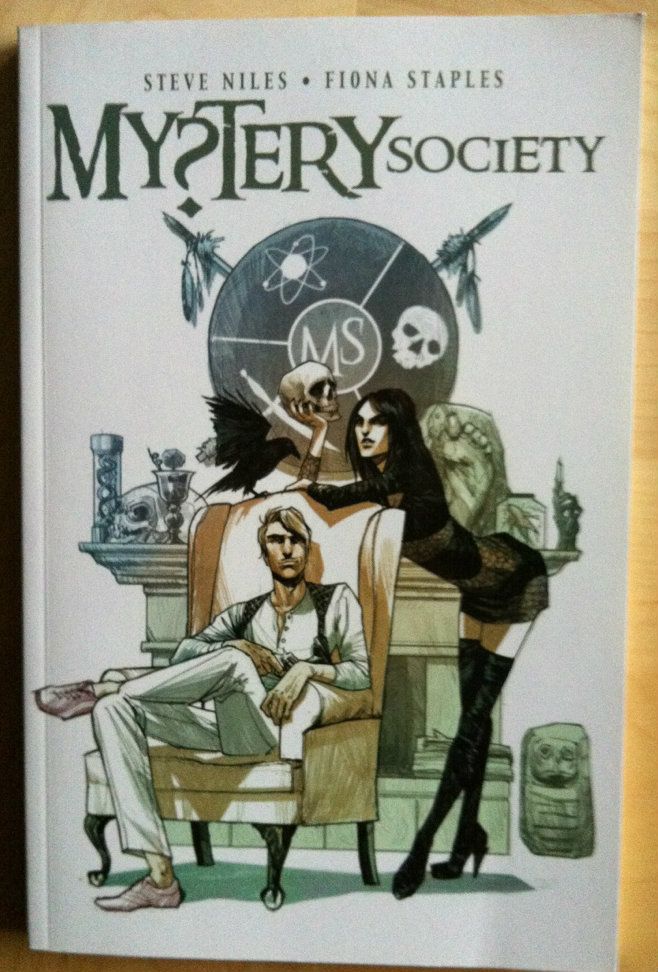
So I Read Mystery Society

A 250 word (or less) review of the Mystery Society collected edition.
By Steve Niles and Fiona staples, IDW Publishing


Mystery Society is kind of like a Saturday morning cartoon in a beautiful comic package. The story follows young occult bookstore owners turned millionaire adventurers Nick and Anastasia Mystery as they set out to debunk urban legends and conspiracies. They are joined by a steampunk robot piloted by the brain of Jules Verne and Secret Skull, a lady who is also dead, and a pair of twin super-powered experimental subjects. Together they form the Mystery Society where they have run-ins within an out-of-control military industrial complex and hijinks ensue. The script by Steve Niles is pleasant enough, with a very happy-go-lucky retro-cartoon feel. It's clever, with some fun jokes and slight twists and is perfectly enjoyable. The real reason to read Mystery Society, though, is to gawk at Fiona Staples' art: it's absolutely gorgeous. The designs are delightful, the characters expressive, and everything is sumptuosly colored. The artwork is worth the price of admission. So if you want to read a remarkably beautiful comic book with a fun premise and a pleasantly well written script, check out Mystery Society.

Word count: 179

Friday, 8 March 2013

Sexy Saga

Or a wonky essay on television headed robot royalty having intercourse.


Saga, by Bryan K Vaughan and Fiona Staples is pretty incredible and is a great example of why everyone should read comic books. It's smart, fun, and beautiful; an absolute rockstar book.

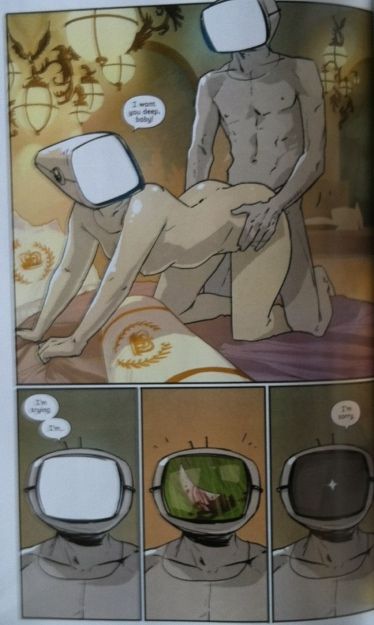
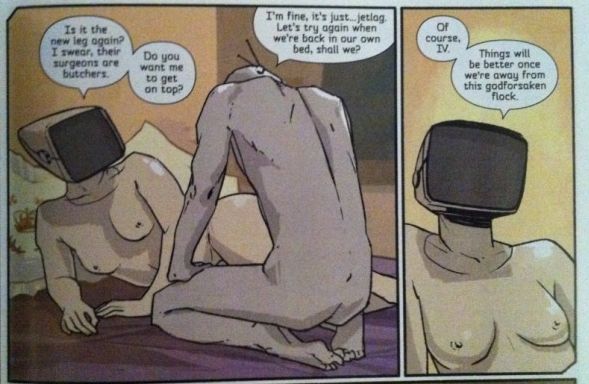
Anyway I noticed something in it, that as far as I can ascertain by googling, no one has discretely pointed out yet. And for posterity I'd like to point out that during the scene where the TV headed robot royalty are having graphic on panel sex that they are "turned on".


I mean, this scene is after it is established that the TV headed robot royalty normally have dark screened heads. So, when our robot royals are having the sex their screen faces are emitting white light it isn't their default expression/display. Furthermore, when Prince Robot IV loses his erection his screen darkens, and then his wife's screen also darkens when it is apparent that the sex isn't happening. So they are no longer "turned on".


So yeah, really clever minor jokey thing about the robot royals being "turned on".

But this great little art descision pun aside, this is a pretty great scene for a bunch of additional reasons too.

Prior to this scene in Saga: Volume 1, I kind of felt that I had a handle on what the series was going to be. It felt familiar when placed in the context of other Science Fiction. I mean prior to this you could categorize Saga as something like:  "Shakespearianish literal star-crossed lovers in an epic intergalactic conflict." And then bam, we have naked TV-headed robots fucking. It's a great statement that, no, no we do not have Saga hammered down, and that this book won't be so easily classified and understood. Because once we think we've put it in a familiar box, we'll get something crazy like TV headed robot royalty having sex.

This scene is also pretty great as an introduction to Prince Robot IV, one of the main antagonists of the comic. It brilliantly sets him up right from the get go as more than a one dimensional villain. Instead of being a simple murder robot, he is a person with desires, emotions, and family. He is a man (kind of) that is only interested in pursuing the protagonists as a means to get back to his pregnant wife which is an understandable motivation and a smart concept: Prince Robot IV must destroy what Markos and Alana have to get that very same thing. But beyond that, visually putting him in such a human/intimate/familair position at first glance means that we will always picture him as a person, as a complex character, in all of his future interactions. TV-headed royal fucking, it's a great way to introduce a character.

The next reason this scene is great takes a bit of explaining. 

I think we as a society have a really peculiar and maybe unhealthy approach to portraying sex in our media. We relentlessly censor it and push it the margins of most of our media. In happy media with functional people sex is almost always pushed out of focus: a couple kisses passionately and we fade out, because to actually show it would be immature, puerile, or icky. Which oddly has the affect of making a lot of the sex in a lot of our media pretty dysfunctional: it's frequently only displayed or discussed in raunchy, shock comedies or when its transgressive, or when someone is being murdered, raped, or both. Or it's porn, which you know is fine, but even then so much of that is just grim-faced, emotionless, orifice stuffing... that I find a lot of it uncanny valley creepy. Which all sort of results in very little fun, companionate sex in media and a lot of weird, violent, or, at least to me, vaguely off putting fucking. 

Which is pretty messed up right? I mean, sex is pretty central to the human experience: the vast majority of us are fundamentally wired to enjoy it and it's how we go about reproducing which is kind of important to us as a species. It perpetually strikes me that the fact we consider it more private and shameful and censorable than murder and violence and rape is all kinds of fucked up. And I think the fact there are so few portrayals of people having stable, emotionally satisfying sex in our media is wicked sad.

So, a big part of why I find this scene so amazing is that it portrays that kind of comfortable sex that happens between people in a stable, loving relationship. Prince Robot IV and his wife are partnered people, who clearly have a strong emotional connection as well as a comfotable familiarity  And as a result a healthy sex life. And here they are having vanilla sex, not for puerile thrill, but because they have been apart and love one another. Hell, they are also trying to procreate, which even if you object to fornication or sex-for-fun, is kind of the point we can all agree on about sex. Contrasted with the majority of our portrayals of sex in our media and this is extremely healthy and normal sex. Just, you know, between TV-headed robot royalty. And the fact that such bizarre creatures are having one of the few (and in comics only that I've read), examples of stable, coupled sex is frankly kind of amazing and brilliant.

Wednesday, 6 March 2013

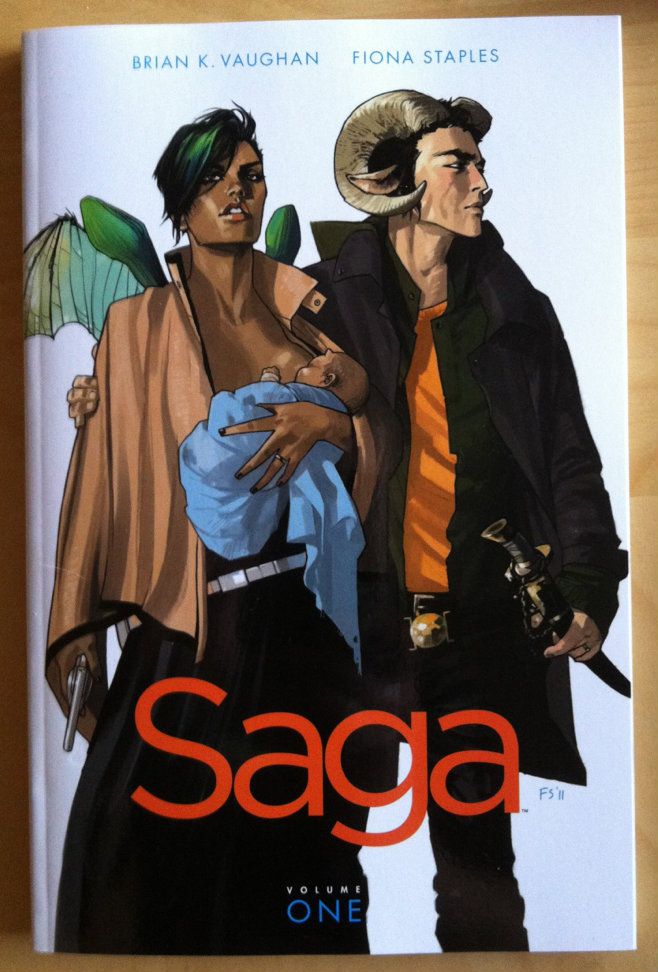
So I Read Saga: Volume 1

A 250 word (or less) review of the first collected Saga volume
By Brian K Vaughan and Fiona Staples, Image Comics


My girlfriend loves Parenthood, a television show with the thesis that parenting is difficult and family is important. For a variety of reasons I don't especially care for this show. Saga is a comic about how parenting is difficult and family is important but with winged alien soldiers, magic space satyrs, television headed robot royalty, graphic sex, and space violence. And it is absolutely perfect. Saga is the story of a child of starcrossed lovers from opposite sides of a generations/ages/centuries old galactic war between the winged people of the planet Landfall and the magic horned/antlered people from its moon Wreath. Hazel, the newly born alien hybrid baby of Landfaller Alana and Wreathan Markos is seen as an abomination by both sides of the conflict and so this new family is hunted by the Landfaller forces, lead by Prince Robot IV, and by the Wreathans using freelance bounty hunters. It's all the chaos and love of new parents splashed with the insanity of a crazy space opera world. The writing from Vaughan is characteristically excellent (clever, snappy, and exciting) but with this confident swagger quality to it that's just so rock and roll. Staples art is, if anything, more amazing: this hyper-realistic painted style that is simultaneously vaguely surreal. It's remarkable and beautiful stuff. I have been anxiously waiting for this trade since this series inception with, based on its pedigree, bated breath and inflated expectations. This book still blew me away. Read it.


Word count: 244

Friday, 11 January 2013

Spinal Tapestry Pt. 1: Back Support.

On the under-appreciated art of comic book spines.

I love print comics. Love them. Especially the larger tradepaperbacks, collected editions, and original graphic novel formats. Part of it is that I think they are a more satisfying reading experience, especially for the more unconventional and challenging comics out there. It's also pretty great that they are more durable/portable format for sharing with friends. But something I really like about the format is that graphic novel format comics are displayable art objects.


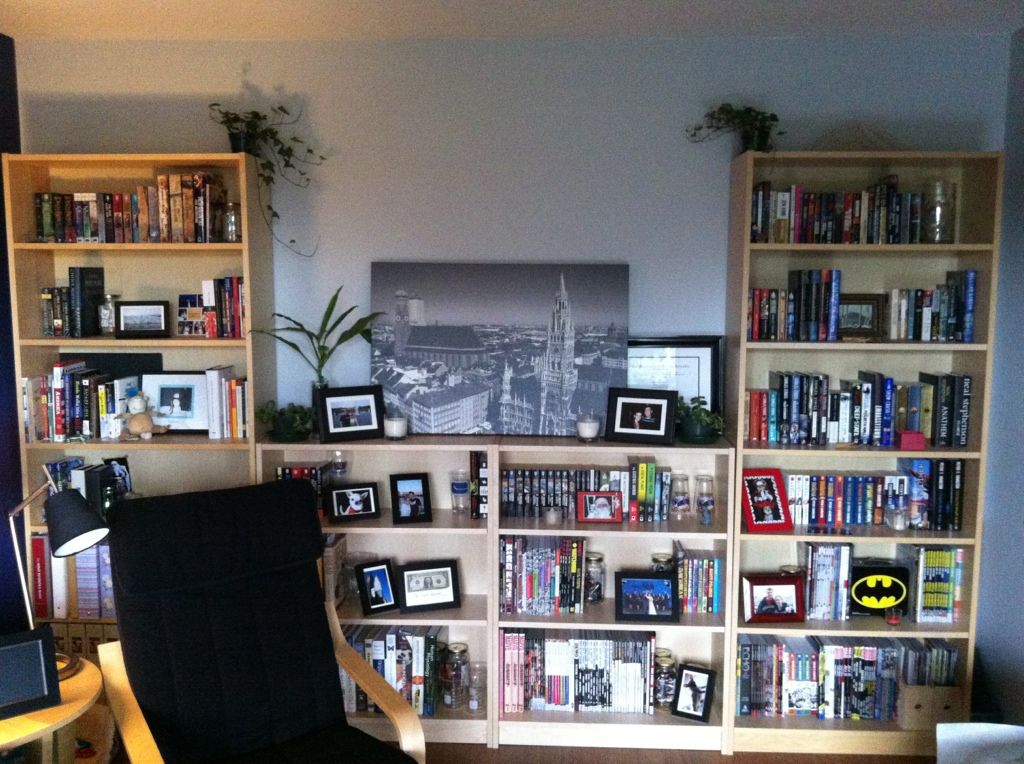
This is the longest non-radiator wall in our apartment, outfitted with bookshelves, which I've been systematically turning into a library of my favourite novels and comics. (It's still a little measly due to my history of public library reading and the used bookstore trade-ins I did when I moved out of my parents house a few years ago... but I'm working on it.)  Besides being an attractive way to decorate an apartment wall, this library really increases the home-iness of my home; all of these amazing worlds that I love are always right there to be seen, appreciated, fondly remembered or visited again. It's great.

But I've come to notice something: all I normally see of these comics are their spines. Actually, for the most part, all any of us see of bigger format comics are their spines: they are shelved at home spines out, shelved in comics shops spines out, and shelved in libraries and book stores spines out. And I think this fact might be under-appreciated by the comics industry.

Take Saga: Volume 1, a comic that I absolutely loved reading (review pending). It has an absolutely great title page showing gorgeous artwork by Fiona Staples and a crisp, clean design aesthetic.


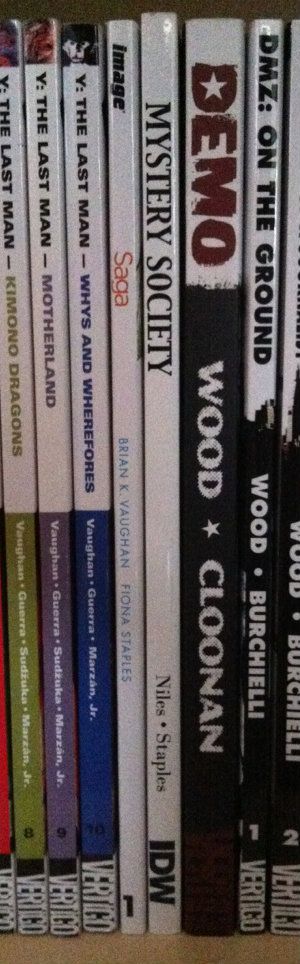
But the spine of Saga: Volume 1 is, well, it's boring. Just a lot of white space with small, bright coloured font that simply gets lost on a bookshelf.


Here is my entire Brian K Vaughan section of my comics library. These are all great comics with solidly attractive and eye-catching covers.  You'll notice though, that all we really see are the comic spines. You might also notice that these Brian K Vaughan comics, spine wise, are not all created equal and include examples of what I think are good and bad comic spine design.


Runaways: I'd call this one adequate spine design. Simple with a clearly visible font. It says what it is and doesn't get lost in the crowd. (Beige is the worst colour on Earth though... so...)

Ex Machina: This one is pretty bad. The spines of this series carries through the artwork on the cover which ends up making the spines black, with random blobs of colours. As a result, there is no unified design across the series. Worse, the title font is small and is obscured by the colour blobs. The only way I know this series is Ex Machina at a glance is its location between Runaways and Y The Last Man. Also, the old wildstorm logo on Ex Machina 5-10 is pretty unattractive.

Y The Last Man: In my opinion this is a pretty good spine design. There is a unified look across the series with each title having its own colour scheme. I can clearly see the series title, each volumes title, and the author credits. There is also a Thumbnail taken from each volumes cover at the top of the spine, which is a nice touch. This spine design is simple, fairly attractive, unified, and conveys the relevant information. I like it.

(Notice the evidence of lending? Huzzah for tradepaperbacks.)

Saga: While it's a little hard to judge with only a single volume, I'd say it isn't good. Less because it's actively bad, and more because it's bland to the point of boring. Maybe it will look better with some friends?

I guess my point in all of this is that comic spine design is an important part of making attractive, displayable print comics. Also, given how most comic shops display the majority of their comics, spine design might be important to actually selling comics. In my experience this design often isn't amazing and could be probably be improved with a bit more attention and love. 

Let's make comics beautiful for bookshelves everywhere.


Friday, 30 November 2012

Weekend Warriors and Trade Waiters

Or on the fundamental difference between tradepaper backs and comics singles.
"Do you prefer to read collections or do you want to dive right into the culture and try singles?  (No judgement — however you want to read is great.  I think there’s something really fun about the weekly countdown to Wednesday, but it’s also not as convenient as picking up a collection — which we call “trades” or “tpbs.” The latter stands for Trade Paperbacks.) 
Is X-Men your thing?  If so, that sounds like a good place to start, though I’ll be honest and confess I haven’t read those books so I can’t really make a personal recommendation. 
You know there happens to have been a brand new X-Men #1 out last week?  You really couldn’t have picked a better time to get started.   
I’m posting this as a screen cap to make it rebloggable so that others can offer their suggestions too.
I will also be SUPER biased and throw out there that AVENGERS ASSEMBLE #9 and CAPTAIN MARVEL #7 both came out in the last week and are good jumping on points.   
What say you, folks?" 

This quote by Kelly Sue DeConnick (or at least from her Tumblr... accreditation is hard with that service, eh?) got me thinking about the relationship between comics singles and collected editions.

I've come to the conclusion that the two are fundamentally different experiences.

For some context, I've recently changed my reading practices from that of the consummate Weekly Warrior, buying largely single comics and the occasional trade, to a Tradewaiter who buys a limited number for singles and mostly collected format books. Which, I guess makes me a hybrid comic buyer. As a result, I've had a bit of experience on how different these two kinds of comics consumption habits are.


The first (and I would argue fundamental) difference between the two is temporality.

Single comics are temporal. They are happening NOW: made fairly recently by the creative team, are part of an ongoing work stream, and brought to market on a universal release date. And then a few weeks later the next new issue drops with the next episodic story allotment for everyone to enjoy all at once. And then the next. Each current issue becoming THE issue for a brief glorious moment. And, since these comics are being released as future issues are being made, they can effectively influence the creative teams descisions about future issues. I guess what I'm trying to say is that single issues are kind of living things that can be influenced be events because they are subject to time.

Trade paperbacks, in contrast, are atemporal. These are completed stories (or portions of stories) that are preserved and reformatted. In some ways these completed stories have become like Jurassic Park mosquitos: fixed in amber and able to convey their magical dinosaur DNA of story, art, and imagination regardless of when you discover them. While they certainly show the period of their manufacture, the story itself is timeless. Shakespeare's Hamlet is still true today, and so is George Orwell's 1984, and so is Alan Moore's The Watchmen or Brian K Vaughan's Y the Last Man. As long as a trade is in print, the story is as it has always been.

The second key difference is, as alluded to in the quote, that of communal versus personal enjoyment. Single comics are a group experience. I go and buy the newest issue of Hawkeye on the same day everyone else goes and buys the newest issue of Hawkeye,and then we all read Hawkeye at about the same time, and then we discuss (gush) about Hawkeye with each other on the Internet. Some fans even respond by making things (which is awesome). Creators make themselves accessible and interact with fans and in some cases foster online communities around their creations where we can all geek out together. I can't think of an experience quite like it: I can't think of any other episodic fiction with quite the insular and vocal fan base. This communal enjoyment is definitely part of what makes comics so special.


Graphic novels, due to their atemporal nature, are much more individual repasts. I think they provide a better reading experience: I'm currently reading all of DMZ (Brian Wood, Ricardo Burchielli, et al.; 2005-2012) and the Locas omnibuses of Love and Rockets (Jaime Hernandez; 1981-2010) and the ability to get large or complete stories and see how they evolve and fit together (without relying on memory) is pretty great. While I am sure other people are also currently reading both these great collections, it's a much smaller subset of the comics community than is reading a new issue of Hawkeye or Batman. Furthermore, while there are older threads and essays, there are fewer people discussing these works in the present compared to things currently being made. Thus ones enjoyment of collected comics lacks that certain community element that buying Wednesday comics has.

Actually in some ways trade waiting on currently being made comics is almost an antisocial enterprise. Take Brian K Vaughan and Fiona StapleSs saga: it came out for nearly a year before I got to read the first trade. A year that I spent actively avoiding every interview, fan reaction, and communal enjoyment of the book for fear of spoilers. So I guess in some ways reading collections isn't just an inherently solitary procedure, but is also an act of taking oneself out of the community.


Personally, I enjoy both formats immensely and I think they each have their place in an ideal comic reading habit. For instance, with my hybrid reading style, I get to enjoy the on-going nature of my mainstream superhero comics and the broader comics community surrounding them while simultaneously getting that richer, more complete reading experience present in trade paperbacks. And really, at the end of the day, I feel this gives me the best of both worlds.

Monday, 20 August 2012

Brian the King Vaughan

Or why Brian K Vaughan and Fiona Staples are the solution to all our comics problems.

There are, in my view, a number of things I wish were better about comic book publishing. In no particular order here are some of the things about comics that I am not excited about:


  • Comic books are really expensive by any metric of content/dollar when compared to other media.
  • Money spent on comics has a tendency of going to support massive corporations instead of comics creators and occasionally comics creators are fantastically screwed by said corporations.
  • The domination of superhero comics as a genre has resulted in a narrower range of comics being produced. There is too little variety in comics today.
  • Comics are produced overwhelmingly by men; there are disproportionately fewer female comics makers and that's kind of crazy-nuts.
  • Artists are frequently swapped in and out in comics so that a greater number of books can be published per unit time. This interferes with establishing a consistent visual tone in books and devalues the importance of artists in the creative process.


recent interview by Brian K Vaughan at the The Comics Beat about Saga has some interesting quotes that make me really very excited:
"Not to brag—maybe a little bit—but the biggest surprise is how much fucking money there is in truly owning your own work."   
"I loved working for my friends at Marvel and DC, and I was always compensated with a very generous upfront page rate, but by betting on myself (and Fiona!) and waiting for money on the back end with Saga, I’m already making way, way, WAY more than what I made on comparably selling books that I wrote for other companies.  And that’s after splitting everything 50/50 with my richly deserving co-creator."
"That cushion blesses me me with a little extra time to give each script 100%, and more importantly, it means we won’t have to use any fill-in artists.  At this stage, I can’t imagine collaborating with anyone but Fiona on this story."
"I don’t know, I guess $9.99 seemed like a pretty fair price for the introductory volume of a new series. Maybe it will cut into our revenue stream, but I’m more interested in getting our story into as many hands as possible than in wringing as much cash as we can out of folks.
Fiona and I would probably be making more money in the short term if we filled the monthly book with annoying ads, or cut the page count down to 20, or charged $3.99 instead of $2.99, but I like to think that giving people more for less buys us a lot of valuable reader loyalty in the long run." 
So by my estimation, Brian K Vaughan and Fiona Staples seem to be solving a bunch of my comics problems with Saga:

  • The Saga 1 trade paperback (which I want THE MOST) will cost $10 for 160 pages. That is insane value! Trades generally run ~$20 for 120 pages, so this book is more than twice the value of most books on a purely content/dollar basis. Also, unlike most high-page-count-but-low-cost projects this one has full colour pages and is made by VERY A-list creators. So not only is it a lot of content/dollar but it's a lot of top quality content/dollar. 
  • Apparently, BKV and Staples are making pretty good money off the project despite charging substantially less for their books than typical ($2.99 for 30 page monthly, $10 for trades). It's just great when I as a consumer can both save money AND get more of it into the hands of creators AND still get a great product. This is the kind of success story I can get behind.
  • Saga as a book (from what I've gleaned) is an ambitious space opera/ science fantasy epic about family which is some nice non-superhero variety in the comics. The fact that this is a very successful book without being 1) superheroes or 2) zombies makes me pretty happy.
  • Fiona Staples is an incredibly talented artist who just happens to be a woman. The more rockstar female creators in comics at this point the better.
  • The importance of Staples to the final product is fully acknowledged both in the fact the books schedule is built around her ability to make the artwork, and in that she is receiving a fair share of the windfall from it.

Hyperbolic claims about BKV and Staples saving comics aside, I think it's really exciting that a high quality, original, indpendent book by top tier creators is doing so well. It's even better when this success comes with all the things I just discussed. I can only hope that Saga continues to make a splash and the comics publishing community takes some lessons from it.

Of course, Brian K Vaughan and Fiona Staples are not exactly any-avergae-comics-person. Their sales numbers don't exactly reflect the reality for a lot, or even most, independent comics makers and few people have the perennial selling power, cross media clout, or raw talent that Vaughan does. So, I'm not sure the awesome reality of their publishing experience is the beating pulse of everyone. But it's encouraging and, who knows, maybe some of it'll catch on?

Regardless, I am SO excited for Saga Volume 1. Waiting is killing me.