Showing posts with label Warren Ellis. Show all posts

Wednesday, 2 March 2016

Konsidering Karnak #2

Or a look at action composition and character in Karnak #2
by Warren Ellis, Gerardo Zaffino, Antonio Fuso, Dan Brown, Clayton Cowles, and Joe Caramagna; Marvel Comics


Last time I wrote about a great action sequence in Ellis/Shavley/Bellaire's Injection and how it used eye-guiding and multi-panel motions to create a kinetic and visceral action sequence. Karnak has a pretty great action sequence that uses eye-guiding to create a substantially different reading experience. A reading experience that I think goes beyond effective storytelling and works as a characterization device. I think it's worth trying to unpack and to contrast with the Injection sequence. 

There will be *SPOILERS* for Karnak #2 below.


Before I get to the action sequence proper I just want to point out this page turn. I am an absolute sucker for a good page turn, where a comic uses the concealment/surprise of turning the page to spring an unexpected or dramatic moment. In the above sequence we see a child Karnak's parents explain his origin essentially and cut from child-Karnak chopping down a block tower to chopping through a goon's neck using the same motion. It's a visceral moment that simultaneously establishes Karnak's transgressive upbringing and the frightening, child-like ease with which Karnak kills the goon. It is a moment that surprised and thrilled me. It also really crystallized just what Karnak's deal is. Great moment.


These are the first three pages of an extended action sequence in Karnak #2. The thing I find interesting about these pages, and to a lesser extent the rest of this sequence, is the repeated use of panels featuring clear left-to-right motion vectors. These panels feature a single predominant motion that is slightly elongated in a way that exaggerates the horizontal direction of the panel. The extreme violence of every panel is evident in the carnage caused, increasing the weight of each moment. However, each of these panels are also lacking in dialogue and extraneous detail, meaning that each panel is quick to read. The effect is a disconnected, repetitive, and rapid series of violent moments. Which, accounting for the fact the motion follows the reading direction, builds this sense of tremendous forward momentum in this action sequence.

This, I think, is incredibly informative about Karnak as a character. The dramatic left-to-right bias of the sequence creates this relentless rhythm, this sense that Karnak is always moving forward and is nigh unstoppable. The fact that Karnak dispatches foes in a series of discrete, single motions showcases the ease with which he is tearing through his enemies and the single-strike nature of his 'powers'. (An effect enhanced by the simple, quick to read panels.) The sheer brutality of the damage being done to each dispatched goon conveys the power and inhumanity of Karnak. And all of this is encoded not in words or narration, but action, which is also informative. This sequence really cements Karnak as a truly impressive figure and I think really creates a cohesive identity for Karnak in this series. Which makes this really smart comics. 

Wednesday, 24 February 2016

Deep Sequencing: Injection Volume 1

Or a look at my favourite storytelling in Injection Volume 1
by Warren Ellis, Declan Shavley, Jordie Bellaire, and Fonograficks; Image Comics


I really like Injection. Unfortunately, I read the first trade for the series shortly before my life became the most busy and the update schedule of Atoll Comics was greatly reduced. Which means I've never sat down and written about some of the really cool comics going on here. Well today this changes! Today I write about some of what I like about Injection!

There will be *SPOILERS* below.


I love the storytelling in Injection. I picked this action sequence because I think it's a good example of the masterful compositions of the comic and because it's rad as hell. The engine of this composition is how it interacts with the reader eye to provide an impactful and seamless reading experience. 

Page 1: The sequence opens dramatically, with very little context, and a character flying against the natural reading direction. This disorients the reader, creates a dramatic moment, and sets the tone for a totally rad fight scene. This is followed by three panels that essentially carry through a single motion of the Big Thug smashing Simeon, the agent-type-guy, into the ceiling. The long clear motion arc imparts speed and, by crossing panel boundaries, creates a sense of momentum that increases the perceived force of the motion. To continue the sense of disorientation, the panels depicting the ceiling-slam also have an unfixed frame of reference that result in unorthodox perspectives that build up the chaotic sense of the fight. It's dramatic and wild and yet still clear and eminently readable.

Page 2: The next page takes smooth, guided tangents that impart a breathless speed and sets the stage for the kitchen brawl. It provides context for the scene change, reads quickly, and provides a quiet moment of contrast for the more violent moments in the sequence. 

Page 3: The magic of this page is the skillet swing perpetrated by the Big Thug. The motion of the swing begins in the top right corner of the page and carries through the entire page, in a single clear arc. This provides the swing with a tremendous amount of speed, momentum, and force. It's simple, but the effect is absolutely perfect: the impact of the pan striking Simeon feels significant and painful. If I were going to compile a collection of example pages everyone should look at, this would certainly make the cut. 

Page 4: The next page combines the same elements again to make for another dramatic page. The top panel has two opposing motions that meet in the other: a vector along the arm of Big Thug along the reading direction which slams into the arc of the knife. It's impactful and gets the reader set to swoop through the multiple panel stab, which transitions smoothly along a tangent to Simeon's cocked-back arm, which then slams down along the reading path into the bottom panel and the page turn...

Page 5: ... which after the turn transitions right into Big Thug's face exploding as Simeon fires his weapon. An event that again acts against the predominant reading direction to enhance surprise, impact, and the visceral horror of the moment. It's great evocative comics.

Which, when taken together is one of the most compelling action sequences I've read in a comic lately.


Another thing that I really liked about Injection was how colouring and shading were used to distinguish between contemporary story sections and flashbacks. Flashbacks in the comic have a soft, bright look that creates sunny, optimistic world. This aesthetic is achieved in part through the use of slightly desaturated harmonious colours, adjacent colours on a colour wheel which blend together to create a mellow unified vision. The modern, post-Injection world of the comic has a much grittier, more granular palette. Colours are bolder and more varied on the page, particularly heavy, sketchy shadows are deployed, and everything is generally darker. It's an aesthetic that feels heavier and somehow more real. When contrasted, these two approaches quietly establish a clear demarcation between the past and present in the comic and build a distinct emotional contrast between the naive and optimistic characters planning to change the future and the haunted and more complex reality of the post-injection world. Great stuff.

Friday, 10 July 2015

Deep Sequencing: Dead Trees

Or a look at the unusual story structure of Trees: Volume One
by Warren Ellis and Jason Howard; Image Comics.

with additional commentary on The Wicked + The Divine Vol. 1 
by Kieron Gillen, Jamie McKelvie, Matt Wilson, and Clayton Cowles; Image Comics


There is a weird thing that happens when you follow enough comics people on twitter: you find yourself eavesdropping on conversations between creators where they talk shop. You feel like a total creep, but you are also exposed to some really cool and insightful ideas. One such idea, floated by Kieron Gillen, is that Trees by Ellis and Howard, has an unusual narrative structure that has more in common with prose novels than the majority of direct market comics. And when I eventually read Trees, I was struck by how profoundly right Kieron Gillen was about this and that this choice is pretty interesting. 

As part of my day job I teach Academic Science writing to Biochemistry students. A byproduct of this is that I tend to think about writing in the context of objectives, that every block of writing is designed to tell the audience something. In academic writing the goal is often to explain something very complex as quickly as possible using a combination of plain English for clarity and jargon for efficiency and specificity of meaning. (I am probably not the fun TA...) Science writing is extremely formalized though, and usually breaks into common sections in Academic Journals that each have a particular objective. An Introduction section is designed to declare what the main goal of the presented research is and to contextualize that goal so the audience knows just what the hell you are trying to figure out. A Results section presents data that Scientific Readers can study themselves and reach their own conclusions on (Quoth the Science Guy: "But don't take my word for it!"). A Methods section explains how the research was done so a reader could try these experiments themselves if they wanted to. And so on. My point here is that the overall goal of Science Writing is made of subsections that have smaller goals that when added together function together to make the larger piece of writing work.

(This previous paragraph was designed to introduce the idea of objectives in writing and portioning them off into sections. Conversely, it may have just been super boring and made you fuck off from reading the rest of this.)

In fiction the broad goal is something like to entertain an audience and make them feel feelings. This larger goal is conveyed by chunks of story, delivered in a variety of mediums, that each serve some broader objective to the larger story in an aesthetic way. But the way the individual packets of a larger work, the quanta of the story, actually assemble together to make the larger fiction work can be radically different. And as Kieron Gillen pointed out, Trees delivers its information in an unusual way.

(Seriously, how have you not fucked off already?)


Because Kieron Gillen infected me with this idea and because I think his work with Jamie McKelvie, Matt Wilson, and Clayton Cowles are excellent examples of a certain mode of comics storytelling I want to look at The Wicked + The Divine as an example of the usual approach to direct market comics. WicDiv has an overall objective of entertaining an audience and making them feel feelings. The series is first published as monthly magazine format comics in the direct market. If we look at these monthly format comics, the smallest published unit, each individual issue works like a semi-independent story. The objective of each unit is to tell a complete narrative arch that is a satisfying reading experience on its own: each issue introduces a premise, forwards the plot and character development, builds to a climactic event, and usually ends on a cliffhanger that builds interest for the next instalment. At the same time, each of these individual issues are also designed to work as components of a larger story, a chapter-like arch of collected issues, as well as a discrete whole. Essentially, in this model every issue of comics is an episode witch each collected chapter functioning as a season with discrete, equivalent chunks. Or put another way, WicDiv and similar comics work, broadly speaking, like TV.


Trees, by Warren Ellis and Jason Howard, is a whole other kind of beast. While the overall story is meant to be entertaining and make the audience feel feelings, it doesn't break down clearly into discrete episodes. In fact, reading Trees Vol. 1 as a trade paperback, I found it difficult to find the seams of the direct market issues that made the larger whole. Instead of discrete, complete episodes, Trees works in shorter narrative blocks that focus intensely on the subplots that comprise the larger story. These smallest story units also have a similar focus on objective: they deliver these intense bursts of plot advancement or character development or information. They are also mostly pretty short, and quickly switch between subplots. This makes Trees Vol. 1 read like a single chapter in a prose novel, split into short "***" divided sections that move between viewpoints. The entire collected "chapter" tells a cohesive chunk of story, but it's constituent components do not. Which, I imagine, must make monthly issues of Trees read like opening a story mid-chapter, reading a few pages, and then bailing out before finishing the chapter. 


When comparing WicDiv Vol. 1 (Above) with Trees Vol. 1 (Below) you can see just how different the two story structures are. These sketches are not to scale or anything, but just general sketch out the shape/structure of the plot.

The collection of WicDiv takes advantage of having a more focused narrative where the creators use events and layout to throttle the tension as the story continues. WicDiv also takes advantage of having discrete chapter breaks to pace the reading experience and give convenient points for readers to put the comic down. The plot structure works very well, and really, WicDiv is a great example of a focused single plotline comic done well.

Trees, conversely, has multiple story streams that all sort of build smoothly, since the comic seldom focuses on individual narratives to throttle the narrative. Instead story tension is buil t initially by a gradual progression of events, and later, by very quick, short clipping between eventful sections of subplots. It's tension from editing. Which I found very effective when combined with the lack of obvious breaks: Trees was consistently a very hard comic to put down because there was always another moment of discovery coming. I am not sure how well this approach worked in individual issues but the tradepaperback was a very engaging and cohesive reading experience.

Which, I guess, goes to show that there are legion ways to make good comics, because despite radically different story structures, Trees and WicDiv Volumes 1 are excellent comics.

Previously:
So I Read Trees Vol. 1
So I Read The Wicked + The Divine Vol. 1

Wednesday, 8 July 2015

So I Read Trees: Volume 1

A 250 word (or less) review of Trees: Volume 1
by Warren Ellis and Jason Howard; Image Comics


Trees is the modern Invasion Science Fiction story. In the comic aliens have invaded Earth in the form of giant "Trees", massive, inscrutable pillars that take root in the ground and tower over humanity. And nothing else. The aliens, it seems, have come to Earth with no interest in interacting with humanity, with communicating peacefully or subjugating our species. However, giant alien Trees cast a long shadow, and the comic explores how human societies react to these artifacts and the marginal spaces that exist in the roots of the Trees: the permissive Special Culture Zone of artists in China, the fascist gangs filling a power vacuum in Cefalu, Italy, the dictator in Somalia who sees the Trees as a tactical asset, and the researchers of remote Blindhail Station who are convinced something new is happening with the Trees. I call Trees a modern Invasion story because it appears to be using alien invasion as a lens to explore the terrors of modern life. While retro-tales of invasions dealt with fearsome conquerers as a way to maybe deal with emotions of international warfare or quick atomic obliteration, Trees seems to be dealing with the perpetual disasters of global warming, economic collapse, and crumbling heart of Westphalian politics. These are not hot, finite challenges, but rather things we don't completely understand that loam constantly over us, seeming existentially horrifying or uncomfortably mundane at the same time. Trees captures this sense, and explores the human consequences with brilliance and aching empathy. 

Word count: 248

Post by Michael Bround 

Tuesday, 9 June 2015

Dead Pig Collector Is A Good Short Story

Or Why You Should Read Dead Pig Collector,
by Warren Ellis


Dead Pig Collector is a short story explaining exactly how you go about disposing a dead body.  The story is about Mister Sun, a self-styled Dead Pig Collector who, for the right price, provides a certain service. He will kill a target and then discreetly dispose of their body. His current assignment sees him visiting loathsome Los Angeles to kill and disappear a certain target, but when he arrives he finds his client dead at the hands of his victim-to-be. A former victim who is eager to learn the art of disposing of a body. Dead Pig Collector is some creepy and informative shit and an arresting brief read.

I would recommend Dead Pig Collector to mature readers looking for a quick, chilling read. It's short, brutal, creepy, and surprisingly charming and a great way to fill about a half hour. Dead Pig Collector is only available digitally, so purchase wherever fine ebooks are sold. 

Friday, 15 August 2014

Atoll Comics Round 15

Or changes to my Top-Ten comics

Due to my spouse seeing how much I spend on comics and an urge to buy better comics, I have decided to be super-selective about which superhero comics I read. Harnessing the Awesome Power of Maths, I have determined that I can afford to read 10 ongoing titles. So I get to read 10, and only 10, titles published by either Marvel or DC as well as one trade paperback a week of my choosing.


A complication of this is that I am forced to drop an on-going title if I want to try reading a new on-going title, an act of very tough love. Being financially responsible is the worst.

I will be adding Rocket Raccoon and dropping Moon Knight.


Why Rocket Raccoon: I've always thought Skottie Young had a fun, Saturday-morning cartoon aesthetic. Unfortunately, most of his projects haven't quite synched up with my interests. Since I only get to read a few ongoing comics it's important for them all to hit some weird arithmetic ideal of characters I'm keen on and creative teams I'm interested in, and the Skottie Young abacus has pretty much always been missing that character hook to get me reading. But with Rocket Raccoon we've finally found a title I'm curious about that seems, with the ludicrous notion of a crazy gun-toting space-raccoon, to be an ideal fit for the frenetic energy of Young's artwork. The result is idiosyncratic and crazy and fun and worth a look. I'm a couple issues in, and while I'm not convinced that I'll be a longterm reader for the series, I'm having lots of fun with it right now.


Why not Moon Knight: I read Moon Knight purely for the strength of its creative team. A comic by Warren Ellis is always worth at least a try and the collaboration between a top tier artist Declan Shavley and living legend colourist Jordie Bellaire, an artistic team that actually live together, would be worth seeing regardless of the writer. Together, well, Moon Knight was fantastic. It was always good, always beautifully made, and occasionally, at it's best, was the kind of semi-experimental master comic that I love. However, Ellis/Shavley/Bellaire are moving on and I think I will be moving on with them. The new creative team looks to be quite talented, but I was reading this comic for Ellis/Shavley/Bellaire and not out of any great love for Moon Knight. I'm happier having had a really great six issue run then press on for the sake of inertia. And I'd much rather save my money and attention for Injection, the new creator-owned project from Ellis/Shavley/Bellaire.

(And real talk: I have feels about Brian Wood and while I might not completely swear off all Brian Wood projects, I'll have to really like the main artist (who spends way more time on a comic than the writer) and really buy into the premise of the project to give it a try. Marginal interest projects like this I'm more inclined to skip.)

Previously:

Friday, 18 July 2014

Monitoring Moon Knight #5

Or how to make a drawn out action sequence not boring in Moon Knight #5
by Warren Ellis, Declan Shalvey, Jordie Bellaire, and Chris Eliopoulus; Marvel Comics


I am deeply interested in comics that solve narrative problems. Comics that dive into some storytelling aspect that is often done poorly and manages to make something banal great are super interesting. Moon Knight #5 is just one of those gutsy problem solving comics.

Paradoxically, for me, extended action sequences are one of the most fraught aspects of comics. They should be kinetic, exciting highlights but I find that the longer they drag on the more boring, confusing, and murky they usually become. Moon Knight #5 is an issue long action sequence that had me hanging off every single panel, every blow, splinter, slash, and contusion. And the way Moon Knight #5 works, the choices the creative team make hat keep the action interesting, are worth examining in further detail.

There will be *SPOILERS* for Moon Knight #5 in this post.


The foundation for any action sequence is its motivation. Why are people fighting? Why should the reader care? If this is not done right, if its two superheroes throwing down over a sandwich based disagreement (or whatever cliche shit) or if the objectives of the conflict are unclear it is hard to get emotionally invested or care about the consequences.  

Moon Knight #5 takes a really simple, straightforward approach to this. A girl has been kidnapped. She is being held captive on the fifth floor of a shithole walkup apartment. Between her and the door is floor after floor of thugs holding her captive. Moon Knight, because he is crazy, plans to walk in the front door and destroy everyone between him and the girl to ultimately affect a rescue. One wacky cape, a stairwell, a dozen or so goons, and a very clear, emotionally affective objective: a scared teenager. The simplicity of this approach helps provide a constant focus on what the point of all the violence is.

 One of the biggest problems with many protracted action sequences is a lack of a well defined location which really makes things feel inauthentic. The simple premise and setup of Moon Knight #5 also does a really effective job establishing a sense of place. By keeping it simple, the stairwell of a shitbox apartment, the comic provides a familiar space that adds a veneer of reality to the proceedings and provides context for all of the resulting action. It seems like such a little thing, but it makes a world of difference.


This little snippet of action here is completely awesome, but also a great example of how action works better with context and spatial positioning. Moon Knight throws scary giant thug off the stairwell and presumably to his death. Now, as a thing a person does, particularly an ostensibly good person, it is crazy and horrific to murder a person by... whatever the balcony equivalent of defenestration is. But, knowing that scary giant thug is involved in the kidnapping of a teenage girl, something that is also crazy and horrific, his dispatch at the hands of Moon Knight feels somewhat justified. We get why this brutal violence is happening. We also, because of the simple well defined layout of the action in a stairwell, understand that Moon Knight has muzzled and thrown scary giant thug through a railing and into the empty space in the centre of the stairwell. Without this sense of space it isn't obvious what the thug is being thrown through or what the consequences of the action are. But with a well established story objective and setting it all works.


Action scenes are a particularly kinetic species of comics. I find that I'm most engaged when the panels are quick to navigate and provide a really clear sequence of events so that they can be read rapidly and clearly. When done perfectly, with additional use of shapes and guides to draw the eye around the page, static panels can feel fast and alive in a really involving way. Moon Knight #5 is great at arranging panels and the events within panels to provide clear snapshots of the ongoing action and to make these snapshots very seamless and organic to read quickly.

 The above sequence is a great example of this: the panels show the three key moments of the scene (Moony grappling with thug, Moony tossing thug, and thug breaking himself on the railing) in a really clean way. Of particular interest in this sequence is how the thug, moving from left to right traces an arc, that takes advantage of our eyes natural progression across the page, to actually capture the feeling of the motion of the toss. It's great comics.


Moon Knight also has some really fantastic examples of fractured panel composition. Continuous composition, which I describe above, shows clear intermediate steps and leads the readers eyes through the composition and along motion vectors, is really good at making a sequence feel quick and kinetic. Fractured panel composition, which is deliberately showing images that don't connect and which have vectors of motion that do not sync up. This discontinuity makes each panel feel heavier: readers have to spend more time on each panel to understand how they relate and how to navigate through the page which makes each panel feel more significant and impactful. This is isn't graceful, this is dragged out, fuck-punching. 

The above collection of panels is a great example of this: as Moony beats the shit out of sideburns thug, there isn't a clear sequence of events from him brandishing his baton to cocking the guy in the face to kneeing him in the stomach to braining him. Which makes each panel a little surprising, and requires us to stop and figure out whats happening at each step. The panels also have very different vectors of motion: the first panel looks to be primarily coming out of the page while the second panel goes bottom left to top right, the motion of the third panel is upward-right, against the grain of the reader carriage-return, and the fourth panel is straight down. It's choppy to read but in a way that enhances the action.

By varying the two approaches throughout the comic, quick elegant violence and brutal, disjointed beat downs, Team Moon Knight gets the best of both worlds: the overall action manages to feel overall quick but punctuated by bone-crushing moments of extreme impact. Alternating panel pacing like this also helps keep the comic interesting. Readers are constantly being forced to adjust the pace of their reading and contend with these different modes of storytelling. And this challenge forces the reader to pay attention and actively decipher the violence. Which is a smart choice.


Long boring action scenes in Superhero comics tend to be weirdly sterile affairs. I mean sure, all of Metropolis might get destroyed in an orgy of property damage, and people are presumably killed in the process, but what we are shown is often nigh-invulnerable superbeings walloping each other while suffering only the most superficial of injuries. In real life violence does not just tear a costume or scratch a person up. Real violence is horrifying and has consequences.

Okay, I play beer league soccer because soccer is fun and jogging is awful, and right now I have a grotesquely swollen and bruised ankle from a sprain I suffered for having the hubris to try and change the direction in which I was moving. Not, you know, being kicked down the stairs by a crazy man in a mask or punched through a wall by a Spacegod. This wasn't even violence and I am hurt in a way that makes standing extremely sucky.

Watch MMA and you will see actual violence: dudes who are fucking beating the shit out of each other for our entertainment and suffering potentially mutilating injuries. (Which is why I cannot watch that stuff...) Humans when beating on one another are damaged and suffer. When scary people set out to hurt each other, people are actually fucking hurt. That is the nature of violence. When a protracted fight scene features untouchable beings throwing lazer beams at one another it does not connect to that frightening, lurid reality and as a result feels inauthentic. 

Moon Knight #5 is one of the most graphic depictions of realistic injury I have seen from mainstream comics. I mean, there are comics where more people are killed, but the granular depiction of realistic injury: the broken wrists, snapped legs, smashed in faces, in this comic are real and viscerally authentic. These are people being hurt in the way people are hurt when terrible violence is done to them. Moon Knight #5 is a comic that when it kicks you in the gut you fucking vomit. And this dedication to depicting the consequences of the action goes a long way to making the action feel real and feel like there are actual stakes. By making everything so goddamn cringe worthy, MK5 makes it impossible to be bored.


Another problem with drawn out superfights is that they tend to be surprisingly unimaginative. Page after page of dudes flying and punching one another in similar ways is not all that engaging. In all things in life, variety is super important.

Moon Knight #5 does a fantastic job of being creative with the application of violence. Moon Knight beats down each thug in a different way while relying on a variety of weapons and tactics in slightly different situations. Like, take the two sequences above where Moony uses the same weapon to dispatch Spider-head and SWAT-ginch thug. Both of these sequences are nothing like each other, and also kind of horrific snowflakes of originality. How often do you see a shuriken driven through the floor of a man's mouth, or a goon tripped down stairs by having a foot stapled to a tread? Not very often in a superhero comic, yeah? And Moon Knight #5 is full of these wild, bizarre feats of asskickery and its this constant experimentation with showing different examples of violence that helps keep such an extended action sequence feeling fresh.

And really, Moon Knight #5 is a comic where a baseline human dispatches other baseline humans on a stairwell. It is both a testament to Team Moon Knight and an indictment of the rest of the superhero comics industry that this very mundane premise is the most creative superhero action sequence I have seen in a long time. In comics where impossible people fight in impossible ways where literally anything imaginable can happen, there shouldn't be boring repetitive action. Ever.

So yeah, if you ever are wondering how to make protracting action super engaging, take a long hard look at Moon Knight #5. Go! Find a copy! 


Previously:
Monitoring Moon Knight #2

Friday, 20 June 2014

Deep Sequencing: Plotting the plotless

Or a plot map of Nextwave: Agents of H.A.T.E.
by Warren Ellis, Stuart Immonen, and Dave McCaig, Marvel Comics


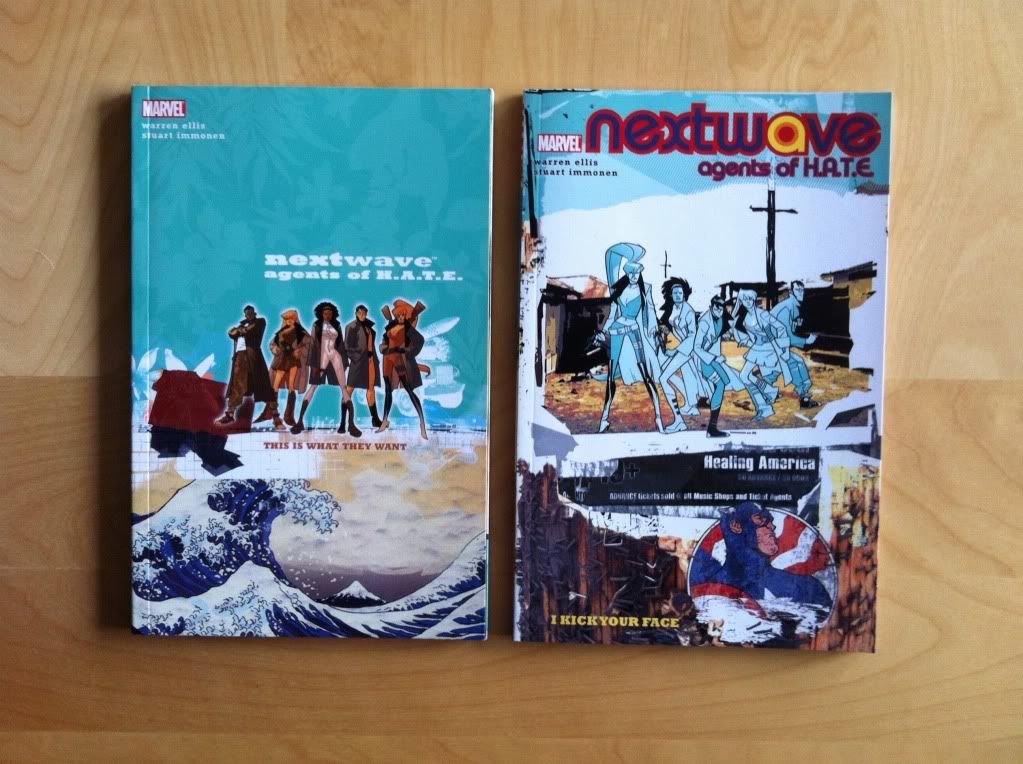
Nextwave: Agents of H.A.T.E. is a revolutionary comic that surgically excises unneeded baggage like plot and characterization and amps up everything left to make the quintessential superhero comic experience. I thought it would be an interesting experiment to try to make plotmaps for Nextwave to try and find what kind of plot remains in a deliberately plotless comic. And this is what I got.

Since this is a plotmap it is basically made out of *SPOILERS*. Be wary.

(Incidentally, if you want a high resolution Nextwave style swears skulls for your comics dialogue .ai or .png file, drop me a line!)
Previously:
Nextwave: Agents of H.A.T.E.

Wednesday, 18 June 2014

So I Read Nextwave: Agents of H.A.T.E.

A 250 word (or less) review of Nextwave 
by Warren Ellis, Stuart Immonen, and Dave McCaig; Marvel Comics


There are some comics so brilliant, so experimental, that they cast a shadow on the entire medium. Most of these remarkable comics are meticulous constructions that perform astonishing feats of wizardry with plot or characterization or theme and provide insight into the human experience and what can even by done with a comic. Nextwave: Agents of H.A.T.E. is an essential, revolutionary comic that says fuck all that let's punch weird stuff. Essentially, Nextwave is a superhero comic that excises plot and character development and melts down the remaining action in a crucible of madness. And the resulting comic, instead of being a drooling lobotomy moron, is fucking transcendental comics alchemy. In Nextwave: Agents of H.A.T.E., a superhero team made of sometime-Avenger Monica Rambeau, monster hunter Elsa Bloodstone, ornery robot Aaron Stack, kleptomaniac celebrity mutant with pyrotechnic powers Tabitha Smith, and The Captain, who is just kind of an asshole, fight the living weapons of mass destruction produced by the Beyond Corporation. And yeah, that's basically the comic: misfit superheroes with personality disorders punch, kick, and blow up really weird and silly monster-things in a stripped-down, hyper efficient comic drawn by a genius-superstar artist. Which is the fundamental unspoken core of superhero comics made explicit and also shut up, it's fucking awesome. Go read it.

Word count: 214