Or a look at nuance, restraint, and sexiness in Casanova: Acedia Vol. 1
by Matt Fraction, Fabio Moon, Michael Chabon, Gabriel Ba, Dustin Harbin, and Cris Peter; Image Comics
Casanova is a sexy comic. And... I wrote 2000+ words of a thesis draft today and marked lab reports, so my ability to write a cogent preamble on demand is kind of lacking. So, uh, without further ado, there is a panel in Casanova: Acedia Vol. 1 that I think really highlights why I find Casanova such a clever, sexy comic.
There will be mild *SPOILERS* for Casanova: Acedia pt. 1
This page, actually really just the bottom panel on this page, absolutely encapsulates why I find Casanova such a fundamentally sexy comic. The key of which is, I think, the inherent restraint of the utilized perspective: rather than show a nude, or semi-nude woman in a more conventionally provocative pose, this panel leaves most of the woman out of view, giving us a tantalizing peek and allowing our imaginations to impart a potentially infinite amount of seductiveness just out of view. Another great aspect of this panel is that it puts the focus on the woman's high heal shoes. Now, I recognize that heels are somewhat problematic, but when worn with agency and intention, I think they are pretty sexy. I'm kind of interested in fashion as like, a form of communication lately (semaphore you can wear!) and high heels can send a message that the person wearing them wants to feel and look sexy. Which given the broader context of the above scene (and some earlier flirtation) definitely communicates the woman's sexy intentions in this scene. The other thing that makes the heels shot so great is the way the woman dangles her toes into the pool. This gesture is just... perfect: dipping expensive pumps like that in water would almost certainly ruin them. This conveys a certain... disregard for consequences and propriety (fuck the cost, fuck the people who designed and made the shoes) on the part of the mysterious woman. Which lends the woman a certain naughty, dangerous air that manages to give her a certain power and the scene a decidedly transgressive air. And all of this is built into a single nuanced, restrained panel of comics that completely establishes a sense of seduction. Which is great comics and just, sexy as hell.
(Also, while we are comics wonking, the relative size of the woman and Casanova in the panel also does a great job establishing the power differential between the two and that fact we are being told that, in this moment at least, the woman is control of the situation.)
Previously:
Deep Sequencing: Imposter Syndrome and Casanova
So I Read Casanova: Luxuria
So I Read Casanova: Gula
So I Read Casanova: Avaritia
Showing posts with label Gabriel Ba. Show all posts
Wednesday, 16 December 2015
Monday, 1 September 2014
Deep Sequencing: Interdimensional Evil Twin
Or The Imposter Syndrome and Casanova: Luxuria
by Matt Fraction and Gabriel Ba; Icon/Image Comics
A quick googling of "Impostor Syndrome" will teach you that some people have a hard time "internalizing their accomplishments", essentially owning the good things in their lives. Instead of accepting that great things happen to them because they are good people or that they have are particularly talented or hard working, they are convinced that they are horrible frauds who have just gotten lucky or have tricked everyone into thinking they are better than they are. And as a huge fraud, these people are convinced that it's only a matter of time until everyone figures out the truth and it all falls apart.
When I read Casanova: Luxuria, the first chapter of the series, I see thematic signs of the Imposture Syndrome everywhere.
There will be *SPOILERS* for Casanova: Luxuria in this post.
Now, I think it might be instructive to explain why when I look at Luxuria I see Impostor Syndrome before I go about heaving evidence because this all might be in my head.
First of all, it occurs to me that Matt Faction may have some experience with Imposter Syndrome. As someone who has apparently rollercoasted into finding himself an Eisner winning comics writer married to a super talented and generous woman who has two pretty cute kids, I could fathom a situation where Fraction might feel like an inter-dimensional interloper living someone else's fantastic life. (I mean, I think that's malarky since Fraction is clearly a super talented and seems like a pretty cool guy, but I could fathom that train of thought.) Of course this is all conjecture based on super incomplete information from tumblr about a man I don't really know.
And it is probably entirely me projecting my own anxieties onto someone else.
Because I have a nagging case of impostor syndrome.
I have a nagging case of impostor syndrome because I'm sometimes convinced that my life is better than I deserve. I just got married to my favourite human who happens to be smart and funny and generous and pretty and responsible and trustworthy and who is absolutely my best friend and who I love so much it actually feels dangerous. We live in my favourite part of a city that is regularly ranked the best place to live in North America in a bunch of liveability surveys. We own a modest but cute apartment in one of the most expensive real-estate markets in the world. We have an adorable little dog and everyone in our immediate family is healthy. I have a job I love and my research project is awesome and I have had some solid success professionally with a bunch of peer-reviewed publications in solid journals and a pretty prestigious scholarship. Hell, even this blog is shaping up to be okay. By any reasonable metric, things are coming up Millhouse. And yet I can't completely shake that little anxiety voice that says I don't deserve this much good stuff and that it's all a series of happy accidents and that sooner or later my luck is going to run out and it's all going to evaporate. And then everyone will know that I am a fraud and an impostor living the stolen life of a better person.
And this is maybe why I see the impostor syndrome all over Casanova.
Luxuria opens with an introduction to Casanova Quinn, the groovy, sexy secret agent who is also the screw-up, black sheep son of Cornelius Quinn, the director of the international espionage organization E.M.P.I.R.E. While Cass' twin sister Zephyr is a dynamo secret agent and the apple of their father's eye, Casanova is a pain in the ass who makes a living breaking the law and doing spy-stuff for whoever will pay. He operates alone, botches his opening mission, sees his sister get killed, seduces and uses a nice young woman, and is just kind of a selfish shithead. If twins operate by a good and evil dichotomy, then Cassanova Quinn in his native universe is the evil twin.
But because Casanova is a comic book with a deeply meta villain with sexy spy plans, Casanova finds himself transported to another dimension. A dimension that is very similar to his own except that the native Cass of this dimension was the good twin and the native Zephyr is very much the evil twin. Newman Xeno, the mastermind villain of Casanova, plans to insert interloper-Cass into the life of the murdered native-Cass to be a double agent for his nefarious plans. Which leaves Casanova in a precarious and exciting plot position.
It also leaves morally dubious interloper-Cass in the position of being an impostor Cass and living the attractive life of the displaced native-Cass. Suddenly he is a rockstar E.M.P.I.R.E. agent instead of a rogue criminal. Suddenly he is liked and surrounded by colleagues and friends. Suddenly his father loves him. Casanova has fallen transdimensionally-ass-backwards into the fantastic life he has always wanted but never been able to build for himself.
But of course, it's all a fiction. Interloper-Cass is an impostor: he is an evil (or at least amoral) twin from another dimension literally living the stolen life of his good counterpart. Worse, Cass is beholden to the villainous Xeno, who, along with evil-Zephyr, are completely aware that Cass is an impostor and are forcing him to behave in ways that risk outing his impostor status. And if he is found out, interloper-Cass was will be exposed as a fraud and implicated in the conspiracy which killed the beloved native-Cass who he has been impersonating. Which not only risks severe disciplinary repercussions but will also destroy the beautiful fiction, the ideal life that Cass is now enjoying. It might just be me, but this feels like the impostor syndrome anxiety made literary in a big sexy, crazy comic book espionage story.
Luxuria even ends in a way that I think speaks to the experience of impostor syndrome paranoia. Casanova, by acting in ways consistent with the expectations of others, by playing the role of his stolen life, manages to win the respect of his ill-gotten friends and allies and manages to defeat Xeno's plans. Interloper-Cass lives up to being the good version of Casanova and reaps the deserved benefits of talent and bravery and moral behaviour. In this moment he earns the attractive life and friends he has stumbled into.
And yet...
And yet he is still ultimately an imposter. Still the interloper-Cass who has stolen the life of another, better person and who will lose everything if anyone ever finds out the truth. And so while Cass is triumphant in the moment, the comic closes with that little voice that his fraudulent nature will always be there and because of that this perfect situation can't possibly last.
That little voice that I can't quite shake.
Previously:
So I Read Casanova: Luxuria
So I Read Casanova: Gula
So I Read Casanova: Avaritia
by Matt Fraction and Gabriel Ba; Icon/Image Comics
A quick googling of "Impostor Syndrome" will teach you that some people have a hard time "internalizing their accomplishments", essentially owning the good things in their lives. Instead of accepting that great things happen to them because they are good people or that they have are particularly talented or hard working, they are convinced that they are horrible frauds who have just gotten lucky or have tricked everyone into thinking they are better than they are. And as a huge fraud, these people are convinced that it's only a matter of time until everyone figures out the truth and it all falls apart.
When I read Casanova: Luxuria, the first chapter of the series, I see thematic signs of the Imposture Syndrome everywhere.
There will be *SPOILERS* for Casanova: Luxuria in this post.
Now, I think it might be instructive to explain why when I look at Luxuria I see Impostor Syndrome before I go about heaving evidence because this all might be in my head.
First of all, it occurs to me that Matt Faction may have some experience with Imposter Syndrome. As someone who has apparently rollercoasted into finding himself an Eisner winning comics writer married to a super talented and generous woman who has two pretty cute kids, I could fathom a situation where Fraction might feel like an inter-dimensional interloper living someone else's fantastic life. (I mean, I think that's malarky since Fraction is clearly a super talented and seems like a pretty cool guy, but I could fathom that train of thought.) Of course this is all conjecture based on super incomplete information from tumblr about a man I don't really know.
And it is probably entirely me projecting my own anxieties onto someone else.
Because I have a nagging case of impostor syndrome.
I have a nagging case of impostor syndrome because I'm sometimes convinced that my life is better than I deserve. I just got married to my favourite human who happens to be smart and funny and generous and pretty and responsible and trustworthy and who is absolutely my best friend and who I love so much it actually feels dangerous. We live in my favourite part of a city that is regularly ranked the best place to live in North America in a bunch of liveability surveys. We own a modest but cute apartment in one of the most expensive real-estate markets in the world. We have an adorable little dog and everyone in our immediate family is healthy. I have a job I love and my research project is awesome and I have had some solid success professionally with a bunch of peer-reviewed publications in solid journals and a pretty prestigious scholarship. Hell, even this blog is shaping up to be okay. By any reasonable metric, things are coming up Millhouse. And yet I can't completely shake that little anxiety voice that says I don't deserve this much good stuff and that it's all a series of happy accidents and that sooner or later my luck is going to run out and it's all going to evaporate. And then everyone will know that I am a fraud and an impostor living the stolen life of a better person.
And this is maybe why I see the impostor syndrome all over Casanova.
Luxuria opens with an introduction to Casanova Quinn, the groovy, sexy secret agent who is also the screw-up, black sheep son of Cornelius Quinn, the director of the international espionage organization E.M.P.I.R.E. While Cass' twin sister Zephyr is a dynamo secret agent and the apple of their father's eye, Casanova is a pain in the ass who makes a living breaking the law and doing spy-stuff for whoever will pay. He operates alone, botches his opening mission, sees his sister get killed, seduces and uses a nice young woman, and is just kind of a selfish shithead. If twins operate by a good and evil dichotomy, then Cassanova Quinn in his native universe is the evil twin.
But because Casanova is a comic book with a deeply meta villain with sexy spy plans, Casanova finds himself transported to another dimension. A dimension that is very similar to his own except that the native Cass of this dimension was the good twin and the native Zephyr is very much the evil twin. Newman Xeno, the mastermind villain of Casanova, plans to insert interloper-Cass into the life of the murdered native-Cass to be a double agent for his nefarious plans. Which leaves Casanova in a precarious and exciting plot position.
It also leaves morally dubious interloper-Cass in the position of being an impostor Cass and living the attractive life of the displaced native-Cass. Suddenly he is a rockstar E.M.P.I.R.E. agent instead of a rogue criminal. Suddenly he is liked and surrounded by colleagues and friends. Suddenly his father loves him. Casanova has fallen transdimensionally-ass-backwards into the fantastic life he has always wanted but never been able to build for himself.
But of course, it's all a fiction. Interloper-Cass is an impostor: he is an evil (or at least amoral) twin from another dimension literally living the stolen life of his good counterpart. Worse, Cass is beholden to the villainous Xeno, who, along with evil-Zephyr, are completely aware that Cass is an impostor and are forcing him to behave in ways that risk outing his impostor status. And if he is found out, interloper-Cass was will be exposed as a fraud and implicated in the conspiracy which killed the beloved native-Cass who he has been impersonating. Which not only risks severe disciplinary repercussions but will also destroy the beautiful fiction, the ideal life that Cass is now enjoying. It might just be me, but this feels like the impostor syndrome anxiety made literary in a big sexy, crazy comic book espionage story.
Luxuria even ends in a way that I think speaks to the experience of impostor syndrome paranoia. Casanova, by acting in ways consistent with the expectations of others, by playing the role of his stolen life, manages to win the respect of his ill-gotten friends and allies and manages to defeat Xeno's plans. Interloper-Cass lives up to being the good version of Casanova and reaps the deserved benefits of talent and bravery and moral behaviour. In this moment he earns the attractive life and friends he has stumbled into.
And yet...
And yet he is still ultimately an imposter. Still the interloper-Cass who has stolen the life of another, better person and who will lose everything if anyone ever finds out the truth. And so while Cass is triumphant in the moment, the comic closes with that little voice that his fraudulent nature will always be there and because of that this perfect situation can't possibly last.
That little voice that I can't quite shake.
Previously:
So I Read Casanova: Luxuria
So I Read Casanova: Gula
So I Read Casanova: Avaritia
Wednesday, 31 July 2013
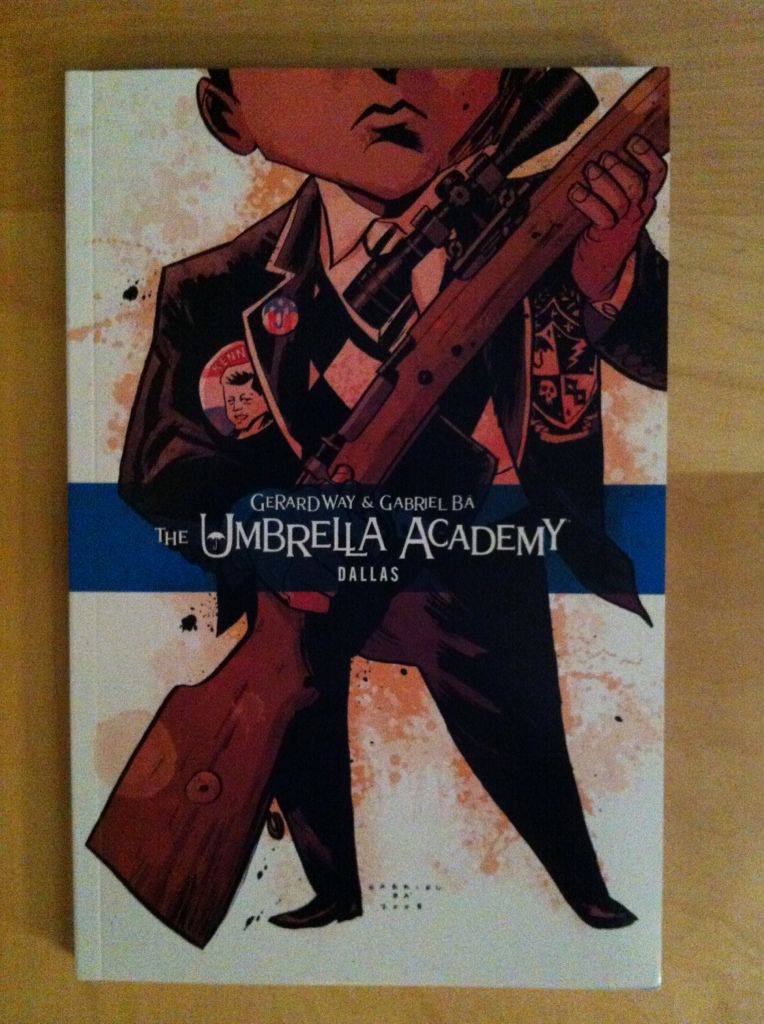
So I Read The Umbrella Academy: Dallas
A 250 word (or less) review of the second The Umbrella
Academy collection
Now this is more like it! I liked the first collection of The
Umbrella Academy, Apocalypse Suite. I thought it had some neat ideas, amazing
art, and solid storytelling, but felt that it was maybe too conventional? Too
adverse to risk? Like, that the premise had a certain amount of untapped potential,
which, if it could be wedded to Ba’s astounding art, could make The Umbrella
Academy a truly great comic. I am happy to report that Dallas lives up to the full
The Umbrella Academy potential. Dallas picks up where Apocalypse Suite leaves
off, with the super-powered orphans of the academy traumatized, maimed, and
scattered from the fallout of the previous chapter. Against this stark tableau
the secret future/history of Number 5 is revealed as well as the horrific
mission he and his family must undertake to save the future. It is, more than anything, a
confounding and brave comic. Where Apocalypse suite is kind of an avant garde
take on the Superhero formula, Dallas is just balls out crazy originality. It’s almost as if, with the basic
foundations of The Umbrella Academy world established, Way and Ba are free to
capitalize on their creativity. Every single page crackles with this manic
energy and nearly every scene goes in an unexpected, yet satisfying
direction. The entire comic is expansive and interesting and just utterly
weird. Dallas is absolutely its own thing and it’s great. The Umbrella Academy:
Dallas is the complete, realized Umbrella Academy package. It’s well worth reading.
Wednesday, 5 December 2012
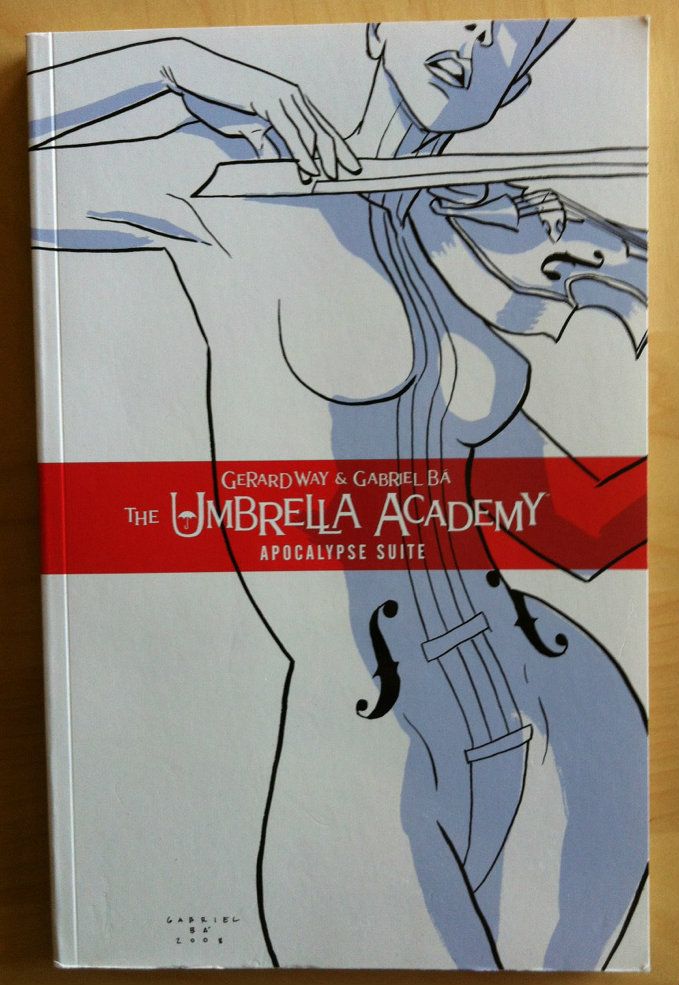
So I Read The Umbrella Academy: Apocalypse Suite
A 250 word (or less) review of the first volume of The Umbrella
Academy
Word count: 250
By Gerard Way and Gabriel Ba, Dark Horse Books.
The Umbrella Academy starts with a pro wrestler delivering an atomic flying elbow to a giant space-squid which caused the spontaneous birth of 43 children with amazing powers. Seven of these children are collected by The Monocle, Sir Reginald Hargreeves, an adventurer, inventor, and secret space alien who raises the seven in his mansion/school The Umbrella Academy. And this is pretty representative of the in-the-past part of the comic: it’s a big goofy, superhero romp, with kind of a Victorian-orphan-fiction vibe that captures the childlike wonder of comics. The other half of Apocalypse Suite, set years later, starts with the death of The Monocle and the reunion of the grown up Umbrella Academy seven. This half of the story, while still campy and comicky is much more adult, rife with violence and death and stakes which makes it feel designed for a more mature audience. The way the two halves of the story play off one another makes me think that The Umbrella Academy is really trying to contrast the different ways children and adults experience comics. The Umbrella Academy is written by Gerard Way, who is apparently the lead singer of My Chemical Romance, which doesn't really matter since the writing is quite clever and exciting and well paced. The artwork by Gabriel Ba is amazing and really elevates the good script and makes The Umbrella Academy: Apocalypse Suite a pretty great book. I'd recommend The Umbrella Academy: Apocalypse Suite as a nice alternative fix for a superhero comic.
Word count: 250
Previously:
Wednesday, 17 October 2012
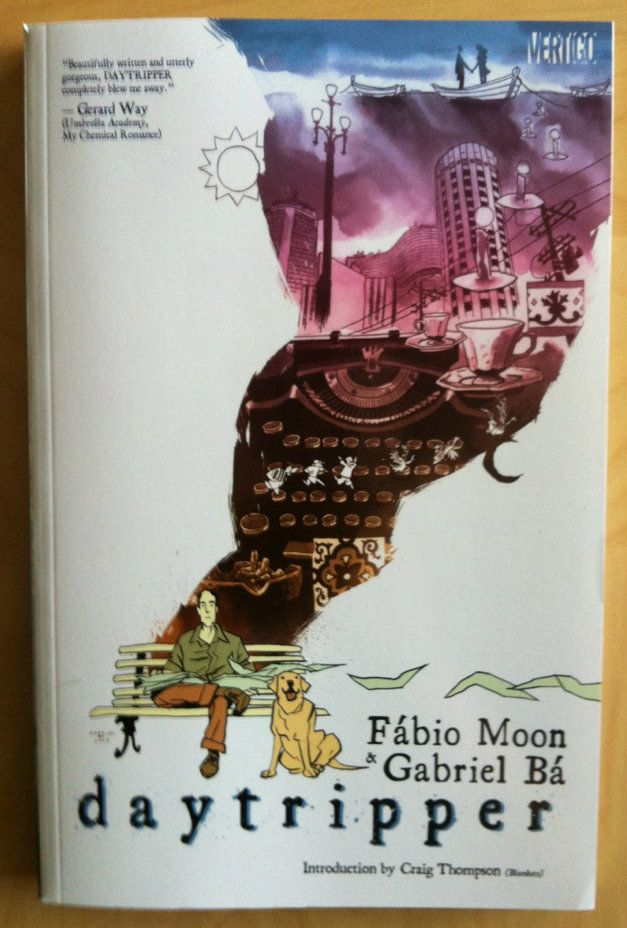
So I Read Daytripper
A 250 word (or less) review of the Daytripper graphic novel
I have this idea that the "truly" literary artistic comics of the world are about reducing life down to its mundanity and depressing reality to reveal something transcendental. When done well it's impactful and transformative and really… a bit of a downer. Daytripper tackles the subject matter of mortality, the relationship between life and death, in a quiet-moments-of-life way that manages to be poignant, artistically powerful, and hugely uplifting. It's a highbrow comic about death that makes me feel better about life. The comic is about Bras de Oliva Domingos, an obituary writer, and the story fills in the details of his life and his many deaths. Structurally each chapter tells a story about an important moment in Bras’ life, when he meets the love of his life or his son is born or when he visited his grandparents’ ranch as a child, and ends in his death. Thematically this seems to say savor these important moments because each one could be your last. Or maybe it's a bit more metaphorical than that and it's saying these moments change you so that the person you were dies and a new you is born. Regardless, the book states that death is an important part of life because it adds finality to our stories and fosters change. It's a beautiful book both in its message but also, with art by Fabio Moon, in its execution. If you want a poignant and artistic book that improves your life outlook check out Daytripper.
By Fabio Moon and Gabriel Ba, Vertigo Comics
I have this idea that the "truly" literary artistic comics of the world are about reducing life down to its mundanity and depressing reality to reveal something transcendental. When done well it's impactful and transformative and really… a bit of a downer. Daytripper tackles the subject matter of mortality, the relationship between life and death, in a quiet-moments-of-life way that manages to be poignant, artistically powerful, and hugely uplifting. It's a highbrow comic about death that makes me feel better about life. The comic is about Bras de Oliva Domingos, an obituary writer, and the story fills in the details of his life and his many deaths. Structurally each chapter tells a story about an important moment in Bras’ life, when he meets the love of his life or his son is born or when he visited his grandparents’ ranch as a child, and ends in his death. Thematically this seems to say savor these important moments because each one could be your last. Or maybe it's a bit more metaphorical than that and it's saying these moments change you so that the person you were dies and a new you is born. Regardless, the book states that death is an important part of life because it adds finality to our stories and fosters change. It's a beautiful book both in its message but also, with art by Fabio Moon, in its execution. If you want a poignant and artistic book that improves your life outlook check out Daytripper.
Word count: 249
Previously:
Wednesday, 12 September 2012
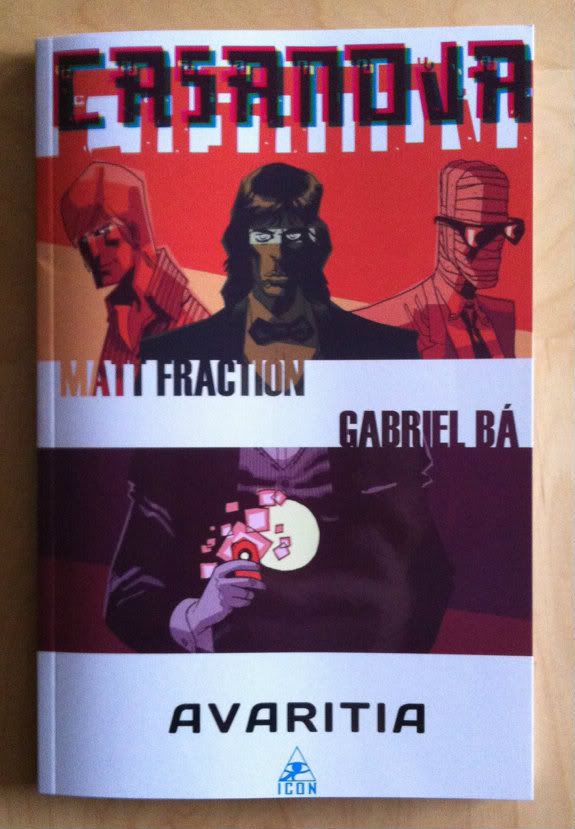
So I read Casanova: Avaritia
A 250 word (or less)
review of the third Casanova volume.
By Matt Fraction and Gabriel Ba, Icon Comics
This book is like a gut punch of creativity. In Avaritia, superspy Casanova Quinn is sent throughout the multiverse to murder the man who would become Newman Xeno, uber-criminal mastermind, over and over and over and over by any means necessary. This book is ANGRY, from its violent story by Matt Fraction to the angular figures by Gabriel Ba (back on art duties from brother Fabian Moon) to the fierce red colour palette of colorist Chris Peter.1 If the first two Casanova issues are vintage pop rock alternately celebrating (Luxuria) and subverting (Gula) comic book tropes then Avaritia is punk rock played by Kurt Vonnegut on the gradually imploding conventions of comics storytelling while announcing that the myopic uruburu of recycled superhero stories is fucking bullshit. Or something?2 It's potent stuff. There are also some considerably less angry, but no less declarative comments on creation/authorship in this book, which I honestly don't complete grok yet in their fullness. What I do understand is pretty profound though. Once again, all I can really say is that Casanova is a must read comic that is beautiful, experimental, profound, and fucking awesome. Also fuck the man, and fuck his uncreative comics.3
Word count: 198
1: I would be remiss to
not mention the great hand lettering of Dustin Harbin. So classy.
2: I lost my train of
thought while looking for someone to punch.
3: I try not to rock the
expletives so much, but Avaritia is a book that fucking requires it. Man!
Previously:
So I Read Casanova: Luxuria
So I Read Casanova: Gula
Previously:
So I Read Casanova: Luxuria
So I Read Casanova: Gula
Wednesday, 22 August 2012
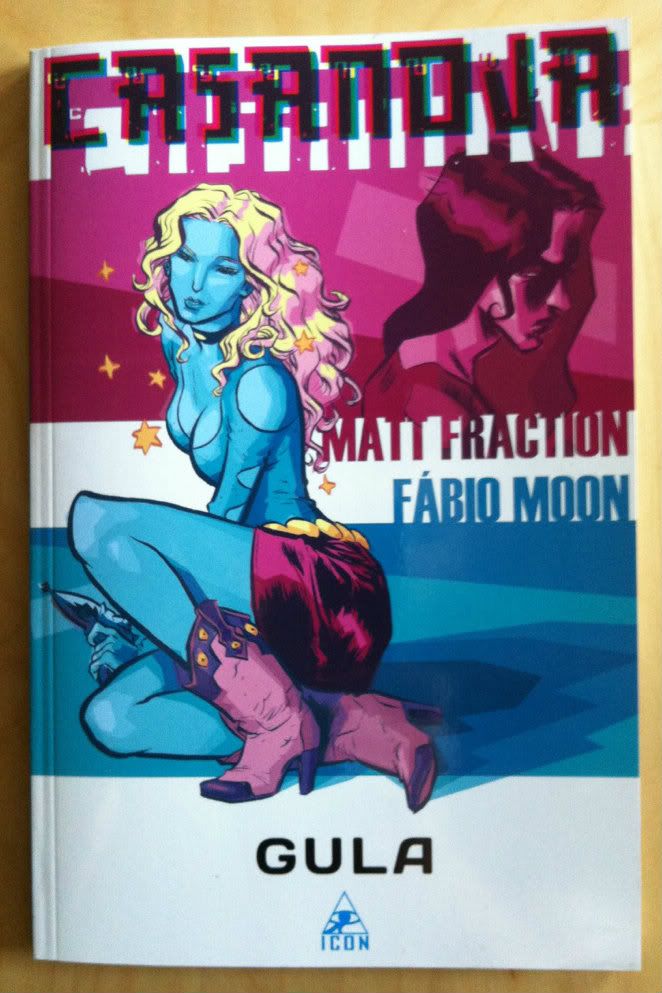
So I Read Casanova: Gula
A 250 word (or less) review of the second Casanova volume
By Matt Fraction and Fabian Moon, Icon Comics
More virtuosic, sexy, smart, fun comics in the Casanova universe. Gula takes place in the same 60's chic, comic book espionage world of the previous book, but this time the plot is built around the mystery of when is Casanova Quinn. Of course, Gula is much more than that (deliberately) shallow plot synospsis. Much like Casanova: Luxuria, this volume functions as a metacommentary on comics as a genre, except this time, instead of using audience/genre expectations to drive the story, Gula subverts them. I guess what I'm trying to say is that the book uses audience preconceptions as misdirection to drive the core mystery. It's very well done. It’s kind of hard to pin-down exactly why I like the Casanova comics so much. I mean, a lot of it has to do with the extremely high quality of story and art… but it’s more than that. There is this ineffable, intoxicating quality to Luxuria and Gula that manages to elevate an already great comic. If I were to describe it, Casanova has that quality that made people lose their minds over the Beatles, or the effect the scent of someone you’re infatuated with has while it claws at your sensory neurons. It’s larger than life in its cool and primal in its delivery. Matt Fraction and Fabian moon, twin brother of Luxuria artist Gabriel Ba, have made one superb comic in Gula and together they pull off one groovy magic trick. Pa-Zow!
Word count: 242
Also, upon rereading Gula,
I gotta say Matt Fraction is one cheeky guy.
Previously:
So I Read Casanova: Luxuria
Previously:
So I Read Casanova: Luxuria
Wednesday, 8 August 2012
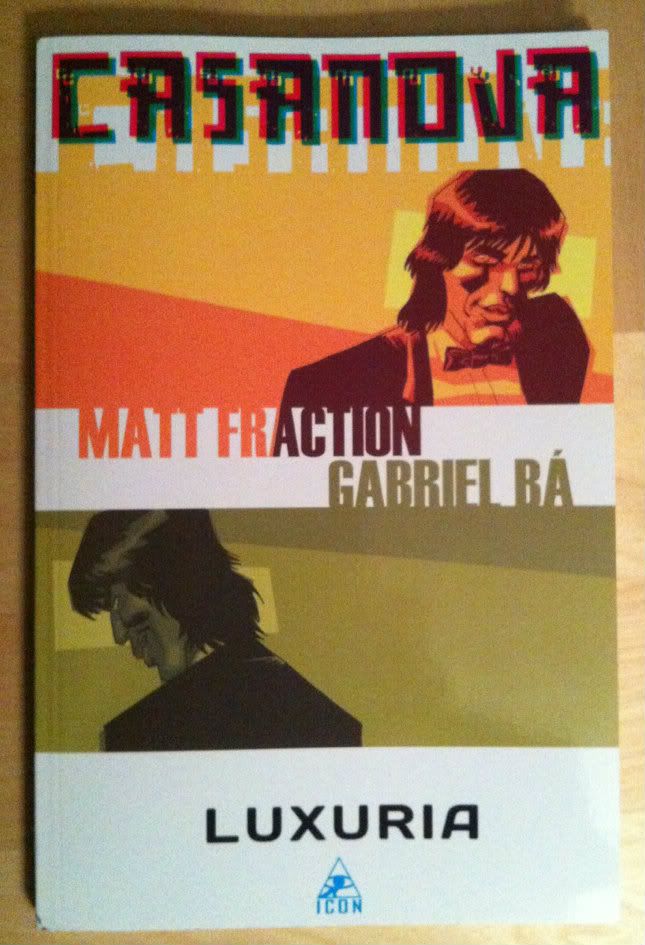
So I Read Casanova: Luxuria
A 250 word (or less) review of the first Casanova
volume.
By Matt Fraction and Gabriel Ba, Icon Comics
Casanova luxuria, more than anything, reminds of a mango.1 Luxuria, like a mango, has this absolutely huge flavour that is simultaneously rich and sugary and tart. It's pulp, not in the comic sub-genre sense, but in the concentrated taste sense. Superficially, Casanova functions as a superhero spy comic... think James bond meets Steranko’s Nick Fury meets the Beatles experimenting with jazz in the '60s. It's as groovy, psychedelic, sexy and acronym laden as you'd expect (Because the genre demands it!). I say superficially a spy comic, though, because like a mango, Luxuria has a secretive hard kernel underneath all it's juicy flesh. I get the feeling the Fraction and Ba are sort of deconstructing comic books as a genre in Luxuria, but in a nice way that literally shouts "I love comic books!”. Maybe reconstruction would be a better word? Regardless, the book plays with genre tropes and expectations in way that is very self aware and slick. Luxuria, also manages to function on this intellectual level without sacrificing sexy good fun which makes it both stimulating and enjoyable to read. Fraction and Ba have written and drawn something daring and beautiful in luxuria and everyone should be reading this. Everyone.2,3
Word count: 201
1: Manila mango, to be specific. It's the best kind.
2: Procuring Luxuria actually proved to be somewhat difficult as my local comics shops (there are four conveniently close to where I work) barely stocked Casanova. Talking to the clerk at one of the smaller shops (mostly a used book store), I found out Casanova doesn't move well despite Fraction's visibility as a "Marvel Architect". This is a sin against comics.
3: Seriously, if we buy enough Casanova maybe Fraction will start doing more creator owned stuff and that can only be amazing.
Subscribe to:
Posts (Atom)