Showing posts with label Stuart Immonen. Show all posts

Wednesday, 25 November 2015

So I Read Russian Olive to Red King

A 250 word (or less) review of the Russian Olive to Red King graphic novel,
by Kathryn Immonen and Stuart Immonen; Adhouse Books


Russian Olive to Red King is a bleak comic. It is a beautifully crafted, achingly sparse story of depression, despair, resolution, and loss. In the comic Olive, an archeologist, is leaving on a work trip to a remote northern location. Her lover Red is staying behind with her dog to struggle with his writers block and finally turn in an overdue article. Tragedy strikes and Olive's small plane crashes in north, forcing her to struggle to survive. Red, meanwhile, cut off from Olive and ignorant to whether she might still be alive, is left to keep the faith. It is, as I've said, a bleak comic. It is also achingly beautiful: whether depicting arctic wilds or huddling in a bedroom, Russian Olive to Red King captures a kind of majestic stillness. It's an aesthetic choice that resonates with enormity and isolation of the story. While the story of the comic is powerful, for me the artwork is its best selling feature and the reason to seek out this comic. It's spectacular. One thing you should be aware of, though, is that the final third of the comic is a lengthy prose section. I found this part of the book as bleak, artful, and powerful as the comic and the perfect way to end the book (and a great statement on the power of art as a mechanism for dealing with emotion). But, your mileage may vary, and reading a comic that ends with an essay may not be your speed.

Word count: 250

Friday, 20 June 2014

Deep Sequencing: Plotting the plotless

Or a plot map of Nextwave: Agents of H.A.T.E.
by Warren Ellis, Stuart Immonen, and Dave McCaig, Marvel Comics


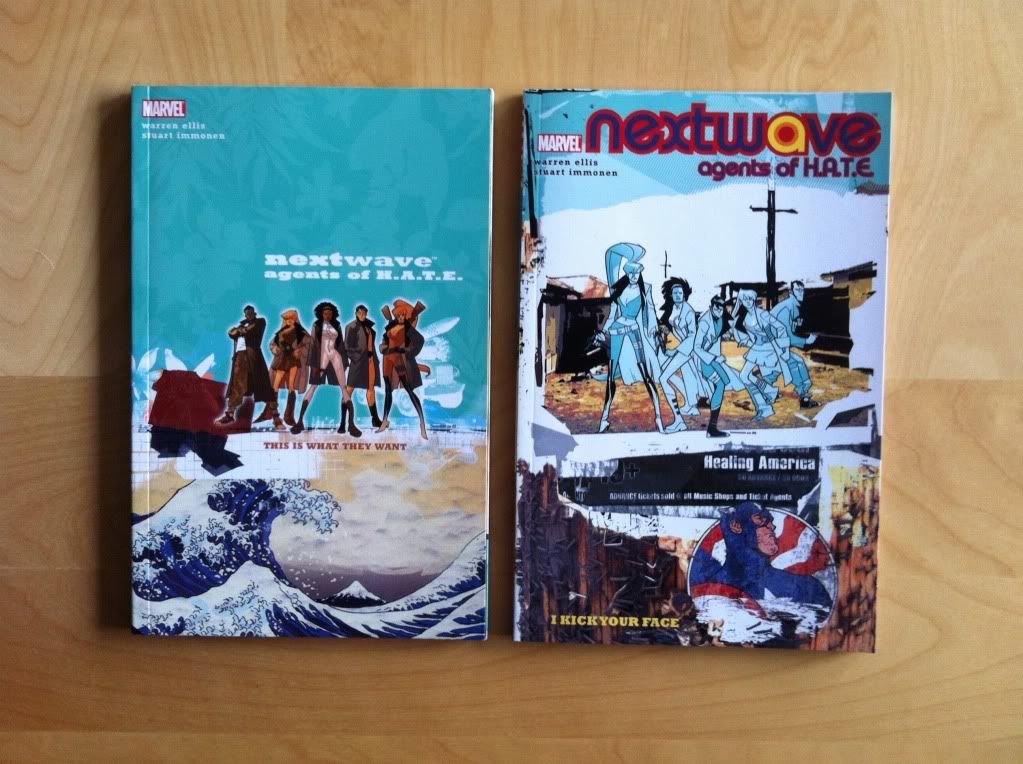
Nextwave: Agents of H.A.T.E. is a revolutionary comic that surgically excises unneeded baggage like plot and characterization and amps up everything left to make the quintessential superhero comic experience. I thought it would be an interesting experiment to try to make plotmaps for Nextwave to try and find what kind of plot remains in a deliberately plotless comic. And this is what I got.

Since this is a plotmap it is basically made out of *SPOILERS*. Be wary.

(Incidentally, if you want a high resolution Nextwave style swears skulls for your comics dialogue .ai or .png file, drop me a line!)
Previously:
Nextwave: Agents of H.A.T.E.

Wednesday, 18 June 2014

So I Read Nextwave: Agents of H.A.T.E.

A 250 word (or less) review of Nextwave 
by Warren Ellis, Stuart Immonen, and Dave McCaig; Marvel Comics


There are some comics so brilliant, so experimental, that they cast a shadow on the entire medium. Most of these remarkable comics are meticulous constructions that perform astonishing feats of wizardry with plot or characterization or theme and provide insight into the human experience and what can even by done with a comic. Nextwave: Agents of H.A.T.E. is an essential, revolutionary comic that says fuck all that let's punch weird stuff. Essentially, Nextwave is a superhero comic that excises plot and character development and melts down the remaining action in a crucible of madness. And the resulting comic, instead of being a drooling lobotomy moron, is fucking transcendental comics alchemy. In Nextwave: Agents of H.A.T.E., a superhero team made of sometime-Avenger Monica Rambeau, monster hunter Elsa Bloodstone, ornery robot Aaron Stack, kleptomaniac celebrity mutant with pyrotechnic powers Tabitha Smith, and The Captain, who is just kind of an asshole, fight the living weapons of mass destruction produced by the Beyond Corporation. And yeah, that's basically the comic: misfit superheroes with personality disorders punch, kick, and blow up really weird and silly monster-things in a stripped-down, hyper efficient comic drawn by a genius-superstar artist. Which is the fundamental unspoken core of superhero comics made explicit and also shut up, it's fucking awesome. Go read it.

Word count: 214

Thursday, 5 July 2012

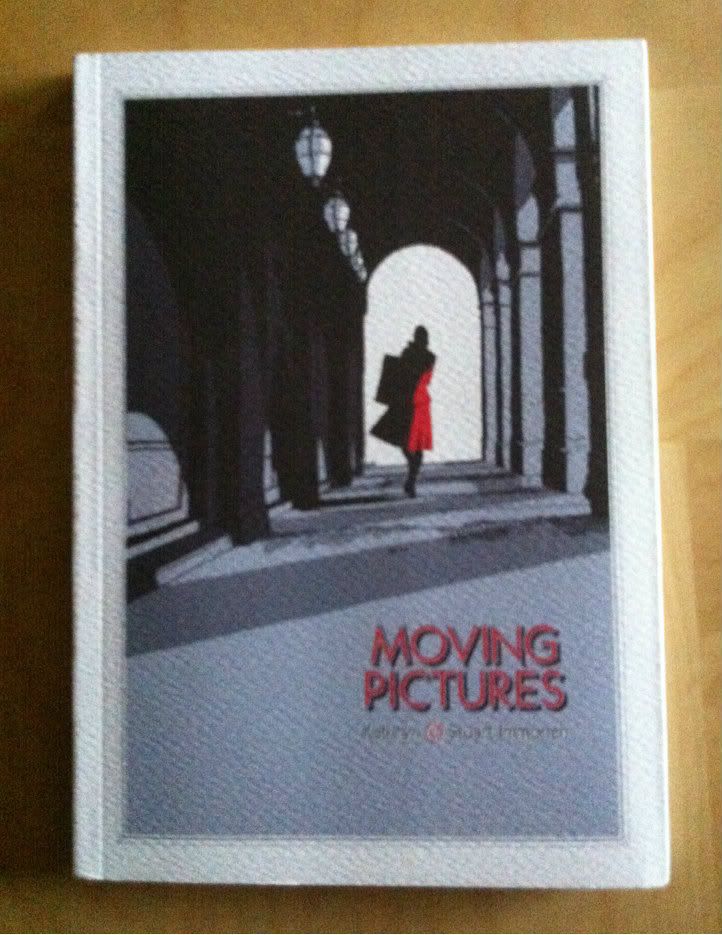
So I Read Moving Pictures


A 250 word (or less) review of Moving Pictures the graphic novel
By Kathryn and Stuart Immonen, Top Shelf Productions

"Comics are just words and pictures… You can do anything with words and pictures."1 Moving Pictures certainly argues to this thesis. The comic takes place during World War 2 in Nazi occupied France and is constructed around efforts by the French to hide their cultural treasures from Nazi art profiteers.2 Although, as the books dustcover synopsis helpfully points out: “this is (not) that story”. Rather the focus of Moving Pictures is Ila Gardner, a Canadian helping the French, who becomes embroiled in a dangerous affair with Rolf Hauptmann, a Nazi Art Commission officer. Kathryn Immonen’s script is constructed in an unorthodox manner, being built around the interrogation of Ila by Rolf interspersed with flashback sequences that serve as portraits3 of the events surrounding the interrogation. Stuart Immonen’s artwork uses this sketchy, minimalist cartoon line with heavy inks… kind of like a period film4 of a noir tintin. The result of the way the comic is structured leaves many key details happening off panel or implied.  To me this left some of the story open to interpretation, forcing me to revisit the flashback portraits to reach my own conclusions about the story. I think this ambiguity may have been a thematic choice: when looking at sculptures or paintings audiences use a single image and setting to construct their own meaning and narratives and I think Moving Pictures is commenting on this process. Of course I, like my interpretation of the book’s events, could be severely wrong. I’d highly recommend Moving Pictures.

Word Count: 250

1: Quoth Harvey Pekar via Warren Ellis…
2: Literally Moving Pictures to safety
3: Portraits that convey the emotionally resonate stakes of the story.  Moving Pictures.
4: A Film. A Moving Picture.

Okay, I kind of want to layout my interpretation of the ending of Moving Pictures on the off chance that someone who read the book reads this entry and wants to compare notes. This is going to be very SPOILER intensive, so I’m going to drop it after the cut.

*SPOILERS*