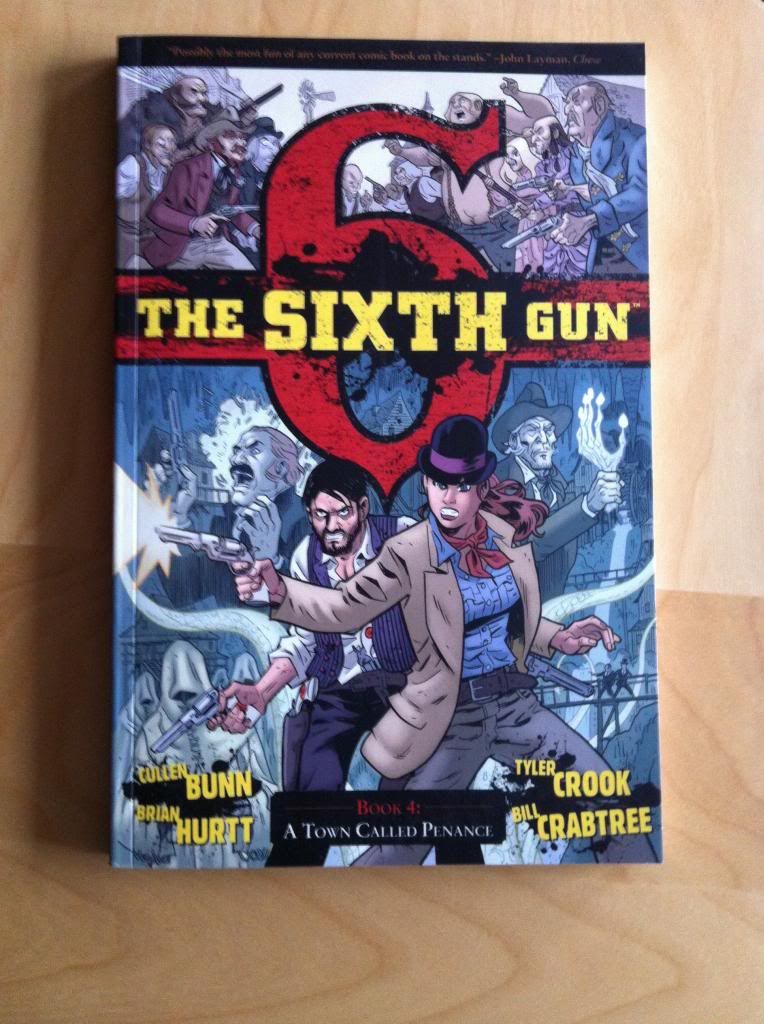
Or the tiny attention to detail at a particularly large table in The Sixth Gun: A Town Called Penance
By Cullen Bunn, Brian Hurtt, Tyler Crook, and Bill Crabtree; Oni Press
The Sixth Gun is a pretty great comic that spins a modern take on American folklore in a kind of wonderful weird western. The story is great and the artwork is excellent, usually in ways that are, well, obvious. There are action sequences in this comic (the deaf, waterwheel-tumbling sequence in Chapter 4 comes to mind) that are as dynamic, chaotic, and thoughtful as anything you will find in comics. But the thing that struck me about The Sixth Gun's visual storytelling, is just how clear and thought out even the quiet, dialogue intensive portions of the comics are laid out. And I want to take a closer look at one sequence in particular and explain why I think it is so effective.
There will be *SPOILERS* in the following post for The Sixth Gun Vol. 4. Proceed appropriately.
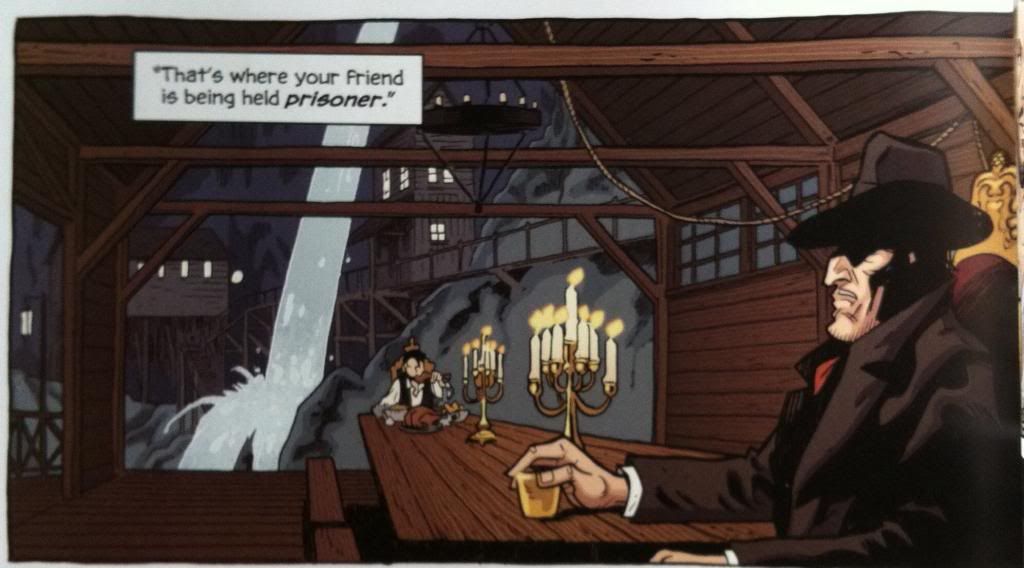
The scene I want to talk about is a conversation that takes place between a captured Drake Sinclair and his capture Gabriel. The object of this conversation is that Drake had formally been a member of The Knights of Solomon, and Gabe wants to convince Drake to come back into the fold. It's very much your genre standard conversation between your morally flexible hero and your powerful, villainous mastermind along a long table.
What I love about this scene is how every image is framed and blocked so to emphasize some aspect of the discourse which enhances the emotional resonance of the entire scene.
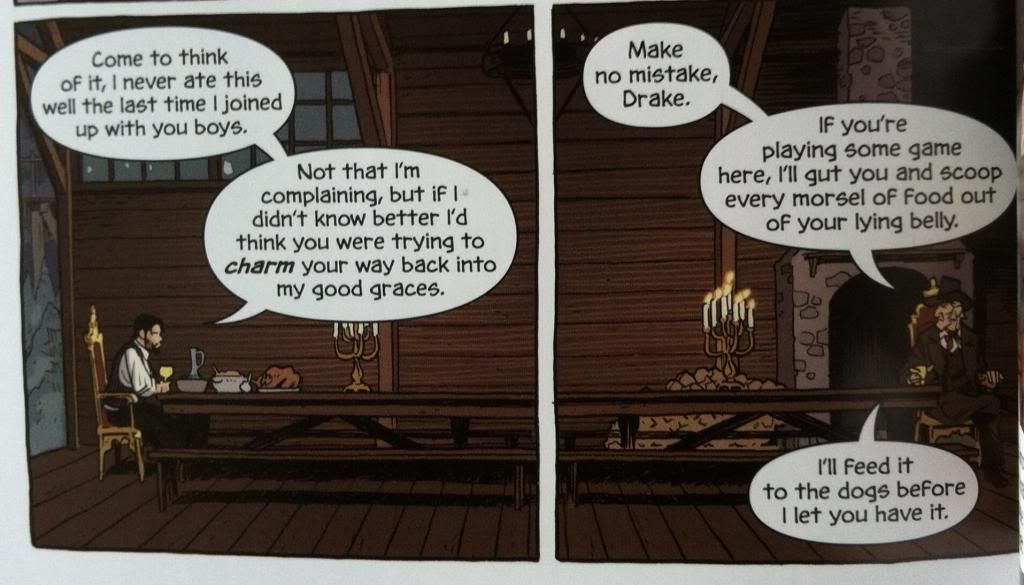
The majority of the panels in this exchange are arranged to emphasize the physical separation between Drake and Gabe, either by using angles that emphasize the length of the table (like in the top image) or like in this panel where the physical separation between the two characters requires a panel break. This distance is a wonderful visual representation of the rhetorical space between the two men: they are far apart because they their way of seeing the world are miles apart.
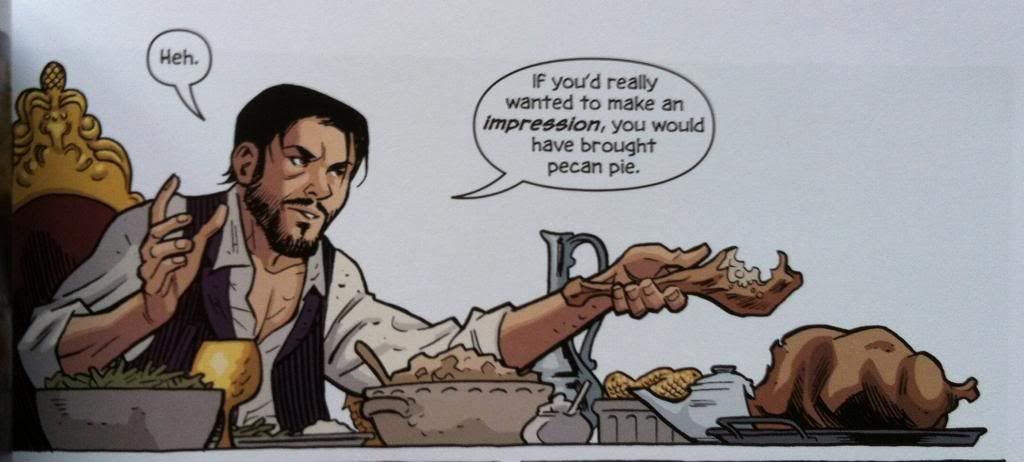
The other layout trick used in this sequence is a bit subtler. The vast majority of Drake shots have him facing from left to right, while Gabe is mostly seen looking right to left (that is when they aren't staring straight out of frame). This cements their position on opposite ends of the long table, but is also another great visual metaphor for disagreeing: the characters literally have opposing views. Again this helps cement the impression of the pair as being diametrically opposed.
(Also, the above panel is great because the choice to exclude the background helps emphasize all of the earthly food and golden temptations in the foreground of the panel, which is another major element of the back and forth between these characters.)
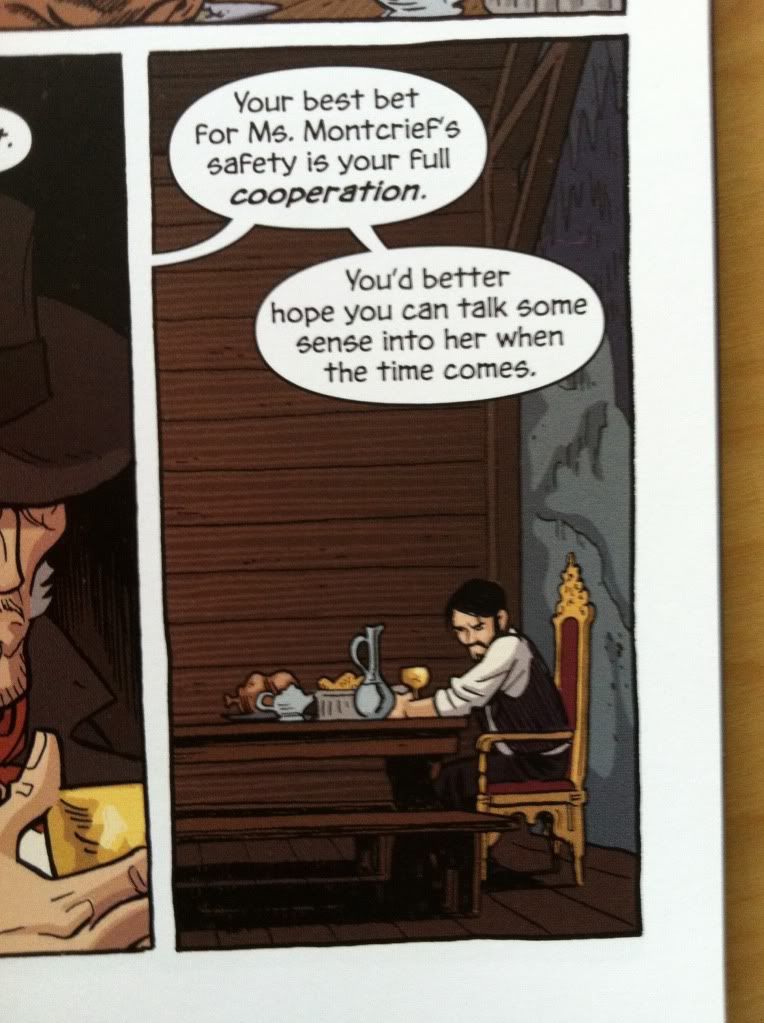
But the thing that cements this sequence as being particularly great is its very last panel. It is at this point that a combination of threats, bribes, and promises finally appears to break through to Drake and convince him to rejoin the Knights. And this is shown in a panel that has Drake, still sitting in the exact same location, face back right to left. Basically, the very same panel where Drake changes his view of things sees the man literally appear to change his view and move to a position that physically resembles that of Gabriel. It's such a small detail, but within the context of the composition it speaks volumes. It's absolutely great comics and emblematic of the sharp storytelling choices that are made throughout The Sixth Gun.
Previously:
The Sixth Gun
Showing posts with label Brian Hurtt. Show all posts
Friday, 2 May 2014
Wednesday, 30 April 2014
So I Read The Sixth Gun: Vol. 1-6
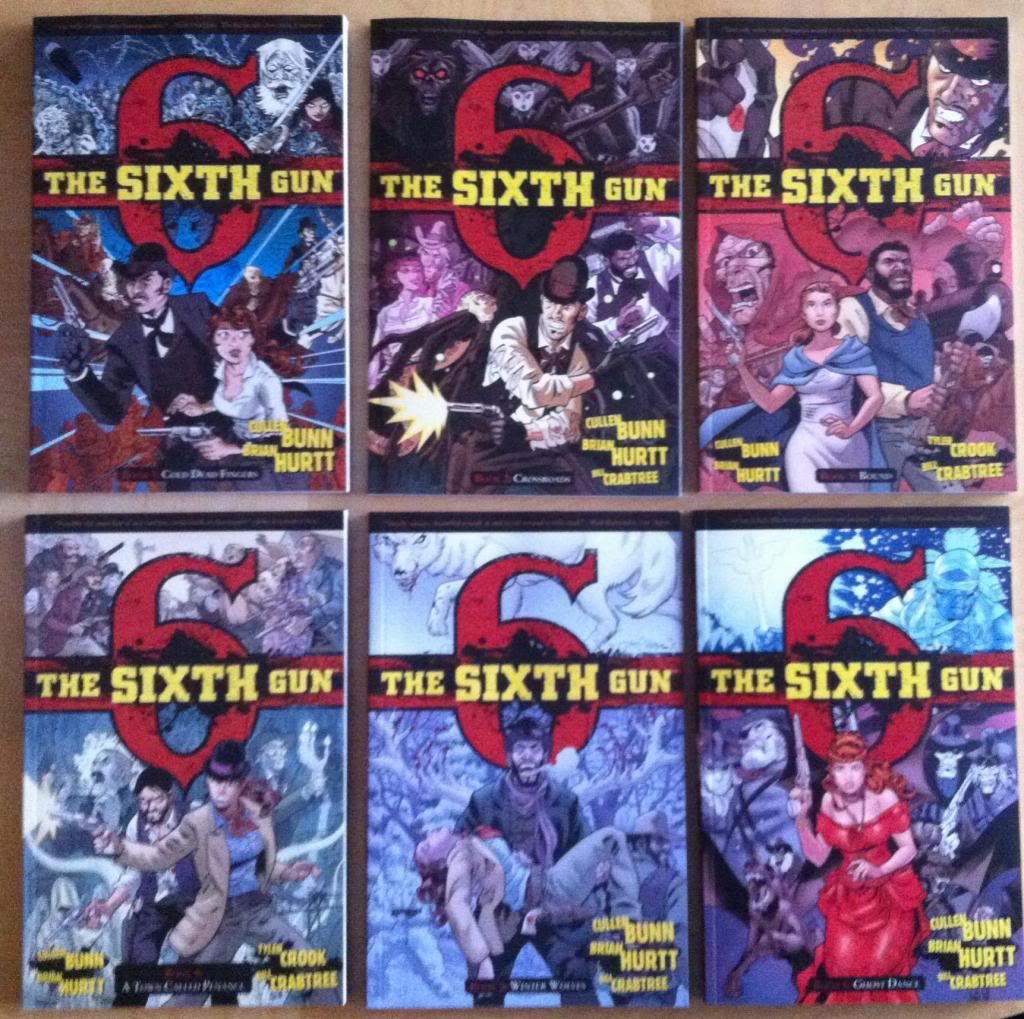
Or a 250 word (or less) review of The Sixth Gun collections: Cold Dead Fingers, Crossroads, Bound, A Town Called Penance, Winter Wolves, and Ghost Dance
by Cullen Bunn, Brian Hurtt, Tyler Crook, and Bill Crabtree; Oni Press
One
of my favourite things about comics is that once you take a step away from
Superhero comics there is a wild, wide-open world of comics to be enjoyed. The
Sixth Gun is a perfect argument for why you should take the leap. The Sixth Gun
is a Western comic blended with a supernatural horror story and infused with swashbuckling adventure. The story revolves around six legendary weapons,
manifesting as pistols, which each have a unique power and together serve as
the keys to the seals of the apocalypse. It is in this world that Drake
Sinclair, a treasure hunter with a shadowy past, finds the lost Sixth Gun in
the hands of Becky Montcrief, the daughter of the gun's caretaker who was
murdered by thieves looking for the weapon. Together the pair must protect the
gun from those who would use it for evil while fighting to collect the other
legendary pistols themselves. Now, bare in mind that I am Canadian and not an authority on
this, but these comics seem very much rooted in the folklore and essence of
American history. The Western is a quintessentially American genre, and the
threats the protagonists face, including an undead confederate general and his
augmented gang, a demon-goddess of the New Orleans swamps, and beasts of native
legend, rise right out of the American historic imagination. And I think that
it's this common thread of zeitgeist that helps make The Sixth Gun feel so
whole and unique. It’s a great comic.
by Cullen Bunn, Brian Hurtt, Tyler Crook, and Bill Crabtree; Oni Press
Word
count: 250
Wednesday, 7 November 2012
So I Read Queen and Country
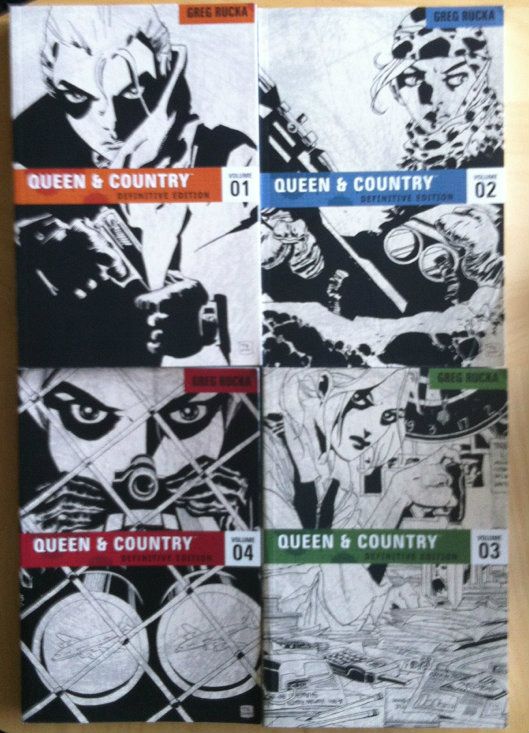
Or a 250 word (or less) review of all four Queen
and Country Definitive Edition omnibuses
By Greg Rucka and Steve Rolston, Brian Hurtt, Leandro Fernandez, Jason Shawn Alexander, Carla Speed McNeil, Mike Hawthorne, Mike Norton, Chris Samnee, Antony Johnston, Christopher Mitten, and Rick Burchett; Oni Press.
Queen and Country is basically an adeptly made espionage Thriller/Procedural. The series depicts members of the British SIS' most elite operatives, called Minders, and the extraordinary missions they are sent on for, well, Queen and Country. Which is the source of the series’ thrills: the missions in Queen and Country are pretty suspenseful and exciting. Even better, the missions and portrayals of espionage in the series are fairly believable which grounds the material and increases the tension. Queen and Country also puts a great deal of emphasis on the bureaucracy, politics, and personal cost of spying. It's this procedural content that adds a layer of strong characterization and ongoing drama to the series. This adds to both the integrity of the story and the depth of the characters… which in turn feeds back into the tension. Greg Rucka, who writes nearly the complete series, is excellent and the artists who rotate to draw the various missions are all quite talented and, at the very least, competent story tellers (although your millage may vary from one to another). Overall, Queen and Country is a very skillfully produced series. There are two canonical prose novels that occur between trades where VERY IMPORTANT THINGS HAPPEN. I was unaware of this when I read the comics and regret not reading them in correct order. Be forewarned that you should probably read these books as you read the comics to get the full experience. Also: the Definitive Edition omnibuses are great value. Check the series out.
Word count: 250.
Subscribe to:
Posts (Atom)