Showing posts with label Neal Stephenson. Show all posts

Tuesday, 6 January 2015

Novels Year In Review 2014

Or a look at the novels I've reviewed in 2014 and my top recommendations

2014 was kind of an odd year for novels on Atoll Comics. I only put up 13 novel review posts this year as opposed to the previous two years on the site where novel reviews were a major component of the site. There are a few reasons for this including the fact I've gotten better at finding comics things to write about, am a lot better at working ahead (novel reviews were often my buffer against vacations or laziness), and that I wanted to focus more on writing critically about comics in 2014. Add to that my new Atoll Comics collaborator Jennifer DePrey, and well, I don't NEED novel posts to hit my updates anymore. But I still read a lot of novels and really like writing about them, so starting in 2015 there will be regular prose novel reviews on the site every Tuesday. And to kick off this new segment, I thought we'd take a look back at the novels of 2014.

Despite the smaller sample size of books this year, I still read some great books that you may want to check out in 2015. Specifically I reviewed:


      Genetopia, by Keith Brooke
      Seed To Harvest Omnibus, by Octavia Butler
      Gentlemen Of The Road, by Michael Chabon 
      Telegraph Avenue, by Michael Chabon 
      The Amazing Adventures of Kavalier and Clay, by Michael Chabon
      Wonder Boys, by Michael Chabon 
      The Man In The High Castle, by Philip K Dick 
      Judas Unchained, by Peter F Hamilton 
      Pandora's Star, by Peter F Hamilton
      The Dispossessed, by Ursula K Le Guin
      Motherless Brooklyn, by Jonathan Lethem 
      Anathem, by Neal Stephenson 
      Breakfast of Champions, by Kurt Vonnegut 
      Cat's Cradle, by Kurt Vonnegut 
      Slautherhouse Five, by Kurt Vonnegut 
      The Sirens of Titan, by Kurt Vonnegut 
      Alif The Unseen, by G Willow Wilson      

Also, since it's traditional, I'd like to do an abbreviated version of my annual top picks for certain genres.

If You Like Science Fiction:
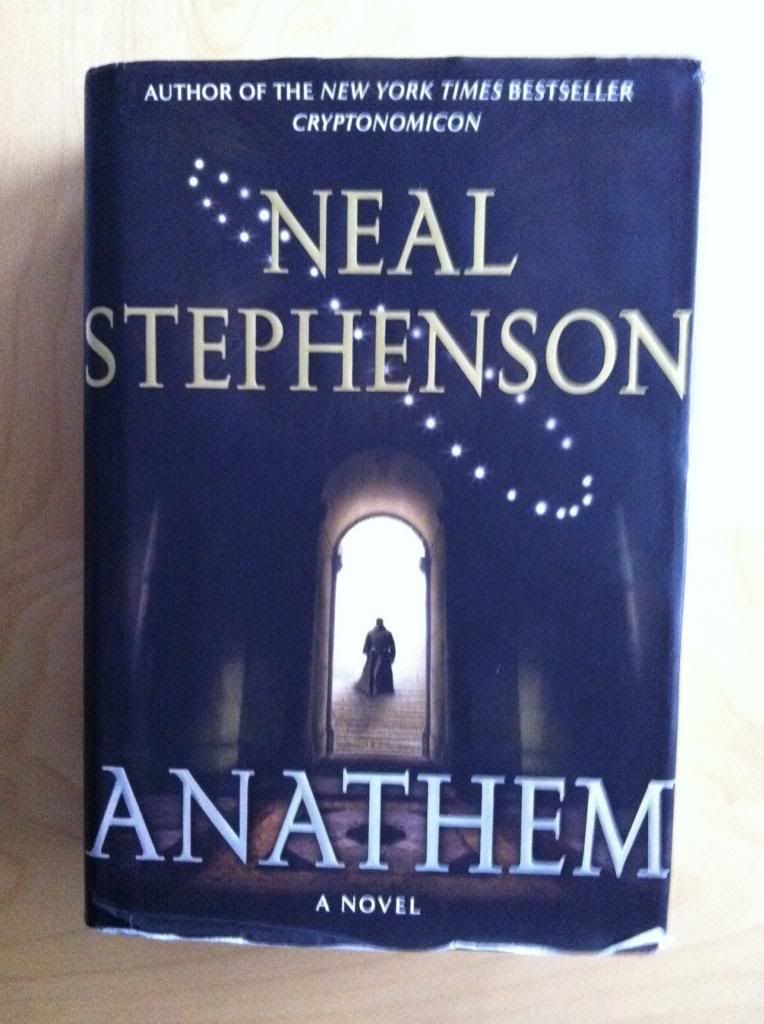


I would recommend Anathem by Neal Stephenson. This might be one of my very favourite novels. It tells the story of Fra Erasmus, a young Science-monk in a society where the academic world lives apart from the Secular world in ascetic monasteries. During a particularly momentous time in Erasmus' life, a startling observation throws his world into disarray and sets off a chain of events with worldwide consequences. Anathem is a sprawling novel about coming of age and personal growth filled with adventure and romance and camaraderie and Science Fiction. It is also a novel that works as a thematic analysis of the philosophy of Science and the relationship between the academic and non-academic portions of our society. It is super insightful and one of the most emotionally true portrayals of Science academia and the act of discovery I have ever seen. I love this book.


If You Like Fantasy:
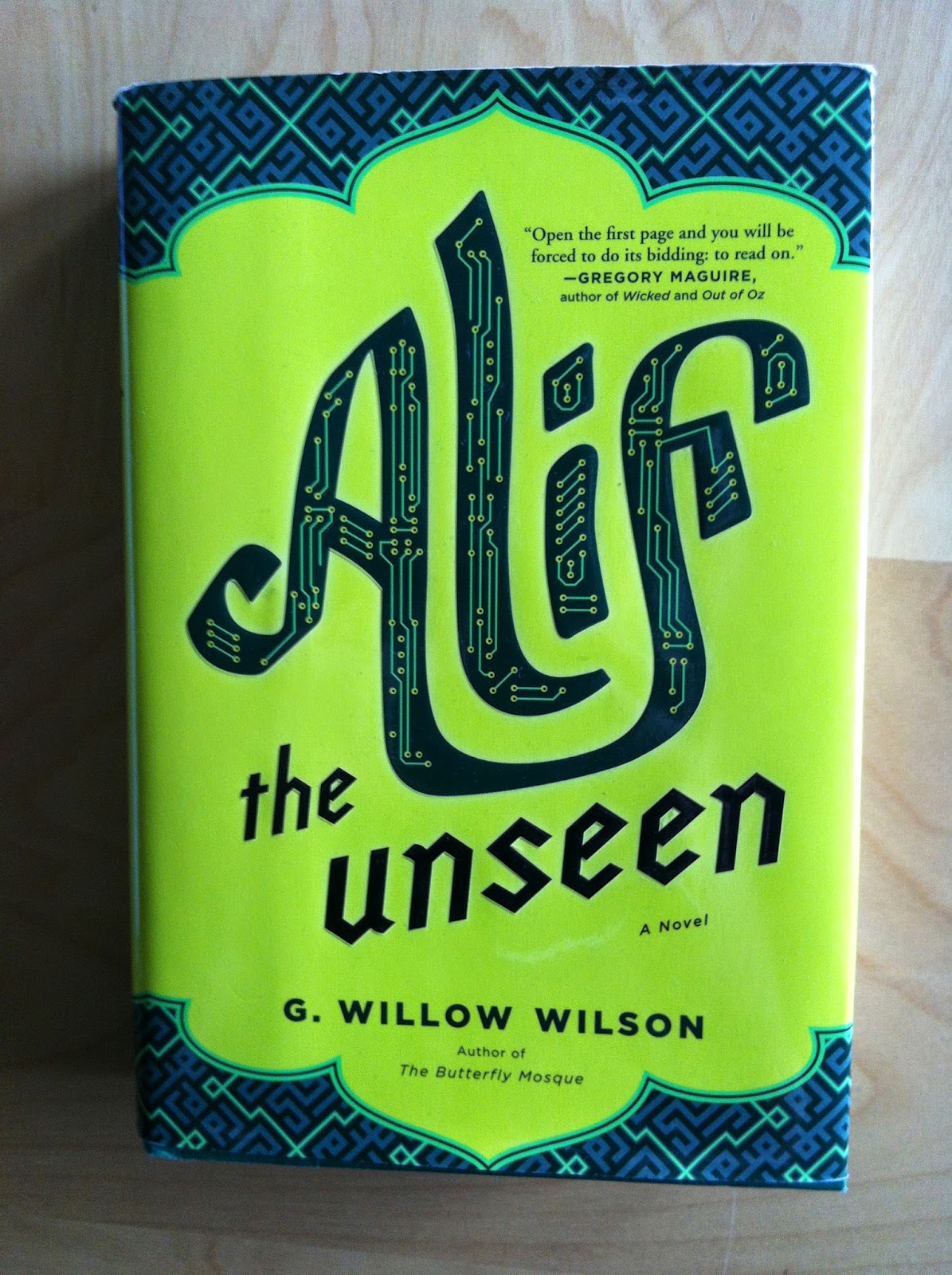


I would recommend Alif The Unseen by G Willow Wilson. Alife The Unseen is a novel that explores what if the more mythical-seeming portions of the Quran were literally true; what if humanity lived along an unseen world of supernatural beings. The novel stars Alif a young hacker living in an Arab Emirate who makes his living by helping dissident voices and staying one step ahead from the ruthless government censors. When Insitar, the wealthy daughter of a powerful man, spurns him, Alif writes a powerful software program that threatens to deliver him into the hands of the state censors. Alif flees, inadvertently dragging along his neighbour Dinah, and finds himself lost in a world of mythical monsters and spirits. Alif The Unseen is a book that mixes an exciting technothriller premise with romance, discovery, and the boundless imagination of a wonderfully realized fantasy world. As a pure work of fiction Alif The Unseen is a great read. This novel is also pretty special in that it portrays young people living in the arabic world and explores the collision of modern and tradition that confronts them. Which is really interesting. Also, Alif The Unseen contains one of the most 'shippable romances ever!

If You Like Superhero Comics:


I would recommend The Amazing Adventure of Kavalier & Clay by Michael Chabon. While not directly a superhero novel, Kavalier & Clay is a novel about the cultural primordial soup and people who first invented Superheroes and produced the comics of the Golden Age. The novel features Joe Kavalier, an young jewish artist and refugee, and Sam Clay, a plucky Jewish kid from Brooklyn a they form a partnership and invent The Escapist, a comic book hero who frees people from the shackles of injustice. The novel really illuminates the way social forces, the spectre of Nazi Germany, Vaudeville magicians and strongmen, all fermented in the imaginations of scrappy young people to create the amazing fantasy worlds we all love today. Kavalier and Clay is also constructed out of all the adventure, romance, and bombast of comic books, but applied to the believable lives of its heroes. It's basically a beautifully written novel about comics that tells a great story. Also, serious points for depicting the best first kiss in fiction.


Or If You Just Like Books:
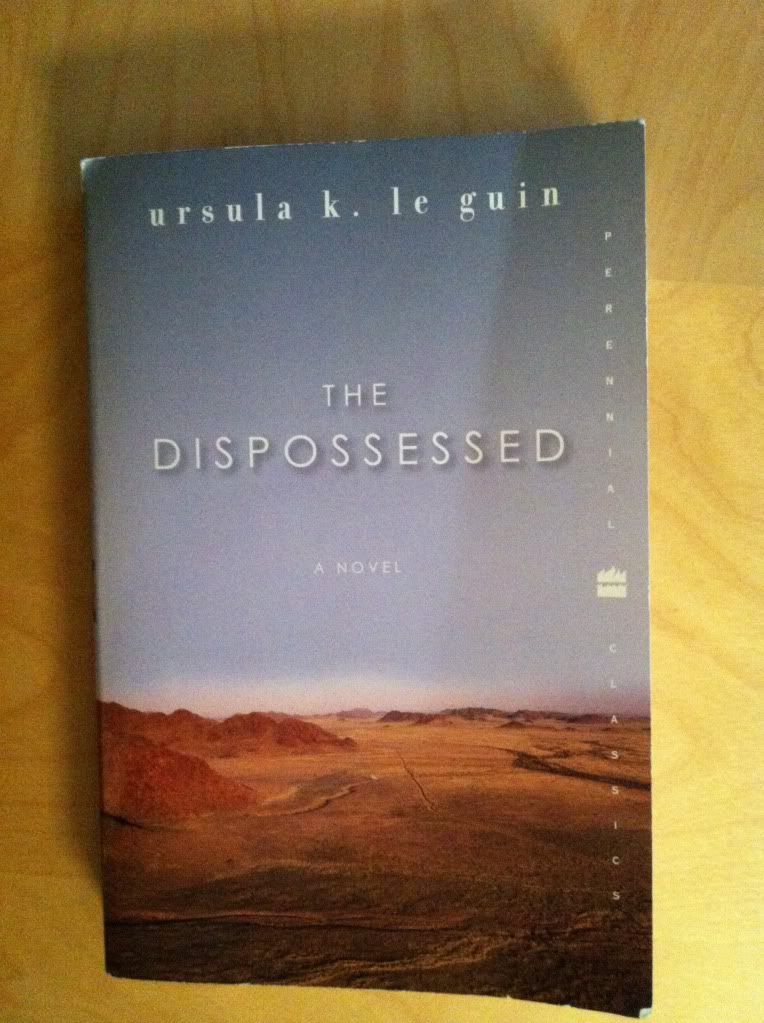


I would recommend The Dispossessed by Ursula K Le Guin. You know when you read books that are clearly Important and Classic and Timeless and yet you never really hear about them? Well The Dispossessed is completely one of these books. The novel is one of the best works of social speculative fiction I have ever read. In the book twin planets, Urras and Anarras, orbit each other in close proximity. Yet, despite this proximity, the inhabitants of these planets could not be more isolated from one another. The Urrasti live on a lush world and live in a capitalistic society of wealth and inequality. The Anarresti however, live on a barren, arid planet and live an ascetic life of anarchic communism to survive. In The Dispossessed, an Anarresti theoretical physicist Shevek travels to Urras to develop and share his theories, breaking the isolation and bringing the two societies into idealogical conflict. The Dispossessed is an absolutely unflinching examination of two societies: western capitalism and an idealized anarchic communism. The novel really shows the strengths and ugliness of both societies and showcases the underlying humanity of people regardless of where they are from. The Dispossessed is a novel that deserves to be held up with the greatest works of social fiction and so I really think you should read it.

Post by Michael Bround

Jennifer DePrey's top pick from 2014:


I would recommend Fangirl by Rainbow RowellFangirl is about Cath, a teenager facing her first year of college. She’s worried about making new friends, leaving home and her father, and finishing her Simon Snow fanfiction before the release of the final book. This coming of age story asks the question of how to begin the process of growing up and still hold onto the interests other people might not understand, but from which we gain strength. Rainbow Rowell’s style is engaging, her dialogue is snappy, and her characters feel like old friends. I was rooting for Cath from page one.

Insert by Jennifer DePrey


Previously:

Novel Reviews 2013

Monday, 12 May 2014

Anathem Is A Good Book

Or why you should read Anathem by Neal Stephenson


Finding a favourite novel is an intensely personal experience. People, all of us, are these exquisitely complex beings made of the interplay of nature (genetics, epigenetics, poorly understood other-RNA-stuff, regulatory protein behaviours, etc) and nurture, that unique set of environmental conditions and experiences that shaped our biology until we end up who we are. We each, as a result, carry our own spectrum of interests and hobbies and experiences which in turn act as the masonry of our perspectives. And so we are all primed to experience, well, everything but for the sake of this: fiction in radically different ways. Which is all a long winded way of getting at the idea that finding that perfect novel, that matrix of ideas and themes and story that just ineffably and perfectly connects to us, is this incredible accident of... for lack of a better way to put it, alignment that it is a kind of magic. 

Anathem by Neal Stephenson is maybe my favourite novel.

Anathem is a difficult book to talk about from a plot perspective since so much of its power revolves around the act of discovery. It is very much a novel that throws you into a new world and walks the perfect line between providing enough exposition to understand the context of the fiction, while also leaving subtext open to interpretation, deduction, and theorizing. Anathem is a story about exploration and discovery where is also along on a journey of exploration and discovery. Which is pretty great.

What I can say about the the story of Anathem is that it takes place at a time when society is split between the general population, the saecular world, and the world of academia, The Mathic world. Essentially, in Anathem, academia, particularly science academia, has been literally walled off from everyone else in monastery like cloisters called Concents where they practice a humble ascetic lifestyle and pursue their studies with the limited tools allowed them. These Concents are also divided within themselves with gated quadrants, called Maths, that only open annually, once a decade, once a century, or once a millenia with each group kept seperated from the larger society as well as one another. Anathem focuses on Erasmus, a young Fra in the Decenarian Math of the Concent of Saunt Edhar on the cusp of adulthood and choosing his special area of study. However, this is thrown out of order when his teacher, the astronomer Orolo, makes a startling observation shortly before Apert, when the gates between the Decenarian Math and the Saecular world are due to briefly open. An observation with great implications for both the Mathic and Saecular worlds that promises great discovery and threatens far reaching discord.

(Which maybe sounds a little dry, but trust me, there is adventure and romance and action to be had amongst the smart stuff.)

The reason why this novel might be my favourite is that I find it both eminently relatable and deeply fascinating from a thematic standpoint. For all of the Science Fiction particulars and story developments, Anathem is also a very thorough and thoughtful meditation on the Philosophy of Science and the relationship between Society at Large and Academia. The Mathic world functions as this amazing metaphor for Science Academia, and is used in the novel as a machine to explore the formative norms of the Science as well as the complicated, fraught relationship between ordinary people and Science Academics. As a dude in the midst of a PhD in the Life Sciences who has an extremely wankery fascination with how Science functions as a philosophy and the history of Science I find this super cool. Which makes this book immently relatable and endlessly fascinating to me. As great and engrossing a story as Anathem is, I just absolutely love this aspect of the novel. It feels like Anathem was written just for me.

I would recommend this book for me: it is the perfect alignment of my interests with a fantastic story. It's absolutely perfect for me. Can I recommend it for other people who are not me? Well, it's hard to say. It's a very well written book with rich characters, some great high concepts, and a really epic plot. And the way it opens up as a process of discovery is just incredible. But Anathem is also a very long  novel (~900 pages) and can get pretty conceptually dense at times. While it was an investment in time for me, it felt effortless and breezy... but I'm me and I love this book. It is very hard for me to be objective about Anathem, but I'd say if you are a Science student who likes Sci-fi you will certainly enjoy the novel. Anathem would also be a good call for any fan of Neal Stephenson or anyone who likes well written, wicked smart, contemporary Science Fiction. 

Previously:
Snow Crash and Diamond Age 
Reamde

Monday, 24 June 2013

Snow Crash and The Diamond Age Are Good Books

Or why you should read the novels Snow Crash and The Diamond Age: Or a Young Lady's Illustrated Primer by Neal Stephenson 

Neal Stephenson is kind of a big deal to me. As might be apparent if you've been following my nonsense at all, I kind of love novels that look at some aspect of life or technology, and just pick it apart in an entertaining way. For me, Neal Stephenson is the master of this kind of discursive, insightful analytical approach to fiction. He has this... perfect way of taking something straightforward, canting it to reveal an unseen facet, and then bombarding it with absolutely unexpected spectra of imagination to uncover something ideal about the concept. It's like making things more real through fiction. I am always entertained by his novels and, in the process, enlightened, somehow. It's pretty great.

Now, I enjoy all of Stephenson's novels. However, like most creative forces, there is a certain arc to his output. His most recent novels are heavily refined works of a master writer, and reflect his experience, while his very earliest novels are fossils of someone still developing their voice. But in between the two are these novels that are kind of magical; the Cambrian Explosion of Stephenson fiction, where the raw experimentation met craft and created these sublime moments of prose. For me, these novels are Snow Crash and The Diamond Age, and they are among my very favourites.


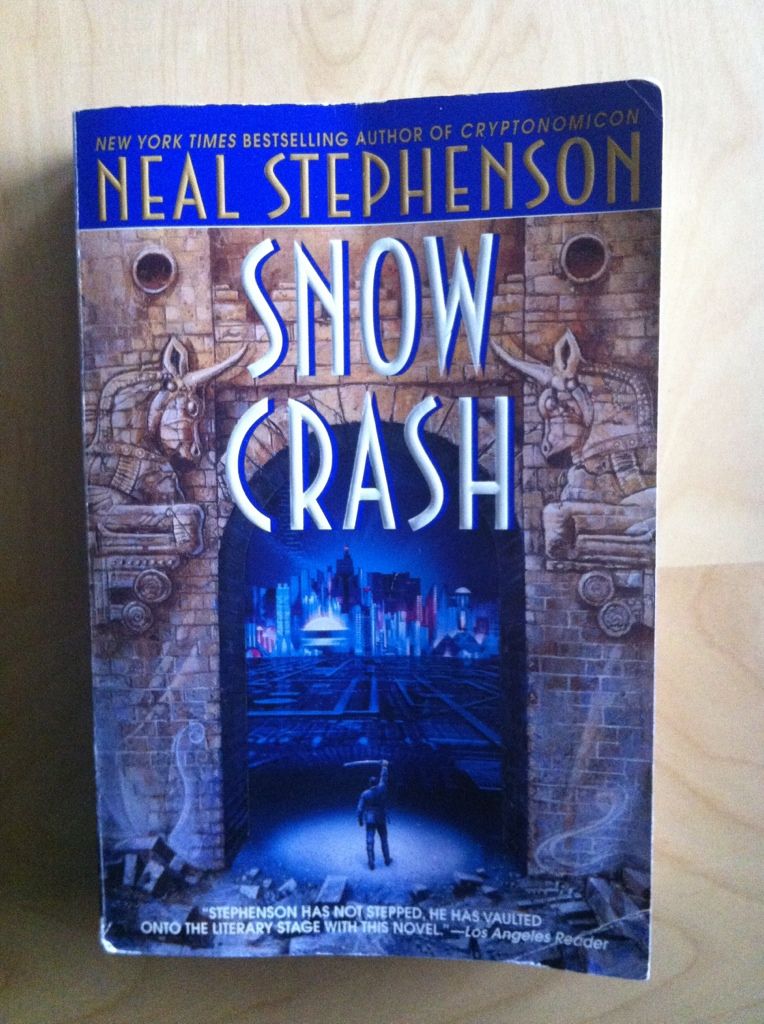
Snow Crash: Is this perfect realisation of a cyberpunk retro-future, that centres around the intersection of Metaverse VR Hackers and the linguistic magic of the ancient Sumerians set in the fragmented, Burbclaved dystopian remnants of the United States of America. It focuses on Hacker, swordsmen, and sometime Costra Nostra Pizza Deliverator, Hiro Protagonist and teenage Skateboard Kourier Y.T. as they form a partnership to gather and archive intelligence for the Central Intelligence Corporation (a merged byproduct of the CIA and Library of Congress) which pits them against an ancient curse, a fanatical religion, and an Aleutian nuclear power with Poor Impulse Control. It is one of the craziest, rawest, and most insightful things I have ever read.

But more than that, Snow Crash is this perfect realisation of the early 90's. Sure, it's a time I barely experienced (given that I was a child at the time), but Snow Crash absolutely encapsulates my sense of the decade. This is one EXTREME novel, with car-harpooning skateboarders and sword fights in virtual reality and The Deliverator and mini-guns and nuclear powered cyborg attack dogs. America has been broken into franchised nation states run by corporations with all of the subtlety and style of Dominos Pizza and 7-11. There is religious fundamentalism influencing power brokers, and poorly understood sexually transmitted diseases, and drugs that are barely invented, and stickers with "Smooth Move Ex-lax" written on them. Even as our present diverges further, and further from the future portrayed in Snow Crash, the novel lives on as this snapshot of the 90s zeitgeist. This is a novel that absolutely everyone has to read.


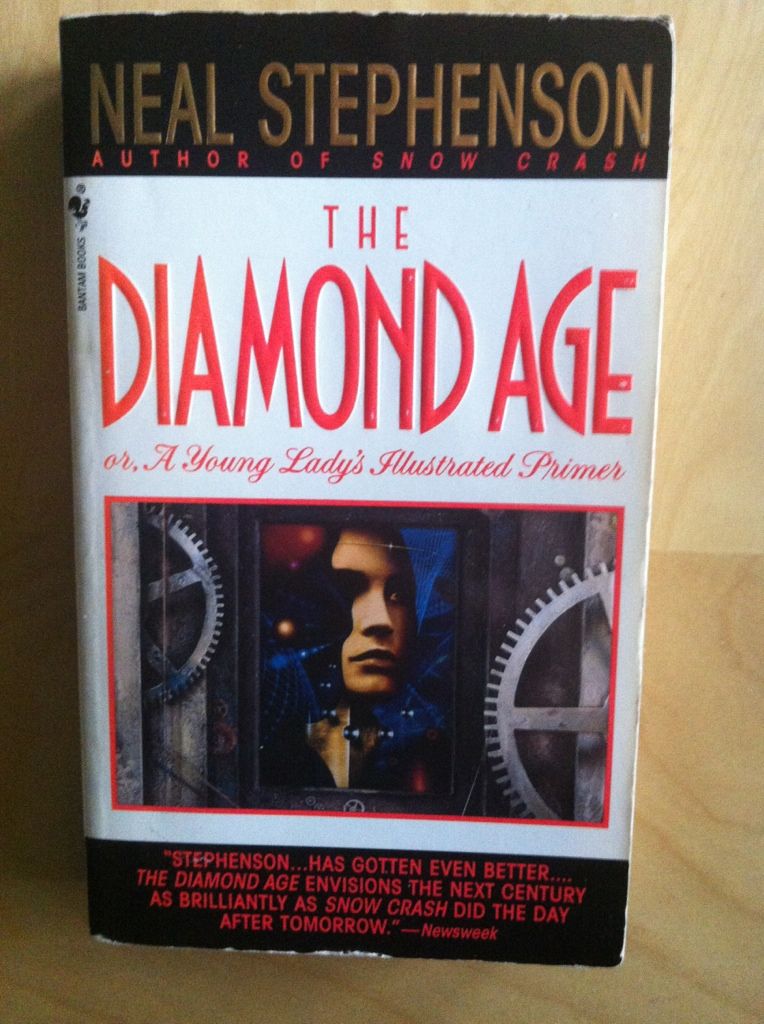
The Diamond Age: Or A Young Lady's Illustrated Primer: is, appropriately, a much more refined and elaborate kind of novel. The novel portrays a very distinct, very original concept of a future where nano-technology using societies are organized intro self-selecting tribes based upon ancient cultures. The Diamond Age takes place largely within the various enclaves of the Chinese Coastal Republic and begins when Lord Alexander Chung-Sik Finkle-McGraw, a high ranking noble of the Victorian tribe worrying about the effects of orthodox education, commissions Bespoke nano-tech engineer John Percival Hackworth to create a wondrous new book/computer for his granddaughter Elizabeth. Hackworth, guided by paternal hopes for his own daughter Fiona, steals a copy of the design for The Young Lady's Illustrated Primer and enlists Dr. X, an illicit technology broker of the Celestial Kingdom, to build a duplicate. Unfortunately, Hackworth is waylaid by street ruffians and the magic book falls into the hands of Nell, a poor tribeless Thete sired by the cyberpunk thug Bud and born of the unmaternal Tequila. Complications ensue, and what follows is a tale of social class, education, family, the war for the future of China, and the development of a new and awesome technology.

The Diamond Age is kind of perfect. Where Snow Crash is this raw, amazing time capsule, The Diamond Age is prisitine and timeless. It is immaculately engineered prose and ornately crafted ideas carved into an emotionally arresting narrative. Less fist pumping jawesomeness, and more dream architecture. It deals with the gonzo fallout of cultural collision and identity, social class and philosophy, and the every-more-relevant concepts of self-selecting communities and friction between ideologies. But more than that, The Diamond Age meditates on the universal themes of education, the magic of imagination, and the power of these to shape lives in just a really beautiful way. In many ways, I think The Diamond Age is the Ur-Stephenson novel: while Snow Crash does set up many of his favourite themes, The Diamond Age realizes them in this mature way that is utterly recognizable in his later works. It feels very much like the foundation of our contemporary Neal Stephenson.

I would recommend these novels to everyone. Snow Crash is just such an absolute kick-to-the-nuts of prose that is simultaneously this incredible cultural artifact of the 90's. It is, most deservedly so, one of those 100 novels everyone should read and in my view absolute canon for any Science Fiction fan. The Diamond Age, should also be a book everyone reads. Its themes are timeless, and if anything, more relevant today than when the novel was originally written. But beyond that, The Diamond Age is just an absolutely fascinating construct... like crystallized imagination. It is a bit challenging but well worth the effort. 

Wednesday, 4 July 2012

Reamde is a Pretty Good Book.


A review of the novel Reamde, by Neal Stephenson


Neal Stephenson is somewhat of an enigma to me. He has written some of my all time favourite works of Science Fiction: Snowcrash is easily a modern Sci-fi classic (if not a general landmark piece of fiction) and his next-most-recent novel Anathem was one of the most satisfying reads I've had in years. However, he has also written some books that are decidedly not my favourite books: from the punky missfire of Zodiac to the gargantuan, grinding, morass of his Baroque novel series. I mean, all of these are "good" books in the sense that they are thoughtful and interesting... it's just his best books are both keenly insightful and pleasantly engaging. His worst books are usually only one of these.

Reamde for me, falls somewhere in the middle.

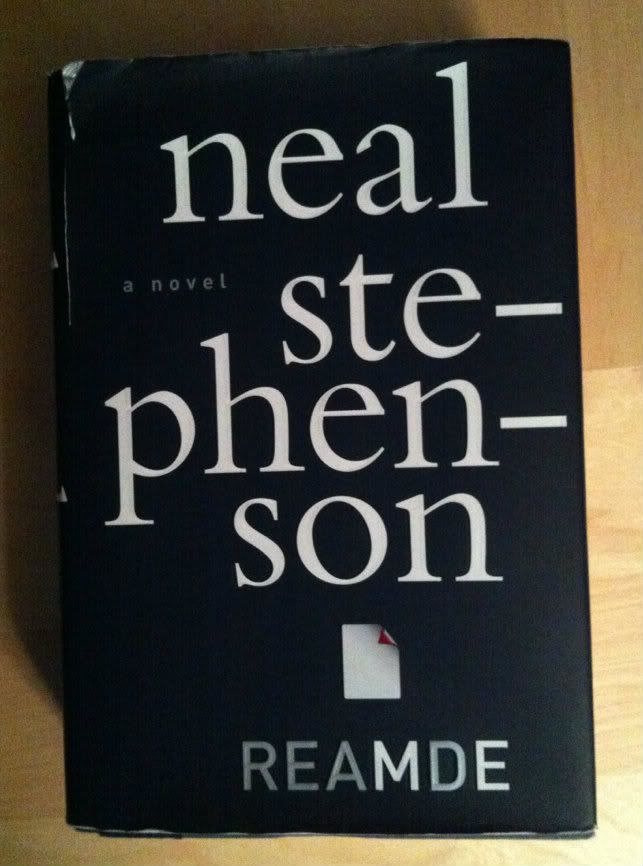
Reamde follows the stories of Richard forthrast, millionaire MMORPG mogul and former marijuana smuggler, and his adopted niece Zula forthrast as they run afoul of the Russian mafia, Chinese hackers, b\British spies and Islamic terrorists in a globetrotting thriller. Reamde, therefore, is a kind of modern meta-thriller, designed around the tropes of Tom Clancy, Robert Ludlum and/or Dan Brown novels. And when I say designed around the tropes (plural) I am being literal: this novel is an aggregate of ALL thriller plots simultaneously. To a certain extent the book functions as a mediation on the genre and its conventions. In a certain sense Reamde succeeds, in that it builds this quintessentially modern thriller story in a highly textured and plausible way. Stephenson's eye for research and his penchant for grounding the over-the-top implausibility of events in the sheer real-world banality that would make them possible (ie. several page discursion on air traffic routing, airline fuel limitations and international radar deployment)really elevates the material. However, the doing-so of this is also Reamde’s greatest flaw. The problem with the novel is one of suspense logistics: it’s hard for a thriller to maintain the kind of tension that is the engine of the genre over 1000+ pages, especially pages that are rife with Stephenson’s particular brand of discursion. Don’t get me wrong: the tangential riffing is some of the best writing in the book and is insightful and interesting which I love (said as a guy who listens to educational podcasts for entertainment while setting up experiments for his graduate studies), but it does bog down the pace of the action. But then again, these tangents are among my favourite parts of Reamde as they act as a direct conduit to the Stephenson-sublime voice that is more prevalent in my favorite books by him. Also, these information rich, laborious discourses are often involved in the mechanics of getting separate plot threads aligned in ingenious ways. Seriously, the character logistics in this book are incredible. It’s technically a very well written book.

Overall, I'd say I enjoyed Reamde, and that I will likely revisit it in a few years. I wouldn't necessarily recommend it to a general reading audience (there are better, more accessible Stephenson novels to try first), but I would recommend the book to anyone who is a fan of Stephenson as an author or is serving a lengthy prison sentence.