Or a look at the diversity and aplomb of some of the art from Zero Vol. 3
by Ales Kot, Ricardo Lopez Ortiz, Adam Gorham, Alberto Ponticelli, Marek Oieksicki, Jordie Bellaire, and Clayton Cowles; Image Comics
Zero is an achingly sincere, brightly subversive, and horrifically violent Sci-fi espionage comic. The ongoing story about Edward Zero, a deeply broken secret agent programmed from childhood to be a killing tool, is fascinating and a comic that I highly recommend as a pure reading experience. It is also a comic that is a great example of an art showcase: every chapter of Zero features a different penciller with a dramatically different style. A style that series writer Ales Kot seems to craf a perfect script for and superstar colourist Jordie Bellaire adds the perfect finishing touch to. And the result is a comic that is a great Spy comic that is also one of the best art anthology comics I've read.
So I thought I would take a look at some examples of the diverse and fantastic artwork from Zero Vol. 3 and the way each artist's style is used to create a distinct chapter of the story.
There will be *SPOILERS*.
The first chapter of Zero Vol. 3 is drawn by Ricardo Lopez Ortiz and is this fantastic lesson in tension. The story of the issue is one where Agent Zero, living a civilian life in Iceland, is waiting for the other shoe to drop and to be attacked by The Agency he escaped from. The story shows Edward living an idyllic life, living on a farm with a beautiful young woman and yet everything about the comic screams THE SHIT IS ABOUT TO HAPPEN. And this is hugely pulled off by style: Ortiz brings this squinty, clenched quality to every panel of the story making the story feel flexed on the edge of catastrophe. Take the above selection where Edward, encouraged by his bubbly lover, is petting the chickens to make for happier eggs: the poses are hunched, Edward is scowling, and in the distance a volcano explodes while the background darkens into a concentrative loom. It's a scene depicting happy chickens being pet, and yet everything feels like the end of the world. It is absolutely brilliant comics.
The second chapter features pencils by Adam Gorham. The story of this chapter sees Edward Zero travel to a house in The United Kingdom infested with some sort of mind-assimilating fungal spore. The sequences around this segment of story are pure rot-horror. What I love about the artwork in this portion of the story, particularly the above selection, is how Gorham's clean and meticulous style juxtapose with the creeping chaos of the creeping fungus: we can see the underlying clean structure as well as the many tiny spores and mushroom caps and climbing molds that are trying to conquer everything in the room. Another thing I love about the above selection is how all of the tiny boxes simultaneously call attention to the finer details of the rot and also lend the page a huge amount of motion as things seemingly grow and spread and creep and drip through the page. It gives the page a sense of urgency and the fungus a ruthless, predatory presence it would otherwise be lacking. Which comes largely from the very smart, very distinct style of this chapter.
The final two chapters in Zero Vol. 3 are drawn by Alberto Ponticelli and Marek Oleksicki. These two artists are masters of brutal violence and do an amazing job capturing the horrendous, gut turning violence of these chapters. Zero is a comic that portrays it's violence not as noble performance art, but bloody, destructive, and disgusting episodes of the worst humanity has to offer. And both Ponticelli and Oleksicki really rise to the occasion delivering two of the most gloriously uncomfortable and best composed fight scenes I've ever read. I actually felt queasy and hot with animal fury at the end of each. I especially love how Ponticelli, above left, builds panel flow into his compositions giving his fight scene a speed and visceral directness that gives that chapter a feeling of people rapidly and viciously hurting each other . Oleksicki is just as impressive using layouts that are fractured, filled with surprising, disjointed vectors. This choice gives the fight in the final chapter a choppy, lurching quality that matches the story of two men animalistically tearing each other apart in this drawn out and oddly intimate way. It's spectacularly awful. Which again is a showcase of great artists using their respective styles to portray really skillful comics stories.
Which I think really speaks to a maybe under-appreciated strength of comics as a medium. Unlike most other storytelling mediums, particularly visual ones, comics have the lowest cost of radically altering styles between chapters. In movies, television, and animation, the time and monetary costs of radically altering the visual look of a project is steep. Comics, with their small creative teams and nigh endless-content budget, have a freedom to experiment with variety that is maybe unique to them. And this allows for comics with a serialized, common story to showcase tense chicken petting, ornate sci-fi horror, and nauseating acts of human destruction all in the same book. Which is pretty cool.
Zero, as a series, is really great at this, which is yet another reason you ought to be reading this comic.
Previously:
So I Read Zero: Vol. 1
So I Read Zero: Vol. 2
So I Read Zero: Vol. 3
Deep Sequencing: Brutal Action
Deep Sequencing: Gun fight!
Deep Sequencing: Zero Atlas
Showing posts with label Zero. Show all posts
Friday, 14 August 2015
Wednesday, 12 August 2015
So I Read Zero: Tenderness Of Wolves
A 250 word (or less) review of Zero Vol. 3
by Ales Kot, Ricardo Lopez Ortiz, Adam Gorham, Alberto Ponticelli, Marek Oleksicki, Jordie Bellaire, and Clayton Cowles; Image Comics
Zero: Tenderness of Wolves is part of an ongoing series. To read about Vol. 1 go here.
Zero: Tenderness of Wolves continues the story of Edward Zero, an assassin and spy trained and indoctrinated from childhood to be an obedient killer. Except in Zero Vol. 3, Edward is free, living in a kind of happiness in Iceland. But when you are the kind of killer Zero is, there can never really be peace and when his former handler gives him an offer he can't refuse Edward Zero reactivates. Zero: Tenderness of Wolves continues the tradition of askew psychological drama with really brutal, really horrifying violence and is just a pretty great comic. Zero: Vol. 3 also really exemplifies the way Zero is also an art showcase anthology: every chapter/issue of Zero is a special story written to show off the skills of a different artist. Which gives every portion of Zero a unique visual identity and makes every story a fantastic example of oddly comedic tension or creepy futuristic horror or truly brutal fight scenes of unbelievable violence. Zero is a worthwhile read both for the quality of its ongoing story and for the quality and variety of the artwork being showcased. You'll discover a subversive, violent world and maybe a new favourite creator or two.
Word count: 199
Post by Michael Bround
Previously:
Zero: An Emergency
Zero: At The Heart Of It All
Deep Sequencing: Zero Mercy
Deep Sequencing: Zero Atlas
Deep Sequencing: Firefight
by Ales Kot, Ricardo Lopez Ortiz, Adam Gorham, Alberto Ponticelli, Marek Oleksicki, Jordie Bellaire, and Clayton Cowles; Image Comics
Zero: Tenderness of Wolves is part of an ongoing series. To read about Vol. 1 go here.
Zero: Tenderness of Wolves continues the story of Edward Zero, an assassin and spy trained and indoctrinated from childhood to be an obedient killer. Except in Zero Vol. 3, Edward is free, living in a kind of happiness in Iceland. But when you are the kind of killer Zero is, there can never really be peace and when his former handler gives him an offer he can't refuse Edward Zero reactivates. Zero: Tenderness of Wolves continues the tradition of askew psychological drama with really brutal, really horrifying violence and is just a pretty great comic. Zero: Vol. 3 also really exemplifies the way Zero is also an art showcase anthology: every chapter/issue of Zero is a special story written to show off the skills of a different artist. Which gives every portion of Zero a unique visual identity and makes every story a fantastic example of oddly comedic tension or creepy futuristic horror or truly brutal fight scenes of unbelievable violence. Zero is a worthwhile read both for the quality of its ongoing story and for the quality and variety of the artwork being showcased. You'll discover a subversive, violent world and maybe a new favourite creator or two.
Word count: 199
Post by Michael Bround
Previously:
Zero: An Emergency
Zero: At The Heart Of It All
Deep Sequencing: Zero Mercy
Deep Sequencing: Zero Atlas
Deep Sequencing: Firefight
Monday, 27 April 2015
Deep Sequencing: Zero Atlas
Or a geographic plot map of Zero Vol. 1-2
by Ales Kot, Michael Walsh, Tradd Moore, Mateus Santolouco, Morgan Jeske, Will Tempest, Vanesa R Del Rey, Matt Taylor, Jorge Coelho, Tonci Zonjic, Michael Gaydos, Jordie Bellaire, and Clayton Cowles; Image Comics
One of my favourite comic things is when a comic rigorously annotates time, date, and location. I think it adds a level of reality to the narrative that makes the comic feel much more authentic. It also means I can take the times, dates, and locations and make annotated plot maps! Zero is a globe trotting Sci-fi espionage comic that lends itself to making a plot-atlas.
I guess there are kind of *SPOILERS* in it.
This version includes events in Zero Vol. 1 and 2. Click on the image for a larger version of the Zero plot-atlas.
Previously:
So I Read Zero: Vol. 1
So I Read Zero: Vol. 2
Deep Sequencing: Brutal Action
Deep Sequencing: Gun fight!
by Ales Kot, Michael Walsh, Tradd Moore, Mateus Santolouco, Morgan Jeske, Will Tempest, Vanesa R Del Rey, Matt Taylor, Jorge Coelho, Tonci Zonjic, Michael Gaydos, Jordie Bellaire, and Clayton Cowles; Image Comics
One of my favourite comic things is when a comic rigorously annotates time, date, and location. I think it adds a level of reality to the narrative that makes the comic feel much more authentic. It also means I can take the times, dates, and locations and make annotated plot maps! Zero is a globe trotting Sci-fi espionage comic that lends itself to making a plot-atlas.
I guess there are kind of *SPOILERS* in it.
This version includes events in Zero Vol. 1 and 2. Click on the image for a larger version of the Zero plot-atlas.
Previously:
So I Read Zero: Vol. 1
So I Read Zero: Vol. 2
Deep Sequencing: Brutal Action
Deep Sequencing: Gun fight!
Friday, 24 April 2015
Deep Sequencing: The Firefight at the heart of it all
Or the fantastic gun play in Zero Vol. 2
by Ales Kot, Jorge Coelho, Jordie Bellaire, Clayton Cowles; Image Comics
Zero is the transgressive, Sci-fi espionage comic that bleeds sincerity. It is also a showcase comic where a rotating cast of artists work with writer Ales Kot and legendary colourist Jordie Bellaire to make comics magic happen. Every chapter of Zero is its own, interesting world with a distinct style and some aspect of comics storytelling done impeccably. Zero: Vol. 2 is no exception and the chapter drawn by Jorge Coelho has what might be the best gunfight I've read in comics. Specifically, there is a certain pair of pages that I think really showcase wha makes this chapter of Zero so special.
There will, as always, be *SPOILERS* below.
The thing about a firefight with multiple gunmen is that they are not linear, clear events. There are numerous participants, all moving through cover, trying to out position one another and gain an unexpected angle of attack. Every armed person can kill at range. Bullets can pass through unexpected barriers, or ricochet and careen, wounding and killing in unpredictable ways. Basically, firefights are fluid, chaos situations that are composed of staccato moments of terror.
I think this layout here absolutely captures the chaos, fluidity, and terror of a firefight perfectly. The chopped, quick panels that focus on consequences, the multiple interspersed narratives, and the sheer speed of the page make for a truly visceral and exciting experience. It is, purely on the surface, awesome comics.
The thing that elevates this sequence for me even more is that I am still not entirely sure what the correct reading order is for these pages. I think you can read the pages either left and then right, or altogether as a double page spread, and be able to draw out a reasonably equivalent narrative experience. Or at the very least a logical chain of events. Whether this is intentional, or a side effect of me being a dummy, what this does for me is make the pages so much more chaotic and fluid, this firefight is so slippery that it defies an obvious reading order. And I think that is amazing comics, and such a great thing that I hope it was on purpose.
I love this sequence so much.
It's also a emblematic of the kind of comics discoveries that can be found in Zero. It's a great comic to be floored by something unexpected in.
Previously:
So I Read Zero: Vol. 1
So I Read Zero: Vol. 2
Deep Sequencing: Brutal Action
by Ales Kot, Jorge Coelho, Jordie Bellaire, Clayton Cowles; Image Comics
Zero is the transgressive, Sci-fi espionage comic that bleeds sincerity. It is also a showcase comic where a rotating cast of artists work with writer Ales Kot and legendary colourist Jordie Bellaire to make comics magic happen. Every chapter of Zero is its own, interesting world with a distinct style and some aspect of comics storytelling done impeccably. Zero: Vol. 2 is no exception and the chapter drawn by Jorge Coelho has what might be the best gunfight I've read in comics. Specifically, there is a certain pair of pages that I think really showcase wha makes this chapter of Zero so special.
There will, as always, be *SPOILERS* below.
The thing about a firefight with multiple gunmen is that they are not linear, clear events. There are numerous participants, all moving through cover, trying to out position one another and gain an unexpected angle of attack. Every armed person can kill at range. Bullets can pass through unexpected barriers, or ricochet and careen, wounding and killing in unpredictable ways. Basically, firefights are fluid, chaos situations that are composed of staccato moments of terror.
I think this layout here absolutely captures the chaos, fluidity, and terror of a firefight perfectly. The chopped, quick panels that focus on consequences, the multiple interspersed narratives, and the sheer speed of the page make for a truly visceral and exciting experience. It is, purely on the surface, awesome comics.
The thing that elevates this sequence for me even more is that I am still not entirely sure what the correct reading order is for these pages. I think you can read the pages either left and then right, or altogether as a double page spread, and be able to draw out a reasonably equivalent narrative experience. Or at the very least a logical chain of events. Whether this is intentional, or a side effect of me being a dummy, what this does for me is make the pages so much more chaotic and fluid, this firefight is so slippery that it defies an obvious reading order. And I think that is amazing comics, and such a great thing that I hope it was on purpose.
I love this sequence so much.
It's also a emblematic of the kind of comics discoveries that can be found in Zero. It's a great comic to be floored by something unexpected in.
Previously:
So I Read Zero: Vol. 1
So I Read Zero: Vol. 2
Deep Sequencing: Brutal Action
Wednesday, 22 April 2015
So I Read Zero: At The Heart Of It All
A 250 word (or less) review of Zero Vol. 2
by Ales Kot, Vanesa R. Del Rey, Matt Taylor, Jorge Coelho, Tonci Zonjic, Michael Gaydos, Jordie Bellaire, Clayton Cowles; Image Comics
This review is for an ongoing series and will have *SPOILERS*. For a clean review of Zero go here.
by Ales Kot, Vanesa R. Del Rey, Matt Taylor, Jorge Coelho, Tonci Zonjic, Michael Gaydos, Jordie Bellaire, Clayton Cowles; Image Comics
This review is for an ongoing series and will have *SPOILERS*. For a clean review of Zero go here.
Zero is a remarkably interesting comic. From a
story perspective Zero is a transgressive, brutal, and charmingly peculiar
espionage comic. In Volume 1 we learned about Edward Zero and his childhood of
conditioning, some of the terrible things he has been commanded to do, and the
disastrous mission that killed the love of his life. In At The Heart Of It All
we see the consequences of this as Agent Zero becomes unmoored and everything
spirals out of control. From a more mechanistic perspective Zero Volume 2 works
as a series of loosely connected stories designed to forward the overall
narrative and also showcase a diverse group of hyper-talented artists. What
this means is that every chapter of At The Heart Of It All is distinct and that
the comic reads as a great infiltration comic and then a perfectly designed tale
of betrayal and then the best fire fight I've ever seen portrayed before two
chapters that are absolutely heart rending. Zero: At The Heart Of It All is a
patchwork of different styles and tones, but each and every one of them tells a great story and is remarkably constructed comics you should be reading. I really can't wait until
I can read the next chapter.
Word count: 208
Post by Michael Bround
Previously:
Monday, 4 August 2014
Deep Sequencing: Zero Mercy
Or a look at the fine action sequence chapter in Zero: An Emergency chapter 4
by Ales Kot, Morgan Jeske, and Jordie Bellaire; Image Comics
In a recent post about Moon Knight #5, a fantastic asskicking comic, I suggested that there might be a formula to making extended action sequences interesting instead of drawn out and boring. In Zero volume one, there is another great example of a lengthy fight scene done right. While it's interesting in its own right, I find this sequence particularly interesting because it follows the same basic make-this-fight-interesting rules as Moon Knight #5. Which is maybe worth taking a look at.
This post will have extensive *SPOILERS* for Zero Vol. 1, specifically the Fourth chapter (Zero. Issue #4 if you're an issues person). While I don't think this post will ruin the whole trade for you, since each issue kind of stands alone, it is probably better to not read this post if you have plans to read Zero. Okay?
Rule 1: The comic must provide a clear and emotionally interesting reason for the fight. The argument here being, if readers don't understand why a conflict is happening it is difficult to get involved in it or if the reason for the fight is shallow the conflict will feel contrived and dumb.
Zero does a great job establishing the premise for the conflict. It is brutally clear: Agent Zero has been sent by his masters to assassinate the man with the eyepatch. His reason for doing this do not go beyond his masters wishes (Zero has been conditioned since childhood to be an obedient killer). Despite the initial simplicity of the premise, the emotional reasons for the fight are much more complex and delightfully transgressive. The man Zero has been sent to kill is a former agent who has found a worthwhile life following his escape and retirement from The Agency: he found love and, following its tragic end, has found meaning protecting and teaching child slum soldiers and improving their lives. In a way, this man represents the best possible future of Zero and yet Zero must kill him. So the emotional crux of the fight is that Zero must kill the eyepatched man for his masters, he doesn't have a choice, and yet it is against Zero's interests to do so. Basically this fight is driven by a deadly straightforward objective mired in the sordid context of Zero. It's great.
Rule 2: Fight scenes should have well defined and utilized settings to provide context to the action. Basically, readers can appreciate movement and better understand events when they are grounded in a place. This rule is less of an action rule, and more of just a comics one. Setting is super important.
Zero doesn't waste a lot of time establishing settings, but does clearly establish where events are taking place. Zero and the man fight on a rooftop in a slum built upon a hill. The fight turns into a car chase and then, while in a car tunnel, they crash and resume kicking the crap out of each other. It's a simple thing, but like a house foundation it provides the stability the story needs to work.
Rule 3: The action must be well composed to maximize kineticism, impact, and overall storytelling. This one is less a rule, rule and more a philosophy of approach. Action sequences are story chunks that rely almost entirely on the art for storytelling: these are dynamic regions where exposition just detracts from whats happening. So it is really important that the art be clear, interesting, and designed in a way that maximizes the motion and bone crunching impact of the depicted action.
Chapter four of Zero has a really brutal approach to fight storytelling. It uses disjointed panels, with wild perspectives to capture the feelings of madness and chaos of the fight while still being clearly readable. The comic also tends to emphasize on moments of impact, with the actual motions being somewhat peripheral to the blows. Take the kick in the above sequence which begins in the back corner of the fourth panel, is highlighted in a small, tight fifth panel, and lands with brutal effect, ghost quick in the sixth panel. It is clear that a kick is happening, but we get this information in a glimpsed, wild way that ends in a face-breaking blow. It's an approach to story telling that is emotional, heavy, and interesting.
Rule 5: Be interesting. Look, there are a lot of comics out there that have fighting and car chases and action in them. As a result readers see a lot of action sequences. A lot. So it is really important that any extended action sequence does something interesting. That is always doing something new, never wallowing in repetition or, even better, it's showing the reader something they haven't seen before.
Zero chapter four manages to be a very interesting action sequence. The disturbing premise of the fight gives it emotional depth, the simple and evolving setting keeps things varied, and the well composed, brutal action is fascinating and horrifying to look at. It's a really well done sequence that is engaging to read. Chapter four of Zero also manages to show me something I haven't seen before in a nifty way. This sequence above which depicts Zero pursuing Eye-patch guy into a car tunnel, crashing into him, which sends the pair tumbling in a massive accident that is really smartly portrayed. I particularly love the way the tunnel lights are used to establish the mood and speed of travelling through the tunnel, and then how that order is subverted and reapplied to convey the chaos and motion of the crash. It's great comics.
So the extended action sequence in Zero Vol. 1 Chapter 4 is pretty great and is another great example of how to keep prolonged fight scenes interesting.
by Ales Kot, Morgan Jeske, and Jordie Bellaire; Image Comics
In a recent post about Moon Knight #5, a fantastic asskicking comic, I suggested that there might be a formula to making extended action sequences interesting instead of drawn out and boring. In Zero volume one, there is another great example of a lengthy fight scene done right. While it's interesting in its own right, I find this sequence particularly interesting because it follows the same basic make-this-fight-interesting rules as Moon Knight #5. Which is maybe worth taking a look at.
This post will have extensive *SPOILERS* for Zero Vol. 1, specifically the Fourth chapter (Zero. Issue #4 if you're an issues person). While I don't think this post will ruin the whole trade for you, since each issue kind of stands alone, it is probably better to not read this post if you have plans to read Zero. Okay?
Rule 1: The comic must provide a clear and emotionally interesting reason for the fight. The argument here being, if readers don't understand why a conflict is happening it is difficult to get involved in it or if the reason for the fight is shallow the conflict will feel contrived and dumb.
Zero does a great job establishing the premise for the conflict. It is brutally clear: Agent Zero has been sent by his masters to assassinate the man with the eyepatch. His reason for doing this do not go beyond his masters wishes (Zero has been conditioned since childhood to be an obedient killer). Despite the initial simplicity of the premise, the emotional reasons for the fight are much more complex and delightfully transgressive. The man Zero has been sent to kill is a former agent who has found a worthwhile life following his escape and retirement from The Agency: he found love and, following its tragic end, has found meaning protecting and teaching child slum soldiers and improving their lives. In a way, this man represents the best possible future of Zero and yet Zero must kill him. So the emotional crux of the fight is that Zero must kill the eyepatched man for his masters, he doesn't have a choice, and yet it is against Zero's interests to do so. Basically this fight is driven by a deadly straightforward objective mired in the sordid context of Zero. It's great.
Rule 2: Fight scenes should have well defined and utilized settings to provide context to the action. Basically, readers can appreciate movement and better understand events when they are grounded in a place. This rule is less of an action rule, and more of just a comics one. Setting is super important.
Zero doesn't waste a lot of time establishing settings, but does clearly establish where events are taking place. Zero and the man fight on a rooftop in a slum built upon a hill. The fight turns into a car chase and then, while in a car tunnel, they crash and resume kicking the crap out of each other. It's a simple thing, but like a house foundation it provides the stability the story needs to work.
Rule 3: The action must be well composed to maximize kineticism, impact, and overall storytelling. This one is less a rule, rule and more a philosophy of approach. Action sequences are story chunks that rely almost entirely on the art for storytelling: these are dynamic regions where exposition just detracts from whats happening. So it is really important that the art be clear, interesting, and designed in a way that maximizes the motion and bone crunching impact of the depicted action.
Chapter four of Zero has a really brutal approach to fight storytelling. It uses disjointed panels, with wild perspectives to capture the feelings of madness and chaos of the fight while still being clearly readable. The comic also tends to emphasize on moments of impact, with the actual motions being somewhat peripheral to the blows. Take the kick in the above sequence which begins in the back corner of the fourth panel, is highlighted in a small, tight fifth panel, and lands with brutal effect, ghost quick in the sixth panel. It is clear that a kick is happening, but we get this information in a glimpsed, wild way that ends in a face-breaking blow. It's an approach to story telling that is emotional, heavy, and interesting.
Rule 4: The fight should have consequences. By which I mean, combatants should get hurt. In the real world violence carries awful, immediate consequences in the form of brutal injuries and if you want your fight to feel real and important and interesting it should reflect that. Now, clearly there are places where brutal injuries don't make sense, but in those instances it is imperative to create other stakes for the conflict. Basically, no one wants to see two invulnerable people hammering at each other with no damage to themselves or dramatic consequences.
Zero is a comic where cringe-worthy injuries make sense. And the action sequence in chapter 4 is appropriately gruesome. Agent Zero and his eye-patched adversary bleed, break, lose teeth and generally get fucking destroyed as they beat each other to death. All of this action then culminates in the eye-pathced guy cutting out zeros fucking eye with a fucking shard of glass before Zero turns the tables and stoves his opponents skull in with a car door. This is fucking brutal action at its best/worst.
Zero chapter four manages to be a very interesting action sequence. The disturbing premise of the fight gives it emotional depth, the simple and evolving setting keeps things varied, and the well composed, brutal action is fascinating and horrifying to look at. It's a really well done sequence that is engaging to read. Chapter four of Zero also manages to show me something I haven't seen before in a nifty way. This sequence above which depicts Zero pursuing Eye-patch guy into a car tunnel, crashing into him, which sends the pair tumbling in a massive accident that is really smartly portrayed. I particularly love the way the tunnel lights are used to establish the mood and speed of travelling through the tunnel, and then how that order is subverted and reapplied to convey the chaos and motion of the crash. It's great comics.
So the extended action sequence in Zero Vol. 1 Chapter 4 is pretty great and is another great example of how to keep prolonged fight scenes interesting.
Wednesday, 30 July 2014
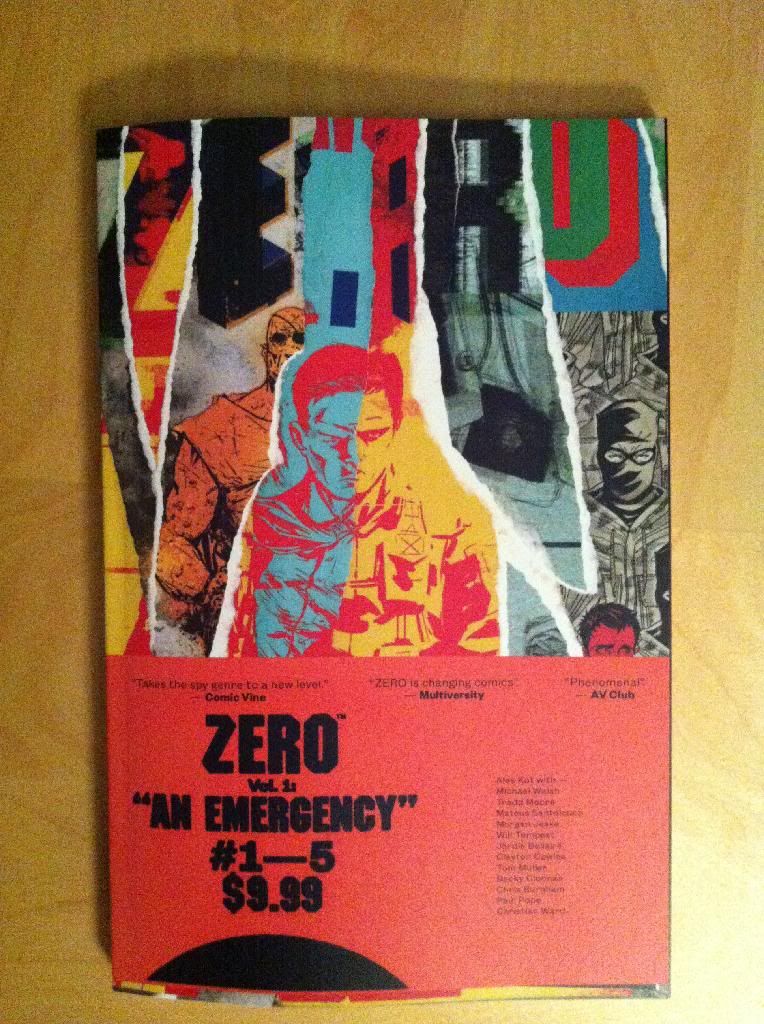
So I Read Zero: An Emergency
A 250 word (or less) review of Zero: Volume 1
by Ales Kot, Michael Walsh, Tradd Moore, Mateus Santolouco, Morgan Jeske, Will Tempest, and Jordie Bellaire; Image Comics
We've been taught by our dumb culture that spies and special operations soldiers are people with glamorous, cool jobs. But the reality isn't White Knights in Armani or swashbuckling, parkour enthusiast assassins. No, the reality is that people trained and conditioned to spy and steal and murder for governments or institutions are fucking scary and their professions are fucking grim business. Zero: An Emergency is a comic that for me captures the sheer brutality and transgression of covert operations in a really interesting and arresting way. In the comic, Edward Zero, an aging, retired special operative, conditioned from childhood to ruthlessly carry out the orders of The Agency, recounts the story of his life to the young agent-in-training sent to murder him as a test. The anecdotes Zero recounts are tales of assassinations and murder and deception filled with horrific violence, startlingly beautiful moments, and a parade of surprising Holy Fuck events. Zero is a comic that just grabs you and slams you into some unexpected places as it hints at a larger overarching mystery. Zero is also a perfect example of why I love reading less mainstream comics: I've found a great writer, learned about some talented artists, and read a stories that I genuinely couldn't predict the endings of. An Emergency is more than anything, a breath of fresh, terrifying air.
Word count: 223
by Ales Kot, Michael Walsh, Tradd Moore, Mateus Santolouco, Morgan Jeske, Will Tempest, and Jordie Bellaire; Image Comics
We've been taught by our dumb culture that spies and special operations soldiers are people with glamorous, cool jobs. But the reality isn't White Knights in Armani or swashbuckling, parkour enthusiast assassins. No, the reality is that people trained and conditioned to spy and steal and murder for governments or institutions are fucking scary and their professions are fucking grim business. Zero: An Emergency is a comic that for me captures the sheer brutality and transgression of covert operations in a really interesting and arresting way. In the comic, Edward Zero, an aging, retired special operative, conditioned from childhood to ruthlessly carry out the orders of The Agency, recounts the story of his life to the young agent-in-training sent to murder him as a test. The anecdotes Zero recounts are tales of assassinations and murder and deception filled with horrific violence, startlingly beautiful moments, and a parade of surprising Holy Fuck events. Zero is a comic that just grabs you and slams you into some unexpected places as it hints at a larger overarching mystery. Zero is also a perfect example of why I love reading less mainstream comics: I've found a great writer, learned about some talented artists, and read a stories that I genuinely couldn't predict the endings of. An Emergency is more than anything, a breath of fresh, terrifying air.
Word count: 223
Subscribe to:
Posts (Atom)