Or a radial plot map of The Wicked + The Divine Vol. 1
by Kieron Gillen, Jamie McKelvie, Matt Wilson, and Clayton Cowles; Image Comics
The Wicked + The Divine is one of my favourite comics right now. It is a comic that does everything well and is a showcase for the many ways you can encode information into sequential art. It's also a comic with a pretty great design aesthetic and a chapter intro/recap page that has a really great character/plot diagram. One that I thought would lend itself to a unique plot diagram of the entire first volume.
Or put another way, it's infographic time!
Since it's a plot map there will be *SPOILERS* for WicDiv Vol. 1 below.
Click on the image below to see a bigger version. Or here for the full size.
Post by Michael Bround
Previously:
So I Read WicDiv: Vol. 1
WicDiv #1 and popart head-splosions
WicDiv #2 and the use of black-space
WicDiv #3 and character design
WicDiv #4 and body language
WicDiv#5 and facial acting
WicDiv #6 and possessions as character
WicDiv #7 and the power of lettering
WicDiv #8 and the disorienting layout
WicDiv #9 and the economics of detail
Showing posts with label Infographic. Show all posts
Friday, 15 May 2015
Monday, 27 April 2015
Deep Sequencing: Zero Atlas
Or a geographic plot map of Zero Vol. 1-2
by Ales Kot, Michael Walsh, Tradd Moore, Mateus Santolouco, Morgan Jeske, Will Tempest, Vanesa R Del Rey, Matt Taylor, Jorge Coelho, Tonci Zonjic, Michael Gaydos, Jordie Bellaire, and Clayton Cowles; Image Comics
One of my favourite comic things is when a comic rigorously annotates time, date, and location. I think it adds a level of reality to the narrative that makes the comic feel much more authentic. It also means I can take the times, dates, and locations and make annotated plot maps! Zero is a globe trotting Sci-fi espionage comic that lends itself to making a plot-atlas.
I guess there are kind of *SPOILERS* in it.
This version includes events in Zero Vol. 1 and 2. Click on the image for a larger version of the Zero plot-atlas.
Previously:
So I Read Zero: Vol. 1
So I Read Zero: Vol. 2
Deep Sequencing: Brutal Action
Deep Sequencing: Gun fight!
by Ales Kot, Michael Walsh, Tradd Moore, Mateus Santolouco, Morgan Jeske, Will Tempest, Vanesa R Del Rey, Matt Taylor, Jorge Coelho, Tonci Zonjic, Michael Gaydos, Jordie Bellaire, and Clayton Cowles; Image Comics
One of my favourite comic things is when a comic rigorously annotates time, date, and location. I think it adds a level of reality to the narrative that makes the comic feel much more authentic. It also means I can take the times, dates, and locations and make annotated plot maps! Zero is a globe trotting Sci-fi espionage comic that lends itself to making a plot-atlas.
I guess there are kind of *SPOILERS* in it.
This version includes events in Zero Vol. 1 and 2. Click on the image for a larger version of the Zero plot-atlas.
Previously:
So I Read Zero: Vol. 1
So I Read Zero: Vol. 2
Deep Sequencing: Brutal Action
Deep Sequencing: Gun fight!
Friday, 26 December 2014
Deep Sequencing: An Atomic Robo Timeline pt. 5
Or a graphical timeline of the first 7 collected volumes of Atomic Robo
by Brian Clevinger and Scott Wegener, Red 5 Comics
Atomic Robo is the fantastic, funny comic about, well, Atomic Robo, the adventuring Action Scientist invented by Nicola Tesla. It's an infectiously fun to read comic that is also constructed in really smart, really unorthodox ways. One of these interesting creative decisions is how Atomic Robo uses time.
A lot of comics, particularly the more superhero-y comics have a weird relationship with time. For the most part time in these comics time is squishy, where publication order does not equate to narrative order and Batman is perpetually the same age despite having stories clearly set in multiple decades. In these comics time is less about an exact measure of time than a... kind of inconvenient medium that events pass through.
Atomic Robo, which is a comic about an ageless robot going on Science Fantasy adventures, has really rigorously annotated time settings. Nearly every story not only has the year it is set in, but even the month and day. As a result, the Atomic Robo comic works like a kind of time capsule of human history during the century (and counting) of Robo's life. It makes for neat settings for stories and a fun look at cultural differences through time.
But beyond being a nifty setting device, this thorough chronicling of time demands a 100 year long giant graphical timeline. So, I've made one, and will update it whenever I finish another Atomic Robo comic.
This is Version 2.2 of my Atomic Robo Timeline. The added entries are for the year 1951.
There will be mild *SPOILERS* in the timeline. Also, there is an up-to-date text based timeline on the Atomic Robo website. So this might be kind of redundant.
Timeline legend:
Vol. 1: Atomic Robo and The Fightin' Scientists of Tesladyne
Vol. 2: Atomic Robo and The Dogs of War
Vol. 3: Atomic Robo and The Shadow From Beyond Time
Vol. 4: Atomic Robo and Other Strangeness
Vol. 5: Atomic Robo and The Deadly Art of Science
Vol. 6: Atomic Robo and The Ghost of Station X
A lot of comics, particularly the more superhero-y comics have a weird relationship with time. For the most part time in these comics time is squishy, where publication order does not equate to narrative order and Batman is perpetually the same age despite having stories clearly set in multiple decades. In these comics time is less about an exact measure of time than a... kind of inconvenient medium that events pass through.
Atomic Robo, which is a comic about an ageless robot going on Science Fantasy adventures, has really rigorously annotated time settings. Nearly every story not only has the year it is set in, but even the month and day. As a result, the Atomic Robo comic works like a kind of time capsule of human history during the century (and counting) of Robo's life. It makes for neat settings for stories and a fun look at cultural differences through time.
But beyond being a nifty setting device, this thorough chronicling of time demands a 100 year long giant graphical timeline. So, I've made one, and will update it whenever I finish another Atomic Robo comic.
This is Version 2.2 of my Atomic Robo Timeline. The added entries are for the year 1951.
There will be mild *SPOILERS* in the timeline. Also, there is an up-to-date text based timeline on the Atomic Robo website. So this might be kind of redundant.
Timeline legend:
Vol. 1: Atomic Robo and The Fightin' Scientists of Tesladyne
Vol. 2: Atomic Robo and The Dogs of War
Vol. 3: Atomic Robo and The Shadow From Beyond Time
Vol. 4: Atomic Robo and Other Strangeness
Vol. 5: Atomic Robo and The Deadly Art of Science
Vol. 6: Atomic Robo and The Ghost of Station X
Vol. 7: Atomic Robo: The Flying She-Devils of the Pacific
Friday, 26 September 2014
Deep Sequencing: Food Freaks V. 2
Or an on-going tabulation of the various food powers in Chew
by John Layman and Rob Guillory, Image Comics
Part of the fun of Chew is how regosh-darn bizarre a comic it is. The premise of people with strange food powers living in a society with a strictly enforced poultry ban is just delightfully strange and wonderful. The thing is though, Chew, as crazy as it is, is builds in this systemic way where each weird idea builds on the last so the entire nuthouse is has this wonderful internally consistency. It's totally crazy, but it works. It's pretty cool and a sign that we should be wary of John Layman and Rob Guillory ever running for government office.
Anyway, in celebration of the weird world of Chew and it's intensely well constructed madness... and because I like to make info-graphics, here is my updated chart of all of the wacky food powers in Chew. Specifically in the Chew collections volumes 1-8.
There will be *SPOILERS* for Chew Vol. 1-8, so proceed with all due caution.
(The new stuff is at the bottom.)
by John Layman and Rob Guillory, Image Comics
Part of the fun of Chew is how regosh-darn bizarre a comic it is. The premise of people with strange food powers living in a society with a strictly enforced poultry ban is just delightfully strange and wonderful. The thing is though, Chew, as crazy as it is, is builds in this systemic way where each weird idea builds on the last so the entire nuthouse is has this wonderful internally consistency. It's totally crazy, but it works. It's pretty cool and a sign that we should be wary of John Layman and Rob Guillory ever running for government office.
Anyway, in celebration of the weird world of Chew and it's intensely well constructed madness... and because I like to make info-graphics, here is my updated chart of all of the wacky food powers in Chew. Specifically in the Chew collections volumes 1-8.
There will be *SPOILERS* for Chew Vol. 1-8, so proceed with all due caution.
(The new stuff is at the bottom.)
Friday, 19 September 2014
Deep Sequencing: Ubergesehicht
Or a comparative timeline between the true history of WW2 and the fictional WW2 of Uber
by Kieron Gillen, Caanan White, Keith Williams, and Digikore Studios; Avatar Press
Uber is a comic that posits an alternate history where Nazi Germany unleashes a force of superhumans in the final days of WW2. This prevents German defeat and causes the war to drag on in a way that diverges from actual history. The contrast and relationship between Uber's fictional history and the real history of WW2 is one of my favourite aspects of the comic. It's adroitly done and interesting to puzzle over.
Uber is also interesting because it falls into that category of alternate history that has rigorously reported timestamps. Virtually every major event in Uber Vol. 1 has the date of the event reported to the audience which is a choice I really, really like. I like it because it gives Uber an authority and a granular, material aspect that makes the comic feel more solid and realistic somehow. For me it changes the language of the comic from "World War 2 superhero adventure" to "thoughtful exploration of a given premise". Less Science Fantasy and more Sci-fi. I also like this choice because it means you can make a nifty timeline comparing the events of Uber to actual history on a day-by-day basis!
(And I love making timelines!)
This is a timeline piece, so it, basically by definition, has a ton of *SPOILERS*.
A few quick methodology points. On the Uber side I focused on the kind of major events that would be recorded in history books, there are events that are tied to dates in the comic that do not appear on the Uber timeline. A couple Uber points are approximate, since the relationship between the date stamp and the point in the timeline is a little nebulous. I did my best, but you know, it's still a bit imperfect. On the History timeline I used Wikipedia's date entry articles (Wiki "May 2") and if that failed I got info from "Today in History" from historyorb.com. So you know, armchair research as opposed to carefully sourced stuff. Take this as infotainment. I tried to make History timeline entries for every day with an entry on the Uber timeline and also included what I considered salient events on days not appearing in Uber that fall within the time covered in the comic (like VE-Day on May 8th 1945). Also, presumably some of the details on the History side of the timeline also appear on the Uber side (like the death of Roosevelt), but I only included events depicted in the comic. You'll have to use your judgement a bit. I feel like this is an overall reasonable approach to compare and contrast the divergent timelines of Uber and History.
Apologies in advance for any mistakes!
Previously:
So I Read Uber
by Kieron Gillen, Caanan White, Keith Williams, and Digikore Studios; Avatar Press
Uber is a comic that posits an alternate history where Nazi Germany unleashes a force of superhumans in the final days of WW2. This prevents German defeat and causes the war to drag on in a way that diverges from actual history. The contrast and relationship between Uber's fictional history and the real history of WW2 is one of my favourite aspects of the comic. It's adroitly done and interesting to puzzle over.
Uber is also interesting because it falls into that category of alternate history that has rigorously reported timestamps. Virtually every major event in Uber Vol. 1 has the date of the event reported to the audience which is a choice I really, really like. I like it because it gives Uber an authority and a granular, material aspect that makes the comic feel more solid and realistic somehow. For me it changes the language of the comic from "World War 2 superhero adventure" to "thoughtful exploration of a given premise". Less Science Fantasy and more Sci-fi. I also like this choice because it means you can make a nifty timeline comparing the events of Uber to actual history on a day-by-day basis!
(And I love making timelines!)
This is a timeline piece, so it, basically by definition, has a ton of *SPOILERS*.
A few quick methodology points. On the Uber side I focused on the kind of major events that would be recorded in history books, there are events that are tied to dates in the comic that do not appear on the Uber timeline. A couple Uber points are approximate, since the relationship between the date stamp and the point in the timeline is a little nebulous. I did my best, but you know, it's still a bit imperfect. On the History timeline I used Wikipedia's date entry articles (Wiki "May 2") and if that failed I got info from "Today in History" from historyorb.com. So you know, armchair research as opposed to carefully sourced stuff. Take this as infotainment. I tried to make History timeline entries for every day with an entry on the Uber timeline and also included what I considered salient events on days not appearing in Uber that fall within the time covered in the comic (like VE-Day on May 8th 1945). Also, presumably some of the details on the History side of the timeline also appear on the Uber side (like the death of Roosevelt), but I only included events depicted in the comic. You'll have to use your judgement a bit. I feel like this is an overall reasonable approach to compare and contrast the divergent timelines of Uber and History.
Apologies in advance for any mistakes!
Previously:
So I Read Uber
Monday, 14 July 2014
Deep Sequencing: Atomic Robo Timeline pt. 4
Or a graphical timeline of the first 6 collected volumes of Atomic Robo
by Brian Clevinger and Scott Wegener, Red 5 Comics
Atomic Robo is the fantastic, funny comic about, well, Atomic Robo, the adventuring Action Scientist invented by Nicola Tesla. It's an infectiously fun to read comic that is also constructed in really smart, really unorthodox ways. One of these interesting creative decisions is how Atomic Robo uses time.
A lot of comics, particularly the more superhero-y comics have a weird relationship with time. For the most part time in these comics time is squishy, where publication order does not equate to narrative order and Batman is perpetually the same age despite having stories clearly set in multiple decades. In these comics time is less about an exact measure of time than a... kind of inconvenient medium that events pass through.
Atomic Robo, which is a comic about an ageless robot going on Science Fantasy adventures, has really rigorously annotated time settings. Nearly every story not only has the year it is set in, but even the month and day. As a result, the Atomic Robo comic works like a kind of time capsule of human history during the century (and counting) of Robo's life. It makes for neat settings for stories and a fun look at cultural differences through time.
But beyond being a nifty setting device, this thorough chronicling of time demands a 100 year long giant graphical timeline. So, I've made one, and will update it whenever I finish another Atomic Robo comic.
This is Version 2.1 of my Atomic Robo Timeline. The added entries are for the years 1951, 1952, and 2011.
There will be mild *SPOILERS* in the timeline. Also, there is an up-to-date text based timeline on the Atomic Robo website. So this might be kind of redundant.
Timeline legend:
Vol. 1: Atomic Robo and The Fightin' Scientists of Tesladyne
Vol. 2: Atomic Robo and The Dogs of War
Vol. 3: Atomic Robo and The Shadow From Beyond Time
Vol. 4: Atomic Robo and Other Strangeness
Vol. 5: Atomic Robo and The Deadly Art of Science
Vol. 6: Atomic Robo and The Ghost of Station X
by Brian Clevinger and Scott Wegener, Red 5 Comics
A lot of comics, particularly the more superhero-y comics have a weird relationship with time. For the most part time in these comics time is squishy, where publication order does not equate to narrative order and Batman is perpetually the same age despite having stories clearly set in multiple decades. In these comics time is less about an exact measure of time than a... kind of inconvenient medium that events pass through.
Atomic Robo, which is a comic about an ageless robot going on Science Fantasy adventures, has really rigorously annotated time settings. Nearly every story not only has the year it is set in, but even the month and day. As a result, the Atomic Robo comic works like a kind of time capsule of human history during the century (and counting) of Robo's life. It makes for neat settings for stories and a fun look at cultural differences through time.
But beyond being a nifty setting device, this thorough chronicling of time demands a 100 year long giant graphical timeline. So, I've made one, and will update it whenever I finish another Atomic Robo comic.
This is Version 2.1 of my Atomic Robo Timeline. The added entries are for the years 1951, 1952, and 2011.
There will be mild *SPOILERS* in the timeline. Also, there is an up-to-date text based timeline on the Atomic Robo website. So this might be kind of redundant.
Timeline legend:
Vol. 1: Atomic Robo and The Fightin' Scientists of Tesladyne
Vol. 2: Atomic Robo and The Dogs of War
Vol. 3: Atomic Robo and The Shadow From Beyond Time
Vol. 4: Atomic Robo and Other Strangeness
Vol. 5: Atomic Robo and The Deadly Art of Science
Vol. 6: Atomic Robo and The Ghost of Station X
Previously:
Friday, 20 June 2014
Deep Sequencing: Plotting the plotless
Or a plot map of Nextwave: Agents of H.A.T.E.
by Warren Ellis, Stuart Immonen, and Dave McCaig, Marvel Comics
Nextwave: Agents of H.A.T.E. is a revolutionary comic that surgically excises unneeded baggage like plot and characterization and amps up everything left to make the quintessential superhero comic experience. I thought it would be an interesting experiment to try to make plotmaps for Nextwave to try and find what kind of plot remains in a deliberately plotless comic. And this is what I got.
Since this is a plotmap it is basically made out of *SPOILERS*. Be wary.
(Incidentally, if you want a high resolution Nextwave style swears skulls for your comics dialogue .ai or .png file, drop me a line!)
Previously:
Nextwave: Agents of H.A.T.E.
by Warren Ellis, Stuart Immonen, and Dave McCaig, Marvel Comics
Nextwave: Agents of H.A.T.E. is a revolutionary comic that surgically excises unneeded baggage like plot and characterization and amps up everything left to make the quintessential superhero comic experience. I thought it would be an interesting experiment to try to make plotmaps for Nextwave to try and find what kind of plot remains in a deliberately plotless comic. And this is what I got.
Since this is a plotmap it is basically made out of *SPOILERS*. Be wary.
(Incidentally, if you want a high resolution Nextwave style swears skulls for your comics dialogue .ai or .png file, drop me a line!)
Previously:
Nextwave: Agents of H.A.T.E.
Friday, 16 May 2014
Deep Sequencing: An Atomic Robo Timeline pt. 3
Or an update to my graphical timeline of the first 5 Atomic Robo collected editions.
By Brian Clevinger and Scott Wegener; Red 5 Comics
Atomic Robo is the fantastic, funny comic about, well, Atomic Robo, the adventuring Action Scientist invented by Nicola Tesla. It's an infectiously fun to read comic that is also constructed in really smart, really unorthodox ways. One of these interesting creative decisions is how Atomic Robo uses time.
A lot of comics, particularly the more superhero-y comics have a weird relationship with time. For the most part time in these comics time is squishy, where publication order does not equate to narrative order and Batman is perpetually the same age despite having stories clearly set in multiple decades. In these comics time is less about an exact measure of time than a... kind of inconvenient medium that events pass through.
Atomic Robo, which is a comic about an ageless robot going on Science Fantasy adventures, has really rigorously annotated time settings. Nearly every story not only has the year it is set in, but even the month and day. As a result, the Atomic Robo comic works like a kind of time capsule of human history during the century (and counting) of Robo's life. It makes for neat settings for stories and a fun look at cultural differences through time.
But beyond being a nifty setting device, this thorough chronicling of time demands a 100 year long giant graphical timeline. So, I've made one, and will update it whenever I finish another Atomic Robo comic.
This is Version 2.0 of my Atomic Robo Timeline. Basically, I thought my old timeline was kind of ugly and rushed, so I spent some time making one that is a lot easier to read/better looking. (There was also a hilarious mistake in the old version: Professionalsim!) The added entries are for the years 1930, 1931, 2011, 2021.
There will be mild *SPOILERS* in the timeline. Also, there is an up-to-date text based timeline on the Atomic Robo website. So this might be kind of redundant.
Timeline legend:
Vol. 1: Atomic Robo and The Fightin' Scientists of Tesladyne
Vol. 2: Atomic Robo and The Dogs of War
Vol. 3: Atomic Robo and The Shadow From Beyond Time
Vol. 4: Atomic Robo and Other Strangeness
Vol. 5: Atomic Robo and The Deadly Art of Science
By Brian Clevinger and Scott Wegener; Red 5 Comics
Atomic Robo is the fantastic, funny comic about, well, Atomic Robo, the adventuring Action Scientist invented by Nicola Tesla. It's an infectiously fun to read comic that is also constructed in really smart, really unorthodox ways. One of these interesting creative decisions is how Atomic Robo uses time.
A lot of comics, particularly the more superhero-y comics have a weird relationship with time. For the most part time in these comics time is squishy, where publication order does not equate to narrative order and Batman is perpetually the same age despite having stories clearly set in multiple decades. In these comics time is less about an exact measure of time than a... kind of inconvenient medium that events pass through.
Atomic Robo, which is a comic about an ageless robot going on Science Fantasy adventures, has really rigorously annotated time settings. Nearly every story not only has the year it is set in, but even the month and day. As a result, the Atomic Robo comic works like a kind of time capsule of human history during the century (and counting) of Robo's life. It makes for neat settings for stories and a fun look at cultural differences through time.
But beyond being a nifty setting device, this thorough chronicling of time demands a 100 year long giant graphical timeline. So, I've made one, and will update it whenever I finish another Atomic Robo comic.
This is Version 2.0 of my Atomic Robo Timeline. Basically, I thought my old timeline was kind of ugly and rushed, so I spent some time making one that is a lot easier to read/better looking. (There was also a hilarious mistake in the old version: Professionalsim!) The added entries are for the years 1930, 1931, 2011, 2021.
There will be mild *SPOILERS* in the timeline. Also, there is an up-to-date text based timeline on the Atomic Robo website. So this might be kind of redundant.
Timeline legend:
Vol. 1: Atomic Robo and The Fightin' Scientists of Tesladyne
Vol. 2: Atomic Robo and The Dogs of War
Vol. 3: Atomic Robo and The Shadow From Beyond Time
Vol. 4: Atomic Robo and Other Strangeness
Vol. 5: Atomic Robo and The Deadly Art of Science
Previously:
Monday, 17 March 2014
Deep Sequencing: Phono-Infogram Pt.3 Setting
Or an infogram of location in Phonogram: Singles Club
By Kieron Gillen, Jamie McKelvie, and Matt Wilson; Image Comics
Phonogram: The Singles Club is kind of a masterpiece of comics craft. Part of this is that The Singles Club is exceptionally well written, with its dynamite premise, an engaging troupe of characters, and perfectly tuned dialogue. It's also a comic with beautiful artwork: fantastic acting, dynamic use of space, and aggressively thoughtful colouring. But the thing that makes Phonogram: The Singles Club the kind of comic that everyone should be taking a very close look at is the way Team Phonogram embeds the story so completely in setting. Structurally, The Singles club tells seven interlocking stories with common settings that occur simultaneously on the same night, and, this complicated, multifaceted beast fits together PERFECTLY. This narratives thread like a tapestry, the chapters obey the timeline of the story like a Teutonic train schedule, and the physical spaces are complete enough to pass building codes. Phonogram: The Singles Club is just about the most granular, engineered short comics run I've ever read.
Because Phonogram: The Singles Club is so well crafted, you can literally create page-by-page maps of plot, time, and setting of really remarkable detail. And, because I love making infographics, I've done just that.
Phono-Infograms:
1: Plot Map
2: Timeline
3: Setting Map
Setting Map: This is, as accurately as I can figure it out, the location of every page and event in Phonogram: The Singles Club. I tried to be as accurate as possible given the information available in the comic (including Jamie McKelvie's great backup info about the club design which I tried to back-engineer). That said, I took artistic license in a few places (the room behind the bar in the club, for instance), had to make some inferences (like Laura starting in Penny's bathroom, and Penny living in a dorm or room in her parent's house instead of an apartment...), and decided not to draw all of Bristol, so outside is just the area not enclosed in a room. Use your imagination. Areas with free drawn, squiggly lines are kind of my fog-of-war demarcations for areas where I lacked enough information to guess at layout. It's also worth noting that I guessed at overall dimensions of spaces, so that is all kind of eyeball approximate. Despite all of this attention to detail, I strongly suspect I still made some other errors in here. (Like in Lloyd's parent's (I guess) house, the leftmost mainfloor wall is, I think, the barrier wall of the home which I imagine is a rowhouse. Lloyd's room on the second floor, then, shouldn't project past it, but the place it seems to fit easiest (and maybe best given the door opening) violates this...) I am also shit at drawing cars from above. But yeah, overall I think it's pretty okay. Please use the other diagrams for time and plot locations.
(Also, it's pretty cool that I got to use my highschool drafting electives for something after all. Woo.)
This diagram is a plot map so there will be *SPOILERS* in the diagram. Be wary.
I don't really have any after commentary for this one, other than setting is just done FLAWLESSLY in The Singles Club. The fact I could look at the comic and generate reasonable floorplans for spaces in the story is CRAZY (even if I cheated and used the club 3D model pictures in the backup). The way this comic uses is setting is absolutely worth looking at in detail.
(Incidentally, this is my first blog post as married Hoo-mon. Weird...)
Previously:
So I Read Phonogram: Rue Britainia
So I Read Phonogram: The Singles Club
Deep Sequencing: Phono-Infogram: Plot Maps
Deep Sequencing: Phono-Infogram: Timeline
By Kieron Gillen, Jamie McKelvie, and Matt Wilson; Image Comics
Phonogram: The Singles Club is kind of a masterpiece of comics craft. Part of this is that The Singles Club is exceptionally well written, with its dynamite premise, an engaging troupe of characters, and perfectly tuned dialogue. It's also a comic with beautiful artwork: fantastic acting, dynamic use of space, and aggressively thoughtful colouring. But the thing that makes Phonogram: The Singles Club the kind of comic that everyone should be taking a very close look at is the way Team Phonogram embeds the story so completely in setting. Structurally, The Singles club tells seven interlocking stories with common settings that occur simultaneously on the same night, and, this complicated, multifaceted beast fits together PERFECTLY. This narratives thread like a tapestry, the chapters obey the timeline of the story like a Teutonic train schedule, and the physical spaces are complete enough to pass building codes. Phonogram: The Singles Club is just about the most granular, engineered short comics run I've ever read.
Because Phonogram: The Singles Club is so well crafted, you can literally create page-by-page maps of plot, time, and setting of really remarkable detail. And, because I love making infographics, I've done just that.
Phono-Infograms:
1: Plot Map
2: Timeline
3: Setting Map
Setting Map: This is, as accurately as I can figure it out, the location of every page and event in Phonogram: The Singles Club. I tried to be as accurate as possible given the information available in the comic (including Jamie McKelvie's great backup info about the club design which I tried to back-engineer). That said, I took artistic license in a few places (the room behind the bar in the club, for instance), had to make some inferences (like Laura starting in Penny's bathroom, and Penny living in a dorm or room in her parent's house instead of an apartment...), and decided not to draw all of Bristol, so outside is just the area not enclosed in a room. Use your imagination. Areas with free drawn, squiggly lines are kind of my fog-of-war demarcations for areas where I lacked enough information to guess at layout. It's also worth noting that I guessed at overall dimensions of spaces, so that is all kind of eyeball approximate. Despite all of this attention to detail, I strongly suspect I still made some other errors in here. (Like in Lloyd's parent's (I guess) house, the leftmost mainfloor wall is, I think, the barrier wall of the home which I imagine is a rowhouse. Lloyd's room on the second floor, then, shouldn't project past it, but the place it seems to fit easiest (and maybe best given the door opening) violates this...) I am also shit at drawing cars from above. But yeah, overall I think it's pretty okay. Please use the other diagrams for time and plot locations.
(Also, it's pretty cool that I got to use my highschool drafting electives for something after all. Woo.)
This diagram is a plot map so there will be *SPOILERS* in the diagram. Be wary.
I don't really have any after commentary for this one, other than setting is just done FLAWLESSLY in The Singles Club. The fact I could look at the comic and generate reasonable floorplans for spaces in the story is CRAZY (even if I cheated and used the club 3D model pictures in the backup). The way this comic uses is setting is absolutely worth looking at in detail.
(Incidentally, this is my first blog post as married Hoo-mon. Weird...)
Previously:
So I Read Phonogram: Rue Britainia
So I Read Phonogram: The Singles Club
Deep Sequencing: Phono-Infogram: Plot Maps
Deep Sequencing: Phono-Infogram: Timeline
Friday, 14 March 2014
Deep Sequencing: Phono-Infogram Pt.2 Timeline
Or an infogram of time in Phonogram: Singles Club
By Kieron Gillen, Jamie McKelvie, and Matt Wilson; Image Comics
Phonogram: The Singles Club is kind of a masterpiece of comics craft. Part of this is that The Singles Club is exceptionally well written, with its dynamite premise, an engaging troupe of characters, and perfectly tuned dialogue. It's also a comic with beautiful artwork: fantastic acting, dynamic use of space, and aggressively thoughtful colouring. But the thing that makes Phonogram: The Singles Club the kind of comic that everyone should be taking a very close look at is the way Team Phonogram embeds the story so completely in setting. Structurally, The Singles club tells seven interlocking stories with common settings that occur simultaneously on the same night, and, this complicated, multifaceted beast fits together PERFECTLY. This narratives thread like a tapestry, the chapters obey the timeline of the story like a Teutonic train schedule, and the physical spaces are complete enough to pass building codes. Phonogram: The Singles Club is just about the most granular, engineered short comics run I've ever read.
Because Phonogram: The Singles Club is so well crafted, you can literally create page-by-page maps of plot, time, and setting of really remarkable detail. And, because I love making infographics, I've done just that.
Phono-Infograms:
1: Plot Map
2: Timeline
3: Setting Map
Timeline: This is, as accurately as I can figure it out, the timeline of Phonogram complete with the music that is explicitly stated. Bear in the mind that there is NO SCALE to the y-axis, because that would be really hard to do. Also keep in mind that some of these placements are best guess and that I am a terrible fraud. Also, for plot details please refer to last week's plot maps to tie this to goings on.
(Apologies in advance for any mistakes or omissions.)
This diagram is a plot map so there will be *SPOILERS* in the diagram. Be wary.
By Kieron Gillen, Jamie McKelvie, and Matt Wilson; Image Comics
Phonogram: The Singles Club is kind of a masterpiece of comics craft. Part of this is that The Singles Club is exceptionally well written, with its dynamite premise, an engaging troupe of characters, and perfectly tuned dialogue. It's also a comic with beautiful artwork: fantastic acting, dynamic use of space, and aggressively thoughtful colouring. But the thing that makes Phonogram: The Singles Club the kind of comic that everyone should be taking a very close look at is the way Team Phonogram embeds the story so completely in setting. Structurally, The Singles club tells seven interlocking stories with common settings that occur simultaneously on the same night, and, this complicated, multifaceted beast fits together PERFECTLY. This narratives thread like a tapestry, the chapters obey the timeline of the story like a Teutonic train schedule, and the physical spaces are complete enough to pass building codes. Phonogram: The Singles Club is just about the most granular, engineered short comics run I've ever read.
Because Phonogram: The Singles Club is so well crafted, you can literally create page-by-page maps of plot, time, and setting of really remarkable detail. And, because I love making infographics, I've done just that.
Phono-Infograms:
1: Plot Map
2: Timeline
3: Setting Map
Timeline: This is, as accurately as I can figure it out, the timeline of Phonogram complete with the music that is explicitly stated. Bear in the mind that there is NO SCALE to the y-axis, because that would be really hard to do. Also keep in mind that some of these placements are best guess and that I am a terrible fraud. Also, for plot details please refer to last week's plot maps to tie this to goings on.
(Apologies in advance for any mistakes or omissions.)
This diagram is a plot map so there will be *SPOILERS* in the diagram. Be wary.
One of the cool things I got out of doing the timeline is how the DJ intensive fourth chapter functions as the time key to the series. Between the songs and the fact the DJs arrive before and leave after the party this Chapter functions as The Single Club's metronome. Which beyond being structurally cool comics is kind of a formally interesting nod to what real life DJs are doing: controlling song choices controls the shape, rhythm, and timing of the party.
(Incidentally, as someone who just had to hammer together a wedding reception playlist, DJing is now a thing I have so much more respect for... but still not enough money to hire out.)
(Stay tuned for more Singles Club Infographics.)
Friday, 7 March 2014
Deep Sequencing: Phono-Infogram Pt.1
Or an infogram of character interactions in Phonogram: Singles Club
By Kieron Gillen, Jamie McKelvie, and Matt Wilson; Image Comics
I really like Phonogram: The Singles Club. Phonogram's premise of music as literally a kind of magic is brilliant and a wonderful metaphor for appreciating media. The way The Singles Club grows this idea and complicates it by portraying a more diverse group of Phonmancers enhances everything I loved about the first volume and tells a fantastic story. It is literally the first comic that the one coworker I've got kind of reading comics tried, and its a big part of why she's still kind of reading comics. Basically The Singles Club is a fantastic, smart, fun and accessible comic that everyone should read.
The thing is, Phonogram: The Singles Club is also kind of a masterpiece of comics craft. Part of this is that The Singles Club is exceptionally well written, with its dynamite premise, engaging troupe of characters, and perfectly tuned dialogue. It's also a comic with beautiful artwork: fantastic acting, dynamic use of space, and aggressively thoughtful colouring (which in hindsight is worthy of its own analysis, seriously). But the thing that makes Phonogram: The Singles Club the kind of comic that everyone should be taking a very close look at, is the way Team Phonogram embeds the story so completely in setting. Structurally, The Singles club tells seven interlocking stories with common settings that occur simultaneously on the same night, and this complicated, multifaceted beast fits together PERFECTLY. This narratives thread like a tapestry, the chapters obey the timeline of the story like a Teutonic train schedule, and the physical spaces are complete enough to pass building codes. Phonogram: The Singles Club is just about the most granular, engineered short comics run I've ever read.
Because Phonogram: The Singles Club is so well crafted, you can literally create page-by-page maps of plot, time, and setting of really remarkable detail. And, because I love making infographics, I've done just that.
Phono-Infograms:
1: Plot Map
2: Timeline
3: Setting Map
Plot Map: The idea here is to give a loose appreciation of each characters overall plot that accounts for interactions and provides loose information on sequence and location. Bear in mind that the y-axis on this sucker is set to absolutely no kind of scale, although events within given lines occur in the order shown, and that generally speaking events at the top of the diagram precede events shown further down. In many ways this diagram is meant chiefly to show character interactions, provide overall shape to the plot, and to function as a unifying plot key for the other two infograms.
(Apologies in advance for any mistakes or omissions.)
This diagram is a plot map so there will be *SPOILERS* in the diagram. Be wary.
(Stay tuned for more Singles Club Infographics.)
Previously:
So I Read Phonogram: Rue Britainia
So I Read Phonogram: The Singles Club
By Kieron Gillen, Jamie McKelvie, and Matt Wilson; Image Comics
I really like Phonogram: The Singles Club. Phonogram's premise of music as literally a kind of magic is brilliant and a wonderful metaphor for appreciating media. The way The Singles Club grows this idea and complicates it by portraying a more diverse group of Phonmancers enhances everything I loved about the first volume and tells a fantastic story. It is literally the first comic that the one coworker I've got kind of reading comics tried, and its a big part of why she's still kind of reading comics. Basically The Singles Club is a fantastic, smart, fun and accessible comic that everyone should read.
The thing is, Phonogram: The Singles Club is also kind of a masterpiece of comics craft. Part of this is that The Singles Club is exceptionally well written, with its dynamite premise, engaging troupe of characters, and perfectly tuned dialogue. It's also a comic with beautiful artwork: fantastic acting, dynamic use of space, and aggressively thoughtful colouring (which in hindsight is worthy of its own analysis, seriously). But the thing that makes Phonogram: The Singles Club the kind of comic that everyone should be taking a very close look at, is the way Team Phonogram embeds the story so completely in setting. Structurally, The Singles club tells seven interlocking stories with common settings that occur simultaneously on the same night, and this complicated, multifaceted beast fits together PERFECTLY. This narratives thread like a tapestry, the chapters obey the timeline of the story like a Teutonic train schedule, and the physical spaces are complete enough to pass building codes. Phonogram: The Singles Club is just about the most granular, engineered short comics run I've ever read.
Because Phonogram: The Singles Club is so well crafted, you can literally create page-by-page maps of plot, time, and setting of really remarkable detail. And, because I love making infographics, I've done just that.
Phono-Infograms:
1: Plot Map
2: Timeline
3: Setting Map
Plot Map: The idea here is to give a loose appreciation of each characters overall plot that accounts for interactions and provides loose information on sequence and location. Bear in mind that the y-axis on this sucker is set to absolutely no kind of scale, although events within given lines occur in the order shown, and that generally speaking events at the top of the diagram precede events shown further down. In many ways this diagram is meant chiefly to show character interactions, provide overall shape to the plot, and to function as a unifying plot key for the other two infograms.
(Apologies in advance for any mistakes or omissions.)
This diagram is a plot map so there will be *SPOILERS* in the diagram. Be wary.
A couple kind of cool things pop out once you look at the plot this way. For instance, Penny, the protagonist of Chapter 1, also acts as a framing narrative as she, like the popular party person she is, circulates around the club and touches base with most of the key characters and narratives. Seriously, study this comic!
(Stay tuned for more Singles Club Infographics.)
Previously:
So I Read Phonogram: Rue Britainia
So I Read Phonogram: The Singles Club
Friday, 1 November 2013
Eye on Hawkeye #13
Or the interaction between time and plot in Hawkeye #13
by Matt Fraction, David Aja, and Matt Hollingsworth
This entire thing is built on a mountain of *SPOILERS* and the corpses of those who ignore spoiler warnings. READ ON IF YOU DARE (or if you are up to date on your Hawkguy).
Hawkeye is a comic about Clint Barton the Avenger who is just a guy and Kate Bishop the Young Avenger who is better than Clint but still just a lady-guy. It's a comic that takes the grand majesty of superhero comics, strips out the romance and epic scale, and infuses an element of, well, shlubby mundanity. And the result is this kind of granular, intimate story that, despite a distinct lack of Asgardian thunder gods and Sorcerers Supreme, has a kind of magic.
Part of this magic can, I think, paradoxically be attribute to the sheer REALNESS of Hawkeye. Team Hawkguy have really created a world that feels legitimate, a world with well established and defined environments, diverse supporting characters, reasonable injuries and consequences, and a really granular, impeccably paced sense of time. And the result of this is a sense of consistent reality that helps suspend disbelief and make every aspect of Hawkeye better.
Hawkeye #13 is a perfect example of the really great and interesting way Team Hawkguy uses time to integrate the plot of their comic.
Normally in superhero comics time is kind of this spongey medium for punching and lasers: the key detail is what is happening instead of when it is happening. Furthermore, most superhero comic series, even those that do acknowledge that time is a thing, tend to start each subsequent issue after the previous issue. That is to say, the events of issue 1 occur before the events issue 2. (This of course is speaking only to the "present" narrative of the story and excludes flashbacks and time travel.) Generally superhero comics also often follow a pretty linear time scale within individual issues: the book begins and then events occur sequentially until the book ends. (Another common variation is a late event in the story occurs, the book starts over and then loops around.) Part of what makes Hawkeye such a remarkable series is that it trumps these conventions.
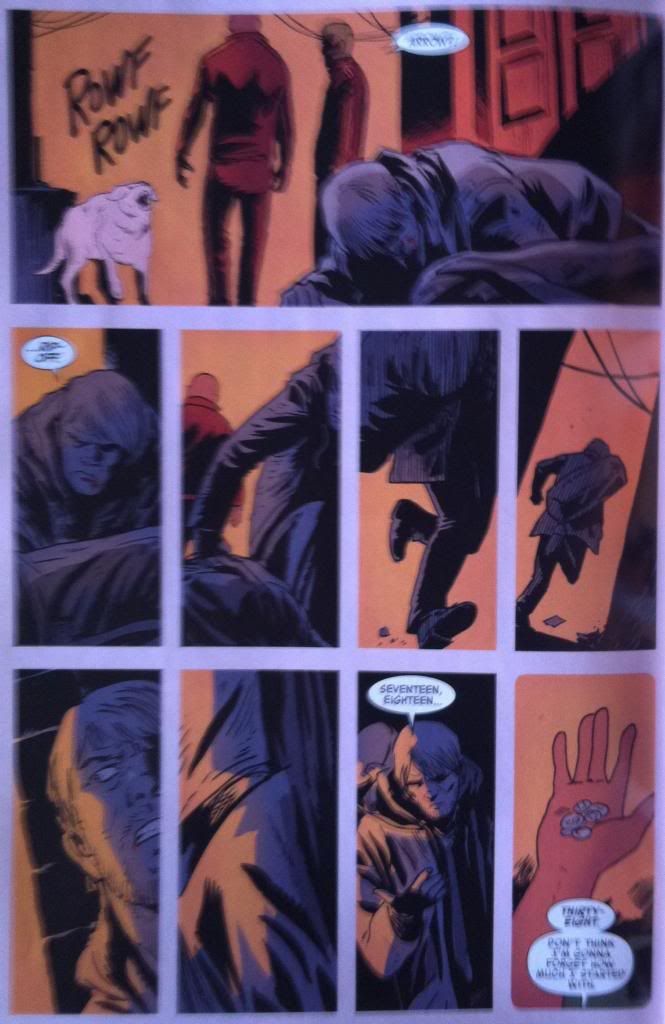
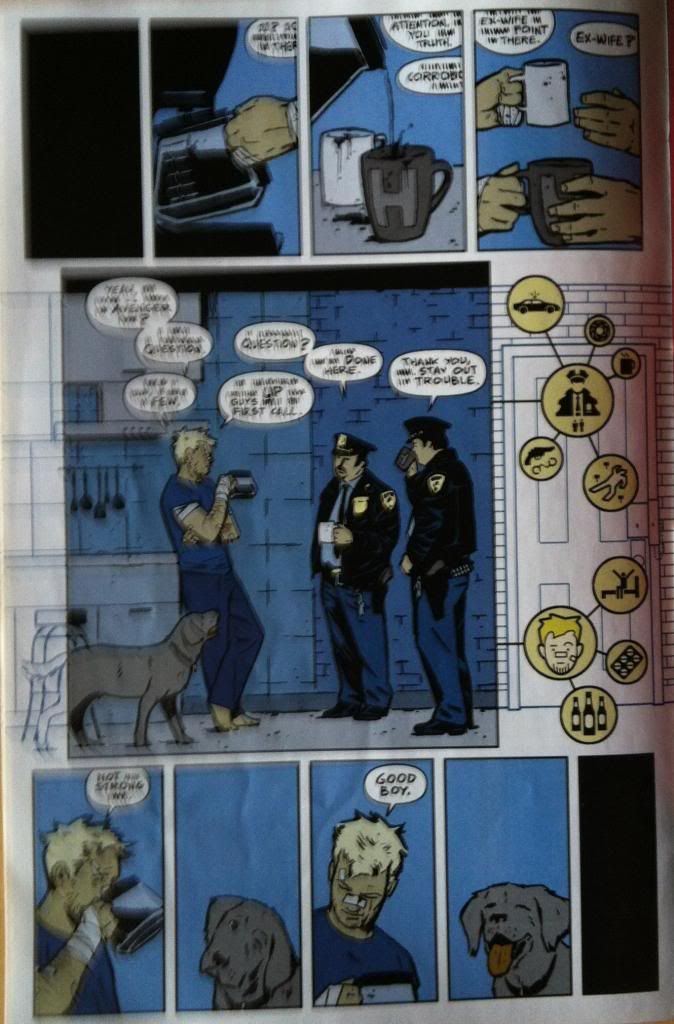
In Hawkeye time is very carefully metered out: events take place at certain times and in specific places. A great example of this is an issue of Hawkeye called "Six Nights in the Life of Hawkeye" (issue #6) set around Christmas that grafts the story onto specific dates and, through the use of a clock, sets events to specific hours of those days. Team Hawkguy also frequently use a non-linear approach to storytelling that takes advantage of the cemented nature of time in Hawkeye to unfold stories in interesting ways. The Christmas Hawkeye also demonstrates this aspect of the book pretty well as events jump from day-to-day and time-to-time in a non-linear order to promote reveals and set up jokes. The one aspect of time in Hawkeye that was mostly conventional for issues #1-8 was that events followed a sequence issue to issue: subsequent chapters of the story picked up where the previous issues had ended.
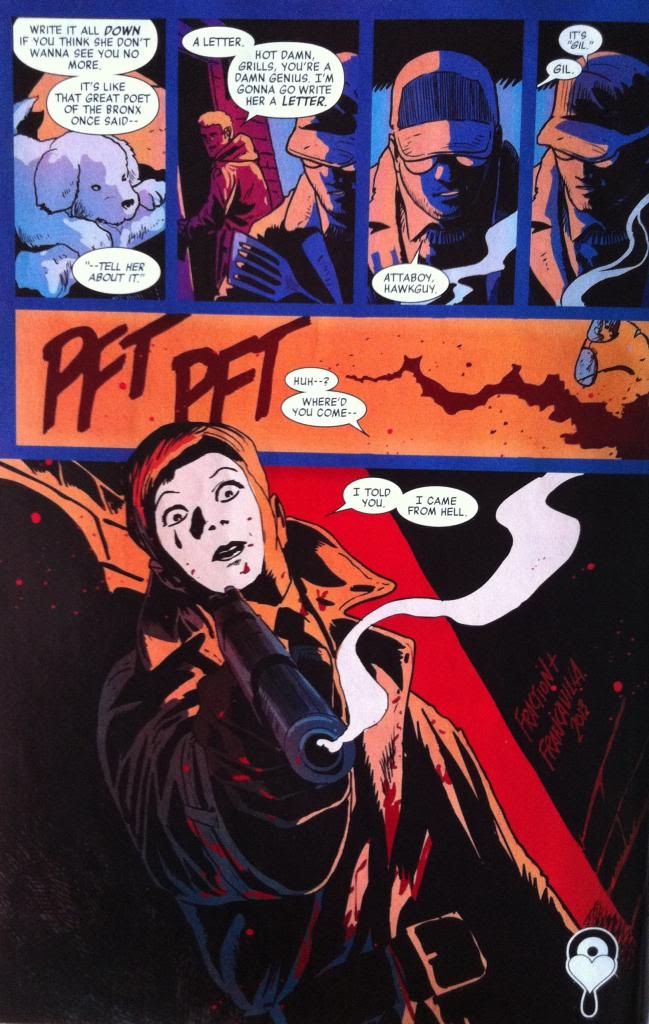
However, this all changed in Hawkeye #9 when WHAT PART OF *SPOILERS* DO YOU NOT UNDERSTAND Grills was murdered. That moment not only dramatically changed the feeling of Hawkeye from a safe space to a place with real, tangible consequences but it also shattered the story structure of the comic into numerous narratives driven by individual characters. One of the remarkable things about this decision is that time in Hawkeye no longer follows a clear issue to issue progression, and that events depicted in Hawkeye #9-13 weave through each other in this interesting way that, if anything, enhances the timed nature of Hawkeye. It's really interesting comics.
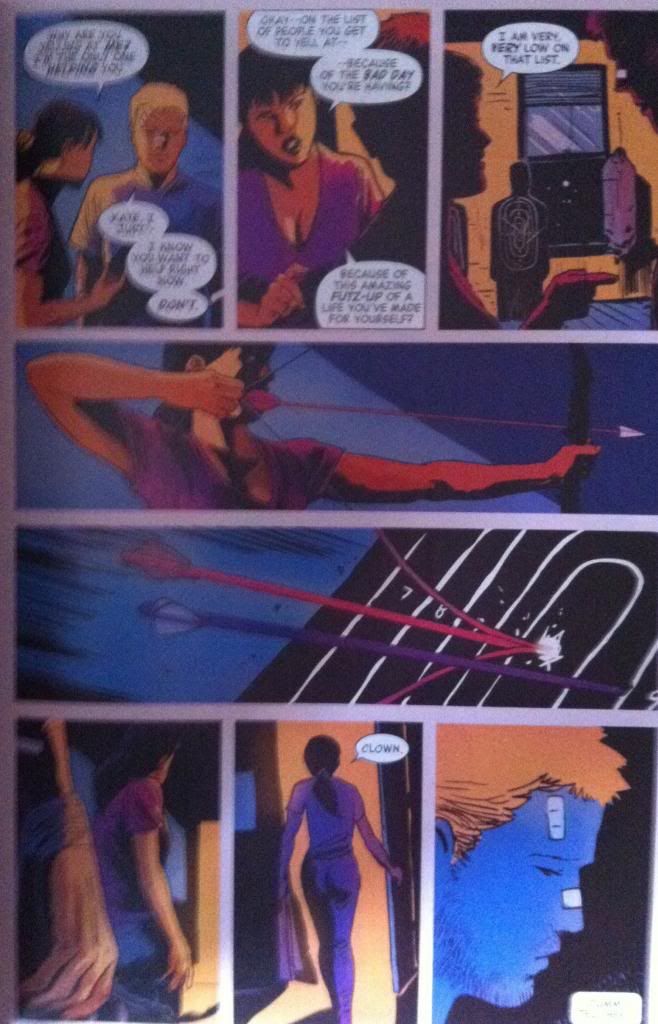
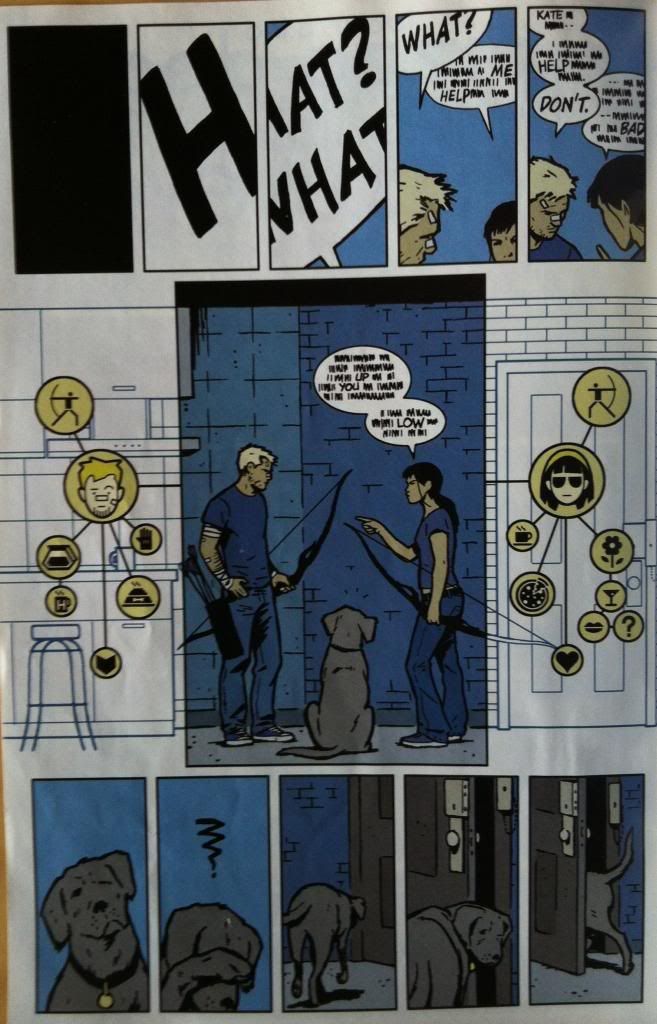
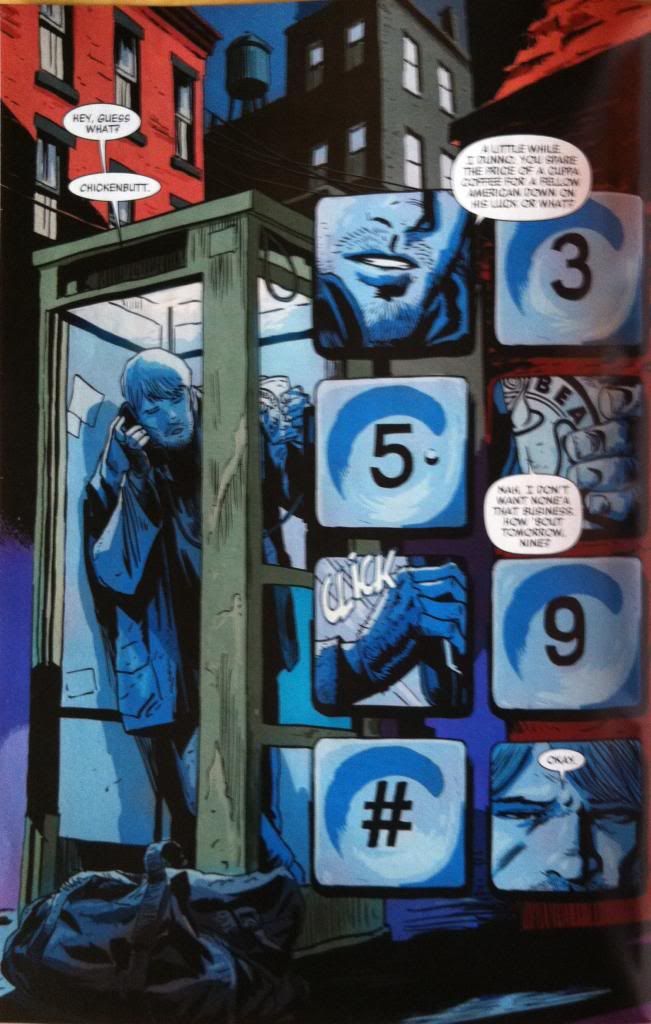
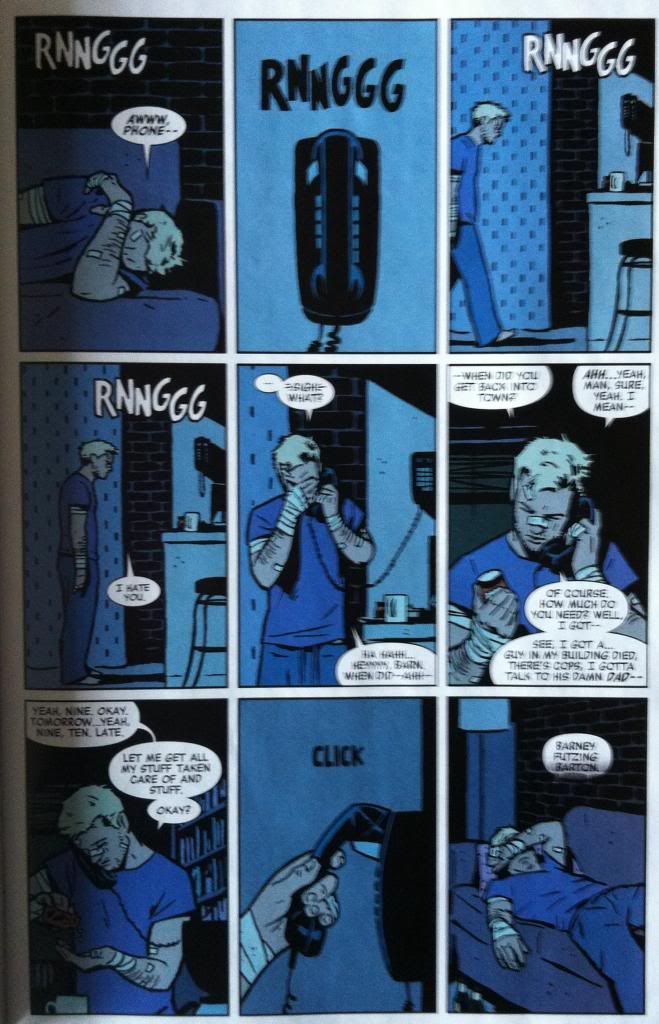
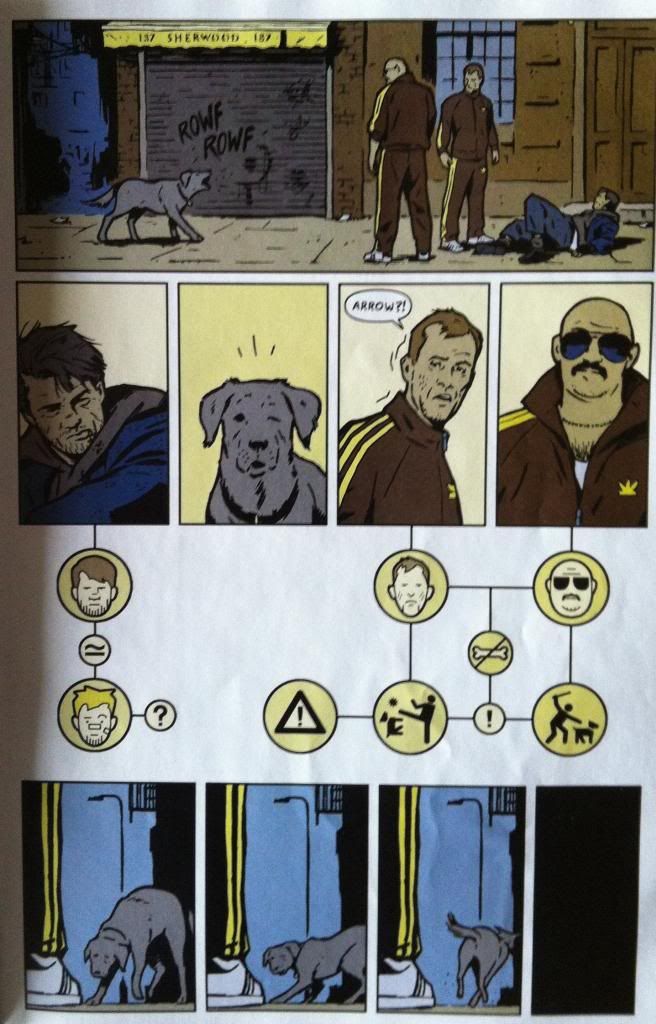
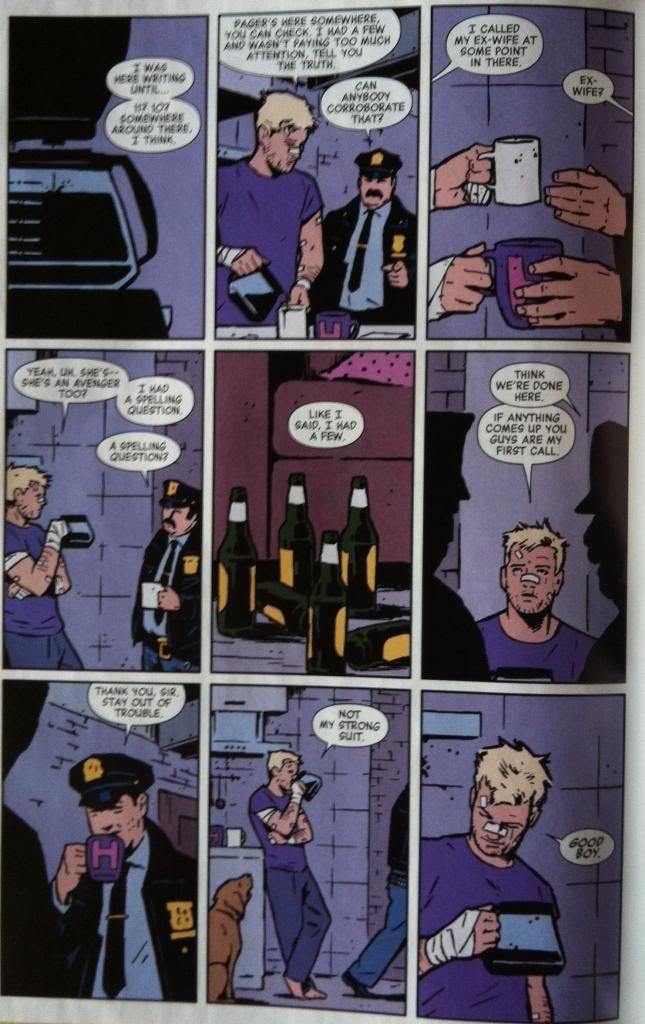
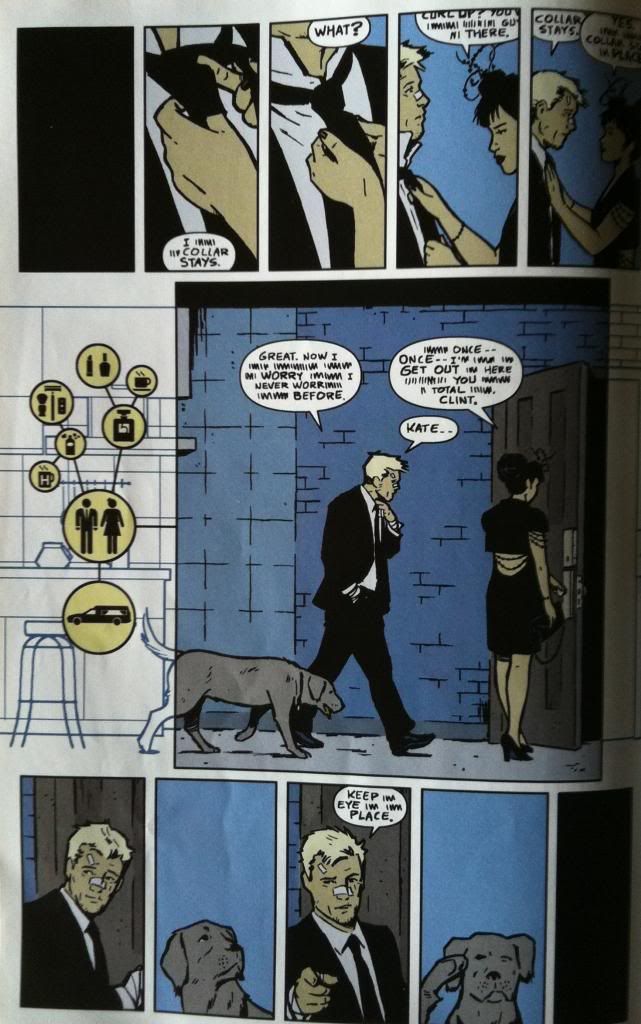
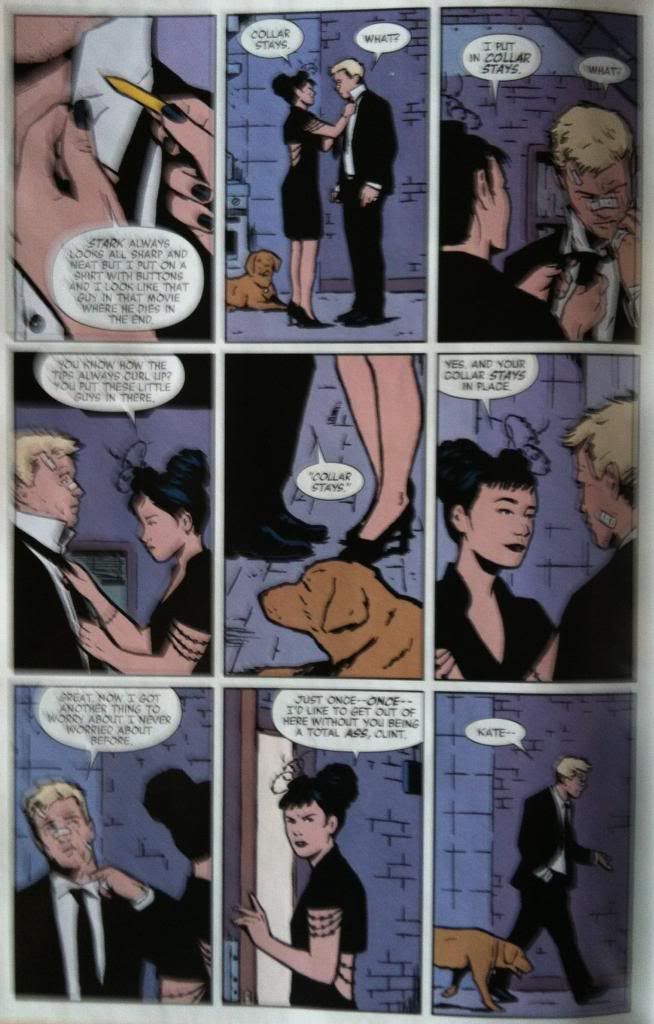
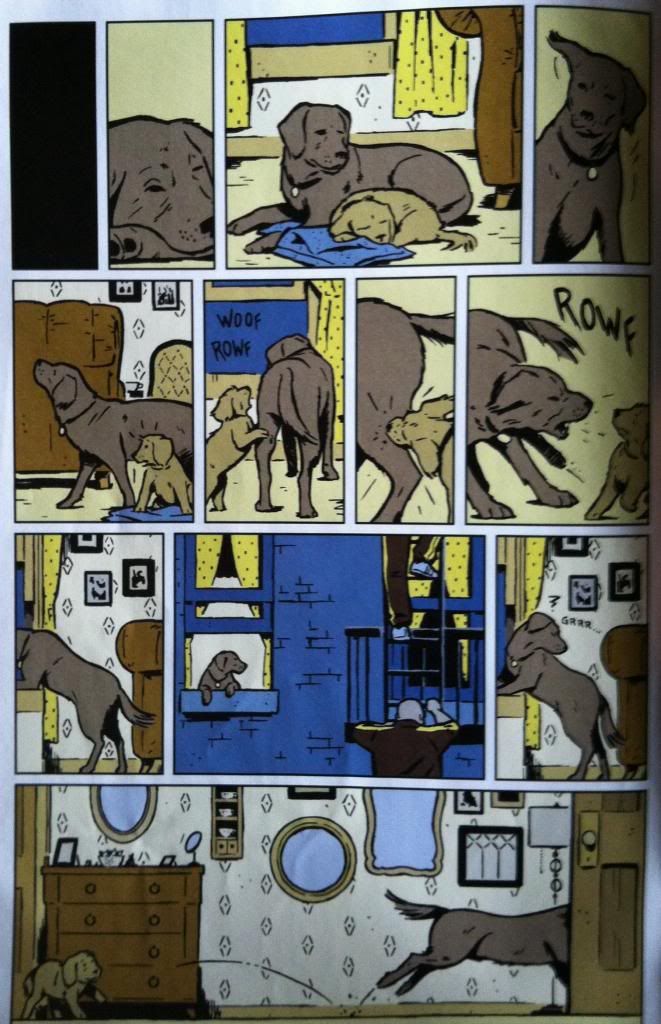
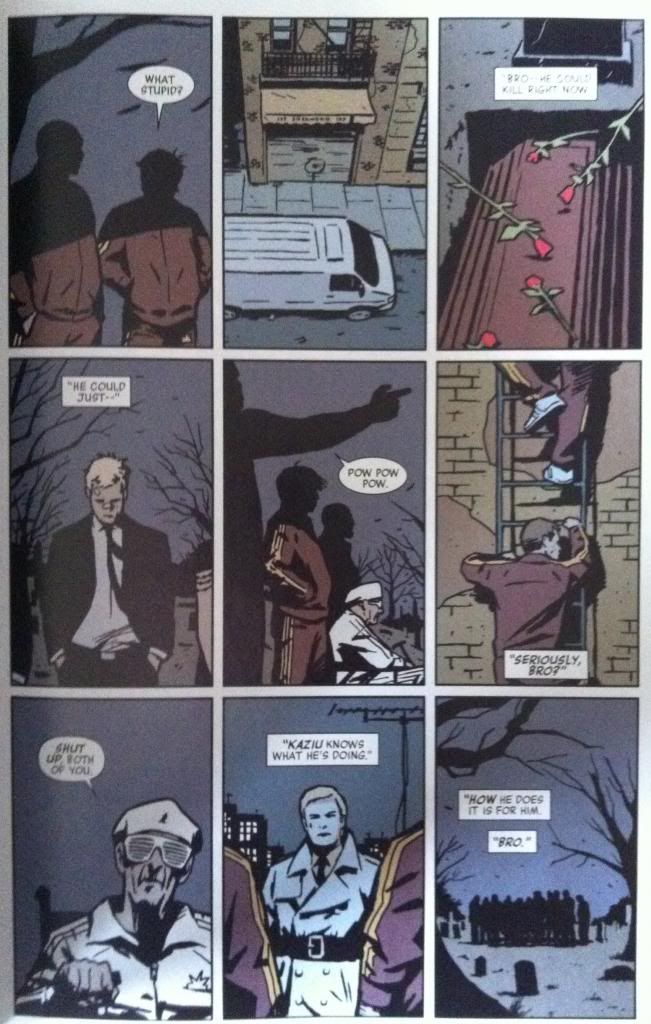
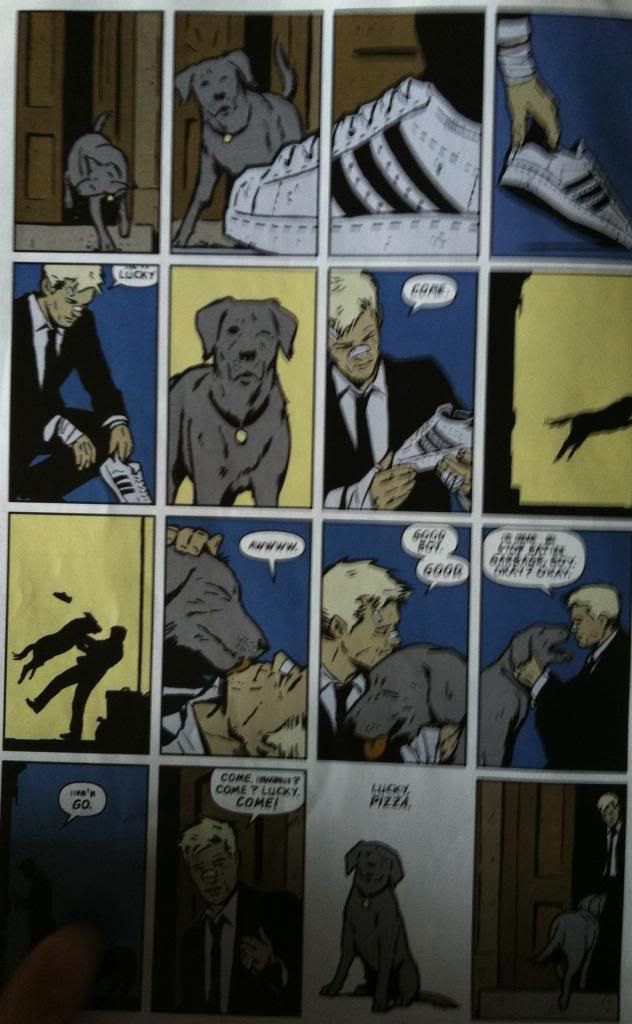
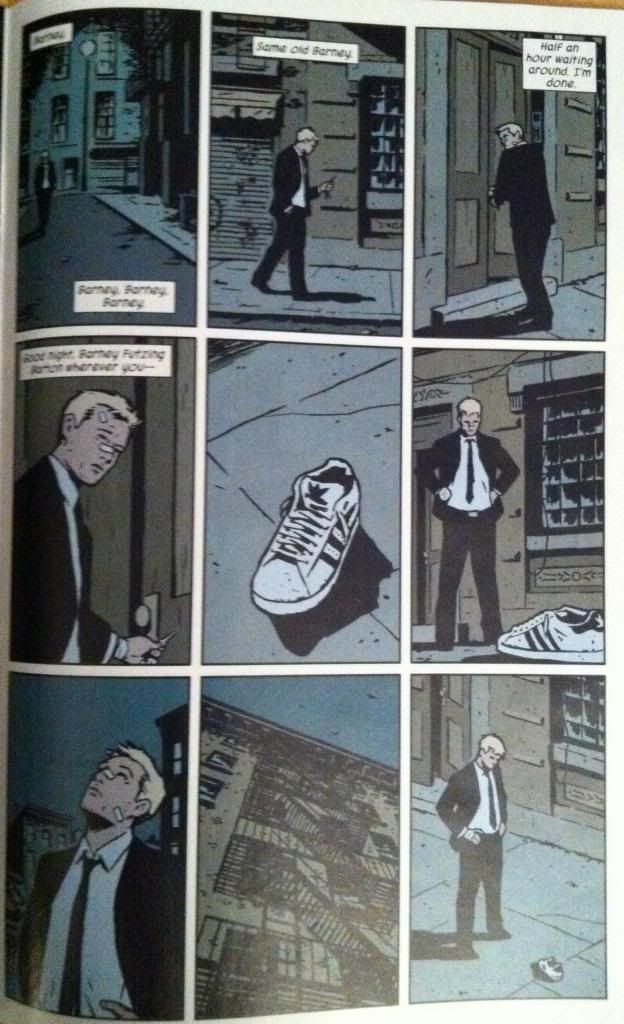
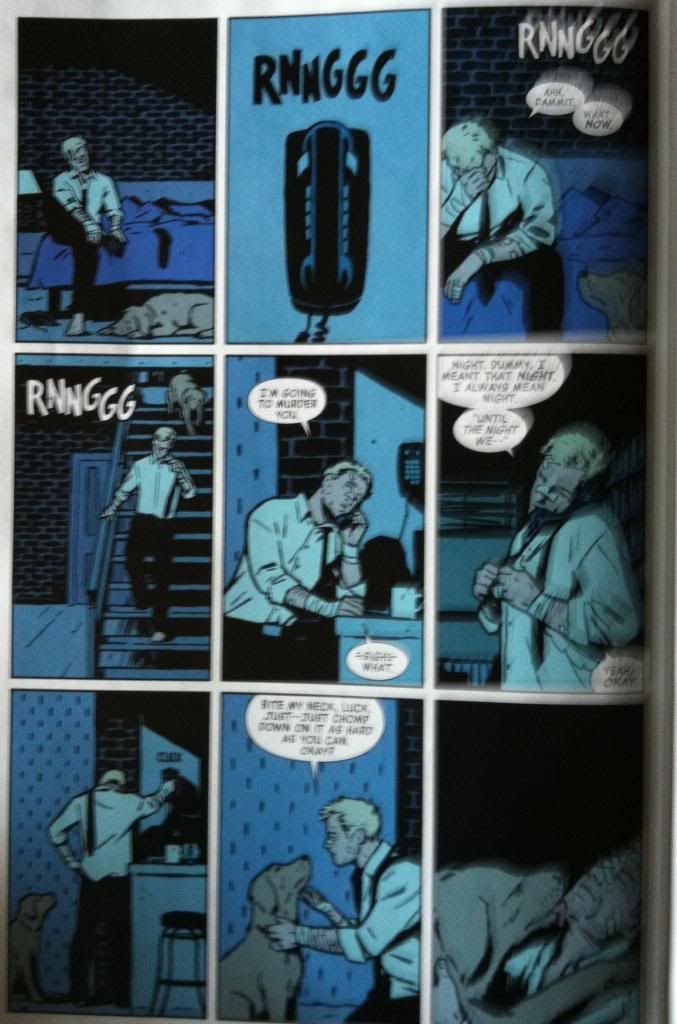
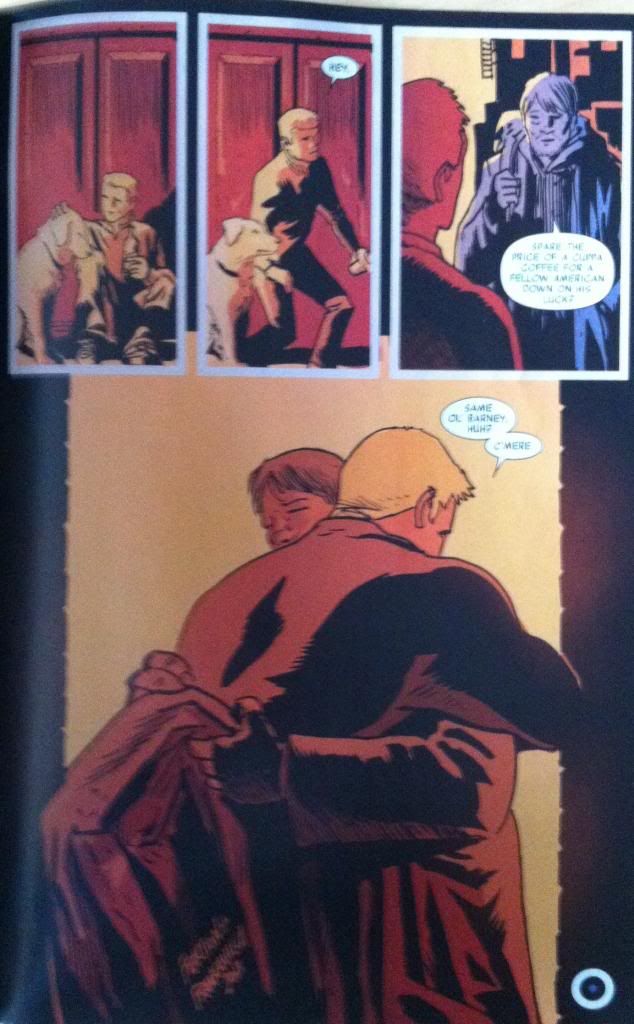
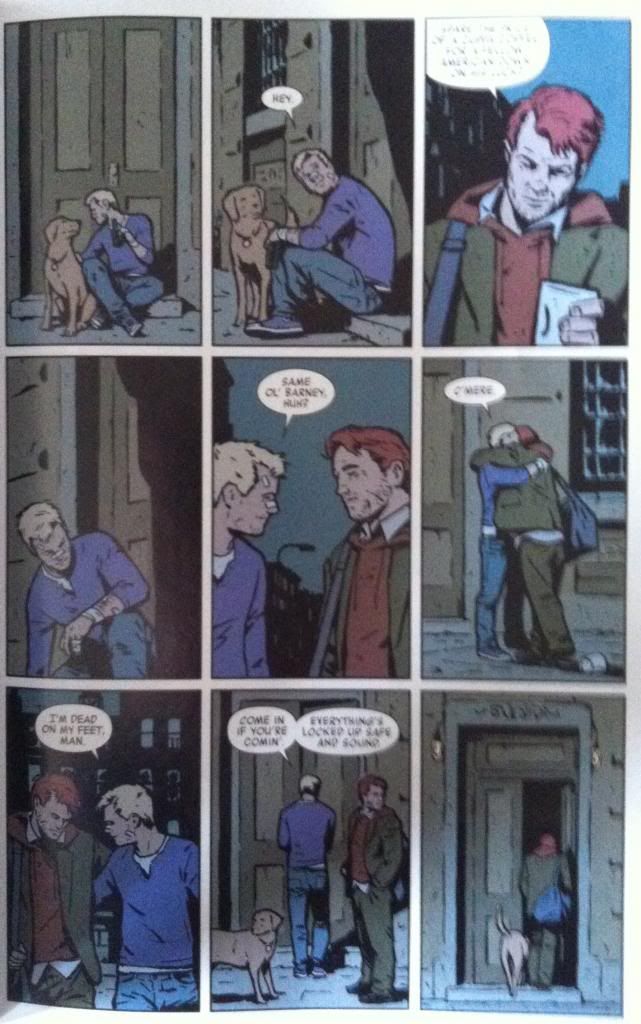
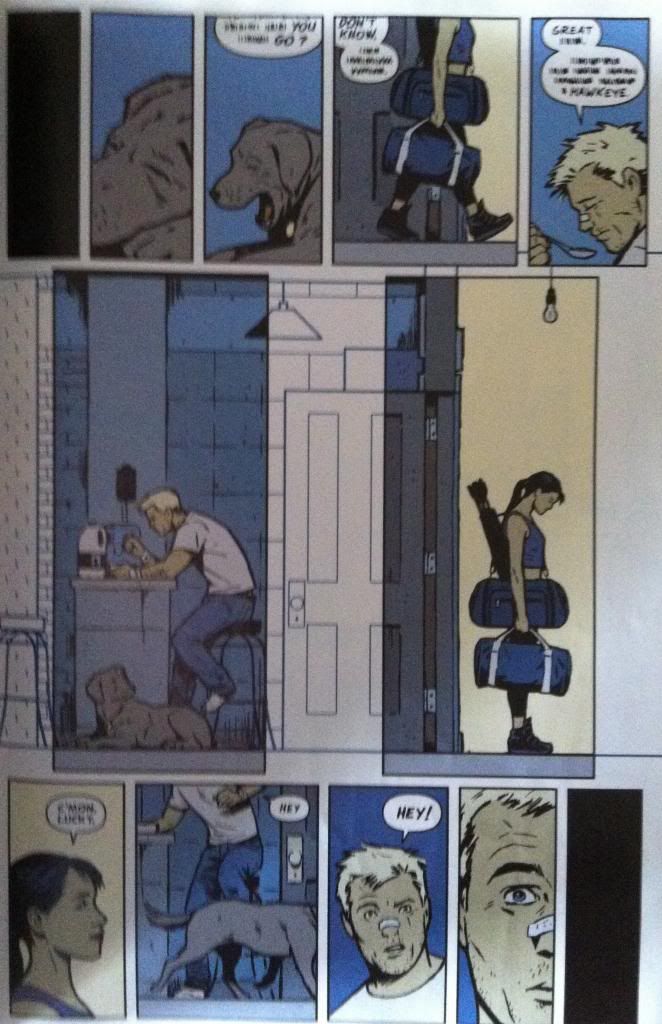
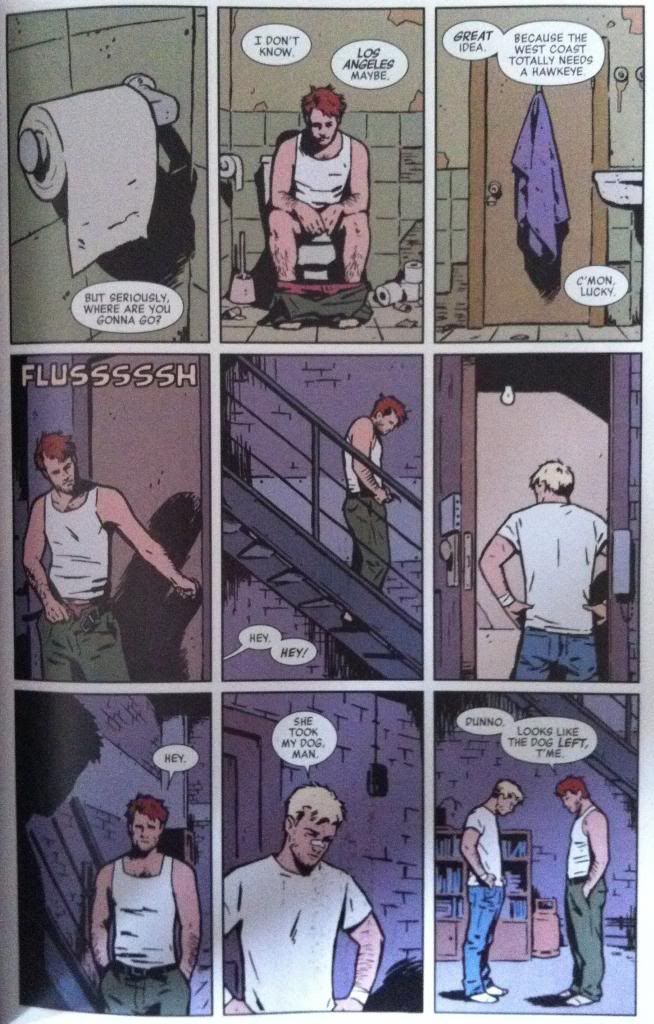
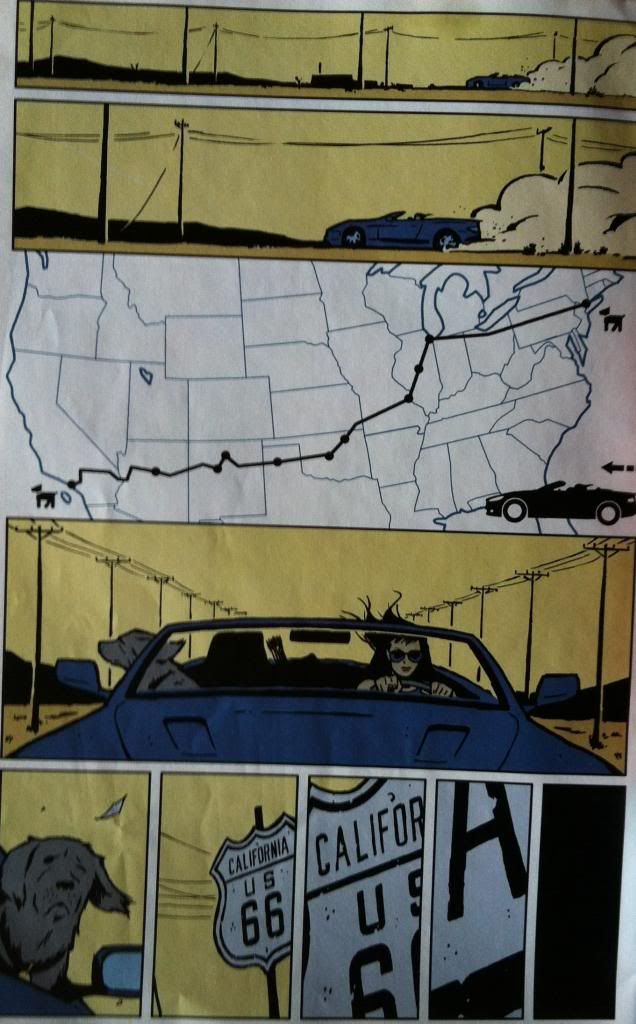
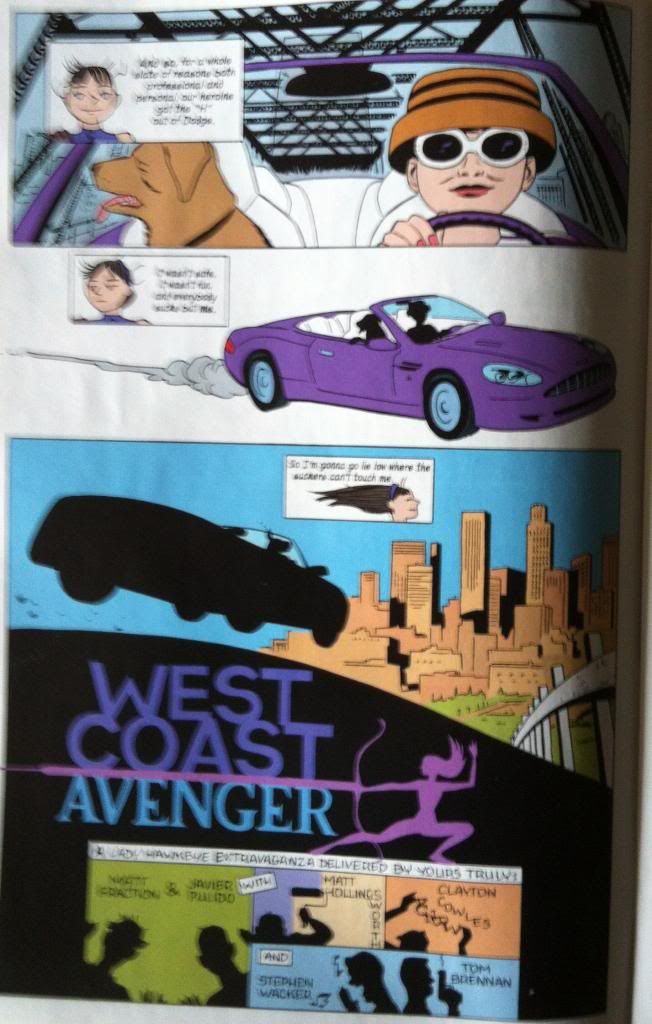
Hawkeye #13 is the most recent issue of the comic and focuses on Clint's perspective of ongoing events. It is also an issue that wends very tightly to events established in previous (in a publication sense) issues of Hawkeye. As such it has a bunch of previously seen scenes that can be used as touchstones to put other issues of Hawkeye into a kind of narrative order. Because I think it's interesting and kind of brilliant I've gone through recent issues of Hawkeye and found all (I think) of the touchstone scenes that can be used to create a Hawkeye timeline:
1. Futzin' Hawkeyes no. 1
2. GAAH SPOILERS SPOILERS SHUT UP!
3. 9 o'clock somewhere part 1.
4. A Lucky encounter on the street
5. Dog Cops
6. Awwww Funeral
7. Pizza Dog and Tracksuit Draculas
by Matt Fraction, David Aja, and Matt Hollingsworth
This entire thing is built on a mountain of *SPOILERS* and the corpses of those who ignore spoiler warnings. READ ON IF YOU DARE (or if you are up to date on your Hawkguy).
Hawkeye is a comic about Clint Barton the Avenger who is just a guy and Kate Bishop the Young Avenger who is better than Clint but still just a lady-guy. It's a comic that takes the grand majesty of superhero comics, strips out the romance and epic scale, and infuses an element of, well, shlubby mundanity. And the result is this kind of granular, intimate story that, despite a distinct lack of Asgardian thunder gods and Sorcerers Supreme, has a kind of magic.
Part of this magic can, I think, paradoxically be attribute to the sheer REALNESS of Hawkeye. Team Hawkguy have really created a world that feels legitimate, a world with well established and defined environments, diverse supporting characters, reasonable injuries and consequences, and a really granular, impeccably paced sense of time. And the result of this is a sense of consistent reality that helps suspend disbelief and make every aspect of Hawkeye better.
Hawkeye #13 is a perfect example of the really great and interesting way Team Hawkguy uses time to integrate the plot of their comic.
Normally in superhero comics time is kind of this spongey medium for punching and lasers: the key detail is what is happening instead of when it is happening. Furthermore, most superhero comic series, even those that do acknowledge that time is a thing, tend to start each subsequent issue after the previous issue. That is to say, the events of issue 1 occur before the events issue 2. (This of course is speaking only to the "present" narrative of the story and excludes flashbacks and time travel.) Generally superhero comics also often follow a pretty linear time scale within individual issues: the book begins and then events occur sequentially until the book ends. (Another common variation is a late event in the story occurs, the book starts over and then loops around.) Part of what makes Hawkeye such a remarkable series is that it trumps these conventions.
In Hawkeye time is very carefully metered out: events take place at certain times and in specific places. A great example of this is an issue of Hawkeye called "Six Nights in the Life of Hawkeye" (issue #6) set around Christmas that grafts the story onto specific dates and, through the use of a clock, sets events to specific hours of those days. Team Hawkguy also frequently use a non-linear approach to storytelling that takes advantage of the cemented nature of time in Hawkeye to unfold stories in interesting ways. The Christmas Hawkeye also demonstrates this aspect of the book pretty well as events jump from day-to-day and time-to-time in a non-linear order to promote reveals and set up jokes. The one aspect of time in Hawkeye that was mostly conventional for issues #1-8 was that events followed a sequence issue to issue: subsequent chapters of the story picked up where the previous issues had ended.
However, this all changed in Hawkeye #9 when WHAT PART OF *SPOILERS* DO YOU NOT UNDERSTAND Grills was murdered. That moment not only dramatically changed the feeling of Hawkeye from a safe space to a place with real, tangible consequences but it also shattered the story structure of the comic into numerous narratives driven by individual characters. One of the remarkable things about this decision is that time in Hawkeye no longer follows a clear issue to issue progression, and that events depicted in Hawkeye #9-13 weave through each other in this interesting way that, if anything, enhances the timed nature of Hawkeye. It's really interesting comics.
Hawkeye #13 is the most recent issue of the comic and focuses on Clint's perspective of ongoing events. It is also an issue that wends very tightly to events established in previous (in a publication sense) issues of Hawkeye. As such it has a bunch of previously seen scenes that can be used as touchstones to put other issues of Hawkeye into a kind of narrative order. Because I think it's interesting and kind of brilliant I've gone through recent issues of Hawkeye and found all (I think) of the touchstone scenes that can be used to create a Hawkeye timeline:
1. Futzin' Hawkeyes no. 1
2. GAAH SPOILERS SPOILERS SHUT UP!
3. 9 o'clock somewhere part 1.
4. A Lucky encounter on the street
5. Dog Cops
6. Awwww Funeral
7. Pizza Dog and Tracksuit Draculas
8. Kick-shot
9. 9 o'clock somewhere part 2
10. Bro! Bro bro bro.
11. Futzin' Hawkeyes no. 2
![]() |
12. Hawk-bye!
So, taking all of these touchstone scenes I have made the following narrative order timeline for recent issues of Hawkeye:
So yeah. There you have it, the complicated, ingenious approach to time in recent issues of Hawkeye. Which, guys, this is a mainstream superhero comic book. It's mind boggling to me that a comic with such a complicated approach to time and storytelling is being published alongside the X-men. The more I try to figure out Hawkeye, the more I'm just kind of grateful that it and Team Hawkguy are things that were allowed to happen.
Previously:
Eye on Hawkeye # Annual Pt. 1: Using silhouettes in arguments
Eye on Hawkeye #12: Setting up the perfect splash page
Subscribe to:
Posts (Atom)