Showing posts with label Keith Brooke. Show all posts

Friday, 8 August 2014

Genetopia Is A Good Book

Or why you should read Genetopia by Keith Brooke


Genetopia is, I think, the first Keith Brooke novel to be released to a North American audience. It's also a novel that took some getting and taught me some lessons about using store fronts of store fronts within amazon. Seriously, woof.

Genetopia is a novel about a future were genetic engineering has run literally wild. In the novel true humanity clings to small settlements surrounded by dangerous, mutant wilds. To survive, True Humans leverage genetically altered humans as slaves. These slaves, called mutts, are treated as subhuman property and compelled to subservience by a genetically bred compulsion. True humans themselves are also in danger of becoming subhuman as any sign of change, birth defect, illness driven mutation, or deliberate exposure to the changing vats, turns the human Lost and throws them into exile or into slavery. It is in this world that Flint, a true human from a wealthy clan, finds his beloved sister Amber missing. Unsure if she has run away or been kidnapped, or even if she is still human, Flint must brave the wilds and travel the world to save her.

Genetopia is obviously an allegory about slavery . It uses genetic manipulation as a device to explore the way that people use labels and tribalism to dehumanize and posses other humans. Genetopia then explores just how awful humans behave when they do not consider a person human and just how fragile humanity and freedom are in such a system. It's an interesting approach.

The thing is, I'm a bit conflicted about Genetopia. I found the narrative engaging and pleasantly fast paced: Genetopia is a well written book. As a professional life scientist who feels that Sci-fi over focuses on robots and computers when we are so close to fully unlocking the fantastic potential of biology, I really appreciated the biotech world the novel creates. But, at the same time, I felt that the novel, maybe out of its brevity, was maybe not as nuanced or careful in its discussion or potrayal of slavery as I would have liked. I don't think Genetopia was necessarily bad in this regard, but slavery is a pretty heavy topic, and I feel like Genetopia could have done better negotiating it. Genetopia is good, but not perfect.

Also, I kind of hate the cover and title of this book. The title is too simplistic for the subject and doesn't catch the dystopian heart of the novel, while the cover I found aesthetically childish and, frankly, a little spoilery. If not for already being impressed with the author, this is a book I would never have picked off a bookshelf. If you accept the premise that the point of a cover and title is to convince a reader to pick up a book, then I think Genetopia failed a bit.

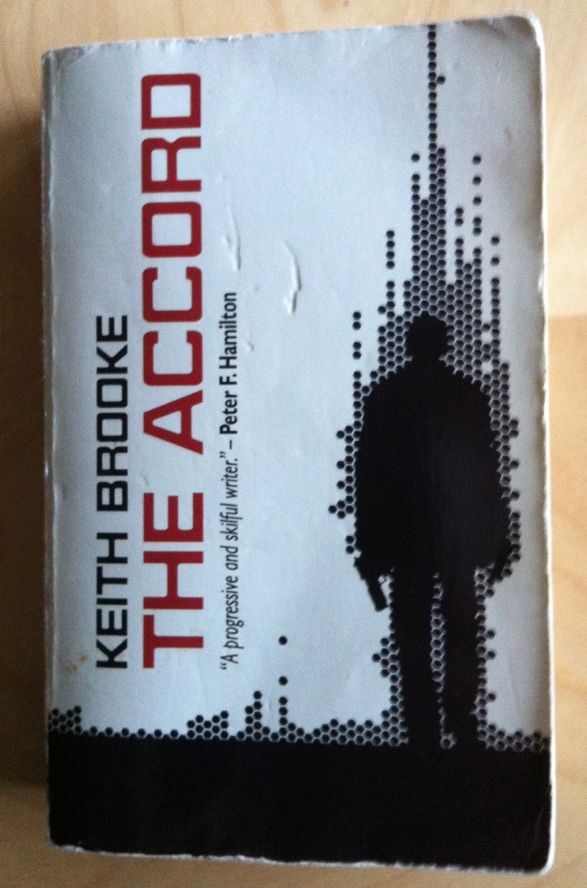
(Incidentally, Keith Brooke's The Accord was a book I picked off a store shelf purely based on the cover and title. It's a great example of smart design (or at least design that conforms to my taste)

I would recommend this book to routine Sci-fi fans looking for a new book: Genetopia is good enough to merit a try. If you are looking for a book about slavery or the complex way we accept or reject other peoples humanity, I'd recommend Octavia Butlers Seed to Harvest or John Wyndham's The Chrysalids instead. If you've never read a Keith Brooke book before, I'd suggest you try The Accord or Harmony instead of Genetopia and then maybe come back to Genetopia after. 

Previously:

Monday, 11 March 2013

The Accord and Harmony Are Good Books

Or why you should read The Accord and Harmony by Keith Brooke

Keith Brooke is a Science Fiction author I never hear anything about. Which is profoundly weird because he is really, really good. He writes very high concept Sci-fi rendered in richly textured prose built around emotionally riveting human dramas. And yet... nothing. Now, I probably don't follow Sci-fi novel journalism well enough to be an expert, but it still surprises me that Keith Brooke isn't a bigger deal.  


The Accord: The Accord tells the story of an extra marital affair between Professor Noah Barakh and Electee Priscilla Burnham and the jealousy of her husband, the powerful Elector Jack Burnham. The Accord is also the story of Elector Burnham as he tries to govern a world devastated by over population, ecological abuse, and ethnic warfare. The Accord also tells the story of Professor Barakh as he tries to construct The Accord, a consesual virtual reality designed to house the digitized minds of the dead of a dying planet. The Accord also tells the story of Priscilla as a post-life human attempting to navigate The Accord and discover meaning now that she is functionally immortal. The Accord is a novel that uses Science Fiction to explore gigantic ideas from the consequences of a literal, manufactured heaven; to the effects of human immortality and reincarnation; to the risks of rendering of human minds/souls into mutable digital information. And in the best tradition of Sci-fi the novel takes these huge thought experiments, sprinkles them liberally with tiny grains of profound smaller ideas, and hangs them all on a scaffold of a beautiful and eminently relatable love story. It's one of the most thought provoking and thoughtful hard Science Fiction novels I have ever read. It's also one of the more beautifully written ones: The Accord's sumptuous prose borrows the syntax and rhythm of preachers and scripture in a way that really complements he thematic discussions. If I were going to create a list of ten Sci-fi novels everyone should have to read, The Accord would be among them. I do not understand how this novel isn't a bigger deal.


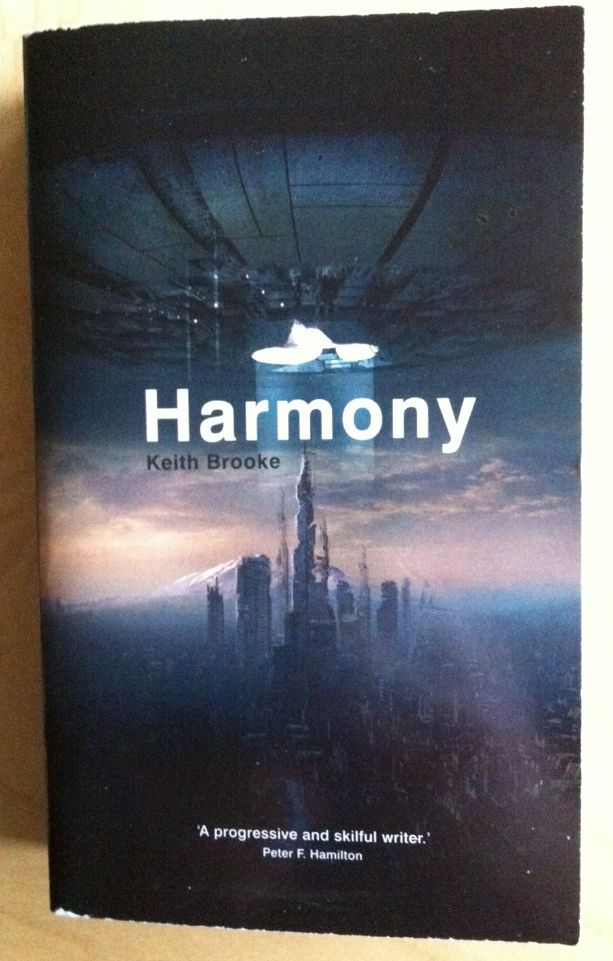
Harmony: In Harmony, Humanity is a marginalized group living among a wide variety of alien species who are relegated to ghettos on the fringes of this bizarre society. Dodge Mercer is one such downtrodden human, scrapping out his meagre living by staying one step ahead of the alien authorities, until he meets Hope Burren, a strange girl who carries in her mind the voices of countless people and, perhaps, the key to humanity's future. Together Dodge and Hope must make a pilgrimage to save their people. Harmony is another complex, well written Science Fiction novel. It has it's own unique voice, but one that carries distinct notes of Charles Dickens, Cyberpunk, and a Clockwork Orange. Thematically, Harmony is even more complex. The novel is clearly a parable of a certain nature, but what nature doesn't become immediately clear. For a big chunk of the book I was convinced that it was riffing on Jewish history: the diaspora, the Holocaust, the establishment of Isreal... and while I'm sure that reading is there it is not the main point of Harmony. No, the real moral, the real push of Harmony isn't really revealed until the last ten pages or so and when it drops... it's perfect. Harmony is just another masterful Sci-fi novel that should also be a bigger deal than it apparently is.