Showing posts with label Matteo Buffagni. Show all posts

Friday, 25 April 2014

Atoll Comics Round 14

Or changes to my Top-Ten comics

Due to poverty and an urge to buy better comics, I have decided to be super-selective about which superhero comics I read. Harnessing the Awesome Power of Maths, I have determined that I can afford to read 10 ongoing titles. So I get to read 10, and only 10, titles published by either Marvel or DC as well as one trade paperback a week of my choosing.


A complication of this is that I am forced to drop an on-going title if I want to try reading a new on-going title, an act of very tough love. Being financially responsible is the worst.

I will be adding Secret Avengers and dropping Avengers Assemble.


Why Secret Avengers: The short version is that I read Zero, a really gripping Super-espionage comic, which featured work by Ales Kot and Michael Walsh, and it was really good! And seeing the pair of them working on a Super-espionage team comic with wonder-colourist Matt Wilson seemed like something worth trying. And man! What a fun comic! The first issue of the Kot/Walsh/Wilson era was filled with zany hijinks including space battles, a spa day, and Hawkguy-Hawkeye complete with Hawkblocking (and Spider-slipping). Despite the Zero pedigree, a comic with its share of fun but also some deeply disturbing shit, Secret Avengers actually felt more like Fraction/Ba/Moon's Casanova, another super-espionage comic with groovy overtones, a personal favourite comic of mine. (This might be largely due to Michael Walsh having a similar style to Fabio Moon or that MODOK reminds me a lot of Ruby-Berserko.) The point here is that Secret Avengers is a fun, crazy espionage comic that should be an accessible place to get your team-book fix if you are not really digging the more continuity heavy Avengers books. Pa-Zow!


Why not Mighty Avengers: It's another beloved comic that has sadly bit the dust. At its best, this comic was exactly what I wanted from a team book: it played with the marquee characters in a continuity light, fun way. While it was solid throughout, Science Bros, the opening arch of the DeConnick era, is, for my money, the best damn open-and-close team comic I've ever read. Magically, it was also great for new readers: it was, after Hawkeye, the first Marvel comics some of my friend's read and they all understood and enjoyed Science Bros. Which is a pretty big accomplishment. People looking to write an accessible, fun comic for new and established fans ought to delve into Science Bros like architects because there is gold in those crypts. What I don't understand is why this is the Avengers title that was axed: it offered an understandable landing pad for new readers who know that The Avengers are a thing and want a comic to try, but are not versed in continuity malarky. I get that the main Avengers titles are geared towards core readers (because they should be!), but it's nuts that Marvel can't offer a Avengers Assemble style, new reader friendly book in it's publishing line. But yeah, sad it's gone, and if you haven't yet, check out Science Bros.


Friday, 16 August 2013

Examining The Enemy Within Crossover

Or on The Enemy Within as a Crossover and reading orders
(Marvelling at Captain Marvel 13-14, Assembly on Avengers Assemble 16-17, and Examining The Enemy Within 1-shot)
by Kelly Sue DeConnick, Scott Hepburn, Jordie Bellaire, Matteo Buffagni, Gerardo Sandoval, Andy Troy, Nolan Woodward, Pepe Larraz, Matt Wilson, and Clayton Cowles; Marvel Comics


The Enemy Within is the recent Crossover between Avengers Assemble and Captain Marvel. The crossover is mostly the climatic act of the ongoing Captain Marvel storyline that sees Carol Danvers beset by rogues from her past and the machinations of the shadowy Yon-Rog. Problems go from personal to global, and Captain Marvel, with the help of the Avengers, must save the world from an enemy within Carol's past. The entire thing feels substantiative and worthwhile and is an absolute must read for anyone who has been following Captain Marvel.

As much as I hate crossovers, I really enjoyed the Enemy Within. (Crossovers force me to buy additional comics or skip stories, and when I agonize over which comics fit in my budget, having a title forced on me is kind of abrasive.) But The Enemy Within is made of books I was already reading, the entire crossover is written by Kelly Sue DeConnick, the regular writer for both series, and features art that is pretty consistent with both books established looks (Jordie Bellaire's colours being pretty core to the look of Captain Marvel and Scott Hepburn being a good fill in for Filipe Andrade). The crossover also does a good job matching the tones of its constituent comics: the Captain Marvel half is faithful to that books mien with themes of camaraderie and heroism with a female focus built around character and drama, while the Avengers Assemble half fits very well into the Comic-book-as-ACDC-song philosophy and will leave you Thunderstruck by heroes as they Shoot to Thrill, villains as they do Dirty Deeds Done Dirt Cheap, and the action as things progress down The Highway to Hell (Which is to say pretty straightforward action with some really clever, fun, and humorous superheroic goodtimes). Fans of both Captain Marvel and Avengers Assemble should enjoy the crossover.

In many ways The Enemy Within was an ideal crossover for me. But I don't really want to belabour that -I tried and it really ended up being an uninteresting post- and instead would rather focus on one of the neater thematic aspects of the comic I noticed: the way in which the story functions as a commentary on continuity in relation to Captain Marvel.

This post is going to be super *SPOILERS* intensive, so you should read it only when you are up-to-date on Captain Marvel up to issue #14.


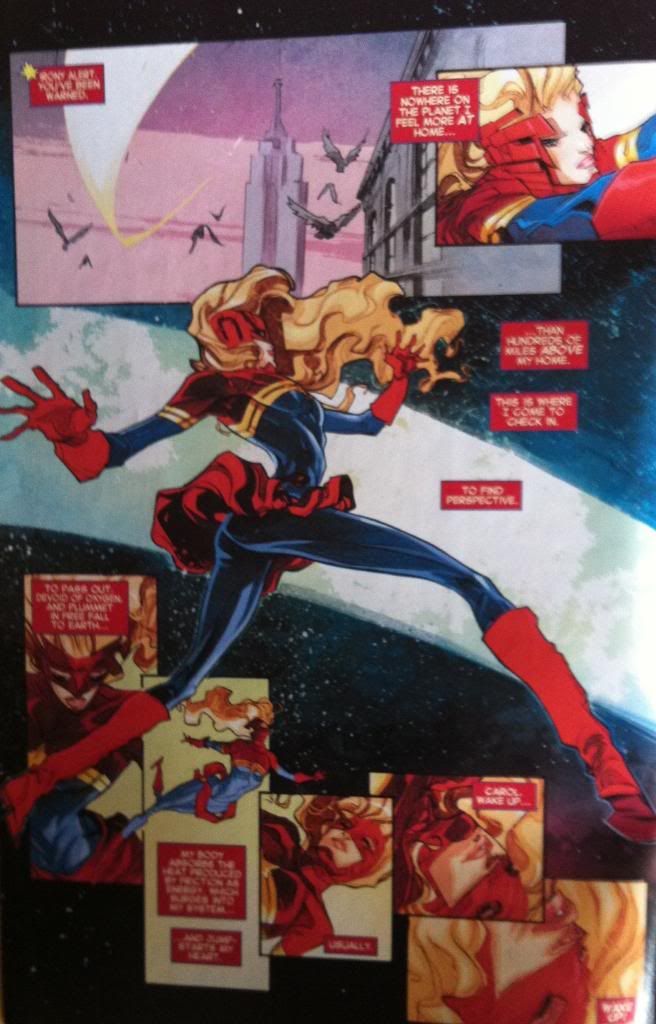
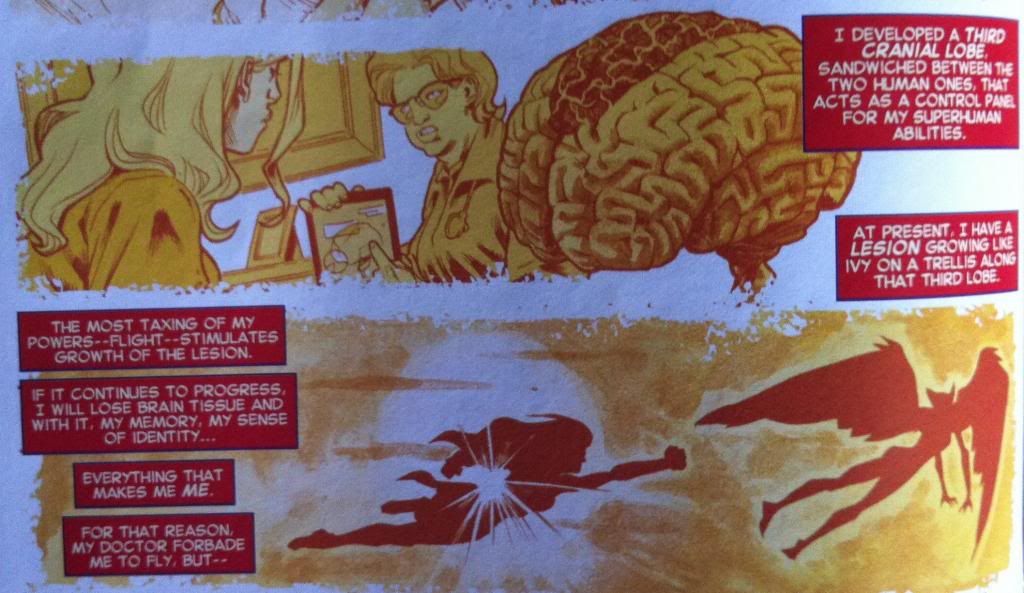
The Enemy Within is to a certain extent built around the ongoing narrative of Captain Marvel. The earliest issues of the comic say Captain Marvel sent travelling through time, visiting moments in female aviation and eventually the site of her own origin, the explosion of the Psyche-Magnitron that granted her powers. This was a cool semi-reinterpretation of Carol Danvers origins that tied her to a tradition of female pilots and heroism. However, the time travel, re-exposure to the Psyche-Magnitron blast, and her own alien-hybrid physiology combined to produce a brain lesion that grows whenever she uses her powers. As a result Captain Marvel is under orders not to fly or over exert herself at the risk of exasperating her condition and possibly causing brain damage, erasing her memories and personality. So, in a way The Enemy Within is about Carol fighting for her history and identity, which is, to a certain extent, fighting to maintain her continuity.


Which makes sense. Carol Danvers as a person would obviously not want her mind obliterated. But beyond that, the continuity, the history, of Captain Marvel makes her pretty cool: a superpowered former fighter jock who is a veteran avenger, has ties to alien empires, and is an unrepentant nerd. In my view she is one of the core Avengers, to the point where I think she should be as key a player as Iron Man, Captain America, and Thor. (It's kind of my hope that by the time that Kelly Sue DeConnick is done with Captain Marvel everyone sees her as being as important as I do.) So, in a lot of ways, the things that make Captain Marvel so marvellous, and more than a super powered sexy-lamp,  are tied to her history and personality. So it makes sense for Carol as a fictional character to fight for control over the good aspects of her history.

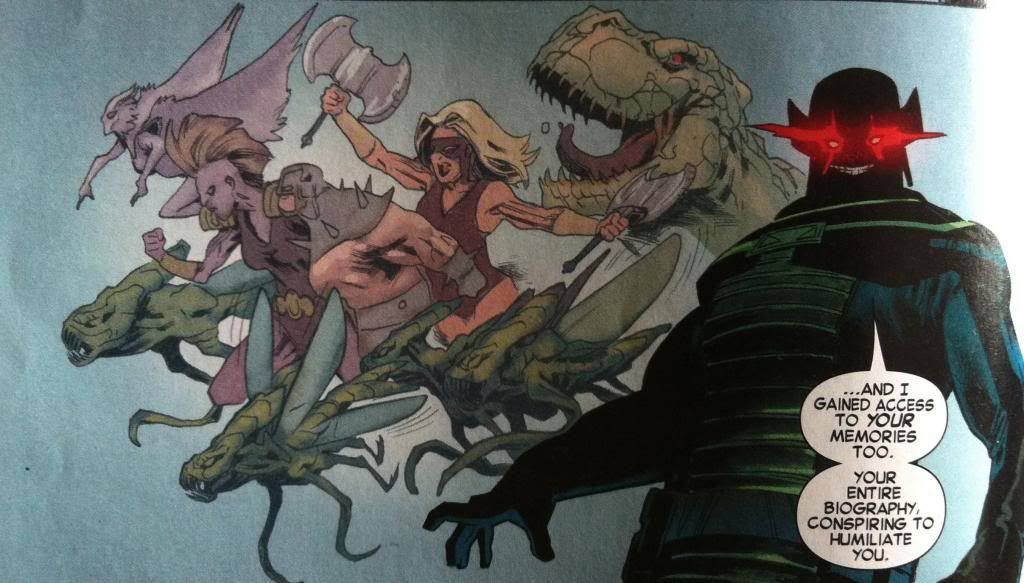
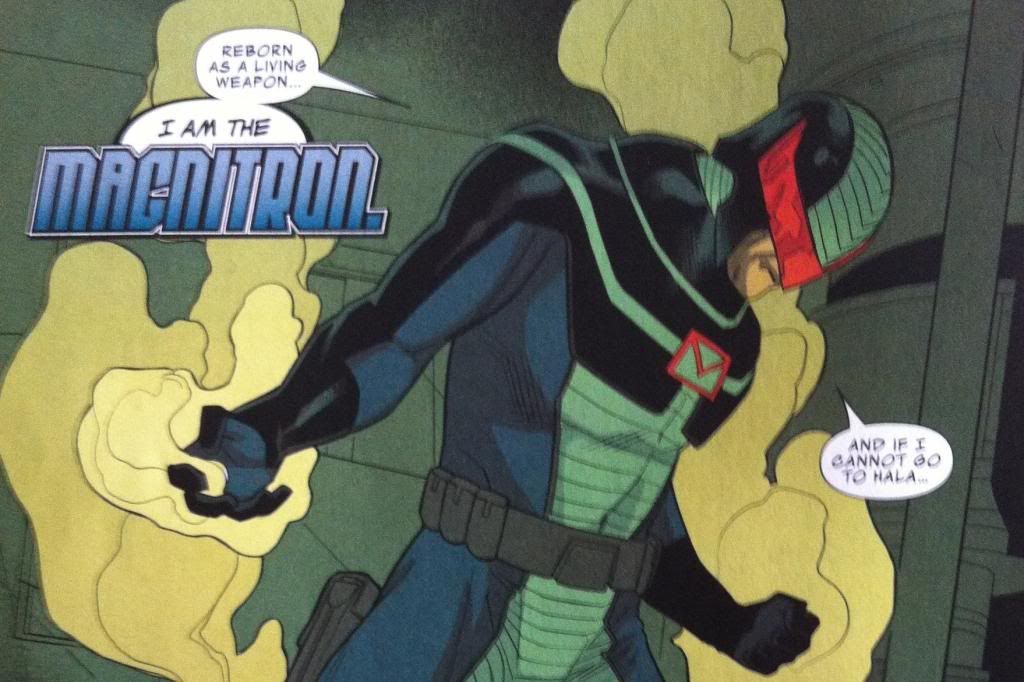
The Enemy Within is also a story built around how Captain Marvel is embattled by her continuity. From a story perspective she is kept grounded by her history: flying and being too amazing comes at the price of wiping out her past. But it goes beyond this. The Enemy Within has Captain Marvel and the Avengers fighting monsters from Carol's past over and over again in a pretty pointed contrast to how Superhero comics often recycle villains and storylines over and over. Moreover, Yon-Rog, a villain present at Carol's superpowered origins, uses a keepsake fragment of the Psyche-Magnitron, another element of Captain Marvel history, to superpower himself. And he uses his new-found power to create a nostalgia-driven mirror version of his homeworld and remake Earth as he would want it. So in a lot of ways The Enemy Within is a story where Carol is literally trying to overcome her past, to defeat a vaguely patriarchal figure yearning for the good-old-days, and to overcome the negative aspects of her continuity.


Again this is a rather pointed observation about the nature of continuity because to a certain extent Carol is also limited by it. To some people Captain Marvel will always be a Miss, a lady-derivative version of a character, himself an object in trademark acquisition, that wears an impractical bathing suit costume. She is a character who has so often been under-utilized as lady set dressing to de-dudify The Avengers. She has also had a lot of considerably shitty things happen to her at the hands of writers: she was raped and impregnated by her own child (kind of), was made into an alcoholic, she had her powers stolen by Rogue, had loved ones killed, was granted amazing cosmic powers just to be stripped of them, was dumped on the shitty side of Civil War, and a lot of other pretty gross things. A lot of profoundly creepy and awful things have happened to Carol Danvers that are probably all better left forgotten and not head canon. So, in many ways, moving Captain Marvel forward as a really fantastic character involves overcoming these less savoury aspects of her past. Which is kind of, in this literallized sense, what Captain Marvel has to do in The Enemy Within.


Which is all a pretty telling commentary on the nature of continuity and history to comic book characters. On the one hand, their history contains a lot of great elements that are key to our love of characters while simultaneously containing a lot of terrible and limiting baggage too. Therefore, there is this tension between the nostalgia of the characters we love and the need to see them move beyond that, to be something new and modern and more than they were. Especially with female characters like Captain Marvel whose histories are doubley complicated by creepy dude writers and the problematic attitudes towards women in the past and present. Moving these characters forward means redefining them to a certain extent and pissing off some people (largely nostalgic Yon-Rogger dudes). Or, to put it differently, to fly and punch through the sky, Captain Marvel has to beat her past and be willing to risk the uncertainty of a future without the certainty of her history and nostalgia, to risk being something new.

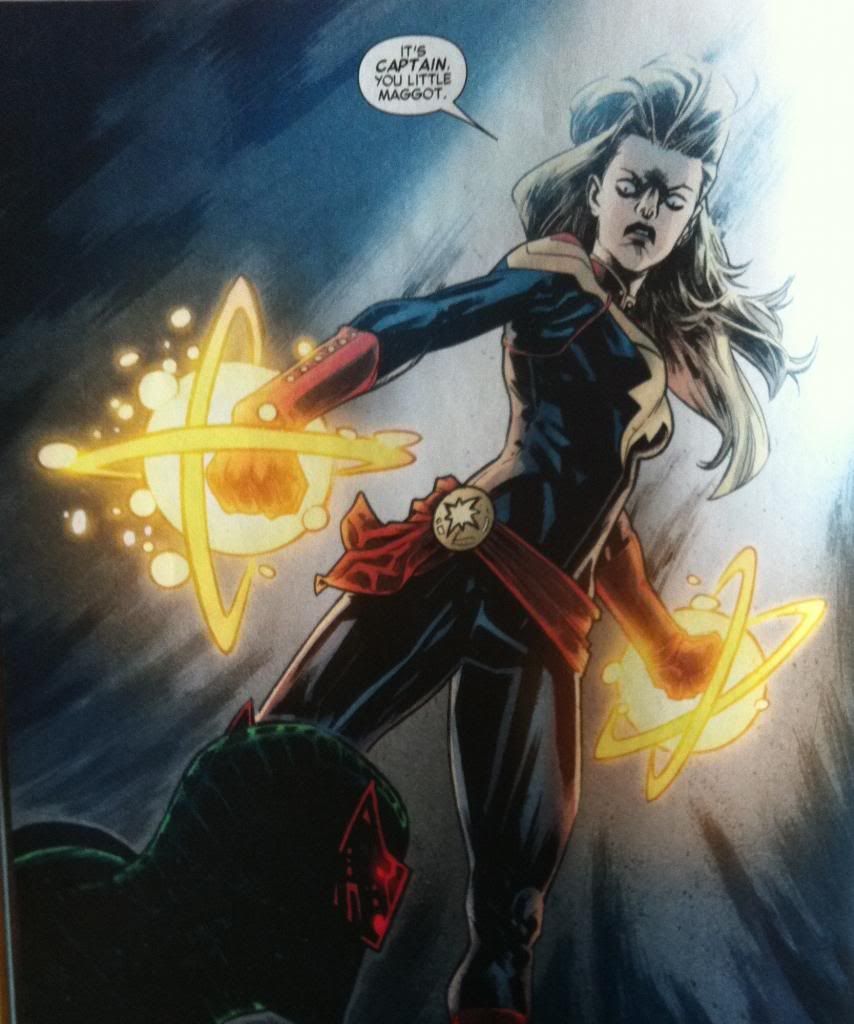
Which, when everything is said and done is basically how The Enemy Within ends: Captain Marvel sacrifices herself, flies and pushes beyond the limitations of her medical condition, potentially forfeiting her past and identity to take away the power of Yon-Rog (himself a manifestation of her conitinuity). It's brilliant and courageous and sad and triumphant and leaves us in a place of uncertainty about who Carol is.  And I for one, could not be more excited to find out.


(Or at least that's my take on it.)


(Oh and something I am just dying to know is why his chest logo looks so much like a certain email provider logo. Is it just an "M"-in-a-square based coincidence? Is it a commentary on how awful a full inbox is? Is it a subconscious response to the chore of correspondence?)

Previously:
Marvelling At Captain Marvel #12: Demarcating reality and fantasy
Marvelling At Captain Marvel #10: A dramatic contract
Marvelling At Captain Marvel #9: How your brain tells time
Marvelling At Captain Marvel #7: Saving a reporter in distress... AND ITS A MAN!
Marvelling At Captain Marvel #1: An alternate reading order that I liked more
Assembly on Avengers Assemble #9-11: Characterizing relationships