Showing posts with label Criminal. Show all posts

Wednesday, 2 October 2013

So I Read Criminal: The Last Of The Innocent

A 250 word (or less) review of the sort-of sixth volume of Criminal
By Ed Brubaker and Sean Phillips; Icon Comics
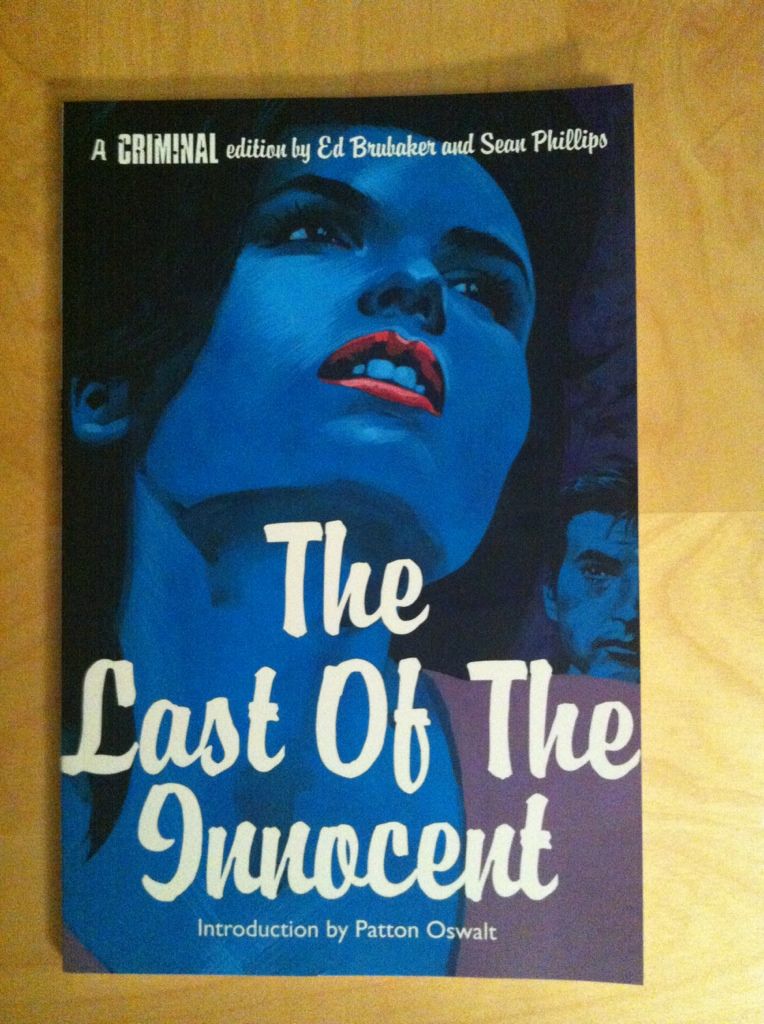


Criminal: The Last of the Innocent is about Riley Richards, the all-American small-town boy, all grown up. He's a successful businessman, rich, and married to the beautiful Felicity, the rich debutante of his high school love triangle. Except Riley's marriage isn't going well, he owes money to the wrong people, and his father is dying of Cancer. And when Riley bumps into Lizzy Gordon, his other, blue-collar high school love interest, Riley wonders about the path not taken and if it's not too late to change his life. And so Riley decides to murder his fucking wife. If all of this sounds vaguely familiar, it should: beneath a legally-distinct-from-copyrighted-characters facade The Last of the Innocent plays out the scenario of Archie Andrews of Archie Comics marrying Veronica, deciding to murder her to be with Betty, and the lengths he would go to get away with it. And the results of this experiment are kind of sublime: the mixture of Criminal Noir, old timey Romance Comics, and the bleed of the former into the latter is brilliant. The way The Last of the Innocent uses this thematic tension, by jumping between art and comic styles, to engage with the fickleness of nostalgia takes the perversely fun premise and adds a cerebral element that makes this one of my favourite comics. This volume of Criminal is also great to foist on non-comics friends: it features top-notch creators telling a mature and accessibly story that plays with the universally recognizable Riverdale gang.


Wednesday, 26 June 2013

So I Read Criminal: The Sinners


A 250 word (or less) review of Criminal: The Sinners
By Ed Brubaker and Sean Phillips, Icon Comics


There is something endlessly, luridly fascinating about crime comics. It’s something I have difficulty explaining: I like to think of myself as a moral person and I’m certainly law abiding to the point of being boring… but give me an empathetic protagonist and drag me into the fucked up, lawless world at the margins and I’m hooked. Criminal: The Sinners is a perfect embodiment of the kind of crime comic that I love. In it, Tracy Lawless (returning from Criminal:Lawless) is reluctantly working as an enforcer for local crime boss Mr. Hyde to pay off his dead brother’s debts. Unfortunately Tracy is a loose canon with a conscience, which makes him a liability to his employer. So Hyde gives him one final job: to investigate and eliminate whoever has been murdering high-level criminal figures around town. Tracy must find away to catch this killer as he negotiates his employer’s temper, avoids capture from the law, and hides his own dirty secret. Criminal: The Sinners is exquisitely balanced: an immersive Noir world of crime brilliantly written and sumptuously drawn.  It’s a comic that weaves together its various story elements with an effortless ease that would probably be delightful if The Sinners wasn’t so starkly brutal and tense. Criminal: The Sinners is exactly the kind of well-crafted crime comic that takes me to the margins and hooks me, morals be damned. Give it a try and you might be leaving your morals behind too.

Friday, 19 April 2013

Deep Sequencing: Guilt, Culpability, and Crime Comics

Or how Criminal, 100 Bullets, and Scalped implicate the reader to generate a guilty response.
Comics by Ed Brubaker and Sean Phillips, Brian Azzarello and Eduardo Risso, Jason Aaron and RM Guerra with others.

I really like Crime Comics. There is just something about the gritty, intense world of people living outside the law that is endlessly fascinating and shockingly entertaining. Now there are probably endless reasons why these comics are so compelling... but looking at some of my favourite examples I think I've figured out one of the genre's key genetic elements.

Guilt.

Guilt is an emotion that I have a complicated relationship with. Whether its competent parenting, a Roman Catholic education, or some fluke of genetics I feel an overwhelming and insistent sense of SHAME whenever I think of certain mistakes I've made. Just writing this I'm probably turning a bit red. My point is that for me guilt is an exceptionally powerful emotion. It's a thing I feel deep down in the bowels of my stomach, something that chills the skin and tightens my back and gives me the weirdest sweats. It's lurid and disgusting and probably one of the handful of strongest emotions I feel.

And the best Crime comics make me feel guilty in spades.

(I've tried to keep this *SPOILER* light, but you know, procede at your own peril.)


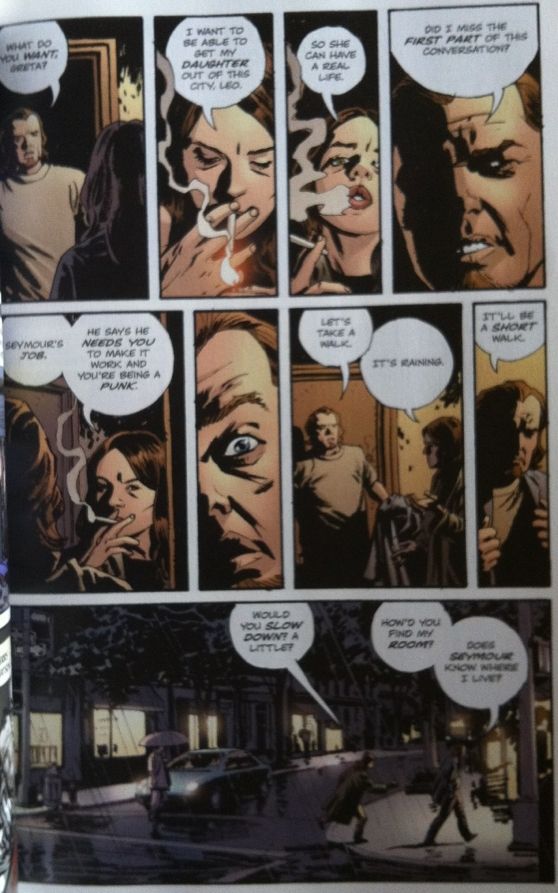
Criminal is the absolutely masterful Crime series by Ed Brubaker and Sean Phillips. Criminal is not so much a series of Crime stories as a WORLD of crime stories populated by granular characters living in an uncompromisingly realized world. You don't so much read these comics as visit them and get blood and grit all over yourself. And part of what makes this experience so engrossing is how Brubaker and Phillips use guilt and culpability.

One of the key components of the Criminal forumla to me is perversely abused empathy. Most of the protagonists in the Criminal stories are, despite their flaws, immensely likeable. Despite knowing that these characters are thieves and thugs and murderers we end up sympathizing with them despite ourselves. This sympathy slowly turns to empathy and we soon find ourselves actively rooting for our protagonists to succeed at whatever their unlawful enterprise is. As the story unfurls, best laid plans are ruined, and the terrible consequences of the protagonists choices become clear we see the fallout of what we wanted. We realize we too are culpable: by actively rooting for the lead character we have become accomplices. And therefore we feel the lurid weight of guilt.


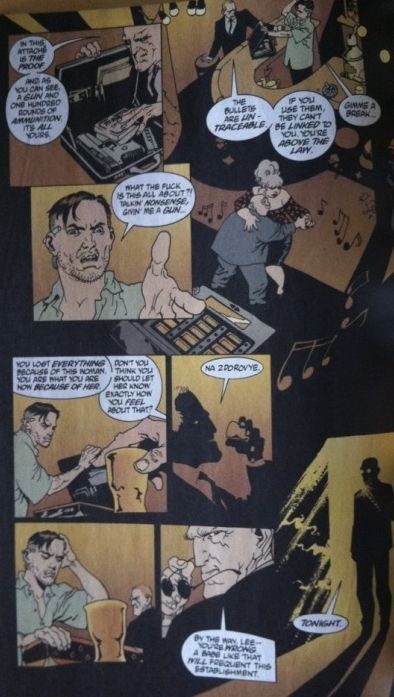
100 Bullets is another great Crime comic by Brian Azzarello and Eduardo Rizzo. Filled with intrigue, conspiracy, murder, and some of the most aggressively flawed characters I have encountered, 100 Bullets is a sprawling comic that revels in the excesses on the edges of society. It's mercilessly written and filled with horrendous images rendered by the exquisite, and beautiful line of Eduardo Risso. But, at the end of the day, one of the most brilliant things in this comic is 100 Bullet's opening premise and how effectively it evokes guilt in the reader.

Throughout the introductory chapters of 100 bullets we see the shadowy Agent Graves approach characters with a brief case and an opportunity. Inside this briefcase is a clean handgun, 100 bullets of untraceable ammunition, and incontrovertible proof that someone who has deeply wronged the character receiving the briefcase is guilty. With these items comes the promise of total immunity from prosecution if said character decides to act on this opportunity  The character then invariable pursues this chance for vengeance in some way and carries through the morality experiment to some sort of conclusion. As a hook it's absolutely perfect.

This premise is also an absolutely perfect way of nabbing the reader and making them culpable in the protagonists decisions. When presented with the scenario, carte blanche to enact justice and the reality of the crimes committed, we can't help but game it out for ourselves. What would you do in the characters' shoes? Would you kill the guilty person if he had you falsely imprisoned? What if he murdered your wife? Raped your daughter? Or could you stop yourself out of some higher moral obligation? By mentally playing these situations out and deciding that vengeance is justified we become just as guilty as the character in the comic when they decide to go through with it. And in doing so, the consequences of their actions become the consequences of our own decision. And so we feel that lurid weight of guilt.


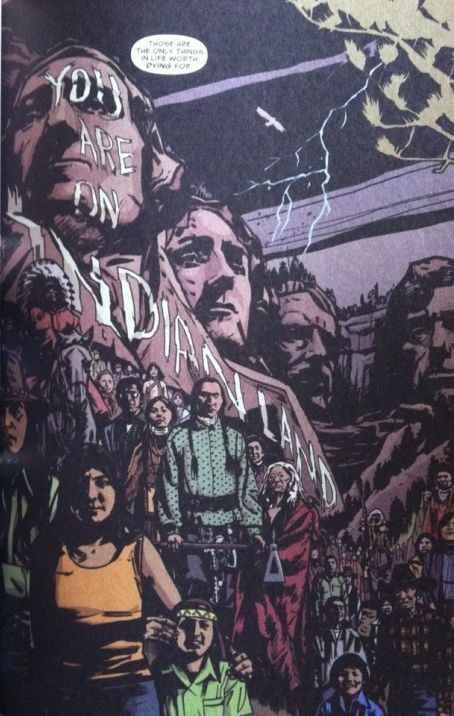
Scalped is another astounding Crime comic by Jason Aaron, RM Guerra, and various collaborators (art above is by Jean Paul Leon). Scalped tells the story of crime on an American Indian Reservation. It is easily one of the most tense, brutal, and heart-pounding reads I've ever enjoyed. It also contains one of the most effective and intelligent uses of reader evoked guilt in comics.

Let me explain. If you are a North American who isn't a full-blooded aboriginal (First Nations if you're Canadian) then you are heir to a pretty awful legacy. We are, all of us, living on land stolen from the people who inhabited it. People who our governments and ancestors swindled, crushed in wars, and basically attempted to commit genocide against. (HBC, Canada's oldest company sent smallpox laced blankets to Canadian First Nations... for instance.) And even after killing the majority of these people and displacing the rest, we, as a society, attempted to wipe out their culture. As if all of this wasn't disgusting enough, we still treat North American aboriginals horrendously, leaving them in far too many cases disenfranchised, marginalized, and impoverished. It's fucking disgusting, and to a certain extent we are all complicit in this. We are all of us guilty.

The thing that Scalped does, beyond displaying how horribly we have betrayed these people, is frame the events portrayed in relation to our guilt. Basically, every awful thing that happens in Scalped is our fault: the situations, the poverty, the desperation  everything is a result of the sins of our past. And so for every crime, every murder, every horrendous thing in Scalped we are all preemptively guilty. And for that reason we experience a much more intimate, visceral, and immediate feeling of guilt. It's hugely effective.

Friday, 5 April 2013

Variety Is The Spice of Comics Pt. 3: Getting Your Friend's Hooked.

Or how variety in comics is amazing and generally a good idea.

I spend a disproportionate amount of time trying to get friends to try reading comics. Most of this stems from the fact that I really, really enjoy reading comics and want to share that experience with the people I care about (as any good geek should). Part of this is maybe also motivated by the fact that I don't really have any comic friends, so it would be cool to convert a friend or two. But on a far more mercenary level, I think convincing a friend to read, and to maybe even buy comics is important for comics as an industry.


Comics, as we try to avoid thinking about, are a commodity. Comics creators are a kind of artisan that produce a specialized commodity for a niche consumer. Publishing companies, some merely facets of giant multinational media empires, act as merchant/distributors and bring the commodity to a retailer (a comic shop/bookstore/web ap/whatever) who then sells the product to consumers. As much as creators, publishers, and retailers are all important cogs in the comics machine, there would not be a comics industry without consumers. (I mean, I'm sure some people would still make and share comics they made for fun... but business-driven professional comics require someone to eventually buy them.) To a certain extent, the pool of comics consumers, the market for the weird, amazing commodity that is comics, dictates how much comics can viably be made and supports the people that actually make the things we care about.


In that light, bringing in new comics readers increases the size of the comics market and, as such, increases the amount of money available to comics which thereby increases the amount of comics that can/will be produced and the amount of money that eventually reaches creators (who are great).  I know that in the years since a friend of mine slipped me a disk of bootleg comics in an Integral Calculus class I have spent THOUSANDS of dollars on comics and as such I have contributed to the continuance and manufacture of more comics. The way I figure it, every friend of mine I can convince to read and purchase comics represents money that is being fed into the comic machine that would otherwise not be there.


(And yes, my friends often liken me to a drug dealer.)


So back to convincing my friends and loved ones to try reading comics. I have found that most people are not interested in reading superhero comics. It's not that Superhero comics are stigmatized, really, it's that they are a known (or presumed to be known) quantity. Everyone thinks they know what Superhero comics are and has an opinion concerning whether or not they would like to read them. (And I would argue that everyone who is interested in reading superhero comics basically already is, and if they aren't, it isn't very hard for them to change that.) As a result, I have found that the trick to convincing people to try reading comics is to present them with the kind of smart, mature, well-written and beautifully drawn non-superhero comics that most people don't know or appreciate exist.


Almost universally, I have found that Y The Last Man is a perfect first comic to spring on the kind of people I am friends with. The comic has a very accessible and addictive script: it has a compelling central mystery and rolls out a relentless series of cliff hangers that keeps readers glued to the series. Moreover from a writing perspective, the comic manages to present extremely well realized, likeable characters, a snappy sense of humour, and a maturity and level of discourse that civilians are frequently surprised to find in comics. Paired with this is really accessible art: on the one hand it looks nice and services the story well and on the other it has a low panel count in conventional layouts and really doesn't experiment too much. Y The Last Man is also kind of the perfect length for a first comic reading experience. It's not so long that new readers burn out, but still long enough that they get to experience a fair amount of comics before reaching the end. Basically, Y The Last Man is a perfect storm of comics for new people. 


That said, in my experience everyone has a different taste in media and wants slightly different things from the experience of it. Part of what makes Y The Last Man such a powerful gateway comic, beyond its execution, is that it manages to straddle a lot of genres and emotional responses simultaneously. Everyone I have ever lent it to has enjoyed it, but frequently for slightly different reasons... and from those responses come critical information about what comes next. And this is where variety (and hence the title of this blog entry) comes in.

(That didn't take a long time to get to at all...)

One of the more successful comic conversions I've had is a coworker I'll call subject A (one that has actually resulted in a comics purchase!). With  this person I started with Phonogram which yielded pay dirt with The Singles Club but not Rue Britannia (which was too myopic for her). I then leant her Y The Last Man which she DEVOURED as fast as I would lend it to her. She then tried and enjoyed Scott Pilgrim, the output of Faith Erin Hicks, and Chew. She finally tried Julia Wertz's The Infinite Wait and Other Stories and was blown away and went and bought her first comic in Drinking at the Movies (well second comic, she gift-exchange-stole The Manhattan Projects: Science  Bad. at our work Xmas party). She is currently slowly working her way through the Runaways and Octopus Pie (which she quite enjoys). Basically, she likes fun, humorous  not super-intense comics that she can relate to.


A similar success story comes from a guy on my soccer teams... who I will call Subject 2. He too devoured Y The Last Man when I leant it to him. From there I tried giving him Chew... which he thought was too ridiculous and silly. So I leant him Criminal, which he apparently likes a lot and is slowly reading in fits and starts. While I am still figuring out what Subject 2 is really into, it seems he likes intense, realistic, page-turning comics.


Which is all proof that not everyone wants to read the same kind of comics. Moreover, it is evidence that the people who are not interested in Superhero comics immediately may be interested in other comics, and that finding what comics they like is mostly a matter of finding what genre of fiction they enjoy. And this is where variety comes in: the more KINDS of comics that are being made, the more likely a new reader will be able to find a comic that fits their media needs exactly (or the more likely I will find that perfect comic to force on my friends). 


To take this idea a step further, maybe the way we can expand the audience, and therefore the market, for comics is not by making better and better and better superhero comics, but by making ALL KINDS of different comics. That way everyone can find the comic they want to read. And who knows? Maybe that will lead to them trying a comic. 


And then another.


And another.


Previously:
Variety is the Spice of Comics Pt. 1: Pony Up
Variety is the Spice of Comics Pt. 2: Year in Review

Wednesday, 20 February 2013

So I Read Criminal: Bad Night


A 250 word (or less) review of the fourth Criminal collection
By Ed Brubaker and Sean Phillips, Icon Comics


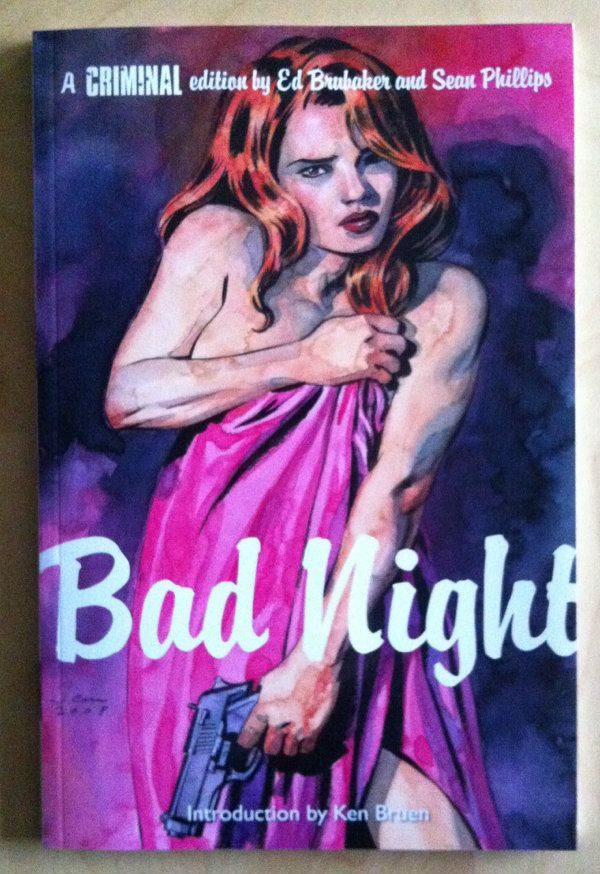
I remember reading a book introduction written by Ed Brubaker where he discussed the downward spiral of the protagonist as a formative element of good Crime/Noir fiction. You know, that particular way in which the "hero" of Noir stories are often undercut by events and then pummeled and dragged through the mud before being buried in their hubris, poor judgement, or just plain shitty luck? Well, Criminal: Bad Night has always exemplified this genre trope for me. In Bad Night Jacob Kurtz, a former counterfeiter turned legitimate newspaper cartoonist, is accidentally dragged back into his life of crime. While trying to walk off his insomnia at a local diner Kurtz accidentally gets caught in a domestic dispute between a thug and his ravishing lady friend. Kurtz tries to give the drunken damsel in distress a ride home and... events spiral out of control. Criminal bad night is another excellent book from Brubaker and Phillips which drags you into their booze and blood and sex filled world of violent criminals. The art is incredible, the writing superb, and the world created endlessly fascinating. I love these books, and I suspect you will too.

Word count: 192


Previously:
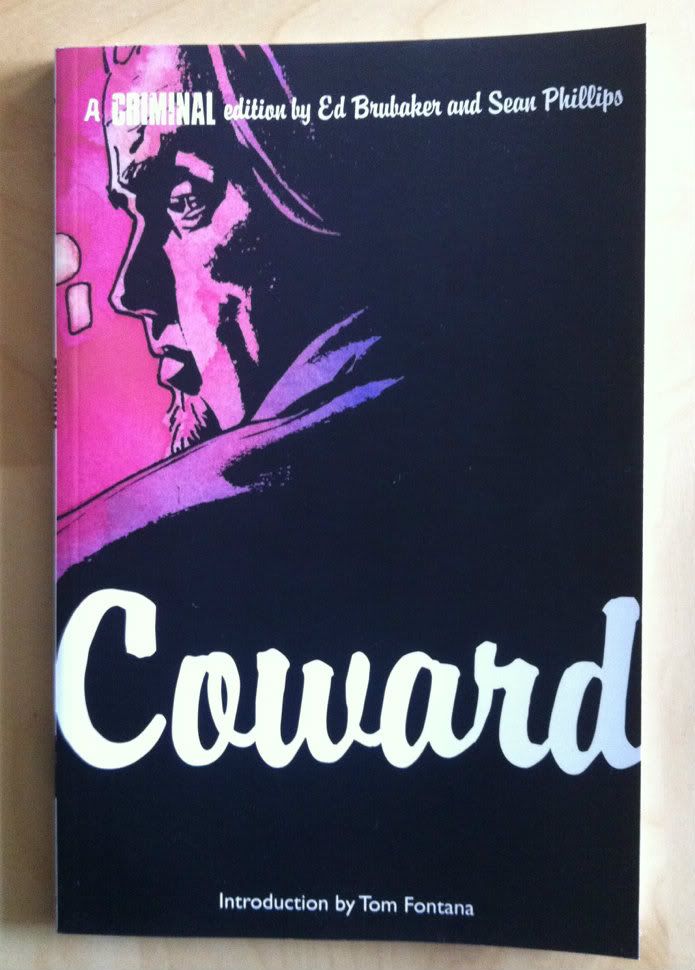
So I Read Criminal: Coward
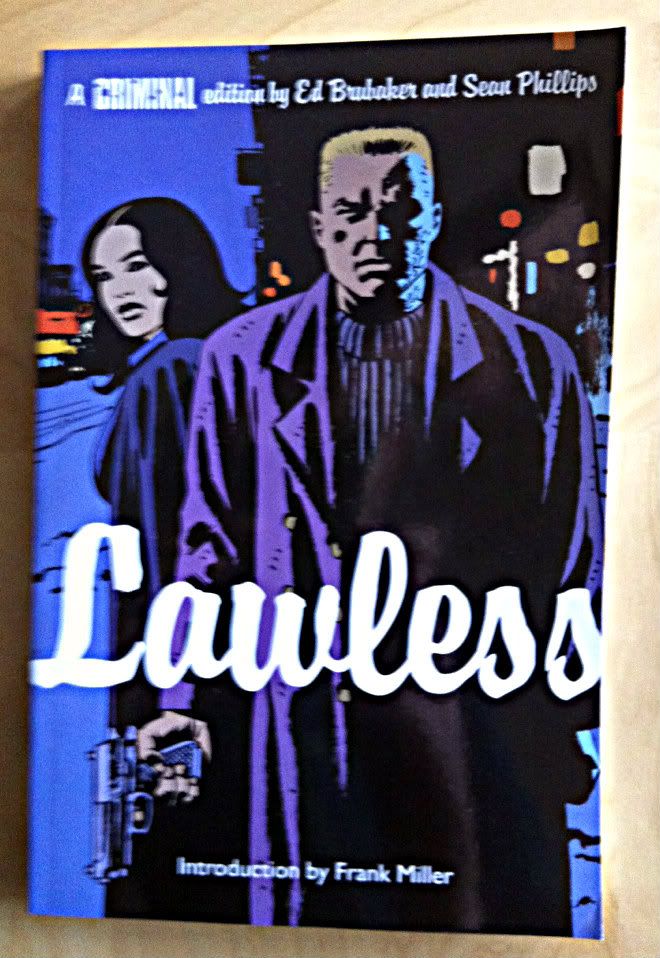
So I Read Criminal: Lawless
So I Read Criminal: The Dead and The Dying
So I Read Fatale: Death Chases Me

Wednesday, 1 August 2012

So I read The Dead and the Dying

A 250 word (or less) review of the third Criminal volume.
By Ed Brubaker and Sean Phillips, Icon Comics


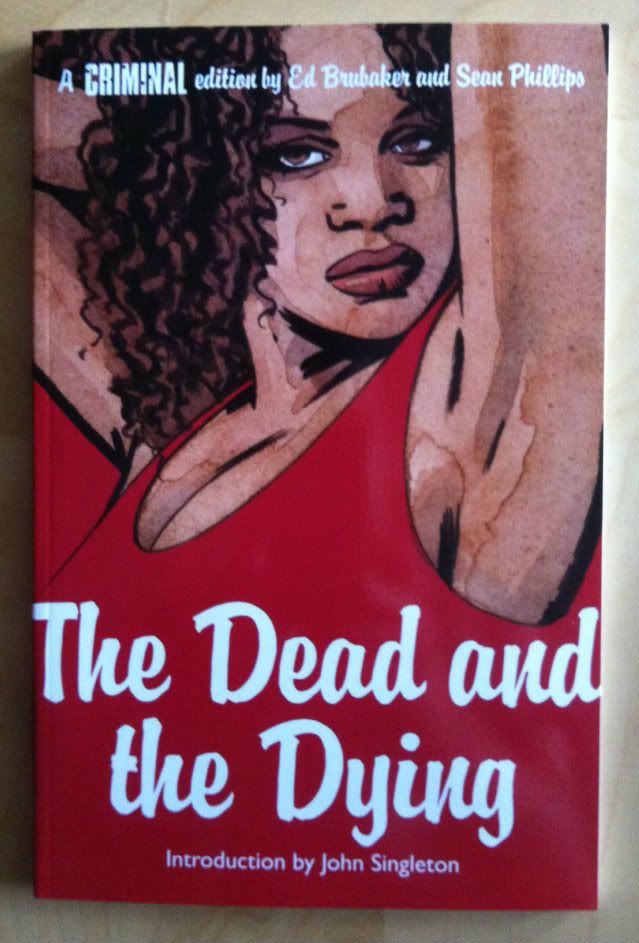
The Dead and the Dying continues the strong collaboration between Brubaker and Phillips as seen in earlier criminal volumes. This time the story they create is set in the 1970s and is constructed around the backstories of Gnarly, the undertow bar proprietor; Teeg Lawless, father of Tracy Lawless; and Danica Briggs, a black woman with a troubled past. Actually, the way the story is told is pretty unique: The Dead and the Dying is really three separate character studies that contain within them the plot of the central story. It's a nifty device. I’m fascinated by the way this approach makes plot secondary to character, and the way that the larger story (which in a typical comic would be the only story) is just the collateral byproduct of the individual character’s stories. It’s kind of an interesting thing to consider in regard to how “real life” or historical narratives are created.1 This issue of Criminal maintains the noir trappings of the criminal series but with a distinct Blaxploitation and Grindhouse flavour (which is appropriate given the subject matter and the time period the story is set in). The writing and art as always are spot on and create this complete world to visit. Like all of the other Criminal books, I'd highly recommend The Dead and the Dying to any comics reader. Incidentally, part three of this book is the first creator owned comic I ever bought. Nostalgia!

Word count: 238

1: World War II as my generation is, perhaps, the aggregate of the byproduct from the individual stories of millions of people. 


Previously:
So I Read Coward
So I Read Lawless

Wednesday, 18 July 2012

So I Read Lawless


A 250 word (or less) review of the second Criminal collection
By Ed Brubaker and Sean Phillips, Icon Comics


Lawless is the second Crime Noir masterwork by Ed Brubaker and Sean Phillips. This time the story follows Tracy Lawless, a burn-scared special forces veteran, on a quest to find his brothers killer. To find the killer Tracy joins his brother’s old gang as a driver and, in doing so, becomes enmeshed in the life and crimes of his brother. Lawless, in proper Criminal tradition, leans heavily on Noir genre tropes of crime, vengeance, doomed romance, and the inexorable slide into chaos that occurs when events conspire against the protagonist. Unlike Coward, the first Criminal volume, which has a big action-movie quality about it, Lawless feels much smaller, character driven, and focused. The result is a story that is much more personal and textured which makes for a more relentless and engrossing read. It also feels more quintessentially noir… if that is a thing that can be said with any sort of authority. Brubakers writing in this edition is peerless; the script delivers thrills and tingle-inducing twists but is still organic and assured feeling. Phillips artwork is as moody and atmospheric as ever, and has a much more refined colour palette than that seen in Coward. Lawless, then, is a masterfully crafted comic book that tells a riveting crime noir story that comes to life on the page.  This book really makes me wonder why the Crime genre of comics died out: when well executed they are every bit as interesting as any superhero comic ever was.

Word count: 247


Previously: 
So I Read Coward

Thursday, 12 July 2012

So I Read Coward

A 250 word (or less) review of the first Criminal collection
By Ed Brubaker and Sean Phillips, Icon Comics


Coward is Ed Brubaker and Sean Phillips’ first love letter to the genre of Crime Noir, it’s also superb comics. In Coward, Leo Patterson, a thief known for his planning acumen and caution, is offered a score too risky to try for but too good to pass up. What follows is a well executed Criminal tale rife with genre tropes: an elaborate caper, crooked cops, dangerous liaisons, violence and vengeance. The characters are vivid and likeable, the artwork atmospheric and dynamic, and the story suspenseful and well crafted, especially as circumstances in the story spin out of control.  The world of Criminal that Brubaker and Phillips create is very convincing and realized: you don’t so much read a Criminal collection as you temporarily inhabit it. That said, Coward is Ed Brubaker and Sean Phillips first Criminal collaboration, and to a certain extent it shows1: the distinctive colour palette of later Criminal volumes hasn’t been fully realized and the script is maybe less assured than later collections. This potential for improvement isn’t obvious though: Coward is a very well executed book by genuine comics superstars who clearly love the subject matter. Coward is a very easy book to recommend to any comics reader and if you at all enjoy Brubaker's mainstream comics work, the Criminal series is an absolute must read.

Word count: 220

1: I have had the pleasure of reading later Criminal stories (I started reading during Volume 3), I’ve come to Coward (and reviewed it) after the fact.