Showing posts with label Munsta Vicente. Show all posts

Wednesday, 13 July 2016

Deep Sequencing: Nick Falling

Or a look at action construction in Civil War II: Choosing Sides: Nick Fury pt. 1
by Declan Shavley, Jordie Bellaire, and Clayton Cowles; Marvel Comics


A thing I am always curious about is how much of a particular comics storytelling approach is driven by the writer in their script and how much are choices made by the illustrator. It clearly differs from creator to creator and from project to project, but it's always fun to see artists I admire write and draw comics. So when I heard Declan Shavley was writing and illustrating a comic in the Civil War II: Choosing Sides anthology I picked the comic up despite not caring at all about Civil War II, being generally opposed to tie-ins on principle, and having very little interest in the other stories (although the one with demon excavator was pleasant enough if very, very silly.) And it's a pretty well executed comic with some flashy storytelling that I'd like to pick apart.

There will be *SPOILERS* below.


I really like how this fall sequence is constructed. The story of the scene is quite straightforward: Agent Fury jumps out of a flying transport taking an adversary with him, falls and lands on top of the adversary thus dispatching them. That said, the execution here, despite it's apparent simplicity involves many smart underlying choices. The first panel has the falling action start right from the top-left corner of the page, bringing the reader right into the fall. This maximizes the distance the fall can travel through the page and also gets the readers attention immediately. The action plays out along a very clear reading path that guides the readers eye cleanly down the fall, through the impact and into the dead adversary before following the motion of Fury crawling for his gun. This eye tracking is key to making the fall read and feel quick and kinetic. Another important aspect of the fall is how space is allotted. The distance between the first two images, the start of the fall and the first impact, is substantially larger than the distance between the second and final images. Since the reader is tracking through this sequence with a clean, quick pace this means that the final two images create the feeling of an abrupt stop. Put all together this creates a kinetic fall ending in a jarring, impactful stop. 


Another important aspect of this fall is a sense of height and the use of the blank background. I would argue that the first panel here has two key pieces of information to convey: that a fall is occurring and that it is from a significant height. The image of the fall satisfies this first storytelling requirement, and the huge white space satisfies the second. A large white space on the page feels very large, and having a large white space under the falling figures tells the reader the fall is happening from a great height. Including a background adds visual information that distracts from just conveying the idea of height. It's unnecessary visual noise that doesn't scream "there is a large space here" as clearly or dramatically as white space. So omitting the background, then, increases the efficiency and effectiveness of the storytelling in this panel. 


I also quite like this sequence here and how it uses horizontal space to create a visually interesting gun battle. Again the secret to making this page work is providing cues to push and pull the reader through the storyspace in the best possible way. The reader enters the page somewhere in the top-left and is drawn to the first speech bubble right at the top of the page. This sets the first panel up as a vertical storyspace where the reader has to look down, in the motion of the repellers, to take in Fury and the lower speech caption. This sells the feeling of the adversaries dropping into the panel and also conveys that the vertical direction is important for the following sequence. This is enhanced by the way the platform in the first panel hangs over the following panels, which really cements that this conflict is happening suspended on the side of a cliff. The reader then moves into the next panel in a right-to-left carriage return where they encounter Fury, highlighted by the colour and his active pose, and then follow the direction of his kick across the panel to the guy knocked off the platform.  This lends the kick a visceral sense of motion. The reader naturally wants to follow the arc of the kicked guy down, so they move into the third panel on the right side and immediately see a new adversary getting his head shot off. They move back to the left, see Fury whose arms create a guide line to steer the reader to the text box where they will notice the goons on the left. The reader moves down into the next panel, and if they are like me, they are immediately attracted to the speech balloon and the big black shape of Fury. The reader then moves left along the blast of the sonic-gun-thing and sees the two adversaries get blasted. The final panel is a simple left-to-right, but one where the colouring of Fury makes him the central, primary figure as he shoots the adversaries. It's a great, easy reading sequence that really constructs evocative, kinetic action.


While we are talking about great gun battle sequences that utilize horizontal story space well, this sequence from Scarlet Witch #7 by James Robinson, Annie Wu, Muntsa Vicente, and Cory Petit, is also pretty great. This sequence does take advantage of eye guiding, in part by using shapes and actions like the above sequence, but it also relies heavily on sound effects to manage where readers look. The reader enters the page in the usual place where they immediately have the character, the Wu, positioned such that their arms pull the reader across the page towards the shot up goons. The yellow KRAK sound effects help pull the reader this way, and critically to this sequence, they work to keep the reader focused on the right side of the page as they move into the second panel. This is important because it deemphasizes the goon sneaking around the dumpster in the second panel so that the reader notices them peripherally. This makes the final panel where, with a THUNK to draw attention, the Wu belts the goon in the face surprising and impactful. (It's also great how this breaks the border of the panel for extra pain points.) The reader then moves along the outstretched arms of the Wu to the next KRAK and into the next page. It's another great gun battle that feels dynamic because of how it manages the readers focus.

Previously:

Injection Volume 1
Moon Knight #5
Moon Knight #2

Hawkeye #16
Scarlet Witch #2

Friday, 26 June 2015

Sussing Spider-Woman #8

Or a look at the use of blank backgrounds in Spider-Woman #8
by Dennis Hopeless, Javier Rodriguez, Alvaro Lopez, Munsta Vicente; Marvel Comics


Backgrounds are an integral part of comics. They provide important spatial context for comic events and provide a level of verisimilitude to the depicted story. When done especially well they can lend comics extra atmosphere and character that permeates every panel of the story to effect better storytelling. I mean, all of this is pretty obvious, backgrounds are obviously important.

The thing is, having a very detailed background is not always helpful and, in some situatons, depicting a blank background is actually better for comics storytelling. And Spider-Woman #8 has a good example of this.

There will be *SPOILERS* for Spider-Woman #8


Despite their obvious value to comics storytelling, backgrounds also look like a total pain in the butt to draw. We live in a hyper granular, complex world and to represent that in an illustration frequently means drawing a world filled with fractal details. Which is problematic because in some situations it must be really annoying and because it also sucks time, which is one of the most precious resources in comics publishing. This creates an incentive to draw pages with blank backgrounds: empty spaces where characters exist but which contain no finicky details that need to be seen. If combined with some judicious establishing shots this can result in some effective if obviously streamlined comics.

In some situations it really does come down to resource management and the compromise between quality and a reasonable, on deadline workload.


In other situations cutting down on background detail is all about story. The white middle panel on this page is a great example of this: in this panel Jessica Drew uses her superstrength to smash apart the mecha-armour of Lady Caterpillar, sending a myriad of components flying. The thing that makes this panel so memorable for me is that it is loaded with finite little details that really sell the emotion of the moment. When Lady Caterpillar is struck, her amour tears apart in a rain of sprockets, and fasteners, and tiny detailed components that when taken all at once wonderfully conveys the sense of something disintegrating. (Honestly, I can nearly hear the pings of components rattling off the floor from this image). 

I would argue a big part of what makes this panel so effective is the white background. By throttling down the background detail and removing any colour from the composition, Team Drew is removing any element of distraction from the panel. This way the reader's attention is firmly locked on the foreground where the reader is able to clearly see and appreciate all of the little, detailed bits of machinery spraying from the impact. It's a really effective choice. 

It's also a great example of how creators can use more passive approaches to drive reader attention in storytelling. Instead of actively using tangents or guides or shapes to drive attention to certain aspects of the composition, creators can also pare down a page and edit out extraneous elements so that readers are better able to see and appreciate what is on the page. Which when used as judiciously as it is here in Spider-Woman #8, this approach can be really smart stuff that is more than just an artist trying to save time. 

Previously:
Spider-Woman #7: the brilliance of the inset panel

Spider-Woman #6: Guided chaos and multiple reading paths
Spider-Woman #5: Character Design and composition


Monday, 25 May 2015

Sussing Spider-Woman #7

Or a look at the genius of an inset panel in Spider-Woman #7
by Dennis Hopeless, Javier Rodriguez, Alvaro Lopez, Munsta Vicente, and Travis Lanham; Marvel Comics


Spider-Woman continues to be a fun, mystery driven detective comic with superhero elements. It's quickly become a staple of the lighter side of my comics reading habit. Part of this is due to the stories which blend a nicely constructed caper, a geek-eye for trivia, and the charm, humour, and scruffiness of the best down-on-her-luck detective characters. A lot of the credit, though, is the artwork in Spider-Woman which blends an effortless, clean style with some really clever layouts to make for a really great looking and effective comic. If you like good comics, Spider-Woman is something you should be reading.

There is one spread in Spider-Woman #7 that I think does a great job demonstrating what makes Spider-Woman such an infectious read.

There will be *SPOILERS* for Spider-Woman #7.


This double page spread does a great job encapsulating everything I'm enjoying about Spider-Woman. The story of the issue is that Jessica Drew, disguised as blackmailed criminal, the Porcupine, allows herself to be taken captive to track down the blackmailer. These pages depict how Jessica escapes her captor and stows away in her abductors car to get closer to the heart of the mystery. From a pure storytelling perspective this spread does a great job showing how Jessica Drew moves through her environment and transitions from the very different positions of being chained up to smuggling herself in a car. This transition could be a huge mess, or an unsatisfying muggufin, but because of the quality of the draftsmenship here, it is instead an intellectually satisfying and fun bit of story. I also really love how much character gets built into these events: we see Jessica go from looking kind of timid in the cell, to almost casually strolling across the roof (with a stretch even), taking a clever moment to survey where she is, before skillfully slipping in the car's trunk. While this complicated escape is happening, we get to see that special mix of in-over-her-head, bravado, and skill that makes Jessica such a compelling protagonist. This spread here is basically why you should be reading this comic. 


This spread is also interesting from a more wonky comics storytelling perspective, I think. The actual doublepage spread has an inset panel that overlays the eyecatching narration and gas station sign text in the top right corner. This is a really clever decision because it primes the sequence and makes sure the reader focuses on Jessica Drew slipping out of her disguise as the beginning of the sequence. It tells us, this happens before everything else, probably before the captor is in the window, and that all of the other Jessicas on the pages come after and happen in the sequence of the intuitive path from this starting position. It is a *really* smart choice. To try and illustrate just why I am hung up on how great this inset panel is, I crudely photoshopped it out of the page and included it above. Notice how much messier the page looks, and how much harder it is to find the start point. Without the extra panel, I find myself drawn first to Jessica popping out of the roof hatch and then having to swirl around and back track to the start, which is a much less effective way of experiencing the page. This sequence might seem effortless to read, but it's only that way because of really smart, really effective comics choices.

Which is yet another reason you ought to be reading Spider-Woman.

Previously:
Spider-Woman #6: Guided chaos and multiple reading paths
Spider-Woman #5: Character Design and composition


Monday, 16 March 2015

Sentencing She-Hulk #10, #11, and #12

Or a look at a great double page spread in She-Hulk #10 and #11
by Charles Soule, Javier Pulido, Munsta Vicente, Gus Pillsbury; Marvel Comics


I love comics that use unexpected and clever ways to encode extra information. I also love collaborative comics that showcase how every member of the creative team contributes to making bold storytelling choices work. She-Hulk routinely has a great double page spreads that exemplify both. Just these great flourishes of design that are just really interesting comics. Comics worth taking a closer look at.

This post has *SPOILERS* for She-Hulk #10  and #11 in it.

This super efficient double page spread from She-Hulk #10 conveys a ton of information in a really smart way. The story of the spread is that young Steve Rogers and his friend meet in New York and then travel by train to Los Angeles. And the way this is conveyed is perfectly clever and filled with comics goodness.


This page has a ton of layered collaborative tricks that makes it work in interesting ways. Broadly speaking the underlying design breaks the page into three storytelling zones: a triangular top section, a horizontal region bound by the train tracks, and a lower triangular section. The top section has drawings of the Brooklyn bridge and Empire State in the winter clearly establish the setting as New York, the train tracks then boldly signify rail travel, and the short sleaves and cinematic marquee in the bottom section depicts LA. This setting break is emphasized by the colouring which depicts old New York with a grey, grainy heavily muted colour like an old photograph but depicts LA in a warmer, sepia tone like old film. This colour shift helps to deliniate the two storytelling regions clearly. And then there is the lettering which interacts with the bold graphical elements, mainly the train tracks, to help guide the reader through the artwork in a manner that is counter-normal and adds a lot of cool effects. It's a great team effort.

What all of this does is make the page organically read in a weird way. Specifically the reader moves across the top of the page from left to right, and then down the tracks from right to left, before moving throgh the LA story portion left to right. This makes the reader travel an extra long way through the page which helps convey the emotional sense of distance and travelling. It also has the really cool effect of making the train tracks from New York to LA move East-to-West on North-to-South on the page like the actual journey. And in a cheeky bit of cleverness, the page has a decidedly "Z" shape to the reader route which is reflected in the "Mark of Zorro" marquee in LA which is totally fun. This is a fantastic page of comics.


She-Hulk #11 opens with some tremendous double-page spreads that make tremendous use of space, onomatopoeia, and design to magnify the events occurring in the pages. This first spread comes after a page turn and begins with Titania, the super-strong lady in purple, cold-cocking a surprised She-Hulk right off the page and through several walls. This spread, beyond being kind of beautiful, makes really great use of space to emphasize horizontal distance. Readers enter the page in the top left, get drawn into the circle shape of Titania's punch and then alone the sound effect and motion line of She-Hulk flying through the air and off the page. It's a quick journey left to right filled with surprise. Readers then shift down the page and read the "Titanium Blues" issue title which stretches from left to right across the whole width of the comic, which again results in rapid left to right eye path. Finally the reader carriage returns to the bottom row of panels and again cruises in a clean, uncluttered left to right pan along the flight path of She-Hulk as she tumbles through walls and offices. This way the reader has cruised across the full width of the comic three complete times following the original punch which really emphasizes just how far She-Hulk has flown from the blow. Which really emphasizes the force and drama of that punch. THWAMM!


Following another page turn the reader is confronted with another double-page spread that makes a thoughtful use of space to emphasize motion and action. In this case the larger canvas is used to emphasize vertical motion instead of horizontal, using tall narrow panels to change the orientation of events. Readers enter this layout in the top left in a panel where Titania snags Shulkie, pans down to Titania twirling She-Hulk by her leg and is thrown quickly to the top of the next panel column which mimics the motion depicted. The net column of panels is interesting in that the first image encountered is actually the final panel of a vertical sequence. The reader sees She-Hulk flying up off the page and then sees the preceding images of her smashing through the stories below and Titania's actual throw. By presenting these panels in reverse-chronological order this section of the page feels simultaneous, as if the events depicted are so fast that they cannot be presented in the normal order. It's like the comics equivalent of a sonic boom trailing a hypersonic jet. Also, by stacking these panels this section of the layout really sells the vertical orientation of the motion and sets the stage for the next region of the page. The last section of the layout takes the reader in a very clean, quick line from the top left with She-Hulk being launched from her office, over Manhattan at the apex of her flight, and down to her landing in the New Jersey Palisades. This part of the spread is interesting in that the reader path actually lies perpendicular to She-Hulk's flight path, and yet the details and iconography of her flight is so elegantly simplified that the reader can take it in as they progress from top left to bottom right. Which of course makes the page feel fairly quick. At the same time, the way that backsplash panel of She-Hulk in flight is sufficiently complicated that I found myself pausing on it and taking in the details for a moment, which for me is so amazingly evocative of that feeling of serene freefall. It's this moment of weightlessness and altitude that is just kind of perfect. This is a really, really cool chunk of comics.


This page from She-Hulk 12 is almost the polar opposite of the other double page spreads gathered here: perfect simplicity. While the other layouts are filled with complex guidelines and ornate layouts to capture complex storytelling or rapid motion, this double page spread distills everything down to a single perfect moment. Gone is the background. Gone is the design. All that remains is looming tidal wave of fearsome She-Hulk poised to crash down on Nightwatch hiding behind puny sibilant platitudes.  It's a breathless freezeframe of catharsis made all the better for it's scale and lack of distractions and cathartic ending to the series.

I hope She-Hulk is only in recess, because I am not ready for this concept and creative team to be adjourned.

Previously:
She-Hulk #1: Fun layouts

Friday, 28 February 2014

Sentencing She-Hulk #1

Or a look at some really innovative layouts in She-Hulk #1
by Charles Soule, Javier Pulido, Munsta Vicente; Marvel Comics


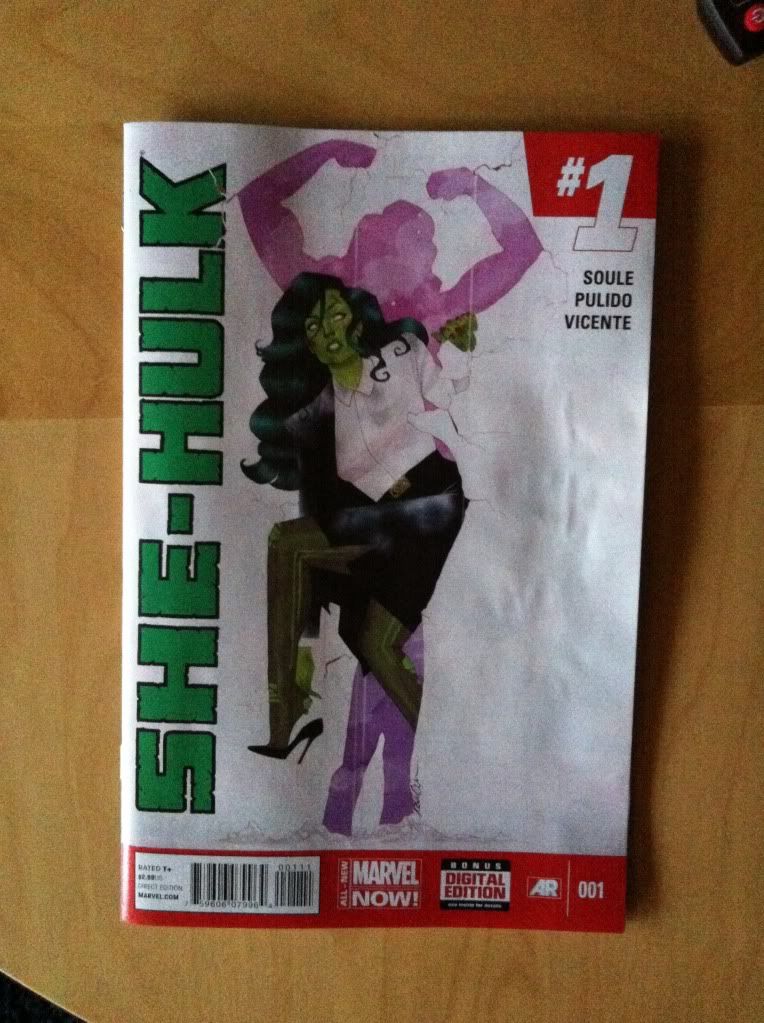
I really enjoyed She-Hulk #1. The hook of She-Hulk being the star of a law procedural with a light, comedic-ish air, while not completely original, is always good fun and Charles Soule, with his perspective as a practicing lawyer, really portrays the practice of law in an interesting and nuanced way in She-Hulk #1. It's a really fun comic.

She-Hulk #1 is also a really great looking, and technically interesting comic with some absolutely dynamite layouts by Javier Pulido paired with some fantastic colouring by Munsta Vicente. I'm going to take a closer look at a couple of my favourite layouts.

There will be *SPOILERS* for She-Hulk #1, so don't commit a crime against yourself and read the comic first.


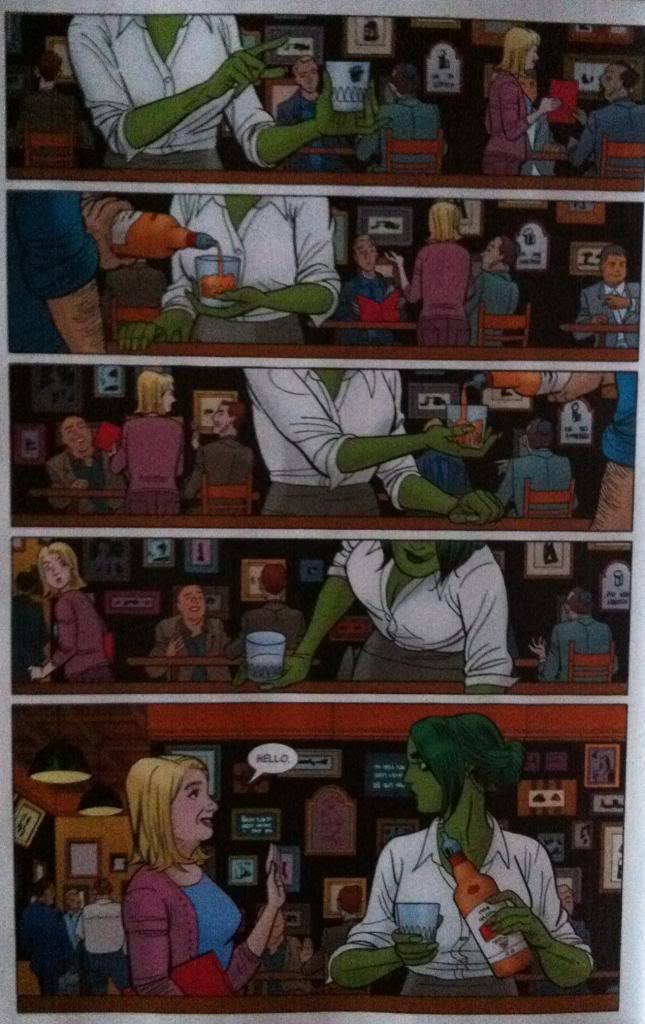
I am absolutely in love with this page: Team Shulkie deliver a really interesting pair of sequences that happen simultaneously. One story on the page is that She-Hulk, having quit her high paying law job hits up the local lawyer bar to unwind with whiskey (as is proper [assuming it is done responsibly]). She-Hulk's story ends in the last panel when a lady suddenly appears and says hello. However, this page has a second story which shows the suddenly-appearing-woman canvassing the lawyer bar with a red folder in the background showing where this woman came from. The way I read the page, I saw the entire She-Hulk story without even noticing the second story of folder-woman, so that I was just as completely surprised by her appearance as She-Hulk. Which is kind of great comics: I experienced the same She-Hulk-self-involvement and then surprise as the protagonist.

Now, admittedly, this might be because I am terrible at reading comics and missed something obvious that everyone else in the world noticed. But, the thing is, I've noticed some design elements that seem designed to trick the reader into only following the She-Hulk story and then doubling back to read folder-lady's tale.


My first pass of this page was governed by She-Hulk. She is the sole character in the foreground and is making a number of interesting, dynamic gestures and motions that change from panel to panel and guide the the reader down the gradual left-to-right line of her positioning. Just by body language and posing there is a rich enough pool of visual information to keep the reader busy and focused on Shulkie. This effect is magnified by the colouring. She-Hulk is coloured her bright, emerald green and is wearing a bright, white blouse, which compared with the drab, cooler colours of the background stands out considerably. Especially, when you account for how BIG the emerald/white colour blocks are compared to the much smaller, broken up colour patches of the people and wall signs in the background. Basically, the colouring of the She-Hulk story is just brighter and bolder and helps keep the reader focused on her story instead of the background.

(And really, the She-Hulk story almost functions without any background since tumblr, bottle, waiters arm, and bar top convey the key setting information in the foreground. Which is a really smart choice if you buy my argument that the artwork is designed to misdirect the reader into paying less attention to the background.)

It was these elements that kept me focusing on She-Hulk and her story on this page and made the appearance of folder-lady such an effective surprise.


Of course, once folder-lady appeared, and I realized she was an important character, I went back through the page and found the whole other story. And many of the same compositional elements used to steer through the foreground are also used to move the reader through the background folder-lady story. Colours highlight the woman's blonder hair and the red of the folder to catch the reader. Similarly the woman's gesture and her relationship to the folder helps make a visual guide that leads the reader through her story so that the folder-lady part of the page ends just as effectively with her looking at She-Hulk. It's a pretty clean, nice little sequence. 

And combined, I think, these two layered sequences make this page super interesting. Misdirection keeps the reader focused on She-Hulk and maximizes surprise, and then rewards the reader with a hidden, yet important story of folder-lady failing to find a lawyer. It's really cool, and honestly, how often do you see comics pages designed to be read twice?


This double page spread is also pretty awesome and does some really cool things with panel shape and perspective to emphasize some really interesting elements of the page that makes the drama/comedy of the page work.


The crux of what I love about this spread is the LOOOoooooooonnnnngggg hallway and how the art emphasizes the heck out of this distance to great effect. The composition, with its 18th floor Ding!, takes from the top of the first panel into the top of the second panel. This places us at the end of the hall and then, as we, look down the very tall panel we see, and experience, just how far away She-Hulk is from the end of the hallway. What's even more great about this is Shulkie is on an angle and facing upwards along the hallway which makes the distance loom larger and emphasizes the uphill-climb-challenge of walking down this very long hallway. This leads into the next two panels which show She-Hulk progressing along the hallway, but also walking uphill, continuing to emphasize the gruelling effort of walking down such a long-ass hallway. The composition then doubles back towards the centre of the page where we meet Legal, Tony Starks lawyer. The result of this doubleback is that the reading path takes just about the longest route possible to get from the elevator to Legal which makes us the reader actually experience the length of the hall. It is absolutely an amazing bit of design and layout work.

She-Hulk #1 is a fantastic comic that has me super excited to read more She-Hulk.


Monday, 24 February 2014

Atoll Comics Round 12

Or changes to my top-ten comics 

Due to poverty and an urge to buy better comics, I have decided to be super-selective about which superhero comics I read. Harnessing the Awesome Power of Maths, I have determined that I can afford to read 10 ongoing titles. So I get to read 10, and only 10, titles published by either Marvel or DC as well as one trade paperback a week of my choosing.

A complication of this is that I am forced to drop an on-going title if I want to try reading a new on-going title, an act of very tough love. Being financially responsible is the worst.

I will be adding She-Hulk and dropping FF.


Why She-Hulk: She-Hulk is absolutely the kind of comic I want to read from mainstream Marvel. It's fun, has an interesting narrative angle (lawyer She-Hulk fixing problems she can't punchout), and is absolutely beautiful with just masterful artwork by Javier Pulido. It's great!

Actually, I think the magic of She-Hulk goes beyond quirk and execution. I'm a career academic who TA's to supplement my income which means I spend a lot of time trying to figure out when people have no idea what they are talking about. So I'd like to think I'm developing a sense for when people are experts or trying to fake it. And the thing is She-Hulk is a comic that is being written by Charles Soule who is an actual, real life lawyer and his expertise really shines through. The result is a comic that feels authentic and nuanced and interesting. While, you know, still being fun and charming and funny. 

And that's not even getting to the art team of Javier Pulido and Muntsa Vicente. She-Hulk is a comic that visually is basically perfect. Javier Pulido has a gorgeous clean style, amazing character acting chops, and just endlessly fascinating approaches to layout that make even the most legal-proceeding heavy sequences interesting to look at. Muntsa Vicente, meanwhile, is the perfect colourist with a bright, pop-arty, flat colouring style that is the perfect partner for Pulido's lineart. She-Hulk is a comic with the kind of art that is worth the price of admission.

If you like my taste in comics, especially those in my top-ten mainstream books, than the first issue of She-Hulk is pretty much a must read. If it is any indication of the kind of book the whole series will be, than it will absolutely be a top-ten comic.


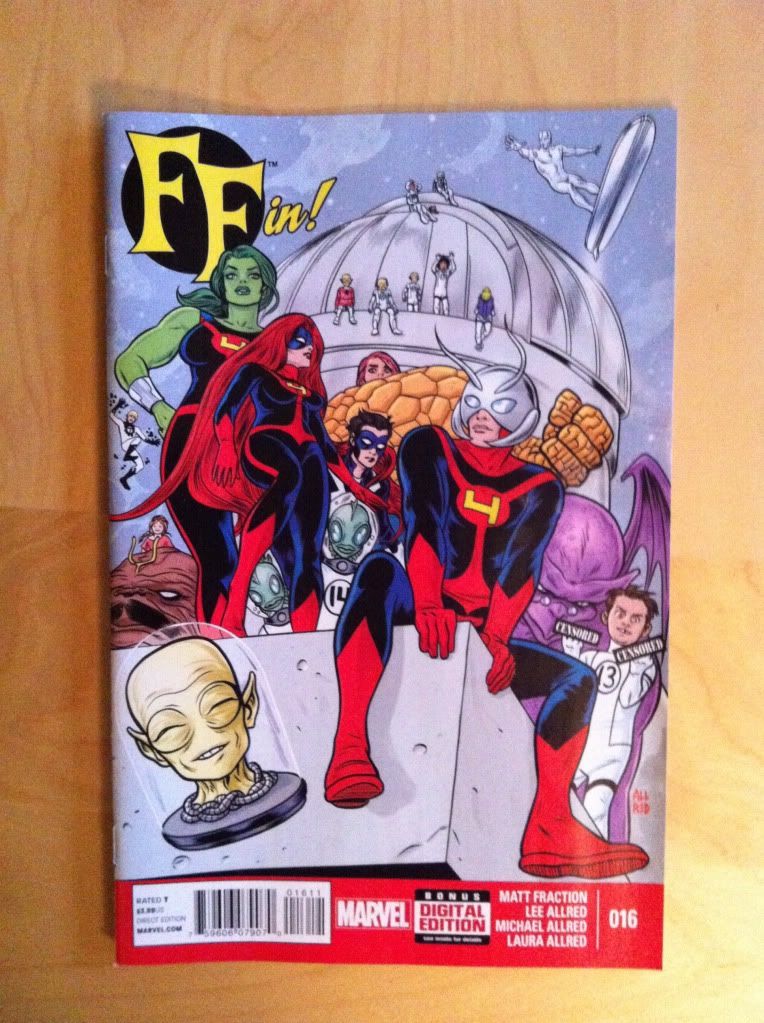
Why not FF: FF is another great comic that has ended. For being a comic I almost didn't buy into, largely because I was so happy with Hickman's FF, I ended up really enjoying the Fraction/Allreds version. This FF wasn't the high concept Sci-fi book that emphasized the weird nature of child genius, but was instead, at its best, a book about a bunch of kooky comic book kids being fun. FF was like this joyful celebration of everything that is great about comics that was also a really well made comic. But like most really great and original mainstream comics, it has an ending and that means it's time to say goodbye and replace it in my Pull List.

Previously: