Showing posts with label John Workman. Show all posts

Wednesday, 17 August 2016

Deep Sequencing: Unshuttering Shutter

Or a look at the use of style motifs in Shutter: Volume 4
by Joe Keatinge, Leila Del Duca, Owen Gieni, John Workman; Image Comics


Shutter is a comic I'm always looking forward to reading the next trade of. Its a solidly engrossing story built around the collision between Saturday-Morning-Cartoon fantasy adventure and a mature approach to consequences. It's also a comic filled with a delightfully mad mashup of well, everything: anthropomorphic animals, steampunk robots, magic, mad science. It's imagination unleashed and super fun to see. Shutter is also proving to be a comic that does some really smart and compelling things with storytelling. And since that is the reason for this blog, I'm going to take a closer look at a couple of my favourite aspects of the comic. 

There will be *SPOILERS* for Shutter Vol. 1-4.


One of the chapters that make up Shutter Volume 2 is split into three parallel backstories. This comic tells the origin stories of Chris Kristopher Jr, The Leopard, and Kalliyan, three secret siblings of Shutter's protagonist. The comic presents all three backstories at once, splitting each page into three panels with one devoted to each character. The comic also colour codes each of these panels, blue for Chris, yellow for The Leopard, and magenta for Kalliyan. This makes the division between stories super obvious to the reader and also gives each story it's own visual character and distinct feeling. It's an effective solution to a clarity problem and basically allows the for the simultaneous presentation of each story. Which is really important because the magic of this chapter is how the three stories play off each other. While a reader could basically read each tiered third as its own miniature comic, the real pizzaz of this part of the comic is seeing the parallels and differences between each character's circumstances. This allows for some really beautiful moments of common humanity and some pretty powerful and sharp differences, especially given what the reader already knows about each character. It's a pretty remarkable comic in its construction and experience. 


The other thing about this volume of Shutter that I quite enjoyed was its use of stylized flashbacks. I've been interested for a while in how comics sometimes use different, retro styles to distinguish between contemporary and flashback sections of the comic. Shutter is interesting because rather than just use a generic 'old comic' approach to its flashbacks, it uses art and comics styles that riff on particular art style and eras. This functions to provide narrative information (contemporary/flashback) but also grounds these flashbacks in a kind of loose timeline. The story about young Chris Khristopher Sr. falling in love borrows a Eurocomic/Herge style that, along with fashion choices, sets the comic in the 1930s or 40s. The flashbacks of Kate Khristopher and her romance with Huckleberry use a kind of zine comic style that feels like the 1980s or 90s. The flashback introduction of Zohra, a past mentor to Chris Khristopher Sr., uses bright popart stylings that tie the flashback to the 1970s or early 80s. Finally, there is a brief flashback sequence of one of the magic ratguys from the comic that uses pure, sepia-toned dot colours and a cartoony style to evoke old timey comics. This choice is less about evoking an era, but more about playing off the contrast between the Saturday-Morning-Cartoon-nostalgia of Shutter's world with the realistic violence and drama that permeates the comic. All of these choices work to provide story clarity but add an extra level of context that helps make Shutter feel more like a real world with a distinct history. It's good stuff. 

Previously:

Monday, 5 May 2014

Deep Sequencing: 100% Dialogue

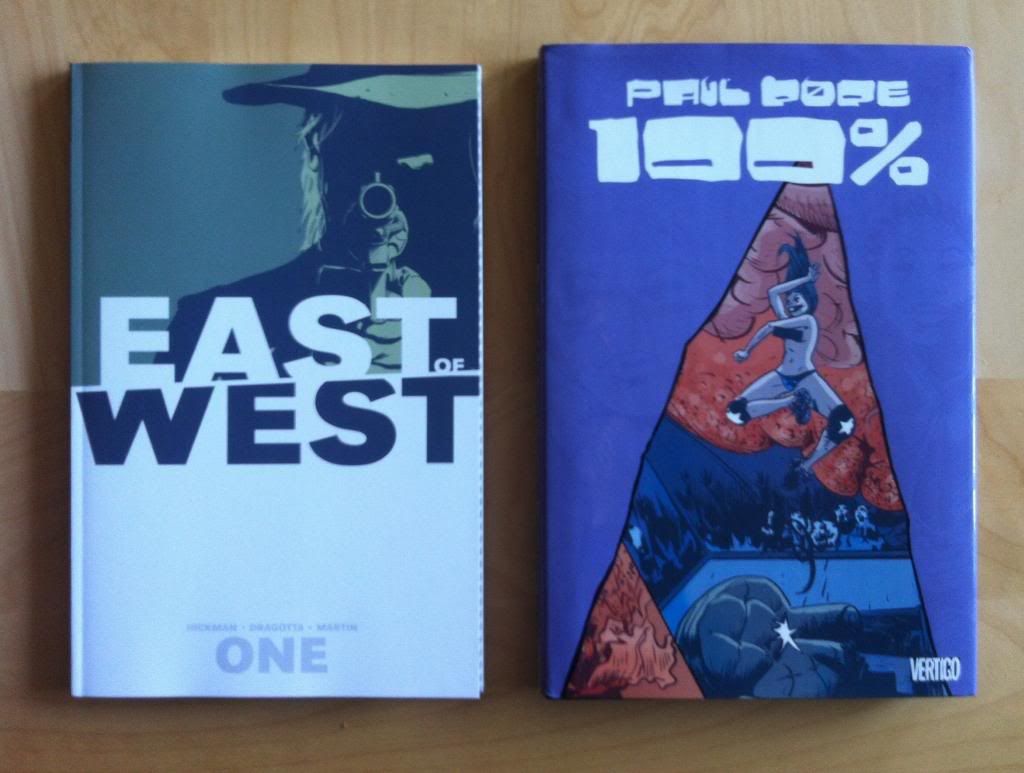
Or an interesting approach to dialogue in Paul Pope's 100% and Jonathan Hickman & Nick Dragotta's East of West: Volume 1
With lettering by John Workman and Russ Wooton


I think one of the most under appreciated aspects of comics is the lettering, that secret art of placing word balloons in just such a way that everything effortlessly works. When done badly, dialogue doesn't follow a comprehensible order and is confusing, and artwork is trampled beneath inelegantly placed text balloons. When done well the dialogue is beautifully and logically arranged on the page in a way that relates to the artwork in an artful, organic way. (And when done perfectly, the placement of text can actually be an asset to help lead the reader through the page.) In this post I'm going to look at two books that have really great, but very different approaches to lettering.

There will be some will *SPOILERS* for East of West: Volume One and 100%.


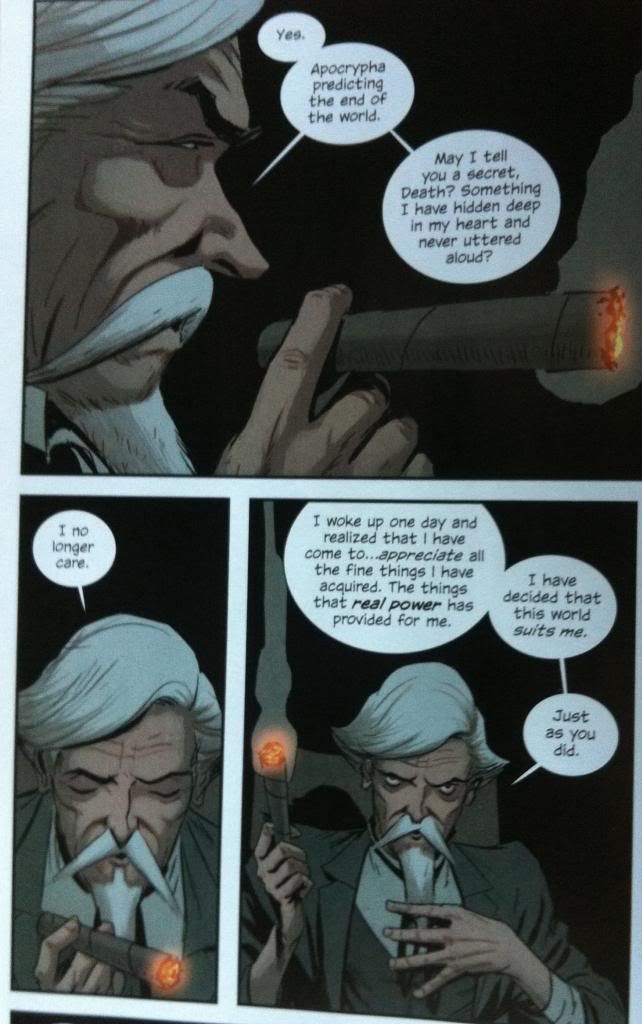
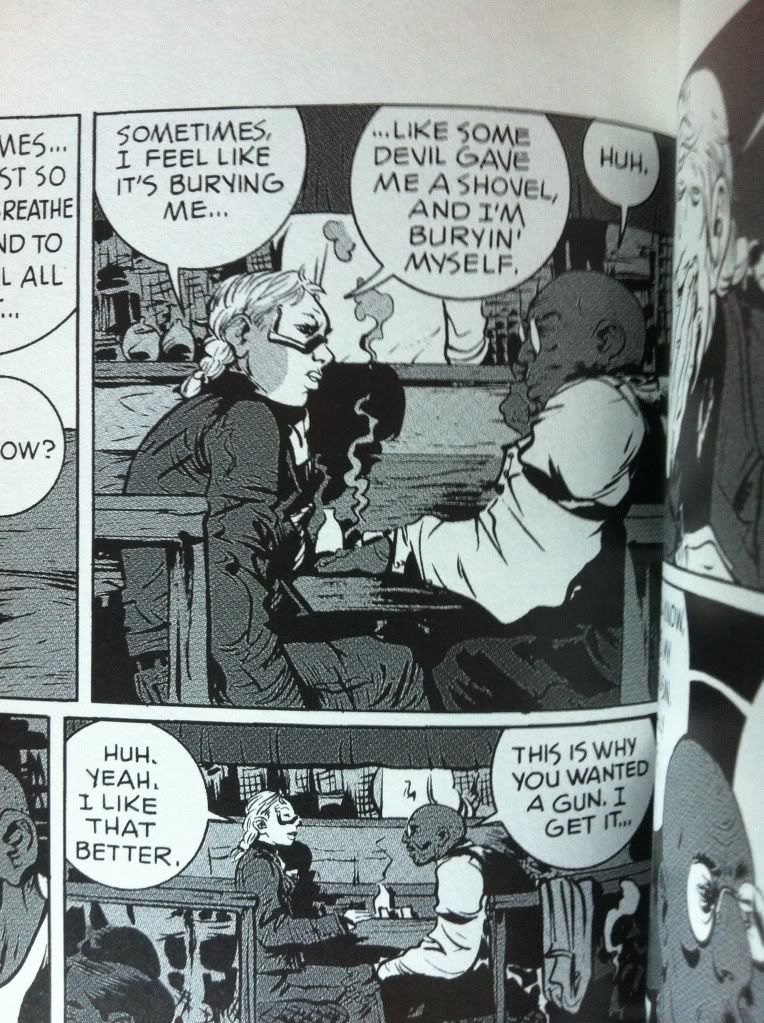
East of West, with lettering by Russ Wooton, has some really expert, really adroit examples of what I would call "conventional" lettering. Most speech bubbles have a single tail, and longer exposition is linked as a series of bubbles. The bubbles are elegant and interacts with the artwork in a really smart way. The two sequences I've picked above are particularly good as they do a great job of leading the eye around the page so that the facial acting in the artwork is encountered in just the right moment. This ensures that the emotional resonance of each word and moment is pitch perfect, which enhances the exposition portrayed and adds tremendous dramatic weight to this sequence. It's great.


The text in this sequence here does some really interesting guide work. For instance in the first panel, we see the man's face before seeing the text which sets the emotional tone. We then read through the dialogue before encountering the glowing tip of the cigar, and important symbol of terrestrial wealth and power throughout this conversation. In the next panel (well I skipped a panel, but the next displayed here) we read the text before seeing the man looking down at the cigar: we see the thought he no longer cares about spiritual things and then see the reason for it (earthly power totem).  We then move into the next panel, see the cigar/totem held aloft like a sceptre/torch, and then proceed straight to the text where we read our way around the panel in a circle, eventually arriving back on the man's face as he looks up at who is addressing in challenge. The way the text keeps us from seeing his face until the end of the page, adds a lot of weight to that final glance. It's great comics.


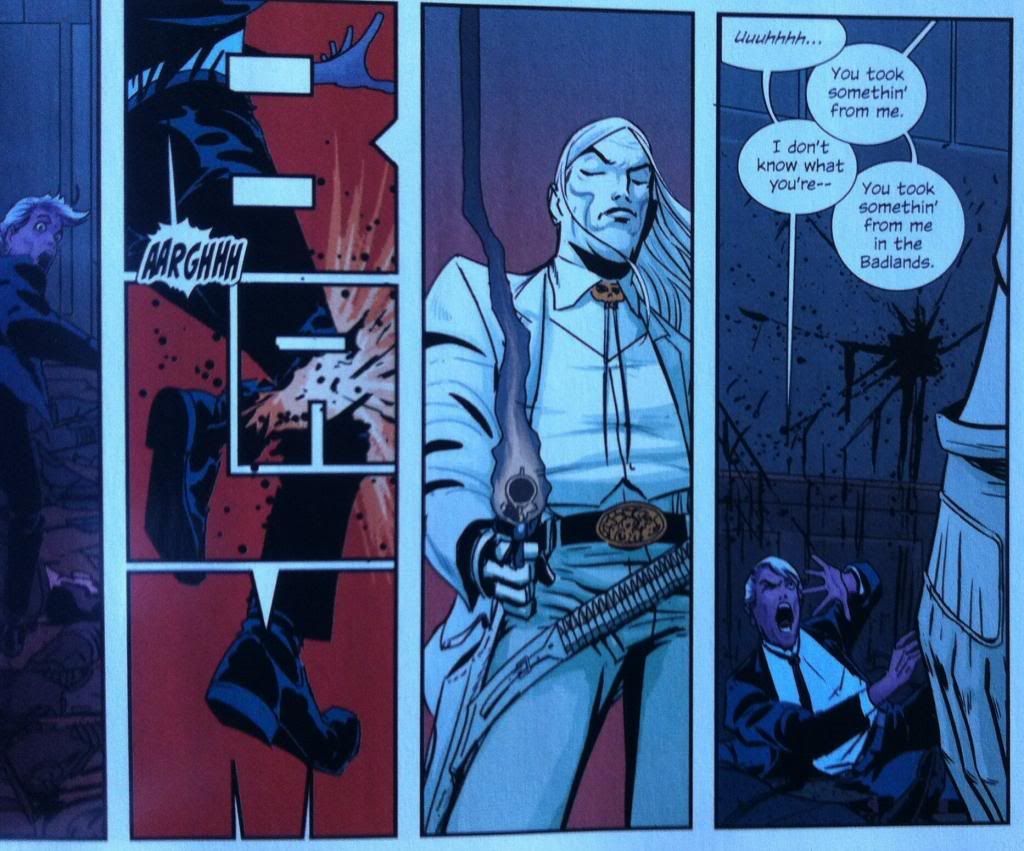
(This sequence here is less about good lettering and more about how much I love the "BLAM" pannel here. I love how the sounds of many words, show the shape of the action or sound. Like "drip", where the "dr" is evocative of water beading, the "i" catches the tiny moment of a drop falling, and the "p" sound catches the noise of a drop hitting a surface. "Blam" works in a similar way where the "Bla" catches the explosive noise, the "m" brings to mind the cavernous echo/silence that follows the report. The fact the "A" of "BLAM" is the point of impact is therefore a stroke of bloody genius. I love it.)


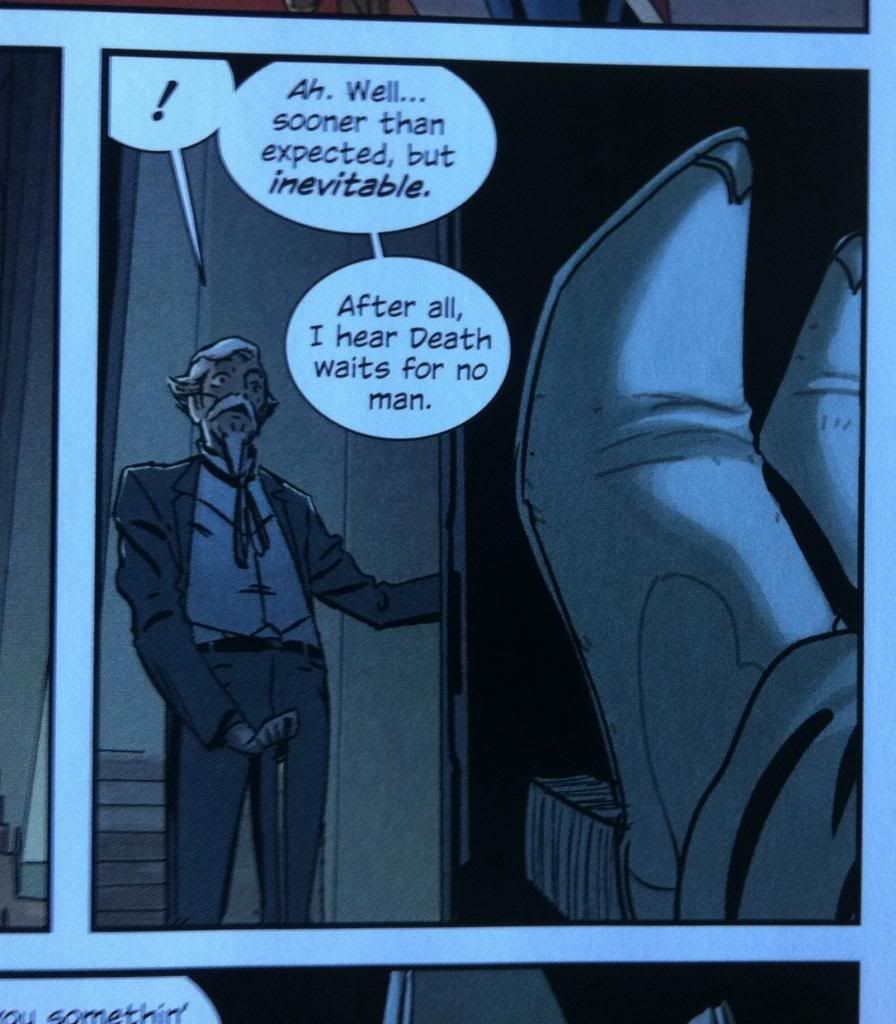
The one problem with conventional dialogue box placement, as pretty as it is, is that sometimes the image of the moment, and the text of the panel don't entirely match. This is an example from East of West this text/image disconnect. We enter this page, read the text, noting the surprise mark and then the transfer to the cool, unflappable dialogue of the character, BEFORE we see the shocked face of the character. The text precedes the face, takes us past the moment of surprise, and then dumps us back in the previous moment. It's not the best lettering in the comic (which is mostly really great!). But to a certain extent this kind of lettering backtracking is unavoidable, a consequence of panel limitations and script being packed in. It is, I think, an inherent risk of the standard lettering approach.


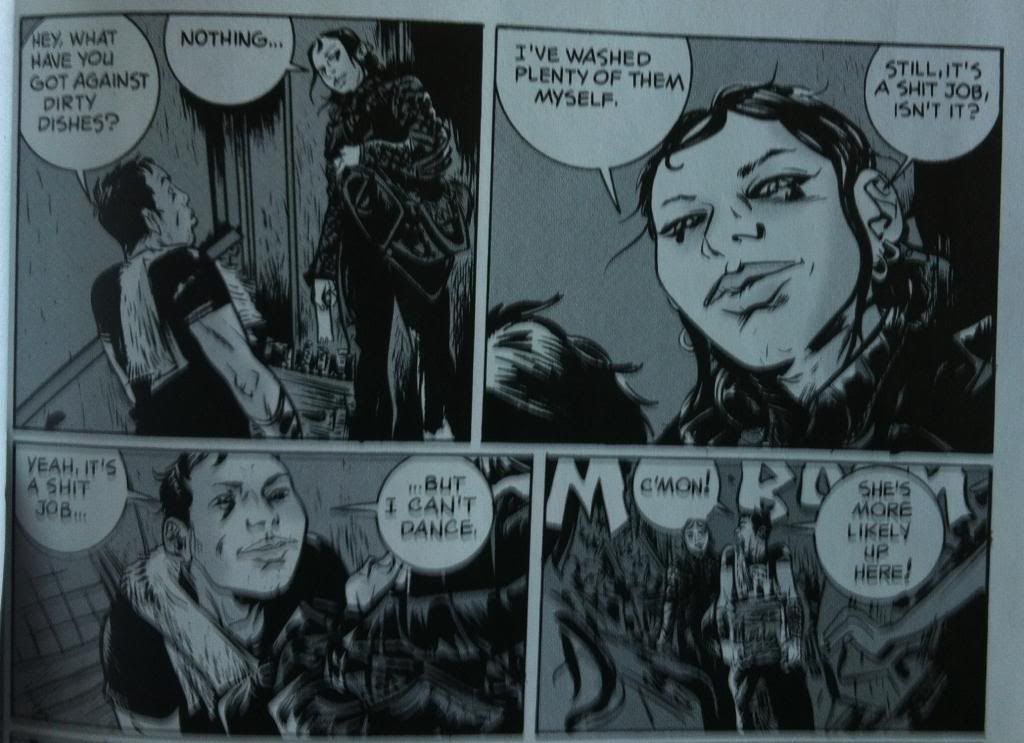
100% by Paul Pope with lettering by John Workman uses a different approach to lettering, and one that I don't see very often. Instead of building dialogue balloons carefully into the artwork with the standard approach, 100% almost always splits the dialogue so that characters are surrounded by their dialogue. We get to experience half the text, see the emotion, and then finish the text. What this does is embed the emotion of the moment right into the centre of the text: the face we see is the face of the whole dialogue moment. It's maybe a bit brute force at times, but it makes sure that the characters acting is always appropriate to the text. Which works really well for a character driven comic about living 100% in the moment. It's really cool comics, and maybe an approach that solves some of the problems of the standard lettering approach.