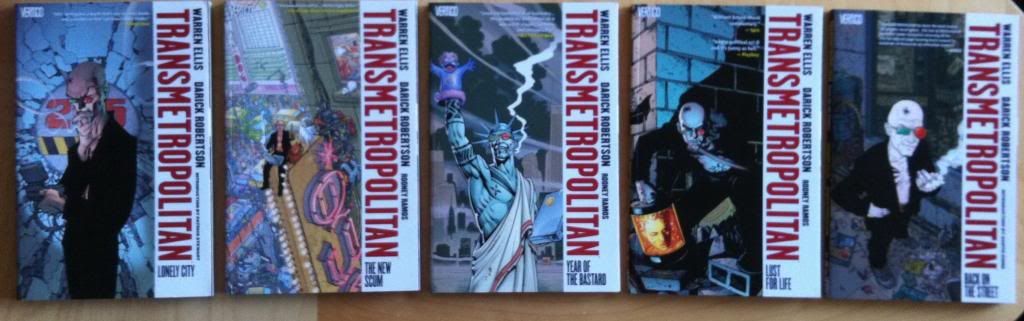
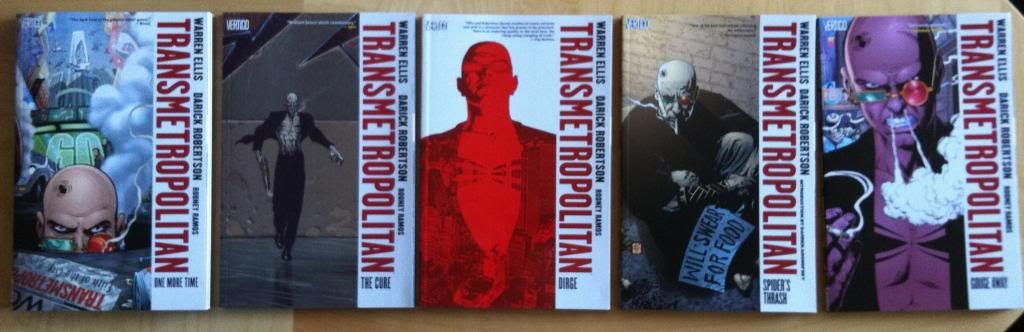
Showing posts with label Darick Robertson. Show all posts

Monday, 7 April 2014

Deep Sequencing: Admiring The Hole

Or some of the brilliant design choices and motifs in Transmetropolitan
By Warren Ellis and Darick Robertson; Vertigo Comics


Transmetropolitan is a comic that, I think, is justifiably very well regarded by a lot of people. It's certainly one of my all time favourite comics. And there are a lot of reasons why I am so crazy about this comic: the thematic examination of the intersection of politics and journalism is fascinating, the way tension in the story builds is breath-bating, the gonzo Science Fiction is fun, and the relentlessly juvenile humour is a joy. Transmetropolitan is also a comic with some really adroit artwork and storytelling, with some of my favourite sequences in comics and a superdense, highly developed sense of place. It's a really great comic.

One of the things I am most interested in Transmetropolitan is how certain recurrent visual elements are used to drive theme and character in the comic. Transmet is, buried in all of the bowel disrupters and sex puppets, a comic that does some remarkably smart things with symbols and motifs to subtly relay information to the reader. And since comics blogging is about obsessing about small, interesting choices I'm gonna show you some of my favourite.

There will, as always, be *SPOILERS* for Transmetropolitan in the following.


THE GLASSES: One of the most obvious recurring elements in Transmetropolitan is Spider Jerusalem's glasses. In the story, the eyewear operate as Spider's hightech personal screens and cameras that record the world around him. But they are also a key part of his character design that convey a lot of information about him. Like, the green and red different coloured lenses are reminiscent of 3D glasses and suggest Spider sees the world in greater depth and detail than those around him. Or, and I'm stealing this from a great character design essay by Aaron Diaz of Desden Codak, the shape of glasses give Spider a permanent cocked eyebrow type of look, which is the perfect expression of inquisitiveness, and the basis for a sardonic smirk. But it maybe even goes a little further than that: Spider is a character very much defined by his paradoxical ability to be a massively cynical analyst while still appreciating the truly remarkable aspects of life. And I think this is captured in his glasses which are split between a wide-eyed awed look and an analyzing scowl.

And the glasses are not limited to Spider. As Transmet progresses The Filthy Assistants progress from caregivers/coffee fetchers to junior journalistic comrades, and by the end of the comic they become chain smoking, glasses wearing truth seekers themselves. Admittedly, both women go through a few different phases of eyewear, but the ones they have on at the end,  I think tell us something about their characters. I have a theory that the shape of their glasses are reflective of their character as journalists. Yelena Rossini takes to wearing very narrow shades, maybe representing her evolution as a cynical, Spider Jerusalem style reporter. Channon Yarrow takes up wearing round glasses, which is maybe symbolic of her eventual career path as a novelist with a more big  picture, less cynical view of the world. Which maybe captures the round-lense, dreamer half of Spider's writing views. 


THE TATTOO: Another recurrent element in Transmet that gets used in interesting, subtle ways is Spider Jerusalem's forehead spider tattoo. It's a great piece of character design: a creepy tattoo drawn directly on the face really cements Spider as a counter-culture figure and acts very much as a symbol of him. A spider for Spider. But this tattoo also gets used in this really clever way to subtly hint at the health status of Spider. When he is healthy the tattoo appears as a crisp, unbroken black tattoo. As Spider's brain condition becomes more prominent and he is injured, the spider tattoo is split in a wide, bloody gash. Spider is symbolically cut asunder. Following this the tattoo shows the steps of Spider's recovery, beginning bandaged and hidden, and then emerging broken, split by a new scar. Symbolically Spider is recovered, but still broken and flawed. And all of this is conveyed only by the status of Spider's head ink. 


The Spider tattoo also tells us things about Yelena. As she becomes more of a journalist and begins to become, more and more, a kind of disciple of Spider, she gets the Spider Jerusalem style spider tattoo on her bottom. A symbolic representation of her growing Spider-ness. In the final chapter of the story, when Yelena is her own, mature, journalist we see her with her own spider-ish tattoo: a female symbol with spider legs: kind of an amalgamation of her Spider-ness with her own, special voice. All shown through symbols.


SMOKING: Another ongoing motif I love in Transmet is cigarettes. Throughout Transmetropolitan smoking is used as a signifier of someone telling the truth. Spider Jerusalem, the vulgar truth spilling asspot himself, chain smokes like an industrial chimney and becomes a plume of smoke when he is telling the truth. The Filthy Assistants, as they become journalists take to smoking. Royce, Spider's editor, chain smokes, particularly in scenes where he trumps his papers management to further the truth. Spider's sources, from the vile Fred Christ to the sympathetic Liesl, a former transient hooker, smoke cigarettes while they tell their truths. And even a lowly TV producer lights up when she decides to fuck the censors and display important news damn the consequences. It's a great visual signal that is not only handy, subtle information for readers, but is also just visually great: it's like the truth is a fire in the belly that billows out as smoke. It's great comics.

Previously:
So I Read Transmetropolitan
Deep Sequencing: My favourite Transmet sequence.

Friday, 4 April 2014

Deep Sequencing: Bowel Disruption

Or one of my all time favourite comics sequences that makes me lose my shit in Transmetropolitan
By Warren Ellis and Darick Robertson, Vertigo Comics


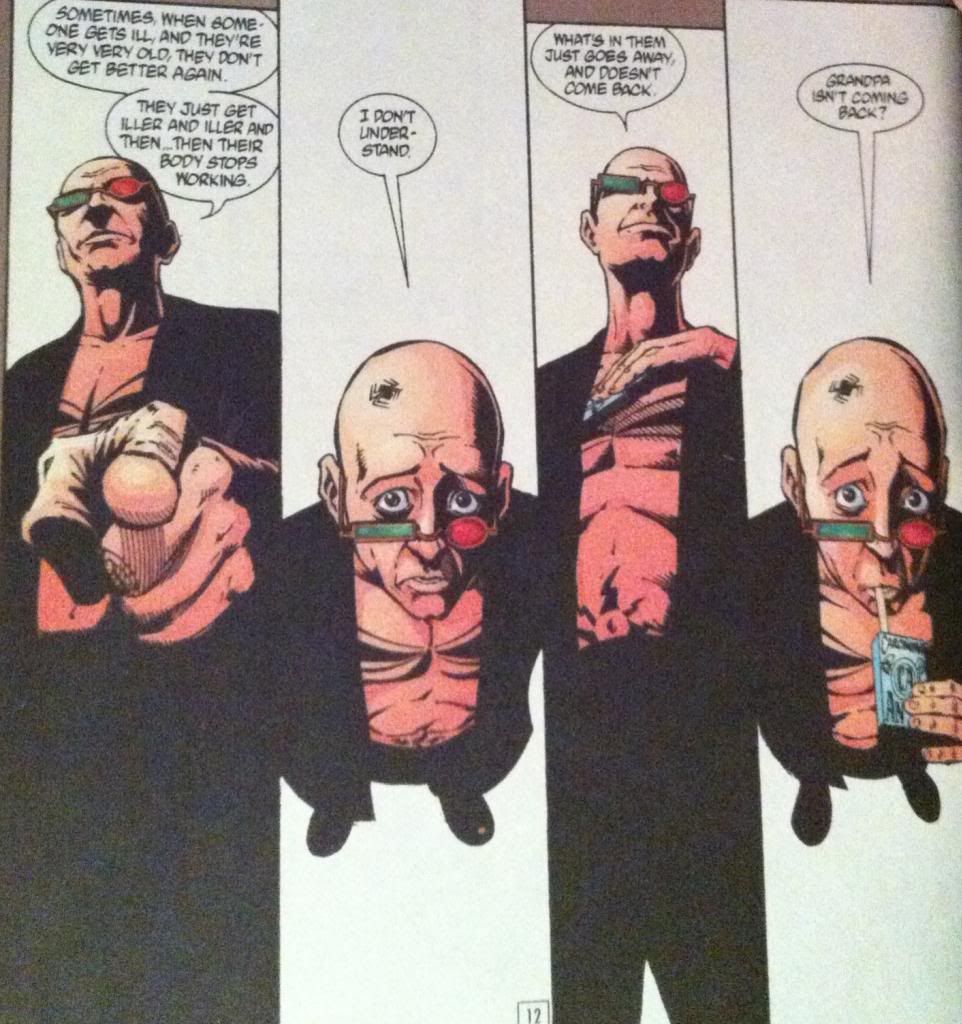
Way before I started writing about comics and really looking at sequential art as a series of story telling choices, there were some sequences in comics that were immediately, obviously great. And this sequence in Transmetropolitan has stuck with me forever as a fantastic comics sequence. It's been my example of how smart composition enhances storytelling from before I had any need for such examples. And now that I actually need such examples of great comics, you better believe we are going to take a closer look.

There will be mild *SPOILERS* for Transmetropolitan below.


This sequence tells the story of Spider Jerusalem relaying an anecdote about his grandfather's death when he was but a boy. As part of this anecdote Spider delivers the dialogue of the conversation between him and his parent, presumably using affected voices.What I love about the sequence is just how clearly it delineates the adult dialogue from the child dialogue in the anecdote. The crux of this is the way the angle of the panels changes so that the "camera" is aimed down at "child" Spider and aimed up at "adult" Spider-parent. What this essentially does is give the reader alternately the perspective of an adult looking down at child or the gaze of a child looking up at a stern parent. It also, has the added effect of presenting Spider in two very different ways: from above he looks smaller, seems to have a larger, disporportionate amount of head, and you can clearly see his eyes, while from below he looms over the frame and his eyes are hidden behind his glasses. These alternating perspectives make this a pretty good sequence.

But the thing that, for me, that makes this sequence so completely memorable, is how the cigarettes are used throughout the composition. In the third panel, Spider reaches into his coat to grab a pack of smokes, making a very adult, commanding hand gesture, reminiscent of a hand cocked to smack a child. While in the fourth panel, and this is my favourite, Spider pulls a cigarette out of the box with his mouth in a way that looks like he is drinking from a juice box. A very childlike activity. Add, in the next page, "adult" Spider performing the very grown up activity of actually smoking and you have cigarettes used to completely enhance the adult/child split in this composition in a way that is super clever and unique to this series of panels. It's perfect.

Previously:
So I Read Transmetropolitan

Wednesday, 2 April 2014

So I Read Transmetropolitan

A 250 word (or less) review of the complete series of Transmetropolitan,
By Warren Ellis and Darick Robertson; Vertigo Comics


Transmetropolitan is easily one of my all time favourite comics. Easily. The comic is about the power and importance of journalism particularly as an essential brake on the machinations of politicians. To explore this, Transmetropolitan uses the lens of Spider Jerusalem, an infamous journalist and mildly loathsome creature, as he returns to The City in a vulgar and shocking future. Jerusalem takes up a column and along with his Filthy Assistants explores the wondrous, the downtrodden, and the futuristic while fucking with the local authorities and generally running amok with a bowel disrupter. That is until the Presidential Election, where Spider delves into the disgusting truth of politics and makes a powerful new enemy. "Journalism is just a gun. It's only got one bullet in it, but if you aim right, that's all you need. Aim it right, and you can blow a kneecap off the world." Transmetropolitan is a comic chock full of brilliantly deep characters, imaginatively vulgar settings, high concept Sci-fi, holy shit tension, and ineffably beautiful observations of the human condition. It is by far one of the most complete long running comics you can read: from beginning to end it maintains a sterling level of writing and art and manages to be a perfect blend of gripping, funny, smart, and offensive. It's fucking fantastic comics. Read it, and it might just blow a kneecap off your world.

Word count: 230