Showing posts with label Alberto Ponticelli. Show all posts

Friday, 14 August 2015

Deep Sequencing: Zero Repetition

Or a look at the diversity and aplomb of some of the art from Zero Vol. 3
by Ales Kot, Ricardo Lopez Ortiz, Adam Gorham, Alberto Ponticelli, Marek Oieksicki, Jordie Bellaire, and Clayton Cowles; Image Comics


Zero is an achingly sincere, brightly subversive, and horrifically violent Sci-fi espionage comic. The ongoing story about Edward Zero, a deeply broken secret agent programmed from childhood to be a killing tool, is fascinating and a comic that I highly recommend as a pure reading experience. It is also a comic that is a great example of an art showcase: every chapter of Zero features a different penciller with a dramatically different style. A style that series writer Ales Kot seems to craf a perfect script for and superstar colourist Jordie Bellaire adds the perfect finishing touch to. And the result is a comic that is a great Spy comic that is also one of the best art anthology comics I've read.

So I thought I would take a look at some examples of the diverse and fantastic artwork from Zero Vol. 3 and the way each artist's style is used to create a distinct chapter of the story.

There will be *SPOILERS*.


The first chapter of Zero Vol. 3 is drawn by Ricardo Lopez Ortiz and is this fantastic lesson in tension. The story of the issue is one where Agent Zero, living a civilian life in Iceland, is waiting for the other shoe to drop and to be attacked by The Agency he escaped from. The story shows Edward living an idyllic life, living on a farm with a beautiful young woman and yet everything about the comic screams THE SHIT IS ABOUT TO HAPPEN. And this is hugely pulled off by style: Ortiz brings this squinty, clenched quality to every panel of the story making the story feel flexed on the edge of catastrophe. Take the above selection where Edward, encouraged by his bubbly lover, is petting the chickens to make for happier eggs: the poses are hunched, Edward is scowling, and in the distance a volcano explodes while the background darkens into a concentrative loom. It's a scene depicting happy chickens being pet, and yet everything feels like the end of the world. It is absolutely brilliant comics.


The second chapter features pencils by Adam Gorham. The story of this chapter sees Edward Zero travel to a house in The United Kingdom infested with some sort of mind-assimilating fungal spore. The sequences around this segment of story are pure rot-horror. What I love about the artwork in this portion of the story, particularly the above selection, is how Gorham's clean and meticulous style juxtapose with the creeping chaos of the creeping fungus: we can see the underlying clean structure as well as the many tiny spores and mushroom caps and climbing molds that are trying to conquer everything in the room. Another thing I love about the above selection is how all of the tiny boxes simultaneously call attention to the finer details of the rot and also lend the page a huge amount of motion as things seemingly grow and spread and creep and drip through the page. It gives the page a sense of urgency and the fungus a ruthless, predatory presence it would otherwise be lacking. Which comes largely from the very smart, very distinct style of this chapter.


The final two chapters in Zero Vol. 3 are drawn by Alberto Ponticelli and Marek Oleksicki. These two artists are masters of brutal violence and do an amazing job capturing the horrendous, gut turning violence of these chapters. Zero is a comic that portrays it's violence not as noble performance art, but bloody, destructive, and disgusting episodes of the worst humanity has to offer. And both Ponticelli and Oleksicki really rise to the occasion delivering two of the most gloriously uncomfortable and best composed fight scenes I've ever read. I actually felt queasy and hot with animal fury at the end of each. I especially love how Ponticelli, above left, builds panel flow into his compositions giving his fight scene a speed and visceral directness that gives that chapter a feeling of people rapidly and viciously hurting each other . Oleksicki is just as impressive using layouts that are fractured, filled with surprising, disjointed vectors. This choice gives the fight in the final chapter a choppy, lurching quality that matches the story of two men animalistically tearing each other apart in this drawn out and oddly intimate way. It's spectacularly awful. Which again is a showcase of great artists using their respective styles to portray really skillful comics stories.

Which I think really speaks to a maybe under-appreciated strength of comics as a medium. Unlike most other storytelling mediums, particularly visual ones, comics have the lowest cost of radically altering styles between chapters. In movies, television, and animation, the time and monetary costs of radically altering the visual look of a project is steep. Comics, with their small creative teams and nigh endless-content budget, have a freedom to experiment with variety that is maybe unique to them. And this allows for comics with a serialized, common story to showcase tense chicken petting, ornate sci-fi horror, and nauseating acts of human destruction all in the same book. Which is pretty cool.

Zero, as a series, is really great at this, which is yet another reason you ought to be reading this comic.

Previously:
So I Read Zero: Vol. 1
So I Read Zero: Vol. 2
So I Read Zero: Vol. 3

Deep Sequencing: Brutal Action
Deep Sequencing: Gun fight!
Deep Sequencing: Zero Atlas

Wednesday, 12 August 2015

So I Read Zero: Tenderness Of Wolves

A 250 word (or less) review of Zero Vol. 3
by Ales Kot, Ricardo Lopez Ortiz, Adam Gorham, Alberto Ponticelli, Marek Oleksicki, Jordie Bellaire, and Clayton Cowles; Image Comics


Zero: Tenderness of Wolves is part of an ongoing series. To read about Vol. 1 go here.

Zero: Tenderness of Wolves continues the story of Edward Zero, an assassin and spy trained and indoctrinated from childhood to be an obedient killer. Except in Zero Vol. 3, Edward is free, living in a kind of happiness in Iceland. But when you are the kind of killer Zero is, there can never really be peace and when his former handler gives him an offer he can't refuse Edward Zero reactivates. Zero: Tenderness of Wolves continues the tradition of askew psychological drama with really brutal, really horrifying violence and is just a pretty great comic. Zero: Vol. 3 also really exemplifies the way Zero is also an art showcase anthology: every chapter/issue of Zero is a special story written to show off the skills of a different artist. Which gives every portion of Zero a unique visual identity and makes every story a fantastic example of oddly comedic tension or creepy futuristic horror or  truly brutal fight scenes of unbelievable violence. Zero is a worthwhile read both for the quality of its ongoing story and for the quality and variety of the artwork being showcased. You'll discover a subversive, violent world and maybe a new favourite creator or two. 

Word count: 199

Post by Michael Bround

Previously:
Zero: An Emergency
Zero: At The Heart Of It All

Deep Sequencing: Zero Mercy
Deep Sequencing: Zero Atlas
Deep Sequencing: Firefight

Friday, 11 April 2014

Deep Sequencing: Unknown Colourist

Or a look at how changing colouring styles alters storytelling in Unknown Soldier
by Joshua Dysart, Alberto Ponticelli, Oscar Celestini; Vertigo Comics 


Unknown Soldier is a great comic that functions as an important glimpse into a pretty important and dark topic while also telling an exciting and accessible story. It's journalism and activism through fiction which is pretty cool.

It's also a comic that uses two radically different colouring/inking styles in different chapters. What's especially interesting about this artistic shift is that both chapters are done by the exact same creative team. What this means is the two chapters share many common elements: an identical authorial tone from the same writer, a consistent approach to storytelling and overall style in the same penciller, and even the same colourist. But at the same time, the style changes, even with the same creators, makes the comic feel radically different. It's like one of those accidental, ideal economic experiments but for colouring. Which I think, make it a pretty cool thing to take a look at.

There will be the mildest of *SPOILERS*.


The majority of Unknown Soldier has what I would call a more conventional comics style. Characters and backgrounds are rendered with clean, but heavy inks that draw eye to the depth of the underlying pencils. The colouring enhances this: colours are mostly flat, with a single primary colour for most subjects, which is then judiciously rendered to provide lighting effects (particularly in night scenes, like above). Coupled to a pretty muted and harsh colour palette, Unknown Soldier is a pretty harsh looking comic that works very well for an action comic set in a horrific warzone.


Dry Season, one of the four main chapters of Unknown Soldier, is set in a refugee camp during a period of extreme heat and dryness. In many ways it is the most journalistic of chapters, given that Unknown Soldier takes a break from war stories to focus on the human cost and tell a more low key, mystery based story. This chapter also features a shift in artwork to a much more painted style. Instead of the very-comics clean, heavy inks and flattish colouring, Dry Season has heavily rendered colours done right over the pencils. The result is something much drier and stiller, which is really appropriate to a story about static refugees dying of thirst. This style is also much more realistic: real life doesn't have inks, and we understand the world around us using light and shadow like a painting, and this style captures this better.

Overall though, I think I like the Dry Season colouring approach more for Unknown Soldier. While I usually prefer simpler, flatter colouring since it doesn't distract from the lineart and  because I think it is often more elegant, I feel like a comic with such journalistic goals benefits from a more photorealistic style. The default style of Unknown Soldier is great, but it looks like a comic, a fictional universe we are visiting. Dry Seasons looks more like the real world, like field sketches of a grim reality. And for the humanitarian goals of this comic, that sense that this horrible shit is really happening makes it so much more affecting. 

Which I guess conveys two things: that a dramatic change in colouring approach can radically change the emotional feeling of a comic and that different types of stories beg for different styles of colouring.

Previously:
Unknown Soldier

Wednesday, 9 April 2014

So I Read Unknown Soldier

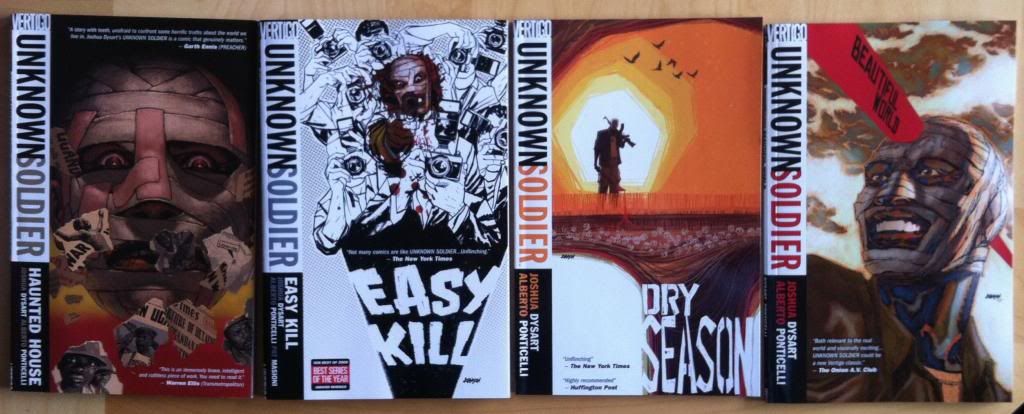
A 250 word (or less) review of Unknown Soldier: Haunted House, Easy Kill, Dry Season, Beautiful World
by Joshua Dysart, Alberto Ponticelli, Pat Masioni, Oscar Celestini, and Jose Villarrubia; Vertigo Comics


While I think I’m a reasonably well-informed person, I really don't know much about Subsaharan Africa and the conflicts afflicting the region. I think this is typical of many North Americans. Unknown Soldier is a comic that aims to educate an ignorant Western audience about the fight against messianic-madman and insurgent leader Joseph Kony and his Lord's Resistance Army during the height of the conflict in Uganda. The comic provides an unflinching look at this truly monstrous thing, from the use of child soldiers and child sex slaves to the desperate plight of the displaced and marginalized Acholi minority in Uganda. Unknown Soldier uses the lens of Dr. Moses Lwanga, a crusading activist and doctor who returns to Uganda from the United States with the intention of building a better future. However, Dr. Lwanga is heir to a dark secret and the violence that confronts him awakens something that sends him charging into the maelstrom. It’s a brutal comic that takes a really hard, uncomfortable look at these events and attempts to make them understandable through fiction. Unknown Soldier is also an action comic that orbits some pretty engrossing mystery and drama so it's also a pretty exciting comic. Unknown Solder does suffer from a very abruptly ending that leaves story potential untapped and it, out of necessity, shows a very narrow view of life in Uganda which maybe feeds the idea of Africa as an exclusively wretched place. On balance, it's an interesting and informative comic well worth reading.


Word count: 250