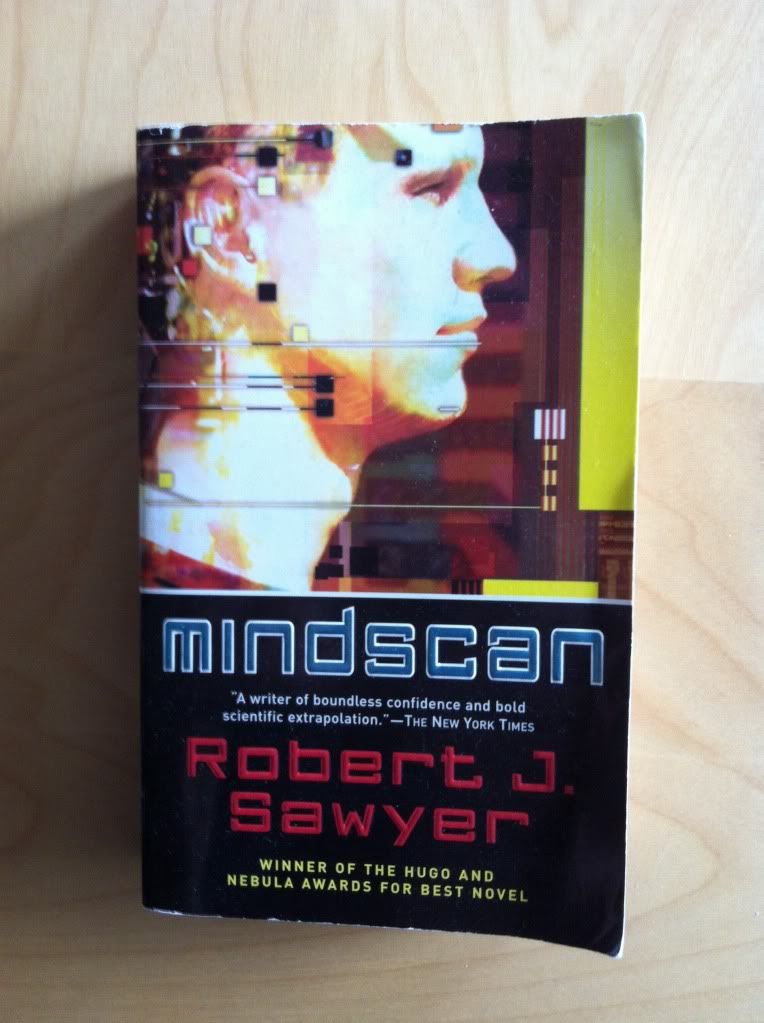
Or why you should read Mindscan by Robert J Sawyer
Robert J Sawyer is kind of the master of using small human stories to explore really big concept, Hard Science Fiction. Mindscan is kind of a quintessential example of this kind of Robert J Sawyer novel. It's also, I think, a great litmus test book to see if you like his approach to novel writing. It's probably also a great book to read if you've never tried a Sawyer novel before.
(Incidentally it's the first one of his novels I tried).
Mindscan posits a future where the fabulously wealthy can upload their consciousness into android bodies to achieve a kind of immortality. Despite being a relatively young man Jake Sullivan, the heir to a local brewing empire, decides to undergo the process to escape a terminal, hair-trigger brain defect. The new Mindscan-Jake gets a new lease on life and meets Karen Bassarian, the Mindscan of an elderly author of a very successful children's novel series (a la Harry Potter). The two fall in love and try to build their new lives together. But when the flesh and blood Karen dies, her biological son brings a suit against Mindscan Karen for her wealth. And so the book becomes one about identity, both in the emotional sense and the legal sense... that is until the flesh and blood Jake wants his life back too.
I would recommend this book to any Sci-fi fan, everyone who loves the genre really ought to try at least one Robert J Sawyer novel. But I think this book could appeal to a wider fiction audience: despite the Sci-fi underpinnings Mindscan is also a love story and social drama that I think transcends genre conventions in a way that I think will appeal to a lot of general fiction lovers.
Previously:
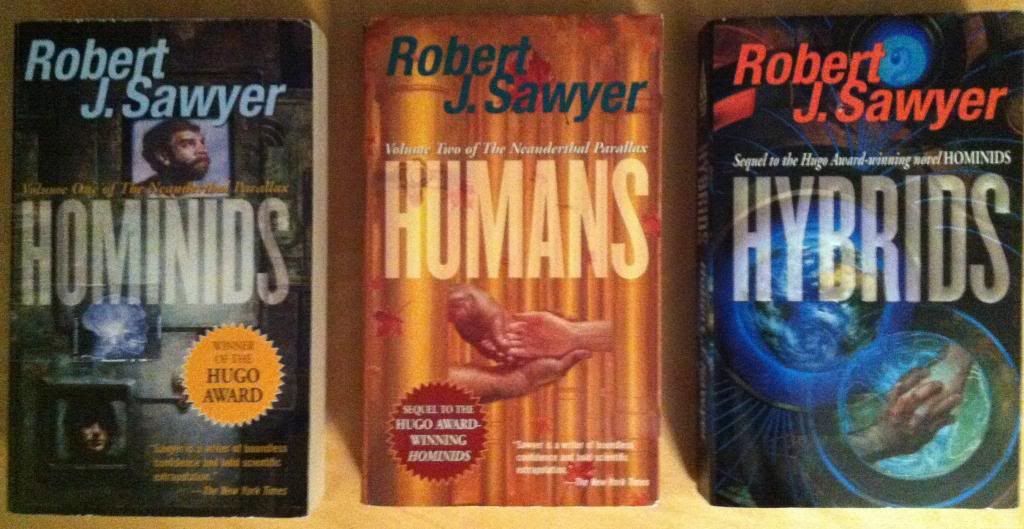
Or why you should read Hominid, Human, and Hybrid by Robert J Sawyer
Okay. This series has a hokey name and a premise that at first blush sounds pretty goofy (Neanderthal Parallax sounds like a bad Stoneage Green Lantern villain). But! This is one of the smartest, best, heartfelt, high concept group of Science Fiction novels I've ever read. Really, it is a fantastically empathetic and intelligent read. These books are among my very favourite. So hear me out!
The premise of the Neanderthal Parallax Trilogy (stay with me) is that a man suddenly appears inside the Sudbury Neutrino Observatory heavy water sphere, which is located kilometres underground in an especially well-shielded, and radioactively inert nickel mine in northern Ontario, Canada. Which is impossible: one moment the tank is empty and the next this sealed, nigh unreachable chamber has a man inside it. Even more impossibly, this man is a Neanderthal, a living example of a prehistoric hominid that cohabited the Earth with humanity for tens of thousands of years. It is quickly discovered that the Neanderthal, Ponter Boddit, is from a technologically advanced civilization from a parallel reality where Neanderthal's became the dominant species of human while Homo Sapiens died off and has ended up on our Earth as the result of an experimental accident. Ponter, together with prehistoric genetics professor Mary Vaughn, doctor Rueben Montego, and astrophysicist Louise Benoit, must find a place for Ponter in this brave new world. Meanwhile Adikor, Ponter's scientific colleague and partner back in his home reality, must discover what happened to Ponter before he is convicted of murder. What follows is the ultimate story of cultural collision as humanity, both Neanderthal and Homo Sapiens are confronted by a whole different society and way of life. Can they see past their many differences and find a way to coexist? Can they learn from one another? Can they even love one another?
The brilliance of this novel is the way it attacks and discusses our preconceived notions of what it means to be human. With the Neanderthals, Sawyer creates a society and, as a result, world that is wildly different than ours. Neanderthals are a society of communist, atheist, polyamorous, bisexual, hunter-gatherer environmentalists. They live in gender segregated communities, uniting the sexes only during the period of the female's synched-up menstrual cycle where they are infertile as a means of rigorous population control. They practice eugenics, sterilizing criminals and the least intelligent to better their genetic legacy. The Neanderthals live under constant surveillance from implanted computers and have a democratic government where only elderly members of society have a voice. And it is the contrast between this Neanderthal society and our own that creates the magic of Hominid, Human, and Hybrid.
Because, here's the thing, there are a lot of interesting social ideas that are taboo. We all agree that eugenics or a total surveillance society are bad. Many of us believe that the notion of monogamy and sexual preference are natural. We think that true communism cannot possibly work. What these novels do is remove human-nature (or at least homo sapiens nature) from the equation, removing any contamination from our socialization and history, and genuinely plays with the idea of what is better. Does eugenics divorced from all the racist garbage have merit? Should we castrate rapists both as a punishment and treatment for their conditions? Is population control a sound solution to our environmental problems? Is perfect, universal surveillance a good thing if we could guarantee that no one would abuse it? Are our sexual habits and shame pig-headed? Is religion just so much superstitious and damaging malarky? The brilliance of these novels is that they provide a safe space for a discourse about some really loaded, really interested ideas. It's really cool.
(Full disclosure, I think eugenics is fascinating. Not in a we-should-actually-do-it way, since it is immoral as anything and just begging to be abused in horrific ways, but in a Scientific curiosity way. Like, how much of who we are is genetic (or epigenetic or encoded in the various other physical ways our bodies store information)? I think it is an interesting question, but one much too hot to really touch given our terrible history with the idea. So I found the discussion of eugenics in the Neanderthal Parallax trilogy pretty engaging.)
But, these books are more than just a scholarly debate. These elements, and a bunch of other really well researched ideas about consciousness and evolution, are built into really engaging narratives. For instance, Hominids functions very much as a mystery novel, dealing with how Pontor reached our Earth and the legal proceedings in the Neanderthal reality, Humans is very much a mystery-suspense novel solving a bunch of questions set up in the initial book, and Hybrids is a good old fashioned techno-thriller with global stakes playing out. But the entire Neanderthal Parallax trilogy is, more than anything, a love story between Mary Vaughn and Ponter Boddit, about whether two people from different worlds, different societies, and even different species can find love and maintain a relationship. It's a pretty touching central narrative that emphasizes Sawyers way of coupling high concept Sci-fi with exciting plots and deeply empathetic human tales. These are eminently readable novels that are also properly smart.
They are also set in Canada. Which I am a sucker for.
I do however have one complaint about the trilogy. Now, these days I am a Science Gradstudent embedded in the academic system of Canadian Science. I have a pretty good idea of how it all works. Unfortunately the Neanderthal Parallax novels doesn't so much... The novels have this weirdly mistaken view of how University Science Faculties work, and if you are affectively living in one it is pretty frustrating! It seems that Sawyer thinks that Science Professors make their living and interact with gradstudents like... I presume Humanities Professors do? He doesn't seem to understand that Science Faculties are all about publishing and grants and an Academic research lab is like a small research business. Teaching isn't how my supervisor makes his living, and is mostly a pleasant chore that comes along with being a Science Professor. And my boss hasn't touched an actual experiment during my time in his lab. The idea that the place you earned your PhD has an impact on your hiring as a prof (as opposed to your publication record) is nuts, as is the idea that young straight white men can't get positions in Science faculties (they can). I mean, this shouldn't be too big a deal, it's a small part of the novel and you probably aren't a Science Academic, but it's a shame that something so simple is wrong in such well researched novels. It just bugs me a bit.
Really though, I heartily recommend these books to anyone. They are so, so smart and so, so heartfelt and very entertaining. The Neanderthal Parallax trilogy are some of my favourite novels, and if you give them a chance they might end up being some of yours too.
Previously:
Red Planet Blues
Triggers
The WWW Trilogy
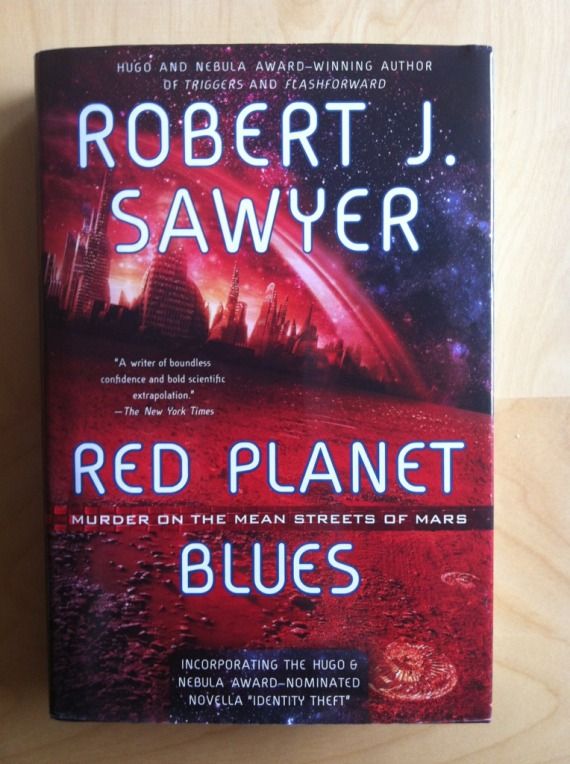
Or why you should read Red Planet Blues by Robert J Sawyer
There's Martian fossils in the red hills of Mars beyond the frontier town of New Klondike. Fossils and the promise of fortune for any enterprising human or uploaded-human-android Transfer lucky enough to find the perfect specimen. Or better yet, there is the possibility of finding the long lost Alpha Deposit, the mother lode of exquisite, priceless Martian fossils, and becoming rich beyond anyone's wildest dreams. And so New Klondike is a town of hopeful prospectors, dejected failures, and the seedy economy of a hard-on-its-luck frontier town built in a dome on Mars. New Klondike is also a company town where the law is less interested in Justice than keeping the piece and protecting the owners assets. And so Alex Lomax, the only Private Eye on Mars, is on the case. These are his Red Planet Blues.
Red Planet Blues is a tale of frontier life, of gold rushes and arctic explorers and greed; extrapolated into a Science Fiction story exploring the concepts of Martian colonies, alien palaeontology, and humans uploading their minds into robots; presented with the style and panache of a pulp Dectective serial. To a certain extent Red Planet Blues, as is perhaps appropriate for a novel set on a planet with a fraction of Terrestrial gravity, is a bouncy read. In being such a loving pastiche of pulp storytelling the novel provides a lot of swashbuckling adventure but also, in its dangerous dames and sassy puns, an inherent eyebrow-shrugging-goofiness. The result is a fairly light and infectiously fun novel that clearly reads like it was a ton of fun to write.
But that isn't to say that Red Planet Blues isn't also a smart piece of Science Fiction. While the action as fast and lose with the rules as the protagonist, the high concept Science Fiction is grounded and thoughtful. The tribulations of living on Mars and the treatment of the Martian Fossils carries the authoritative weight all of Sawyer's work seems to. Moreover, the concept of having Transfers, androids run by the minds of uploaded humans, as robots exploring Mars for signs of life is just such a brilliantly clever and timely decision. At once gobsmackingly obvious and deviously subversive. (It also, I think, makes Red Planet Blues a semi-sequel to Mindscan, another great Sawyer novel.) My point here is that under the hood of the adventuring detective story is an elaborate engine of Sci-fi that gives the novel some literary depth.
My only real criticism of the novel is that some of the earlier who-dunnits of Red Planet Blues were kind of obvious to me. Now, it might be that I've read a few novels lately that play with the idea of human minds as software (Accelerando and Glasshouse, The Accord) or it could be that my significant other and I have watched too much mid-nineties Law and Order, but some of the cases just immediately suggested their solutions. To be fair though, as the novel progresses the capers become more convoluted and complicated, leading to some satisfying and unexpected twists in later parts. Which, if you think about it, is probably the right direction for increasing complexity.
At the end of the day I'd recommend this book to fans of genre fiction, be they Sci-fi, detective, or adventure aficionados. Red Planet Blues is, after all, a stupendous combination of these genres. I also can't help but think this is a novel that could be foisted well onto youth readers: it's fun, informative, and exciting enough to keep pages turning. Just be aware that it's genre-appropriately violent and acknowledges the existence of sex in a way that is somewhat discrete but still honest about how things work. Depending on your parenting style, it might get a bit racey. But yeah, I whole-heartedly recommend this book.
Or why you should read Triggers by Robert J Sawyer.
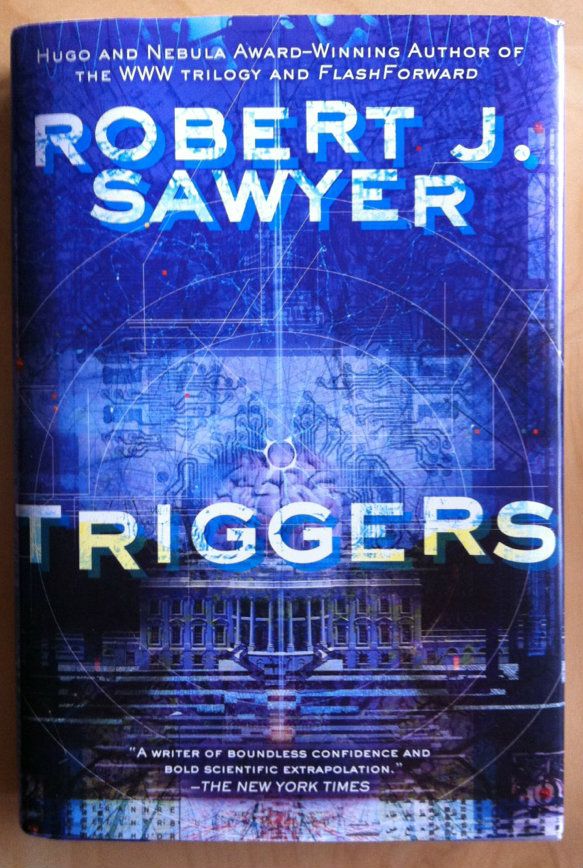
At first pass Triggers seems like a straight forward political/action/thriller with a Sci-fi magguffin thrown in to make the plot go. The book opens with the attempted assassination of US President Seth Jerrison on the steps of the Lincoln memorial shortly after a number of terrorist attacks in the United States. President Jerrison is rushed to a hospital to receive life saving surgery where he is exposed to the side effects of a lab accident. You see, elsewhere in the same hospital Canadian scientist Dr. Ranjip Singh performs an experiment to treat PTSD in a war veteran. This experimental treatment goes awry and inadvertently entangles the minds of various hospital staff, patients, and visitors such that every one of them experiences the memories of one of the other affected individuals. The president, of course, is one of the affected individuals, meaning that someone in the hospital has access to all of his memories. This is taken as a threat to national security. It falls to Secret Security agent Susan Dawson and Dr Singh to discover who has the presidents memories. So yeah, pretty thriller-esque.
(The book is called TRIGGERS for Pete's sake.)
The things is, despite the thrillery premise and actiony title (and cover art), Triggers is really a high concept Sci-fi novel about empathy. The novel's main theme is that human empathy is amazing but basically impossible. I, as a person, can certainly sympathise with say, the plight of a woman being harassed on the train, but since I can't experience it myself I can never truly empathize with her. Triggers asks what if we all could empathize with someone else. Since the characters can all access the memories of another person they can perfectly empathize with that person and exploring this idea is the real meat of Triggers. Sawyer also focuses his attention on all the different things people would do if they could basically read another person's mind: from being in two places at once, to using it for their professional advantage, to being kinky, to borrowing skills. So, despite the thrillery window dressing of Triggers, the main thrust of the book are the interpersonal relationships of the novel's characters and the way realizing true empathy changes them.
Triggers: its smart, engrossing, and uplifting. Read it.
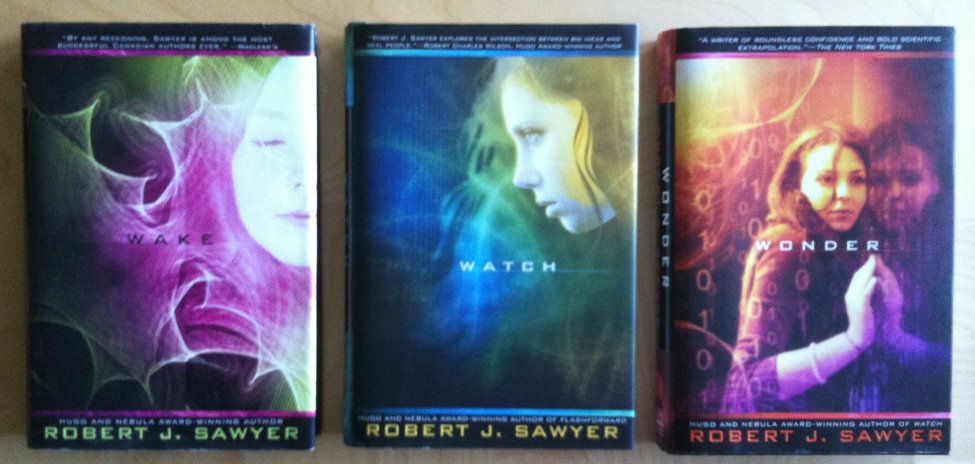
Or why you should read the WWW trilogy by Robert J Sawyer
There is a tendency in Sci-fi to do dystopian futures with gritty male characters who commit gritty murders. As the record shows I love a good dystopian male murderfest on occasion, but I also enjoy utopian thinky books too. Robert J Sawyer is by my estimation the best contemporary writer of optimistic and thoroughly well researched Sci-fi. He is also a Canadian Sci-fi author who takes great pride in using Canadian characters and settings which is pretty neat (said as a proud Canadian).
The WWW trilogy is a near-future, hard science fiction story about a blind girl and a super-intelligent machine intelligence. The protagonist of the novels is Caitlin, a blind American expat teenager, living in Waterloo Ontario with her academic parents. Caitlin was born completely blind, but due to an experimental optic nerve implant, she gains sight for the first time early in the trilogy. In the process of debugging her new sight-aid to perfect her vision, Caitlin "sees" evidence of an emerging intelligence in the Internet. This emerging intelligence, with the aid of Caitlin, gains sentience, names itself Webmind, and begins to interact with the world... and the story goes on from there.
Of course the books also has some pretty important subplots about Chinese dissident bloggers and the plight of hobo the bonobo painter.
These novels are tremendously well researched and highlight some pretty nifty theories about the development of consciousness, the relationship between vision and thought, and the way the Internet works. On top of these well researched bones are some thoughts about neurodiveristy, growing up, living with a disability, and the existence of a super intelligent machine sentience. It's the kind of science fiction where you actually learn some things and are introduced to some pretty high concept ideas.
The novels also, through their use of Americans living in Canada, highlight some of the little quarks of Canadiana that make Canada a distinct place.
The engines of the book are, however, the characters. Sawyer is a master of creating these vibrant, amazing characters thr you really care about which he uses to ground and drive his higher concept story elements. As much as I'm intrigued about how webmind will change the future of mankind, I find myself engrossed in the day-to-day struggles of the characters: from Caitlin's social life to the plight of hobo the bonobo to the challenges associated with being autistic. It's thought provoking Sci-fi with a big giant human heart. Which, if you think about it, is a great concept since the amazing technology and innovations of Sci-fi really only matter in the context of actual people.
If you enjoy hard Science Fiction and like seeing lovable, complex, and diverse characters I'd sugget you read this book (particularly if you love Canada). If you care more about laser pistols and deathbots... read this anyways because variety is the spice of Arrakis.