Showing posts with label 100 Bullets. Show all posts

Friday, 23 August 2013

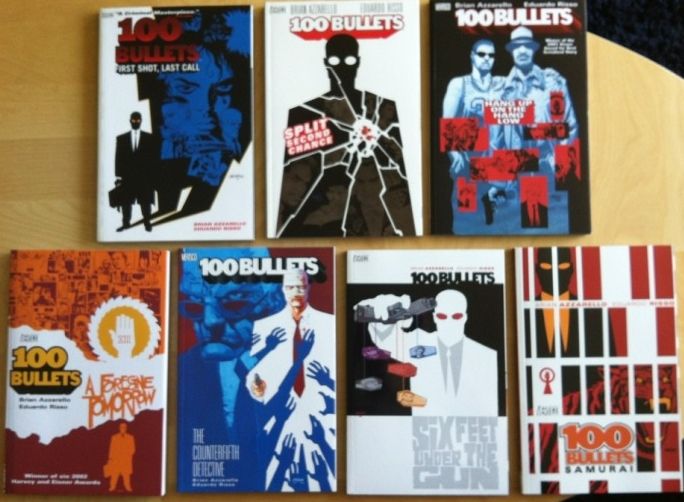
Deep Sequencing: The Male Gaze In 100 Bullets: Hang Up On The Hang Low

Or the self-aware use of sexualized imagery to service story in 100 Bullets: Volume 3.
By Brian Azzarello and Eduardo Risso; Vertigo Comics
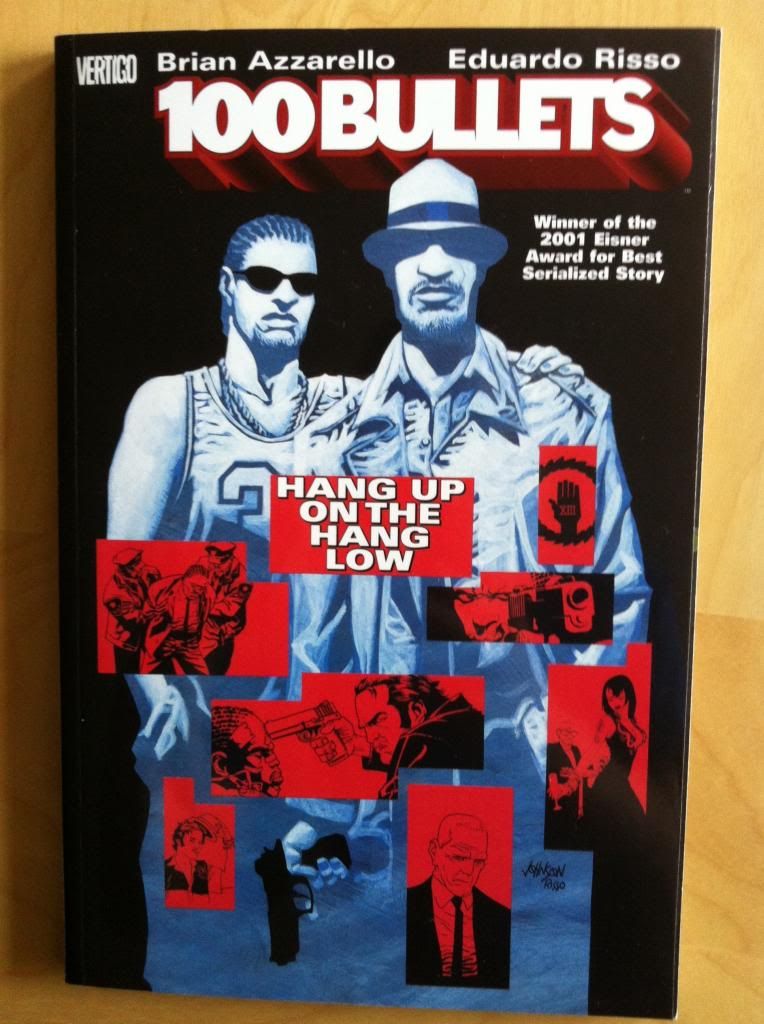


100 Bullets is a pretty ugly comic. I mean, it's exquisitely drawn by Edurardo Risso, but the comic is full of terrible people doing godawful things in horrifying ways. Despite how entertaining and smart it is, 100 Bullets is a WILDLY problematic comic in a LOT of ways.

One of the more striking ways 100 Bullets is problematic is in its portrayal of women. They really get the shittiest end of the shitstick and have all kinds of dramatically terrible things happen to them. They are also portrayed in a VERY sexual, very objectified way. Eduardo Risso is a master of the male gaze: drawing attractive women with fantasy proportions and then framing panels to highlight the bejesus out of them. It's complicated and problematic and skeevy and sometimes hard to reconcile with the story. I mean, I think the over-sexualizing of women in the comic is about deliberately creating a certain transgressive atmosphere of hyper-violence and hyper-sexuality... But maybe Eduardo Risso just likes to draw beautiful, fantasy women in dangerous situations? Regardless, it's a facet of the series, and it's one that I have a hard time reconciling myself with or really understanding completely within the context of the comic. It is not my favourite part of 100 Bullets.

However, there is one chapter of 100 Bullets where the male-gaze objectification of a female character is used in this really self-aware way and in service to the story. This is in the third collected chapter: Hang Up On The Hang Low.

This post will deal with extensive *SPOILERS* to this chapter of the comic. So read it first.
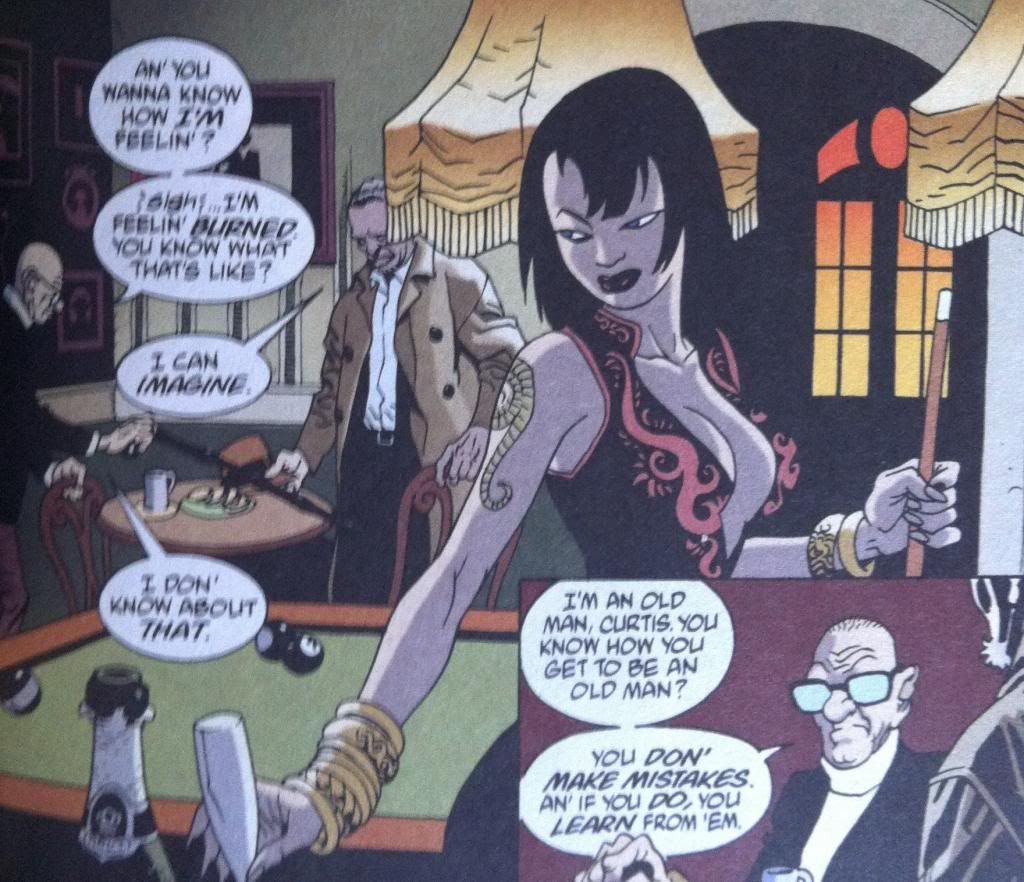


In this section of the story Agent Graves, the shadowy purveyor of Revenge, gives Loop, a young black man, a clean gun, 100 untraceable bullets, protection from law enforcement, and information as to where he can find his deadbeat father. Loop tracks down his father, an enforcer for a local crime boss, and rather than kill his dad, he joins him in the family business. Unfortunately things go sideways, Loop's father is murdered, and Loop decides to kill the crime boss responsible. It's a neat character study, revenge scenario, and like all of 100 Bullets, arresting comics.
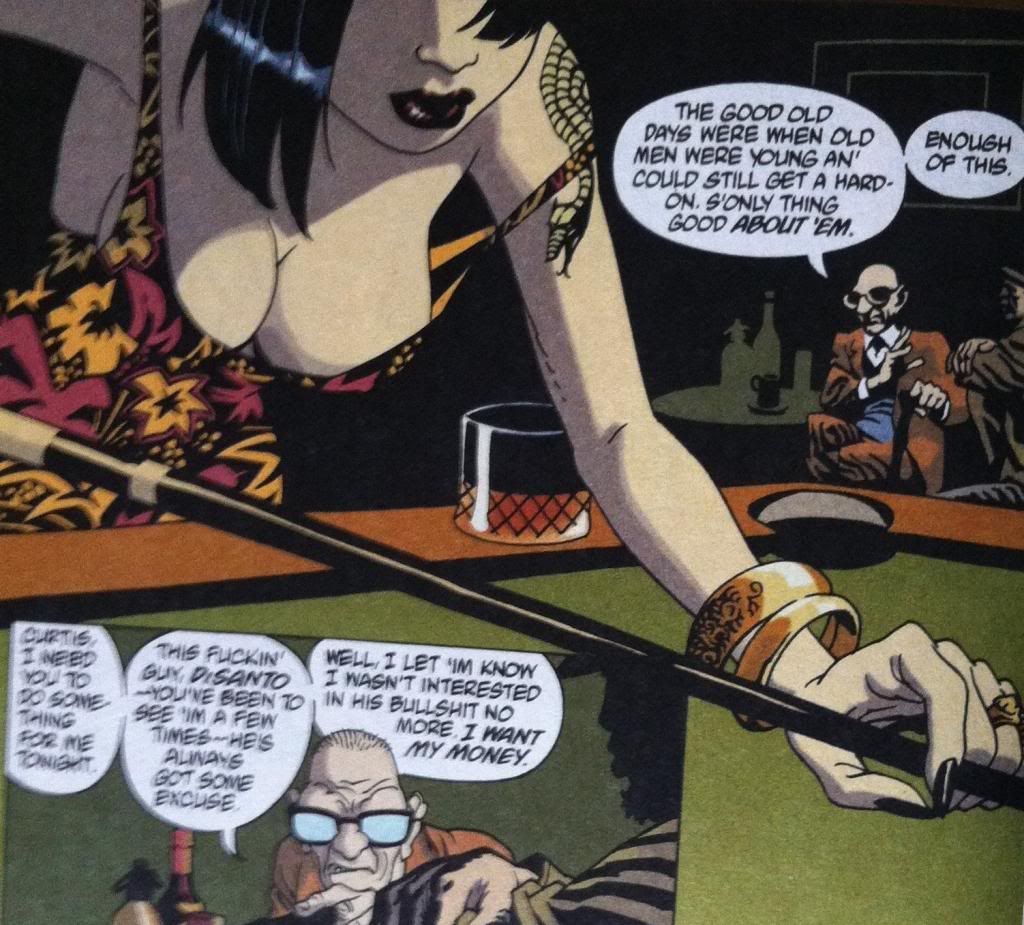


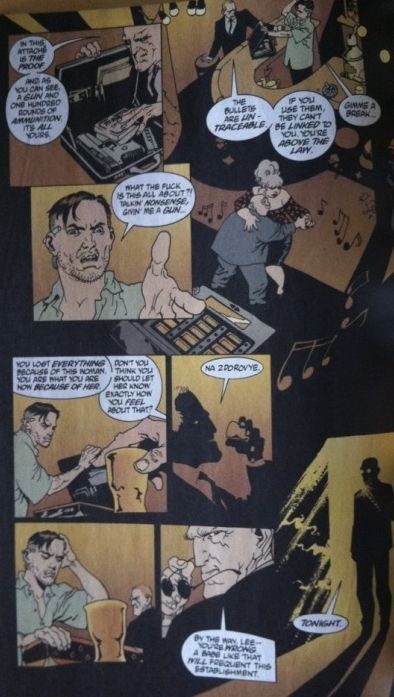
One of the cooler aspects of this comic is how the male gaze, using image framing to show off sexy body parts, is used to sexualize the asian woman playing pool. I mean the first time you see her, based on her dress, how the comic frames her, and the context of the situation, you make some assumptions. I mean, this young woman is wearing provocative clothing, playing pool alone in a room with a little old man who is a crime boss and within the context of the story holds all the power. Moreover, the comic artwork focuses on her breasts and places her in the background, disinterested and silent, like, to borrow a DeConnick-ism, a sexy lamp who really likes Billiards.  So we all assume that she is most likely there to be eye-candy for the creepy crime boss, or a sexual plaything, or something equally fucking deplorable and exploitative.
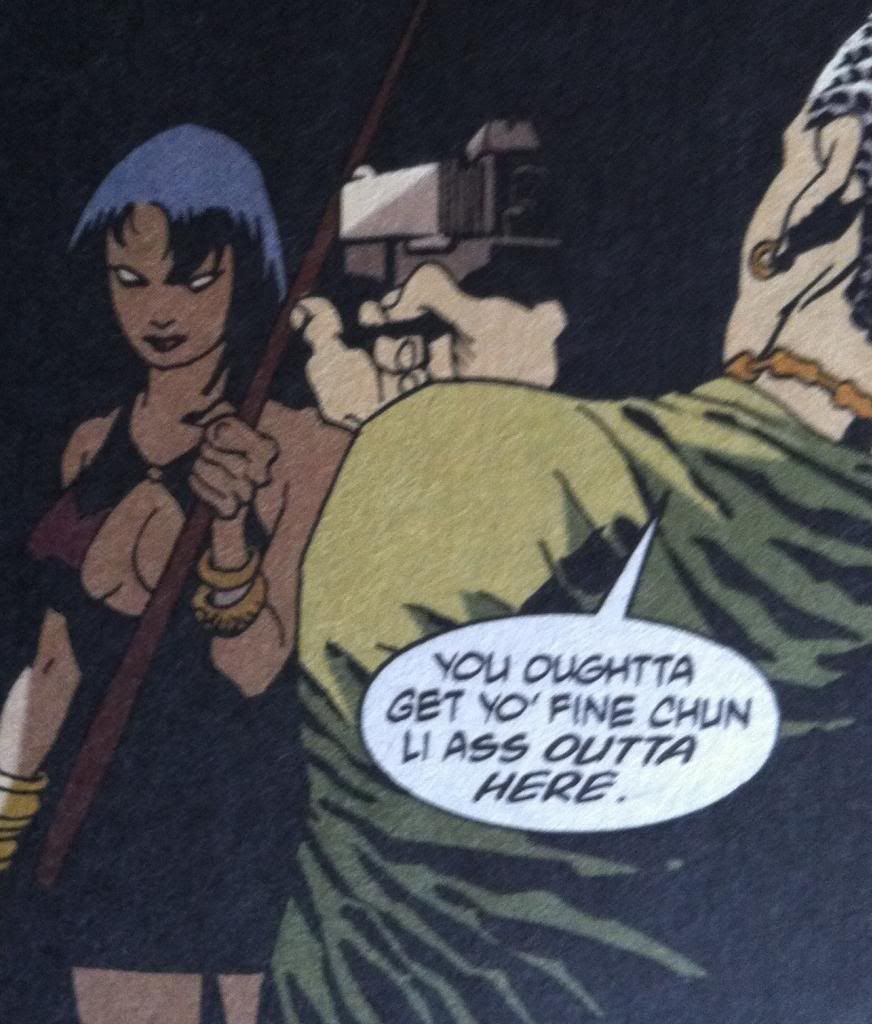


Which makes it so amazing and surprising when she turns out to be a bodyguard. We, and Loop, and make the assumption she is a sexy lamp, and then BAM we find out she is really a stonecold shitkicking motherfucker. This comic has used the male gaze to cause us to make assumptions based on gender roles and appearance which leads us to underestimate this character and disguise her true role in the story. And this is pretty self-aware and effective use of the male-gaze to actually drive a story instead of just glorify in smut, and it makes the point that we should check our assumptions when it comes to sexuality and gender. It's cool comics.
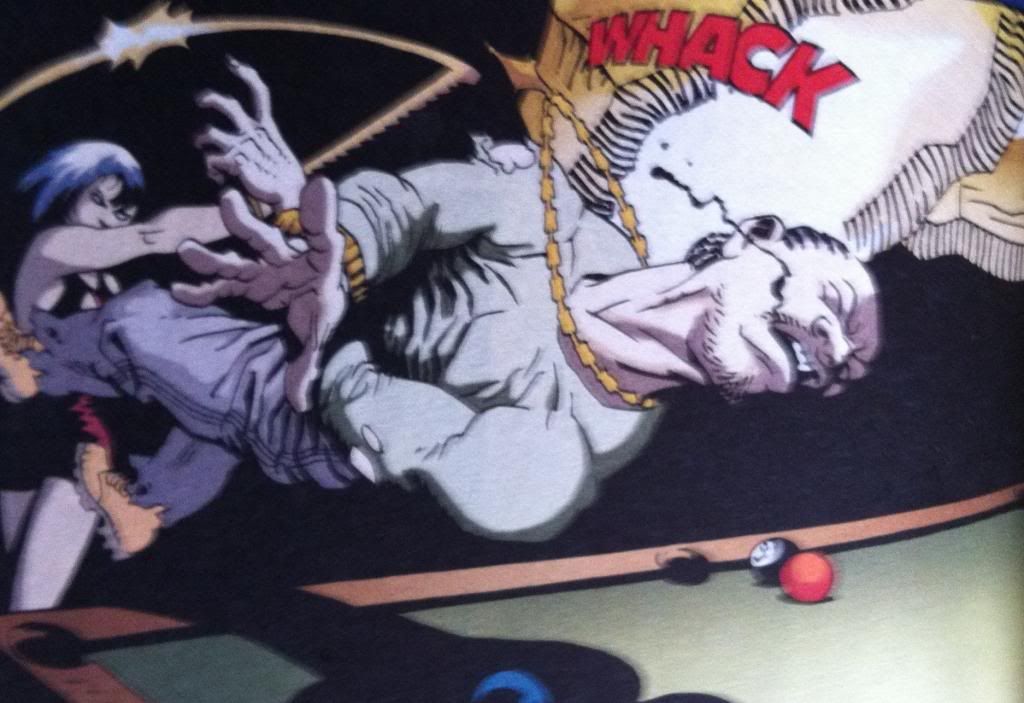


I mean, there is still a lot of problematic male gaze use in 100 Bullets, but this particular example, I think, is pretty great. (But you know, still problematic, which is pretty much how all of 100 Bullets works.)


Previously:
Deep Sequencing: Guilt and Crime Comics

Wednesday, 21 August 2013

So I Read 100 Bullets

A 250 word (or less) review of 100 Bullets, the complete series
By Brian Azzarello and Eduardo Risso, Vertigo Comics


What would you do with the perfect opportunity for revenge? 100 Bullets, in its earliest chapters, asks just that question when the mysterious Agent Graves gives characters lurking on the edges of society a briefcase containing a clean handgun, 100 bullets of untraceable ammunition, incontrovertible proof of a perpetrators guilt, and the promise of no repercussions. From these grisly, intense moral experiments, 100 Bullets grows into an immense and convoluted crime epic about the power of the shadowy Trust, broken by greed and ambition and guilt, and the horribly flawed enforcers whose job is to referee it. In many ways 100 Bullets is a comic of flaws: horrendously, glorious flawed characters performing flawed and reprehensible acts, for reasons that are equally disgusting and flawed. It is an absolutely brutal read, that, I think contains within it, amongst the shock and violence, some truly remarkable and sublime moments. Brian Azzarello delivers an unrelenting script that never shies from going to the most uncomfortable and tragic places; it is a brave and audacious story. Eduardo Risso, meanwhile, is a goddamn genius. His artwork, this minimalistic cartoon line, has such beauty and elegance of composition to it, and yet, renders such brutality and evil with such ease. It is worth the price of admission alone. That said, 100 Bullets does have some flaws itself: some creative decisions treat groups of characters, particularly women, in spectacularly shitty ways that are wildly problematic. 100 Bullets is a gloriously, horribly flawed comic that you should read. 

Word count: 250


Friday, 24 May 2013

Spinal Tapestry 3: Reading Rainbow

Or the under-appreciated art of comic book spines

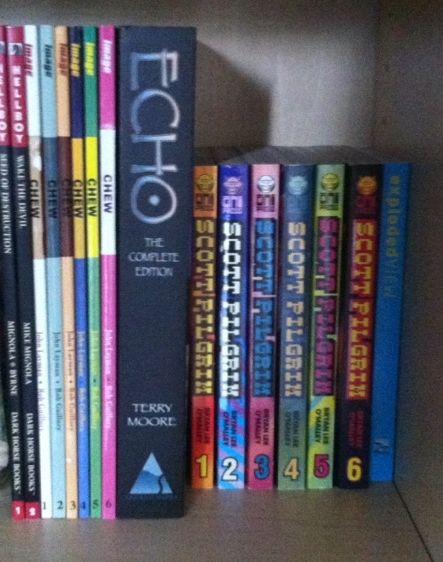
Book spines are, I think, the most overlooked component of book design in collected editions of comics. Whether because of all the emphasis placed on cover pages or the comic industry's infatuation with staple bound invertebrate single issues, comic spines don't generally get the love they deserve. Which is a shame, because in most settings, be they home bookshelf or retail bookshelf, the comic spine is the only part of the comic visible. Ignoring this portion of the comic's exterior hurts a print comics value as an art object (which I think is one of the key value-added features of the print format) and probably has an adverse effect on a comics retail performance. Paying attention to it can make comics look great and stand out from the crowd.

When dealing with long comics series in collected editions, I think one of the key design choices that can really improve the look and visual impact of a series is a unifying design. By tying individual books together with common elements, a series gains an identity and becomes instantly recognizable as an aggregated whole. Generally, one of the keys to this seems to be choosing a few colours to give the comics a harmonious relationship. By wildly varying spine colours, you can pretty much ruin the look of a series.


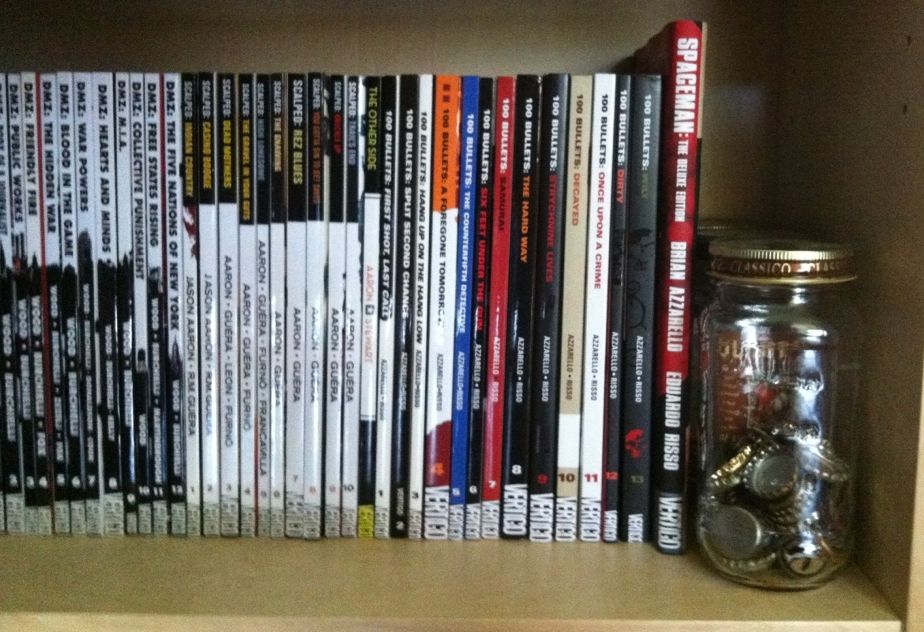
100 Bullets, by Brian Azzarello and Eduardo Risso,  is a fantastic crime comic about the opportunity to avenge injustice wrapped in a grand conspiracy. The interior of the comic is gorgeous, absolute brutality drawn with precise elegance by Risso, and the covers of the series (including these collections), by Anthony Johnson, are perfect. That said, the spines of this series are terrible. It seems the choice was made to make the spines of the 100 Bullets collections entirely dependent on cover art, which makes the spines lack identifiable common elements or common colours. When put next to the clean, unified design of Scalped, or the brilliant design of DMZ, 100 Bullets looks like a mess of random comics instead of a lovingly appointed series. And I think it's shelf presence suffers for that.


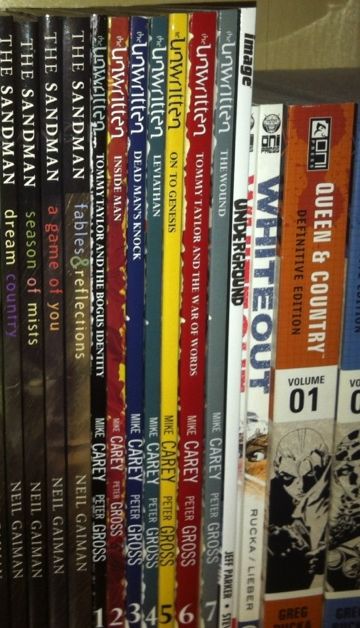
The Unwritten, by Mike Carey and Peter Gross, is a great comic about the power of literature to affect society and people with the bourgeoning power to tap into it. The Unwritten is also another comic with great interior art and superb covers, by Yuko Shimizu, but poor spine design. The Unwritten makes that fairly common mistake of giving each edition its own colour to make a rainbow effect. The problem is that this breaks up any cohesion over the entire series and doesn't really tell us anything about the identity of the Unwritten. Varying colours like this is almost never the best choice.


But like all rules there are exceptions. Scott Pilgrim and Chew are two comics that absolutely break what common sense suggests is good book design. They use bright, obnoxious colours that change and clash between books. And while they do maintain common elements between books (Chew's cutout and Scot Pilgrims weighty logo), their overall look is just garish as hell. The thing is, this WORKS for these comics. Chew, by John Layman and Rob Guillory, is an insane comic about people with mental food powers solving ridiculous food crimes: the plot is crazy, the art is bombastic and cartoony, and the aesthetic of the book is frankly pretty garish. So a cover spine design that clashes between issues and uses bright, cartoony colours completely sells the identity of the book. Similarly  Scott Pilgrim, by Brian Lee O'Malley, also has a cartoony look and bombastic style. Scott Pilgrim is a comic about being brave enough to love while being an adrift 20-something, and has a style influenced by manga and 1990's video games that is just really inviting and fun. The spines of the Scott Pilgrim books, with their garish bright colours, manga-ish book size, and pixelated logo font absolutely evoke the visual identity of the book. What I am saying, basically, is that these comics, by having insane cartoony spines,  are able to convey their visual identity instantly. And that is, I think, the core of book design.

Previously:
Spinal Tapestry 1
Spinal Tapestry 2

Friday, 19 April 2013

Deep Sequencing: Guilt, Culpability, and Crime Comics

Or how Criminal, 100 Bullets, and Scalped implicate the reader to generate a guilty response.
Comics by Ed Brubaker and Sean Phillips, Brian Azzarello and Eduardo Risso, Jason Aaron and RM Guerra with others.

I really like Crime Comics. There is just something about the gritty, intense world of people living outside the law that is endlessly fascinating and shockingly entertaining. Now there are probably endless reasons why these comics are so compelling... but looking at some of my favourite examples I think I've figured out one of the genre's key genetic elements.

Guilt.

Guilt is an emotion that I have a complicated relationship with. Whether its competent parenting, a Roman Catholic education, or some fluke of genetics I feel an overwhelming and insistent sense of SHAME whenever I think of certain mistakes I've made. Just writing this I'm probably turning a bit red. My point is that for me guilt is an exceptionally powerful emotion. It's a thing I feel deep down in the bowels of my stomach, something that chills the skin and tightens my back and gives me the weirdest sweats. It's lurid and disgusting and probably one of the handful of strongest emotions I feel.

And the best Crime comics make me feel guilty in spades.

(I've tried to keep this *SPOILER* light, but you know, procede at your own peril.)


Criminal is the absolutely masterful Crime series by Ed Brubaker and Sean Phillips. Criminal is not so much a series of Crime stories as a WORLD of crime stories populated by granular characters living in an uncompromisingly realized world. You don't so much read these comics as visit them and get blood and grit all over yourself. And part of what makes this experience so engrossing is how Brubaker and Phillips use guilt and culpability.

One of the key components of the Criminal forumla to me is perversely abused empathy. Most of the protagonists in the Criminal stories are, despite their flaws, immensely likeable. Despite knowing that these characters are thieves and thugs and murderers we end up sympathizing with them despite ourselves. This sympathy slowly turns to empathy and we soon find ourselves actively rooting for our protagonists to succeed at whatever their unlawful enterprise is. As the story unfurls, best laid plans are ruined, and the terrible consequences of the protagonists choices become clear we see the fallout of what we wanted. We realize we too are culpable: by actively rooting for the lead character we have become accomplices. And therefore we feel the lurid weight of guilt.


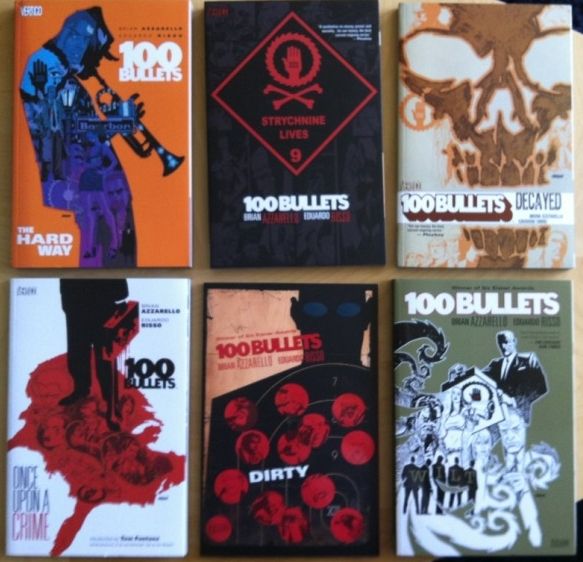
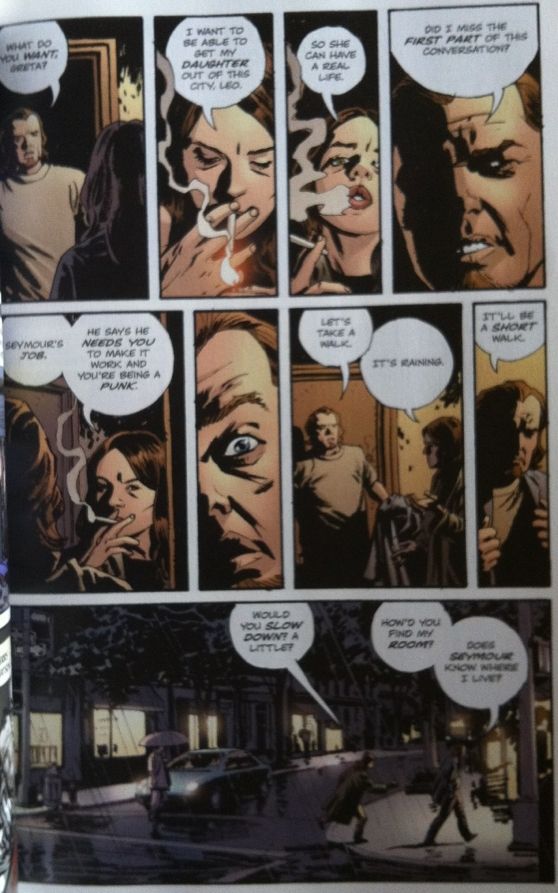
100 Bullets is another great Crime comic by Brian Azzarello and Eduardo Rizzo. Filled with intrigue, conspiracy, murder, and some of the most aggressively flawed characters I have encountered, 100 Bullets is a sprawling comic that revels in the excesses on the edges of society. It's mercilessly written and filled with horrendous images rendered by the exquisite, and beautiful line of Eduardo Risso. But, at the end of the day, one of the most brilliant things in this comic is 100 Bullet's opening premise and how effectively it evokes guilt in the reader.

Throughout the introductory chapters of 100 bullets we see the shadowy Agent Graves approach characters with a brief case and an opportunity. Inside this briefcase is a clean handgun, 100 bullets of untraceable ammunition, and incontrovertible proof that someone who has deeply wronged the character receiving the briefcase is guilty. With these items comes the promise of total immunity from prosecution if said character decides to act on this opportunity  The character then invariable pursues this chance for vengeance in some way and carries through the morality experiment to some sort of conclusion. As a hook it's absolutely perfect.

This premise is also an absolutely perfect way of nabbing the reader and making them culpable in the protagonists decisions. When presented with the scenario, carte blanche to enact justice and the reality of the crimes committed, we can't help but game it out for ourselves. What would you do in the characters' shoes? Would you kill the guilty person if he had you falsely imprisoned? What if he murdered your wife? Raped your daughter? Or could you stop yourself out of some higher moral obligation? By mentally playing these situations out and deciding that vengeance is justified we become just as guilty as the character in the comic when they decide to go through with it. And in doing so, the consequences of their actions become the consequences of our own decision. And so we feel that lurid weight of guilt.


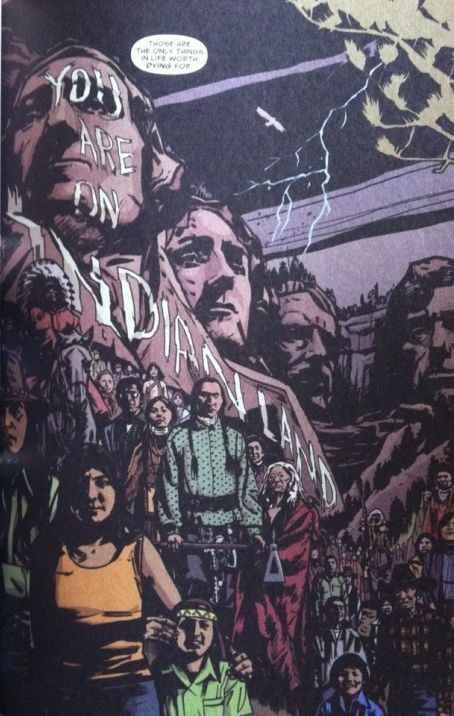
Scalped is another astounding Crime comic by Jason Aaron, RM Guerra, and various collaborators (art above is by Jean Paul Leon). Scalped tells the story of crime on an American Indian Reservation. It is easily one of the most tense, brutal, and heart-pounding reads I've ever enjoyed. It also contains one of the most effective and intelligent uses of reader evoked guilt in comics.

Let me explain. If you are a North American who isn't a full-blooded aboriginal (First Nations if you're Canadian) then you are heir to a pretty awful legacy. We are, all of us, living on land stolen from the people who inhabited it. People who our governments and ancestors swindled, crushed in wars, and basically attempted to commit genocide against. (HBC, Canada's oldest company sent smallpox laced blankets to Canadian First Nations... for instance.) And even after killing the majority of these people and displacing the rest, we, as a society, attempted to wipe out their culture. As if all of this wasn't disgusting enough, we still treat North American aboriginals horrendously, leaving them in far too many cases disenfranchised, marginalized, and impoverished. It's fucking disgusting, and to a certain extent we are all complicit in this. We are all of us guilty.

The thing that Scalped does, beyond displaying how horribly we have betrayed these people, is frame the events portrayed in relation to our guilt. Basically, every awful thing that happens in Scalped is our fault: the situations, the poverty, the desperation  everything is a result of the sins of our past. And so for every crime, every murder, every horrendous thing in Scalped we are all preemptively guilty. And for that reason we experience a much more intimate, visceral, and immediate feeling of guilt. It's hugely effective.