Or why you should read The Lathe of Heaven
by Ursula K Le Guin
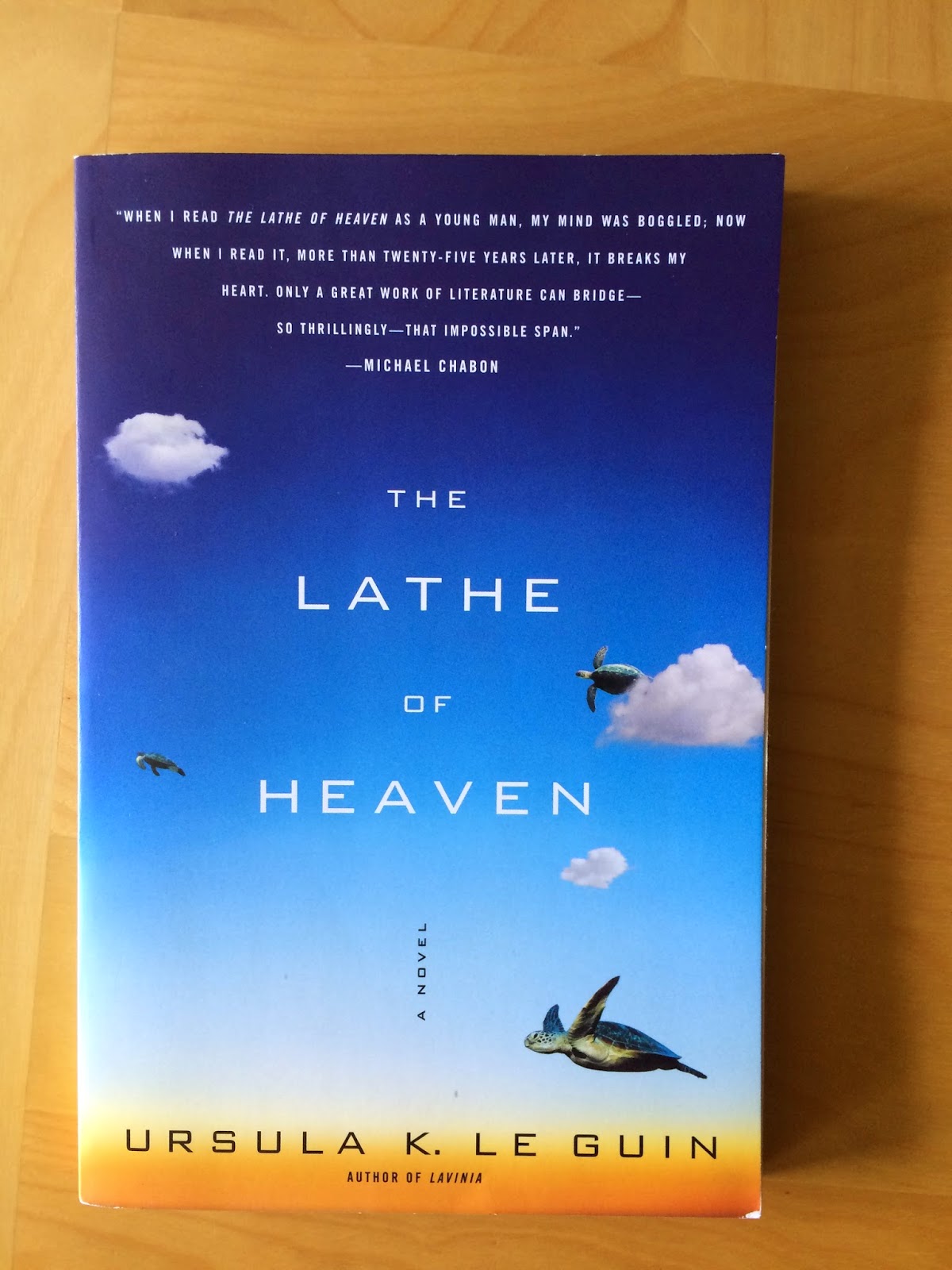
The Lathe of Heaven is a novel about a man with the power to change reality with his dreams. George Orr, a humble draftsmen, is abusing drugs to prevent himself from sleeping because he is convinced his dreams are warping reality. Fearing for his sanity Orr is sent to Dr. William Haber for psychiatric care and counselling. Dr. Haber begins a course of induced dream therapy using hypnosis and a trancap, his invention, and discovers that Orr *can* affect reality with his dreaming mind. Rather than try to cure or suppress Orr's dreams, Dr. Haber decides to try and use this power to fix the ills of his overcrowded, war torn, polluted world. But to do this Dr. Haber must navigate the complexities of reality, Orr's subconscious, and his own questionable intentions.
The Lathe of Heaven is an extremely sharp book that asks some very fundamental questions about the nature of reality. Specifically, the novel asks just how solid reality is, whether there is an objective continuity to events or if it's all an illusion based on limited perspective. Which... is a thing that sometimes bothers me in this kind of facile, academic way. One of the events which The Lathe of Heaven makes reference to is the fact that Japan sent fir balloons, essentially weather balloons laden with explosives, to terrorize the United States and Canada and that one balloon did manage to kill some US civilians in Oregon. This is a fact I only recently learned about on the Radiolab podcast before encountering in this novel written in YEAR that I am only now just reading for the first time. Which is weird right? Or, in a longer coincidence, a US thriller novel I was reading made a small reference to the French town of Narbonne and I read this while sitting on a train platform in Narbonne while en route from Marseille to Barcelona. These kinds of coincidences always make me feel like reality has a dream-like quality, like my observations and ideas are somehow shaping reality. And so the questions about a mutable reality in The Lathe of Heaven really resonate with and fascinate me.
The Lathe of Heaven also asks some less academic and more practical questions about the kind of people who want to wield power. In the novel different people try to harness the power of Orr's dreams. Orr himself is afraid of the power and tries his hardest to not change reality with his dreams. However, when pushed to it by necessity, he makes altruistic use of his powers to help others. Dr. Haber, meanwhile, has a combination of confidence, altruistic intentions, and a special kind of greedy drive that makes him deeply want to exploit Orr's dream powers. He blithely uses and abuses the godlike dream powers in a way that imposes his goals on the world and helps himself. The contrast between these two characters really gets at what makes someone seek corporeal power. It's deeply insightful stuff.
I would recommend The Lathe of Heaven to anyone who enjoys speculative fiction. It's as smart and thorough as any other classic work of Science Fiction. It's also, like many of the other giants of Sci-fi canon, beautifully written with wonderfully rich prose. The Lathe of Heaven is a joy to read. It is a novel that should really be on your reading list if not your classic Sci-fi bookshelf.
Previously:
The Left Hand of Darkness
The Dispossessed
Showing posts with label Ursula K Le Guin. Show all posts
Tuesday, 6 October 2015
Tuesday, 20 January 2015
The Left Hand Of Darkness Is A Good Book
Why you should read The Left Hand of Darkness by Ursula K Le Guin
The Left Hand of Darkness is a classic work of Science Fiction. In the novel Genly Ai, a human emissary from the Ekumen, an intersteller coalition of affiliated humanoid worlds, is sent to the planet Gethen, also known as Winter. Genly's mission is to convince the natives of Gethen to join the Ekumen and begin to share in the broader culture of humanity. But Genly's mission is challenged by the inhospitable, frozen world of Gethen and the alien, inscrutable nature of its inhabitants. The humans of Gethen have no gender, and a biology that carries the potential for both reproductive sexes. The Gethenian normally are functionally sexless, but as part of a monthly cycle enter the state of Kemmer where they become sexually receptive and temporarily express the sexual characteristics of either a female or male. Genly's mission also runs afoul of tension between Gethen nation states and forces Genly to entrust his mission and life to the enigmatic Estraven.
The Left Hand of Darkness is an absolute masterwork of Science Fiction. As much as the novel revolves around a gripping tale of political intrigue and survivalism, the true engine of the novel is a thought experiment about what a genderless society would look like. So much of our society focuses on the differences between men and women, from the way products are marketed, to career expectations, to the way sexuality is policed to, well just about everything. By focusing on the ambisexual Gethenian species, The Left Hand of Darkness explores how society might work if the vast majority experienced gender and sexuality in the same manner and the gender barriers in our society just didn't exist. The results of the novel's thought experiment are interesting and, in a way that demonstrates tremendous intellectual maturity, are really believable and possessed. (This is a novel that could be "Isn't this crazy!" and is instead rigorous and honest.) My point here is, for all of its beauty and tension, this is a really, really smart novel.
I would recommend The Left Hand of Darkness to any Science Fiction fan. This is classic, canon Sci-fi that everyone keen on the genre really ought to read. If you're like me and have an interest in touring the essential classic works of Sci-fi, than The Left Hand of Darkness is an absolutely necessary read. Go read it.
The Left Hand of Darkness is a classic work of Science Fiction. In the novel Genly Ai, a human emissary from the Ekumen, an intersteller coalition of affiliated humanoid worlds, is sent to the planet Gethen, also known as Winter. Genly's mission is to convince the natives of Gethen to join the Ekumen and begin to share in the broader culture of humanity. But Genly's mission is challenged by the inhospitable, frozen world of Gethen and the alien, inscrutable nature of its inhabitants. The humans of Gethen have no gender, and a biology that carries the potential for both reproductive sexes. The Gethenian normally are functionally sexless, but as part of a monthly cycle enter the state of Kemmer where they become sexually receptive and temporarily express the sexual characteristics of either a female or male. Genly's mission also runs afoul of tension between Gethen nation states and forces Genly to entrust his mission and life to the enigmatic Estraven.
The Left Hand of Darkness is an absolute masterwork of Science Fiction. As much as the novel revolves around a gripping tale of political intrigue and survivalism, the true engine of the novel is a thought experiment about what a genderless society would look like. So much of our society focuses on the differences between men and women, from the way products are marketed, to career expectations, to the way sexuality is policed to, well just about everything. By focusing on the ambisexual Gethenian species, The Left Hand of Darkness explores how society might work if the vast majority experienced gender and sexuality in the same manner and the gender barriers in our society just didn't exist. The results of the novel's thought experiment are interesting and, in a way that demonstrates tremendous intellectual maturity, are really believable and possessed. (This is a novel that could be "Isn't this crazy!" and is instead rigorous and honest.) My point here is, for all of its beauty and tension, this is a really, really smart novel.
I would recommend The Left Hand of Darkness to any Science Fiction fan. This is classic, canon Sci-fi that everyone keen on the genre really ought to read. If you're like me and have an interest in touring the essential classic works of Sci-fi, than The Left Hand of Darkness is an absolutely necessary read. Go read it.
Tuesday, 6 January 2015
Novels Year In Review 2014
Or a look at the novels I've reviewed in 2014 and my top recommendations
2014 was kind of an odd year for novels on Atoll Comics. I only put up 13 novel review posts this year as opposed to the previous two years on the site where novel reviews were a major component of the site. There are a few reasons for this including the fact I've gotten better at finding comics things to write about, am a lot better at working ahead (novel reviews were often my buffer against vacations or laziness), and that I wanted to focus more on writing critically about comics in 2014. Add to that my new Atoll Comics collaborator Jennifer DePrey, and well, I don't NEED novel posts to hit my updates anymore. But I still read a lot of novels and really like writing about them, so starting in 2015 there will be regular prose novel reviews on the site every Tuesday. And to kick off this new segment, I thought we'd take a look back at the novels of 2014.
Despite the smaller sample size of books this year, I still read some great books that you may want to check out in 2015. Specifically I reviewed:
Breakfast of Champions, by Kurt Vonnegut
Cat's Cradle, by Kurt Vonnegut
Slautherhouse Five, by Kurt Vonnegut
The Sirens of Titan, by Kurt Vonnegut
Alif The Unseen, by G Willow Wilson
Also, since it's traditional, I'd like to do an abbreviated version of my annual top picks for certain genres.
If You Like Science Fiction:
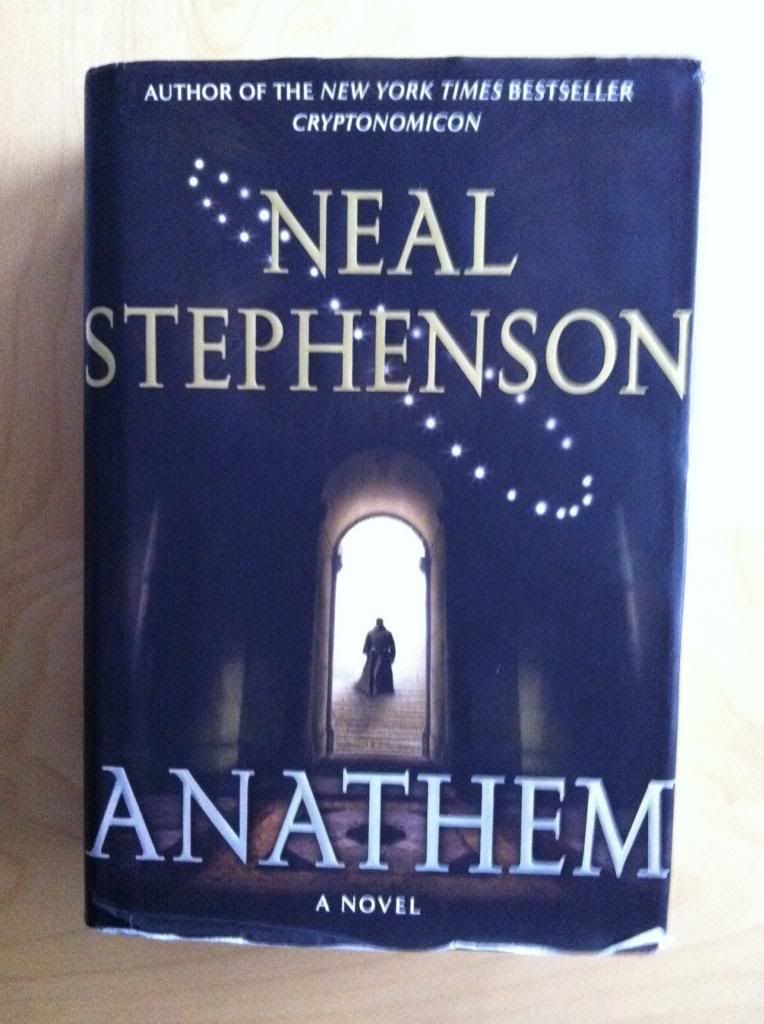
I would recommend Anathem by Neal Stephenson. This might be one of my very favourite novels. It tells the story of Fra Erasmus, a young Science-monk in a society where the academic world lives apart from the Secular world in ascetic monasteries. During a particularly momentous time in Erasmus' life, a startling observation throws his world into disarray and sets off a chain of events with worldwide consequences. Anathem is a sprawling novel about coming of age and personal growth filled with adventure and romance and camaraderie and Science Fiction. It is also a novel that works as a thematic analysis of the philosophy of Science and the relationship between the academic and non-academic portions of our society. It is super insightful and one of the most emotionally true portrayals of Science academia and the act of discovery I have ever seen. I love this book.
If You Like Fantasy:
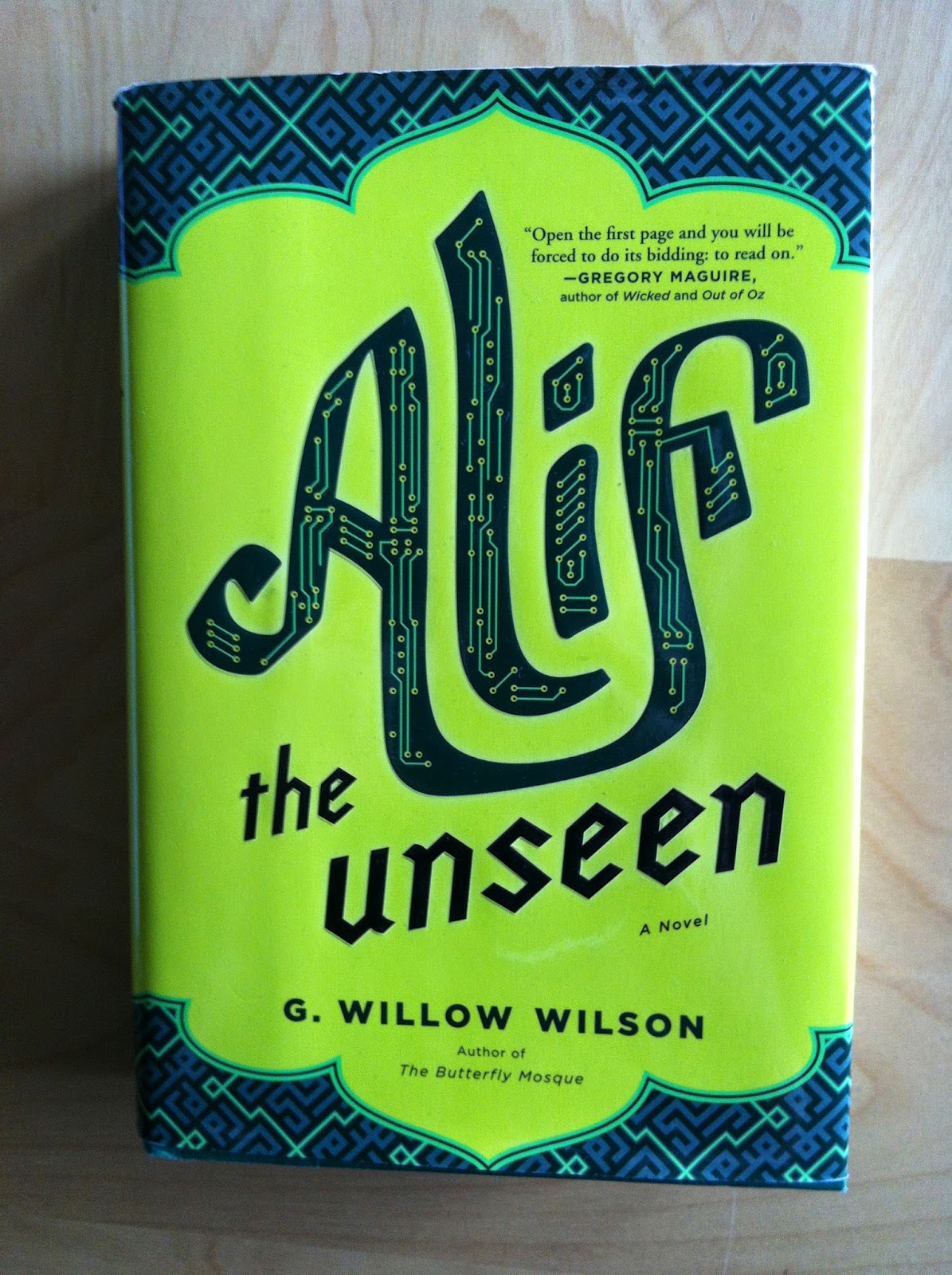
I would recommend Alif The Unseen by G Willow Wilson. Alife The Unseen is a novel that explores what if the more mythical-seeming portions of the Quran were literally true; what if humanity lived along an unseen world of supernatural beings. The novel stars Alif a young hacker living in an Arab Emirate who makes his living by helping dissident voices and staying one step ahead from the ruthless government censors. When Insitar, the wealthy daughter of a powerful man, spurns him, Alif writes a powerful software program that threatens to deliver him into the hands of the state censors. Alif flees, inadvertently dragging along his neighbour Dinah, and finds himself lost in a world of mythical monsters and spirits. Alif The Unseen is a book that mixes an exciting technothriller premise with romance, discovery, and the boundless imagination of a wonderfully realized fantasy world. As a pure work of fiction Alif The Unseen is a great read. This novel is also pretty special in that it portrays young people living in the arabic world and explores the collision of modern and tradition that confronts them. Which is really interesting. Also, Alif The Unseen contains one of the most 'shippable romances ever!
If You Like Superhero Comics:
I would recommend The Amazing Adventure of Kavalier & Clay by Michael Chabon. While not directly a superhero novel, Kavalier & Clay is a novel about the cultural primordial soup and people who first invented Superheroes and produced the comics of the Golden Age. The novel features Joe Kavalier, an young jewish artist and refugee, and Sam Clay, a plucky Jewish kid from Brooklyn a they form a partnership and invent The Escapist, a comic book hero who frees people from the shackles of injustice. The novel really illuminates the way social forces, the spectre of Nazi Germany, Vaudeville magicians and strongmen, all fermented in the imaginations of scrappy young people to create the amazing fantasy worlds we all love today. Kavalier and Clay is also constructed out of all the adventure, romance, and bombast of comic books, but applied to the believable lives of its heroes. It's basically a beautifully written novel about comics that tells a great story. Also, serious points for depicting the best first kiss in fiction.
Or If You Just Like Books:
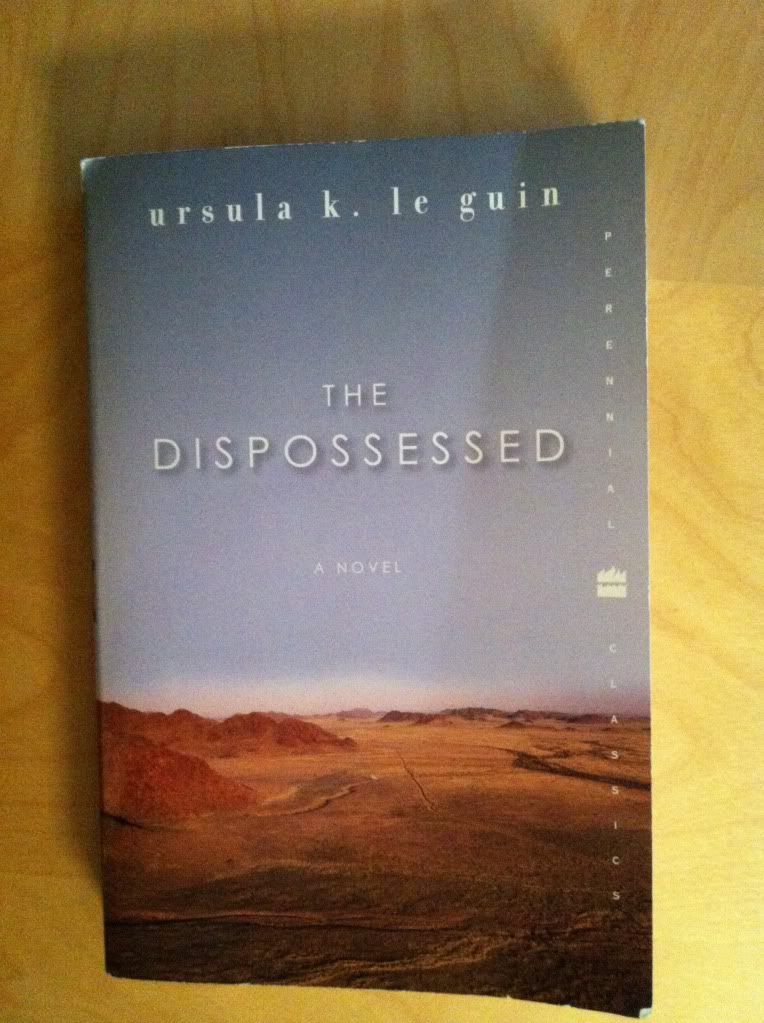
I would recommend The Dispossessed by Ursula K Le Guin. You know when you read books that are clearly Important and Classic and Timeless and yet you never really hear about them? Well The Dispossessed is completely one of these books. The novel is one of the best works of social speculative fiction I have ever read. In the book twin planets, Urras and Anarras, orbit each other in close proximity. Yet, despite this proximity, the inhabitants of these planets could not be more isolated from one another. The Urrasti live on a lush world and live in a capitalistic society of wealth and inequality. The Anarresti however, live on a barren, arid planet and live an ascetic life of anarchic communism to survive. In The Dispossessed, an Anarresti theoretical physicist Shevek travels to Urras to develop and share his theories, breaking the isolation and bringing the two societies into idealogical conflict. The Dispossessed is an absolutely unflinching examination of two societies: western capitalism and an idealized anarchic communism. The novel really shows the strengths and ugliness of both societies and showcases the underlying humanity of people regardless of where they are from. The Dispossessed is a novel that deserves to be held up with the greatest works of social fiction and so I really think you should read it.
Post by Michael Bround
Jennifer DePrey's top pick from 2014:
Insert by Jennifer DePrey
Previously:
Novel Reviews 2013
2014 was kind of an odd year for novels on Atoll Comics. I only put up 13 novel review posts this year as opposed to the previous two years on the site where novel reviews were a major component of the site. There are a few reasons for this including the fact I've gotten better at finding comics things to write about, am a lot better at working ahead (novel reviews were often my buffer against vacations or laziness), and that I wanted to focus more on writing critically about comics in 2014. Add to that my new Atoll Comics collaborator Jennifer DePrey, and well, I don't NEED novel posts to hit my updates anymore. But I still read a lot of novels and really like writing about them, so starting in 2015 there will be regular prose novel reviews on the site every Tuesday. And to kick off this new segment, I thought we'd take a look back at the novels of 2014.
Despite the smaller sample size of books this year, I still read some great books that you may want to check out in 2015. Specifically I reviewed:
Genetopia, by Keith Brooke
Seed To Harvest Omnibus, by Octavia Butler
Gentlemen Of The Road, by Michael Chabon
Telegraph Avenue, by Michael Chabon
The Amazing Adventures of Kavalier and Clay, by Michael Chabon
Wonder Boys, by Michael Chabon
The Man In The High Castle, by Philip K Dick
Judas Unchained, by Peter F Hamilton
Pandora's Star, by Peter F Hamilton
The Dispossessed, by Ursula K Le Guin
Motherless Brooklyn, by Jonathan Lethem
Anathem, by Neal Stephenson Breakfast of Champions, by Kurt Vonnegut
Cat's Cradle, by Kurt Vonnegut
Slautherhouse Five, by Kurt Vonnegut
The Sirens of Titan, by Kurt Vonnegut
Alif The Unseen, by G Willow Wilson
Also, since it's traditional, I'd like to do an abbreviated version of my annual top picks for certain genres.
If You Like Science Fiction:
I would recommend Anathem by Neal Stephenson. This might be one of my very favourite novels. It tells the story of Fra Erasmus, a young Science-monk in a society where the academic world lives apart from the Secular world in ascetic monasteries. During a particularly momentous time in Erasmus' life, a startling observation throws his world into disarray and sets off a chain of events with worldwide consequences. Anathem is a sprawling novel about coming of age and personal growth filled with adventure and romance and camaraderie and Science Fiction. It is also a novel that works as a thematic analysis of the philosophy of Science and the relationship between the academic and non-academic portions of our society. It is super insightful and one of the most emotionally true portrayals of Science academia and the act of discovery I have ever seen. I love this book.
If You Like Fantasy:
I would recommend Alif The Unseen by G Willow Wilson. Alife The Unseen is a novel that explores what if the more mythical-seeming portions of the Quran were literally true; what if humanity lived along an unseen world of supernatural beings. The novel stars Alif a young hacker living in an Arab Emirate who makes his living by helping dissident voices and staying one step ahead from the ruthless government censors. When Insitar, the wealthy daughter of a powerful man, spurns him, Alif writes a powerful software program that threatens to deliver him into the hands of the state censors. Alif flees, inadvertently dragging along his neighbour Dinah, and finds himself lost in a world of mythical monsters and spirits. Alif The Unseen is a book that mixes an exciting technothriller premise with romance, discovery, and the boundless imagination of a wonderfully realized fantasy world. As a pure work of fiction Alif The Unseen is a great read. This novel is also pretty special in that it portrays young people living in the arabic world and explores the collision of modern and tradition that confronts them. Which is really interesting. Also, Alif The Unseen contains one of the most 'shippable romances ever!
If You Like Superhero Comics:
I would recommend The Amazing Adventure of Kavalier & Clay by Michael Chabon. While not directly a superhero novel, Kavalier & Clay is a novel about the cultural primordial soup and people who first invented Superheroes and produced the comics of the Golden Age. The novel features Joe Kavalier, an young jewish artist and refugee, and Sam Clay, a plucky Jewish kid from Brooklyn a they form a partnership and invent The Escapist, a comic book hero who frees people from the shackles of injustice. The novel really illuminates the way social forces, the spectre of Nazi Germany, Vaudeville magicians and strongmen, all fermented in the imaginations of scrappy young people to create the amazing fantasy worlds we all love today. Kavalier and Clay is also constructed out of all the adventure, romance, and bombast of comic books, but applied to the believable lives of its heroes. It's basically a beautifully written novel about comics that tells a great story. Also, serious points for depicting the best first kiss in fiction.
Or If You Just Like Books:
I would recommend The Dispossessed by Ursula K Le Guin. You know when you read books that are clearly Important and Classic and Timeless and yet you never really hear about them? Well The Dispossessed is completely one of these books. The novel is one of the best works of social speculative fiction I have ever read. In the book twin planets, Urras and Anarras, orbit each other in close proximity. Yet, despite this proximity, the inhabitants of these planets could not be more isolated from one another. The Urrasti live on a lush world and live in a capitalistic society of wealth and inequality. The Anarresti however, live on a barren, arid planet and live an ascetic life of anarchic communism to survive. In The Dispossessed, an Anarresti theoretical physicist Shevek travels to Urras to develop and share his theories, breaking the isolation and bringing the two societies into idealogical conflict. The Dispossessed is an absolutely unflinching examination of two societies: western capitalism and an idealized anarchic communism. The novel really shows the strengths and ugliness of both societies and showcases the underlying humanity of people regardless of where they are from. The Dispossessed is a novel that deserves to be held up with the greatest works of social fiction and so I really think you should read it.
Post by Michael Bround
Jennifer DePrey's top pick from 2014:
I would recommend Fangirl by Rainbow Rowell. Fangirl is about Cath, a teenager facing her first year of college. She’s
worried about making new friends, leaving home and her father, and finishing
her Simon Snow fanfiction before the release of the final book. This coming of
age story asks the question of how to begin the process of growing up and still
hold onto the interests other people might not understand, but from which we
gain strength. Rainbow Rowell’s style is engaging, her dialogue is snappy, and
her characters feel like old friends. I was rooting for Cath from page one.
Insert by Jennifer DePrey
Previously:
Novel Reviews 2013
Friday, 28 March 2014
The Dispossessed Is A Good Book
Or why you should read The Dispossessed by Ursula K Le Guin,
The Dispossessed is a utopian Science Fiction novel about binary contrasts and the human spirit. The novel is set in the twin planets Urras and Anarras in the Tau Ceti star system. Despite their proximity, the two planets are diametric opposites: Urras, is a lush, fertile garden world of plentiful resources while Anarras is a hostile, arid world rich in minerals but poor in natural life. While both planets are inhabited by the Cetain species, the cultures of the two worlds are radically different. Urras is mostly an aggressively capitalist planet, divided into warring nation-states which are governed by vaguely authoritarian governments. Urrasti society, as a result, is very much divided between the rich and the poor, the powerful and the repressed. Anarres, in contrast, is a world without governments, ownership, commerce, or hierarchies. Anarresti society, based on the collectivist/anarchist philosophy of Odo, is defined around equality, sharing, achieving personal happiness, and surviving the harsh Anarras environment and the collective poverty of the world. The two worlds, Urras and Anarres, despite their proximity are, aside from some minor trade, completely isolated from each other and have been for generations. It is against this contrasting background that the novel tells the story of the brilliant Anarresti theoretical physicist Shevek, who in his quest to achieve a General Temporal Theory, must consult alien physicists and chooses to travel to Urras to pursue his research. And in doing so Shevek becomes a lens to explore both societies, both halves of the binary, and in so doing examines what it means to be human in a society. It's a brilliantly smart and humane work of fiction.
I would recommend The Dispossessed to any Science Fiction fan: if you have pretensions of being a serious Sci-fi reader this is a must read book. It's beautifully written, emotionally deep, and painfully intelligent (although in a very accessible way). It is also one of the most astute political explorations I've ever read, and unlike most landmark social speculation novels it does't rely on dystopia. Instead it's a frank look at different societies in a way that is aware that few societies are completely shit: most, for all their problems, also have strengths, and the way The Dispossessed uses and breaks its binaries is really mindful of that. It's pretty refreshing. And so I would also recommend this book to anyone into fiction with a heavy element of social meditation because this is Sci-fi built for political nerds. The Dispossessed is also a novel that I would recommend to people looking for more great Sci-fi by women authors. Part of why I picked this book up was having it pointed out/realizing just how few women authors I read and a desire to find out if I'm missing out on some great Sci-fi. And, well, The Dispossessed is exactly the kind of novel I was afraid I was missing out on.
The Dispossessed is a utopian Science Fiction novel about binary contrasts and the human spirit. The novel is set in the twin planets Urras and Anarras in the Tau Ceti star system. Despite their proximity, the two planets are diametric opposites: Urras, is a lush, fertile garden world of plentiful resources while Anarras is a hostile, arid world rich in minerals but poor in natural life. While both planets are inhabited by the Cetain species, the cultures of the two worlds are radically different. Urras is mostly an aggressively capitalist planet, divided into warring nation-states which are governed by vaguely authoritarian governments. Urrasti society, as a result, is very much divided between the rich and the poor, the powerful and the repressed. Anarres, in contrast, is a world without governments, ownership, commerce, or hierarchies. Anarresti society, based on the collectivist/anarchist philosophy of Odo, is defined around equality, sharing, achieving personal happiness, and surviving the harsh Anarras environment and the collective poverty of the world. The two worlds, Urras and Anarres, despite their proximity are, aside from some minor trade, completely isolated from each other and have been for generations. It is against this contrasting background that the novel tells the story of the brilliant Anarresti theoretical physicist Shevek, who in his quest to achieve a General Temporal Theory, must consult alien physicists and chooses to travel to Urras to pursue his research. And in doing so Shevek becomes a lens to explore both societies, both halves of the binary, and in so doing examines what it means to be human in a society. It's a brilliantly smart and humane work of fiction.
I would recommend The Dispossessed to any Science Fiction fan: if you have pretensions of being a serious Sci-fi reader this is a must read book. It's beautifully written, emotionally deep, and painfully intelligent (although in a very accessible way). It is also one of the most astute political explorations I've ever read, and unlike most landmark social speculation novels it does't rely on dystopia. Instead it's a frank look at different societies in a way that is aware that few societies are completely shit: most, for all their problems, also have strengths, and the way The Dispossessed uses and breaks its binaries is really mindful of that. It's pretty refreshing. And so I would also recommend this book to anyone into fiction with a heavy element of social meditation because this is Sci-fi built for political nerds. The Dispossessed is also a novel that I would recommend to people looking for more great Sci-fi by women authors. Part of why I picked this book up was having it pointed out/realizing just how few women authors I read and a desire to find out if I'm missing out on some great Sci-fi. And, well, The Dispossessed is exactly the kind of novel I was afraid I was missing out on.
Subscribe to:
Posts (Atom)