Showing posts with label John Layman. Show all posts

Friday, 26 September 2014

Deep Sequencing: Food Freaks V. 2

Or an on-going tabulation of the various food powers in Chew
by John Layman and Rob Guillory, Image Comics


Part of the fun of Chew is how regosh-darn bizarre a comic it is. The premise of people with strange food powers living in a society with a strictly enforced poultry ban is just delightfully strange and wonderful. The thing is though, Chew, as crazy as it is, is builds in this systemic way where each weird idea builds on the last so the entire nuthouse is has this wonderful internally consistency. It's totally crazy, but it works. It's pretty cool and a sign that we should be wary of John Layman and Rob Guillory ever running for government office. 

Anyway, in celebration of the weird world of Chew and it's intensely well constructed madness... and because I like to make info-graphics, here is my updated chart of all of the wacky food powers in Chew. Specifically in the Chew collections volumes 1-8.

There will be *SPOILERS* for Chew Vol. 1-8, so proceed with all due caution.

(The new stuff is at the bottom.)


Wednesday, 24 September 2014

So I Read Chew: Family Recipes

A 250 word (or less) review of Chew Vol. 8
by John Layman and Rob Guillory; Image Comics


This review will contain *SPOILERS*. For a clean review go here.


Chew is a comic about a detective who gets psychic impressions from everything he eats in a crazy universe that involves a poultry ban, a cannibal vampire, a cyborg game cock, and extraterrestrial Armageddons. It's a comic that is gloriously weird, but still compelling and accessible comics. Chew: Family Recipes brings the lens of the series back on Tony as he realises that his dead twin sister Toni had managed to leave him an amputated toe filled with important information. Tony's sister was cibovoyant, able to predict the future of any living thing she ingests. Sensing her own demise, she took steps to leave a fleshy clue for her cibopathic brother so she could equip him with important knowledge about his future from beyond the grave. Of course, this is Chew, so complications and hijinks ensue that are ridiculous and awesome. It's really business as usual for Chew and it's great. Which is actually pretty diverse business. I frequently see my favourite comics spaces try to mathematically quantify how diverse a particular comic is, to figure out whether a particular comic panders to a default audience or tries to represent a more realistic view of society. And Chew is actually pretty great about this: the protagonist of Chew is of Asian decent, his partner is a bisexual cyborg, and a significant portion of key characters are a demographically plausible mix of genders, sexual orientations, and ethnicities. So, I guess, come for the mad fun, stay for the thoughtful representation.


Word count: 249

Previously:
Chew Vol. 1-5
Chew Vol. 6
Chew Vol. 7

Friday, 31 January 2014

Deep Sequencing: Food Freaks

Or an on-going tabulation of the various food powers in Chew
by John Layman and Rob Guillory, Image Comics


Part of the fun of Chew is how regosh-darn bizarre a comic it is. The premise of people with strange food powers living in a society with a strictly enforced poultry ban is just delightfully strange and wonderful. The thing is though, Chew, as crazy as it is, is manufactured in this really thoughtful, systemic way where each weird idea builds on the last so that entire nuthouse is constructed in this alt-logical, internally consistent way. It's pretty cool and a sign that we should be wary of John Layman and Rob Guillory eventually starting a cult-religion. (I am on to you, gentlemen.)

Anyway, in celebration of the weird world of Chew and it's intensely well constructed madness... and because I like to make info-graphics, here is my new recurring chart of all of the wacky food powers in Chew. Specifically in the Chew collections volumes 1-7.

There will be *SPOILERS* for Chew Vol. 1-7, so proceed with all due caution.


Wednesday, 29 January 2014

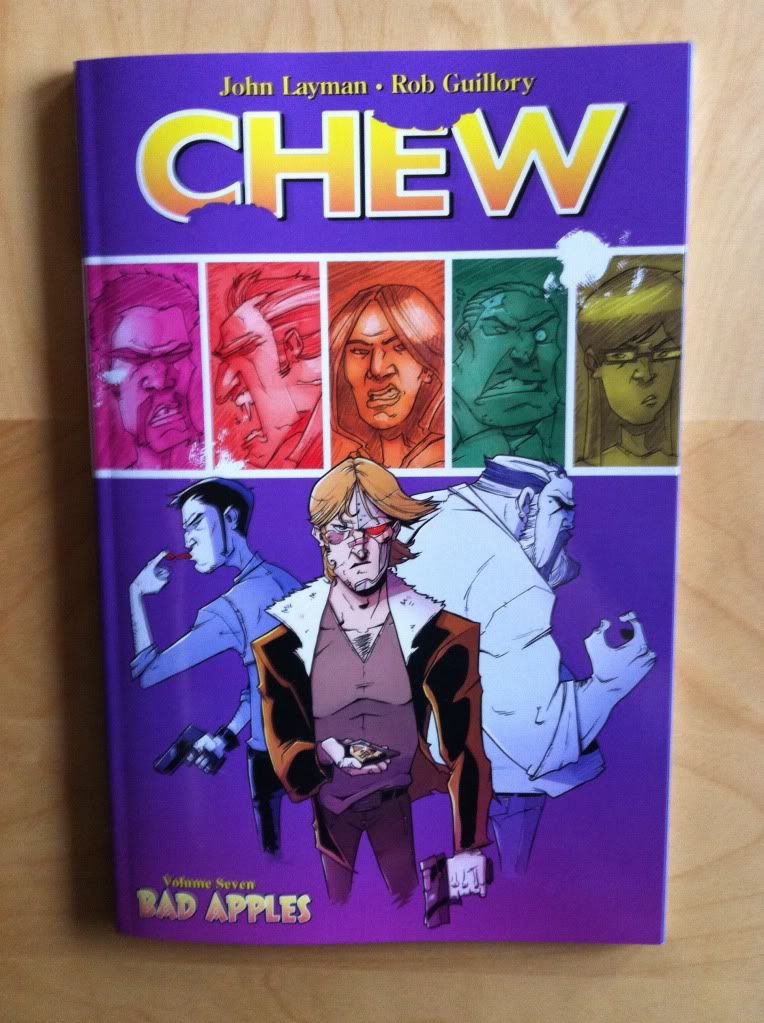
So I Read Chew: Bad Apples

A 250 word (or less) review of Chew Volume 7
By John Layman and Rob Guillory; Image Comics


This short review could have *SPOILERS* for Chew 1-6. Click here for a clean review.


Chew is certainly one elaborate and lengthy comic for being so completely insane. Over it's many chapters it has grown from a comic about a psychic cannibal detective enforcing a poultry ban to a much larger story with a cast of dozens of weirdoes pursuing a kaleidoscope of crazy storylines. Chew is very much a mountain of madness built on a surprisingly meticulous foundation of characterization, story structure and pacing. Chew: Bad Apples is a Chew comic that is about maintaining the rigorous narrative logistics of this gloriously goofy comic. Chew has, in recent issues, diffracted into some pretty separate storylines, and Bad Apples is about touching base with all of these diverse elements. It's a comic that is about keeping all of the plates, piled high with their bizarre and gruesome deserts, spinning. But! Chew: Bad Apples is still a Chew comic! The stories the comic is touching base with include the psychic cannibal cop hunting a vampire that murdered a loved one, his cyborg partner discovering a secret betrayal, and well, a bunch of other Chew family madness. It's a great, funny, mad comic that really feels like its gearing up to go somewhere interesting with its wild premise. I’m excited to see the madness that is coming!

Wednesday, 12 June 2013

So I Read Chew: Space Cakes


A 250 word (or less) review of Chew Volume 6
By John Layman and Ron Guillory, Image Comics


This review will contain unavoidable *SPOILERS*. For a *SPOILER* free review of Chew please go here.

I often feel like one of the key advantages that creator owned comics have over mainstream books is their sheer originality. Chew, let it be said, has originality in spades. The kind of out of control originality that makes you pause and wonder if it might just be a bit mentally unbalanced. But, you know, in a charming, fascinating way. Chew is a comic about sometime FDA agent Tony Chu, a Cibopath who can gain psychic impressions from everything he ingests, as he pursues various forms of food criminals, from the low level poultry bootlegger to the exotic criminal with a food related ability. Space Cakes sees Tony out of commission and instead follows his twin sister Toni while he recovers. Toni is like a more fun and well-adjusted version of her brother: she is a Cibovoyant, able to forecast the future of any person she bites, and an agent of NASA. In Space Cakes Toni and other Chew staple characters investigate the disappearances of people with food related abilities. Oh, and Poyo the cyborg fighting rooster has a solo adventure. Chew: Space Cakes is one very fun and funny comic drawn in a delightfully bombastic cartoon style. This volume is also the first collection that really shows evidence of the hidden mechanism of the broader Chew plot: all this borderline insanity is finally feels like it's going somewhere. Chew, it's worth checking out because there isn't anything else like it.

Word count: 240

Previously:
So I Read Chew Volumes 1-5

Friday, 24 May 2013

Spinal Tapestry 3: Reading Rainbow

Or the under-appreciated art of comic book spines

Book spines are, I think, the most overlooked component of book design in collected editions of comics. Whether because of all the emphasis placed on cover pages or the comic industry's infatuation with staple bound invertebrate single issues, comic spines don't generally get the love they deserve. Which is a shame, because in most settings, be they home bookshelf or retail bookshelf, the comic spine is the only part of the comic visible. Ignoring this portion of the comic's exterior hurts a print comics value as an art object (which I think is one of the key value-added features of the print format) and probably has an adverse effect on a comics retail performance. Paying attention to it can make comics look great and stand out from the crowd.

When dealing with long comics series in collected editions, I think one of the key design choices that can really improve the look and visual impact of a series is a unifying design. By tying individual books together with common elements, a series gains an identity and becomes instantly recognizable as an aggregated whole. Generally, one of the keys to this seems to be choosing a few colours to give the comics a harmonious relationship. By wildly varying spine colours, you can pretty much ruin the look of a series.
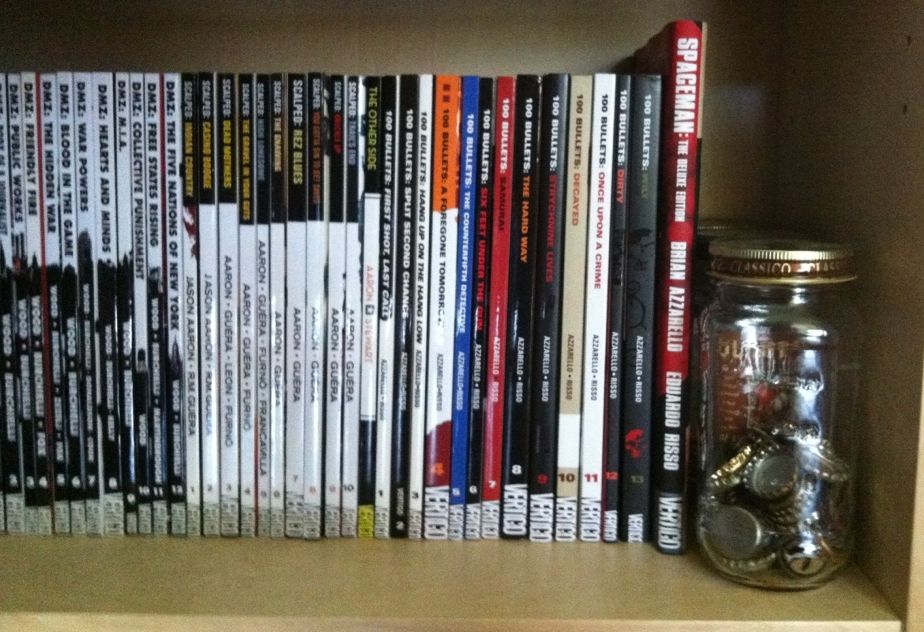

100 Bullets, by Brian Azzarello and Eduardo Risso,  is a fantastic crime comic about the opportunity to avenge injustice wrapped in a grand conspiracy. The interior of the comic is gorgeous, absolute brutality drawn with precise elegance by Risso, and the covers of the series (including these collections), by Anthony Johnson, are perfect. That said, the spines of this series are terrible. It seems the choice was made to make the spines of the 100 Bullets collections entirely dependent on cover art, which makes the spines lack identifiable common elements or common colours. When put next to the clean, unified design of Scalped, or the brilliant design of DMZ, 100 Bullets looks like a mess of random comics instead of a lovingly appointed series. And I think it's shelf presence suffers for that.


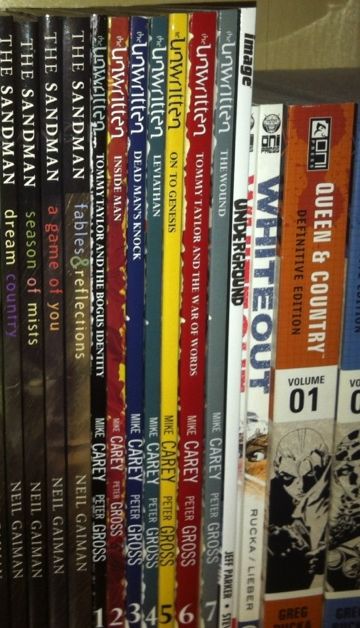
The Unwritten, by Mike Carey and Peter Gross, is a great comic about the power of literature to affect society and people with the bourgeoning power to tap into it. The Unwritten is also another comic with great interior art and superb covers, by Yuko Shimizu, but poor spine design. The Unwritten makes that fairly common mistake of giving each edition its own colour to make a rainbow effect. The problem is that this breaks up any cohesion over the entire series and doesn't really tell us anything about the identity of the Unwritten. Varying colours like this is almost never the best choice.


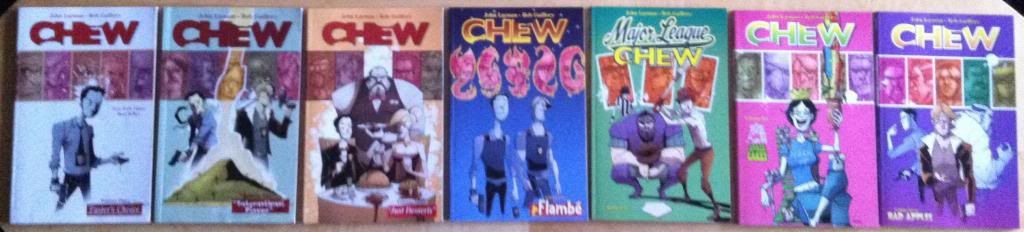
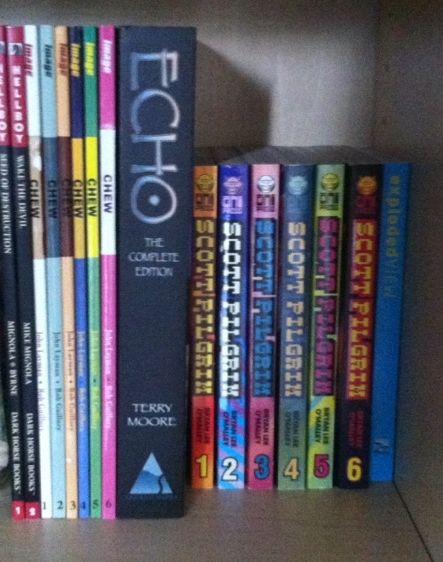
But like all rules there are exceptions. Scott Pilgrim and Chew are two comics that absolutely break what common sense suggests is good book design. They use bright, obnoxious colours that change and clash between books. And while they do maintain common elements between books (Chew's cutout and Scot Pilgrims weighty logo), their overall look is just garish as hell. The thing is, this WORKS for these comics. Chew, by John Layman and Rob Guillory, is an insane comic about people with mental food powers solving ridiculous food crimes: the plot is crazy, the art is bombastic and cartoony, and the aesthetic of the book is frankly pretty garish. So a cover spine design that clashes between issues and uses bright, cartoony colours completely sells the identity of the book. Similarly  Scott Pilgrim, by Brian Lee O'Malley, also has a cartoony look and bombastic style. Scott Pilgrim is a comic about being brave enough to love while being an adrift 20-something, and has a style influenced by manga and 1990's video games that is just really inviting and fun. The spines of the Scott Pilgrim books, with their garish bright colours, manga-ish book size, and pixelated logo font absolutely evoke the visual identity of the book. What I am saying, basically, is that these comics, by having insane cartoony spines,  are able to convey their visual identity instantly. And that is, I think, the core of book design.

Previously:
Spinal Tapestry 1
Spinal Tapestry 2

Wednesday, 19 December 2012

So I Read Chew Volumes 1-5

A 250 word (or less) review of Chew trade paperbacks 1-5
By John Layman and Rob Guillory, Image Comics


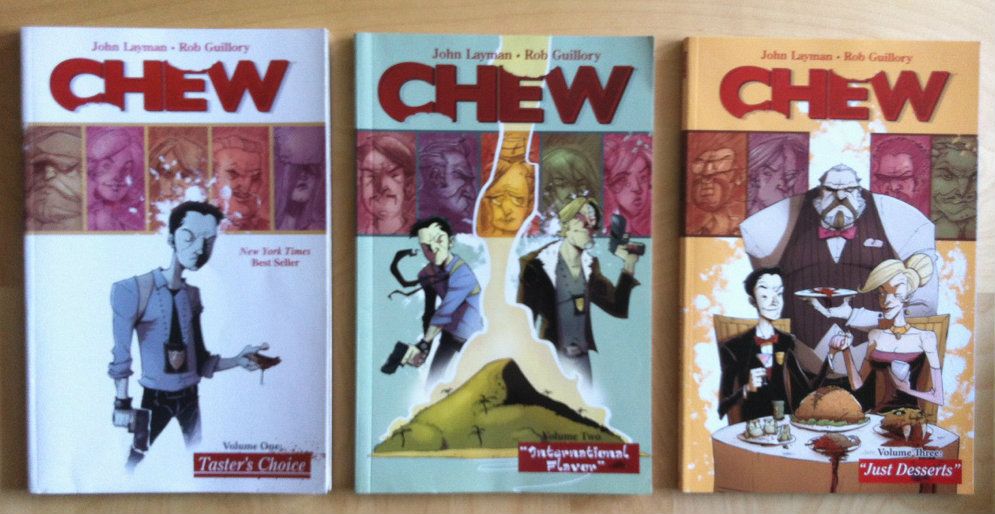
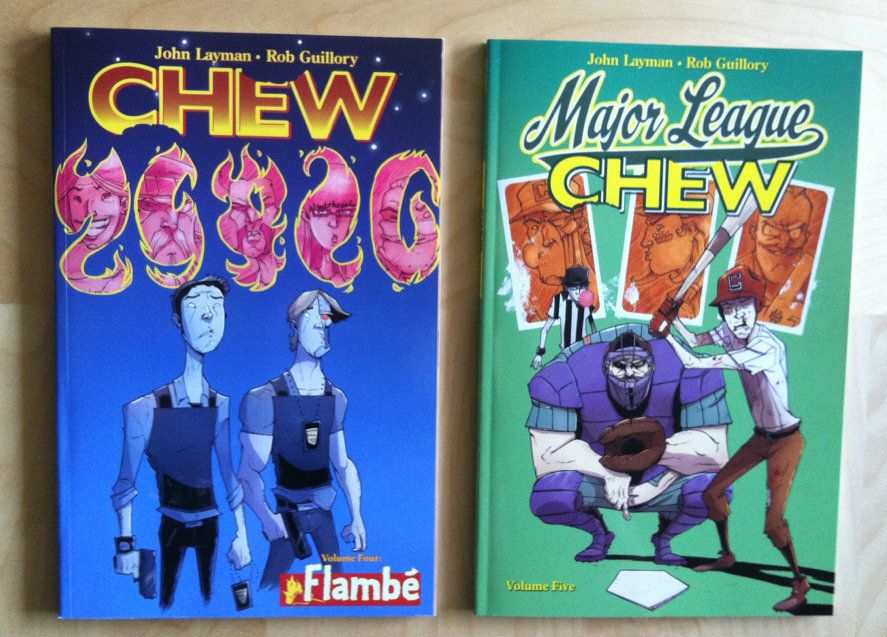
Delightfully demented, wonderfully weird and alliteratively awesome. Chew is a book about detective turned FDA agent Tony Chu who is cibopathic. A cibopath is a person who receives the psychic impressions and from whatever he eats: from plants a sense of pesticides, from meat the manner of their slaughter and from people, or their corpses, their skills and memories. From beets: nothing, they are inscrutable. Chu's adventures take place in a world where, due to an apparent outbreak of avian flu, poultry is illegal and illegal fried chicken is big business which the FDA is tasked with cracking down. The overall plot of Chew is built around exploring Chu’s cibopathy by constructing increasingly elaborate and ridiculous situations for his talent/curse to be useful. Oh, and there is an overarching plot about a possible conspiracy concerning the chicken ban. The resulting script, coupled with Guillory’s vividly cartoony artwork, is this offbeat and clever book that is also incredibly weird. I mean, it's a story about a psychic cannibal detective whose adventures pit him against chicken smugglers, an alien fruit that tastes just like chicken, mutant chicken-frogs, space writing, a vampire, and Poyo the greatest fighting rooster of all. It’s also hilarious, filled with a brilliant array of absurdity and jokes that are genuinely funny instead of the usual quippy. If you’re looking for a
fiercely original book with some solid laughs, Chew is definitely worth checking out.

Word count: 236