A 250 word (or less) review of The Complete Wonton Soup
by James Stokoe; Image Comics

Sometimes it's easy to forget that comics are an art form instead of just machines for telling stories. Comics are able to function purely as an aesthetic medium if you look at them a certain way. And the thing about art is that it often involves a certain amount of experimentation: developing a voice, trying new methods, honing skills. A trip to a museum dedicated to a single master will often show the learning phase along with the eventual masterpieces which is super cool to see and proof that every artistic achievement is built on lesser accomplishments and failures. Wonton Soup is the early work experimentation of the comics art of James Stokoe. It tells the story of a pair of space truckers: Johnny Boyo, a talented chef on an inspiration seeking walkabout, and Deacon, a druggy sex-pervert trying to find love after the loss of his Sex Bear. The pair have a number of ridiculous adventures including an iron chef style cooking competition for space culinary school bragging rights, Sex Bear husbandry, and a wild drug trip that maroons the pair in an alien jungle. Mostly, though, the comic functions as a fun background for Stokoe to experiment with storytelling and develop his artisitic voice. I have never read a comic that spans such a profound evolution of style that shows both someone's early work and their later mature aesthetic. It's pretty great and a testament to the hard work needed to be a really great comics artist.
Word count: 249
Previously:
So I Read Godzilla: The Half-Century War
So I Read Orc Stain Vol. 1
Or how narrative caption layout generates a sense of scale in Godzilla: Half Century War
By James Stokoe; IDW Publishing
James Stokoe's Godzilla: The Half-Century War is a fun comic with some distinct, gorgeous artwork. It tells the progression of the Godzilla mythos and the ever escalating and evolving nature of the giant monster-lizard through the lens of of the humans tasked with controlling the beast. It's good comics.
As far as I'm concerned, there are two key elements to a convincing Godzilla comic (which can probably be extended to Kaiju stories in any media): the giant monsters have to feel massive, and intricate environments need to be smashed to pieces. Stokoe is pretty much a goddamn master at drawing interesting, and intricate environments and he uses this skill to satisfy this second element in spades. As for the issue of scale in Godzilla: The Half-Century War, Stokoe comes up with a really simple, elegant solution:
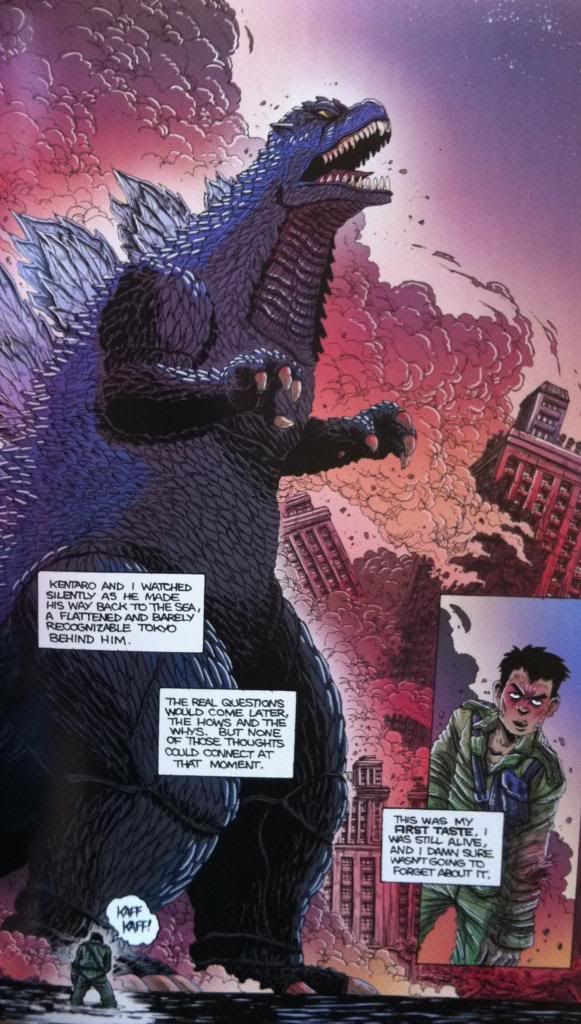
Stokoe places the narration captions in the lower half of the page. It's that simple. Instead of the normal convention of placing the boxes along the top of the page, the narration sits in the middle. And this in turn makes the page feel extra tall, as if additional page height had to be added just to capture the full height of Godzilla. Which, when coupled with an upshot, and a small human in the forground makes for a Kaiju that feels absolutely huge. Like he towers over the comic. It's really smart comics.
It also, I think, emphasizes how important and effective lettering placement can be as a storytelling tool. Lettering, like colouring, is an under appreciated comics artform that, while often invisible-seeming, is integral to comics.
A 250 word (or less) review of the Godzilla: The Half-Century War collection
By James Stokoe; IDW Publishing
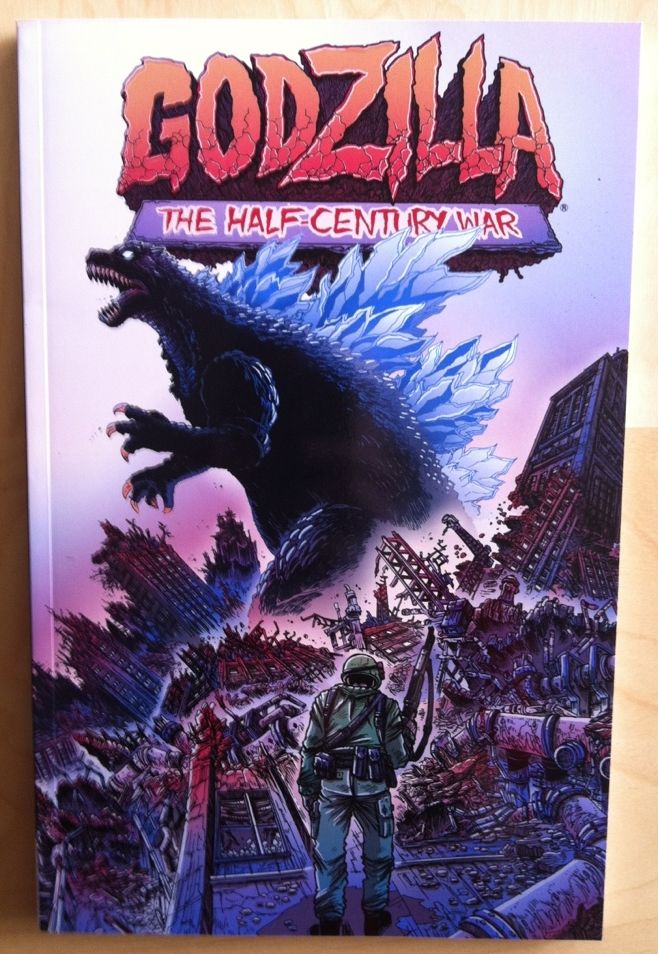
Godzilla
is a cultural icon. From what little I understand, this rubbersuit Lizard
is the towering mascot of the entire Kaiju genre of giant monster films.
Godzilla and his genre of films have been around for... a half-century (and a
bit) and Godzilla: Half-Century War is very much a celebration of this fact. In
the comic Ota Murakami, a Japanese soldier caught in Godzilla's first rampage circa 1954, gets drafted into the Anti-Megalosaurus Force to fight this giant
monster. What follows is a half-century of globe trotting conflict as Ota and
his comrades fight a war against Godzilla and the ever-growing roster of Kaiju
monsters, from Mothra to Gigan, in an effort to save humanity from these
beasts. And in that way, Godzilla: The Half-Century war functions as an homage to
Kaiju films, and acts as a kind of primer to the overall shape of Godzilla's
history, lovingly presented, costume seams and all. If you are a comics person
but not a passionate Godzilla fan, The Half-Century War is still worth picking up
for the art. James Stokoe is a fantastic artist, with a mad aesthetic unlike
anything else in comics. A mad aesthetic that features brilliantly detailed
environments and a real zeal for portraying scaly, bestial things. Basically,
what I am saying is James Stokoe was pretty much born to draw a series of
comics about Godzilla levelling cityscapes. It’s an absolutely
beautiful, confounding, art central comic that is also a loving tribute to Godzilla.
A 250 word (or less) review of Orc Stain Vol. 1
By James Stokoe, Image Comics

Have you ever wondered what all those Orcs you
read about in fantasy novels get up to when they aren't guarding dungeons or
enlisting in villainous hordes? Well wonder no more! They are fighting over
phalluses. Orc stain is the story of the political, social, and economic fabric
of Orc society. Specifically, it is about a mighty Orc chieftain's quest for
status by finding his "God Organ"
and the prophecy that he must capture the one-eyed Orc to find it. Much of Orc
stain is seen though the lens of One-Eye, a uniocular safe-cracking thief who
gets swept up in the Orc chieftain's quest. Along the way we learn about Orc
culture, Orc-kind’s gronch based currency, and the elaborate craft of Orcish
poisoning. Despite its uncouth sensibilities and creative tangents, from a
story standpoint Orc Stain is pretty straightforward. Where the comic really sets
itself apart is visually: this is one remarkable looking comic. The world of
Orc Stain is a profoundly strange looking place: everything is lumpy and
grotesque and ornate and exquisitely detailed and it’s all coloured in a
feverish mix of bright greens and reds and purples. It’s a place that is at
once endlessly fascinating to look at and ballsout (often literally)
insane. If you are looking for a comic to read that is nothing like the norm
give Orc Stain a try. Just be sure to hold onto your gronch. Or lady gronch.
Word count: 238
