Showing posts with label Dexter Soy. Show all posts

Thursday, 5 February 2015

Sound Adivice: Captain Marvel Volume 1.1

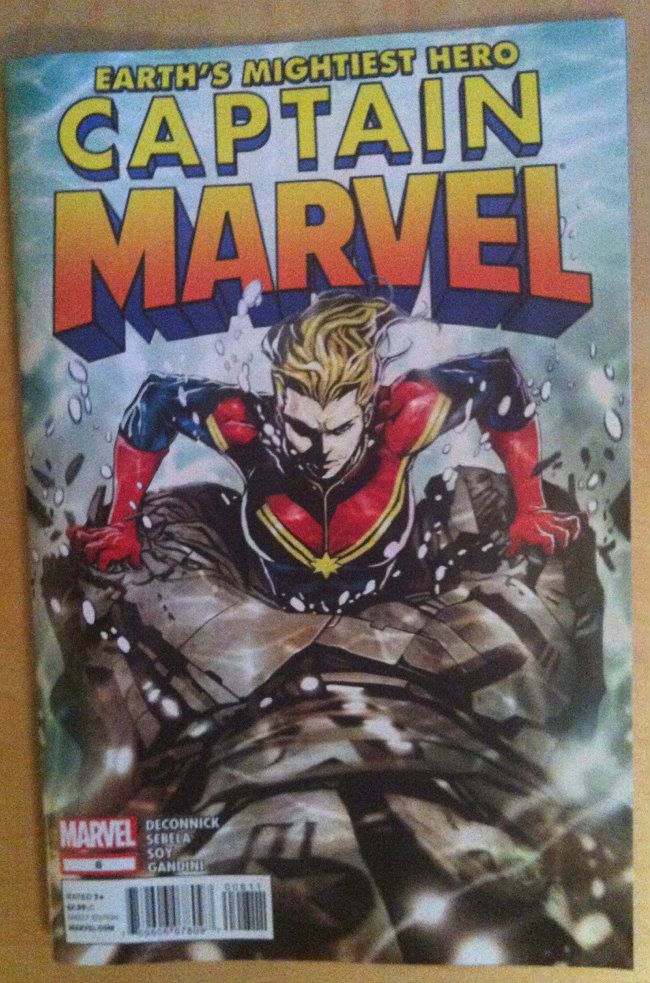
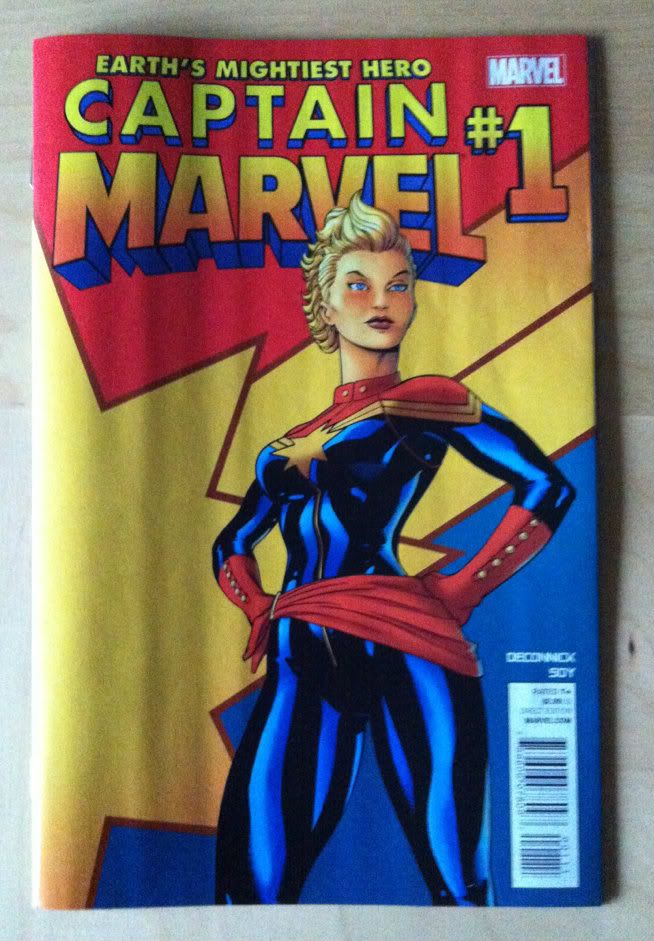
Captain Marvel Volume 1: In Pursuit of Flight
Kelly Sue DeConnick, Dexter Soy, Emma Rios, Jordie Bellaire, Clayton Cowles; Marvel Comics


So, you’ve heard Marvel is producing a film called Captain Marvel in 2018 and want to know where to start reading about this hero?  You have come to the right place.

Captain Marvel is Carol Danvers, a former USAF pilot, current Avenger, and my all-time favorite super hero. I feel like it’s only fair to tell you before we move on: I have an ongoing Carol Danvers Situation, capital S necessary. There is a bias in this post, and the bias is that I think Carol Danvers is actually THE BEST.

Marvel Studios’ recent Phase 3 announcement brought us the news that a Captain Marvel film  will be hitting the big screen in July of 2018. I’m completely floored by the news, but for many people, the announcement bought questions about who this character is, why she should be the character to land the Marvel Cinematic Universe’s first female-led title, and why this matters. With In Pursuit of Flight, collecting issues 1-6 of Kelly Sue DeConnick’s 2012 run of Captain Marvel, we see many of the story elements that have me excited for the hero Carol Danvers to gain a wider audience.

As I talk though these points, *SPOILERS* will arise, so continue at your own risk.

------

1. She looks like a female superhero should look.

Carol Danvers looks strong and powerful without surrendering her femininity. Jamie McKelvie’s redesigned uniform drew me to Captain Marvel in the first place—here we have a woman fighting in a flight suit instead of a bathing suit, wearing something that fans refer to more frequently as Carol’s “uniform” than her “costume.” Though a costume change may seem like a small thing, consider my own comics experience—thought I’ve been reading comic books since I was a kid in the late 1990’s, the look of a superhero was never intriguing enough for me to pick up a book until Carol’s Captain Marvel uniform hit the stands in 2012.

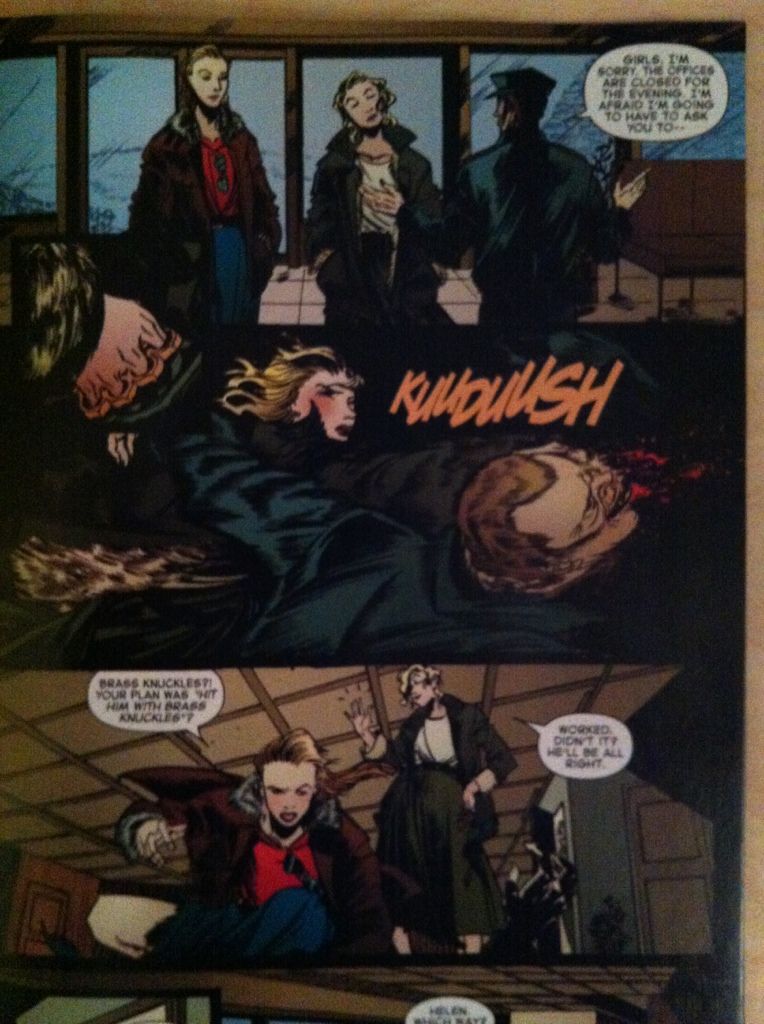
The art of In Pursuit of Flight supports this strength. Dexter Soy, who provides the art for the first part of this trade, is a favorite artist of mine because of how powerful Carol looks, and how dynamic his world feels on the page.


Emma Rios, who provides art for the second portion of the trade, brings a completely different style, one in which Carol has never looked more ethereal and magical.


Both artists avoid exploitive poses or costumes, and both are masters at showing emotion in their drawing.

2. Carol Danvers is confident about who she is and what her strengths are.

For all that this book touches on the question of names and titles and how those concepts impact our identity, Carol is very clear about who she is—She’s an Avenger. First and foremost, Carol Danvers is fighting to protect, save, and to serve, because that is what heroes do. She also clearly knows that she’s good at it—Her dialogue during fight scenes is some of the best I’ve read, because Carol is very aware that she excels at punching and blasting. Her confidence borders right on the edge of cockiness, and it’s a sort of confidence I think we see very rarely from female super heroes. “These girls have never seen anything like this in their lives,” she narrates as she begins to face down some powerful alien tech. “I’m an Avenger…we call this Tuesday.”

This is not, I should point out, to say that Carol Danvers isn’t smart. All the time she is reacting in the moment, she’s also putting together the pieces of what’s going on, considering her plan, and adjusting as new information arises. The USAF veteran is also a tactician, one who often adapts her plans on the fly, even if she sometimes does so recklessly, disregarding her own safety.

3. Her weaknesses are just as familiar to her.

The central plot of In Pursuit of Flight circles around a time travel adventure that sees Carol dropped unexpectedly into the era of WWII. She realizes this when she runs into the Banshee Squadron, an all-women group of WWII pilots, and realizing the potential of altering history Carol fully acknowledges that she has no idea what she should be doing. Though I’m usually not one for time travel plots, this one calls itself out early on. Time travel is a compelling problem for Carol to face, because it isn’t one she can't easily fight head on.


4. Carol maintains interpersonal relationships with other women.

For some reason, varied relationships between female characters can be hard to come by in comics. In just the first volume, we see a number of these relationships in Carol’s life, such as a supportive friendship with Jessica Drew, Spider-Woman, a friendship with Tracy, a older friend and former coworker who Carol is supporting through a fight with cancer, and even her relationship with Helen Cobb, clearly someone Carol views as a hero or mentor, and later, when the time travel plot brings Carol together with Helen’s young self, as competition. We see Carol relate to the Banshee Squadron as a fellow soldier and as a leader, as well. As a medium, comics can sometimes forget that friendships can cross generations, and that relationships have a huge spectrum of variation, In Pursuit of Flight remembers.

5. She considers the value of legacy.

First we see it at the start of our story, when Carol has to decide if she’s going to take on the mantle of Captain Marvel. It’s clear that part of her is worried it somehow lessens Mar-Vell’s legacy for her to do so—and part of her clearly wants the power and history of that legacy to become part of her own story. We see it again when Helen Cobb leaves Carol her plane in her will—Carol’s first act is to set off to prove that Helen Cobb’s flight record is accurate.

The whole of this arc of Carol’s story also considers a broader legacy—that of the women that came before her. The Banshees are our first reminder, couched in this fictional world, of a very real sexism experienced by women throughout history – women could not be pilots in the armed forces in WWII, so women much like the Banshee Squadron served in civilian support roles, even though they often were putting their lives on the line just as much as enlisted forces.  They thought of themselves as soldiers, even if no one else would recognize them as such.


Our second reminder comes with another jump to the 1960s, where the women pilots of Mercury 13 are facing down the injustice of a system that won’t allow them to pursue a NASA training program. Their hopes are dashed by their gender and their era, and it’s heartbreaking to witness these women’s devastation for both the reader and for Carol.


This story is absolutely about the legacy of women such as the Banshees and the Mercury 13 left for women who came after, an unashamedly feminist statement about how important it is for us to remember and honor their struggle for equality. DeConnick does her best to honor them in story, and Carol clearly recognizes how these women helped pave the way for her own service and the pursuit of her own dreams to fly.

6. For as much as legacy is valued, Carol sees the importance of continuing to move forward.

It’s a letter from Helen that is the final push Carol needs to take the title of Captain Marvel. “Helen would punch holes in the sky,” she reasons to herself, sitting at the edge of space thinking about her place in the world. When in the final arc of the book, she finds herself in a position to reset, to remove the weight of legacy, Carol can see the value of who she is, and when the moment comes, she rushes right in because someone needs saving, and that is what heroes do. Not only is this who she is, but it’s who she wants to be.


Carol’s story is one of continuing to dream and to push forward. She encourages it in others and expects it of herself. “You and me’ve always been like this,” Helen writes in her letter. “Always dreaming. Of higher, further, faster, more. The Lord put us here to punch holes in the sky, and when a soul is born with that kind of purpose, it’ll damn sure find a way.”

------

In Pursuit of Flight is the beginning of Carol Danvers’ tenure as Captain Marvel, and is as much about the shift in how she names herself as it is about the time travel shenanigans and fighting bad guys. The volume features an adventurous plot and a cast of characters to be marvelled at. The dialogue is snappy and engaging, a balance between being believable and sounding exactly like what a super hero would say.  I can, at the same time, relate to Carol’s relationships and wish I could have abilities as awesome as hers. It’s a fantastic volume if you’re new to super hero comics, or if you’re just looking for a new hero to love.

And Carol Danvers? I believe this list is just a few of the many reasons Carol Danvers as Captain Marvel has resonated with so many people. Carol is everything I want in a hero: she’s strong and confident. She lifts up and encourages those around her, but still banters playfully with her friends. While she’s facing down a challenge, she knows her strengths and her weaknesses, and isn’t afraid to own that there are some things that are not her forte. She’s both confident and questioning, strong and soft.  She flies fast, kicks ass, and looks fly as hell while she’s doing it.

I often describe Captain Marvel as the book I wish someone could have handed to 12-year-old me, but the truth is I need to hear what she has to say even now, on a pretty much daily basis. I needed a hero like this at 8 and 12 and 16 and 19 and even now at 26. When she’s on the big screen in 2018, girls won’t have to wait until they’re an adult to see a hero they want to be.


Fly. Be bold. Honor those that came before you, but never stop pushing for your own dreams. Punch holes in the sky.

Post by Jennifer DePrey

Previously:

Monday, 7 January 2013

Marvelling at Captain Marvel #7 (not #6)

Or how a comic can be both a kickass Superhero story and a feminist one.


Captain Marvel is the comic telling the ongoing adventures of Carol Danvers, who is in my opinion one of Marvel's more interesting heroes. The book is being written by Kelly Sue DeConnick and drawn/painted by the epically epic Dexter Soy. (The current arc also features the talents of Christopher Sebela on writing.) It's a beautiful written and drawn comic that solidly brings the Super in Superhero while also quietly providing ideas about female heroism. It's pretty great.

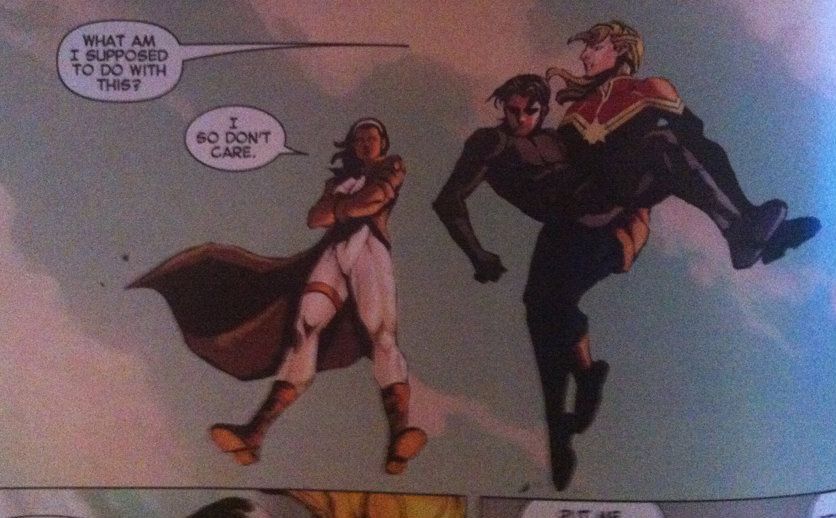
Take issue #6  #7 (EDIT: My mistake... (1))  which features Captain Marvel, and Monica Rambeau, a sometime Captain Marvel herself, fighting a giant robot comprised of sunken ships and crashed aircraft to protect the New Orleans levies. So you know, giant ridiculous Superhero action.

But on this backdrop we have our heroes saving a powerless civilian reporter in distress: and it's a dude:


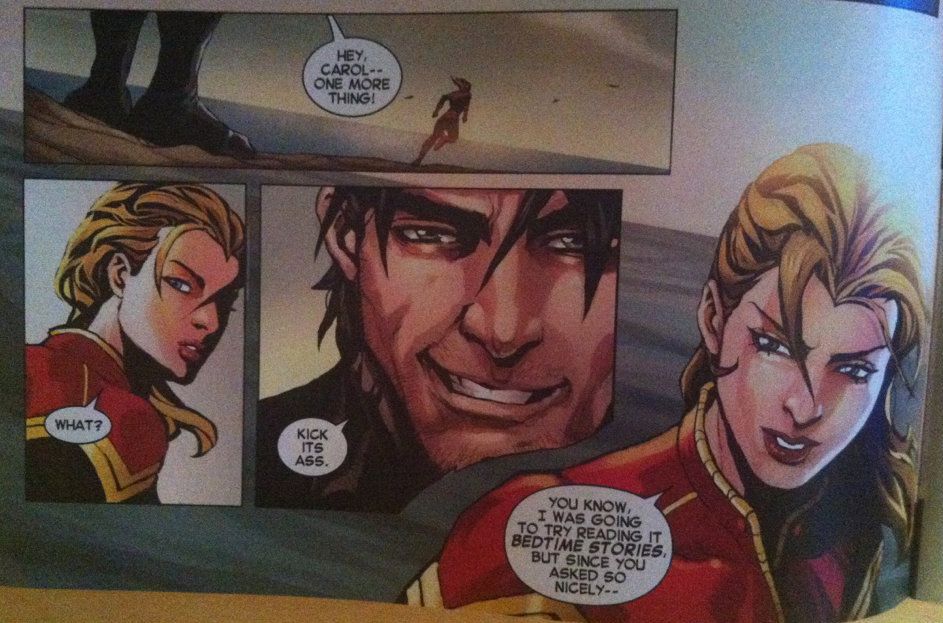
Which, as refreshing as it is, is immediately followed by this little scene:


Look at this! We have the hero of the story being told to go and be amazing by a romantic interest from the sidelines. How many times have we seen the lady love interest of the leading man in a Superhero or Sports movie or comic egg on her man from the sidelines during some conflict or event she lacks the ability to participate in. In my experience, the answer is a lot. This is, as far as I can come up with, the only time I've seen this with a woman being the action star and a man being the supportive but passive one. And it's pretty great to see.

Of course, all of this happens between punching a giant Robot. 

1: As I was snapping pics for this post, I was lending my brother my stack of ~3 months of new comics (comics being one of our few common interests). It occurred to me just as I was handing him the pile of books at a family dinner that I lacked a cover photo. I hastily snapped a quick one of a cover that looked right and wrote the post without the issue in hand. My apologies for messing that up...

Friday, 26 October 2012

My Two Marvels

Or a case study in the effects of fill-in artists.

This age of double shipping each comic every month at Marvel puts a terrible strain on the wrists of artists. As a result, most titles are going to see multiple rotating artists. As often as not this switch is done in a way to maintain the visual tone of the book: a noiry artist filling in for a noiry artist for instance. Sometimes, though, you get artists with radically different styles which produces  radically different issues of the same comic series.

Captain Marvel recently had such a radical shift when Emma Rios filled in for series regular Dexter Soy.

For those of you who aren't reading Captain Marvel, it's a great comic focusing on Marvel's it's-stupid-she-isn't-a-bigger-deal superhero Carol Danvers aka Captain Marvel. She flies, is super strong and durable, and can absorb and project energy blasts. She is also a former airforce fighter pilot with her share of demons and a connection to Cosmic Marvel. Under the writing duties of Kelly Sue DeConnick we see her defined by her strength of character and by her identity as an aviator. Actually, these first several issues of the series sees DeConnick kind of create a retroactive origin for Danvers that ties her to the history of women in aviation. It's a great hook, a great way to contextualize and ground the character, and honestly a pretty great story in itself. I highly recommend this book on the merits of the writing alone.


Captain Marvel #1: Art Dexter Soy, Words Kelly Sue DeConnick


The book has a great regular artist in Dexter Soy. He has this epicly-epic painted style that punctuates the strength, power, and majesty of the superhero genre. If being a geek becomes a religion this is the guy who needs to paint the ceiling frescos (also Fiona Staples). I guess what I'm saying is Soy renders some pretty amazing fight scenes and does a pretty solid job dealing with kind of surreal/horror and cosmic themes as well. Under his brush Captain Marvel just feels, well, EPIC. The comic is brash and... expansive, I guess, and seems to play to his ability to render naked power. It's a distinctive look that is integral to the identity of Captain Marvel.


(At the end of Captain Marvel 4 another fill-in artist pencilled the final few pages and it felt... not like Captain Marvel.)


Captain Marvel #2: Art Emma Rios, Words Kelly Sue DeConnick
Which is why when Emma Rios fills in it feels like a very different comic book. Emma Rios is another stupidly talented artist, but one with a radically different style than Dexter Soy. I'd describe her as a "cartoonist"... in that she uses pencils and inks instead of painting and she doesn't focus on the photorealism of a more traditional "illustrator". The result is this super charming and frenetically animated style. Her characters pop with emotion  (wry looks, sly grins) and seem to careen around the page with movement... until all of a sudden brutal, terrible violence is carried out. Rios' expressive characters can act and emote with the best of them, as well as bring the amazing action. (I mean look at the example). Under Rios, Captain Marvel is a bit more playful and whimsical without sacrificing tension and action. It feels like a much more character driven experience when compared to Soy's Captain Marvel.

So between these two amazing artists we get two very different captain marvels. With Soy we get this darker feeling, epic adventure driven book and with Rios we get a more manic and character centric feeling book. And this is with the same writer (who I'm assuming writes tonally similar scripts for each artist). 

I think this Soy/Rios switch is a perfect example of both the strengths and weaknesses of using fill-in artists. 


This artistic switch can be a weakness because it disturbs the visual tone of the book (especially when the artists have radically different styles) which can alter the overall feel of the book. In this case Rios' artwork is almost a 180 degree shift from Soy's which changes the book from epic adventure to a more expressive, character driven story. The result is two comics that, despite a common writer and protagonist, feel like they come from different series. Being a fan of one does not necessarily make one a fan of both and can really mess with the consistency of a title.

But then again altering artists and styles can also be a strength in comics storytelling as artists with distinct visual styles can be matched to scripts with complimentary tones. For instance a fun, cartoony artist could draw a comedic story arc, and a creepy, disturbing artist could be matched to a horror story arc without the shift feeling inorganic or merely the result of production limitations. To some extent, the Soy/Rios switch is a good example of this.Soy's epically-epic art was a perfect fit for a Sci-fi and Horror infused World War 2 adventure comic (Issues 2-4). Similarly, I can't picture the story of Carol Danvers competing and working with a young Helen Cobb (as seen in issue 5) drawn by anyone other than Rios: she just brings so much moxie to a story defined by it. So maybe these comics were better for the artistic switch.

So I guess what I'm saying is that fill-in artists, while still not my favourite practice since it messes with consistency, can actually be a boon to story telling. Especially if their names are Dexter Soy and Emma Rios.


Also, everyone should give Captain Marvel a try: there are at least two great versions now for you to choose from.
(Also, also: holy crap am I excited for Pretty Deadly by Kelly Sue DeConnick and Emma Rios. If it is anything like Captain Marvel #5, it's going to be fantastic!)


Friday, 20 July 2012

Marvel, Captain


Or how reading Captain Marvel #1 out of order is the correct way to enjoy the comic.


As the record shows, I’m pretty excited for the new Captain Marvel series by Kelly Sue DeConnick and Dexter Soy. This week the premier issue of the series came out… and I was a little underwhelmed by it. I was hoping for a great comic and what I got, while it was certainly a good comic (the writing was good and the artwork was enjoyable and there are some great ideas in there) everything seemed subtlety off, like the sections of the book were disjointed somehow. It lakes cohesion. As a result the book felt a bit like two stories sutured together, the result becoming a good but generic and maybe a little over ambitious superhero comic.

But here’s the thing, there is LITERALLY a great comic in there. It just needs a bit of reader surgery to be assembled properly.

If you don't know Kieron Gillen (writer of Phonogram, Journey Into Mystery, Uncanny X-me, etc) has a comics crafting podcast called Decompressed. His most recent episode (002) has Kelly Sue DeConnick performing a post-mortem on Captain Marvel #1. In it she humbly, and self awarely discusses the book and some of its problems. It’s really worth a listen.


DeConnick also informed us that the book was not published in the order it was originally written. The flashback section near the end set 14 years ago about Helen Cobb, was originally supposed to be the first bit. Thus, in the correct order, Captain Marvel #1 is bookended by the two Helen Cobb stories. Go read (or reread) Captain Marvel #1 in that order.

I cannot overemphasize how much better the comic is when read it in that order.


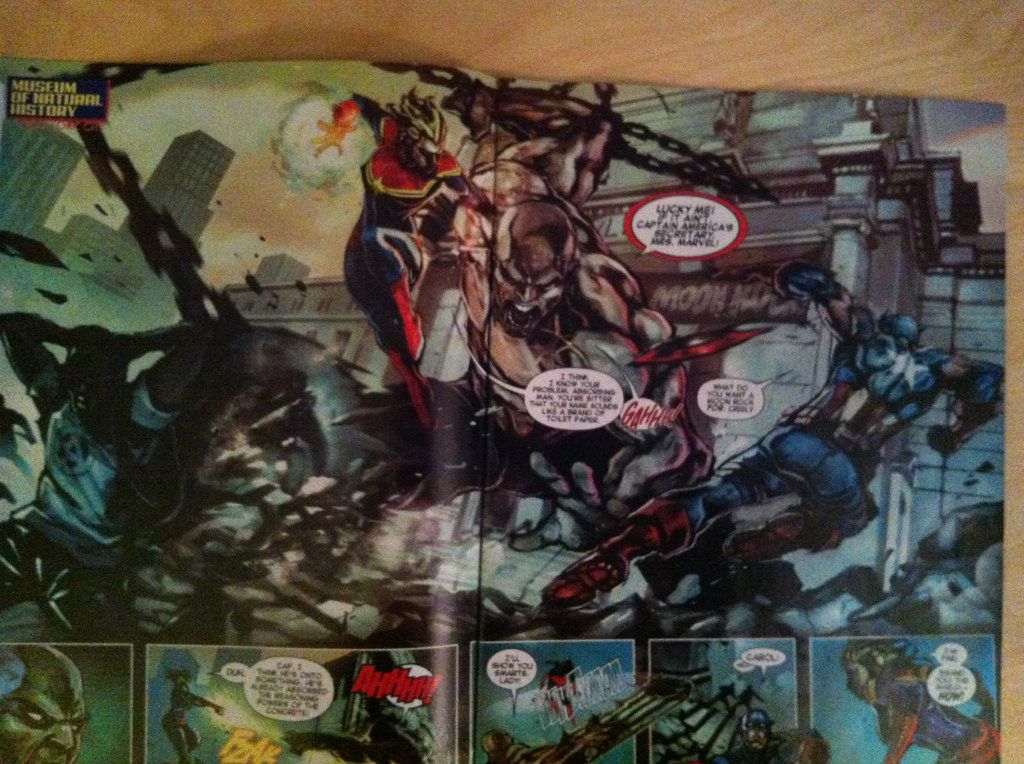
When you read Captain Marvel #1 in the right order everything suddenly makes sense. The disjointed nature of the book's sections coalesce, any somewhat perplexing events suddenly have better context, and the book develops this huge emotional resonance. Hell, even the gratuitous fight scene splash page becomes more effective as an introduction of Carol Danvers as superhero (look how far she has come).

Read in the right order it goes from being a good comic to a GREAT comic. Probably one of the single best comic issues I've ever read.

(Some SPOILERS in the next section.)

More than that, it becomes a great story about barriers and breaking through them, with a cool feminist slant.1 The proper first section lays that out with aviatrix Helen Cobb, Carol’s youthful hero, breaking the barrier of becoming a pilot but not breaking the barrier of entering space. The main story shows a critical scene where Carol breaks the barrier of entering space and then, while thinking of Cobb, makes the descision to break the next barrier and become Captain Marvel, an unqualified superhero.2 (Of course, both of these barriers were only surmountable because Cobb broke the barrier of flight, which allowed Carol to be a pilot in the first place.) The final part then becomes Carol breaking the space barrier posthumously for Cobb by carrying Cobb’s ashes into space. Thus in the correct order Captain Marvel #1 becomes a beautiful, meaningful story about empowerment and inspiration. I really, really enjoyed it.

It's a profound shame that it got fouled to show an exciting fight scene first.

(It’s also a shame how the final funeral scene, a particularly emotionally resonant and beautifully rendered part of the book, was cut in half by a double page spread of Avengers Academy ads.)

1: I also find it interesting that the book seems to lay out other barriers for Carol in the sense of misogyny in the superhero realm (The news paper title “New Captain Marvel, and He’s a She” and in the Absorbing Man’s taunts). Barriers surpassed, barriers yet to surpass.
2: I find it particularly cool that Carol decided to do this based on inspiration from a female icon as opposed to from Captain America, who is essentially an idealized paternal inspiration icon. 

Monday, 11 June 2012

Atoll Comics: Round 1.


Or Changes to My Top-Ten Comics

Due to poverty and an urge to buy better comics, I have decided to be super-selective about which superhero comics I read. Harnessing the Awesome Power of Maths, I have determined that I can afford to read 10 ongoing titles. So I get to read 10, and only 10, titles published by either Marvel or DC as well as one trade paperback a week of my choosing.

A complication of this is that I am forced to drop an on-going title if I want to try reading a new on-going title, an act of very tough love. Being financially responsible is the worst.

I will be adding Captain Marvel to my ten comic list and dropping Thunderbolts/Dark Avengers.

Why after the cut: