Showing posts with label Novel Reviews. Show all posts

Tuesday, 20 October 2015

The Cold Commands Is A Good Book

Or why you should read The Cold Commands
by Richard Morgan


The Cold Commands is the second book in a series. To read about the first book go here.

The Cold Commands is the second novel in the A Land Fit For Heroes trilogy. In the first novel Ringil Eskiath, a veteran war hero and social outcast, is brought back into the world to find a kidnapped cousin. During his investigation he discovers a fell force behind the slave trade, an ancient  race of Dwenda, using the slave trade to find their way back into the world. Seethlaw, leader of the Dwenda, offers Ringil his favour and training to make him a king among humans. But instead Ringil, assisted by war heroes Egar the Dragonslayer and Archeth, the lonely heir of the departed Kiriath, they manage to defeat the Dwenda and prevent their return. The Cold Commands picks up the story with Ringil scouring the world avenging his cousin on the slavers as he tries to deal with the dark magic world he has been exposed to. Meanwhile, Archeth is on a mission from the emperor to travel to An-Monal, the volcanic stronghold of her departed people to investigate a special messenger the enigmatic Kirath Helmsmen are expecting.  Egar the Dragonslayer, in his efforts to protect Archeth from Religious Zealots, finds himself balls deep in a fundamentalist conspiracy deep within the capital city. In many respects The Cold Commands is a quintessential second novel in a trilogy where our characters grow and develop and the plot is advanced towards the ultimate final conflict in the series. It’s a worthy instalment, but not a fully satisfying episode of entertainment in itself.

The Cold Commands is more mature Grimdark, swords and sorcery fantasy. This is a dark, gritty novel filled with anti-heroes and moral complexity. There are certain choices in this novel that are very hard to read and may cross what you view as a moral event horizon. Which makes for an odd read as The Cold Commands is some regards a fairly progressive book featuring queer protagonists and seems very aware of just how immoral and transgressive many of the darker moments are.  It's grimdark certainly, but in a decidedly thoughtful and calculating way; a way that continues ruthlessly examining the themes of exclusion of outsiders. As someone who generally likes morally challenging, gritty fiction that is well written and interesting I really enjoyed this novel.


I would recommend this novel to fans of dark, mature fantasy novels. It is downright bleak at times and is clearly not for everyone given some of its problematic contents, but if you can tolerate some grimness, this is a pretty exciting and engrossing instalment in a pretty excellent Fantasy series. I would strongly recommend that you read The Steel Remains first since this novel is a direct sequel and doesn’t really work particularly well on its own.

Previously:
The Steel Remains

Tuesday, 13 October 2015

You Don’t Love Me Yet Is A Good Book

Or why you should read You Don’t Love Me Yet
by Jonathan Lethem


You Don’t Love Me Yet is a novel about a nameless band struggling in obscurity to find their breakthrough success. The band is made of Matthew, a charismatic and handsome singer who is deeply upset about a sick kangaroo at the zoo her works at, Denise, a practical, professional drummer who works in an LA sex shop, Bedwin, a talented writer and musician with a fragile temperament, and Lucinda Hoekke, a passionate bassist looking for a day job. In an effort to make a living Lucinda takes a job working in her friends art piece as a phone operator listening to strangers complaints. Lucinda finds herself ensnared by the complexity of one callers compelling complaints and bringing them to her band, uses them to craft incredible new songs. But now, finally on the edge of success, Lucinda finds herself infatuated with her special Complainer who knows whats she’s done and wants in.

You Don’t Love Me Yet is a pretty weird, fun, and engrossing read. It has a wonderfully playful tone and weird aesthetic that vacillates between inane humour and a kind of precious, cerebral depth that makes for a compelling read. It’s a novel made out of a bassline, the energy that exists between the gleeful vulgarity of an over-the-top guitar solo and the mechanical discipline of a drummers craft. It’s a bit like an erection, all bloated and hard and eager, a finel honed sex machine developed by millennia of evolution, but also, you know, a hilarious rubbery prong. It’s the kind of novel that makes a person want to write sentences like that.

You don’t love Me Yet is also a novel with some thematic heavy lifting going on. It’s a bit nebulous, but if I had to take a stab at it, I’d say it’s a novel about creativity and being an artist. In some ways, I think you could argue that the nameless band in the novel is a stand in for the facets of an artist. Bedwin is the brilliant, broken introvert who represents the alien talent that makes art happen. Denise is the dedicated work ethic that is needed to actually make art. Matthew is the charismatic sense of cool needed to be the face of artwork. Lucinda is the wildcard sense of perverse passion that is maybe the embodiement of the “midnight disease” LINKLINKLINK at the heart of a lot of talent. The Complainer is maybe a sense of greed or commercial success that drives and weighs on the creative process. If viewed from this lens, You Don’t Love Me Yet is a testament about the triumph and conflict that exists between these separate creative forces in every collaborative or individual artist. Or at least, that’s my book club take.

I would recommend this book to anyone who likes genre writing but also has a cautious curiosity about literary fiction. You Don’t Love Me Yet has the sense of fun and self-awareness that good genre writing displays, but is also just pretentious and precious enough to work as a pretty nifty feat of literary fiction. I find a lot of straight literary fiction kind of stuffy or much too invested in its own cleverness to be particularly entertaining, but this novel walks a careful line which made it a genuinely fun book to read that was also a smart little Work Of Art Writing. I quite enjoyed it.

Previously:

Tuesday, 6 October 2015

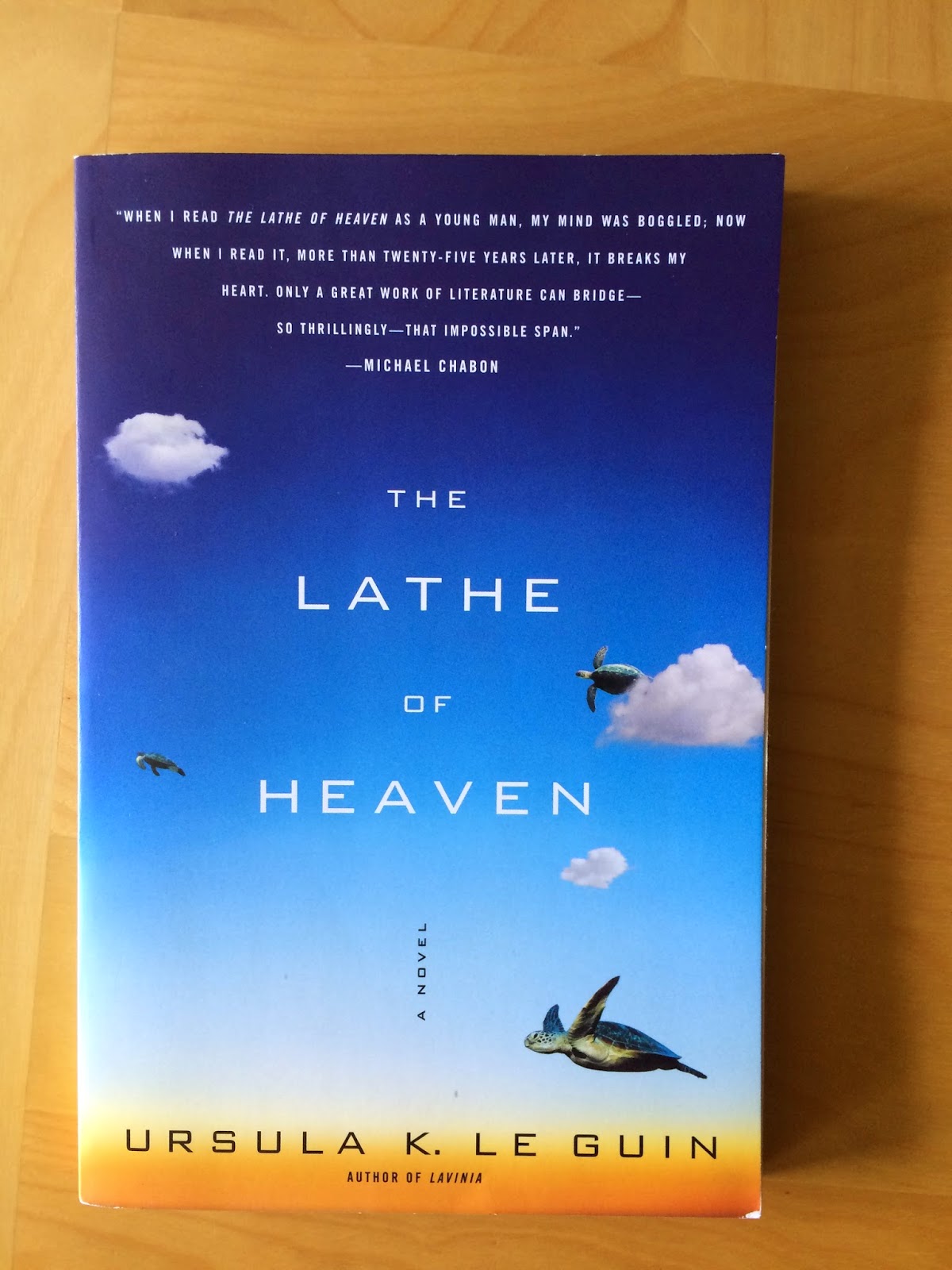
The Lathe Of Heaven Is A Good Book

Or why you should read The Lathe of Heaven
by Ursula K Le Guin


The Lathe of Heaven is a novel about a man with the power to change reality with his dreams. George Orr, a humble draftsmen, is abusing drugs to prevent himself from sleeping because he is convinced his dreams are warping reality. Fearing for his sanity Orr is sent to Dr. William Haber for psychiatric care and counselling. Dr. Haber begins a course of induced dream therapy using hypnosis and a trancap, his invention, and discovers that Orr *can* affect reality with his dreaming mind. Rather than try to cure or suppress Orr's dreams, Dr. Haber decides to try and use this power to fix the ills of his overcrowded, war torn, polluted world. But to do this Dr. Haber must navigate the complexities of reality, Orr's subconscious, and his own questionable intentions.

The Lathe of Heaven is an extremely sharp book that asks some very fundamental questions about the nature of reality. Specifically, the novel asks just how solid reality is, whether there is an objective continuity to events or if it's all an illusion based on limited perspective. Which... is a thing that sometimes bothers me in this kind of facile, academic way. One of the events which The Lathe of Heaven makes reference to is the fact that Japan sent fir balloons, essentially weather balloons laden with explosives, to terrorize the United States and Canada and that one balloon did manage to kill some US civilians in Oregon. This is a fact I only recently learned about on the Radiolab podcast before encountering in this novel written in YEAR that I am only now just reading for the first time. Which is weird right? Or, in a longer coincidence, a US thriller novel I was reading made a small reference to the French town of Narbonne and I read this while sitting on a train platform in Narbonne while en route from Marseille to Barcelona. These kinds of coincidences always make me feel like reality has a dream-like quality, like my observations and ideas are somehow shaping reality. And so the questions about a mutable reality in The Lathe of Heaven really resonate with and fascinate me.

The Lathe of Heaven also asks some less academic and more practical questions about the kind of people who want to wield power. In the novel different people try to harness the power of Orr's dreams. Orr himself is afraid of the power and tries his hardest to not change reality with his dreams. However, when pushed to it by necessity, he makes altruistic use of his powers to help others. Dr. Haber, meanwhile, has a combination of confidence, altruistic intentions, and a special kind of greedy drive that makes him deeply want to exploit Orr's dream powers. He blithely uses and abuses the godlike dream powers in a way that imposes his goals on the world and helps himself. The contrast between these two characters really gets at what makes someone seek corporeal power. It's deeply insightful stuff. 

I would recommend The Lathe of Heaven to anyone who enjoys speculative fiction. It's as smart and thorough as any other classic work of Science Fiction. It's also, like many of the other giants of Sci-fi canon, beautifully written with wonderfully rich prose. The Lathe of Heaven is a joy to read. It is a novel that should really be on your reading list if not your classic Sci-fi bookshelf.

Previously:
The Left Hand of Darkness
The Dispossessed 

Tuesday, 29 September 2015

Influx Is Not A Good Book

Or a look at why I wouldn't recommend Influx
by Daniel Suarez


Influx is a technothriller about a secret cabal who vanish disruptive technologies and inventors in an effort to protect the status quo. Jon Grady, a brilliant rogue Scientist and inventor has just discovered a way to bend gravity fields, a discovery that should net him a Nobel Prize and change the course of physics. But on the night of his triumph he and his colleagues are kidnapped and inducted into the secret world of The Bureau of Technology Control with all of its wonders of hidden Science. Now Jon Grady is given unlimited resources to further his technology, but only if its kept secret and he submits to total control. Jon Grady isn't a man to submit to a gilded prison, but to escape he must outwit captors who have the future at their disposal.

Which is a pretty great sounding premise right? It makes Influx sound like a Scientifically literate story that delivers imaginative, Sci-fi action that might just challenge notions about the role of technology in society. The trouble is, Influx proved not to be this kind of book and really failed to deliver on this promising premise. And, as a result, I found that Influx really wasn't a very satisfying reading experience.

TLDR: I really did not enjoy Influx.

Jon Grady, the protagonist of the novel, is a poster child of why I found Influx so unsatisfying. The conceit of the character is that he is a free-thinking, self-made supergenius who is too libertine and brilliant for academia. Which, right off the bat, is pretty unlikely. The notion that you can just bootstrap yourself into being a thought leader in high energy physics without formal training or access to the resources of Academia is about as likely as Jon Grady being the Kwisatz Haderach. Which would all be fine if Jon Grady was written as a supergenius: if Jon Grady was able to demonstrate with his narration or actions that he is plausibly a once-in-a-generation mind, then his unlikely situation could be overlooked in service to the story. Unfortunately Jon Grady never demonstrates his brilliance and is written as a pretty regular, not especially intelligent guy. The novel does try to get around this somewhat by giving Jon Grady a special synesthesia where he conflates colours, math, and music in his mind and that this is part of what makes him a supergenius. But this too is done poorly with the synesthesia treated more like a convenient superpower rather than a consistent mental outlook/condition that he has to deal with or regularly utilizes. Also, I am in no way an expert on stynesthesia, but the portrayals in this book read as extremely superficial or at least highly unconvincing. Collectively, Jon Grady is just not a convincing genius which means that I fundamentally didn't buy into the novel.

(Incidentally, Jon Grady is a great example of why I think we often experience geniuses in fiction from the perspective of a colleague or friend. Everyone can relate to being around someone smarter than them, but very few people are actually legitimately brilliant. So it is much easier to make a Watson's internal life believable than it is to sell a convincing Sherlock.)

The same systemic issues that prevent Jon Grady from being a convincing protagonist also serve to poison a lot of other facets of Influx. A huge number of plot developments do not make sense under scrutiny and seem to occur mostly as a convenient way to advance the plot. For instance, a prison cell designed to feed inmates via a surgically implanted umbilical system can conveniently also magically prepare passable pho soup for some reason. It's distractingly silly. Similarly, the villains of the novel are cartoonishly two-dimensional, bland, and, for being the masterminds of the BTC, distractingly stupid. Instead of getting convincing, earnest villains who believe in their mandate and are impressive in their intelligence we get laughable strawmen with cartoon diabolical plots. The love interest of the story is a genetically engineered woman meant to be perfect, which means that along with enhanced strength and intelligence she has perfect beauty and irresistible sexy pheromones which is just amazingly foolish, sexist, and juvenile. Influx, for being sold as am intelligent techno-thriller alternative is just full of really, really dumb choices. 

This even extends to the Science of Influx. Influx seems to very proudly announce itself as a Scientifically literate piece of fiction. I have an armchair-enthusiast level of knowledge about high-energy particle physics, so the collection of superficial physics buzz-words in Influx could very well checkout and be fine. I am however a cardiac cell biologist who specializes in calcium ionic signalling so I know a fair amount about neurobiology and specifically the processes in neurobiology that involve ionic calcium signals. As a result I can tell you that pretty much the entirety of the neurobiology in Influx is wrong: either vaguely mistaken or downright bonkers incorrect. For instance the idea that glial cells (a family of neuron-like brain cells) constitute a second "chemical brain" that works independent of your "more electrical" normal brain is ridiculous. In reality glial cells are integral to the one brain in your skull and seem to play mostly a supportive role in coupling things like blood flow to brain activity. (BTW, the *entire* brain is a chemical brain.) The other glial idea that what separates supergeniuses from regular people is a difference in the number of glial cells in their brain is also ludicrous and actually pretty problematic (since imbuing physical differences to intelligence like this is a slippery slope to craniometry batshittery). Of the Science I could parse through the condescending grapeshot of jargon well enough to assess, it was all entirely wrong. So Influx also fails utterly at being scientifically plausible. 

I clearly would not recommend Influx. I think it is a failure as a technothriller and just generally an unenjoyable book. If you want to read a really good, really scientifically literate technothriller, I cannot recommend Ramez Naam's Nexus enough. It is everything Influx tried and failed to be: smart, exciting, and a really thoughtful examination of the role of technology in society. If you would like to read a bonkers book about rugged, misunderstood geniuses facing institutional morons I'd read Atlas Shrugged. Thematically Influx and Atlas Shrugged are crazy similar and Ayn Rand's novel, despite being loopy and toxic, is at least written with the zeal of the true believer. (I kid you not, there is a scene in Influx where Jon Grady forgets his name and nearly calls himself John Galt. *Seriously*.) And, real talk, a novel that compares unfavourably to Atlas Shrugged is not a book you should ever, ever read. So please, read something else.

Tuesday, 22 September 2015

The Shambling Guide To NYC Is A Good Book

Or why you should read The Shambling Guide to NYC
by Mur Lafferty


I think one of the hardest things in the world is to write a properly good light, fun book. When done well, these books are the anti-grimdark; the perfect bright, sweet treat that I think every reading habit needs for variety and the occasional soul medicine. The thing is, finding the perfect mix of humour, character, melodrama, and genuine plot stakes needed to make a novel simultaneously fluffy fun and engrossing is razor alchemy. For me there are maybe only a handful of novels that have ever really managed that kind of magic. The Shambling Guid to NYC is one of these precious few.

In The Shambling Guide to NYC, Zoe Norris, a recently unemployed travel writer, has moved back to New York City. The trouble is that to stay there, Zoe needs a job and it seems out of work travel writers are not in demand. So you might say Zoe is down on her luck. That is until she stumbles across a job posting in a bookstore that refuses to sell to her kind of person; a job writing travel books for coterie (I'd say monsters, but that's pejorative). Not willing to pass up an opportunity or a challenge, Zoe finds herself working for a Vampire publisher with zombies, an incubus, water nymph, and even a death goddess for coworkers. Zoe must now figure out how to navigate the dangerous, strange world of the unseen supernatural amongst us and put out a top notch Travel Book. Or at least avoid being eaten.

The Shambling Guide to NYC is a novel that is, more than anything, deeply charming. The book is well written, filled with rich characters, and genuinely funny, but more than all of that, it is just super charismatic. Which is, I think, what happens when an author pulls off the feat of sorcery to make light, fun book work perfectly; The Shambling Guide is thoroughly entertaining and just like, a novel length grin in prose form. The experience of reading this book made me happier which made the book difficult to put down. I am so glad I tried this book!

And honestly, the premise of The Shambling Guide is not something I would typically have tried, but some enthusiastic endorsements from writers I like and a cover by the fantastic Jamie McKelvie (whose artwork is generally a stamp of quality) convinced me to give it a look. Even if The Shambling Guide to NYC is not in your typical reading roundhouse, you might want to give it a chance anyway; you may be pleasantly surprised.

I would recommend this book to any geek-positive readers out there. It is fun, geeky, and utterly, utterly charming. If you want to read something that will entertain you in a pleasant, but still substantial way, The Shambling Guide to NYC is just about the ideal novel.

Tuesday, 15 September 2015

Dune Is A Good Book

Or why you should read Dune 
by Frank Herbert


There are some works of Science Fiction that through their quality or influence have become essentially timeless classics. Just what these books are might vary person to person, since everyone makes their own totally valid canon. Dune is a novel that for me is absolutely canon, and maybe epitomizes what it means to be a classic work of Science Fiction. And I suspect that if you've read it, it's in your canon too.

Dune is the story of Paul Atreides, a would be messiah king in an alien culture. Paul is the sole ducal heir of a charismatic vassal of an interstellar empire. Due to disfavour with the Padishah Emperror, the Atreides family is being sent from their feudal home planet to the harsh desert planet Arrakis, also known as Dune. Arrakis is a deeply inhospitable planet nearly devoid of water, covered in deserts ruled by monstrous sandworms, home to the rebellious Fremen clans, and infested with agents of the hated Harkonnen rival family. Arrakis is also the source of Spice, the most sought after resource and drug in the universe. To survive this hellish world and betrayal from all around Paul Atreides will find himself at the crossroads of prophecy; a potential Lisan al-Gaib messiah to the Fremen and a possible Kwisatz Haderach, the foretold messiah of the Bene Gesserit. A position that might give Paul a chance to survive or give him the fulcrum he needs to disturb the order of the universe.

Dune is one of those unique, virtually perfect stories. The elaborate world of Dune; the cultures, the politics, the sheer conviction of the thing, is a thing to be marvelled at. In a world filled with novels that show futuristic cultures built on extrapolations Western Civilization, all rationality and lense-flare shiny, Dune really stands out using references from the Arabic cultures, the Byzantine Empire, and British Colonialism to create a much more original world. Add in some truly strange, psychedelic mysticism and aesthetic and Dune feels truly like an alien world. Dune is also significant for how it examines the way charismatic, messianic leaders can co-opt belief to gain power. This is a fundamentally human experience, repeated through our history, and one often not explored with the honesty and empathy on display in Dune. Dune is also one of the most interesting examinations of cultural collision and power systems in a colonial environment I've ever read, which is particularly striking given when the novel was published. This is a blisteringly smart and very strange novel that stands out from and above most other novels.

Like... here's the thing: Dune has a bunch of sequels, some of which are regarded as quite good. I have never read them, and maybe, probably never will. Dune is such a singular, such an important book to me that I am not interested in having it diluted or scarred by lesser subsequent works. Dune is... everything it needs to be and I think I'm happiest with just that. *That* is how much I love this book.

I would recommend Dune to literally every human. 

Tuesday, 8 September 2015

One Kick Is A Good Book

Or why you should read One Kick
by Chelsea Cain


There once was a girl named Kit Larson, a normal kid from a loving home, who was kidnapped. And then she was Beth, a doting "daughter" with a starring role in popular child porn. Now she is Kick Larson, a free woman trained to protect herself and obsessed with freeing other abducted children from their captors. When two more children go missing Kick is recruited by an enigmatic and wealthy stranger to help him rescue the kidnapped children. Kick finally has her chance to make a difference, but as the mystery deepens, she will have to confront her own dark history to save the missing kids.

One Kick is a pretty exciting and emotionally brutal book. It is that special breed of high octane thriller that slams, kicks, and choke holds your attention from the first chapter (a truly great sickly slow reveal), to the final climatic pages. This is the kind of novel that leaves you sick in the pit of the stomach and sore in the hands from gripping the book. It's also the kind of book that swallows you into the story: Kick, her struggles to define herself, and her dark history are deeply arresting and soul guttering stuff. One Kick is a Thriller with substance and I quite enjoyed it.

One Kick is also kind of formally interesting. This is a very lean book. One Kick errs very strongly on cutting out anything that isn't adding to the action, tension, or the character of Kick. This helps keep the novel rocketing along, but also cuts out a lot of the connective tissue and rationale behind some of the novels events; some things just seem to conveniently happen. Which makes some of the events in One Kick feel a little manufactured. (Of course, when compared to some thriller novels that have tried to build in all of the logistics, One Kick does a much better job managing suspense. It's definitely a tradeoff.) Anyway, I'm bringing this up because I found this aspect of how the novel is written really interesting: the appearance of some of the more improbable and convenient events in the novel created a sense of chaos in the story. Kick as a protagonist is Not Completely Okay, and spends a certain amount of One Kick reacting to inexplicable or difficult events. The judicious editing, the lack of some connective tissue, means that as readers we are also reacting to unexplained situations and slammed by surprising events. I feel like this structural choice makes reading the novel somewhat replicate part of the emotional experience of Kick. Which is a pretty cool trick of writing.

One Kick is a novel that deals with child pornography and child molestation. If these are things you cannot deal with, or want to avoid reading about, One Kick is not a novel you will enjoy. That said, if you are a mature reader who enjoys Thriller novels with an affecting emotional core and stories that deal difficult topics, One Kick is a smart, challenging, and exciting read . If you are looking for a swift kick of action, One Kick might be the book for you. 

Tuesday, 1 September 2015

Moxyland Is A Good Book

Or why you should read Moxyland
by Lauren Beukes


Moxyland is a novel set in a dystopian, near future Cape Town, South Africa. The novel follows four young adults as they try and navigate a landscape dictated by corporations, militarized police, connectivity, pervasive advertisement, surveillance and runaway technology. Kendra is a young photographer interested in using analog film in a digital era who offers herself up as an experimental test subject in return for lucrative corporate sponsorship. Lerato is a ruthless corporate ladder climber and computer programmer who is willing to do anything to get promoted and maintain her cushy corporate lifestyle. Tendeka is an activist who sees the social injustice around him and wants to help, but he needs money for his projects and has a problem with his temper. Toby, the trust-fund baby of wealthy parents, spends his time having fun and broadcasting "The Diary of Cunt", his lifeblog, in hopes of fame, fortune, and better drugs. Moxyland examines how these characters live in a world shaped by some of our most alarming social trends and whether they can survive when a cyberterrorist mastermind sets their sights on Cape Town.

Moxyland is maybe the novel that best captures the economic realities of being a Millenial. Reading this book as a late 20-something trying to suss out the career path that will take turn my passions into a financially viable reality, I am struck by just how much I see that struggle reflected in the pages of the novel. It already seems that some toxic mix of technology, income inequality, corporate personhood, runaway capitalism, and democratic failure is already restricting the economic opportunities of my contemporaries. I already know Kendras who have had to abandon artistic pursuits or sold out their creativity to corporations or sponsorships just to keep making. I know Leratos who have leveraged their education and skills for corporate gigs that pay well but ultimately absorb their lives and make them part of the system. I know Tendekas who are appalled at social injustice and who have fucked off the grid to become professional protestors and activists. I know Tobys who have decided the whole fucking thing is a scam and decided to live life for the fun of it any way they can. And now I'm left here after reading Moxyland trying to figure out which one of the characters I want to be or already am, and if I am ultimately just as fucked as they all are. 

I would recommend Moxyland to just about everyone. It is a really well written and darkly fascinating book with memorable characters in an interesting setting; it's great from a pure reading experience and I had trouble putting it down. If you are like me, a young adult ruminating on career prospects and the worrying trends of our governments, Moxyland is the dystopian mirror world of our reality. It's everything that makes me wonder how the fuck I'll ever raise kids in this world turned just the tiniest bit up. It's kind of an important read. If you are an older person, maybe in marketing, trying to figure out why Millenials aren't buying cars or whatever, Moxyland is a pretty good peek into our economic nihilism. Basically, I think Moxyland really captures everything horrible about today and posits a plausible tomorrow, and if you are at all interested in being ready for it, I'd read this book.

Previously:
Zoo City

Tuesday, 25 August 2015

Half The World Is A Good Book

Or why you should read Half The World
by Joe Abercrombie


Half The World is the second novel in the Shattered Sea series by Joe Abercrombie. The novel takes place following the events of Half A King. In the novel Thorn, a young woman touched by Mother War dreams of being a warrior to honour and avenge her father, a hero killed in combat. She wants this more than anything, enough to brave the practice square and the indignities and petty cruelty of her male trainees. That is, until a she kills a boy in a training accident and is branded a murderer. Brand, a young man who considers himself a good person, also dreams of being a warrior. He dreams of being a warrior to do right by his sister, escape poverty, and to find the camaraderie and family he's always wanted. Except when he sees the injustice done to Thorn he has to say something, a decision that derails his plans. Now the pair find themselves swept up in the plans of Father Yarvi, the deep-cunning Minister and royal advisor, as he travels the world seeking allies against the tyrant High King. Thorn and Brand must decide if they are pawns or heroes and must discover out just how far they can trust a deep-cunning man.

Half The World is kind of perfect. While I thought it's predecessor Half A King was a perfectly enjoyable read, it suffered a bit by being too straight forward and familiar. Half The World, perhaps freed from the heavy lifting of world building, manages to be a much deeper novel. While still a very direct read, and one simplified a bit for a younger reader, it still manages to deliver a surprisingly nuanced story filled with remarkably deep and memorable characters in a complex and challenging world. As a lighter, taught Fantasy novel Half The World was a really enjoyable page turner. As a work of Young Adult Fiction, Half The World with its morally complex world, adult perspective on sexuality and violence, and nuanced touch on diversity is pretty incredible. This is a book made with teens in mind that still manages to deliver a fairly grown up story.

In a lot of ways Half The World feels like a response to criticism. Some of Abercrombie's earlier novels have been criticized for their lacklustre or problematic portrayal of women and relentless grim-darkness. Some of the key characters in Half The World seem a little like a second look at archetypes that didn't get the fairest shake in earlier novels: the sister left behind, the young warrior interested in doing good, and the prickly, violent woman out for revenge all return in this book and get a different look. As someone who still has feels about some of the darker moments in Abercrombie's novels, it is pretty refreshing to see this response to criticism. These same choices also go a considerable way into making Half The World the kind of YA Fantasy fiction avoids a lot of the sexist pratfalls that beset many of my own youthful favourites. 

I would recommend Half The World to just about anyone. As an adult reader and occasional Fantasy fan, I had trouble putting the book down and thoroughly enjoyed myself. By the time this post is published, I'll also be a parent of some sex-to-be-determined child. (INSERT UPDATE) Which has really gotten me thinking about the kinds of stories I want to share with my kid. Half The World is the kind of novel that I would have loved as a younger reader and is also, due to its nuanced portrayal of adult themes and empathetic portrayal of people, the kind of novel that I hope my kid is exposed to when they are old enough to appreciate it. I'll be handing this book to my kid in 13 or 14 years and I can't think of a higher recommendation for this kind of book. You and your younger readers should read it.

Post by Michael Bround

Previously:
Half A King
The First Law, Best Served Cold, The Heroes
Red Country

Tuesday, 18 August 2015

Steel Beach Is An Interesting Book

Or why you could read Steel Beach
by John Varley


Steel Beach is a novel about a future where humanity has been exiled from Earth by conservationally inclined aliens. The surviving humans now live on the Steel Beach of the lifeless planets of solar system in manufactured habitats. Here humanity has prospered, living a permissive, technologically advanced life and cared for by a benevolent computer intelligence. People are functionally immortal, able to change their appearance and sex on demand, and provided with all of their basic needs and wants. But gifted with all of these wonders, people are beginning to feel bored and, more and more, worryingly depressed and suicidal. Which is an even bigger problem when the NAME NAME, the lifegiving computer intelligence itself, becomes infected with suicidal thoughts and feelings. The novel follows Hildy NAME, an experienced reporter, struggling with ennui and depression, who is commissioned by the NAME NAME to help uncover the source and solution of this growing dissastisfaction.

Steel Beach is a novel that I have a pretty mixed reaction to.

Steel Beach is without a doubt an interesting book. Steel Beach is at it's core a novel that explores the meaning of contemporary life through the lens of a madcap Sci-fi adventure. We see the role of technology explored through the guise of a suicidal AI that humanity needs to live. We see celebrty culture, the news media, animal rights activists, libertarians, Sci-fi dreamers, parents, athletes, and more all examined and lampooned. We see gender roles and identity and sex all explored in intimate detail. If anything, Steel Beach reads like a smart man trying to figure out life and what it means to him and sharing that exploration with readers through this story. In that context, this is a fascinating book; like or hate his ideas, seeing these concepts worked through in such a rigorous and gonzo way is pretty interesting. 

Steel Beach also has a lot of problems, though. John Varley was born in 1947 and has views that jar with a contemporary reading. (For context I was born in 1987.) While he's clearly a liberal guy, some of his ideas, particularly those dealing with gender, sex, and sexuality are out-dated and problematic by my standards. This leads to some pretty infuriating moments in the novel and just a general sense that other authors probably could say more interesting and current things about gender than Varley. (I would love to read a Sci-fi novel by a Trans author exploring gender in a society where bodies are fully mutable.) There is also a pretty systemic future-anachronism problem: Steel Beach is rife with contemporary cultural references from the 19th and 20th centuries which in a novel set in a post-civilization moon colony in the distant future make zero sense. I only kind of understand cultural references from the 1920s and know virtually nothing about popular culture from like, the 1890s. The idea that people living in a distant, alien future who are deeply versed in contemporary culture is bonkers and frustrating. It's kind of one of my Sci-fi pet peeves.

(As an aside, Steel Beach is kind of interesting in that it clearly is riffing on The Moon Is A Harsh Mistress by Robert A Heinlein, and the novel Glasshouse by Charles Stross, a personal favourite, draws some inspiration from Steel Beach. Novels!)

On balance I think I would recommend Steel Beach. It wouldn't be my first choice of book for most readers since I'm not sure it's good enough to be a timeless classic or current enough to work especially well as contemporary Sci-fi. That said, I found Steel Beach engagingly insightful, engrossingly infuriating, and always interesting the entire way through. As a person trying to sort out what adult life means, reading a smart person from a generation before trying to sort it all out was worth the time invested in the read. I can't guarantee that Steel Beach will please every Science Fiction fan, but if you are interested in reading someone examine the modern meaning of life, Steel Beach might be up your alley.

Tuesday, 11 August 2015

The Rhesus Chart Is A Good Book

Or why you should read The Rhesus Chart
by Charles Stross


The Rhesus Chart is the fifth novel in the Laundry Files, a collection of novels and short stories about The United Kingdoms paranormal defence and espionage agency. (Go here for the first volumes.) The series follows Bob Howard, a hapless geek turned secret agent when he accidentally encountered Non-Euclidian cosmic horrors when developing software. Over the course of the preceding books Bob learns fieldcraft, masters magic, becomes partially Hungry Ghost, and begins to navigate the terrors of government bureaucracy and the secret Management of Mahogany Row. He also gets married to a Agent CANDID, the sometime philosopher and wielder of a Erich Zahn original Violin, a terrible weapon of eldritch destruction. In the Rhesus Chart, Everyone knows that Vampires don't exist, at least until Bob Howard uncovers evidence of them feeding on the public while surfing the Nation Health Services database. Now it is up to him to uncover the ancient evil lurking in the Banking Industry before the problem spreads further. 

Oh, and he adopts a cat. 

The Rhesus Chart is basically my ideal easy-reading kind of book. The novel, and really the Laundry Files series in general, is this balanced, tight reading experience. The cosmic horror and espionage core of the plot is suitably creepy and suspenseful and makes The Rhesus Chart an exciting read. The novel also has an infectious sense of fun: the wry humour of Bob Howard and the absurdist madness of Rube Goldberg bureaucracy provide a pleasant counterpoint to the novels more serious elements. Critically, The Rhesus Chart is also a very clever novel. Lurking below the genre action and jokes is a sharp intellect manifesting itself in the uncannily plausible portrayal of magic as a consequence of advanced mathematics and in the meticulously logical mundane elements of the plot. Also, the idea of vampires, which we all know don't exist, appearing from within the investment banking industry is endlessly delightful. Basically the Rhesus Chart is kind of like the novel equivalent of fancy ice cream for me: it's decadent and appeals to my reading sweet tooth, but still has enough complexity of flavour and craft to satisfy my more mature literary palette. The Rhesus Chart just makes me really happy, you know, in a tragic disquieting kind of way. 

I would recommend this book to anyone who reads at least five genre novels a year. Or rather, I would recommend the Laundry Files series, since the books are very much best read in the order intended. These books are positively geeky and a fusion of many familiar genre elements and make a great fun but smart alternative to build into a reading schedule. They are my injection of manic excitement and glee between more stodgy and traditionally rigorous fare and I suspect they might be able to work their indescribable, horrific magic on you as well.

Previously:
The Laundry Files Novels
The Atrocity Archives
The Jennifer Morgue
The Fuller Memorandum
The Apocalypse Codex
Equoid

Other Stross Novels
Accelerando and Glasshouse
Saturn's Children and Neptune's Brood
Halting State and Rule 34
The Merchant Princes Series (Novels 1-6/1-3)
The Rapture of The Nerds

Tuesday, 4 August 2015

Ancillary Sword Is A Good Book

Or why you should read Ancillary Sword
by Ann Leckie


Ancillary Sword is the second novel in a trilogy. To see a *SPOILER* free review of Ancillary Justice, the first book, go here.

Anaander Mianaai, the Lord of the Radch interstellar Empire, is at war with herself. Anaander Mianaai has a single mind spread over many bodies living throughout the Radch, ruling as one. Secretly though, she is at war with herself, with factions of her mind operating at cross purposes, fighting for and against military expansion. In Ancillary Justice, Breq, the last surviving slave body Ancillary of the Troop Carrier ship Justice of Torren, committed an act of revenge against Anaander Mianaai which caused the secret conflict within the Lord of the Radch to become an open civil war. In Ancillary Sword, Breq throws her lot in with the faction of Anaander working for peace and is given a ship, The Mercy of Kalr, and instructions to defend the backwater Athoek system. Breq and her crew find themselves in a troubled society split by inequality and injustice which they must find a way to protect.

Ancillary Sword is a really good novel, maybe even better than Ancillary Justice. And why I think so comes down to this: "When something [horrible that you caused] happens, you have two choices... You can admit error and resolve never to repeat it, or you can refuse to admit the error and throw every effort behind insisting you were right to do what you did, and would gladly do it again." This idea is at the heart of Ancillary Sword and is the crux of something I spend a lot of time thinking about. As someone with a ton of privilege, contending with culpability in systemic injustice and deciding where I stand in relation to this guilt has been a big part of growing up for me. And I can see other people in positions of power contending with this same culpability and reacting to it in different ways constantly. It is a very important thing to explore in fiction. Ancillary Sword creates a world that directly explores how power structures help and fail individuals, unite and divide societies and how people rationalize their role within power structures to fight or deny injustice. It is a very slow moving but intensely intimate examination of personal responsibility in the context of social power dynamics which is a surprisingly gripping and moving read. What Ancillary Sword maybe lacks in obvious excitement or narrative focus it more than makes up for in the complexity and emotional stakes of its thematic core. It is a fantastic book. 

I love this book and think pretty much everyone should read it. That said, to really appreciate this novel, I think you pretty much have to read Ancillary Justice first. So I would recommend you go out and read Ancillary Justice and then proceed to read Ancillary Sword. They are tremendous. 

Previously: