Friday, 3 January 2014

Comics Year in Review 2013

Or a look at this years reviewed comics and their genre distribution

It is almost 2014, and so the time has come for lists. But since this website is partially a top-ten list of my favourite mainstream comics, it's a bit silly to write a thing that just reiterates that list. The other half of the website is me talking reviewing and talking about creator-ownederish comics that I really like. These are diverse books that I think are hard to compare and, well, I think most of these books could be the best book in the world to some particular person. And so, I am not particularly interested in ranking them.

What I am interested in doing, however, is to look at the differences in genre diversity in Mainstream (Marvel/DC) and Creator-Ownderish comics. I think one of the most interesting and important differences between Marvel/DC and other comics publishers is the spectrum of stories that they publish. So just like last year, I am going to assign genres to all of this year's Top-ten mainstream comics and reviewed Creator-Ownederish comics.

The genres:

Comics don't automatically get assigned genres, and are infrequently sorted by genre in stores. Instead, they tend to get sorted by format (monthlies, tradepaperbacks, original graphic novels etc). So I'm going to assign my own genres to all these comics. For convenience (and ease of graphing) I'm also going to lump a bunch of genres together. To keep us all on the same page these are the genres I'll be using and a short definition of what I mean by them.


Adventure:
 An action packed story with elements of travel, journey, and discovery. Usually a bit light hearted. Think Indiana Jones.

Autobiography: A truthful, or semi-truthful account of the authors life. Think... well any autobiography.
Comedy: A sizeable percentage of the story is devoted to making the audience laugh or subverting the premise for comedic/absurd reasons. I'm using this in both the humour and satirical sense. Think: Superbad or Dr. Strangelove.
Crime: A story about criminals and those that live outside the law. Usually has heist and/or thriller elements. Think Drive or Lock Stock and Two Smoking Barrels or even Ocean's 11 (the original please).
Cultural: I'm using this as a catch all for a story that integrally features a commentary on some sort of cultural construction. Think District 9 and apartheid or The West Wing and presidential politics.
Drama: A story whose action is built around emotional tension and consequences. Think Sophie's Choice.
Espionage: About spies. Think James Bond
Fantasy: A story involving a supernatural element like magic. I'm going to use it in the context of historic, epic, or mythic elements. Think Lord of The Rings
Historic: Set in the past: actual or alternate. Think Gladiator or Band of Brothers.
Horror: Stories that endeavour to scare, frighten, or creep out its audience. Think The Shining, or if you're me ET.
Mystery: A story that is constructed around solving a mystery or crime. I'm also going to lump police procedurals into this category. Think Law and Order.
Other: Something that defies easy classification. Like, well that's kind of the issue isn't it.
Science Fantasy: A story with fantastical technologies or a story set in the future with fantastical elements without regard for Scientific plausibility. Think Star Wars or Firefly.
Science Fiction: A story that features some sort of societal or technological thought experiment. Think 1984 or I Robot
Slice-of-Life: About the lives of characters in a texture of their everyday life kind of way. That's a terribly nebulous definition... but it works? Think Forest Gump.
Superhero: People with super natural abilities have adventures of some sort. Think Avengers.
Thriller: Excitement! Suspense! Action! Danger! Think Die Hard.
Travelogue: *NEW* A story that revolves around travelling to a new place and trying to convey the reality of living or visiting that place. Think Lonely Planet.
Urban Fantasy: A story set in the present with modest supernatural elements. Think Buffy The Vampire Slayer or Ground Hog Day or American Gods.
War: *NEW* A story set during a war and about people involved in the event. Think Band of Brothers or Full Metal Jacket.
Western: A story about the Wild West, cowboys, etc. These stories have their own kinds of genre tropes and narrative feel which goes beyond the subject matter which I think justifies them as having their own genre. Think True Grit or The Good, The Bad, and The Ugly.

Mainstream (Marvel & DC) comics I've read since starting the blog:


So here are all the comics that have been in my Top Ten at some point during the last year. How this is going to work is each title is worth 1 point towards further analysis. Since many titles don't clearly sit in one genre, their 1 point can be broken up and assigned to multiple genres. So for a book with two genres, each genre will get 1/2 a point. Pretty straight forward, right?


So with this scoring system in place these are the books I've read this year and the genres I think they most belong to:


Avengers:
 Superhero (Analysis)

Avengers Assemble: Superhero (Analysis)
Batman: Superhero
Captain Marvel: Superhero (Analysis)
Daredevil: Superhero (Analysis)
FF (2): Superhero, Adventure (Analysis)
Hawkeye: Superhero, Thriller (Analysis)
The Indestructible Hulk: Superhero (Analysis)
The Movement: Superhero, Cultural (Analysis)
The Young Avengers: Superhero (Analysis)
Uncanny Avengers: Superhero
Winter Soldier: Superhero, Espionage
Wonder Woman: Superhero, Fantasy (Analysis)

Which gives me the following genre breakdown for Mainstream comics:


Adventure: 0.5

Cultural: 0.5
Espionage: 0.5
Fantasy: 0.5
Superhero: 10.5 
Thriller: 0.5

Which when graphed looks like this:


Creator-ownederish comics I've read since starting this blog:


In the same period of time I read all or some of the following creator-ownederish comics. Again, each title is worth 1 point, and this point can be chopped into parts for titles that span multiple genres. Oh, and I've included links to all the reviews that have been published. Here's the list:


100 Bullets: Thriller, Crime (Review)
Atomic Robo: Adventure, Comedy (Review)
Beast: Fantasy, Horror (Review)
Black Hole: Horror, Cultral (Review)
Chew: Mystery, Comedy (Review)
Criminal: Crime (Review)
Daybreak: Horror (Review)
Demo: Superhero, Drama (Review)
DMZ: Thriller, Cultural (Review)
Drinking At The Movies: Autobiographical, Comedy (Review)
Fatale: Crime, Horror (Review)
Four Eyes: Fantasy, Historic (Review)
Gingerbread Girl: Slice-of-Life (Review)
Global Frequency: Thriller, Science Fiction (Review)
Glory: Superhero (Review)
Godzilla: The Half-Century War: Science Fantasy, Horror (Review)
I Kill Giants: Fantasy, Drama
Jan's Atomic Heart: Science Fiction (Review)
Jerusalem: Travelogue, Autobiographical (Review)
Love and Rockets: Slice-of-Life, Other (Review)
Mystery Society: Science Fantasy (Review)
Nothing Can Possibly Go Wrong:  Slice-of-Life, Comedy (Review)
Orc Stain: Fantasy (Review)
Planetary: Superhero, Cultural (Review)
Pretty Deadly: Western, Fantasy (Review)
Prophet: Science Fiction (Review)
Saga: Science Fantasy (Review)
Saucer Country: Science Fiction, Cultural (Review)
Scalped: Crime, Thriller (Review)
Spaceman: Science Fiction, Crime (Review)
Stumptown: Mystery, Thriller (Review)
Sweet Tooth: Science Fantasy, Horror (Review)
The Five Fists of Science: Science Fantasy, Historic (Review)
The Infinite Wait and Other Stories: Autobiographical, Comedy (Review)
The Massive: Thriller, Cultural (Review)
The Other Side: War, Historic (Review)
The Underwater Welder: Drama (Review)
The Unwritten: Urban Fantasy, Cultural (Review)
Umbrella Academy: Superhero (Review)
Underground: Thriller (Review)
Whiteout: Thriller (Review)
Y The Last Man: Science Fiction, Horror (Review)
Zombies Calling: Horror, Comedy (Review)

Which gives us the following genre breakdown:

Adventure: 0.5
Autobiography: 1.5 
Comedy: 3.5
Crime: 3
Cultural: 3
Drama: 2
Espionage: 0 
Fantasy: 3
Historic: 2
Horror: 4.5
Mystery: 1
Other: 0.5
Science Fantasy: 5
Science Fiction: 3
Slice-of-Life: 1
Superhero: 3
Thriller: 5
Travelogue: 0.5

Urban Fantasy: 0.5 
War: 0.5

Western: 0.5 

Which gives us a genre distribution that looks like this:


And if we compare the genre distribuitions between Mainstream (DC/Marvel) and Creator-Ownederish (basically everything else), we get the following:


This is the second year I've done one of these roundup/genre analysis posts. 2012 can be read here. What this means is that I can pool my genre distributions (correcting for any repeat titles and redundancies) to increase the sample size of the analysis and maybe cut down on sampling bias a little. 

Between the two posts I have looked at 22 Mainstream titles with the following genre distribution:


I have also looked at 64 Creator-Ownederish titles the encompass this genre distribution:


And if compare all of the analyzed Mainstream and Creator-Ownederish comics reviewed in 2012 and 2013 I get the following comparison plot (which is normalized for percent due to different sample sizes):


The trend that immediately pops out of both data sets is that the mainstream comics I read are overwhelmingly Superhero comics while the alternative comics press, the Creator-Ownderish books encompass a much wider spectrum of genres. And I think this is pretty interesting.

Now there is obviously some sampling bias going on here. Like, I am pretty keen on the geekier corridors of genre fiction so Science Fiction and Fantasy genres are probably over represented in both sample groups. Similarly, I feel like my Superhero genre interests are being satisfied by my Mainstream reading habits the many Creator-Ownderish Superhero comics that are available aren't reflected in the data. I am also just starting to get into the more literary strains of comics, so the more dramatic/literary fiction aspects of comics are greatly underrepresented in these plots too. Basically, my point is that this is in no way a Scientific poll, and should be taken with a grain of salt.

(Although, I think a similar genre distribution of the Diamond Shipping lists in any month will yield similar distributions...)

But. Despite the issues with sampling, I think these genre distributions get at an essential truth of comics: Mainstream (Marvel/DC) comics are overwhelmingly Superhero comics. Which means that almost every single title the two biggest comics publishers make belong to, at least in part, a single genre. Or, put another way, about 2/3s of the direct comics market (at least) is comprised of a single genre. Which is crazy! Comics are a medium in the same way novels or television or film are media. They are devices that can tell literally ANY KIND OF STORY. And yet, the majority of North American comics sold at any given time are Superhero comics.

That said, the data also shows that alternatives to Superhero comics clearly exist. People are very much making any kind of story using comics, and one just has to take a small step away from Marvel and DC to find them. If nothing else, this indicates that there is some sort of market for a wider variety of comics.

And this is really the crux of what I find interesting about these genre distributions. Clearly there is a huge market for Superhero comics and DC and Marvel have both geared up to satisfy these markets. It also seems that the largest Creator-Ownederish comics publishers/imprints/etc have focussed on publishing a much wider variety of genres. Which creates a bunch of questions. Do Marvel and DC essentially have control of the Superhero market to such a degree that it isn't viable for other publishers to also focus exclusively on Superhero comics? Is the Superhero market over or fully saturated? Conversely, are other genres of comics under served? Does the broader genre distribution of Creator Ownederish a reflection of them fulfilling this niche? Do non-Superhero genres comics have room to grow? And about a hundred more questions...

I think this is relevant because growing the comic reading audience would be really good for comics. There is only so much money any individual comic reader WILL or CAN spend on comics. More people reading comics means more money for comics publishers and creators. A bigger comics market means more comics and more options for readers. Basically the more readers there are the better it is for everyone. The trouble is that I think most people who are inclined to try a Superhero comic already have. This is entirely anecdotal, but the friends I've gotten to try, read, and even buy comics are never initially interested in Superhero comics. They are always way more willing to try comics that are similar to their favourite novels or shows. Which has led me to believe that one of the ways for comics to grow the market is to be more genre diverse to appeal to people outside the traditional audience. And my graphs here indicate that Creator-Ownederish comics do a much better job of this than Marvel and DC.

Which is food for thought, eh?

Previously:
Comics Year in Review 2012

Wednesday, 1 January 2014

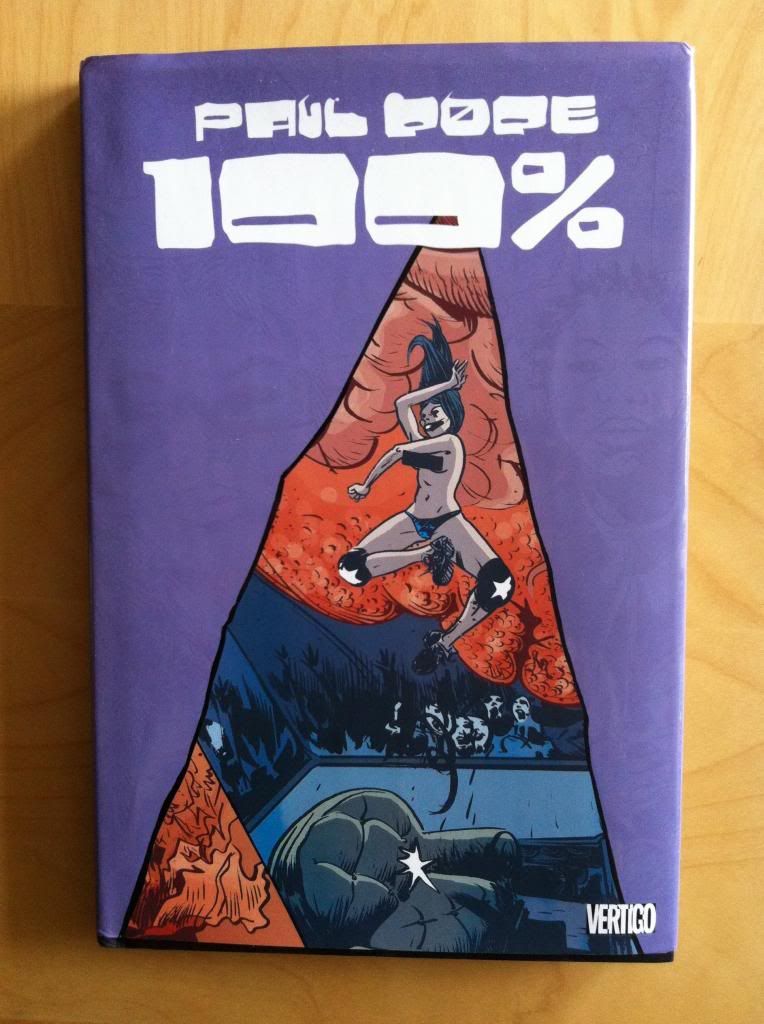
So I Read 100%

A 250 word (or less) review of the 100% collected edition
by Paul Pope; Vertigo Comics


100% is the first comic I've read by Paul Pope, chosen because it was a last minute purchase, it was on sale, and it was a Paul Pope comic and I've been meaning to try his work. From my never-read-a-Paul-Pope perspective I was expecting 100% to be a brilliantly drawn, intensely action-focused, Sci-fi infused comic. And the cover of the comic certainly suggested that. But what 100% is, while certainly beautiful to look at, is an intimate, character driven comic about relationships with a semi-dystopian Sci-fi set-dressing. Specifically 100% tells the story of a group of young people giving it their all to make it in future-Manhattan: a degree-holding busboy, a frightened bartender , a vagabond exotic dancer, a single mother with dreams, a broke artist, and a prize fighter with a broken heart all trying to live 100%. It's, in a way I wasn't expecting, a really emotionally satisfying comic with some remarkably sharp dialogue... the way characters interact has a casual naturalness to it that has a kind of magical authenticity to it. 100% is like a comic stage play, maybe? While it maybe lacks for ballsout action, 100% still manages to be a really great looking art comic, with detailed environments, wonderfully expressive characters, and intelligent composition that makes even a series of conversations interesting to look at. I can recommend this comic... 100%.

Word count: 227

Monday, 30 December 2013

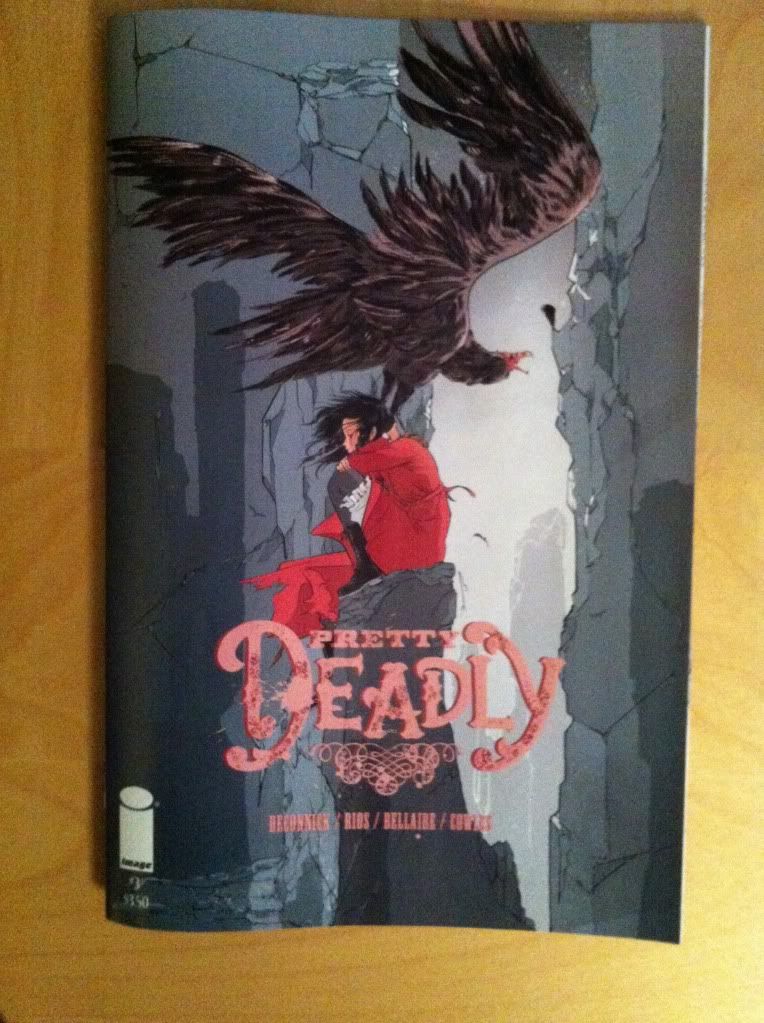
Pondering About Pretty Deadly #3

Or more Holy Shit artwork and moments from Pretty Deadly #3
By Kelly Sue DeConnick, Emma Rios, Jordie Bellaire,Clayton Cowles; Image Comics


Pretty Deadly continues to be a pretty mind explodingly good comic filled with awesome artwork and cuss-out-loud moments of storytelling. Pretty Deadly #3 is very much a comic worth taking a closer look at, and since the approach of working through an issue's Holy Shit moments and artistic highlights seemed to work alright last time, I'm going try that again. That said, Pretty Deadly #3 works as the issue that sets the stage of what I think may be the ongoing conflict of the series, and two Holy Shit moments are pretty important revelations so this review is going to be VERY *SPOILERS*.

Seriously folks, if you haven't read Pretty Deadly #3 there will be fury-inducing *SPOILERS*. If you have never read Pretty Deadly and want to gauge if the series is for you, this post is Spoiler free, and this more indepth post is Spoiler-lite. Okay? I would absolutely hate to ruin some of the surprises in this issue for you...


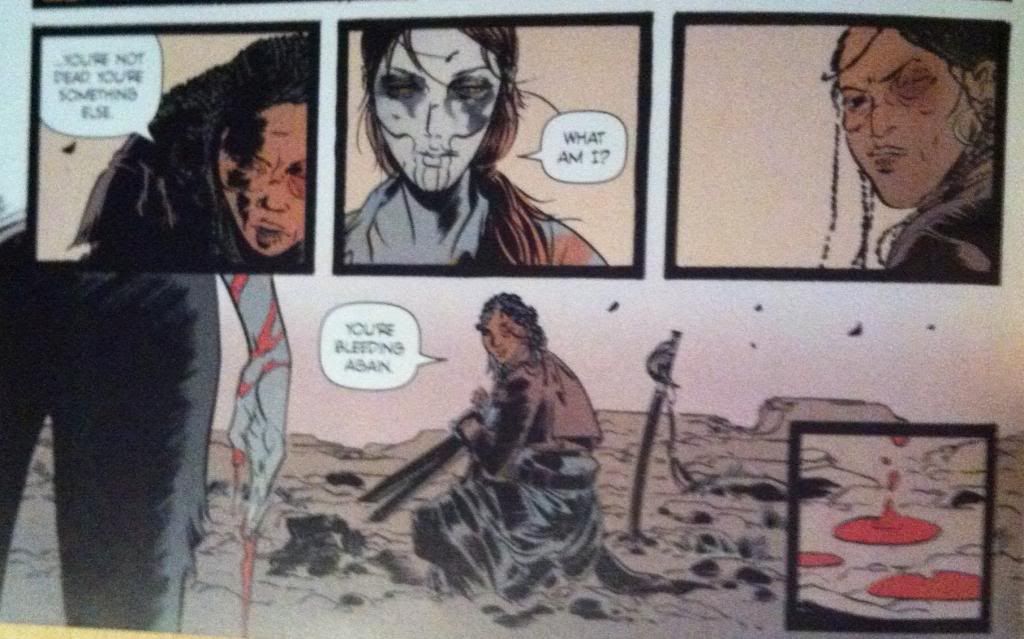
If the second issue of Pretty Deadly was defined by a symphony of violent beauty, Pretty Deadly #3 is governed by surprises and brutally effective sequences of conversation or exposition. This short sequence here is a good example of this issues approach to dialogue exchanges and how these conversations are these beautifully layered constructions of art and writing. 

From a writing/script perspective this exchange here is pretty damn cool just from the dialogue: 


            Sarah: "...you're not dead. You're something else."

            Ginny: "What am I?"

            Sarah: "You're bleeding again."

Even without any artwork or accompanying exposition or description, these three lines of dialogue convey a huge amount of information pertinent to the character of Ginny and Sarah, how they relate to each other, and is badass in a way that is very much the tone of Pretty Deadly. As much as I might focus more on elements of artwork or plot in these reviews, the dialogue in Pretty Deadly is amazing in and of itself and is fundamental to my enjoyment of the series. It's really, really good.


This dialogue, as good as it is, is coupled seamlessly to artwork that enhances every aspect of the exchange. The way the composition, colouring, and dialogue box placement leads the reader through this sequence adds enormous weight and characterization. The first two panels emphasize that Sarah is stooped and kneeling while Ginny is standing and conveys the power differential between the characters and the fact that Ginny has control over the situation. However this is undone in the third panel where Sarah draws herself up, with a look of defiance, and places herself compositionally on the same level as Ginny in the preceding panel. We visually see Sarah reject the power dynamic in the preceding panels. The artwork then takes us across the page to the fourth panel in reverse order (right to left) so that we read the "bleeding" dialogue before we see Ginny's hand with its bright flash of red blood. This is nifty for a couple reasons: it places defiant-Sarah in the third panel above the bloody hand, implying that her defiant strength is tied to her realization that Ginny is bleeding. It's also a cool bit of layout as it draws our eyes to Ginny's wrist so that our eyes can traces the red streams of blood down to her hand: we get to experience the blood running down her arm. It's great.

Another cool feature of this page is the isolated fifth panel of the blood dripping onto the ground. Due to it's corner position it is somewhat isolated from the rest of the sequence which gives it a certain remoteness and significance. It's also almost a panel form the tarot image banner that Sissy and Foxy use to tell stories: it seems to emphasize that the blood is the most important take away from this page. Ginny for all her badassery is mortal.

The thing about this sequence that is maybe more remarkable than the quality of the script or artwork alone is just how efficient it is. In five panels we learn a really impressive amount of information about Sarah and Ginny in a really interesting way. Ginny is cemented further as an exceptionally tough woman since she had to have it pointed out by another character that she was bleeding pretty profusely.  We also have it directly emphasized that Ginny is mortal: she can be hurt and she can be killed. We also get the impression that Rachel is herself a properly steely character as, even after seeing the violent power of Ginny, she still draws herself up in defiance, deduces Ginny's vulnerability, and manages to grunt out some bravado. This sequence also conveys a bunch of information about the relationship between Ginny and Sarah: it shows that while Ginny is in control, Sarah has no intention of remaining in her power. All of this in a minor sequence of five panels. 


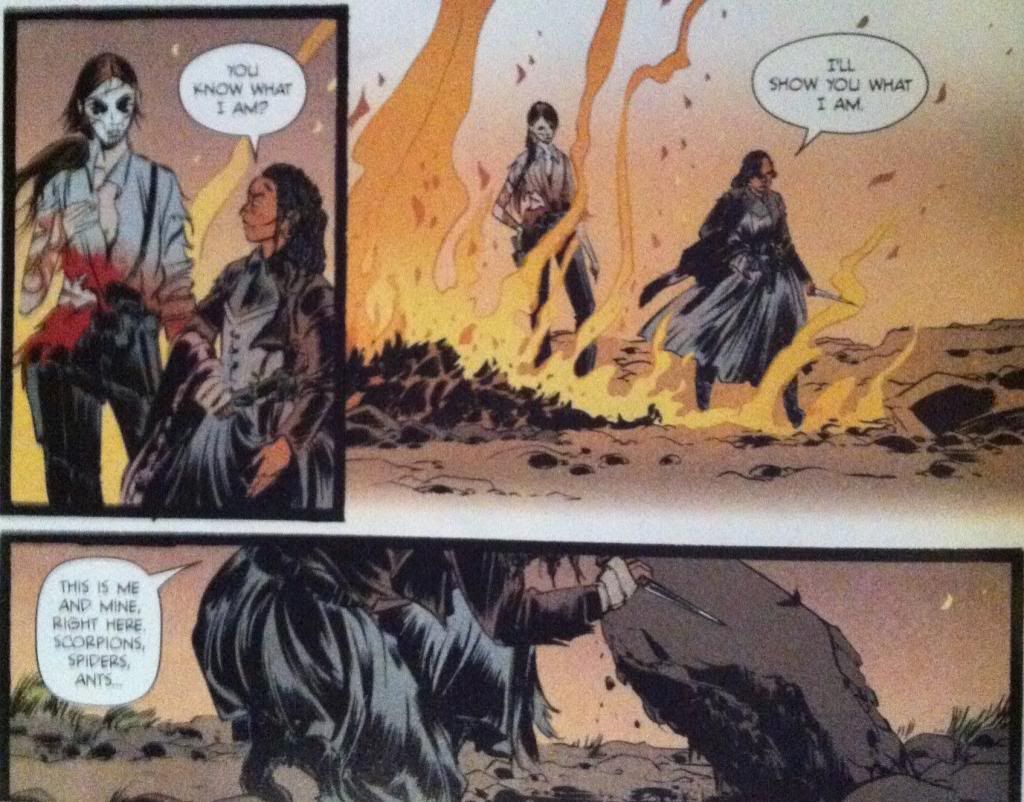
This big, long sequence contains Holy Shit Moment #1 and Holy Shit Moment #2 and perfectly encapsulates what I love about this series. It's brutal and beautifully drawn, the dialogue is intricate and complicated and just when the story seems to be going a certain way, it turns and rears unexpectedly in absolutely guttering directions. It's absolutely virtuosic comics and emblematic of how good Pretty Deadly can be.

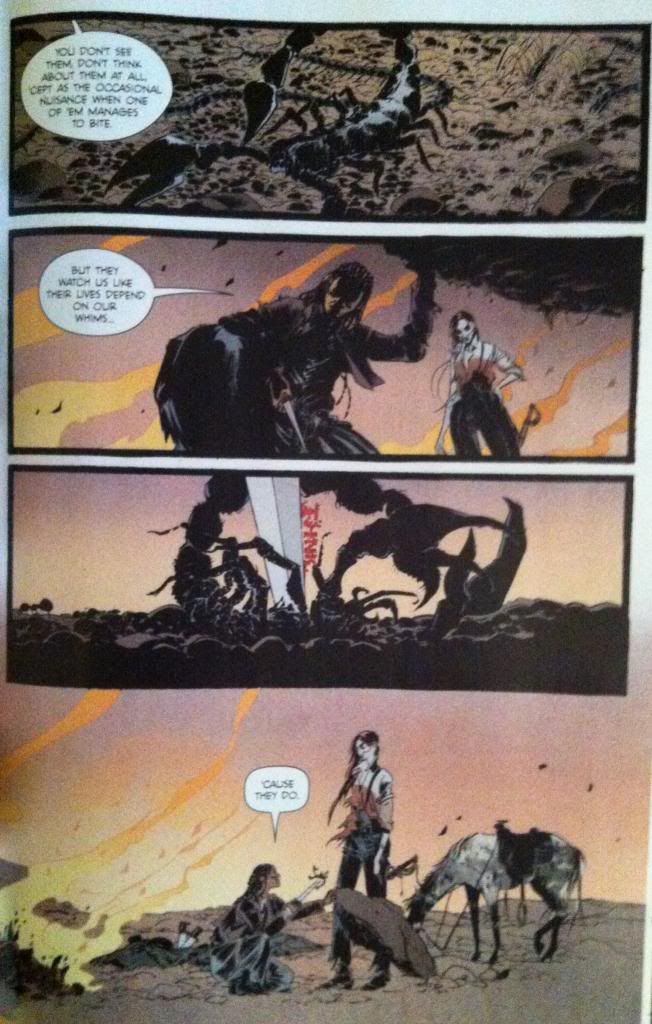
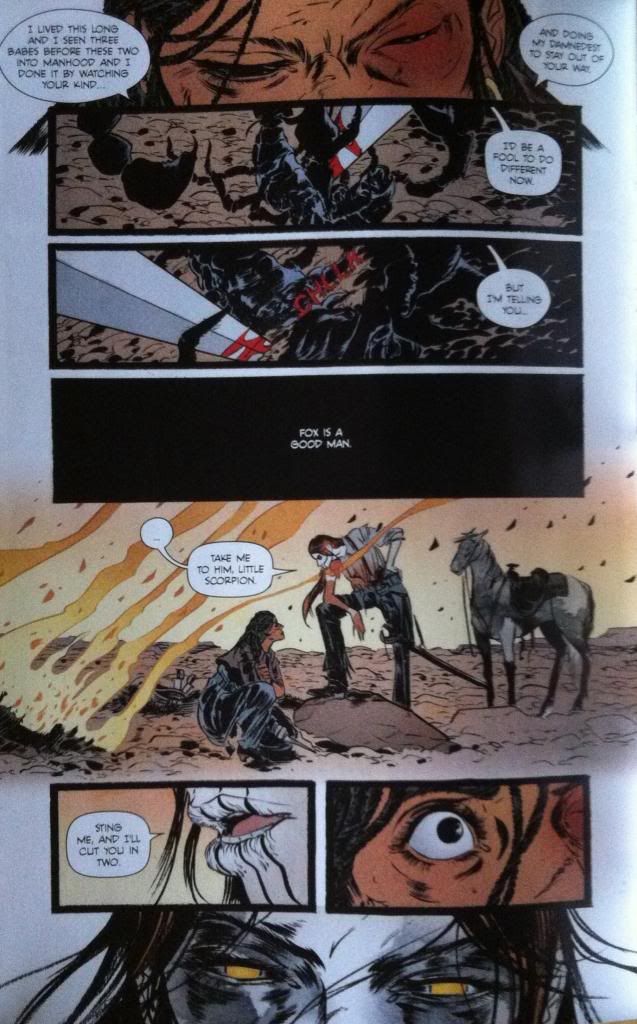
This extended sequence contains what I think is my favourite run of dialogue in Pretty Deadly to date. It starts with Sarah comparing herself to a bug at the mercy of a human, suggesting that the humans of Pretty Deadly are under tremendous threat by the whims of Ginny and the other supernatural elements of the comic. She stabs a scorpion to emphasize the point, which for me, is Holy Shit Moment #1. As a metaphor, it is brutally direct. This sequence than continues with Ginny AGREEING and using the metaphor to threaten Sarah into cooperating. It is Ginny argeeing that she is a merciless, godlike monster who views Sarah as a potentially useful bug. Which is Holy Shit Moment #2.

But beyond being a masterstroke sequence of dialogue and plot, this series has some really interesting comics going on in the artwork.


There are an absolute ton of small, elegant touches throughout this sequence. For one, the way the composition leads the eye through the stabbing and cutting of the scorpion so the eye darts along the path of the blade is brilliant and visceral. Another fantastic element are the flames burning in the background throughout the composition, which add an atmosphere of ruin and quiet menace to the entire sequence. And then there is the size differential between Sarah and Ginny throughout the sequence: Ginny is consistently portrayed looming over Sarah as a very clear visual signifier of their difference in power. It's just absolutely brilliant comics.


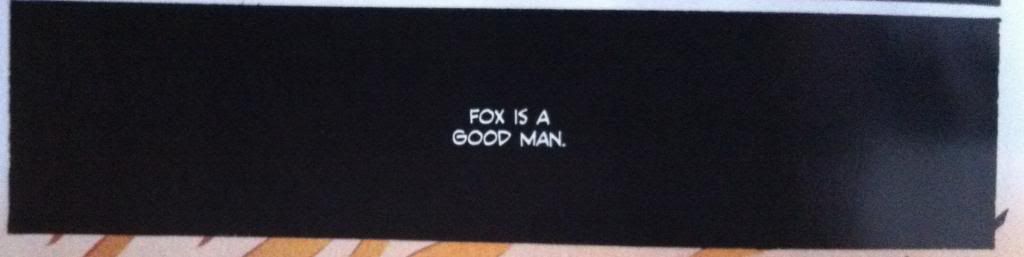
But I think my favourite thing about this sequence is this panel of dialogue here. From a story perspective, this panel has a black background as Ginny has kicked back over the rock the scorpions and bugs live under, so it conveys a nice bit of story information between panels. But what is brilliant about this panel is that the idea it contains, that "Fox is a good man" is portrayed in black and white. It is portrayed as an absolute. Which implies that Sarah, who says this, absolutely believes this idea. But, since we can't see Ginny listening to this statement this panel implies that she is deaf to it: Sarah is expressing this idea into a vacuum. What I love about the use of black and white here is just how solid and binary it is, its an idea you accept or an idea you reject and the fact that Sarah believes it and Ginny does not seems as if it will be the crux of their conflict. And this is all encapsulated in this single panel. Love it.


This sequence here is really great, largely for how it leads the reader so seamlessly through the composition and builds so much force and drama into every moment. The way the artwork captures the motion of Sissy crashing in a huff or spectacularly builds up the moment and explosive motion of Fox punching the rock face is great comics. The layout guiding even manages to capture the motion of Foxy's unstable stumble following the punch. And then the final three panels in the series beautifully and succinctly captures the emotions and status of all of the characters following the rage-punch. It's a really dramatic and efficient page.

Okay this next bit is going to be ginormous *SPOILERS* so please stop now if you haven't read the issue yet or if you are tradewaiting.


So the *SPOILER* intensive next section of the comic is the story of The Mason (the cuckolded husband of The Beauty who was the mother of Ginny). This section builds to a dramatic revelation which is Holy Shit Moment #3 and makes use of some really cool comics along the way.

This page here features one of the cooler mechanics at play during this section which is that Sissy is actively painting the story of The Mason, as related by Foxy, in the style of the Tarot images used for The Song of Death Face Ginny during a sudden rainstorm. This is kind of magical: it's a comic literally being made by a collaboration between Foxy and Sissy within another comic. And the way this process engages with the narrative and the fact that Pretty Deadly is itself a crafted comic leads to pretty interesting quirks. For instance, the two drawn panels in the middle third of the page: they depict The Mason holding his dead wife and deciding to die with her followed by another panel where the rain washes it away. This is a panel Sissy drew made of fantasy that is undone by the flow of reality. And then both of these panels are contrasted with the pose of Foxy immediately below them as he crouches on the ground in what can only be described as FORESHADOWING. (Incidentally, this is when I went "oh fuck, is that what's going on...?")

This page also features another really cool decision, which is the placement the panel about digging at the very bottom of the page, under the level of the ground. It's a panel about digging that is literally buried in the composition. It's a small, but very effective choice.


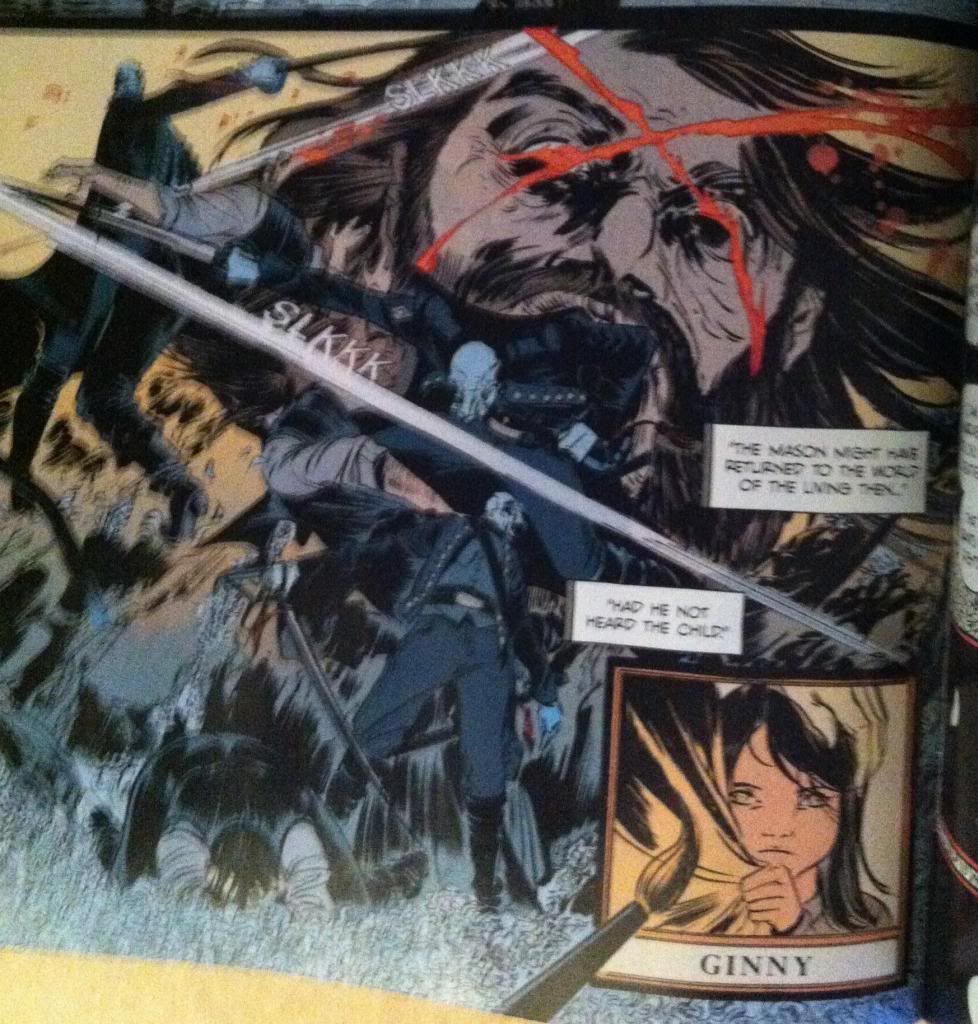
Foxy's story of The Mason eventually brings us to the *SPOILER* intensive Holy Shit Moment #3: Foxy IS The Mason. This fact is so brilliantly, brutally, obviously perfect that it is amazing. It explains so much of Ginny's motivation and Foxy's behaviour and adds a cord of dramatic connectivity to the entire series. It is also depicted on another amazing page that shows more of Pretty Deadly's trademark elegant composition in convention straining chaotic violence. This sequence of the blinding of Foxy/Mason by Death swirls about with seeming abandon, with Death and Foxy/Mason appearing almost randomly around the page in front of the giant, agonized face of Foxy. But closer inspection reveals a carefully arranged set of guides that steer the reader effortlessly through the chaos with the speed and exactness of Death's sabre: it's great comics.

It is also a pretty interesting sequence because of the contrast and similarities between the action/motion of Sissy's brush strokes and the strokes of Death's sabre. In the same way Ginny slashes her brush across say, Ginny's face in the last panel to draw a strand of hair, Death slashes across Foxy/Mason's head to carve the blinding X into the man's face. Which leads to a bunch of interesting ideas, like, what is the relationship between creation and destruction? Or what are the differences between enacting and depicting violence? Or, if we take things a little wider and look at the role of Team Pretty Deadly as slashers of pens and brushes, what is the relationship between violence and the creation of imagined violence. Pretty Deadly is a very thematically dense and complicated comic.

As dramatic and satisfying a revelation as Foxy's true identity is, it pales in comparison to how cool and amazing the revelation that comprises Holy Shit Moment #4 of the comic. But this moment is too perfect, too important to ruin here on the internet. So you will have to go and read Pretty Deadly #3 if you want to experience it. Which you should, because Pretty Deadly #3 is amazing.

Previously:
Pretty Deadly #2: Holy Shit Moments depicted with Holy Shit artwork
Pretty Deadly #1 pt. 2: The Song of Deathface Ginny
Pretty Deadly #1 pt.1: Breaking Rules

Friday, 27 December 2013

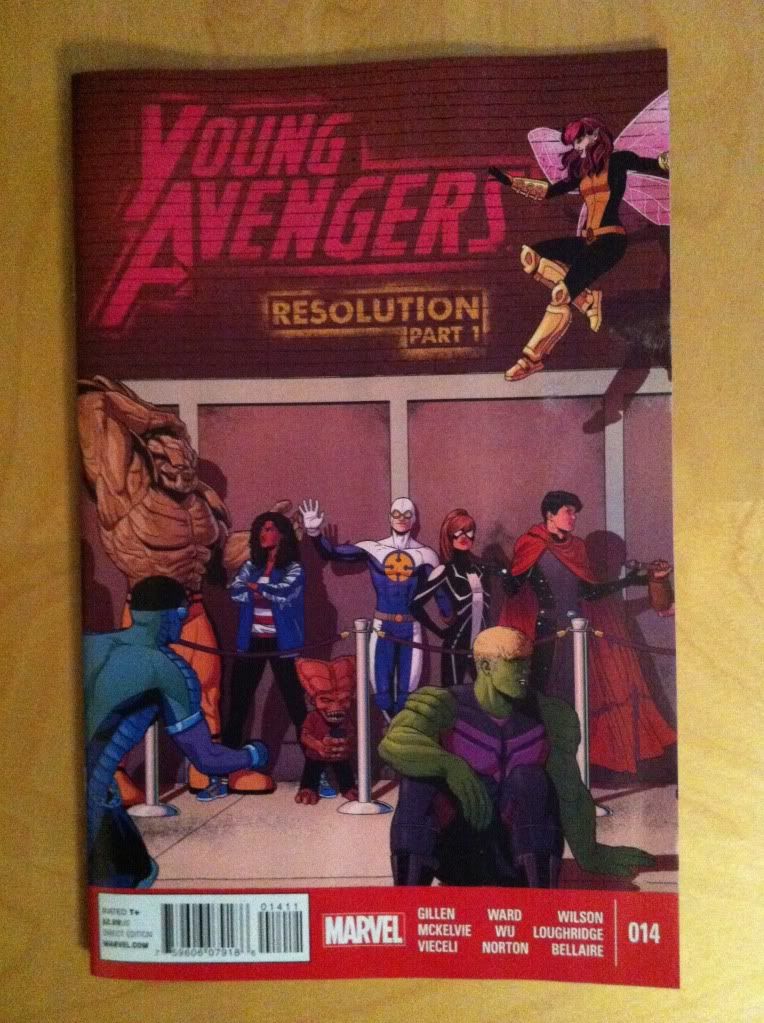
Favouring The Young Avengers #14

Or looking at the use of panel shape in Young Avengers #14
by Kieron Gillen, Jamie McKelvie, Matt Wilson, Emma Vieceli, Lee Loughridge, Christian Ward, Annie Wu, and Jordie Bellaire; Marvel Comics


Young Avengers #14 is the first half of an extended "Resolution" to the series. It wraps up some loose ends and begins the unenviable task of providing some closure to a really remarkable series. It's a great issue, but difficult to talk about as it feels very much like a portion of a larger statement. 

So in lieu of a premature series retrospective, I'd like to use Young Avengers #14 to explore how panel shape can be used to enhance storytelling because the issue has some really nifty examples. 

There will, as always, be *SPOILERS* beyond this point. So be wary.

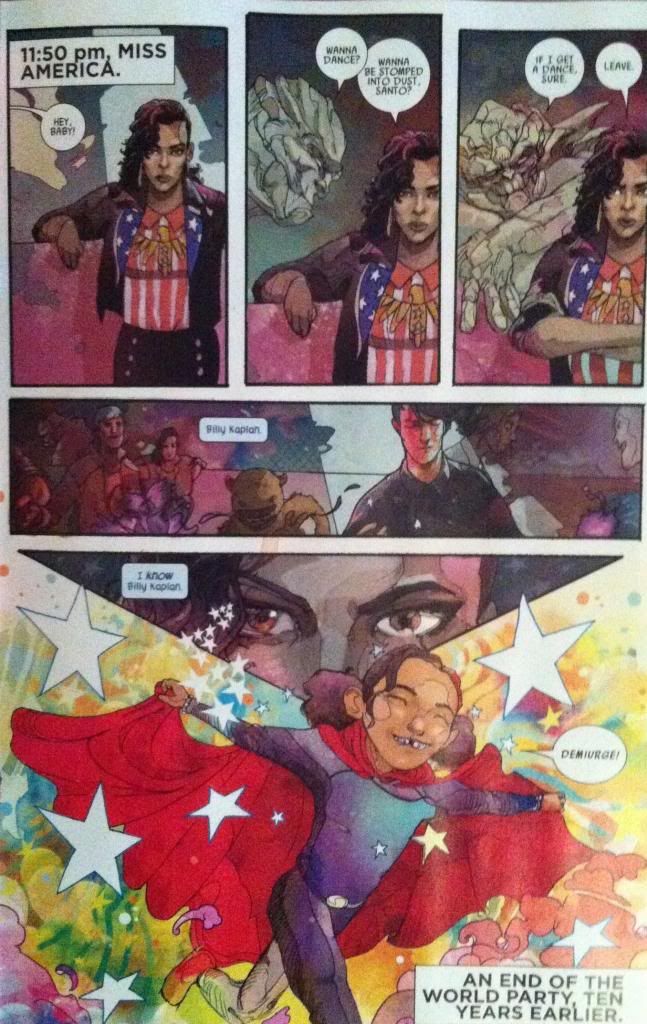
Specifically I want to talk about the America Chavez section of the issue drawn and coloured by Christian Ward. Ward has a really distinctive approach to artwork that makes really interesting use of colour and shape to convey additional story information. And it is completely worth taking a closer look at.


This page here has a bunch of interesting transitional elements. The page starts in the present with realistic, mature artwork that uses very structured panels and gritty, natural colouring, but transitions into a flashback sequence featuring America's childhood which is defined by a looser, more childlike style and a riot of brilliant colours. The change in colour and style clearly marks the difference between the flashback and present day sections of the comic and beautifully sets a tonal shift from the cynical, worldly perspective of grown up Chavez and the more joyful, naive perspective of young America. I also especially love the triangular fifth panel on this page showing the closeup of America's eyes. This panel makes a great use of shape here: the panel seems to be an arrow that points at what is happening in America's mind. It's a great way to effect the story transition that occurs between the fifth and sixth panels.


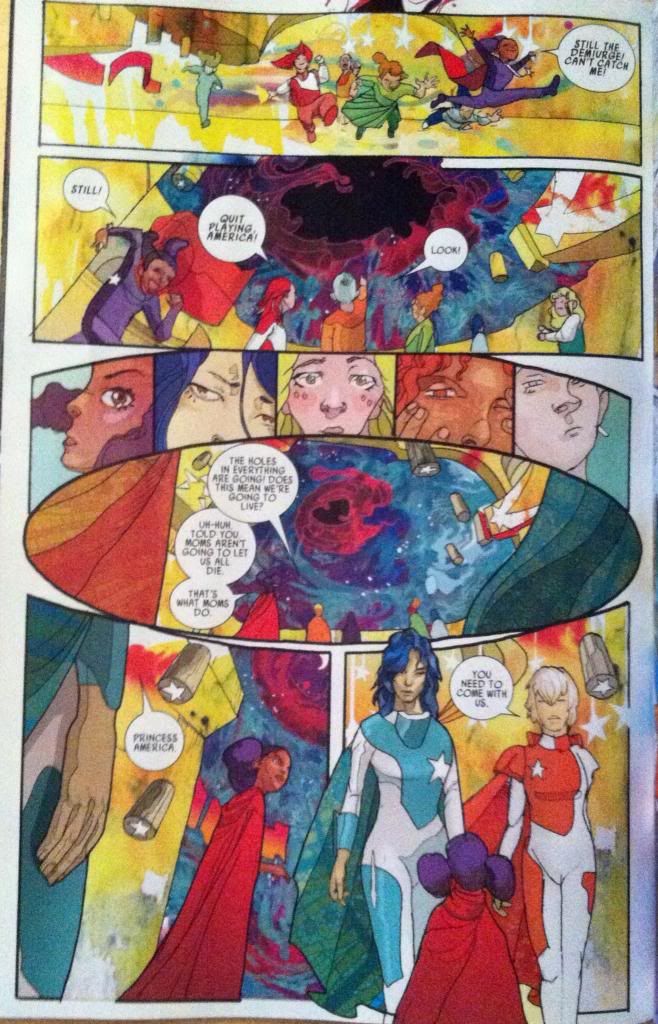
This page here has another pretty great use of shape. In this case the page uses a round panel in the centre of the page to add dramatic emphasis to the HOLE IN REALITY featured in the centre of the panel. It's as if the hole in the centre of the panel is a singularity pulling at the very fabric of the comic and warping the square panels around it into its orbit. It suggests that the hole in reality is vastly important to the larger story of America's childhood (of which we only get a glimpse) and really cements it as a focal point of this page and this section of the comic.

(Also notice the use of the Demiurge colour scheme around the hole in reality? The recurrent iconography in Young Avengers is pretty amazing.)


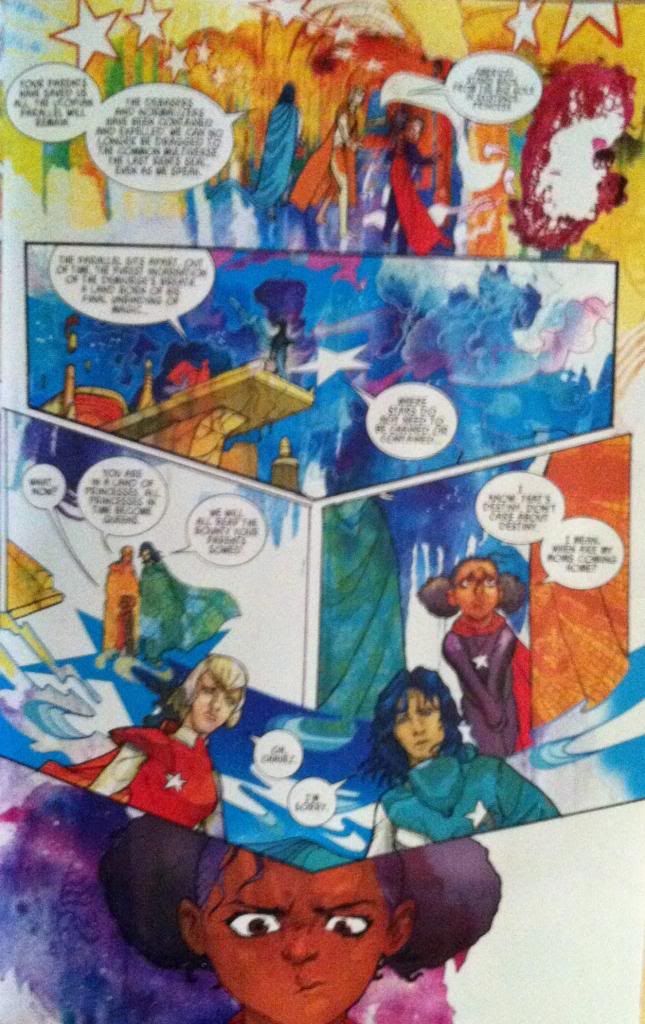
This page here makes a subtle, but really effective use of shape as well. Essentially the dramatic beat of this page is Chavez being presented with a choice, with the majority of the page containing the exposition leading to the choice which is revealed on the following page. What I find so great about this page is that the expositional elements come to a point on America's head as she makes a decision. I think this is clever because it's as if all of the information that effects Chavez decision is projecting above her head and literally on her mind. It's also quite clever as the decision that Chavez makes at the end of this page is the crux of the America section of Young Avengers 14 and the layout of the page focuses in, and balances on this decision. It's subtle, but great stuff.


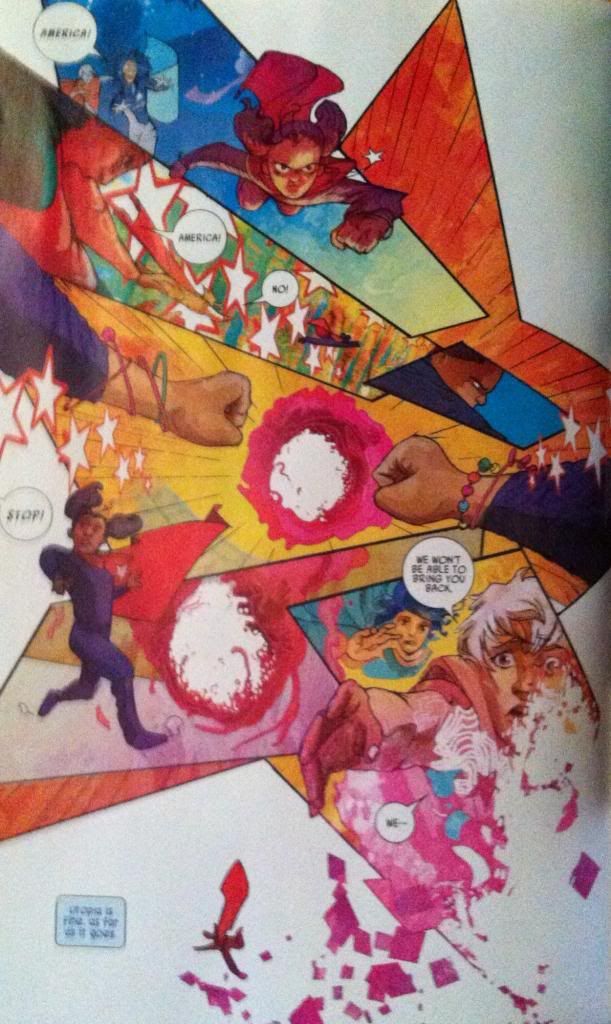
This page is the dramatic climax of the America story and portrays young America Chavez breaking through the hole in reality, leaving utopia and casting herself on the path that would eventually land her in the events of Young Avengers. And, since this is a sequence that uses magic (demiurge magic judging by the colours) the page contains a breakdown in the progression of comics reality. In this case the page loses its structured panels and instead is drawn into a star-shaped, whirlwind of comics chaos that ends with America Chavez falling right out of the plane of the composition and into the background. Great comics.

(Also, incidentally, I had always assumed the stars associated with America Chavez were a United States of America thing, but I wonder if they had, perhaps, been a nod to the Demiurge all along?)

Avengers #14 is another great issue in an outstanding series with a bevy of great artists working on wrapping things up. I'm going to miss this series when it's gone...

Previously:
Favouring The Young Avengers #13

Favouring The Young Avengers #12 (pt. 2)
Favouring The Young Avengers #12 (pt. 1)
Favouring The Young Avengers #11
Favouring The Young Avengers #10
Favouring The Young Avengers #8
Favouring The Young Avengers #7


Wednesday, 25 December 2013

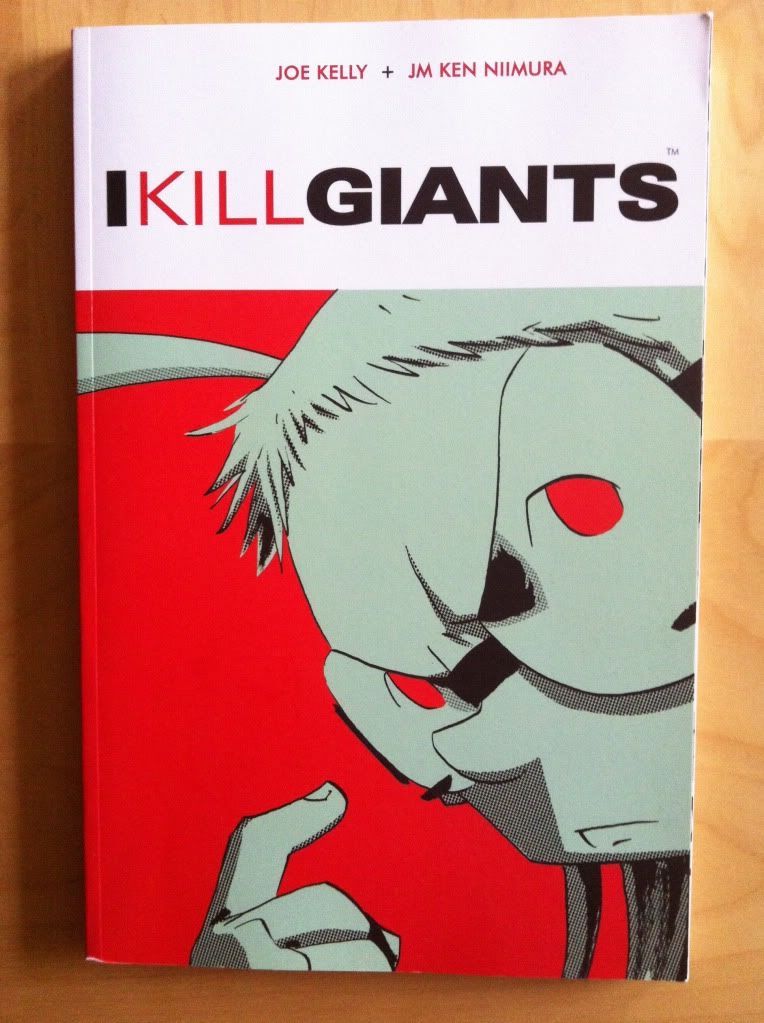
So I Read I Kill Giants

A 250 word (or less) review of the I Kill Giants graphic novel
By Joe Kelly and JM Ken Niimura; Image Comics


I Kill Giants is the story of Barbara Thorson, a girl who is obsessed with killing giants. She knows the giants are coming and that it is absolutely up to her to wield the mighty hammer Coveleski to slay her gigantic foes and protect her family from certain destruction. Barbara is also an elementary school student where she is a dorky, Dungeons and Dragons obsessed loner with a penchant for offending authority. And yet there is something else Barabara must deal with, another monstrous reality that she cannot face. And so instead she kills giants. I Kill Giants is a pretty heartfelt comic that tells a story that, like some sort of emotions singularity, just drags empathy out of you. It is also a pretty clever comic, balancing the opposing forces of fantasy and reality to sort of play with that fuzzy space inbetween in this pretty interesting way. I Kill Giants is a pretty fun comic too: the story has an energy to it, characters are vibrant, and Barabara is pretty hilarious. But I think the thing that nabs me most is that I found the comic eminently relatable. Shockingly, I was a pretty dorky kid who, before I found my peeps, leaned into the fictional world (your sci-fi, your fantasy, etc) to get through the special hell of the educational system. Now, my situation was nowhere as tough as Barbara's, but I get where she is coming from, in a way I too killed giants. Try it.

Word count: 249

Monday, 23 December 2013

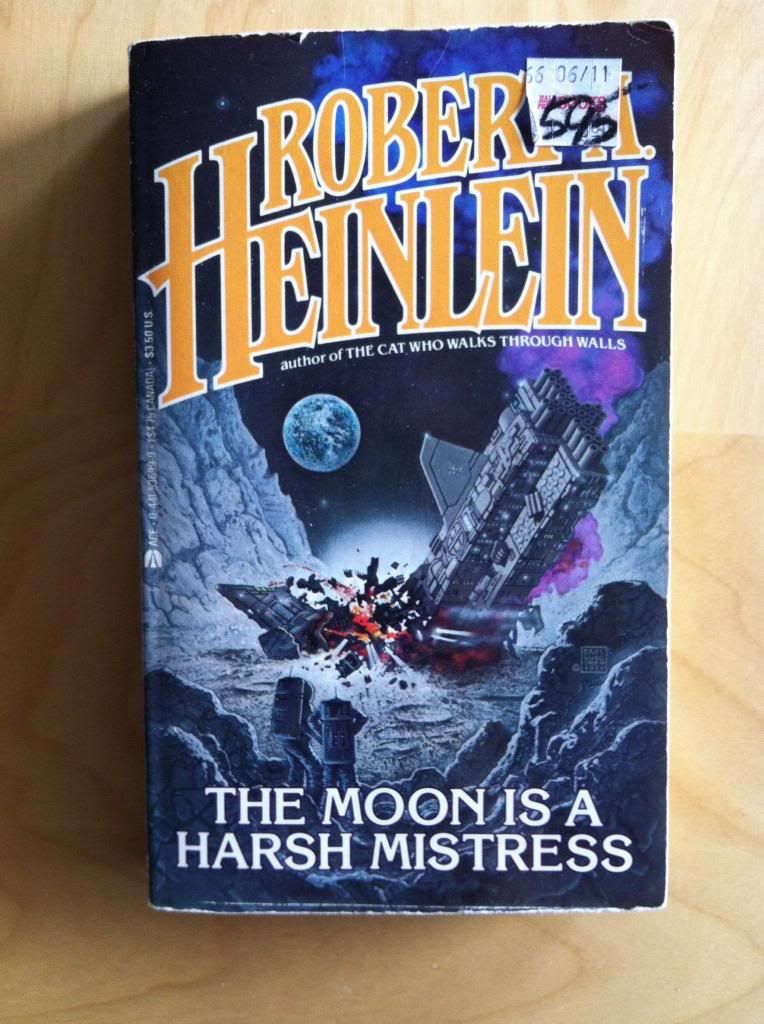
The Moon Is A Harsh Mistress Is A Good Book

Or why you should read The Moon Is A Harsh Mistress by Robert A Heinlein


There are some works of Science Fiction that are classic, baby, classic. And it's hard to get much more classic than Robert A Heinlein, and hard to get much more classic Heinlein than The Moon Is A Harsh Mistress. He is one of the big three early Sci-fi authors and The Moon Is A Harsh Mistress is considered one of his most important and best novels.

The Moon Is A Harsh Mistress is about the greatest revolution for independence in space. In the novel the Moon is the worlds penal colony, where criminals from almost every nation on Earth are sent on a one way trip to farm the lunar tunnels and send their produce back to a starving Earth. However, within the free folk of the Moon is growing dissatisfaction and the knowledge that the Loonies are losing precious, irreplaceable resources. And so a conspiracy is formed between  Manuel Garcia "Mannie" O'Kelly-Davis, a computer expert and local farmer, Wyoming "Wyo" Knott, a lunar freedom activist, and Professor Bernardo de la Paz, an elderly political exile to free the Moon from the control of Federal Earth. With the help of Mike, a sentient emergent intelligence living within the Lunar computer network the Loonies slowly build the conditions for a revolution that will pit the tiny Moon against the mighty power of Earth.

And it's easy to see why The Moon Is A Harsh Mistress is so well regarded. The way the Lunar revolution is rolled out makes a lot of sense and while there are Scientific inaccuracies within the book, the majority of the mechanics of life on the Moon and the Loonies revolutionary strategy is constructed with the precision of an engineer. Add to that the brilliance of the conversation about computer sentience and control at a time well before the emergence of computers and a really cheeky look at polyandry as a family model, particularly in a location with severe gender imbalance. There really is a lot that holds up in this novel.

Unfortunately, there is an equal amount about The Moon Is A Harsh Mistress that reads pretty poorly from a modern perspective. The most obvious issue it that this novel is wildly problematic. Robert J Heinlein has a world view that is very, very much shaped by his era: his gender politics are quite icky, the novel praises Ayn Rand, and a character literally uses Black-face as a disguise. While I don't think Heinlein meant to be malicious with these choices, it is really uncomfortable to read them. A less significant, but more systemic problem, is that The Moon Is A Harsh Mistress uses a kind of Loonie Slang that is mostly just English that is slightly ungrammatical. While it isn't disgusting, it is REALLY distracting and took some time to warm up to every time I opened the book.  So despite some great Sci-fi in it, The Moon Is A Harsh Mistress is a pretty flawed book.

I'd really only recommend this book to Sci-fi completists. I mean, there is certainly fun to be had with The Moon Is A Harsh Mistress, but I feel like there are enough better contemporary and classic Sci-fi novels that you could read instead. But at the same time, if you wanted to read all of Sci-fi's touchstone works, The Moon Is A Harsh Mistress would obviously be included.  If you are looking for a good Heinlein novel, I'd recommend Starship troopers instead.

Previously:
Starship Troopers