Or why isn't consumer budgeting considered when first issue sales are discussed?
There is a phenomenon in comics where the first issue of a new title greatly outsells subsequent issues. Generally speaking the #1 issue sells a certain, fairly large number of issues but then over the course of subsequent issues the number slowly declines. Often the decline between first and second issue is the largest, dropping many units between the first and second issue. And this attrition in comics sales for any particular series is something I worry about.
It seems that this is also something that the big comic companies worry about too: they are often engineering new ways to sell #1 issues or buzzy one-shots, and constantly launching and relaunching new series. In part, I think, to generate high sales from first issues. From my casual-industry-following vantage it looks like comic publishers think they can grow their sales by launching lots of new series as a way to increase the numbers of titles readers will follow. However, I think something else might be going on, something, it seems, that isn't being discussed much.
I am a huge contributor to the first issue effect. Not because I am a collector, or because I slowly lose interest in comics I am reading but because I am strictly budgeting my comics intake. I read ten and only ten ongoing mainstream published comics at a time. As a result if I want to pick up a new title, I have to drop one of the ones I am currently reading: and this looks a lot like comics sales attrition. But, I do not drop old titles out of a lack of interest in them, I drop old titles because something new comes along and I cannot afford to read both. I also frequently try first issues, sometimes even two or three, when new comics series are released. I like to try new titles, see if I like them more than what I am already reading, and then decide if I will adopt this new title in place of a current one. Often I will read a first issue, decide it isn't better than what I am already reading and never pick up a subsequent issue (first issues, they are important). I will sometimes pick up a couple more issues to help me make up my mind, but often in this instance I will still end up dropping the new title after only these first couple issues. Both of these things will contribute to the remarkably high sales of comics for the first few issues. (Conversely, if I pick up a new title, I drop another title which contributes to the sales attrition of longer running titles.) What I am trying to say is that the first issue phenomenon could be explained by people trying new titles within the context of a maxed out comics budget.
My point is that the high sales of #1's and the gradual attrition of sales on other titles might be evidence of an over saturated comics market. If this hypothesis is true the audience is already buying, basically, all it can afford to buy. Adding new titles just dislodges the audience from established books so that a new title doesn't really generate any new, sustainable sales. The spike in sales with a new number one beyond people simply switching titles might only be curious readers giving the new title a try before deciding to stick with their current, budgeted collection. If so, then releasing tons of #1's generates an artificial bump in sales that comes on the expense of existing readers and might just be a mechanism of wringing just a little bit more cash out of the audience. And this is something I worry about.
Previous Things I Worry About:
Geek Fashion
Sharing Media
Problematic Themes
Problematic Creators
Tradewaiting
Monday, 16 September 2013

Friday, 13 September 2013
Describing Daredevil #30
Or turning on and off the flow taps in Daredevil #30
By Mark Waid, Chris Samnee, Javier Rodriguez, and Joe Caramagna; Marvel Comics
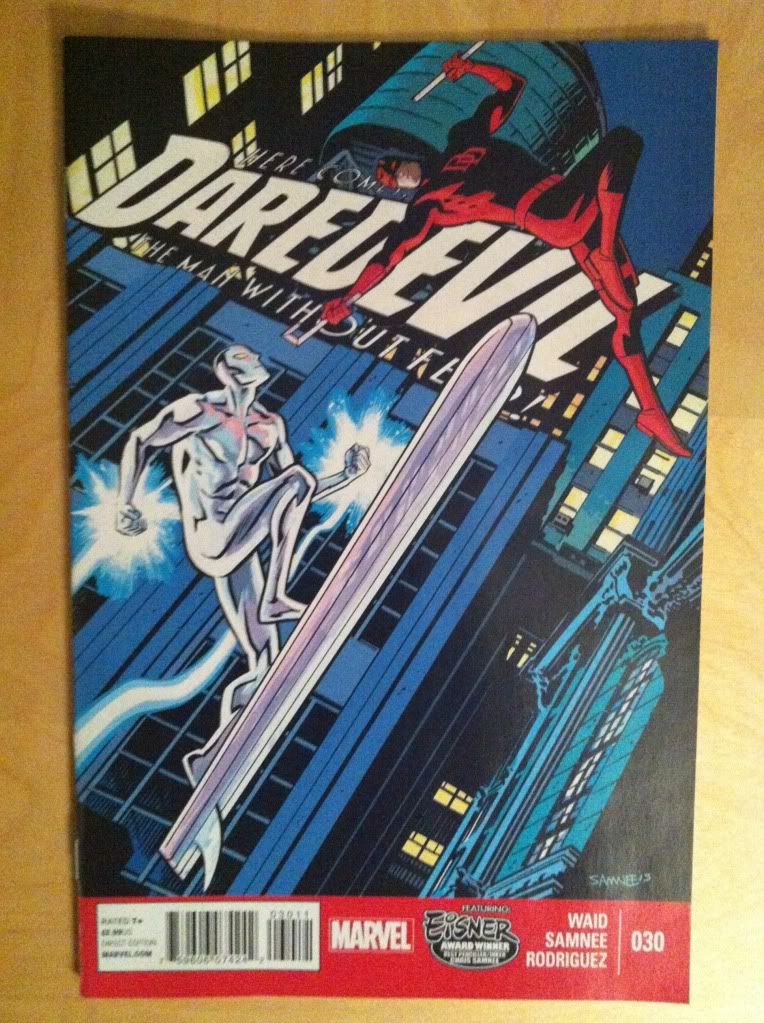
Daredevil #30 is this great, kind of a Silver-agey story about Daredevil teaming up with The Silver Surfer to fight a menace. It's a bit goofy, but filled with a lot of unexpected, fun moments and a kernel of despair that sets up what looks like an important plot thread. It's another great comic in a series known for being great comics.
It's also a comic that has some great examples of different approaches to panel progression that I think maybe bear a closer look.
This post will contain *SPOILERS* for Daredevil #30. So read the comic first.
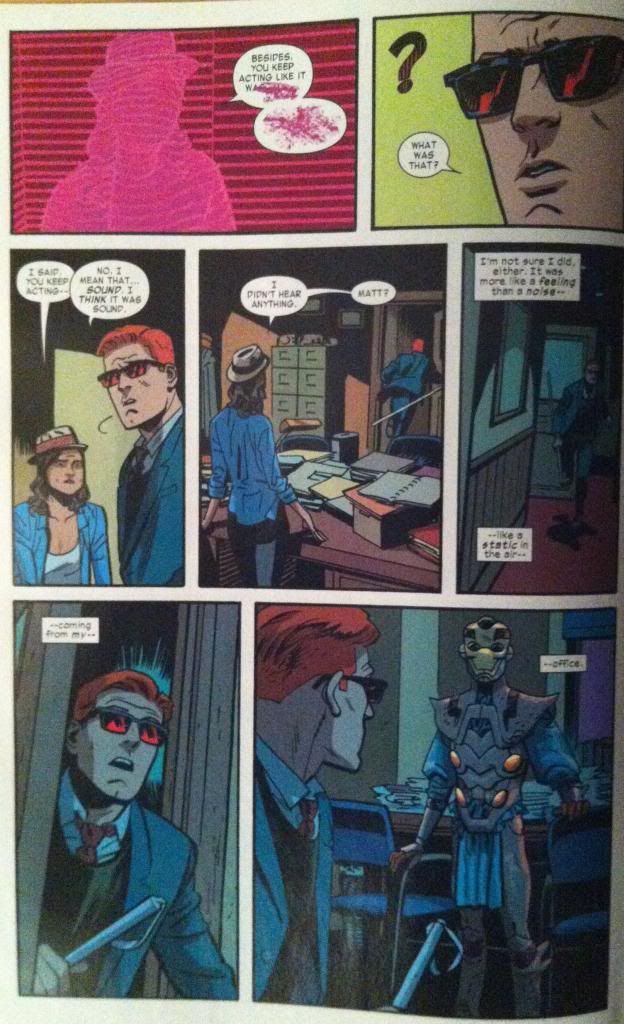
So, I'm pretty interested (obsessed?) with comic pages that exhibit especially fluid or directed storytelling. I'm interested in this because one of the problems sequential storytelling has to contend with is how to make a reader look at things in, well, the right sequence. If character A is reacting to event or character or speech B than the audience ought to see B before A for the best effect. And so the kinds of pages that lead the reader through the artwork in a way that correct queues events can add extra value and impact to the storytelling. Even in quiet talking scenes. And I think this page is a great example of a kind of holistic, natural approach to guiding the reader through events in the perfect order. It's all kinds of subtle, but damn if it isn't effective.

This page works its magic mostly by just framing events, and maybe subtly adjusting, the normal reading path of comics to create the perfect sequence for each storybeat. The view-path starts in the top left (the natural starting point) with the Daredevil-sense-silhouette of Kirsten McDuffie (love-interest/new lawyer partner) and then travels through the two conveniently placed word balloons to the edge of the first panel. You scan right, pick up the perfectly placed word balloon, and track across to Matt Murdock's confused face. You carriage return across the page and crash right into Matt's confused fez before carrying on the same view path to see Kirsten's reaction to his behaviour. You (or at least I) then dealt with this panel's word balloons before moving to the next panel taking in Kirsten standing and the first speech bubble before carrying on to Matt running out of the office and the second word balloon. Which is great because it basically splits this panel into two separate moments adding a sense of time and, as an added bonus, imparts the motion of Matt moving into the hallway. This neat movement effect is continued into the next panel where our eyes sweep around the corner, the actual motion of Murdoch, before crossing the page to the next row which is a continuation of Matts trajectory in this panel. (Also, notice the split narration caption box adds to this sweeping motion.) The carriage return transition here also has the added bonus of being like a semi-page turn, making the shocked Matt in the bottom left panel suddenly appear adding a great extra weight to the panel. We then carry on across the page in the level of Matt's gaze straight (catching Matt in the next panel to add a nice sense of place) to the unexpected alien visitor. It's just a great page that uses really great layout, figure placement, and brilliant lettering to ensure everyone is seen and everything is read in just the right order while also adding extra drama to key events. It's great comics.
(I also love the use of green, which contrasts sharply with the red of Matt's glasses and hair to punch up the emotions of surprise in the top right and bottom left panels. Colour theory!)
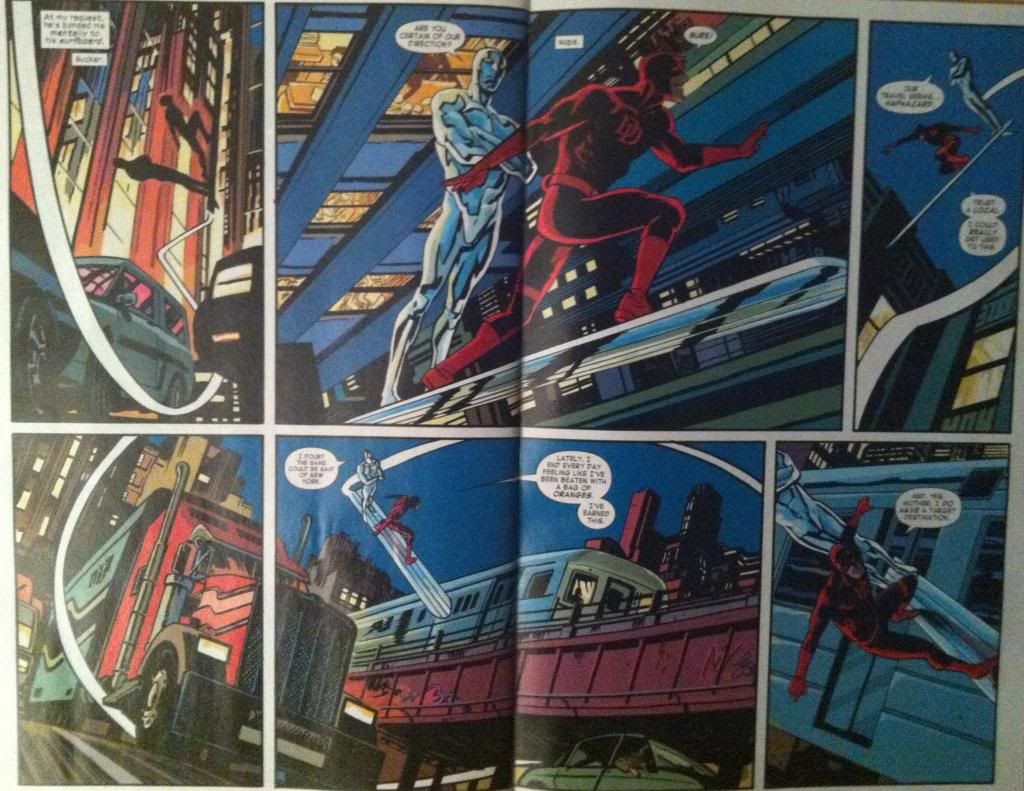

How this double page spread works, at least for me, is that the surf board becomes the key guiding shape: the board being a straight guide, and the long swooping contrail acting to impart a directionality to the guide. Basically, I feel like the Silver Surfboard acts as a vector that directs the reader. However it directs the reader not to the next logical location in a smooth series, but instead points in random, even opposing, directions to create the haphazard feelings of the scene.
So starting in the top left panel we have a vector that points not to the next panel, but instead sharply up and off the page as if Daredevil and Surfer are flying off the grid. We then move to the left panel which has a board vector almost perpendicular to the previous one and then move to the third panel where the vector opposes the one in the previous panel. There is no smooth transition from each of these positions and makes it feel fast (too fast to tie together) and random. We then carriage return from the top right panel to the bottom left along the vector of the board in the top right panel, swooping rapidly down along the path of the characters flight (which is pretty great). We then jog right, across a panel split designed only to further dilate time and add a sense of velocity, and see an unexpected downward pointed Silver Surfboard before moving to the final panel with yet another unconnected vector. Basically, to my eyes at least, the layout is a series of directional snapshots that don't entirely sync up but in a way that better sells the dramatic nature of the sequence. It's cool stuff.
So there you have it, two very different pages with opposite approaches to panel flow, one very guided and one deliberately disjointed, that both add a lot of drama to their individual scenes.
Previously:
Describing Daredevil 29: A great page
By Mark Waid, Chris Samnee, Javier Rodriguez, and Joe Caramagna; Marvel Comics
Daredevil #30 is this great, kind of a Silver-agey story about Daredevil teaming up with The Silver Surfer to fight a menace. It's a bit goofy, but filled with a lot of unexpected, fun moments and a kernel of despair that sets up what looks like an important plot thread. It's another great comic in a series known for being great comics.
It's also a comic that has some great examples of different approaches to panel progression that I think maybe bear a closer look.
This post will contain *SPOILERS* for Daredevil #30. So read the comic first.
So, I'm pretty interested (obsessed?) with comic pages that exhibit especially fluid or directed storytelling. I'm interested in this because one of the problems sequential storytelling has to contend with is how to make a reader look at things in, well, the right sequence. If character A is reacting to event or character or speech B than the audience ought to see B before A for the best effect. And so the kinds of pages that lead the reader through the artwork in a way that correct queues events can add extra value and impact to the storytelling. Even in quiet talking scenes. And I think this page is a great example of a kind of holistic, natural approach to guiding the reader through events in the perfect order. It's all kinds of subtle, but damn if it isn't effective.

This page works its magic mostly by just framing events, and maybe subtly adjusting, the normal reading path of comics to create the perfect sequence for each storybeat. The view-path starts in the top left (the natural starting point) with the Daredevil-sense-silhouette of Kirsten McDuffie (love-interest/new lawyer partner) and then travels through the two conveniently placed word balloons to the edge of the first panel. You scan right, pick up the perfectly placed word balloon, and track across to Matt Murdock's confused face. You carriage return across the page and crash right into Matt's confused fez before carrying on the same view path to see Kirsten's reaction to his behaviour. You (or at least I) then dealt with this panel's word balloons before moving to the next panel taking in Kirsten standing and the first speech bubble before carrying on to Matt running out of the office and the second word balloon. Which is great because it basically splits this panel into two separate moments adding a sense of time and, as an added bonus, imparts the motion of Matt moving into the hallway. This neat movement effect is continued into the next panel where our eyes sweep around the corner, the actual motion of Murdoch, before crossing the page to the next row which is a continuation of Matts trajectory in this panel. (Also, notice the split narration caption box adds to this sweeping motion.) The carriage return transition here also has the added bonus of being like a semi-page turn, making the shocked Matt in the bottom left panel suddenly appear adding a great extra weight to the panel. We then carry on across the page in the level of Matt's gaze straight (catching Matt in the next panel to add a nice sense of place) to the unexpected alien visitor. It's just a great page that uses really great layout, figure placement, and brilliant lettering to ensure everyone is seen and everything is read in just the right order while also adding extra drama to key events. It's great comics.
(I also love the use of green, which contrasts sharply with the red of Matt's glasses and hair to punch up the emotions of surprise in the top right and bottom left panels. Colour theory!)
This layout here is also pretty cool. Not because it flows effectively from panel to panel... but because it deliberately doesn't. I mean, if you look closely at each panel there is a clear sequence of events portrayed: Daredevil drives the Silver surfboard up, turns it around, swoops down and around and carries on. But this series of events broken up in a way that adds a lot of chaos to the scene, a haphazardness that really sells that Daredevil is just screwing around and plays on the gag of a blind fellow driving (and maybe also a little bit on New York cabbies who used to take the long way for a higher fare...). It's a really interesting choice.

How this double page spread works, at least for me, is that the surf board becomes the key guiding shape: the board being a straight guide, and the long swooping contrail acting to impart a directionality to the guide. Basically, I feel like the Silver Surfboard acts as a vector that directs the reader. However it directs the reader not to the next logical location in a smooth series, but instead points in random, even opposing, directions to create the haphazard feelings of the scene.
So starting in the top left panel we have a vector that points not to the next panel, but instead sharply up and off the page as if Daredevil and Surfer are flying off the grid. We then move to the left panel which has a board vector almost perpendicular to the previous one and then move to the third panel where the vector opposes the one in the previous panel. There is no smooth transition from each of these positions and makes it feel fast (too fast to tie together) and random. We then carriage return from the top right panel to the bottom left along the vector of the board in the top right panel, swooping rapidly down along the path of the characters flight (which is pretty great). We then jog right, across a panel split designed only to further dilate time and add a sense of velocity, and see an unexpected downward pointed Silver Surfboard before moving to the final panel with yet another unconnected vector. Basically, to my eyes at least, the layout is a series of directional snapshots that don't entirely sync up but in a way that better sells the dramatic nature of the sequence. It's cool stuff.
So there you have it, two very different pages with opposite approaches to panel flow, one very guided and one deliberately disjointed, that both add a lot of drama to their individual scenes.
Previously:
Describing Daredevil 29: A great page
Wednesday, 11 September 2013
So I Read The Other Side
A 250 word (or less) review of The Other Side
By Jason Aaron, Cameron Stewart, and Dave McCaig; Vertigo Comics
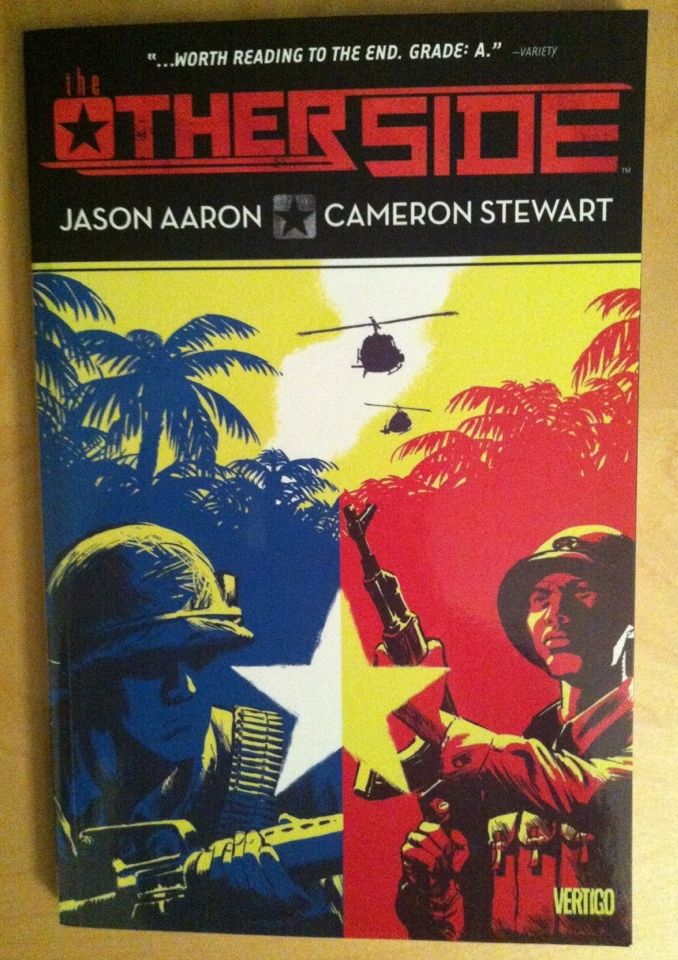
As a Canadian born in the late '80s, the Vietnam War seems crazy and weird. I grew up with the narrative that it was a misguided thing, and that the American soldiers involved were victims and poorly equipped for the nightmare they were thrust into. I grew up with media littered with tales of these broken soldiers, in awful places, doing awful things, and then ignobly returning home. What was lacking, though, was any discussion from the side of the Northern Vietnamese, the people who had very legitimate reasons for resisting and fighting the American invaders. The Other Side is a comic that strives to tell the stories of both sides of the Vietnam War. The comic contrasts the now familiar story of Bill Everette, a draftee from Alabama who goes through a full-metal-jacket-esque trajectory, with Vo Binh Dai, an impoverished, but patriotic youth from Northern Vietnam who volunteers to protect his homeland. And the contrast here is stark, between the valiant patriotic Dai sacrificing and sacrificing and sacrificing for his family, and Bill forced to fight in a war he doesn’t give two fucks about in an army that doesn’t care about him and for a nation that isn’t really invested in the conflict. The Other Side unflinchingly portrays the excesses and horrors and courage of both sides’ soldiers, but overall paints a picture where all of the soldiers are tragic victims of American Imperialism. It's a sad, and horrific, and very effective comic.
By Jason Aaron, Cameron Stewart, and Dave McCaig; Vertigo Comics
As a Canadian born in the late '80s, the Vietnam War seems crazy and weird. I grew up with the narrative that it was a misguided thing, and that the American soldiers involved were victims and poorly equipped for the nightmare they were thrust into. I grew up with media littered with tales of these broken soldiers, in awful places, doing awful things, and then ignobly returning home. What was lacking, though, was any discussion from the side of the Northern Vietnamese, the people who had very legitimate reasons for resisting and fighting the American invaders. The Other Side is a comic that strives to tell the stories of both sides of the Vietnam War. The comic contrasts the now familiar story of Bill Everette, a draftee from Alabama who goes through a full-metal-jacket-esque trajectory, with Vo Binh Dai, an impoverished, but patriotic youth from Northern Vietnam who volunteers to protect his homeland. And the contrast here is stark, between the valiant patriotic Dai sacrificing and sacrificing and sacrificing for his family, and Bill forced to fight in a war he doesn’t give two fucks about in an army that doesn’t care about him and for a nation that isn’t really invested in the conflict. The Other Side unflinchingly portrays the excesses and horrors and courage of both sides’ soldiers, but overall paints a picture where all of the soldiers are tragic victims of American Imperialism. It's a sad, and horrific, and very effective comic.
Word
count: 245
Monday, 9 September 2013
The Ocean At The End Of The Lane Is A Good Book
Or why you should read The Ocean At The End Of The Lane by Neil Gaiman
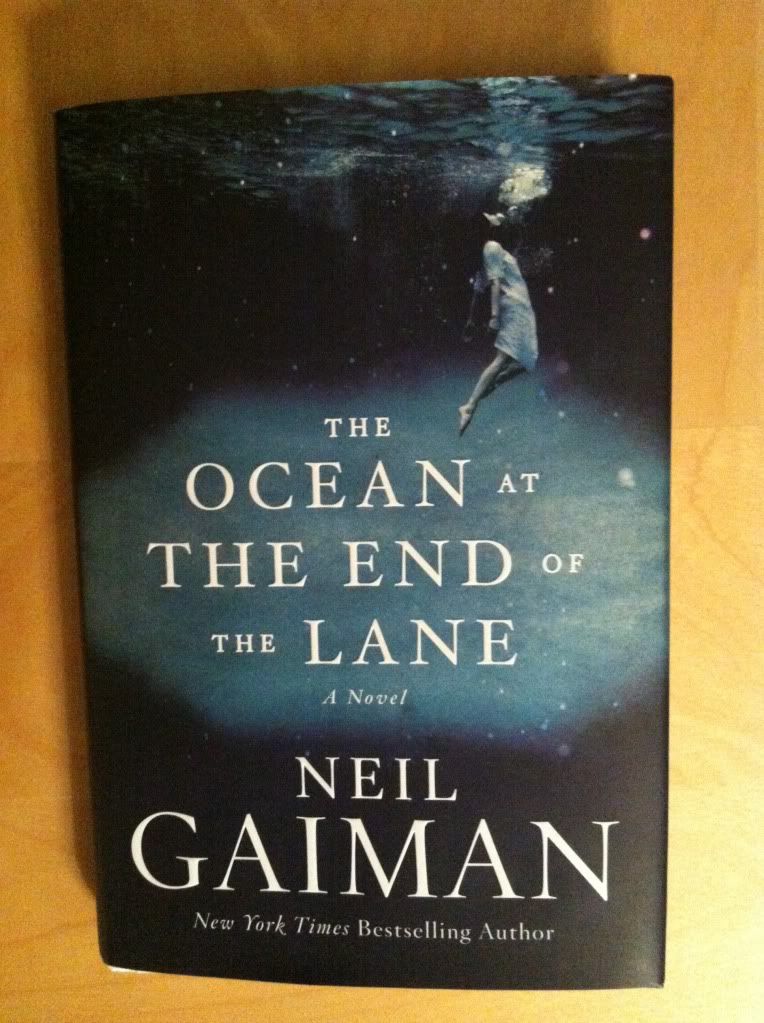
The Ocean At The End of The Lane is the first novel for adult readers by master of magic and mystery, Neil Gaiman. And it is of course, delightful.
The novel is about a middle-aged man visiting his childhood country home and remembering a magical, horrific experience from his childhood. He recalls a terrible event that lead to a supernatural something bestowing gifts with a price on unsuspecting people. The man, as a boy, turns to the aid of Lettie Hempstock, an eleven year old girl neighbour whose family is tied to an ancient magic themselves to help exorcise the local haunting. But instead something goes wrong, and the man-as-boy brings something supernatural back with him from beyond The Ocean, something that invades the boys home and life and threatens to destroy it all.
The Ocean At The End of The Lane is absolutely full of imagination and whimsy and magic. The supernatural is portrayed with the conviction of childhood, and the mundane with this kind of exquisite hindsight filled with profound little moments. Which is actually one of the coolest aspects of the book: its a childrens tale, filled with imagination and wonder, but married to this mature, measured tone of an adult. It's like The Ocean At The End of The Lane is a book not so much written for adults as a novel written for the half-remembered child that lives in every gown up. It begs us to remember exploring, creating games with elaborate internal logic, and our strange childhood neighbours. It is a wonderful place to visit.
I also kind of love how the whole story exists in this tension between the magical elements as real and the magical elements as an elaborate childhood game/fantasy constructed to deal with some pretty troubling real life issues. It's pretty nifty.
The Ocean At The End of The Lane is a pretty light read: it's short and open. It's the kind of book you can read in one long sitting, or over a weekend in little snippets. (Which, is probably appropriate for its storybook for adults contents.) As a result I would recommend this book as an excellent weekend at the cabin or camping book: it's easy to read, fun, and will stoke your inner child.
Previously:
American Gods and The Anansi Boys
The Ocean At The End of The Lane is the first novel for adult readers by master of magic and mystery, Neil Gaiman. And it is of course, delightful.
The novel is about a middle-aged man visiting his childhood country home and remembering a magical, horrific experience from his childhood. He recalls a terrible event that lead to a supernatural something bestowing gifts with a price on unsuspecting people. The man, as a boy, turns to the aid of Lettie Hempstock, an eleven year old girl neighbour whose family is tied to an ancient magic themselves to help exorcise the local haunting. But instead something goes wrong, and the man-as-boy brings something supernatural back with him from beyond The Ocean, something that invades the boys home and life and threatens to destroy it all.
The Ocean At The End of The Lane is absolutely full of imagination and whimsy and magic. The supernatural is portrayed with the conviction of childhood, and the mundane with this kind of exquisite hindsight filled with profound little moments. Which is actually one of the coolest aspects of the book: its a childrens tale, filled with imagination and wonder, but married to this mature, measured tone of an adult. It's like The Ocean At The End of The Lane is a book not so much written for adults as a novel written for the half-remembered child that lives in every gown up. It begs us to remember exploring, creating games with elaborate internal logic, and our strange childhood neighbours. It is a wonderful place to visit.
I also kind of love how the whole story exists in this tension between the magical elements as real and the magical elements as an elaborate childhood game/fantasy constructed to deal with some pretty troubling real life issues. It's pretty nifty.
The Ocean At The End of The Lane is a pretty light read: it's short and open. It's the kind of book you can read in one long sitting, or over a weekend in little snippets. (Which, is probably appropriate for its storybook for adults contents.) As a result I would recommend this book as an excellent weekend at the cabin or camping book: it's easy to read, fun, and will stoke your inner child.
Previously:
American Gods and The Anansi Boys
Friday, 6 September 2013
The Neanderthal Parallax Trilogy Are Good Books
Or why you should read Hominid, Human, and Hybrid by Robert J Sawyer
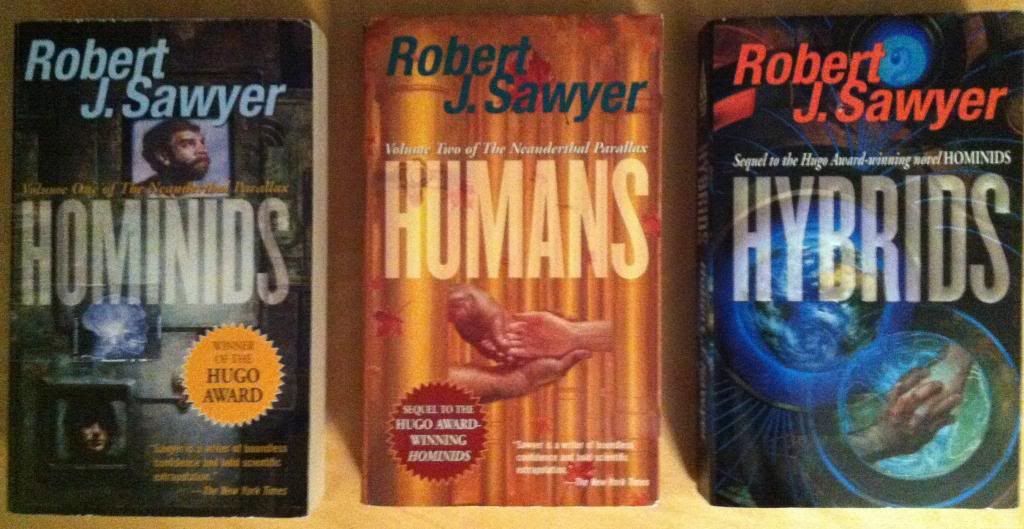
Okay. This series has a hokey name and a premise that at first blush sounds pretty goofy (Neanderthal Parallax sounds like a bad Stoneage Green Lantern villain). But! This is one of the smartest, best, heartfelt, high concept group of Science Fiction novels I've ever read. Really, it is a fantastically empathetic and intelligent read. These books are among my very favourite. So hear me out!
The premise of the Neanderthal Parallax Trilogy (stay with me) is that a man suddenly appears inside the Sudbury Neutrino Observatory heavy water sphere, which is located kilometres underground in an especially well-shielded, and radioactively inert nickel mine in northern Ontario, Canada. Which is impossible: one moment the tank is empty and the next this sealed, nigh unreachable chamber has a man inside it. Even more impossibly, this man is a Neanderthal, a living example of a prehistoric hominid that cohabited the Earth with humanity for tens of thousands of years. It is quickly discovered that the Neanderthal, Ponter Boddit, is from a technologically advanced civilization from a parallel reality where Neanderthal's became the dominant species of human while Homo Sapiens died off and has ended up on our Earth as the result of an experimental accident. Ponter, together with prehistoric genetics professor Mary Vaughn, doctor Rueben Montego, and astrophysicist Louise Benoit, must find a place for Ponter in this brave new world. Meanwhile Adikor, Ponter's scientific colleague and partner back in his home reality, must discover what happened to Ponter before he is convicted of murder. What follows is the ultimate story of cultural collision as humanity, both Neanderthal and Homo Sapiens are confronted by a whole different society and way of life. Can they see past their many differences and find a way to coexist? Can they learn from one another? Can they even love one another?
The brilliance of this novel is the way it attacks and discusses our preconceived notions of what it means to be human. With the Neanderthals, Sawyer creates a society and, as a result, world that is wildly different than ours. Neanderthals are a society of communist, atheist, polyamorous, bisexual, hunter-gatherer environmentalists. They live in gender segregated communities, uniting the sexes only during the period of the female's synched-up menstrual cycle where they are infertile as a means of rigorous population control. They practice eugenics, sterilizing criminals and the least intelligent to better their genetic legacy. The Neanderthals live under constant surveillance from implanted computers and have a democratic government where only elderly members of society have a voice. And it is the contrast between this Neanderthal society and our own that creates the magic of Hominid, Human, and Hybrid.
Because, here's the thing, there are a lot of interesting social ideas that are taboo. We all agree that eugenics or a total surveillance society are bad. Many of us believe that the notion of monogamy and sexual preference are natural. We think that true communism cannot possibly work. What these novels do is remove human-nature (or at least homo sapiens nature) from the equation, removing any contamination from our socialization and history, and genuinely plays with the idea of what is better. Does eugenics divorced from all the racist garbage have merit? Should we castrate rapists both as a punishment and treatment for their conditions? Is population control a sound solution to our environmental problems? Is perfect, universal surveillance a good thing if we could guarantee that no one would abuse it? Are our sexual habits and shame pig-headed? Is religion just so much superstitious and damaging malarky? The brilliance of these novels is that they provide a safe space for a discourse about some really loaded, really interested ideas. It's really cool.
(Full disclosure, I think eugenics is fascinating. Not in a we-should-actually-do-it way, since it is immoral as anything and just begging to be abused in horrific ways, but in a Scientific curiosity way. Like, how much of who we are is genetic (or epigenetic or encoded in the various other physical ways our bodies store information)? I think it is an interesting question, but one much too hot to really touch given our terrible history with the idea. So I found the discussion of eugenics in the Neanderthal Parallax trilogy pretty engaging.)
But, these books are more than just a scholarly debate. These elements, and a bunch of other really well researched ideas about consciousness and evolution, are built into really engaging narratives. For instance, Hominids functions very much as a mystery novel, dealing with how Pontor reached our Earth and the legal proceedings in the Neanderthal reality, Humans is very much a mystery-suspense novel solving a bunch of questions set up in the initial book, and Hybrids is a good old fashioned techno-thriller with global stakes playing out. But the entire Neanderthal Parallax trilogy is, more than anything, a love story between Mary Vaughn and Ponter Boddit, about whether two people from different worlds, different societies, and even different species can find love and maintain a relationship. It's a pretty touching central narrative that emphasizes Sawyers way of coupling high concept Sci-fi with exciting plots and deeply empathetic human tales. These are eminently readable novels that are also properly smart.
They are also set in Canada. Which I am a sucker for.
I do however have one complaint about the trilogy. Now, these days I am a Science Gradstudent embedded in the academic system of Canadian Science. I have a pretty good idea of how it all works. Unfortunately the Neanderthal Parallax novels doesn't so much... The novels have this weirdly mistaken view of how University Science Faculties work, and if you are affectively living in one it is pretty frustrating! It seems that Sawyer thinks that Science Professors make their living and interact with gradstudents like... I presume Humanities Professors do? He doesn't seem to understand that Science Faculties are all about publishing and grants and an Academic research lab is like a small research business. Teaching isn't how my supervisor makes his living, and is mostly a pleasant chore that comes along with being a Science Professor. And my boss hasn't touched an actual experiment during my time in his lab. The idea that the place you earned your PhD has an impact on your hiring as a prof (as opposed to your publication record) is nuts, as is the idea that young straight white men can't get positions in Science faculties (they can). I mean, this shouldn't be too big a deal, it's a small part of the novel and you probably aren't a Science Academic, but it's a shame that something so simple is wrong in such well researched novels. It just bugs me a bit.
Really though, I heartily recommend these books to anyone. They are so, so smart and so, so heartfelt and very entertaining. The Neanderthal Parallax trilogy are some of my favourite novels, and if you give them a chance they might end up being some of yours too.
Previously:
Red Planet Blues
Triggers
The WWW Trilogy
Okay. This series has a hokey name and a premise that at first blush sounds pretty goofy (Neanderthal Parallax sounds like a bad Stoneage Green Lantern villain). But! This is one of the smartest, best, heartfelt, high concept group of Science Fiction novels I've ever read. Really, it is a fantastically empathetic and intelligent read. These books are among my very favourite. So hear me out!
The premise of the Neanderthal Parallax Trilogy (stay with me) is that a man suddenly appears inside the Sudbury Neutrino Observatory heavy water sphere, which is located kilometres underground in an especially well-shielded, and radioactively inert nickel mine in northern Ontario, Canada. Which is impossible: one moment the tank is empty and the next this sealed, nigh unreachable chamber has a man inside it. Even more impossibly, this man is a Neanderthal, a living example of a prehistoric hominid that cohabited the Earth with humanity for tens of thousands of years. It is quickly discovered that the Neanderthal, Ponter Boddit, is from a technologically advanced civilization from a parallel reality where Neanderthal's became the dominant species of human while Homo Sapiens died off and has ended up on our Earth as the result of an experimental accident. Ponter, together with prehistoric genetics professor Mary Vaughn, doctor Rueben Montego, and astrophysicist Louise Benoit, must find a place for Ponter in this brave new world. Meanwhile Adikor, Ponter's scientific colleague and partner back in his home reality, must discover what happened to Ponter before he is convicted of murder. What follows is the ultimate story of cultural collision as humanity, both Neanderthal and Homo Sapiens are confronted by a whole different society and way of life. Can they see past their many differences and find a way to coexist? Can they learn from one another? Can they even love one another?
The brilliance of this novel is the way it attacks and discusses our preconceived notions of what it means to be human. With the Neanderthals, Sawyer creates a society and, as a result, world that is wildly different than ours. Neanderthals are a society of communist, atheist, polyamorous, bisexual, hunter-gatherer environmentalists. They live in gender segregated communities, uniting the sexes only during the period of the female's synched-up menstrual cycle where they are infertile as a means of rigorous population control. They practice eugenics, sterilizing criminals and the least intelligent to better their genetic legacy. The Neanderthals live under constant surveillance from implanted computers and have a democratic government where only elderly members of society have a voice. And it is the contrast between this Neanderthal society and our own that creates the magic of Hominid, Human, and Hybrid.
Because, here's the thing, there are a lot of interesting social ideas that are taboo. We all agree that eugenics or a total surveillance society are bad. Many of us believe that the notion of monogamy and sexual preference are natural. We think that true communism cannot possibly work. What these novels do is remove human-nature (or at least homo sapiens nature) from the equation, removing any contamination from our socialization and history, and genuinely plays with the idea of what is better. Does eugenics divorced from all the racist garbage have merit? Should we castrate rapists both as a punishment and treatment for their conditions? Is population control a sound solution to our environmental problems? Is perfect, universal surveillance a good thing if we could guarantee that no one would abuse it? Are our sexual habits and shame pig-headed? Is religion just so much superstitious and damaging malarky? The brilliance of these novels is that they provide a safe space for a discourse about some really loaded, really interested ideas. It's really cool.
(Full disclosure, I think eugenics is fascinating. Not in a we-should-actually-do-it way, since it is immoral as anything and just begging to be abused in horrific ways, but in a Scientific curiosity way. Like, how much of who we are is genetic (or epigenetic or encoded in the various other physical ways our bodies store information)? I think it is an interesting question, but one much too hot to really touch given our terrible history with the idea. So I found the discussion of eugenics in the Neanderthal Parallax trilogy pretty engaging.)
But, these books are more than just a scholarly debate. These elements, and a bunch of other really well researched ideas about consciousness and evolution, are built into really engaging narratives. For instance, Hominids functions very much as a mystery novel, dealing with how Pontor reached our Earth and the legal proceedings in the Neanderthal reality, Humans is very much a mystery-suspense novel solving a bunch of questions set up in the initial book, and Hybrids is a good old fashioned techno-thriller with global stakes playing out. But the entire Neanderthal Parallax trilogy is, more than anything, a love story between Mary Vaughn and Ponter Boddit, about whether two people from different worlds, different societies, and even different species can find love and maintain a relationship. It's a pretty touching central narrative that emphasizes Sawyers way of coupling high concept Sci-fi with exciting plots and deeply empathetic human tales. These are eminently readable novels that are also properly smart.
They are also set in Canada. Which I am a sucker for.
I do however have one complaint about the trilogy. Now, these days I am a Science Gradstudent embedded in the academic system of Canadian Science. I have a pretty good idea of how it all works. Unfortunately the Neanderthal Parallax novels doesn't so much... The novels have this weirdly mistaken view of how University Science Faculties work, and if you are affectively living in one it is pretty frustrating! It seems that Sawyer thinks that Science Professors make their living and interact with gradstudents like... I presume Humanities Professors do? He doesn't seem to understand that Science Faculties are all about publishing and grants and an Academic research lab is like a small research business. Teaching isn't how my supervisor makes his living, and is mostly a pleasant chore that comes along with being a Science Professor. And my boss hasn't touched an actual experiment during my time in his lab. The idea that the place you earned your PhD has an impact on your hiring as a prof (as opposed to your publication record) is nuts, as is the idea that young straight white men can't get positions in Science faculties (they can). I mean, this shouldn't be too big a deal, it's a small part of the novel and you probably aren't a Science Academic, but it's a shame that something so simple is wrong in such well researched novels. It just bugs me a bit.
Really though, I heartily recommend these books to anyone. They are so, so smart and so, so heartfelt and very entertaining. The Neanderthal Parallax trilogy are some of my favourite novels, and if you give them a chance they might end up being some of yours too.
Previously:
Red Planet Blues
Triggers
The WWW Trilogy
Wednesday, 4 September 2013
So I Read The Massive: Black Pacific
Or a 250 word (or less) review of The Massive Volume 1
By Brian Wood, Kristian Donaldson, Garry Brown, and Dave Stewart; Dark Horse Books
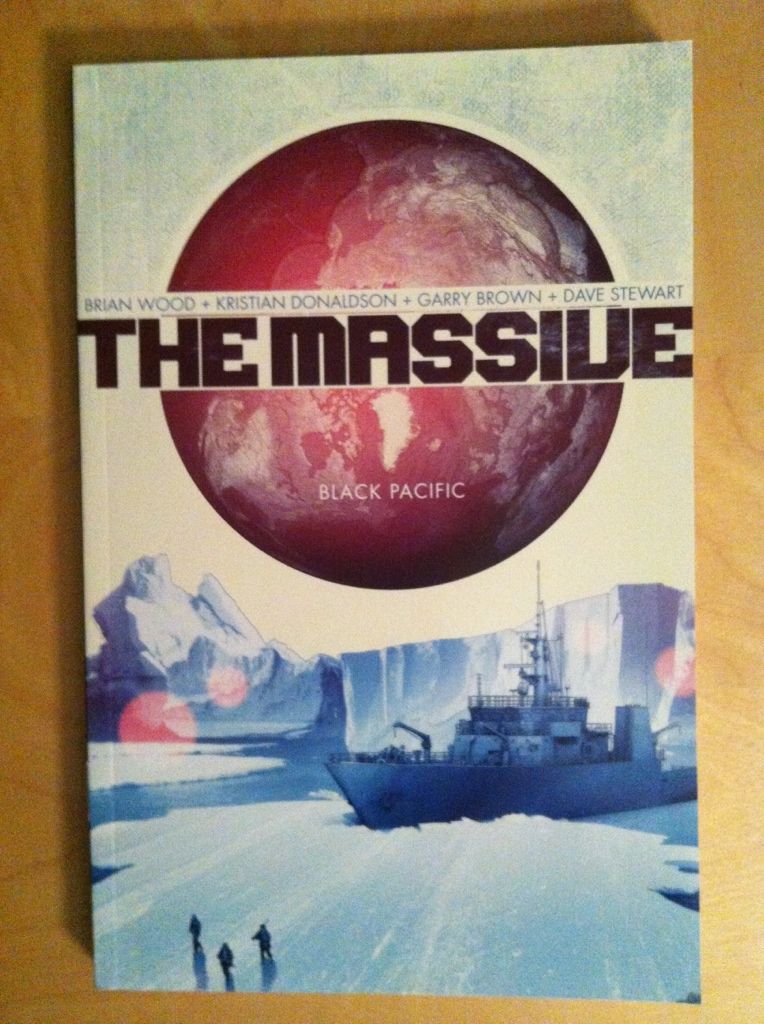
One of the problems with trying to make informed decisions is that they require, well, information. So when confronted with something really important but utterly outside our experience, we lack the context to really understand consequences and make the best decisions. And this is just compounded when the choice in question is beyond all of humanity's experience, something never seen before. Which is the value of The Massive: a comic designed to illustrate the consequences of uncontrolled Climate Change and Global Warming. Specifically, The Massive: Black Pacific tells the story of the Ninth Wave activist crew of the Kapital as they search a world decimated by ecological disaster for their sister ship The Massive. Lead by mercenary turned pacifist Callum Isreal, ex-Tamil Tiger Mag Nagendra, and the mysterious Mary, the group must negotiate their way to water, food, and fuel in a globe rapidly running out to fuel their search. The Massive: Black Pacific is an eco-thriller of worst-case scenario proportions that emphasizes just how fucked humanity is if we ruin our habitat. The comic is, fortunately, quite cerebral, laying out ghastly scenarios, but in a smart reasonable way: less “the sky is falling” hysteria and more logical, but inconvenient truths illustrated with haunting beauty and human drama. Black Pacific also does an effective job introducing us to a pretty compelling mystery likely important to the ongoing comic. The Massive: Black Pacific is a solid first chapter in what looks to be a thoughtful, exciting, and engrossing new comic.
By Brian Wood, Kristian Donaldson, Garry Brown, and Dave Stewart; Dark Horse Books
One of the problems with trying to make informed decisions is that they require, well, information. So when confronted with something really important but utterly outside our experience, we lack the context to really understand consequences and make the best decisions. And this is just compounded when the choice in question is beyond all of humanity's experience, something never seen before. Which is the value of The Massive: a comic designed to illustrate the consequences of uncontrolled Climate Change and Global Warming. Specifically, The Massive: Black Pacific tells the story of the Ninth Wave activist crew of the Kapital as they search a world decimated by ecological disaster for their sister ship The Massive. Lead by mercenary turned pacifist Callum Isreal, ex-Tamil Tiger Mag Nagendra, and the mysterious Mary, the group must negotiate their way to water, food, and fuel in a globe rapidly running out to fuel their search. The Massive: Black Pacific is an eco-thriller of worst-case scenario proportions that emphasizes just how fucked humanity is if we ruin our habitat. The comic is, fortunately, quite cerebral, laying out ghastly scenarios, but in a smart reasonable way: less “the sky is falling” hysteria and more logical, but inconvenient truths illustrated with haunting beauty and human drama. Black Pacific also does an effective job introducing us to a pretty compelling mystery likely important to the ongoing comic. The Massive: Black Pacific is a solid first chapter in what looks to be a thoughtful, exciting, and engrossing new comic.
Word
count: 249
Monday, 2 September 2013
Things I Worry About: Fashion and Corporate Identity
Or why I might just have to give up on nerd pop culture T-shirts.
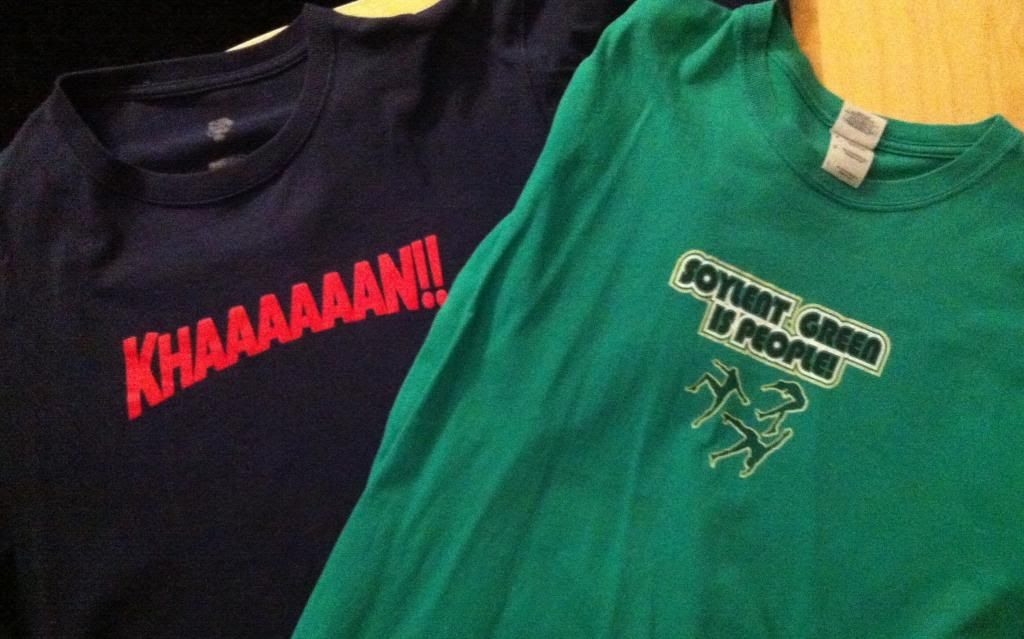
These are two of my favourite T-shirts. They are both shirts I have bought twice, replacing the original when it disintegrated from use. And one of them, I fear might have been ruined for me.
For the last decade I have pretty much lived in geeky t-shirts. I have t-shirts with references to Star Wars and Star Trek and Firefly and Soylent Green. I have shirts with the Bat-symbol, Superman's crest, and the costume of 1920s Iron Fist Orson Randall. Some of my shirts have chemical structure diagrams of common and elaborate molecules while others are amusing joke-shirts made by webcartoonists like the creators of A Softer World and Doctor McNinja and Dresden Codak. Some are just ridiculous and obtuse and I don't really understand where they come from. Basically, what I'm trying to say, is that I have a lot of nerdy Tee's that show a rainbow of my favourite things.
And I have been at this so long that these geeky T-shirts have become part of my identity, as much as the sideburns I have stubbornly kept clinging to my face since before I could really grow sideburns. People know it's my thing. Hell, my supervisor brings this up when he introduces me to lab visitors where I work. "Here's Mike, he's the lab's heart guy, and he wears a lot of geeky shirts... check that one out." Actually.
The thing is, I think I might be falling out of love with them.
Some of it is that I seem to be in the midst of a sartorial awakening where the basics of men's fashion is starting to interest me. Stylish button downs and smart sweaters and blazers just look sharp. Or maybe it is just part of me growing up; part of this weird late-twenties crisis of oldifying I'm going through where I suddenly find economics fascinating, and televised golf tournaments relaxing, and slowly sipping a good single malt a million times more rewarding than getting shitfaced at a club. Or maybe I'm just getting bored with wearing the same 30 or so t-shirts in rotation 7 days a week. I don't know.
But a part of it is that I realized that I don't own the references on these shirts and that I am visually defining myself by the property of corporations.
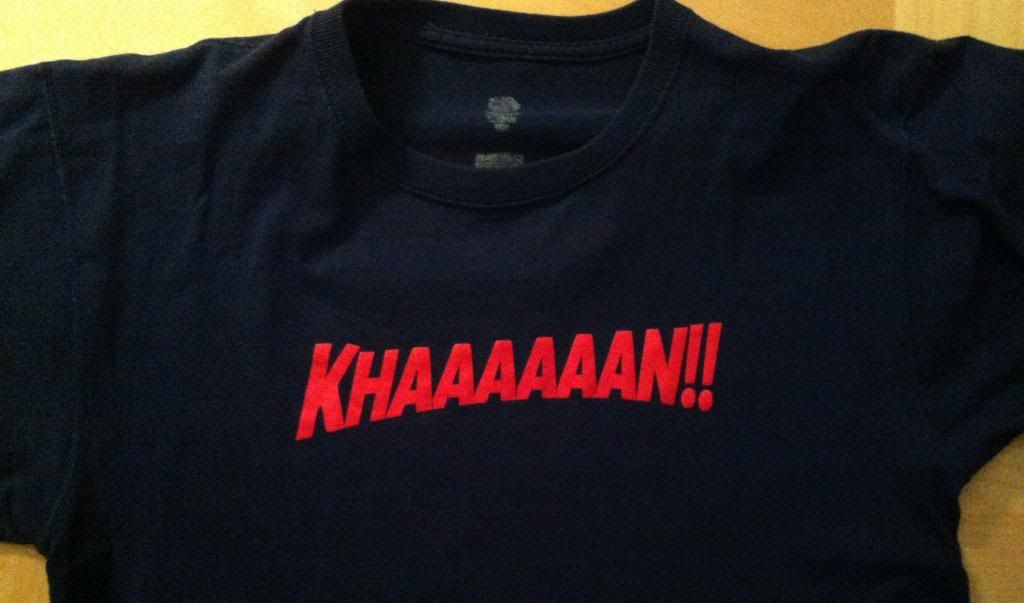
I really like this T-shirt. I'm a sucker for navy blue garments and love the simple, centralized graphic design of the KHAAAAAAN!!. The reference on this shirt is awesome, because Wrath of Khan is a goddamn masterpiece, Old Bill Shatner is a Canadian treasure, and because shouting peoples names in rage is inherently dramatic and hilarious. I even love how the shirt manages to be Star Trek reference shirt without being obvious. I mean, I'm not hiding it, but historically it has been this litmus test that separated out the Trekkers, those people who would see the shirt and then SEE the shirt and then smile and nod a little. It was like being in a private nerd club. This has probably been my favourite shirt for years.
The trouble is that KHAAAAAAN!! isn't just a reference to Wrath of Khan anymore. With the advent of the fanfictiony shitstorm of Star Trek: Into Darkness, a movie that was at once very pretty, well acted, and absolutely infuriating, the very nature of this T-shirt has changed. Now not only is it a reference to a buried alive Captain Kirk cursing his ruthless nemesis, but also nuSpock in a scene-that-is-so-clever-oh-my-god-it's-reversed-JJ-Abrams-you-are-too-smart-by-half shouting Khan because Into Darkness is so much shmaltzy-fan fiction and JJ Abrams is a fucking hack. And not only is this shirt now a reference to something that frustrates the crap out of me, but this Into Darkness reference is much more current and much more recognizable. To the general public the KHAAAAAAN!! shirt might as well be an Into Darkness tee. And this bothers me.
What it also does is hammer home the fact that we don't own the references we garb ourselves in. Star Wars belongs to Disney, Marvel comics belongs to Disney and DC comics to Time Warner. Firefly belongs to Fox and Doctor Who to the BBC. Videogames all belong to their publishers. As much as we like and even define ourselves by these properties, they are ultimately commodities that belong to huge, lumbering corporations driven by the single imperative to make money. These beloved references are going to get leveraged again and again and again and changed in ways that run contrary to why we love them and there isn't a thing we can do to stop them. And the question is, do I really want to define myself visually with something I don't really own? Do I really want to be a free walking billboard advertisement for some corporation in this emerging attention economy?
I don't know. But I worry about it.
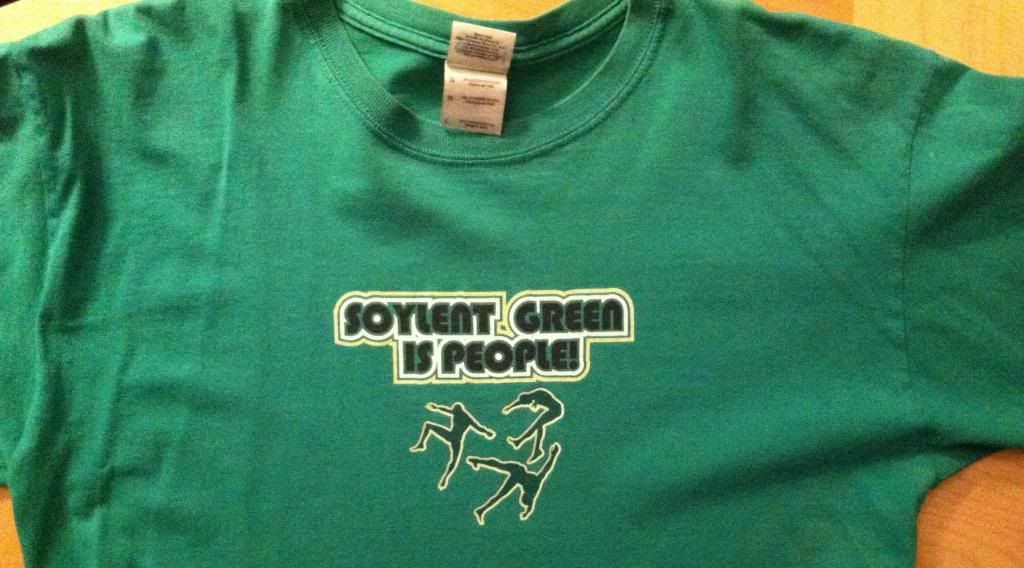
Just like I worry that whoever owns Soylent Green is about to release a remake starring Taylor Kitsch and ruin this Tshirt too.
These are two of my favourite T-shirts. They are both shirts I have bought twice, replacing the original when it disintegrated from use. And one of them, I fear might have been ruined for me.
For the last decade I have pretty much lived in geeky t-shirts. I have t-shirts with references to Star Wars and Star Trek and Firefly and Soylent Green. I have shirts with the Bat-symbol, Superman's crest, and the costume of 1920s Iron Fist Orson Randall. Some of my shirts have chemical structure diagrams of common and elaborate molecules while others are amusing joke-shirts made by webcartoonists like the creators of A Softer World and Doctor McNinja and Dresden Codak. Some are just ridiculous and obtuse and I don't really understand where they come from. Basically, what I'm trying to say, is that I have a lot of nerdy Tee's that show a rainbow of my favourite things.
And I have been at this so long that these geeky T-shirts have become part of my identity, as much as the sideburns I have stubbornly kept clinging to my face since before I could really grow sideburns. People know it's my thing. Hell, my supervisor brings this up when he introduces me to lab visitors where I work. "Here's Mike, he's the lab's heart guy, and he wears a lot of geeky shirts... check that one out." Actually.
The thing is, I think I might be falling out of love with them.
Some of it is that I seem to be in the midst of a sartorial awakening where the basics of men's fashion is starting to interest me. Stylish button downs and smart sweaters and blazers just look sharp. Or maybe it is just part of me growing up; part of this weird late-twenties crisis of oldifying I'm going through where I suddenly find economics fascinating, and televised golf tournaments relaxing, and slowly sipping a good single malt a million times more rewarding than getting shitfaced at a club. Or maybe I'm just getting bored with wearing the same 30 or so t-shirts in rotation 7 days a week. I don't know.
But a part of it is that I realized that I don't own the references on these shirts and that I am visually defining myself by the property of corporations.
I really like this T-shirt. I'm a sucker for navy blue garments and love the simple, centralized graphic design of the KHAAAAAAN!!. The reference on this shirt is awesome, because Wrath of Khan is a goddamn masterpiece, Old Bill Shatner is a Canadian treasure, and because shouting peoples names in rage is inherently dramatic and hilarious. I even love how the shirt manages to be Star Trek reference shirt without being obvious. I mean, I'm not hiding it, but historically it has been this litmus test that separated out the Trekkers, those people who would see the shirt and then SEE the shirt and then smile and nod a little. It was like being in a private nerd club. This has probably been my favourite shirt for years.
The trouble is that KHAAAAAAN!! isn't just a reference to Wrath of Khan anymore. With the advent of the fanfictiony shitstorm of Star Trek: Into Darkness, a movie that was at once very pretty, well acted, and absolutely infuriating, the very nature of this T-shirt has changed. Now not only is it a reference to a buried alive Captain Kirk cursing his ruthless nemesis, but also nuSpock in a scene-that-is-so-clever-oh-my-god-it's-reversed-JJ-Abrams-you-are-too-smart-by-half shouting Khan because Into Darkness is so much shmaltzy-fan fiction and JJ Abrams is a fucking hack. And not only is this shirt now a reference to something that frustrates the crap out of me, but this Into Darkness reference is much more current and much more recognizable. To the general public the KHAAAAAAN!! shirt might as well be an Into Darkness tee. And this bothers me.
What it also does is hammer home the fact that we don't own the references we garb ourselves in. Star Wars belongs to Disney, Marvel comics belongs to Disney and DC comics to Time Warner. Firefly belongs to Fox and Doctor Who to the BBC. Videogames all belong to their publishers. As much as we like and even define ourselves by these properties, they are ultimately commodities that belong to huge, lumbering corporations driven by the single imperative to make money. These beloved references are going to get leveraged again and again and again and changed in ways that run contrary to why we love them and there isn't a thing we can do to stop them. And the question is, do I really want to define myself visually with something I don't really own? Do I really want to be a free walking billboard advertisement for some corporation in this emerging attention economy?
I don't know. But I worry about it.
Just like I worry that whoever owns Soylent Green is about to release a remake starring Taylor Kitsch and ruin this Tshirt too.
"Soylent Green is people," he sternly murmurs, "it's people."
Previous Things I Worry About:
Sharing Media
Problematic Themes
Problematic Creators
Tradewaiting
Previous Things I Worry About:
Sharing Media
Problematic Themes
Problematic Creators
Tradewaiting
Subscribe to:
Posts (Atom)