Friday, 4 July 2014

Worshipping The Wicked + The Divine #1

Or a roundup of my favourite aspects of The Wicked + The Divine #1
by Kieron Gillen, Jamie McKelvie, Matt Wilson, and Clayton Cowles; Image Comics


You know what, I'm just going to lay this out: I am probably hugely biased here. Kieron Gillen, Jamie McKelvie, and Matt Wilson are individually three of my favourite creators, and when working together, they have made some remarkable comics. Phonogram: The Singles Club is, and I will happily show you the work, one of the best made comics I've read. It's also really accessible in a way that has a fairly ungeeky coworker actively reading comics now. Young Avengers, the last time the band got together, was one of the most interesting and experimental comics being published by mainstream publishers. Having watched this team grow and develop, collectively and apart, how could I not be excited about their newest effort?

The Wicked + The Divine #1 is the second comic I've broken my tradewait for creator owned comics rule for. It is the first comic I have actually preordered properly.

So, yeah, I am an unrequited fanboy and this is going to be shaded by that.

(I feel you Laura, I feel you.)

But, I'm also going to try and be somewhat academic about this because The Wicked + The Divine #1 is also a comic which does some interesting things and some important things that I'd like to try and parse. 

There will be *SPOILERS* for the Wicked + The Divine #1.


This is a relatively small thing, but I really love the 1-2-3-4 on these pages as layout elements. I mean, it's a really clean, great way to integrate the title of the issue into the page and helps solidify the 1-2-3-4 (and indirectly snapping) as important motifs for the issue, but its also really smart reader guiding. Two pages with the same, regular panel layouts, especially without a direct narrative sequence of events (due to time jumps) risk being read accidentally as a single double page spread instead of two discrete pages. The 1-2-3-4 functions to inform the reader that the two pages are separate and provides the correct reading order. It also, in a less direct way, helps set the feel of time passing in the event montage. It's, in the grand scheme of things, a small choice that is really effective.


One of the my favourite things about Gillen/McKelvie/Wilson joints are how they play with the idea of magic in comic books. In Young Avengers they effectively broke the rules of comics to showcase the supernatural: the idea being that comics-as-usual represent reality and things that break the conventions of this represent the impossible happening. WicDiv continues this, but in a (and this is going to sound a bit crazy in a minute) more restrained and thoughtful way. I love this panel here as an example of this in WicDiv: Luci, who is kind of Satan, is about to reveal her wicked/divine nature and make some miraculous shit happen. The lighting has changed and critically, Luci's body breaks the comic rules and becomes spot coloured as the very fabric of the comic reality is being undone by her godly powers. It's a very smart visual cue. 

I am also in love with the way Luci's black forelock, askew, resembles a devil's horn. This is the kind of tiny, smart choice that I love about this creative team.


The showcase act of divine magic in WicDiv #1 are the exploding of heads. Again we see the rules of comics break down, replacing the modern colouring of the main narrative with a boiling cauldron of popart excess. Again we see spot colouring, a white background, and a colour scheme straight out of a Roy Lichtenstein explosion. (And, I strongly suspect some very cool 3D effects on the last head-plosion [right], although I lack the necessary spectacles to test this.) This is a visually impressive representation of magic. 

It's also so fucking thematically perfect it makes me spin. Luci the David Bowie-esque literal Devil makes people's heads explode in popart. 

Just chew on that for a bit.


All of that aside, I think the most important thing Team WicDiv accomplished in their first issue, even more than establishing the premise, is making Luci charismatic. For this series to work, especially given the cliffhanger, we, like Laura, have to BELIEVE in Luci. And for that to work Luci has to be everything we want in a cool, sexy, smooth Lucifer. We have to be convinced, seduced, and terrified. We must feel Sympathy For The Devil and be scared shitless by Satan. And The Wicked + The Divine fucking nails it.

And they do it with the perfect balance of character design, facial acting, and dialogue. For what it has to be, it's perfect.

I love Luci.

(I totally think she's lying.)


Wednesday, 2 July 2014

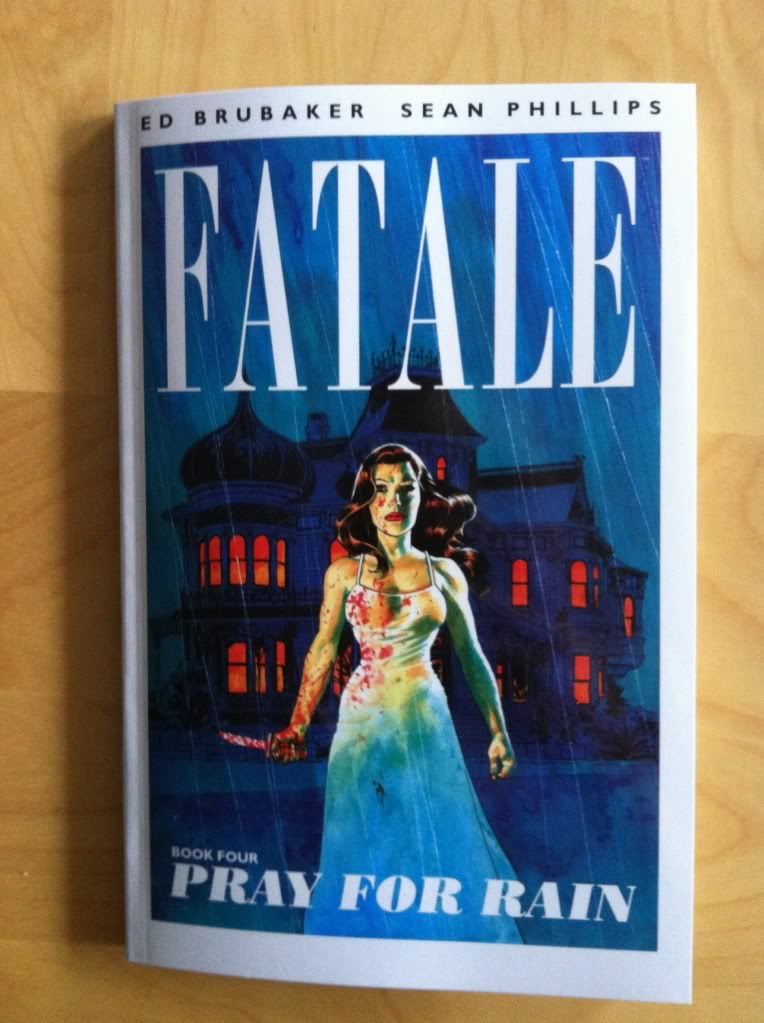
So I Read Fatale: Pray For Rain

A 250 word (or less) review of Fatale: Volume 4
by Ed Brubaker, Sean Philips, and Elizabeth Breitweiser; Image Comics


Fatale: Pray for Rain continues the story of Jo, an immortal woman cursed to be the literal femme fatale with the power to control and captivate the men around her at the cost of driving them to madness and ruin. The current chapter primarily focuses on her life in the 1990s when an accident leaves her without her memory and sends her crashing into the wreckage of a Seattle Grunge band in the aftermath of Cobain's suicide. What's cool about Pray for Rain is just how alive it feels: as great as the other chapters of Fatale have been, they've felt like well-crafted stories, while this chapter feels like an anecdote of personal history. It’s easily my favourite chapter in the series so far. Pray for Rain also makes apparent that Fatale, as much as it plays with the idea of the femme fatale as a character archtype in a variety of settings, is also playing with the different genre/types of horror in period appropriate ways. Previous chapters have seen Jo tossed into a 1930s monster horror, 1950s lovecraftian horror, and a 1970s cult/Helter-Skelter horror, while Jo-like characters also appear in a medieval fearsome fairytale and a scary American western yarn. This chapter sees Jo right in the middle of a 90s slasher film in the very 90s milieu of urban Seattle. Fatale: Pray for Rain really cements for me what a smart, engaging comic the series is and why everyone really should be reading it.


Monday, 30 June 2014

Marvelling at Captain Marvel #4

Or a look at how the band brings the band together with panache in Captain Marvel #4
by Kelly Sue DeConnick, David Lopez, Lee Loughridge, and Joe Caramagna; Marvel Comics


Captain Marvel has been one of the most consistent mainstream comics in my top ten. I'm always looking forward to the next issue and once I get it, it's often one of the first in my stack I read. It is easily one my favourite comics.

But it's a little hard to express exactly why. 

Captain Marvel is a fairly straight forward superhero comic: Carol Danvers, aka, Captain Marvel, fights villains and does inspiring heroic things. Team Captain Marvel have done a great job presenting interesting wrinkles and challenges to keep the superheroing interesting, but the comic isn't doing nifty things with genre like many of the other comics I'm currently reading. Similarly, Team CM, while great storytellers, also aren't really experimenting with the medium of comics in the way most of my other favourite books are. So it's a little hard for me to pin down exactly what it is about Captain Marvel that makes it stand out in a field of genre-bending, medium-experimenting comics.

Captain Marvel #4 might be the explanation I've been looking for.

There will be *SPOILERS* for Captain Marvel #4 in this post.


Captain Marvel #4 is, at first glance, a business story. It fleshes out the premise of the current storyline, introduces and solidifies the new supporting cast, and advances the plot to the point where the comic can begin telling the meat of the story. In most collections, this would be a down chapter, a necessary block of logistics for later chapters. This should be a forgettable chapter of comics.

But Captain Marvel #4 might be one of the best comics I've read in a while.

The crux of what makes Captain Marvel #4 a memorable comic for me is all about craft and collaboration. While the issue might not have the wildest plot, every single aspect of this comic is pitch perfect and allows the story to function brilliantly. This a fantastic example of a creative team firing on all cylinders.


David Lopez, the current main penciller on Captain Marvel is a solid storyteller and a fantastic acting artist. His characters emote dramatically, and just beam feelings off the page. A lot of this, I think, is that his characters are juuusssstt a little exaggerated in their expressions and gestures, and this really helps each snapshot convey optimal emotion. (This approach to acting makes me really wonder if Lopez has a background in animation.) Lopez's excellent character work helps make every character exchange pop, and makes everyone depicted in the comic feel unique and alive. It's great stuff.


Kelly Sue DeConnick, the writer in Team CM, is a wizard at dialogue. There is a certain brisk snappy rhythm to the words that is just... for lack of a better way to express it, fun. DeConnick writes really engaging characters. And, in a way that is really important for this issue, she gives each of her characters a unique voice which, when coupled with Lopez's excellent acting, allows each character to come into their own really quickly. 


Lee Loughridge, the colourist in Team CM, pulls off a quietly great issue of comics. Captain Marvel #4 has a wide variety of settings which are swapped pretty rapidly. Loughridge does a fantastic job using different colours and shadow work to help distinguish these settings and keep them all straight. My favourite examples from this issue are his treatment of the various planets in the comic: from the sickly-yellow suffused lighting of Torfa, to the flat gey and harsh lighting of Ursor 2, to the warm, soft glowing orange of the Maniaciano Outpost of Ursor 4. Beyond keeping these settings distinct, it gives every planet it's own feel (Miasmic Torfa, post-apocolypticky Ursor 2, and gritty port-esque Maniaciano). It's a small, background portion of the comic, but it really makes everything clearer throughout the issue.


<PAGE TURN!>


When all of these collaborators and their individual elements come together, there are these great sequences in Captain Marvel #4. Like this sequence here: a great joke series with a pretty good 1-2-3 gag strip, and then an even better surprise punchline (ha!) after the page turn. It's great comedic timing, but more than that, fantastic sequential storytelling that displays the strengths of Team CM. 


The cohesive work of Team CM also does a fantastic job establishing all of the characters in the current cast of Captain Marvel. This issue really highlights the traits of the alien cast and solidifies the voice of each team member as the story moves forward. We see Carol being earnest and headstrong, Tic being clever and common sensed, Gil being strong and angry and maybe not terribly thoughtful, Bee clowning around, and Jackie swash-buckling and generally being the best person ever. And we also see how all of these characters fit together: the gluey regard they all hold for Tic, the abrasive friction between Carol and Gil and the sparks of new friendship maybe developing between Jackie and Carol. Captain Marvel #4 with a great deal of quiet skill manages to take a group of new strangers and make them a team that we as readers understand. I think that's a pretty solid accomplishment.


Another aspect I really like about Captain Marvel #4, and the series as a whole, is how the story and its structure fit into the broader themes of the series. Beyond general heroism and smashing vaguely patriarchal figures (which you could argue this issue is building too with the Spartax Emperor), I feel like Captain Marvel has been about finding and building communities and picking yourself back up after failures. And I think Captain Marvel #4 speaks brilliantly to both of these themes. This issue shows Captain Marvel finding and building a new team, in a new community playing into the comics motif of finding your people. Meanwhile the structure of Captain Marvel #4 has Carol dropped into a new scenario she is ill-equipped to deal with, building a team, picking herself back up and trying again to address the problem in a new way. 

And this is why I think so highly of Captain Marvel: even a down issue of character development and plot logistics is a pretty fantastic study in authorial collaboration and technical skill. This series is, in a way that I think is under-appreciated, quietly great comics.

Previously
Marvelling at Captain Marvel #3: When joke and story telling collide

Marvelling at Captain Marvel 17: A meta-fandom salute
Marvelling at Captain Marvel 15-16: On tie ins
Marvelling At Captain Marvel #13-14: On The Enemy Within
Marvelling At Captain Marvel #12: Demarcating reality and fantasy
Marvelling At Captain Marvel #10: A dramatic contract
Marvelling At Captain Marvel #9: How your brain tells time
Marvelling At Captain Marvel #7: Saving a reporter in distress... AND ITS A MAN!
Marvelling At Captain Marvel #1: An alternate reading order that I liked more

Friday, 27 June 2014

Deep Sequencing: Multiplex Warheads

Or a look at the crowded, populated aesthetic of Multiple Warheads,
by Brandon Graham


One of my favourite pieces of culture as a kid were the Where's Waldo books. Not so much for the finding Waldo, because frankly, I sucked at finding that striped toque wearing tourist, but because these books provided teeming worlds to visit. Waldo and his narrative (such as it is) was just a tiny facet of these grand, chaotic environments full of a million other stories, from battling samurai to space aliens. And so the Waldo books ended up being more about all the cool or silly little side stories taking place in these awesome, riotous, packed environments than any quest for Waldo. Basically, I loved the books for their roles as gateways to worlds of stories than the books' central conceit.

(Also, speaking of Waldo, did anyone else see the guy cosplaying him during, I think, the Ivory Coast  -vs- Japan game?)

Anyway, I bring all of this up because Multiple Warheads has that same magic. It's central narratives of Sexica and Nikoli going on a roadtrip vacation and Nura the organ hunter on the trail of god organs take place in this amazing world filled with all kinds of bizarre, silly, and cool discursions and embellishments. Like my beloved childhood Waldo books, Multiple Warheads is a gateway to a world populated with hordes of fun characters and brimming with minutely detailed environments. And, like Waldo, I enjoyed the comic as much for the fun world it creates as the actual narrative.

There will be mild *SPOILERS* for Multiple Warheads below.


This double page spread here really encapsulates the big crazy world building of Multiple Warheads. This spread takes place during the Nura narrative, of the organ hunter searching for some particularly potent organs. Nura and her ally, the Coat-of-Arms guy have tracked Ian Marx, a person of interest in their organ hunt, to a small island community perched on the back of a flying whale. Once there the two hunters discover a summit of many clone (?) versions of Ian Marx (the Marx men) before being waylaid by sky pirate organ hunters, The Puzzlemen (who swap hearts with one another). This page captures the heat of the raid of The Puzzlemen on the floating whale village. And it is exactly why I think Multiple Warheads is such a great comic.

It is also just a really technically great spread of comics. These pages are absolutely loaded with environmental detail, 6 simultaneous narrative streams, and a handful of fun peripheral characters and details. And yet, for all this business, this double page spread is immanently readable and balanced. And how it's pulled off is worth taking a closer look at. 


Stacked across the top of the spread are smaller panels that depict the protagonist's stories. Starting on the top left IN RED we have Nura fighting a Puzzlemen with a dialogue-box like pointer-arm showing where the action takes place in the larger environment. This way we get to see what's up with Nua but also how she fits into the larger world of the raid. Next to those panels,  IN BLUE, are panels depicting the naked Coat-of-Arms (fresh from an interrupted bath) acrobatically fighting more Puzzlemen right above the area where the action takes place. What's cool about this sequence is that the Coat-of-Arms action sequentially starts in the panels and ends in the larger environmental drawing. Like the background is the third panel in the story. 


And then we have IN GREEN the panels depicting Nura's loyal motorcycle hearing the whistle (which we've already seen in the RED Nura panels) and springing to action to help her. We then work out way back and see IN YELLOW the Cyst Ant assistant of Coat-of-Arms guy carrying garments and fleeing from a marauding Puzzleman.


We then work our way down to the bottom of the spread and see IN TEAL the Bored to Death burrowing rodent torpedos of the Puzzlemen digging their way into the flesh of the flying whale to reach its sensitive internal organs. Below that we have panels IN PURPLE that take place in the nerve centre of the whale where the denizens of the village are able to pilot the flying whale. These two narratives come together right before an explosion that is depicted on the following page.


And because Multiple Warheads is a comic depicting a cluttered world rather than just a focussed narrative, there are all over the periphery of the page IN ORANGE extra people and call outs which help increase the scope of the page.

So there you have it, a big chaotic world delivered in a really clear and interesting double page spread. You really ought to check out Multiple Warheads and visit its crazy world yourself.

Wednesday, 25 June 2014

So I Read Multiple Warheads

Or a 250 Word of The Complete Multiple Warheads (Vol. 1)
by Brandon Graham; Image Comics


Multiple Warheads is a pretty hard comic to categorize. For one, the series started out as a porn comic in which organ smuggler Sexica sews a werewolf penis (which she smuggled in her butt) onto her boyfriend Nikoli with sexy diphalic results. The series was then re-imagined as a kind of Science Fantasy love story/travelogue set in a bizarre post apocalyptic Russia that sees Sexica and Nikoli go on a travelling vacation across futuristic wastelands. There is also a so far unrelated story about a badass motorcycle bounty hunter tracking a bizarre godling filled with valuable organs across the same decimated landscape. Multiple Warheads is, as you might imagine, not a very plot driven comic. What is beyond imagining, and what is the real draw of the comic, is the art: Brandon Graham's wasted Russia is this mad, ornate place just littered with detail and weird little people and places and things. And so, so many puns. It's a comic that is beautiful in this really unusual, unique way that manages to pull off this cool, goofy vibe that is a lot of fun to read. Multiple Warheads, is as much as anything, a really cool looking comic made by a great artist just having fun with the page in a way that really shines through. I am not entirely sure what Multiple Warheads is exactly, but I know that I like it and that its different enough that you ought to check it out for yourself.


Word count: 247

Previously:

Monday, 23 June 2014

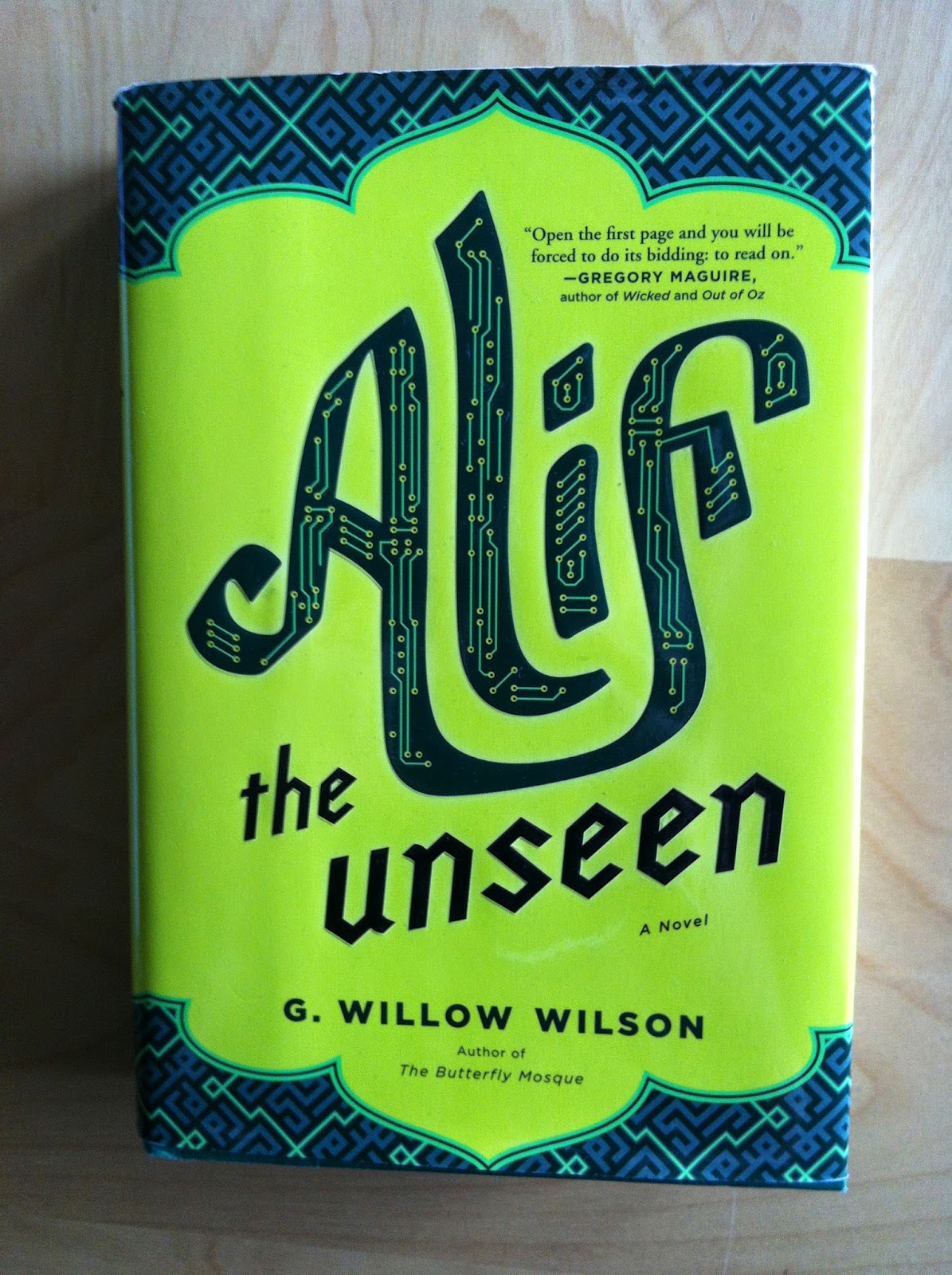
Alif The Unseen Is A Good Book

Or why you should read Alif The Unseen by G Willow Wilson


Alif The Unseen is a modern fantasy novel set somewhere in the United Arab Emirates. It focuses on Alif, a young hacker with a chip on his shoulder and a problem with authority, who provides internet security for dissidents of repressive Middle Eastern regimes. Alif is also a young man madly in love with Intisar, the beautiful daughter of a wealthy family, who, due to social constraints, spurns Alif. In response Alif writes a program with the terrible potential to identify and track dissident bloggers and inadvertently delivers it to The Hand, his nemesis and chief State censor. Fearing for his freedom Alif flees, dragging along his neighbour Dina, on a path that will bring him an enigmatic book of secrets and launch him into the mythical, unseen world of supernatural beings of the Quran. 

Alif The Unseen is very much a novel interested in the tension between colliding, supposedly conflicting forces. The overall story is driven on the friction between the mundane world of the empirically minded hacker and the fantastic world of Arabian myth, while the plot pits a very timeless tale of the clever outsider courting the beautiful princess and falling afoul of a corrupt vizier against the very now story of the Arab Spring, of technologically empowered revolutionaries fighting against corrupt regimes. Alif The Unseen examines the tension between modernism and tradition, secularism and faith, technology and imagination, examining each in a really nuanced way that seeks to reconcile, or perhaps strike a balance between opposing cultural forces. And I think this core element of Alif The Unseen is the Universal in the novel: everyone has to contend with these kinds of cultural paradoxes and negotiate some form of position on them. I mean, Alif The Unseen is a properly exciting novel filled with suspense and discovery, romance and adventure, but it's this tight wound kernel of thematic conflict that made this novel so wonderfully compelling for me.

Alif The Unseen also does that wonderful thing where books, particularly Science Fiction and Fantasy, can act as empathy translators. Every Sci-fi and Fantasy novel acts as portal to foreign world, and every author, particularly of these genres, acts as a kind of broker between the fictional world and the reader. As such, the novelist functions to translate their fictional world and contextualize it through understanding the world they create and the sort of information the reader wants to know. They live in both worlds. Part of the magic of Alif The Unseen is that, for a Western audience, it acts as a portal to the fictional world of the unseen supernatural, but also to the very real world of a tech savvy young man living in the Arab world. G Willow Wilson, an American student of Islam who lived in Egypt, is a tremendous story broker able to contextualize and translate for a Western reader not only the mythical but also a certain snapshot of Arab society. As a result, Alif The Unseen, in a really matter-of-fact way, explains the realities of living in an Emirate while still highlighting the ultimate universal humanity of its characters. Alif essentially wants the same things as me, and for all of his flaws, I want to see him succeed and be happy and find love (no spoilers, but I 'shipped some characters so hard in this book). And the empathy this novel generates goes a long way to making something foreign into something real and relatable. It's fantastic stuff.

(And this is kind of an ongoing aside, but Alif The Unseen is also, for me, a great example of why you should read novels that aren't by bookish/geeky-straight-white-dudes sometimes. While it's not impossible that a white-dude author could write this book, I feel like this novel is so particular to the experience of Wilson that it's hard to imagine anyone else writing Alif The Unseen or doing it with the same nuance and insight. Experiencing non-default perspectives, beyond being morally good, can lead to some really interesting, unexpected places.)

Alif The Unseen is a very easy novel to recommend. The story is compelling and exciting, the mysteries are fantastic, and the thematic discussions are engaging. It's a properly good book that I think a pretty wide group of people could deeply enjoy. The only caveat on a truly universal recommendation is that the novel features a fair amount of computer jargon and plot. I fear that some people, particularly older readers, may struggle to relate to a large aspect of the book. That said, my computer literacy is pretty basic and I had no trouble following the novel, so I think if you have a general, basic understanding of information technology you should be fine. So yeah, I'd recommend this book to anyone and everyone who knows the basics of how the internet works.

Friday, 20 June 2014

Deep Sequencing: Plotting the plotless

Or a plot map of Nextwave: Agents of H.A.T.E.
by Warren Ellis, Stuart Immonen, and Dave McCaig, Marvel Comics


Nextwave: Agents of H.A.T.E. is a revolutionary comic that surgically excises unneeded baggage like plot and characterization and amps up everything left to make the quintessential superhero comic experience. I thought it would be an interesting experiment to try to make plotmaps for Nextwave to try and find what kind of plot remains in a deliberately plotless comic. And this is what I got.

Since this is a plotmap it is basically made out of *SPOILERS*. Be wary.

(Incidentally, if you want a high resolution Nextwave style swears skulls for your comics dialogue .ai or .png file, drop me a line!)
Previously:
Nextwave: Agents of H.A.T.E.