Friday, 30 November 2012

Weekend Warriors and Trade Waiters

Or on the fundamental difference between tradepaper backs and comics singles.
"Do you prefer to read collections or do you want to dive right into the culture and try singles?  (No judgement — however you want to read is great.  I think there’s something really fun about the weekly countdown to Wednesday, but it’s also not as convenient as picking up a collection — which we call “trades” or “tpbs.” The latter stands for Trade Paperbacks.) 
Is X-Men your thing?  If so, that sounds like a good place to start, though I’ll be honest and confess I haven’t read those books so I can’t really make a personal recommendation. 
You know there happens to have been a brand new X-Men #1 out last week?  You really couldn’t have picked a better time to get started.   
I’m posting this as a screen cap to make it rebloggable so that others can offer their suggestions too.
I will also be SUPER biased and throw out there that AVENGERS ASSEMBLE #9 and CAPTAIN MARVEL #7 both came out in the last week and are good jumping on points.   
What say you, folks?" 

This quote by Kelly Sue DeConnick (or at least from her Tumblr... accreditation is hard with that service, eh?) got me thinking about the relationship between comics singles and collected editions.

I've come to the conclusion that the two are fundamentally different experiences.

For some context, I've recently changed my reading practices from that of the consummate Weekly Warrior, buying largely single comics and the occasional trade, to a Tradewaiter who buys a limited number for singles and mostly collected format books. Which, I guess makes me a hybrid comic buyer. As a result, I've had a bit of experience on how different these two kinds of comics consumption habits are.


The first (and I would argue fundamental) difference between the two is temporality.

Single comics are temporal. They are happening NOW: made fairly recently by the creative team, are part of an ongoing work stream, and brought to market on a universal release date. And then a few weeks later the next new issue drops with the next episodic story allotment for everyone to enjoy all at once. And then the next. Each current issue becoming THE issue for a brief glorious moment. And, since these comics are being released as future issues are being made, they can effectively influence the creative teams descisions about future issues. I guess what I'm trying to say is that single issues are kind of living things that can be influenced be events because they are subject to time.

Trade paperbacks, in contrast, are atemporal. These are completed stories (or portions of stories) that are preserved and reformatted. In some ways these completed stories have become like Jurassic Park mosquitos: fixed in amber and able to convey their magical dinosaur DNA of story, art, and imagination regardless of when you discover them. While they certainly show the period of their manufacture, the story itself is timeless. Shakespeare's Hamlet is still true today, and so is George Orwell's 1984, and so is Alan Moore's The Watchmen or Brian K Vaughan's Y the Last Man. As long as a trade is in print, the story is as it has always been.

The second key difference is, as alluded to in the quote, that of communal versus personal enjoyment. Single comics are a group experience. I go and buy the newest issue of Hawkeye on the same day everyone else goes and buys the newest issue of Hawkeye,and then we all read Hawkeye at about the same time, and then we discuss (gush) about Hawkeye with each other on the Internet. Some fans even respond by making things (which is awesome). Creators make themselves accessible and interact with fans and in some cases foster online communities around their creations where we can all geek out together. I can't think of an experience quite like it: I can't think of any other episodic fiction with quite the insular and vocal fan base. This communal enjoyment is definitely part of what makes comics so special.


Graphic novels, due to their atemporal nature, are much more individual repasts. I think they provide a better reading experience: I'm currently reading all of DMZ (Brian Wood, Ricardo Burchielli, et al.; 2005-2012) and the Locas omnibuses of Love and Rockets (Jaime Hernandez; 1981-2010) and the ability to get large or complete stories and see how they evolve and fit together (without relying on memory) is pretty great. While I am sure other people are also currently reading both these great collections, it's a much smaller subset of the comics community than is reading a new issue of Hawkeye or Batman. Furthermore, while there are older threads and essays, there are fewer people discussing these works in the present compared to things currently being made. Thus ones enjoyment of collected comics lacks that certain community element that buying Wednesday comics has.

Actually in some ways trade waiting on currently being made comics is almost an antisocial enterprise. Take Brian K Vaughan and Fiona StapleSs saga: it came out for nearly a year before I got to read the first trade. A year that I spent actively avoiding every interview, fan reaction, and communal enjoyment of the book for fear of spoilers. So I guess in some ways reading collections isn't just an inherently solitary procedure, but is also an act of taking oneself out of the community.


Personally, I enjoy both formats immensely and I think they each have their place in an ideal comic reading habit. For instance, with my hybrid reading style, I get to enjoy the on-going nature of my mainstream superhero comics and the broader comics community surrounding them while simultaneously getting that richer, more complete reading experience present in trade paperbacks. And really, at the end of the day, I feel this gives me the best of both worlds.

Wednesday, 28 November 2012

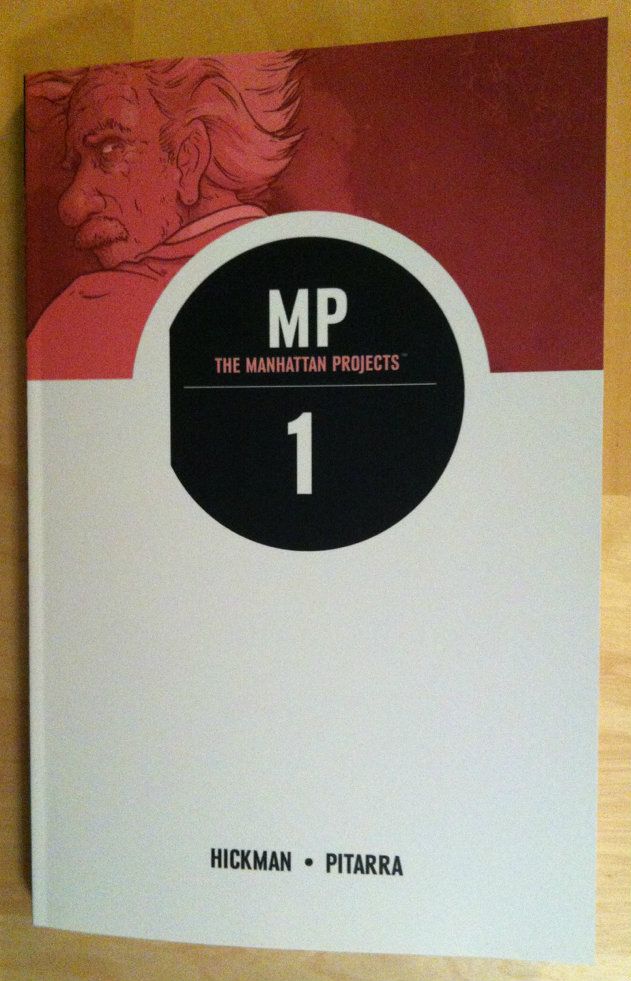
So I Read The Manhattan Projects: Volume 1


A 250 word (or less) review of the first volume of The Manhattan Projects.
By Jonathan Hickman and Nick Pitarra, Image Comics


There is nothing in comics, or fiction in general, that aggravates me as much as the trope that scientists are amoral misanthropes who only care about advancing their Science without regard to consequences or ethics. It’s lazy, played out, and untrue.1 I’m pretty sick of it. The Manhattan Projects: Volume 1 is the first collected edition of an ongoing series about amoral misanthrope scientists using the development of the atomic bomb as a cover story for a kaleidoscope of Mad Science. The comic sees beloved real life scientists, such as Feynman, Einstein, and Oppenheimer, portrayed as villains driven to do terrible things in the name of Science. So The Manhattan Projects is basically a perfect storm of my most hated comic stereotype taken to the extreme. The thing is I kind of LOVE IT. A lot of this can be chalked up to execution: this book is awesome! Hickman’s script is smart, warped, funny, and deranged and Pitarra’s artwork is chaotic and detailed and expressive and vaguely... wrong. I think Volume 1 is also helped by being somewhat tongue-in-cheek. Despite having gravitas and some profoundly heavy and dramatic moments, the book is very transparent about being an exaggerated work of fiction. I also really appreciate that the book doesn’t get bogged down trying to logically rationalize its Mad Science because, honestly, that would just be distracting and ancillary to the story. Despite myself, The Manhattan Projects: Volume 1 is a Mad Science exploitation comic I can heartily recommend.

Word count: 248

1: Full disclosure: I am a Scientist by profession. Also: I own both Feynman autobiographies.


Previously:
So I Read The Nightly News
So I Read The Red Wing
So I Read Transhumanism
So I Read Pax Romana

Monday, 26 November 2012

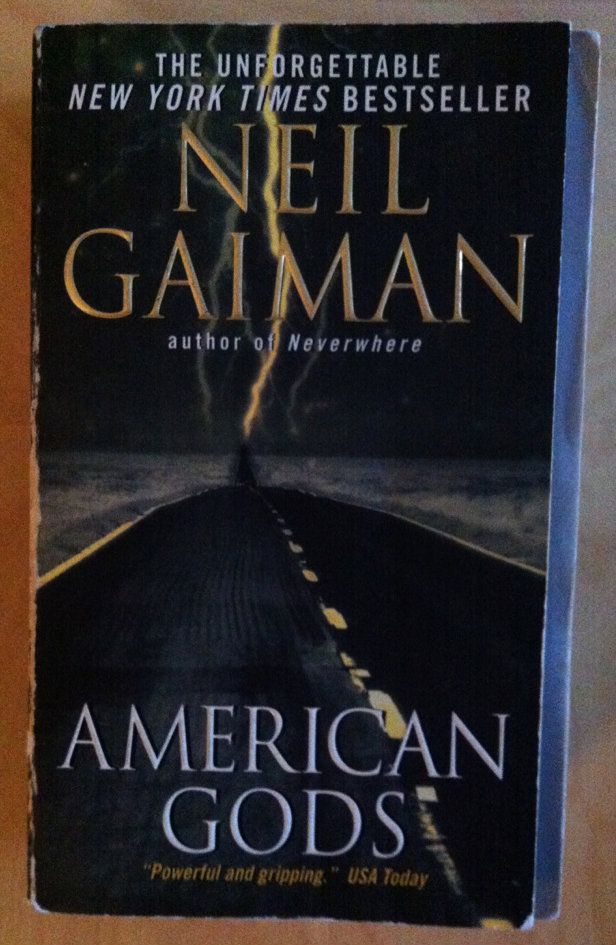
Neil Gaiman's American Gods Novels are Good Books.

Or why you should read American Gods and the Anansi Boys by Neil Gaiman

Neil Gaiman is something else. I haven't quite decided whether he is a highly talented flesh and blood man or  some kind of mythical spirit storytelling character from one of his stories. Regardless, dude has written some influential and important comics as well as some pretty great novels.

These are two of my favourite.

American Gods


In this novel Shadow, a freshly paroled convict with a dead wife, finds himself hired by an enigmatic Mr. Wednesday.Through this association Shadow gets embroiled in a conflict for the spiritual heart of america between the old gods, those belief driven entities dragged to the new world from the old, and the new gods, the technicolor electric deities invented by modern America. American Gods is a novel about belief and about stories and about the struggle between tradition and invention. It's a story old as time and as new as tomorrow and it is superbly written. It's also very Gaiman-y: beautiful and funny and empathetic but also melancholy and dark in that I'm-very-creative-and-deep-like-that way. I'd genuinely recommend this book to anyone.

The Anansi Boys.


This novel spins out of American Gods and tells the story of Fat Charlie Nancy, the son of the old god Compe Anansi, the spider/storyteller/trickster god. The novel is mostly about what happens to Fat Charlie when he invites his Demi-god brother he never knew he had for a visit. Will Fat Charlie escape with his engagement, employment, and freedom intact or will he just straight up die of embarrassment? The Anansi Boys is a novel about stories and, specifically, how these narratives shape family identity. It's sumptuously written, an absolute meal of distinct and gorgeous prose. It's bombastic and hilarious and fun, but also creepy and suspenseful but no where near as serious and, well, gothy as American Gods. It's my favourite of these two very good novels and everyone should definitely give this one a try.

Friday, 23 November 2012

Atoll Comics Round 4


Or Changes to My Top-Ten Comics

Due to poverty and an urge to buy better comics, I have decided to be super-selective about which superhero comics I read. Harnessing the Awesome Power of Maths, I have determined that I can afford to read 10 ongoing titles. So I get to read 10, and only 10, titles published by either Marvel or DC as well as one trade paperback a week of my choosing.

A complication of this is that I am forced to drop an on-going title if I want to try reading a new on-going title, an act of very tough love. Being financially responsible is the worst.

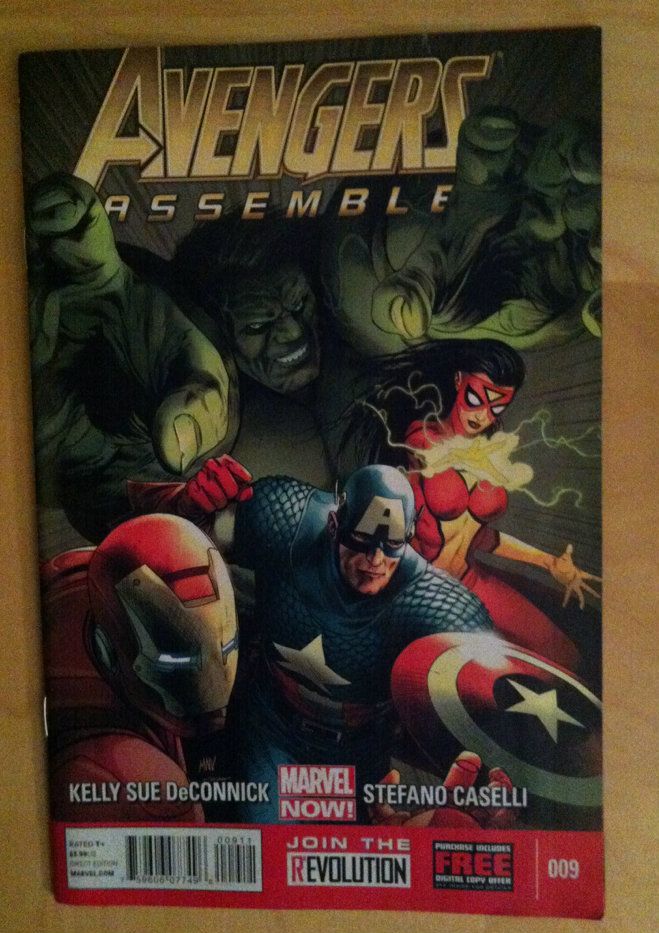
I will be adding Avengers Assemble to my ten comic list and dropping The Invincible Ironman.

Why Avengers Assemble?


From what I've been given to understand Avengers Assemble is meant to be an accessible (particularly for Avengers movie watchers) and lighter book with a rotating cast of Avengers. Part of the premise, I think, is that different teams are made depending on the parameters of their missions and then action occurs. So you know, not the typical comic I'd want to read. The only reason I find such a casual comics premise attractive is based purely on execution, which in turn is based on the creative team of Kelly Sue DeConnick and Stefano Caselli. The Internet has taught me that DeConnick has a character first approach to writing and this strength really shines through in an ensemble. (Which is great because many team books suffer from poorly defined, mono-voiced characters.) DeConnick actually writes her first issue (AA9) almost like a superhero sitcom (which I would watch the hell out of) and bases her team around a friendlt bet which is kind of brilliant. Caselli is, for lack of anything more substantiative to say, a very talented artist with his own distinct style. The man can draw a mean action sequence but can also pull off the "acting" required by DeConnick's script. These two creators seem to be clicking, and if Avengers Assemble #9 is any indication, they seem to be creating a pretty much perfect comic book.

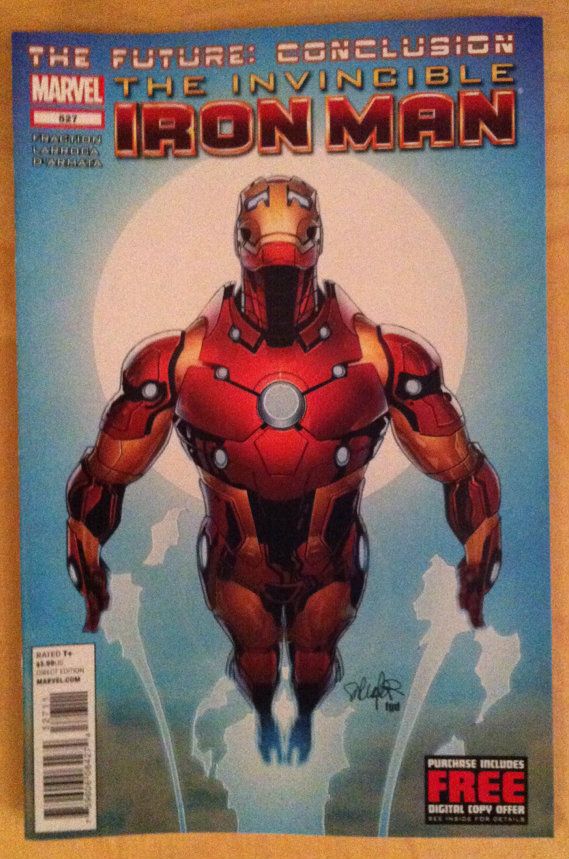
Why not The Invincible Ironman?


The Invincible Ironman was a great comic by Matt Fraction and Salvador Larroca. Fraction writes a perfect Tony Stark and confronts him with flawlessly derived challenges while Larroca draws the hell out of robotic things. The run of these two creators (who did the entire uninterrupted run) will stand, at least to me, as the definitive take on Ironman. Sadly, all good things must end and this title has been cancelled upon the altar of Marvel NOW. So I can't be reading it anymore.

(I think i'll be giving the new Ironman title a skip. I love Kieron Gillen and think he will write the hell out of Tony (if only based on David kohl and Emily Aster of Phonogram), but Greg Land is not one of the artists whose work I'm interested in if I'm only going to read ten comics.)

Wednesday, 21 November 2012

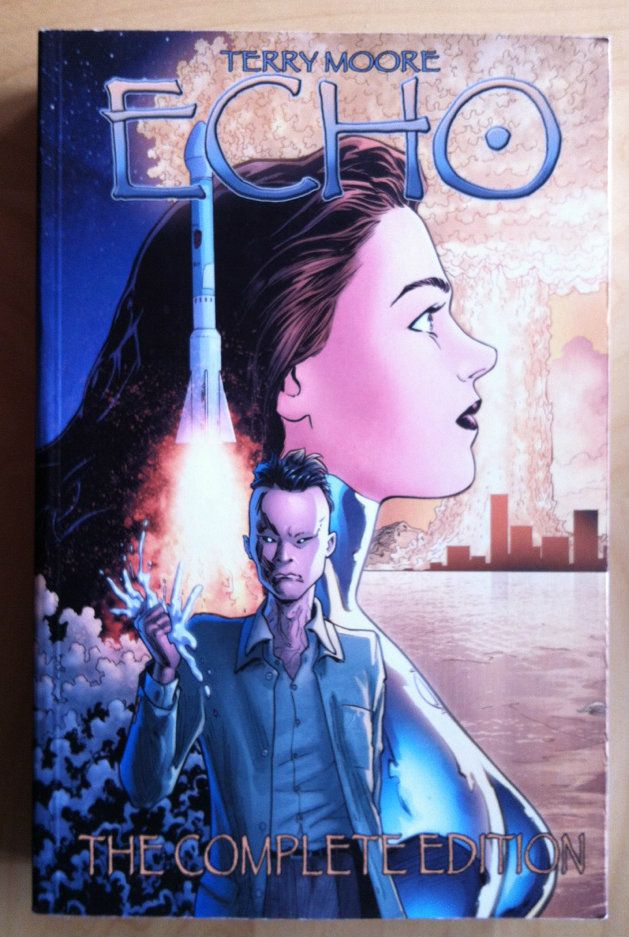
So I Read Echo


Or a 250 word (or less) review of Echo the complete series
By Terry Moore, IDW Publishing


Echo is an enjoyable and kind of kooky Superhero genre comic book series. The plot revolves around the Phi alloy: a Science Fantasy magguffin substance that is both a potently radioactive material and a liquid
metal supersuit armour thing. In Echo nefarious government scientists kill a test pilot wearing said Phi armour which exposes a struggling young photographer named Julie to its fallout. Julie becomes bonded to the Phi alloy armour, gets superpowers from the metal, and has super-adventures fighting nefarious government agents, apocalyptic conspiracies and biblical villains. As a straightforward popcorn action comic there is a lot to like about Echo: the story is fun and full of zany characters and plot beats and the artwork is delightful and expressive. It's a well made comic. But, to be honest, it does have its problems too. The protagonist basically has
magic breasts for a long while which was a bit gratuitous and one of the villains was VERY yellow peril-esque. Also the science (oh the science!) was just flagrantly wrong. Which would have been fine if the story didn't insist on laboriously describing the "logic" of the story with absolute nonsense for whole chapters, but as it stands was hugely distracting. Also I HATE the plot beat that scientists don't care about ethics or society… l find it lazy, stupid, and personally insulting. But if you’re willing to grit your way through horrible Quasi- science lectures, there is a really fun superhero comic to be enjoyed here.

Word count: 247

Monday, 19 November 2012

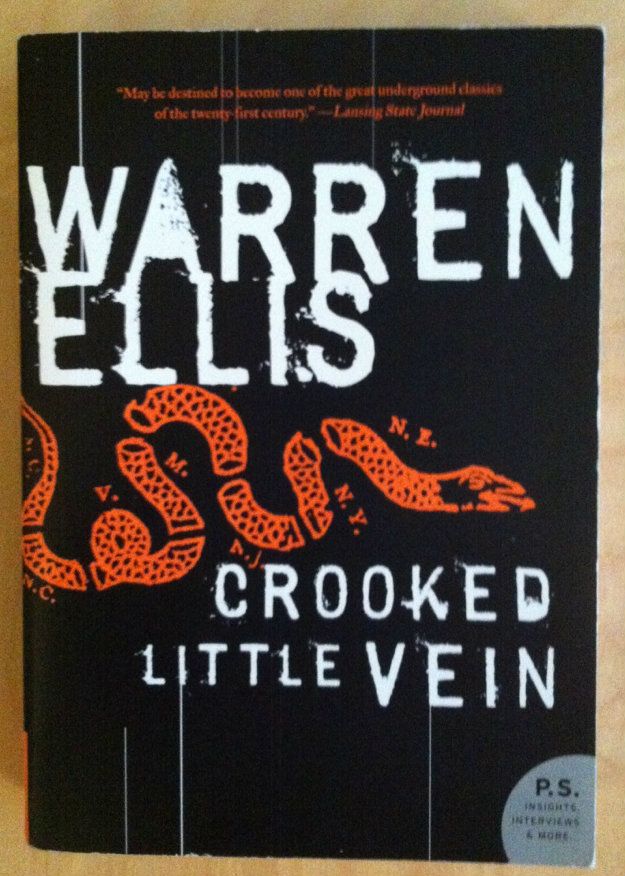
Crooked Little Vein Is A Good Book

Or why you should read Crooked Little Vein by Warren Ellis


Warren Ellis is -or perhaps more accurately, was- one of my all time favourite comic book writers. Much like many of his contemporaries, Mr Ellis has decided, in recent years, to focus on writing prose novels for a living. Crooked Little Vein is his debut novel.

Crooked Little Vein tells the story of hard-on-his-luck private detective Michael McGill and his spunky sidekick/partner/love-interest, Trix, as they go on a mission (given to them by the high-functioning heroin addict US chief of staff) to find an alien-hide bound book containing the secret additional chapters of the US constitution. The pair track the book, used as a kind of underground currency, from sex pervert to fetishist on a depraved cross America trip. Crooked Little Vein is a briskly fun read that is full of voyeuristic delight.

Actually, a better description of this book reads something more like: "Warren Ellis finds horrifying fetishes on the Internet and wishes you to share in his horror." Or maybe: "Warren Ellis writes old fashioned pulp detective story where instead of the hero getting shit-kicked he encounters and experiences weird, disturbing sex things." Or maybe: "a travelogue of how fucking insane the United States seems to everyone else in the world, but with a veneer of awful sex things." Or finally perhaps: "the consequences of someone having the courage and poor manners to publish the results of their surreptitious googling history instead of desperately hiding it like the rest of us." It might go without saying, but I quite enjoyed this book.

(I wouldnt be surprised if Crooked Little Vein, then, uses the some of the same diseased neurons that brought us Fell, Transmetropolitan, and Ellis' Thunderbolts. )

I'd recommend this book to anyone who enjoys Ellis' comics work or who finds human perversion as endlessly fascinating as I do. I'd also recommend this book for your most conservative and elderly relatives, because frankly that would be hilarious.


Previously:
So I Read Ignition City
So I Read Fell: Feral City

Wednesday, 14 November 2012

So I Read Pax Romana

A 250 word or less review of the Pax Romana graphic novel
By Jonathan Hickman, Image Comics


Time travel stories are a staple of genre fiction and comic books. Typically, these stories are built around a few general plots: accidental time travelers try not to alter history, or our heroes try to prevent a villainous entity from changing the past, or time travelers attempt to alter a single event in history (often a personal one) usually with dire consequences. These stories often play with ideas of causality and the paradox of traveling through time and generally portray fiddling with past events as irresponsible or immoral. Pax Romana says fuck all that, let's “destroy the past to create the future”. The plot of Pax Romana, briefly, is that a group of time travelers decide to disregard their orders and prevent the fall of the Roman Empire in an attempt to engineer the conditions for a better present/future. The writing in the book is characteristically excellent with the particulars of the story being very intellectually satisfying and with some reveals being jaw-droppingly clever. Visually Pax Romana, being a solo Hickman enterprise, is a kind of deconstructed comic book with a generous application of white space that, by making liberal use of timelines, transcribed conversations, and other trappings of textbooks, appears to be a kind of alternate history teaching manual. This is a visually dynamic book built around a great high concept and executed with a brilliant eye for details. Also, if anyone invents a time machine, I suggest we give the chrono-tunneling-initiatrix-controls to Hickman… for the good of humanity.