Tuesday, 12 May 2015

Just The Tips Is A... I Want To Say Good Book

Or why you could read Just The Tips,
by Matt Fraction and Chip Zdarsky; Image Comics


Just The Tips is a sex advice book from the creators of the Sex Criminals comic. It answers some questions about sex, I guess. I mean not very effectively; I wouldn't give Just The Tips to like, a curious teenager looking for information to make informed decisions about doing it. But if you want to read some hilarious not-very-helpful and, yeah, sometimes terrible sex advice, dirty talk suggestions, and pick up lines mixed with some amusing sex anecdotes and porn-in-the-woods stories from Brimpers, the unofficial official fanclub of Sex Criminals, this is a pretty enjoyable little book. 

Also, book design, excellent book design. Seriously you guys look at the book design. This has to be the best looking inane sex advice ever printed. Easily. 

I would recommend Just The Tips for sexually active adults who have a sense of humour about sex stuff. It's obviously not for minors, the prudish, or my parents. So uh, enjoy responsibly.

Post by Michael Bround

Previously:
Scientific Errors in Just The Tips
So I Read Sex Criminals Vol. 1
Deep Sequencing: Sex Criminals and adult sex portrayals
Sound Advice: Sex Criminals

Monday, 11 May 2015

Uncaging Bitch Planet #4

Or a look at structural separation and breaking barriers
by Kelly Sue DeConnick, Valentine De Landro, Cris Peter, and Clayton Cowles


Bitch Planet is a comic about a Sci-fi penal colony for Non-Compliant women who reject the control of a dystopian patriarchy. It's a badass, middle-finger raised take on women-in-prison exploitation cinema and a feminist examination of the bullshit woman experience at the hands of society. It's also a really, really well made comic that does a variety of technically impressive things worth taking a closer look at.

Bitch Planet #4 continues the trend and pays off a long running structural element in a really interesting and satisfying way.

There will be *SPOILERS* for Bitch Planet #4.


One of the recurrent elements in Bitch Planet are two semi-omnipresent guard characters. These two characters seem to run some sort of prison control station and have a very high degree of access to the events happening on Bitch Planet. On the one hand, they are interesting in that they operate as semi-narrators, sharing their knowledge of Bitch Planet with the reader from a position of authority. Which is, in and of itself, a pretty nifty choice.


What is also interesting about these guards is their ironclad separation from the inmate population. We never see these guards in the same panel as any of the Non-Compliant women. Which is a choice that helps cement these control room guards as semi-narrators: they exist in a story... zone between the reader and the story as they are observers who are apart from the main story. This choice is also quite significant as these guards are the only male faces we see on Bitch Planet, and they are scrupulously kept separated from the women. This helps establish a story rule where the men in charge of the prison are segregated from the women.


Of course, Bitch Planet does have other male guards. However, we never really see them as individual people. All of the guards who actually mix with the inmate population wear masks that completely cover their faces. This further suggests that their is a structural, institutional rationale for the strictly enforced separation between women and men. I think you could argue this is interesting from a feminist perspective since we see a patriarchal penal system that punishes women and drives structural divisions between genders.  I also think it's quite interesting from a storytelling perspective since it sets a precedent and creates a narrative tension that can be exploited in interesting ways.

And Bitch Planet #4 pays this tension off in some really cool and satisfying ways.


One of the most technically impressive sequences in Bitch Planet so far leverages the separation between men and women on Bitch Planet to tell a really daring and effective bit of story. The story of the scene is that Kam is given covert information by a pair of women who enjoy shower sex, in part, as a smokescreen for moments of "privacy". This being Bitch Planet, there is no real privacy, and their sexual relationship is observed by a peeping tom who doesn't report their illicit dalliance in return for being allowed to peep. Which is quintessential women in prison exploitation story fodder.

This is also a scene that is some expert level comics. For one it plays with the barrier between women and men in some cool ways. The peeping tom is separated from the non-compliant women in the shower by a wall and his mask, which is, in a way, consistent with the rules of segregation on Bitch Planet. In a perverse way the barriers between men and women are still intact. And yet, the separation of sexes is incomplete since the peeper has a hole in the wall to peak through and we can clearly see his eyeball. This is a clear violation of the narrative rules of the comic and represents a storytelling transgression which enhances the inherent perversity of the peeper's behaviour. Which is a pretty nifty use of the gender separation trope which has been established.

This scene is also pretty great in the way it makes the hole in the wall and the peeper the central part of each pages composition. By driving the readers attention to the peeper instead of the naked women, this composition drives home the wrongness of the peeper's behaviour and serves to associate any titillation we might experience as readers with his perversity. Which really takes what could be a pervy, exploitive scene and repurposes it into something that transcends its problematic roots and makes some broader points.


The conclusion of Bitch Planet #4 also does some pretty spectacular things with the separation of men and women on the prison planet. Specifically, the closing pages of the comic see Kam smash through the shower wall, breaking down the barrier between genders, and drag the peeping tom guard into the prison. This is significant because it represents the first time we have seen a man on panel with the Non-Compliants. As such this represents a complete violation of the segregation rules in the prison. It also represents a violation of the narrative rules that have, until this point, served to keep the women and men apart in the comic. As such this scene feels hugely significant and deeply transgressive: because Kam is overcoming the inertia of the comic structurally keeping men and women apart this scene feels extra shocking and powerful. It also makes Kam's achievement here that much more impressive since, in a way, she defeated the comic itself to nab herself a perverted man-guard. Which is a great payoff to a thoroughly established narrative tension and really sells just how much trouble this perverted guard is in.

Bitch Planet is a comic you should be reading.

Previously:
Uncaging Bitch Planet #1

Uncaging Bitch Planet #2
Uncgaing Bitch Planet #3
Surviving Bitch Planet #1

Friday, 8 May 2015

Deep Sequencing: Through The Comics

Or a look at something awesome from Through The Woods
by Emily Carroll; McElderry Books


Through The Woods might be one of the most interesting comics I've read recently. It has a unique aesthetic that presents a wonderful command of the page. This is a comic that is just filled with great comics choices that carefully control the readers mood, attention, focus, and timing to tell these yawning, looming stories full of dread and emotional impact. If you are the kind of person who cares about technically well made and interesting comics, Through The Woods is must read material.

Through The Woods is also a comic that I am not really sure how to write about. So much of what makes it such an incredible experience has to do with how its stories work as complete machines. The way pacing and recurrent elements and colour work together to create the emotional effects in the comic is really something that has to be surveyed all at once to really grok. But, Through The Woods is also full of some really commanding small choices that lend themselves to my normal analysis, and because I think this comic is too good to not at least try to pick apart, I'm going to try to give a preview of why this comic is so bonkers good. But you know, this is should be taken as like, an appetizer of a full course comics meal.

There will be *SPOILERS* below. So you really ought to just go read it.


This is the opening page of one of the stories in Through The Woods and it serves as a flawless introduction to the characters of the story. The hand written lettering gives everything an intimate, journally vibe that helps give everything a homesteader feel and really solidifies the narrator as a fairly reliable young woman. But for me, the flourish of this page is the way panel size is used to introduce the three sisters. From oldest to youngest the panels become shorter in height which immediate gives the reader the feeling of their ages and the relationship between the characters. It's a really simple choice that is just beautifully effective at delivering the needed story information. It's just an example of the wonderful attention to panel construction and detail that Through The Woods delivers.


In the above selection the use of space, blue and red makes for an amazing, evocative sequence. The huge blue page on the left is calm, yet menacing in it's proportions, almost overwhelming. The next page enters on the same calm blue, but is broken by these red flashes of violence in panels that tear out the very layout of the page before returning to the serene, almost distant blue with its calmly staring face and single lock of hair askew. It's a great sequence that manages to capture this drawn out, schizophrenic quality to the events... the emotional state of the character and how she goes from this contained, pent up dread into this flurry of violence. It's just a masterful use of storytelling events to create this warped feeling bit of story. It's great.


Another great aspect of Through The Woods is just how planned the stories are, and the way parallel imagery is used to really hammer home key story moments. The above selections more or less bookend one of the stories in the anthology. The page on the left occurs early in the story and portrays the "good" times, when the woman is enjoying the calm blue garden in the golden light of day. Her red finery makes her the focus and gives the page a leisurely feeling to it. The page on the right occurs in the "evil" time and depicts the panicking woman fleeing her home in the black of the night. Now the garden is a raging red, appearing a nightmare bonfire that the woman's yellow dress belnds into. This helps make the woman's dress blend in and makes her black, terrified eyes the focus of the page and helps speed the time the reader takes to blast through the page with the fleeing woman. It is a horrifying page of comics all on its own, but when contrasted with the earlier, happier page it appears all the darker for it. It's great comics.


Maybe the most magical element of Through The Woods is the use of lettering and dialogue. For being a visual, silent medium this comic makes really remarkable use of dialogue captions. In the above selection, the sleeping woman is haunted by a horrifying song that physically intrudes into her sleep, gathers her attention, and eventually leads her to a it's source. What's so great about the execution of this is that the red (RED!) dialogue caption DEMANDS the readers attention like the haunting song, and then acts as a vision guide that drags the reader around the page and on the path to its source in the same way it does with the protagonist. It's evocative and powerful and creepy and just great comics.

And all of this is just the smallest portion of the cool comics at work in Through The Woods, glanced at and taken out of story context. If I haven't managed to convince you before, then let me try again: Through The Woods is a comic you absolutely need to track down. It's a force of comics.

Post by Michael Bround

Previously:
So I Read Through The Woods


Wednesday, 6 May 2015

So I Read Through The Woods

Or a 250 word (or less) review of Through The Woods
by Emily Carroll; McElderly Books


Through The Woods is an anthology comics of short horror stories by Emily Carroll. The stories are presented in kind of a fairytale, storybook style and share a common theme of lurking horror. They are also just wonderfully creepy as hell. Carroll is a master at drawing out that moment of yawning dread and has designed a series of comics to just viscerally capitalize on it. If you like to be unsettled this is an excellent comic to choose. Through The Woods is also just really smart, really interesting comics. Carroll does some fantastic, experimental things with the use of colour and blank space and lettering and just about every formative element of comics. I often notice one or two things in a comic that I want to examine and show everyone, in Through The Woods there are comics that I just want to pick apart in their entirety on this blog. If you are the kind of person who likes cerebral, virtuosic comics, Through The Woods is a comic you have to read. It's just unreal and you have to see it for yourself.


Word count: 185

Tuesday, 5 May 2015

The Peripheral Is A Good Book

Or Why You Should Read The Peripheral
by William Gibson


Flynne's brother Burton, a disabled veteran of the US Advanced Haptic Recon force, needs a favour. He needs her to fill in for him at his off the books job and pilot a security drone in a game set in a futuristic London. Which was fine, even when the woman she was guarding is brutally murdered. It's a shock, but it's only a game. Except, it turns out, Burton's job wasn't a game and Flynne is now the witness to an actual, inexplicable murder. And now a man named Wilf Netherton is contacting her and claiming to be from the future. 

The Peripheral is a time travel story designed to explain our bizarre, fractured present. The novel oozes futurism, weaving central concepts with snappy one-off ideas into this granular, dense polymer of potential. This is a novel that is absolutely crammed full of material to ponder over. It's also a novel with a central premise that I cannot get over: the Sci-fi conceit of The Peripheral is time travel as a metaphor for inequality which I find endlessly fascinating. The novel portrays two different futures, years apart, one in the far future populated by a small number of insanely wealthy people enjoying the amazing fruits of technological achievement, and another, more contemporary future filled with poor, rural veterans struggling to get by. It perfectly captures the growing divide between the wealthy and the poor and the almost temporally different worlds they already inhabit. It's deeply insightful. Of course, this is all explored in a story filled with mystery, suspense, and humour; The Peripheral is far from a dry Sci-fi textbook. It's smart, but also very readable. I really enjoyed this book.

I would recommend The Peripheral to a pretty wide reading audience. Anyone interested in Science Fiction will absolutely enjoy this book: it's a mainline of futurism built around a brilliant high concept. But The Peripheral is also a suspenseful mystery novel filled with memorable, fun characters and deals with some pressing contemporary issues in an entertaining way. The Peripheral is also very well written. This is a novel that anyone who just likes good, engrossing books will probably enjoy. So, I would say that The Peripheral is a must read for any Sci-fi fan and a book worth looking into for anyone else looking something to read. It's good stuff.

Monday, 4 May 2015

Stuff I Like: Webcomics

Or here are some webcomics you might enjoy.


Before I was reading print comics I really enjoyed web comics of the joke-a-day variety. As an internet savvy undergad I enjoyed how accessible the comics were and how free to read they all were. Three panel strips about lulz video games and angsty heart ache where a fun way to kill five minutes before a class started on my brand new, first ever laptop, or something to ease myself into a study session on the pretty brutal library PCs before that. All of these webcomics were fun at the time, and I will forever hold the time spent reading them with a special nostalgia.

As time has gone by, I've fallen out of love with most of what I was reading. I stopped giving craps about video games or realized that the sort of edgy sexy comedy comic is actually wildly problematic. I saw comics I like end as the creators moved on to new, better paying projects. I saw comics get mired in bland repetition, or slow to an update schedule that was unforgivable, or just fade away. In one case I watched a creator clearly experience a break with reality. In another I watched with grim fascination as the geeks became business men who became just kind of total assholes. And in some cases my tastes just changed.

But there are still a few stalwart, regularly updating strip-style webcomics that I still absolutely love and think you might really enjoy. So, here are some Webcomics I can recommend without reservations:


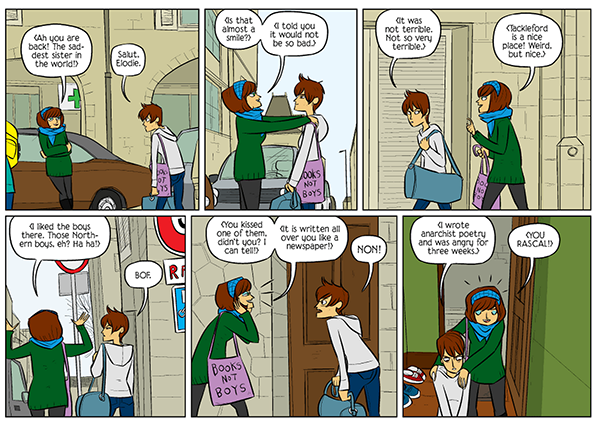
Scary Go Round by John Allison: At the moment, I think the enterprise is called Bad Machinery, or maybe it's Bobbins (the new Bobbins, not the original one). It was just Expecting To Fly. It is sometimes Murder She Wrote and Giant Days, except now Giant Days is an ongoing from Boom Studios. For me, though, it will always be Scary Go Round. Or maybe more accurately, the amazing comics of John Allison. Because really all of the stories are at least loosely connected with each other and span, wow, probably at least a decade of storytelling. The Scary Go Round comics show a pretty impressive range of stories and characters but generally centre around the fictional northern English town of Tackleford and often involve some sort of Sci-fi or supernatural MacGuffin to drive the plots. (A favourite chapter for instance features The Boy (Le Garcon!) on a French exchange where he must resist his extra-relationship feelings for a cute French girl and expose the new French Easter Bunny as a Wendigo in disguise). Scary Go Round (etc) is just filled with fun, uncouth stories filled with wonderfully developed characters and a weird and inane sense of humour coupled to some of my favourite cartoon art in the world. It is endlessly fun and I cannot recommend it enough. Updates Mon-Fri and sometimes more.

Jumping on points: 
Recent continuity free Scary Go Round story: Expecting to Fly
Fairly recent reboot focusing on new characters: Bad Machinery
Favourite older Scary Go Round stories: Giant Days and The Bell


Octopus Pie by Meredith Gran: Remember those earnest television cartoons from our Millennial Youths? Those fun, but really dramatic cartoons that followed young teens as they learned about life largely by making mistakes? Well Octopus Pie is like the adult equivalent of these deeply important cultural artifacts. It stars a pair of 20-something women and their friends living in Brooklyn and trying to figure out life. But not in like, a super precious way: Octopus Pie has a certain self-deprecating charm that stops it from being obnoxiously twee. While Octopus Pie starts as a Nerds-vs-Stoners odd couple story, it grows and evolves into a story about really well developed young adults struggling with under-employment, being cash-strapped, relationship angst, and just generally being emotional dummies. I find the comic relatable, funny, and just filled with first-world tragedy and cathartic mini-triumphs. It's great. Updates once or twice a weekly usually.

Jumping on points:
The current storyline is mostly easy to pick up and is in colour: Go HERE.
A classic story that serves as a good intro to the world: Couch Sitter
A personal favourite of mine: Skate or Don't


Gunnerkrigg Court by Tom Siddell: Not all strip comics have to be humour focused. Gunnerkrigg Court is a strip based, serialized comic about two girls at a weird boarding school filled with magic and mad science and mystery. The plot centres around the two girls, Antimony Carver and Katerina Donlan, as they grow up, discover their aptitudes, and become embroiled in the complicated and contentious relationship of the structured Court and the surrounding magical denizens of the Forest. Gunnerkrigg Court is all ages in the best ways and is filled with humour, wonder, and discovery. The art is quite nice and is constantly evolving and growing along with the characters and writing. It's fantastic. Updates M-W-F.

Jumping on points:
Honestly, as much as the comic improves as it runs, I think you need to start this one at the beginning: Go HERE.


The Perry Bible Fellowship by Nicholas Gurewitch: This comic barely updates anymore, but for me it will always be, like, the ideal of gag strips. The comic features beautiful artwork and a warped, transgressive sense of humour. PBF also is maybe the best comic I've read at quickly establishing premises and delivering unexpected, clever punchlines. Every joke is different and worth at least looking at. Updates "wheneverly" and rarely.

Jumping on points:
Every joke stands alone so go to the home page (HERE) and just mash the "random" button and enjoy.

Post by Michael Bround

Previously:
Stuff I Like: Podcasts

Friday, 1 May 2015

Marvelling At Captain Marvel #10-14

Or a roundup of cool features from recent issues of Captain Marvel
by Kelly Sue DeConnick, Warren Ellis, David Lopez, Marcio Takara, Laura Braga, Lee Loughridge, Nick Filardi, and Joe Caramagna; Marvel Comics


Captain Marvel is another comic I can count on to always be good. It's also a comic that is frequently pretty seamless: it features amazing dialogue, fantastic acting artwork, and clear functional storytelling. It's a comic that does all of its constituent jobs well, but often in a way that is quietly great. Less elaborate flourish, more solid workmanship. Which makes writing about the comic a little difficult sometimes. 

That said, Captain Marvel does feature some pretty clever choices, so I've rounded up some of my favourite comics moments recently in Captain Marvel here.

There will be *SPOILERS* for Captain Marvel #10, #11, and #12 specifically


Captain Marvel #10 makes good use of infringing on comic gutters for fun storytelling effects. The more obvious of these choices is for emphasis: we see Spider-Woman break panel borders with her body and see her energy blasts surge over boundaries and seemingly out of the page. This makes her the focal and emotional centre of the page and makes her blasts seem especially powerful and important. It's a straightforward approach but it makes this page exciting and interesting. 


Captain Marvel #10 has more adept and interesting games to play with the gutter spaces between panels. The story of the issue has amoral (or maybe outright evil) genius Grace Valentine launch a quest of vengeance against Captain Marvel and her allies by mind controlling a horde of New York rats. So much of the story revolves around hundreds and hundreds of rats (a ratatouille of rats?) overrunning New York and invading the subleased Statue of Liberty apartment of Carol Danvers. In a really clever and adorable bit of comics, many of the gutters feature little rats peaking out from between the panels. On the one hand this is just kind of fun, but on another it really emphasizes the feeling of being infested with rodents. There are so many rats in Captain Marvel #10 that they are even appearing in the parts of the comic that it should be impossible for them to be in. It's a really effective and fun choice.


Captain Marvel #11 has a great two page sequence that does some interesting, comics rule breaking things. The sequence, which sees Carol Danvers drugged unconscious by the Toxic Doxy and then regain consciousness captive is delivered in a very effective way. After Carol is dosed with the drug, there is a break between the normal structure of the comic, which functions as a sort of visual shorthand for reality, and Carol herself. We see the background panels become repetitive and strrreettcchhhh as the moment drags out, while meanwhile Carol falls, along with some collapsing panels, out of the plane of the page and faints into a white, roiling zone perpendicular to the normal structure of the comic. Then we get a well placed page turn, giving a clear break between events, before returning to Carol as, golden coloured and still surrounded by the panels of fainting, she oozes back into the page and reality. Which on a purely visual level is pretty interesting.

It is also super evocative of the experience of being sedated to the loss of consciousness. I've only done local anaesthesia once in my life, but I can remember the way time stretched, growing dim and fuzzy, before suddenly I was thrown from reality and rendered oblivious before, even fuzzier, I slowly swam back to reality. The way this sequence dilates time, literally casts Carol out of the universe of the page, and then gives a clear, quick feeling discontinuity between story sections wonderfully encapsulates that experience. It's a really smart stretch of comics.


This double page spread from Captain Marvel #12 is also pretty cool. Obviously it has a giant Space Tardigrade, aka Space Water Bear, which is totally rad. More things in life should feature Water Bears, particularly giant Water Bears. It's also a cool spread because it quietly does a lot of smart comics things to make a pretty dense composition work really well. The page is double page spread which immediately imparts a sense of size and majesty to the Tardigrade and puts the rest of the events in relation to this noble space monster. The rest of the key storytelling items are arranged on the page in a long continuous curve starting at the Space Water Bear's eye catching mouth and sweeping across the page. This allows readers to quickly parse the story elements and experience them in a fast feeling order. This sweeping arc of smaller panels is also interesting in how it plays with panel position and size to impart motion and proximity in a clear way. While swinging across the page we see Carol's spacecraft start big and "close" and shrink as it travels "further away" while the space between panel moments increase as the ship accelerates. Conversely we see the HUD display of the enemy base/refinery grow larger as the ship dwindles, signifying that the spaceship and the story are approaching the base. It all comes off as a tremendously smooth and organic page, but when you break it down this sequence introduces a cool new setting, a new situation, and some stage direction very clearly. And, you know, giant Space Water Bear.

Captain Marvel is another absolute horse of a comic that does its normal comics business very well and sometimes also manages to make some really clever comics.

Post by Michael Bround

Previously:
Marvelling at Captain Marvel #9: a rhyme map of a rock and roll space opera
Marvelling at Captain Marvel #4: Joyous collaboration.
Marvelling at Captain Marvel #3: When joke and story telling collide
Marvelling at Captain Marvel 17: A meta-fandom salute
Marvelling at Captain Marvel 15-16: On tie ins
Marvelling At Captain Marvel #13-14: On The Enemy Within
Marvelling At Captain Marvel #12: Demarcating reality and fantasy
Marvelling At Captain Marvel #10: A dramatic contract
Marvelling At Captain Marvel #9: How your brain tells time
Marvelling At Captain Marvel #7: Saving a reporter in distress... AND ITS A MAN!
Marvelling At Captain Marvel #1: An alternate reading order that I liked more