Or how Young Avengers reminds makes me think of Phonogram: The Singles Club
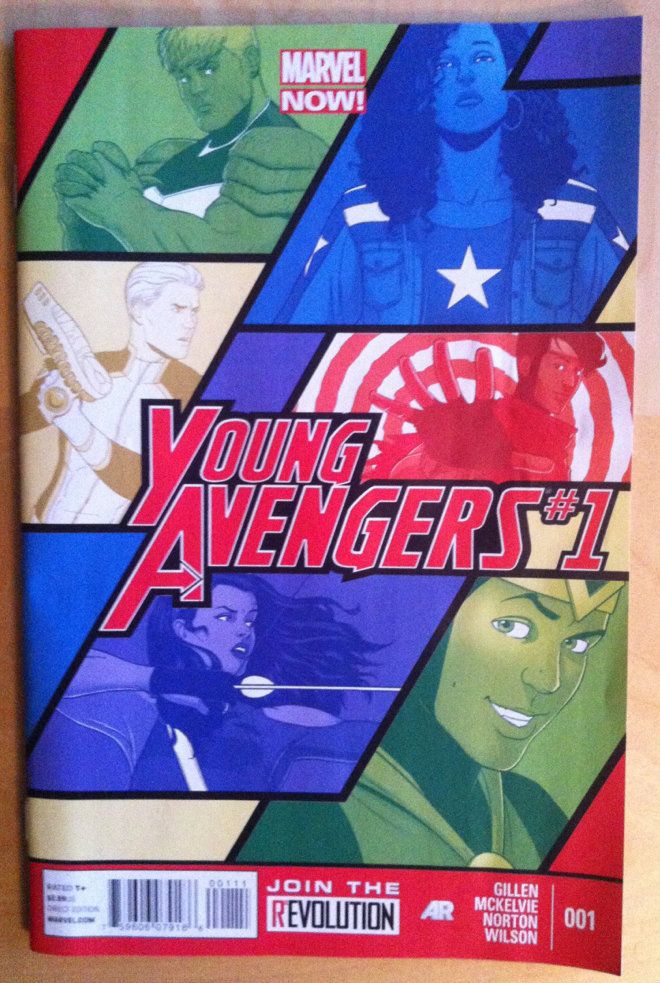
Young Avengers is a comic about a group of young superheroes on the cusp of adulthood. Phonogram: The Singles Club tells a story about music as magic and focuses on a group of young Phonomancers (music-wizards) on the cusp of adulthood. Both comics are written by Kieron Gillen, drawn by Jaimie McKelvie, and coloured by Matt Wilson. They are both pretty great comics.
But I think the similarity between the two runs deeper than a common level of quality and shared creators. There is a thematic link about what it is to be on the cusp of adulthood and a similar sensibility about how to convey these ideas that unites both these titles and which at times borders on the uncanny. Now, clearly there are dramatic differences between the two: one features caped heroes and punching and the other a blizzard of pop music references and dancing but the two clearly share a common thread of DNA. I kind of want to compare it to brocoli and cauliflower, how they share a distinct genetic background, a common ancestor from which both modern vegetables are derived. And I think, if you squint a bit at Young Avengers and The Singles Club, the similarities and the evidence of this common thematic ancestor becomes apparent. Like to the point where certain moments, stripped of their Superheroics or music, are virtually indistinguishable.
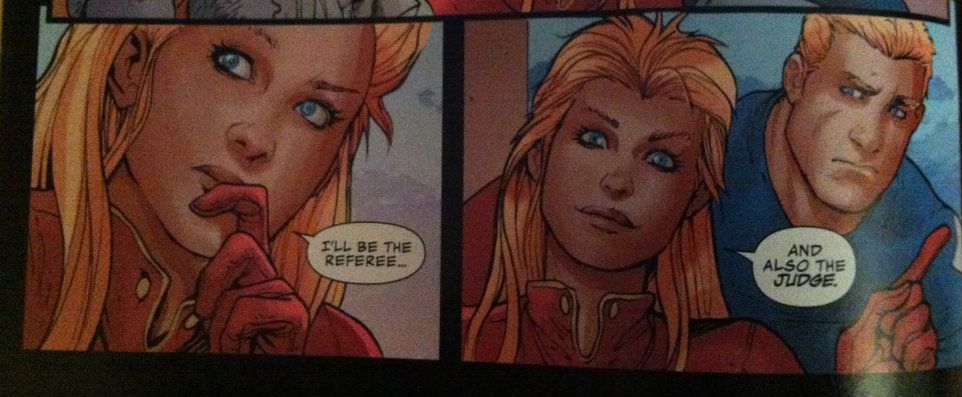
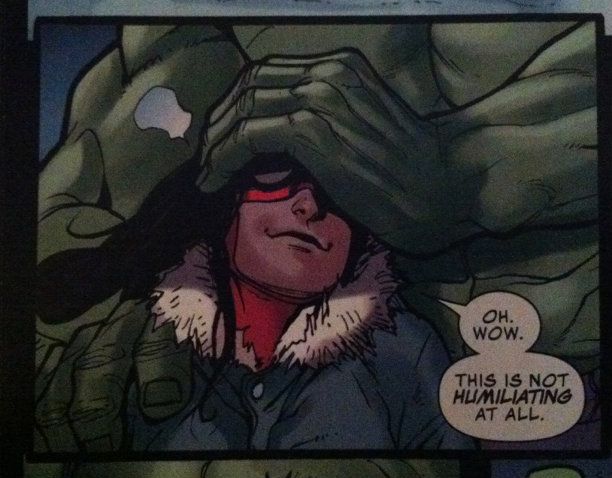
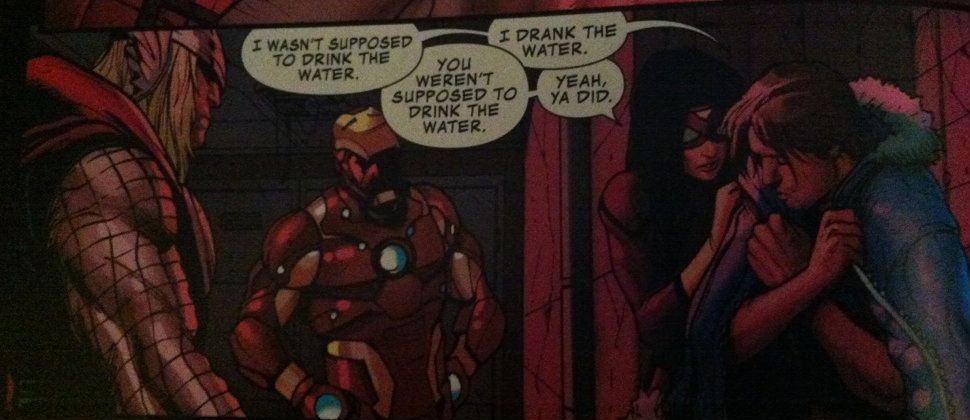
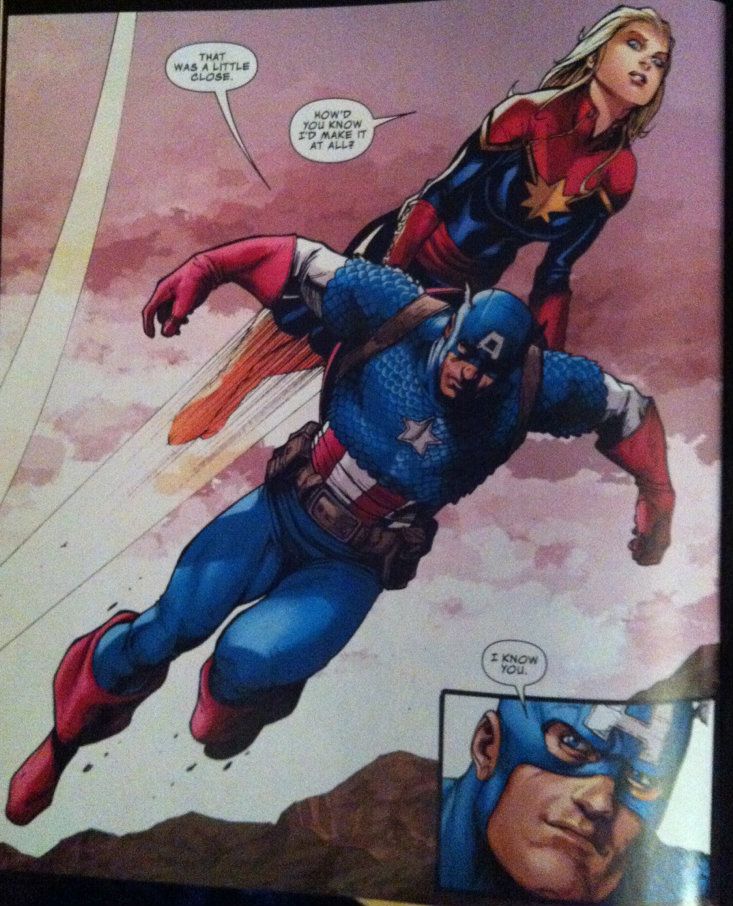
To that end, I've put together the following test. I've cropped out panels from Young Avengers #1 and Phonogram: The Singles Club to illustrate the uncanny similarity between the two.
1: If you are unfamiliar and haven't read either book, then I challenge you to guess which title each panel is from.
2: If you have read both books and can tell which book each is from based on remembering the panel or recognizing the characters depicted, then I challenge you to look past that and see if you can see the commonalities, the thematic relationship between the two comics.
(Obviously I chose panels that lacked Superheroics and musical references, because those are dead give aways.)
Uncannily similar right? Or am I crazy?
Anyway, I see the common DNA between the two titles and I LOVE it. Phonogram was a brilliant comic, and a mainstream Superhero comic that looks and feels like it is absolutely something that I want and so, I say to you, that Young Avengers is the next best thing to having new Phonogram and that you should all be reading it.
Friday, 1 February 2013
Wednesday, 30 January 2013
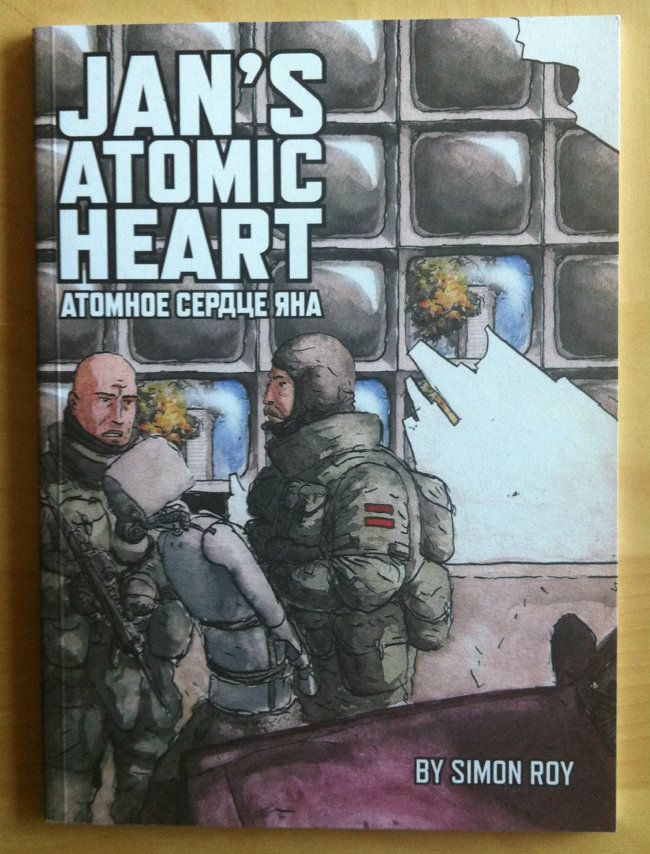
So I Read Jan’s Atomic Heart
A 250 word (or less) review of the Jan’s Atomic Heart
comic
Science fiction, at its atomic heart, is about nifty futurist ideas bootstrapped to a compelling fictional story. A good piece of science fiction pops with dozens of great concepts that are elaborated to the reader as the story progresses. Great Sci-fi immerses you in a different world where you are expected to piece together the futurisms on display through inference instead of instruction. Jan's Atomic Heart is an example of this kind of great Sci-fi. Jan's Atomic Heart is about a man, Jan, who finds himself in a temporary robotic body after his real body is destroyed in a car accident. He learns that his new robotic body is the same model used as mobile bombs by terrorists and begins to worry that he too is a bomb. Jan’s Atomic Heart is a beautifully rendered comic with a compelling story with some great futurisms and twists. The comic, for being a fairly short story, also does a huge amount of world building. Roy brilliantly works in small peripheral details and snippets of tangential dialogue - a panel here, a panel there - that manage to convey the stories environment and broader context without distracting from the main plot and characters. It's a pretty great technique for packing in setting detail without losing too much page real-estate. Jan's Atomic Heart is a brilliant Sci-fi book and well worth checking out if you can find it.
By Simon Roy, New Reliable Press
Science fiction, at its atomic heart, is about nifty futurist ideas bootstrapped to a compelling fictional story. A good piece of science fiction pops with dozens of great concepts that are elaborated to the reader as the story progresses. Great Sci-fi immerses you in a different world where you are expected to piece together the futurisms on display through inference instead of instruction. Jan's Atomic Heart is an example of this kind of great Sci-fi. Jan's Atomic Heart is about a man, Jan, who finds himself in a temporary robotic body after his real body is destroyed in a car accident. He learns that his new robotic body is the same model used as mobile bombs by terrorists and begins to worry that he too is a bomb. Jan’s Atomic Heart is a beautifully rendered comic with a compelling story with some great futurisms and twists. The comic, for being a fairly short story, also does a huge amount of world building. Roy brilliantly works in small peripheral details and snippets of tangential dialogue - a panel here, a panel there - that manage to convey the stories environment and broader context without distracting from the main plot and characters. It's a pretty great technique for packing in setting detail without losing too much page real-estate. Jan's Atomic Heart is a brilliant Sci-fi book and well worth checking out if you can find it.
Word count: 234
Monday, 28 January 2013
Atoll Comics Round 7
Or Changes to My Top-Ten Comics
Due to poverty and an urge to buy better comics, I have decided to be super-selective about which superhero comics I read. Harnessing the Awesome Power of Maths, I have determined that I can afford to read 10 ongoing titles. So I get to read 10, and only 10, titles published by either Marvel or DC as well as one trade paperback a week of my choosing.
A complication of this is that I am forced to drop an on-going title if I want to try reading a new on-going title, an act of very tough love. Being financially responsible is the worst.
I will be adding Young Avengers and dropping Winter Soldier.
Why Young Avengers? Phonogram. That's why.
Okay, let me clarify. Phonogram is easily one of my favourite comics. In a nutshell it's a comic that presents music as literal magic in an effort to describe how amazing it is. The series is original, beautifully written, and shockingly good looking. The second chapter, "The Singles Club" deals with additional themes of growing up and defining oneself. Phonogram was written by Kieron Gillen, drawn by Jamie McKelvie with art assists by Julia Scheele and coloured by Matthew Wilson (Vol. 2).
Young Avengers is written by Kieron Gillen, drawn by Jamie McKelvie with Mike Norton, and coloured by Matthew Wilson. It's a book that follows the titular Young Avengers (Hulkling, Wiccan, Hawkeye, Marvel Boy, Miss America, and Kid Loki) and is about growing up with Superheroics being a metaphor for talent or individuality . It's a comic by the same creative team as Phonogram and deals with similar themes. If the first issue is any gauge, it is shockingly similar in theme and tone and execution to Phonogram: The Singles Club. In a world without an ongoing Phonogram comic, Young Avengers is a must read. And honestly, with the creative team involved, it's probably a must read even if Phonogram was on the stands weekly.
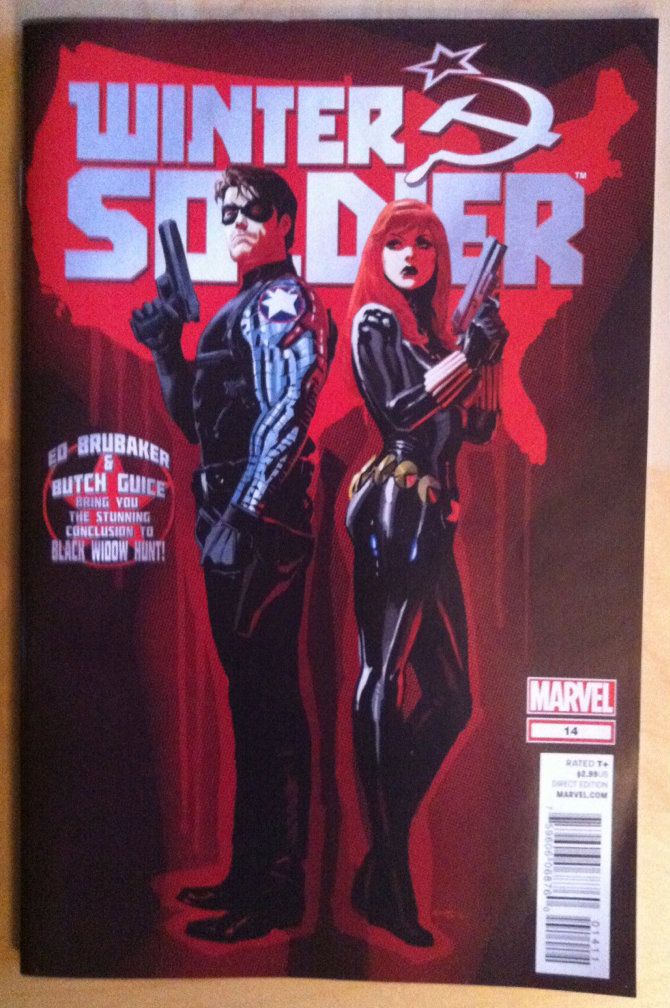
Why not Winter Soldier? This is another end of an era title drop. Ed Brubaker's Captain America/Winter Soldier work has been a staple of comics habit since I started reading comics as an adult. Between monthly magazine format comics and trade collections I own the entire Captain America to Winter Soldier story. It is an amazing comics work and if you are looking for a mainstream Superhero comic to read in back issues or trades, I highly recommend it. But Ed Brubaker is moving on to pursue a career making creator owned comics and writing for movies and television and is no longer writing comics for Marvel. As great as this comic has been, I cannot imagine reading a story about the Winter Soldier that isn't written by Brubaker. So I won't. But I don't think that's all...
I like endings. One of the greatest weaknesses of mainstream Superhero comics is that they don't end. Without endings there can be no real resolution, no real closure to them. Just conclusions of storylines and fresh new takes. The closest thing to a real ending I've seen in Superhero comics is the semi-conclusion and change up following a years long run on a title by a single writer or creative team. Like Brubaker leaving Winter Soldier, Fraction finishing with Iron Man, or Hickman concluding his Fantastic Four/FF run. It's kind of nice when these semi-endings occur to draw a line under everything that came before, step away from the title, and enjoy the sort-of-closure for a while. Savour the story as a complete, definitive unit of Captain America, Iron Man, or the Fantastic Four. And my dropping Winter Soldier falls into this: I'm happy with Winter Soldier, how it ended, and am not super interested in reading more right now.
Friday, 25 January 2013
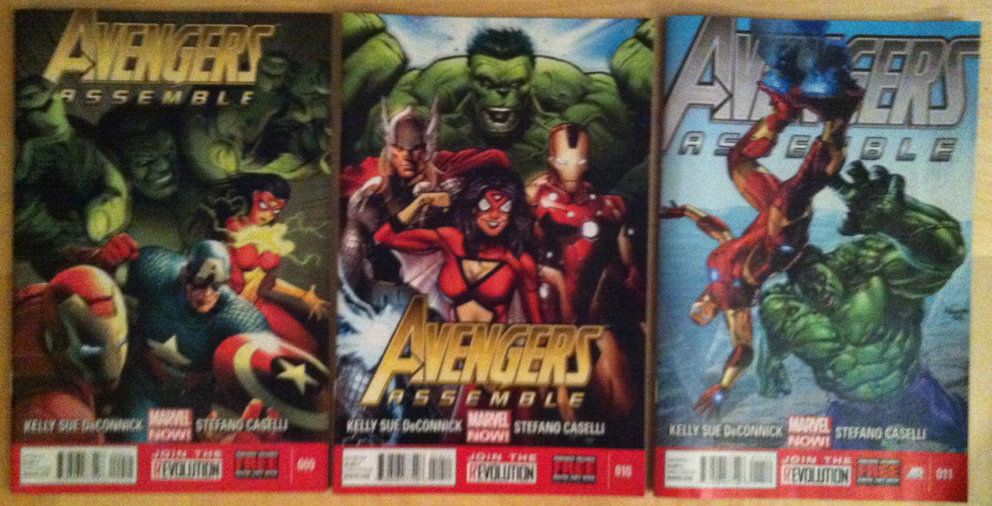
Assembly on Avengers Assemble 9-11
Or an analysis of characterization in Avengers Assemble
By Kelly Sue DeConnick and Stefano Caselli
Avengers Assemble is the continuity light version of the Avengers franchise meant to be accessible to new readers. It utilizes a rotating cast of favourite Avengers going on missions to save the world in shorter self-contained stories. It's basically a very pretty, very well written straight forward Superhero comic designed to be an introduction to Superhero comics.
It's not what I would typically read.
If you pay attention to the ten Superhero comics I'm reading at any given time you'll notice that I tend to go for the more polarizing and original... the ones that are not strictly Superhero comics. I like to read things that are new, that contain the characters and themes I love but also do something more that changes it up or elevates the material. The fact that Avengers Assemble is intentionally a straight forward Superhero comic would generally make it a comic that I would skip in the interest of reading something else.
But Avengers Assemble is ridiculously well executed. The writing is excellent and the art is perfect for the script. It's also a comic that focuses on making each character in the ensemble distinct.
When it comes to team Superhero books I'd say there are two key ingredients to success: fun/exciting character moments and a clever and functional central plot. I'd even go so far as to say a well negotiated compromise between these two story elements is the formative norm of a good team book. There are certainly different approaches to this, and most writers/comics end up somewhere on a spectrum between a character driven story or a story driven by the overall plot. Typically this balance falls towards the plot end of things with characters each distinct within themselves, but with poorly defined relationships. This approach can certainly lead to some great comics, but kind of at the expense of wholly realized characters.
Avengers Assemble puts characterization first in a way that is atypical in Superhero team books and this, I think, is what makes the comic remarkable and worth reading.
*SPOILERS* will exist beyond this point.
Every person in real life is, if not unique, then certainly distinctive. If fiction is to mimic real life then every character portrayed in a group also has to be distinct and defined. Avengers Assemble does a really good job of this: the entire cast of the ensemble felt realized and distinct from every other member of the cast.
(Rather than go page to page and annotate every single character moment, I'm just going to list the overall sense of each character).
Iron Man: Tony is brilliant but insecure, which makes him competitive and show-offy. As a result he is fairly likeable and good with people, but also somewhat childish and a bit of an egotistical dick (This is all conveyed rather effectively in the scene where he proposes "the bet" to one-up Banner). He cares a little too much about getting others approval.
The Hulk: Banner is smart, timid, maudlin, and maybe possessed of a bit of an inferiority complex (does pessimistic futurist talk; rises to bet). This makes him awkward and self-conscious in group settings and the kind of person who gets teased, I think. He just wants to be respected. As Hulk is he is simpler and more excitable, kind of a weird fusion of man and child.
Captain Marvel: Carol is at once competent and mature (won't participate in "the bet") while still having a sense of fun (quips with Tony, enforces losing conditions of bet). She is also a bit of a control freak (wants to be referee and judge).
Captain America: Steve is a serious guy. He knows who he is and is secure in it which means he isn't reliant on validation from others. This makes him a bit terse and plain spoken. Steve is a guy who is comfortable being silent. He carries himself with maturity and good deal of poise. He does not participate in "the bet", and clearly disproves of it.
Spider-woman: Jessica is awkward and unsure of herself and how she fits in. I got this mostly from artwork and how she gravitates towards Hulk as a fellow outsider. Also she tends towards self deprecation a bit, which has always struck me as a mechanism for breaking down the awkward. She is also pretty funny, if you like her brand of humour (which I do). She clearly wants to be part of the group but feels that she isn't.
Thor: Is probably the least defined the the central cast. But even then we get a character who is kind of aloof and burdened with weird cultural expectations and references.
Avengers Assemble does this level of characterization quite well, but it's the next thing it does that is especially cool. In real life people aren't defined purely by character traits and moods. For better or worse we are all somewhat defined by our relationships; especially within group dynamics. This is where most ensemble comics break down and where Avengers Assemble truly excels.
Iron Man and The Hulk: Tony and Banner, like a lot of really smart academics I know, are super competitive with one another in a really childish way. However, when things get complicated, their underlying respect, common ground, and admiration shine through. They have a complicated relationship built around their similarities and mutual insercurities.
Captains Marvel and America: Carol and Steve just get each other. They know where they each stand and have a comfortable association built on just being on the same wavelength. Also, so much trust. The kind of friendship where silence is comfortable. I suspect they would do okay as roommates.
Spider-woman and The Hulk: Jessica seems kind of drawn to both Banner and the Hulk. I read it as a projection of her own self-doubts, lack of confidence, and feelings of kind of being an outsider. She sees those traits in Banner/Hulk and responds to them. Kids on the outside gots to stick together.
Thor and Everyone: Thor is the worst defined character in the book, and his relationships with other characters also suffer a bit. The result is he seems, well, aloof and apart from his fellow Avengers. Given that he is a centuries old Norse god, this kind of characterization actually makes a good deal of sense. So maybe it was intentional? I'm not sure.
Iron Man and Captain America: There isn't a huge amount of interaction to go on, but well, have you ever had a coworker or classmate who, despite being admirable in a number of ways, just kind of rubbed you the wrong way? Well, I get that kind of take on Steve and Tony in Avengers Assemble.
Hulk and Everyone (but Spider-woman): Hulk is hulk. Dangerous, childish, hard to get along with. The Avengers seem to view him a bit as a liability and thing instead of a full fledge person and equal.
Captain Marvel and Iron Man: Carol and Tony are friends. Friends in that there-are-things-I-like-about-you-but-we-should-never-be-roomates way. They clearly see things in one another they like and enjoy, but are clearly very different people who I'm sure get on each others nerves frequently. Also the teasing.
Captain Marvel and Spider-woman: Oddly, these two don't have a well defined relationship in Avengers Assemble. I think they share one spat of dialogue, but its pretty plot drivey and, from a character perspective, more to do with Spider-woman and Hulks relationship.
I think one of the more remarkable aspects of the strong character work in Avengers Assemble is that its all integrated into a self-contained Superhero adventure comic. All this characterization is built into a three comics that explain the formation of the team, lay out the motivation of the plot, introduce a threat and a villain, contain the requisite punching, and conclude in a satisfying way. This kind of economy of storytelling is really impressive.
Another thing that's probably a worthwhile take away from this arch of Avengers Assemble is that solid character work can make a read incredibly satisfying without resorting to EXTREME STAKES to make the story meaningful. When reading these comics I became invested in the characters and their relationships and cared more about their emotional consequences than the threats they faced in this comic. Not to say that the plot stakes weren't interesting or considerable (they were!), but this is a mainstream Superhero comic, the good guys are gonna win eventually (possibly with a noteworthy and temporary character death along the way). By making the characters and their relationships important readers get an additional series of consequences to worry about that are far more likely to pay off in an interesting way. I think I'd like to see more of this kind of storytelling in Superhero comics, it's a nice change.
But seriously, I would read a Kelly Sue DeConnick penned Rescue Me style comic about the Avengers hanging out in the Tower between missions and their daily personal lives in a heartbeat.
By Kelly Sue DeConnick and Stefano Caselli
Avengers Assemble is the continuity light version of the Avengers franchise meant to be accessible to new readers. It utilizes a rotating cast of favourite Avengers going on missions to save the world in shorter self-contained stories. It's basically a very pretty, very well written straight forward Superhero comic designed to be an introduction to Superhero comics.
It's not what I would typically read.
If you pay attention to the ten Superhero comics I'm reading at any given time you'll notice that I tend to go for the more polarizing and original... the ones that are not strictly Superhero comics. I like to read things that are new, that contain the characters and themes I love but also do something more that changes it up or elevates the material. The fact that Avengers Assemble is intentionally a straight forward Superhero comic would generally make it a comic that I would skip in the interest of reading something else.
But Avengers Assemble is ridiculously well executed. The writing is excellent and the art is perfect for the script. It's also a comic that focuses on making each character in the ensemble distinct.
When it comes to team Superhero books I'd say there are two key ingredients to success: fun/exciting character moments and a clever and functional central plot. I'd even go so far as to say a well negotiated compromise between these two story elements is the formative norm of a good team book. There are certainly different approaches to this, and most writers/comics end up somewhere on a spectrum between a character driven story or a story driven by the overall plot. Typically this balance falls towards the plot end of things with characters each distinct within themselves, but with poorly defined relationships. This approach can certainly lead to some great comics, but kind of at the expense of wholly realized characters.
Avengers Assemble puts characterization first in a way that is atypical in Superhero team books and this, I think, is what makes the comic remarkable and worth reading.
*SPOILERS* will exist beyond this point.
Every person in real life is, if not unique, then certainly distinctive. If fiction is to mimic real life then every character portrayed in a group also has to be distinct and defined. Avengers Assemble does a really good job of this: the entire cast of the ensemble felt realized and distinct from every other member of the cast.
(Rather than go page to page and annotate every single character moment, I'm just going to list the overall sense of each character).
Iron Man: Tony is brilliant but insecure, which makes him competitive and show-offy. As a result he is fairly likeable and good with people, but also somewhat childish and a bit of an egotistical dick (This is all conveyed rather effectively in the scene where he proposes "the bet" to one-up Banner). He cares a little too much about getting others approval.
The Hulk: Banner is smart, timid, maudlin, and maybe possessed of a bit of an inferiority complex (does pessimistic futurist talk; rises to bet). This makes him awkward and self-conscious in group settings and the kind of person who gets teased, I think. He just wants to be respected. As Hulk is he is simpler and more excitable, kind of a weird fusion of man and child.
Captain Marvel: Carol is at once competent and mature (won't participate in "the bet") while still having a sense of fun (quips with Tony, enforces losing conditions of bet). She is also a bit of a control freak (wants to be referee and judge).
Captain America: Steve is a serious guy. He knows who he is and is secure in it which means he isn't reliant on validation from others. This makes him a bit terse and plain spoken. Steve is a guy who is comfortable being silent. He carries himself with maturity and good deal of poise. He does not participate in "the bet", and clearly disproves of it.
Spider-woman: Jessica is awkward and unsure of herself and how she fits in. I got this mostly from artwork and how she gravitates towards Hulk as a fellow outsider. Also she tends towards self deprecation a bit, which has always struck me as a mechanism for breaking down the awkward. She is also pretty funny, if you like her brand of humour (which I do). She clearly wants to be part of the group but feels that she isn't.
Thor: Is probably the least defined the the central cast. But even then we get a character who is kind of aloof and burdened with weird cultural expectations and references.
Avengers Assemble does this level of characterization quite well, but it's the next thing it does that is especially cool. In real life people aren't defined purely by character traits and moods. For better or worse we are all somewhat defined by our relationships; especially within group dynamics. This is where most ensemble comics break down and where Avengers Assemble truly excels.
Iron Man and The Hulk: Tony and Banner, like a lot of really smart academics I know, are super competitive with one another in a really childish way. However, when things get complicated, their underlying respect, common ground, and admiration shine through. They have a complicated relationship built around their similarities and mutual insercurities.
Captains Marvel and America: Carol and Steve just get each other. They know where they each stand and have a comfortable association built on just being on the same wavelength. Also, so much trust. The kind of friendship where silence is comfortable. I suspect they would do okay as roommates.
Spider-woman and The Hulk: Jessica seems kind of drawn to both Banner and the Hulk. I read it as a projection of her own self-doubts, lack of confidence, and feelings of kind of being an outsider. She sees those traits in Banner/Hulk and responds to them. Kids on the outside gots to stick together.
Thor and Everyone: Thor is the worst defined character in the book, and his relationships with other characters also suffer a bit. The result is he seems, well, aloof and apart from his fellow Avengers. Given that he is a centuries old Norse god, this kind of characterization actually makes a good deal of sense. So maybe it was intentional? I'm not sure.
Iron Man and Captain America: There isn't a huge amount of interaction to go on, but well, have you ever had a coworker or classmate who, despite being admirable in a number of ways, just kind of rubbed you the wrong way? Well, I get that kind of take on Steve and Tony in Avengers Assemble.
Hulk and Everyone (but Spider-woman): Hulk is hulk. Dangerous, childish, hard to get along with. The Avengers seem to view him a bit as a liability and thing instead of a full fledge person and equal.
Captain Marvel and Iron Man: Carol and Tony are friends. Friends in that there-are-things-I-like-about-you-but-we-should-never-be-roomates way. They clearly see things in one another they like and enjoy, but are clearly very different people who I'm sure get on each others nerves frequently. Also the teasing.
Captain Marvel and Spider-woman: Oddly, these two don't have a well defined relationship in Avengers Assemble. I think they share one spat of dialogue, but its pretty plot drivey and, from a character perspective, more to do with Spider-woman and Hulks relationship.
I think one of the more remarkable aspects of the strong character work in Avengers Assemble is that its all integrated into a self-contained Superhero adventure comic. All this characterization is built into a three comics that explain the formation of the team, lay out the motivation of the plot, introduce a threat and a villain, contain the requisite punching, and conclude in a satisfying way. This kind of economy of storytelling is really impressive.
Another thing that's probably a worthwhile take away from this arch of Avengers Assemble is that solid character work can make a read incredibly satisfying without resorting to EXTREME STAKES to make the story meaningful. When reading these comics I became invested in the characters and their relationships and cared more about their emotional consequences than the threats they faced in this comic. Not to say that the plot stakes weren't interesting or considerable (they were!), but this is a mainstream Superhero comic, the good guys are gonna win eventually (possibly with a noteworthy and temporary character death along the way). By making the characters and their relationships important readers get an additional series of consequences to worry about that are far more likely to pay off in an interesting way. I think I'd like to see more of this kind of storytelling in Superhero comics, it's a nice change.
But seriously, I would read a Kelly Sue DeConnick penned Rescue Me style comic about the Avengers hanging out in the Tower between missions and their daily personal lives in a heartbeat.
Wednesday, 23 January 2013
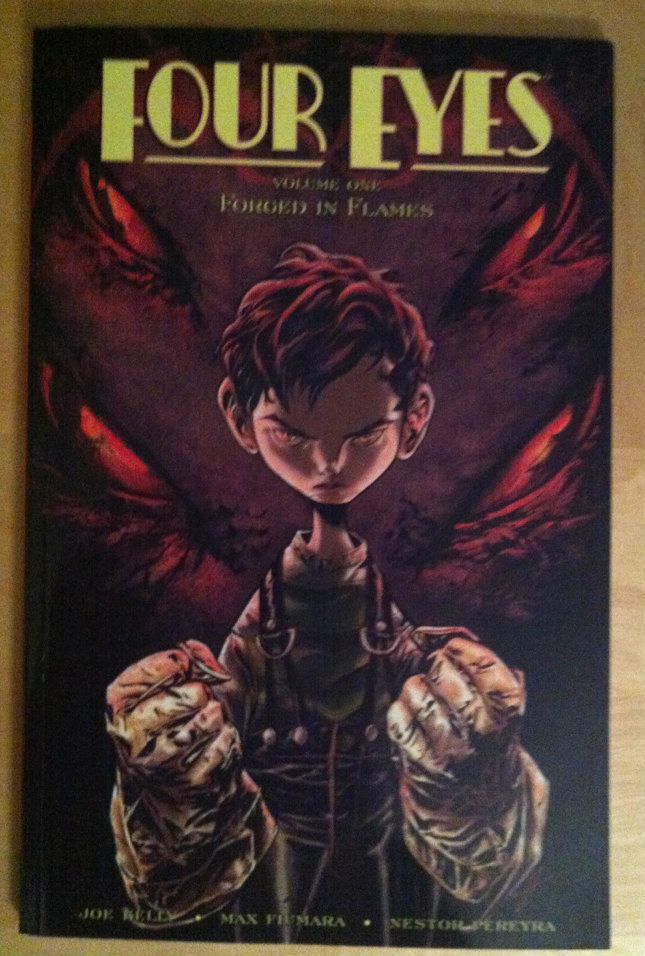
So I Read Four Eyes: Forged In Flames
A 250 word (or less)
review of the first Four Eyes trade paperback,
By Joe Kelly and Max Fiumara, Image Comics
I really like Joe Kelly. A
bootleg disk of his Deadpool run is a big part of why I got into comics and I'm
pretty fond of his recent Spider-man stories. I've been given to understand,
however, that Mr. Kelly is a bit of a lightning rod for comics controversy:
people are bitterly divided over the quality of his DC comics work (which I
have never read). So bearing in mind that I like Joe Kelly, I think Four Eyes
is a book everyone can enjoy. The comic is about Enrico, a boy who must fend
for himself and his mother during the Great Depression after his father is
killed in an accident. Also there are dragons that fight in underground rings
run by criminal syndicates. The story operates as a kind of period piece
depicting the hardships and strange cultural conditions of the great depression
and also dragons. Built into this amazing setting is the thematic core of the
story, which is about trying to grow up and be a man without a father to
emulate. And also dragons. Joe Kelly's script for this book is great, but the
real star for me is Max Fiumara. His artwork just has such a sense of panache that
it makes this world of the-Great-Depression-but-with-dragons come to life and
be convincing. It's a gorgeous book with a great concept and story. Sadly, I’m
unsure when/if we’ll see more Four Eyes, but Forged In Flames is pretty
complete and well worth checking out.
Word count: 250
(Apparently the next issueis in the can, and Kelly and Fiumara are just waiting until they have a
completish arch to solicit… but who knows when we’ll see that?)
Monday, 21 January 2013
Gun Machine Is A Good Book
Or why you should read Gun Machine by Warren Ellis
Detective John Tallow had just killed a man and seen his partner murdered when he stumbles into an apartment full of guns. An apartment full of guns arranged in elaborate patterns on the walls and on the floor and on the ceiling. An apartment full of infamous guns each linked to an unsolved murder spanning decades. An apartment where someone is trying to build a Gun Machine. Now John Tallow must decipher this mechanism and catch a serial killer before he can complete his murder device or begin making a new one.
Gun Machine is a pretty great crime story: its central mystery is darkly compelling, its hero flawed and likeable, its villain fascinating and terrible, and its plot properly suspenseful and exciting. Don't let this endorsement fool you, while Gun Machine is a great crime story, it refuses to conform to expectations on account of it being completely mad. Among other forms of madness, Gun Machine has a sense of humour and fun about it and is able to laugh at absurdity as well as its able to chuckle at the gallows or wallow in the terrifying and horrible. Gun Machine is also interesting, filled with many well researched, granular details about all kinds of nifty topics, from the common place to the futuristic or historical. Gun Machine is the kind of book I absolutely love: eminently readable, quirky and original, and impossible to define.
Warren Ellis has written some of my favourite comic books, and with Gun Machine, a great novel. If you are a fan of his comics work and unsure if his prose writing is for you, well, there are a lot of favourable parallels. Gun Machine has the big ideas and humour that live in all of his work, as well as the kind of keenly intelligent central plot Ellis is known for. Actually, Gun Machine reminds me a lot of Fell, Ellis' comic with Ben Templesmith. Both works are detective stories that dig into the horrific debauchery that exists at the borders of our society. Both stories are dark, but also faintly hilarious and absurd and informative. Both detectives Fell and Tallow could be cut from the same world weary cloth. Gun Machine even manages to capture, with the hyper-articulate yet humble prose of Ellis, some of the visual magic of Ben Templesmith's Fell work (if that makes sense). I guess what I'm trying to say is that if you like Ellis' comic work, particularly Fell, you'll likely enjoy Gun Machine.
Honestly though, Gun Machine is the kind of novel I feel I can recommend to anyone: it's smart, exciting, and just a well written book.
Previously
So I Read Crooked Little Vein
So I Read Ignition City
So I Read Fell: Feral City
Detective John Tallow had just killed a man and seen his partner murdered when he stumbles into an apartment full of guns. An apartment full of guns arranged in elaborate patterns on the walls and on the floor and on the ceiling. An apartment full of infamous guns each linked to an unsolved murder spanning decades. An apartment where someone is trying to build a Gun Machine. Now John Tallow must decipher this mechanism and catch a serial killer before he can complete his murder device or begin making a new one.
Warren Ellis has written some of my favourite comic books, and with Gun Machine, a great novel. If you are a fan of his comics work and unsure if his prose writing is for you, well, there are a lot of favourable parallels. Gun Machine has the big ideas and humour that live in all of his work, as well as the kind of keenly intelligent central plot Ellis is known for. Actually, Gun Machine reminds me a lot of Fell, Ellis' comic with Ben Templesmith. Both works are detective stories that dig into the horrific debauchery that exists at the borders of our society. Both stories are dark, but also faintly hilarious and absurd and informative. Both detectives Fell and Tallow could be cut from the same world weary cloth. Gun Machine even manages to capture, with the hyper-articulate yet humble prose of Ellis, some of the visual magic of Ben Templesmith's Fell work (if that makes sense). I guess what I'm trying to say is that if you like Ellis' comic work, particularly Fell, you'll likely enjoy Gun Machine.
Honestly though, Gun Machine is the kind of novel I feel I can recommend to anyone: it's smart, exciting, and just a well written book.
Previously
So I Read Crooked Little Vein
So I Read Ignition City
So I Read Fell: Feral City
Friday, 18 January 2013
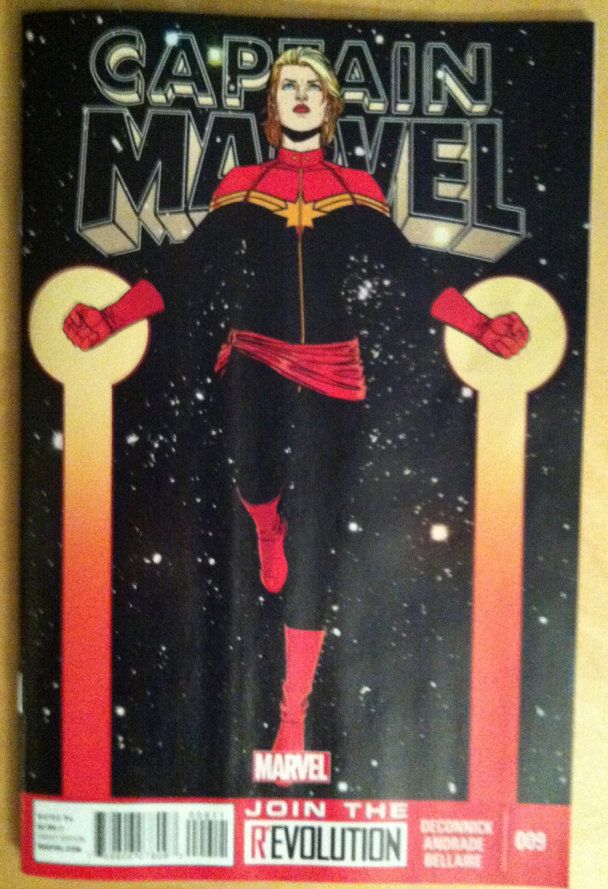
Marvelling at Captain Marvel #9
Or an excuse to talk about Science in the context of comic books.
There be *SPOILERS* in this one. So go read Captain Marvel #9 before reading this post. Don't have it? Shame on you, this is an amazing comic.
First let it be said that Captain Marvel #9 kicks so much ass. I mean, I've really enjoyed every issue of Captain Marvel so far, but this one is fantastic. To the point where if someone were to ask me "Why do you read superhero comics?", I could answer "Because Captain Marvel #9". It's based around a slice-of-life ordinary day for Carol and is filled with satisfying character moments, little snippets of great comedy, a broadening supporting cast, and a gun point standoff. And a ridiculous "lucky" touque (I'm Canadian, we have a word for that). AND dinosaurs in downtown Manhattan. In Captain Marvel #9 Kelly Sue DeConnick manages to turn what could kind of be considered a setup/logistical issue into a beat perfect superhero comic. Filipe Andrade, this issue's artist, has a kinetic and kind of exaggerated style that is pretty great and completes the package. Did I mention I really like this comic?
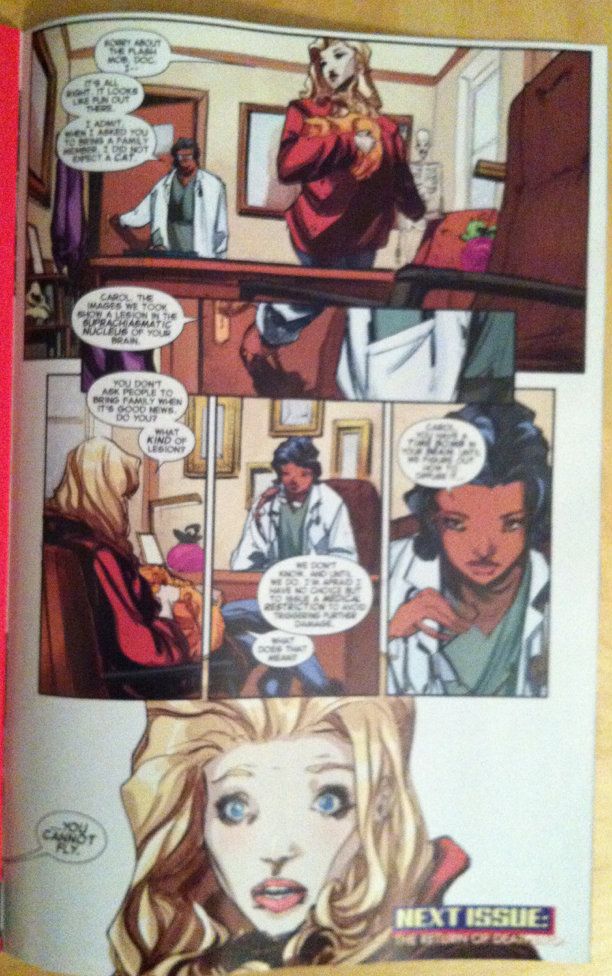
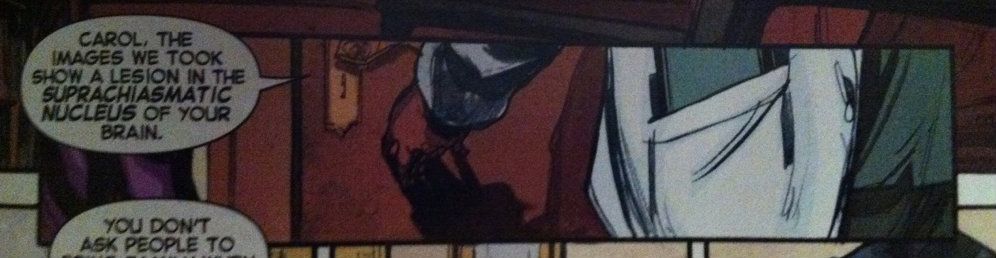
Anyway, on the last page *SERIOUS SPOILERS* it's revealed that Carol has a lesion in the Suprachiasmatic Nucleus of her brain.
You might be wondering, what is a Suprachiasmatic Nucleus (or SCN). Well, since two of my favourite non-human things are Science and comics, I'll try to defuse this jargon.
Structurally the SCN is a small collection of neuron cells that live kind of behind the optic nerve and some visual signalling structures (one of which is called the optic chiasm) in the brain. In the brain, small clusters of neurons are referred to as a nucleus (not to be confused with the nucleus that contains DNA; Scientists are the worst at naming things). So we have a collection of neurons that lives close to the optical chiasm: hence Suprachiasmatic Nucleus.
But brain structures only matter in so far as they do something. So what does the SCN do? Well, it's where our bodies' internal clock lives.
People evolved on a planet that has light and dark cycles; day and night. A consequence of this is that our bodies adapted to do certain things at certain times of the day. Like to sleep at night and wake up in the morning or to get hungry during the day, but to fast and slow our metabolism at night. To manage this our brains contain a time keeping mechanism that counts out almost exactly 24 hours before resetting. And this time keeping mechanism lives in the SCN. Which is pretty cool. But how does it work?
So a clock works because some part of it is able perform a motion in a consistent, regular way. A grandfather clock has a pendulum (a big ass weighted chain) that sways back and forth at a regular interval (which is maintained by a slowly uncoiling spring). Old pocket watches work by winding a spring that slowly and regularly uncoils and spins gears that turn with a certain speed to keep time. Modern watches use a piezoelectric crystal (essentially a cool rock that will physically oscillate in size (a little) when you run an electric field through it from, say, a watch battery) to mark the regular, periodic passage of time. Well, the SCN works in a fairly similar way, except it oscillates protein levels to tell time.
In the SCN a protein called CLOCK ("circadian locomotor output cycles kaput"... because sometimes Scientists DO name things well) is produced. CLOCK is something called a "transcription factor", which is a protein that can bind to DNA in a cell and turn on or off the production of other proteins. They are kind of like control switches. Anyway, in the SCN, CLOCK is made at a steady rate. Initially it has a low concentration and is stuck in the main compartment of the cell (called the Cytoplasm). Eventually CLOCK reaches a high enough concentration to enter the Nucleus of the cell and bind to DNA. CLOCK can turn on and off a lot of different protein making pathways, but some key genes that get turned on are the ones that manufacture Period (PER) and Cryptochrome (CYC) proteins. PER and CYC are also transcription factors, and when they are turned on they bind to DNA and turn off the production of CLOCK. This causes CLOCK levels to fall (because cells recycle things), which eventually means CLOCK can't turn on PER and CYC, which means PER and CYC can't turn off CLOCK, which means that CLOCK production starts up again. The cycle repeats.
So to recap, in the SCN during a 24 hour day, CLOCK is made until it turns on production of PER and CYC which turns off CLOCK which eventually will turn off PER and CYC which turns on CLOCK. And then this repeats during the next 24 hours. Which is, in a basic sense, how your brain keeps track of time.
Of course, it's WAY more complicated than that. There are other proteins in the SCN that also fluctuate during a 24 hour period and interact with CLOCK to help keep time. (such as BMAL1, REV-ERBa, RORa etc). Your brain also takes in environmental information and uses this to fine tune the clock. So things like light and dark are used to alter the clock and make it run even more accurately. (Which is why it is important to sleep in a DARK room and why when my dog needs a 3am emergency bathroom run involving a well lit hallway my sleep gets ruined.) But all of this action takes place in the SCN.
Information from the clock in the SCN gives timed instructions to other areas of the brain, like centres that control wakefulness and hunger or regulate the release of hormones like insulin, melatonin, and growth hormone. So it's a pretty important little structure that affects pretty much every other system in your body.
Which makes the SCN not a great place to have a lesion.
Did I mention I love this comic book?
There be *SPOILERS* in this one. So go read Captain Marvel #9 before reading this post. Don't have it? Shame on you, this is an amazing comic.
First let it be said that Captain Marvel #9 kicks so much ass. I mean, I've really enjoyed every issue of Captain Marvel so far, but this one is fantastic. To the point where if someone were to ask me "Why do you read superhero comics?", I could answer "Because Captain Marvel #9". It's based around a slice-of-life ordinary day for Carol and is filled with satisfying character moments, little snippets of great comedy, a broadening supporting cast, and a gun point standoff. And a ridiculous "lucky" touque (I'm Canadian, we have a word for that). AND dinosaurs in downtown Manhattan. In Captain Marvel #9 Kelly Sue DeConnick manages to turn what could kind of be considered a setup/logistical issue into a beat perfect superhero comic. Filipe Andrade, this issue's artist, has a kinetic and kind of exaggerated style that is pretty great and completes the package. Did I mention I really like this comic?
Anyway, on the last page *SERIOUS SPOILERS* it's revealed that Carol has a lesion in the Suprachiasmatic Nucleus of her brain.
You might be wondering, what is a Suprachiasmatic Nucleus (or SCN). Well, since two of my favourite non-human things are Science and comics, I'll try to defuse this jargon.
Structurally the SCN is a small collection of neuron cells that live kind of behind the optic nerve and some visual signalling structures (one of which is called the optic chiasm) in the brain. In the brain, small clusters of neurons are referred to as a nucleus (not to be confused with the nucleus that contains DNA; Scientists are the worst at naming things). So we have a collection of neurons that lives close to the optical chiasm: hence Suprachiasmatic Nucleus.
But brain structures only matter in so far as they do something. So what does the SCN do? Well, it's where our bodies' internal clock lives.
People evolved on a planet that has light and dark cycles; day and night. A consequence of this is that our bodies adapted to do certain things at certain times of the day. Like to sleep at night and wake up in the morning or to get hungry during the day, but to fast and slow our metabolism at night. To manage this our brains contain a time keeping mechanism that counts out almost exactly 24 hours before resetting. And this time keeping mechanism lives in the SCN. Which is pretty cool. But how does it work?
So a clock works because some part of it is able perform a motion in a consistent, regular way. A grandfather clock has a pendulum (a big ass weighted chain) that sways back and forth at a regular interval (which is maintained by a slowly uncoiling spring). Old pocket watches work by winding a spring that slowly and regularly uncoils and spins gears that turn with a certain speed to keep time. Modern watches use a piezoelectric crystal (essentially a cool rock that will physically oscillate in size (a little) when you run an electric field through it from, say, a watch battery) to mark the regular, periodic passage of time. Well, the SCN works in a fairly similar way, except it oscillates protein levels to tell time.
In the SCN a protein called CLOCK ("circadian locomotor output cycles kaput"... because sometimes Scientists DO name things well) is produced. CLOCK is something called a "transcription factor", which is a protein that can bind to DNA in a cell and turn on or off the production of other proteins. They are kind of like control switches. Anyway, in the SCN, CLOCK is made at a steady rate. Initially it has a low concentration and is stuck in the main compartment of the cell (called the Cytoplasm). Eventually CLOCK reaches a high enough concentration to enter the Nucleus of the cell and bind to DNA. CLOCK can turn on and off a lot of different protein making pathways, but some key genes that get turned on are the ones that manufacture Period (PER) and Cryptochrome (CYC) proteins. PER and CYC are also transcription factors, and when they are turned on they bind to DNA and turn off the production of CLOCK. This causes CLOCK levels to fall (because cells recycle things), which eventually means CLOCK can't turn on PER and CYC, which means PER and CYC can't turn off CLOCK, which means that CLOCK production starts up again. The cycle repeats.
So to recap, in the SCN during a 24 hour day, CLOCK is made until it turns on production of PER and CYC which turns off CLOCK which eventually will turn off PER and CYC which turns on CLOCK. And then this repeats during the next 24 hours. Which is, in a basic sense, how your brain keeps track of time.
Of course, it's WAY more complicated than that. There are other proteins in the SCN that also fluctuate during a 24 hour period and interact with CLOCK to help keep time. (such as BMAL1, REV-ERBa, RORa etc). Your brain also takes in environmental information and uses this to fine tune the clock. So things like light and dark are used to alter the clock and make it run even more accurately. (Which is why it is important to sleep in a DARK room and why when my dog needs a 3am emergency bathroom run involving a well lit hallway my sleep gets ruined.) But all of this action takes place in the SCN.
Information from the clock in the SCN gives timed instructions to other areas of the brain, like centres that control wakefulness and hunger or regulate the release of hormones like insulin, melatonin, and growth hormone. So it's a pretty important little structure that affects pretty much every other system in your body.
Which makes the SCN not a great place to have a lesion.
Did I mention I love this comic book?
Subscribe to:
Posts (Atom)