Friday, 31 August 2012

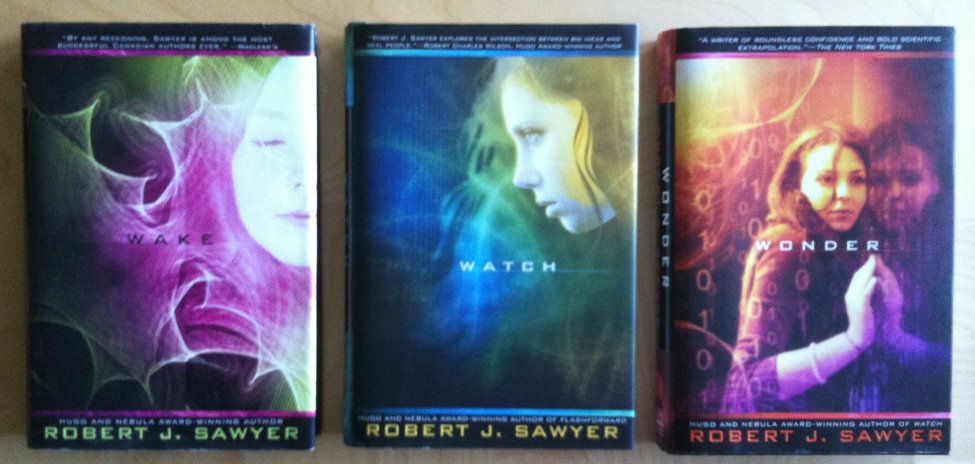
Wake, Watch and Wonder Are Good Books

Or why you should read the WWW trilogy by Robert J Sawyer


There is a tendency in Sci-fi to do dystopian futures with gritty male characters who commit gritty murders. As the record shows I love a good dystopian male murderfest on occasion, but I also enjoy utopian thinky books too. Robert J Sawyer is by my estimation the best contemporary writer of optimistic and thoroughly well researched Sci-fi. He is also a Canadian Sci-fi author who takes great pride in using Canadian characters and settings which is pretty neat (said as a proud Canadian).


The WWW trilogy is a near-future, hard science fiction story about a blind girl and a super-intelligent machine intelligence. The protagonist of the novels is Caitlin, a blind American expat teenager, living in Waterloo Ontario with her academic parents. Caitlin was born completely blind, but due to an experimental optic nerve implant, she gains sight for the first time early in the trilogy. In the process of debugging her new sight-aid to perfect her vision, Caitlin "sees" evidence of an emerging intelligence in the Internet. This emerging intelligence, with the aid of Caitlin, gains sentience, names itself Webmind, and begins to interact with the world... and the story goes on from there.

Of course the books also has some pretty important subplots about Chinese dissident bloggers and the plight of hobo the bonobo painter.


These novels are tremendously well researched and highlight some pretty nifty theories about the development of consciousness, the relationship between vision and thought, and the way the Internet works. On top of these well researched bones are some thoughts about neurodiveristy, growing up, living with a disability, and the existence of a super intelligent machine sentience.  It's the kind of science fiction where you actually learn some things and are introduced to some pretty high concept ideas. 

The novels also, through their use of Americans living in Canada, highlight some of the little quarks of Canadiana that make Canada a distinct place. 


The engines of the book are, however, the characters. Sawyer is a master of creating these vibrant, amazing characters thr you really care about which he uses to ground and drive his higher concept story elements. As much as I'm intrigued about how webmind will change the future of mankind, I find myself engrossed in the day-to-day struggles of the characters: from Caitlin's social life to the plight of hobo the bonobo to the challenges associated with being autistic. It's thought provoking Sci-fi with a big giant human heart. Which, if you think about it, is a great concept since the amazing technology and innovations of Sci-fi really only matter in the context of actual people.

If you enjoy hard Science Fiction and like seeing lovable, complex, and diverse characters I'd sugget you read this book (particularly if you love Canada). If you care more about laser pistols and deathbots... read this anyways because variety is the spice of Arrakis.

Wednesday, 29 August 2012

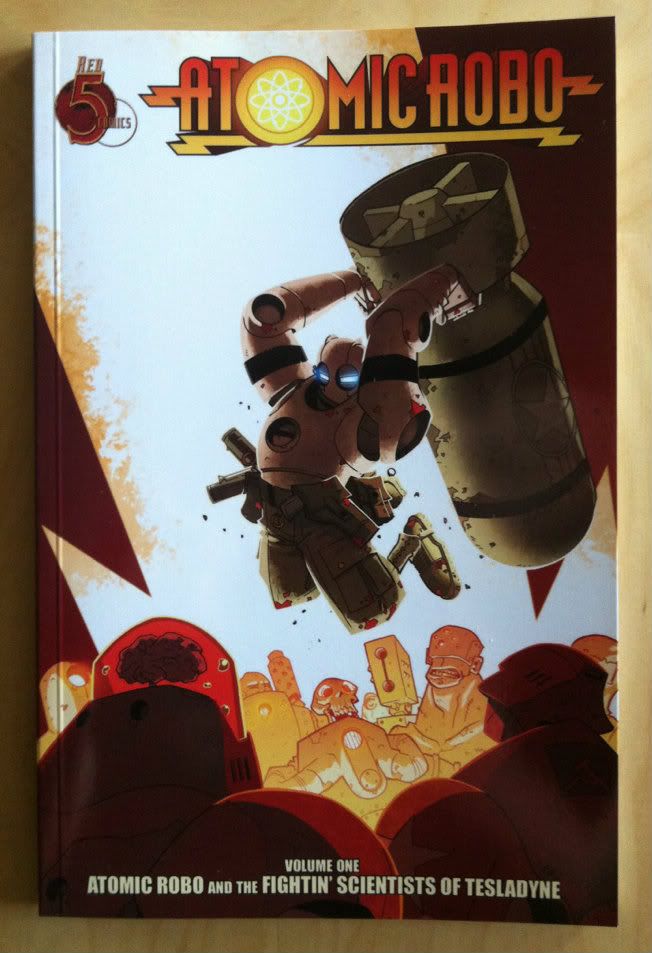
So I Read Atomic Robo and The Fightin’ Scientists of Tesladyne


A 250 word (or less) review of the first Atomic Robo collected edition.
By Brian Clevinger and Scott Wegener, Red 5 Comics


Atomic Robo is a fun comic. Specifically, it is a fun adventure comic with a liberal helping of comedy. In Atomic Robo and the Fightin' Scientists of Tesladyne we follow the adventures of Atomic Robo, a charismatic nuclear powered robot built by Nikola Tesla in 1923, and his team of Action Scientists as they confront paranormal threats. The collected edition works as an encapsulation of the entire Atomic Robo concept: to tell funny, action packed stories set throughout the various time periods of Robo’s life (the 20’s to the Modern day). The upside of this is the comic doesn’t waste time on excessive exposition and can focus on the most entertaining moments in Robo’s life. The downside is that at times some helpful setting information is lost on the altar of Action and that this first trade lacks a central narrative which gives it a schitzophrenic feel (for instance a two issue cliff hanger is left a-dangle).1,2 The balance of this equation, though, is a comic that sees Robo fight Nazi’s, battle cyborg armies, combat giant ants, study a mobile attack pyramid, and take an uneventful trip to Mars… which is pretty great. It also bears mentioning that Atomic Robo is audibly funny. I am not a person prone to laughing aloud at my fiction very often, but Atomic Robo had me snorting up a storm. Celvinger and Wegener have created exactly what they sought to: a funny, action-packed adventure comic. It’s unique, laugh-out-loud funny, and genuinely good comics.

Word count: 249

1: I want to know what happened with the giant mummy robot, damn it!
2: This is mostly an artifact of it being a collection of single issues. Subsequent trades are more cohesive and better. But still, great comics.

Monday, 27 August 2012

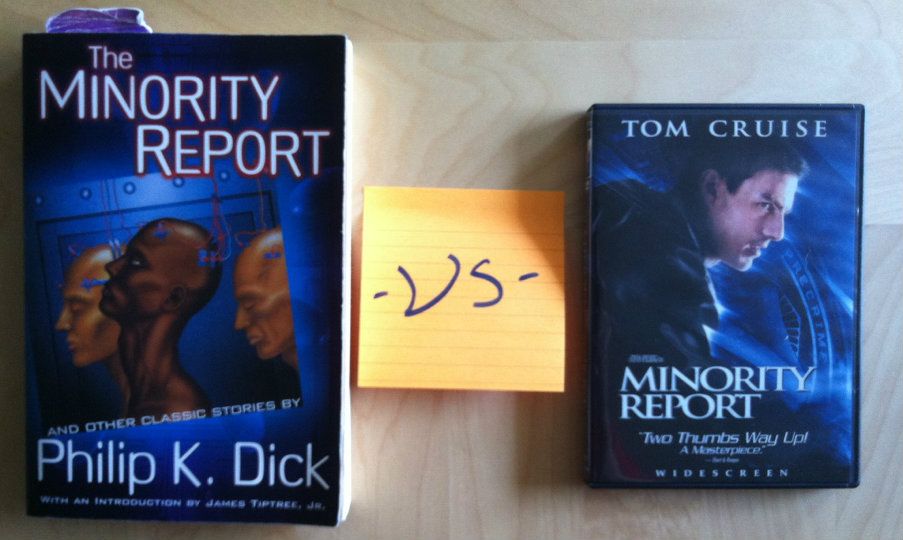
The Minority Report vs The Minority Report

Or a comparison between the source and the adaption.


One of the interesting consequences of having so many different flavours of media these days is that things have a tendency to be adapted between formats. Comics become movies which are adapted to novels which inspire TV shows which spin into new comics. Each media transition often involves different people with different objectives, goals, and creative tastes. Each flavour of media has its own individual strengths and weaknesses. While the core story can never really be completely divorced from its creators or media, I think it's a fun game to compare different versions of the same story and see which I like best.


In the following essay I will discuss and compare the classic Phillip K Dick short story The Minority Report with the Steven Spielberg action film adaptation The Minority Report.


There will be many *SPOILERS* in this article.

My analysis after the cut:


Friday, 24 August 2012

Lights, Camera, Action Comics.

Or how questionable comic motifs have made into our comic book movies.

As a guy who loves comics, Hollywood's current obsession with quality superhero flicks is pretty great. That said, I've noticed some odd choices in some of these films, which at first glance would seem like unusual/practical film choices, but upon closer examination I suspect these are just films attempting to better mimic comic books.

It should be noted that this is going to be *SPOILER*-tastic


The Avengers: You know how the climatic conflict between the Avenges and Loki's invading army took place in a tiny chunk of manhattan which features many of the New Yorkiest locations? I think this was a deliberate attempt to be more comic booky. Sure, an argument could be made that the battle was limited to such a small and familiar location to give it a sense of place and to contextualise the giant CG action (to stop the Michael Bay effect), but I think this is misguided. Instead, think about how Marvel comics are based in mirror world New York and how many superhero fights take place within view of the Chrysler Building, the Empire State Building, Central Park, a New York bridge, the Statue of Liberty or on Coney Island. It's a lot right? The Avengers final fight scenes setting is just trying to stay true to the source material.


"We sure look like Grad Students"
The Amazing Spider-man: I think the choice to cast 20-something actors as teenaged Peter Parker and Gwen Stacey was an attempt to be comic booky. There may be a Hollywood tendency to cast distractingly old actors to play teenagers, perhaps out of a shortage of actual teenage actors with the skill, reputation, or schedule necesary to pull off a tent pole film. I'll concede it's also possile that the studio thought the actors' inherent Peter Parkerness and Gwen Stacey-tude made up for any age issues. But the choice of Andrew Garfield (28) and Emma stone (23) has nothin to do with these studio politicky or creative choices. Instead casting older actors is a tribute to comic book artists tendency to draw teens, especially girls, with adult proportions. I mean, If you look at the comics where Spider-Man was actually in highschool, Peter and Gwen already looked like young adults. So yeah, Amazing Spider-Man is an unexpected tribute to comics art.


The Dark Knight Rises: Gotham is a city of deserted streets for the vast majority of the movie. Is this pragmatic film making designed to cut the costs of many extras? Nope. It's clearly an attempt to mimic the visual tone of comics where the art team minimizes background characters for efficiency.

There you have it, three comic book movies with three questionable comic motifs included. Here's to faithfulness to the original material.

Wednesday, 22 August 2012

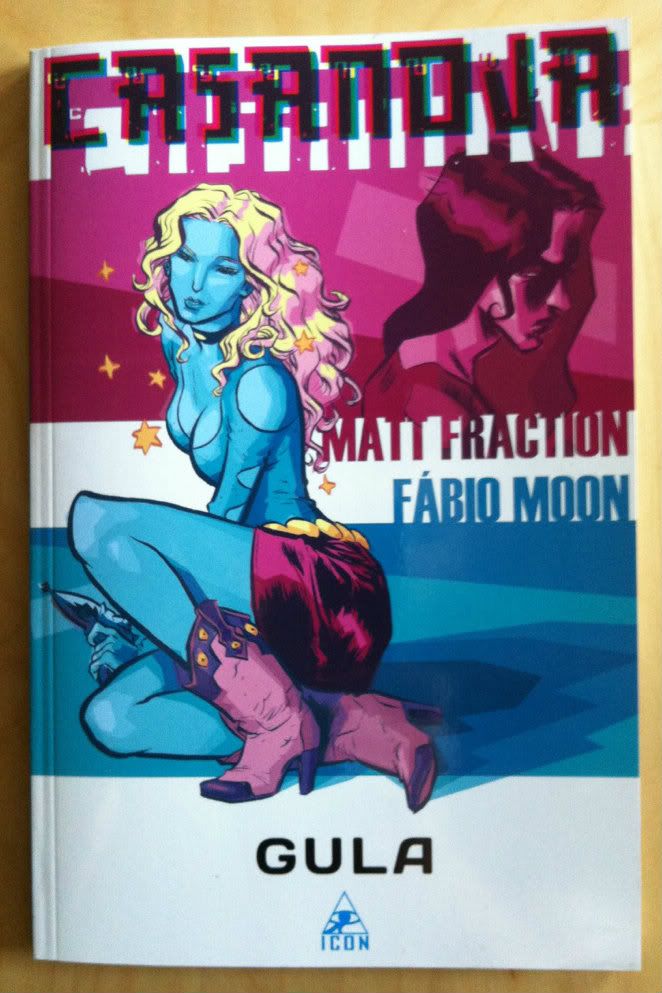
So I Read Casanova: Gula


A 250 word (or less) review of the second Casanova volume

By Matt Fraction and Fabian Moon, Icon Comics


More virtuosic, sexy, smart, fun comics in the Casanova universe. Gula takes place in the same 60's chic, comic book espionage world of the previous book, but this time the plot is built around the mystery of when is Casanova Quinn. Of course, Gula is much more than that (deliberately) shallow plot synospsis. Much like Casanova: Luxuria, this volume functions as a metacommentary on comics as a genre, except this time, instead of using audience/genre expectations to drive the story, Gula subverts them. I guess what I'm trying to say is that the book uses audience preconceptions as misdirection to drive the core mystery. It's very well done. It’s kind of hard to pin-down exactly why I like the Casanova comics so much. I mean, a lot of it has to do with the extremely high quality of story and art… but it’s more than that. There is this ineffable, intoxicating quality to Luxuria and Gula that manages to elevate an already great comic. If I were to describe it, Casanova has that quality that made people lose their minds over the Beatles, or the effect the scent of someone you’re infatuated with has while it claws at your sensory neurons. It’s larger than life in its cool and primal in its delivery. Matt Fraction and Fabian moon, twin brother of Luxuria artist Gabriel Ba, have made one superb comic in Gula and together they pull off one groovy magic trick. Pa-Zow!

Word count: 242

Also, upon rereading Gula, I gotta say Matt Fraction is one cheeky guy.

Previously:
So I Read Casanova: Luxuria

Monday, 20 August 2012

Brian the King Vaughan

Or why Brian K Vaughan and Fiona Staples are the solution to all our comics problems.

There are, in my view, a number of things I wish were better about comic book publishing. In no particular order here are some of the things about comics that I am not excited about:


  • Comic books are really expensive by any metric of content/dollar when compared to other media.
  • Money spent on comics has a tendency of going to support massive corporations instead of comics creators and occasionally comics creators are fantastically screwed by said corporations.
  • The domination of superhero comics as a genre has resulted in a narrower range of comics being produced. There is too little variety in comics today.
  • Comics are produced overwhelmingly by men; there are disproportionately fewer female comics makers and that's kind of crazy-nuts.
  • Artists are frequently swapped in and out in comics so that a greater number of books can be published per unit time. This interferes with establishing a consistent visual tone in books and devalues the importance of artists in the creative process.


recent interview by Brian K Vaughan at the The Comics Beat about Saga has some interesting quotes that make me really very excited:
"Not to brag—maybe a little bit—but the biggest surprise is how much fucking money there is in truly owning your own work."   
"I loved working for my friends at Marvel and DC, and I was always compensated with a very generous upfront page rate, but by betting on myself (and Fiona!) and waiting for money on the back end with Saga, I’m already making way, way, WAY more than what I made on comparably selling books that I wrote for other companies.  And that’s after splitting everything 50/50 with my richly deserving co-creator."
"That cushion blesses me me with a little extra time to give each script 100%, and more importantly, it means we won’t have to use any fill-in artists.  At this stage, I can’t imagine collaborating with anyone but Fiona on this story."
"I don’t know, I guess $9.99 seemed like a pretty fair price for the introductory volume of a new series. Maybe it will cut into our revenue stream, but I’m more interested in getting our story into as many hands as possible than in wringing as much cash as we can out of folks.
Fiona and I would probably be making more money in the short term if we filled the monthly book with annoying ads, or cut the page count down to 20, or charged $3.99 instead of $2.99, but I like to think that giving people more for less buys us a lot of valuable reader loyalty in the long run." 
So by my estimation, Brian K Vaughan and Fiona Staples seem to be solving a bunch of my comics problems with Saga:

  • The Saga 1 trade paperback (which I want THE MOST) will cost $10 for 160 pages. That is insane value! Trades generally run ~$20 for 120 pages, so this book is more than twice the value of most books on a purely content/dollar basis. Also, unlike most high-page-count-but-low-cost projects this one has full colour pages and is made by VERY A-list creators. So not only is it a lot of content/dollar but it's a lot of top quality content/dollar. 
  • Apparently, BKV and Staples are making pretty good money off the project despite charging substantially less for their books than typical ($2.99 for 30 page monthly, $10 for trades). It's just great when I as a consumer can both save money AND get more of it into the hands of creators AND still get a great product. This is the kind of success story I can get behind.
  • Saga as a book (from what I've gleaned) is an ambitious space opera/ science fantasy epic about family which is some nice non-superhero variety in the comics. The fact that this is a very successful book without being 1) superheroes or 2) zombies makes me pretty happy.
  • Fiona Staples is an incredibly talented artist who just happens to be a woman. The more rockstar female creators in comics at this point the better.
  • The importance of Staples to the final product is fully acknowledged both in the fact the books schedule is built around her ability to make the artwork, and in that she is receiving a fair share of the windfall from it.

Hyperbolic claims about BKV and Staples saving comics aside, I think it's really exciting that a high quality, original, indpendent book by top tier creators is doing so well. It's even better when this success comes with all the things I just discussed. I can only hope that Saga continues to make a splash and the comics publishing community takes some lessons from it.

Of course, Brian K Vaughan and Fiona Staples are not exactly any-avergae-comics-person. Their sales numbers don't exactly reflect the reality for a lot, or even most, independent comics makers and few people have the perennial selling power, cross media clout, or raw talent that Vaughan does. So, I'm not sure the awesome reality of their publishing experience is the beating pulse of everyone. But it's encouraging and, who knows, maybe some of it'll catch on?

Regardless, I am SO excited for Saga Volume 1. Waiting is killing me. 


Friday, 17 August 2012

Heart Attack!

Or the implausibly plausible Science in the Heart of Hush storyline by Paul Dini and Dustin Nguyen


Two of the things I love in this world are comic books and Science. Sometimes I like to write about both. This... Is one of those times.


In a recent post, the internet's foremost Batmanologist Chris Sims panned the character of Hush, criticized his origin and also the "Heart of Hush" storyline. Critically he dismissed the latter story for its entertainment value as well as its Scientific believability. I am here to tell you, in my capacity as an actual heart scientist, that as far as comics go, it's actually not too unbelievable.


Okay, gotta lay some caveats and addenda down here. While I might tease Mr. Sims for his knowledge of heart Science/Medicine, his Batman knowledge is encyclopedic and incredible and his taste in comics is impeccable. His thesis that Hush is a silly character with bizarre motivations and contrived story uses is totally correct. Hush stinks. The Hush origin books, while visually appealing are derivative and ultimately a base amalgam of much better comics. And yeah, the Heart of Hush storyline, wherein Hush literally steals Catwoman's heart is pretty ridiculous. (Although, I thought the Catwoman-Batman love story part of it was kind of nice; much better than the anatomically bizarre rooftop fucking of the New 52.)

The crazy thing is though, is that the Sci-fi of the story (Hush surgically removes Catwoman's heart, then keeps both Selina Kyle and her heart alive with machines, after which her heart is replanted) is actually not as far fetched as you might think.

A Scientific discussion of the Heart of Hush storyline after the cut: