Or a look at the use of vertical height and time in Octopus Pie
by Meredith Gran
A thing I find interesting is how the limitations of a media shape the way stories are told. In the case of print comics there are obvious limits imposed by the physical nature of the product: comics are expensive to print, so that page sizes and issue lengths are dictated in part by the economics of making the thing. The physical nature of comic books also dictate that the books have sequential pages. This effects the flow of time such that it flows page to page through the comic and also adds all kinds of nifty clipping and cutting effects between pages. There are just endless ways the form of print comics effects the reading experience.
The same is true for webcomics, but in different frequently interesting ways.
In particular, I want to talk about Octopus Pie by Meredith Gran and some of the nifty things she is doing with vertical space in her comic to play with time.
Specifically, I'll be talking about this comic. While Octopus Pie has lots of fun examples of this effect, this comic is maybe the most extreme example and really emphasizes just how far this effect can be taken. You should definitely go read the thing before we get started. (I'm not going to post it here because it is giant, so please follow the link.)

Unlike print comics, which are constrained by page size, webcomics are constrained by browser resolution and the way computers navigate. Essentially webcomics have a fixed width that will fit comfortably in a browser window since scrolling sideways is weird. At the same time there is practically no vertical direction limits: scrolling up and down a page is very intuitive and easy which means that even a very tall comic feels natural and readable. Webcomics are also free of printing costs or the physical constraints of different printing formats, which means that there is no reason to be locked into a particular height of comic (except probably the time it takes to draw comics of varying lengths). What this means is that storytelling space in a webcomic can be as tall or short as a creator wants and can even vary between instalments to do some nifty comics.

Octopus Pie uses this vertical freedom to play with time. The webcomic uses space as a surrogate for time (like pretty much all comics). Due to horizontal constraints, this space-time-continuum exists mostly in the vertical direction where there are no practical limitations. In this comic Meredith Gran really stretches this space out to make a comic about routine and ennui and dealing with heart ache with time. The comic stretches, and stretches down the page with snippets of moments in a grand repetitive routine. It's really effective stuff from a purely use of space front. It is also really cool because of the tactile experience of navigating the page: such a tall webcomic requires readers to stroke trackpads or whatever making the navigating the page an actual effort, a kind of ersatz exercise that mirrors the jogging in the page. It's like the touch equivalent of using eye guiding to create emotional resonance. It's super cool comics.
Or here are some webcomics you might enjoy.
Before I was reading print comics I really enjoyed web comics of the joke-a-day variety. As an internet savvy undergad I enjoyed how accessible the comics were and how free to read they all were. Three panel strips about lulz video games and angsty heart ache where a fun way to kill five minutes before a class started on my brand new, first ever laptop, or something to ease myself into a study session on the pretty brutal library PCs before that. All of these webcomics were fun at the time, and I will forever hold the time spent reading them with a special nostalgia.
As time has gone by, I've fallen out of love with most of what I was reading. I stopped giving craps about video games or realized that the sort of edgy sexy comedy comic is actually wildly problematic. I saw comics I like end as the creators moved on to new, better paying projects. I saw comics get mired in bland repetition, or slow to an update schedule that was unforgivable, or just fade away. In one case I watched a creator clearly experience a break with reality. In another I watched with grim fascination as the geeks became business men who became just kind of total assholes. And in some cases my tastes just changed.
But there are still a few stalwart, regularly updating strip-style webcomics that I still absolutely love and think you might really enjoy. So, here are some Webcomics I can recommend without reservations:
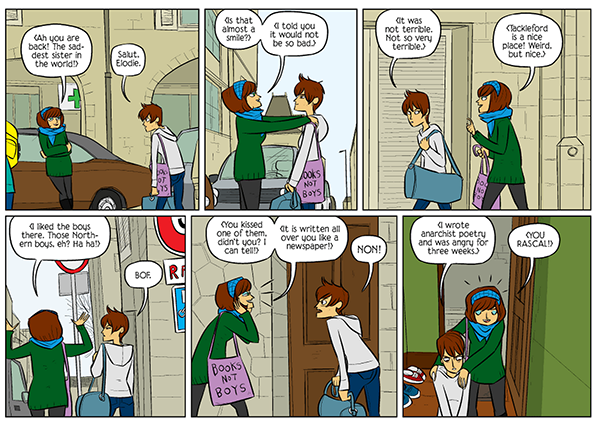
Scary Go Round by John Allison: At the moment, I think the enterprise is called Bad Machinery, or maybe it's Bobbins (the new Bobbins, not the original one). It was just Expecting To Fly. It is sometimes Murder She Wrote and Giant Days, except now Giant Days is an ongoing from Boom Studios. For me, though, it will always be Scary Go Round. Or maybe more accurately, the amazing comics of John Allison. Because really all of the stories are at least loosely connected with each other and span, wow, probably at least a decade of storytelling. The Scary Go Round comics show a pretty impressive range of stories and characters but generally centre around the fictional northern English town of Tackleford and often involve some sort of Sci-fi or supernatural MacGuffin to drive the plots. (A favourite chapter for instance features The Boy (Le Garcon!) on a French exchange where he must resist his extra-relationship feelings for a cute French girl and expose the new French Easter Bunny as a Wendigo in disguise). Scary Go Round (etc) is just filled with fun, uncouth stories filled with wonderfully developed characters and a weird and inane sense of humour coupled to some of my favourite cartoon art in the world. It is endlessly fun and I cannot recommend it enough. Updates Mon-Fri and sometimes more.
Jumping on points:
Recent continuity free Scary Go Round story: Expecting to Fly
Fairly recent reboot focusing on new characters: Bad Machinery
Favourite older Scary Go Round stories: Giant Days and The Bell

Octopus Pie by Meredith Gran: Remember those earnest television cartoons from our Millennial Youths? Those fun, but really dramatic cartoons that followed young teens as they learned about life largely by making mistakes? Well Octopus Pie is like the adult equivalent of these deeply important cultural artifacts. It stars a pair of 20-something women and their friends living in Brooklyn and trying to figure out life. But not in like, a super precious way: Octopus Pie has a certain self-deprecating charm that stops it from being obnoxiously twee. While Octopus Pie starts as a Nerds-vs-Stoners odd couple story, it grows and evolves into a story about really well developed young adults struggling with under-employment, being cash-strapped, relationship angst, and just generally being emotional dummies. I find the comic relatable, funny, and just filled with first-world tragedy and cathartic mini-triumphs. It's great. Updates once or twice a weekly usually.
Jumping on points:
The current storyline is mostly easy to pick up and is in colour: Go HERE.
A classic story that serves as a good intro to the world: Couch Sitter
A personal favourite of mine: Skate or Don't
Gunnerkrigg Court by Tom Siddell: Not all strip comics have to be humour focused. Gunnerkrigg Court is a strip based, serialized comic about two girls at a weird boarding school filled with magic and mad science and mystery. The plot centres around the two girls, Antimony Carver and Katerina Donlan, as they grow up, discover their aptitudes, and become embroiled in the complicated and contentious relationship of the structured Court and the surrounding magical denizens of the Forest. Gunnerkrigg Court is all ages in the best ways and is filled with humour, wonder, and discovery. The art is quite nice and is constantly evolving and growing along with the characters and writing. It's fantastic. Updates M-W-F.
Jumping on points:
Honestly, as much as the comic improves as it runs, I think you need to start this one at the beginning: Go HERE.
The Perry Bible Fellowship by Nicholas Gurewitch: This comic barely updates anymore, but for me it will always be, like, the ideal of gag strips. The comic features beautiful artwork and a warped, transgressive sense of humour. PBF also is maybe the best comic I've read at quickly establishing premises and delivering unexpected, clever punchlines. Every joke is different and worth at least looking at. Updates "wheneverly" and rarely.
Jumping on points:
Every joke stands alone so go to the home page (HERE) and just mash the "random" button and enjoy.
Post by Michael Bround
Previously:
Stuff I Like: Podcasts
Or how variety in comics is amazing and generally a good idea.
I spend a disproportionate amount of time trying to get friends to try reading comics. Most of this stems from the fact that I really, really enjoy reading comics and want to share that experience with the people I care about (as any good geek should). Part of this is maybe also motivated by the fact that I don't really have any comic friends, so it would be cool to convert a friend or two. But on a far more mercenary level, I think convincing a friend to read, and to maybe even buy comics is important for comics as an industry.
Comics, as we try to avoid thinking about, are a commodity. Comics creators are a kind of artisan that produce a specialized commodity for a niche consumer. Publishing companies, some merely facets of giant multinational media empires, act as merchant/distributors and bring the commodity to a retailer (a comic shop/bookstore/web ap/whatever) who then sells the product to consumers. As much as creators, publishers, and retailers are all important cogs in the comics machine, there would not be a comics industry without consumers. (I mean, I'm sure some people would still make and share comics they made for fun... but business-driven professional comics require someone to eventually buy them.) To a certain extent, the pool of comics consumers, the market for the weird, amazing commodity that is comics, dictates how much comics can viably be made and supports the people that actually make the things we care about.
In that light, bringing in new comics readers increases the size of the comics market and, as such, increases the amount of money available to comics which thereby increases the amount of comics that can/will be produced and the amount of money that eventually reaches creators (who are great). I know that in the years since a friend of mine slipped me a disk of bootleg comics in an Integral Calculus class I have spent THOUSANDS of dollars on comics and as such I have contributed to the continuance and manufacture of more comics. The way I figure it, every friend of mine I can convince to read and purchase comics represents money that is being fed into the comic machine that would otherwise not be there.
(And yes, my friends often liken me to a drug dealer.)
So back to convincing my friends and loved ones to try reading comics. I have found that most people are not interested in reading superhero comics. It's not that Superhero comics are stigmatized, really, it's that they are a known (or presumed to be known) quantity. Everyone thinks they know what Superhero comics are and has an opinion concerning whether or not they would like to read them. (And I would argue that everyone who is interested in reading superhero comics basically already is, and if they aren't, it isn't very hard for them to change that.) As a result, I have found that the trick to convincing people to try reading comics is to present them with the kind of smart, mature, well-written and beautifully drawn non-superhero comics that most people don't know or appreciate exist.
Almost universally, I have found that Y The Last Man is a perfect first comic to spring on the kind of people I am friends with. The comic has a very accessible and addictive script: it has a compelling central mystery and rolls out a relentless series of cliff hangers that keeps readers glued to the series. Moreover from a writing perspective, the comic manages to present extremely well realized, likeable characters, a snappy sense of humour, and a maturity and level of discourse that civilians are frequently surprised to find in comics. Paired with this is really accessible art: on the one hand it looks nice and services the story well and on the other it has a low panel count in conventional layouts and really doesn't experiment too much. Y The Last Man is also kind of the perfect length for a first comic reading experience. It's not so long that new readers burn out, but still long enough that they get to experience a fair amount of comics before reaching the end. Basically, Y The Last Man is a perfect storm of comics for new people.
That said, in my experience everyone has a different taste in media and wants slightly different things from the experience of it. Part of what makes Y The Last Man such a powerful gateway comic, beyond its execution, is that it manages to straddle a lot of genres and emotional responses simultaneously. Everyone I have ever lent it to has enjoyed it, but frequently for slightly different reasons... and from those responses come critical information about what comes next. And this is where variety (and hence the title of this blog entry) comes in.
(That didn't take a long time to get to at all...)
One of the more successful comic conversions I've had is a coworker I'll call subject A (one that has actually resulted in a comics purchase!). With this person I started with Phonogram which yielded pay dirt with The Singles Club but not Rue Britannia (which was too myopic for her). I then leant her Y The Last Man which she DEVOURED as fast as I would lend it to her. She then tried and enjoyed Scott Pilgrim, the output of Faith Erin Hicks, and Chew. She finally tried Julia Wertz's The Infinite Wait and Other Stories and was blown away and went and bought her first comic in Drinking at the Movies (well second comic, she gift-exchange-stole The Manhattan Projects: Science Bad. at our work Xmas party). She is currently slowly working her way through the Runaways and Octopus Pie (which she quite enjoys). Basically, she likes fun, humorous not super-intense comics that she can relate to.
A similar success story comes from a guy on my soccer teams... who I will call Subject 2. He too devoured Y The Last Man when I leant it to him. From there I tried giving him Chew... which he thought was too ridiculous and silly. So I leant him Criminal, which he apparently likes a lot and is slowly reading in fits and starts. While I am still figuring out what Subject 2 is really into, it seems he likes intense, realistic, page-turning comics.
Which is all proof that not everyone wants to read the same kind of comics. Moreover, it is evidence that the people who are not interested in Superhero comics immediately may be interested in other comics, and that finding what comics they like is mostly a matter of finding what genre of fiction they enjoy. And this is where variety comes in: the more KINDS of comics that are being made, the more likely a new reader will be able to find a comic that fits their media needs exactly (or the more likely I will find that perfect comic to force on my friends).
To take this idea a step further, maybe the way we can expand the audience, and therefore the market, for comics is not by making better and better and better superhero comics, but by making ALL KINDS of different comics. That way everyone can find the comic they want to read. And who knows? Maybe that will lead to them trying a comic.
And then another.
And another.
Previously:
Variety is the Spice of Comics Pt. 1: Pony Up
Variety is the Spice of Comics Pt. 2: Year in Review


