Showing posts with label The Unwritten. Show all posts

Wednesday, 29 April 2015

So I Read The Unwritten: The Unwritten Fables

Or a 250 word (or less) review of The Unwritten Vol. 9
by Mike Carey, Bill Willingham, Peter Gross, Mark Buckingham, Steve Leiahola, Inaki Miranda, Russ Braun, Dean Ormston, Chris Chuckry, Todd Klein; Vertigo Comics


This review is on part of an ongoing series. For a *SPOILER* free review of the first issues go here. But, this comic has like, nothing to do with the series proper, so you should be fine to read the review.


Once upon a time I read a pretty big chunk of Fables, something like the first 7 trade paperbacks. I found them endlessly charming, filled with adventure and romance and just enough tragedy. I remember this time fondly and have always meant to get back to the series. But, man, judging from The Unwritten Fables, Fables proper has gotten fucking bonkers. The Unwritten Fables is a crossover comic between The Unwritten and Fables, two comics that have no real overlap. In the comic, Tom Taylor, the maybe-a-fictional-boy-wizard hero of The Unwritten is waylaid by the fables of Fables and drafted into their war against Mister Dark, AKA the Bogeyman. Tom Taylor is transformed into his boy-wizard-self and, along with the desperate surviving Fables, mounts a last, cataclysmic stand against their all-powerful foe. And this comic sucked. If you read this blog, you know I try to be nuanced in my criticism, but this comic is a creative failure.  It fails as an Unwritten story since the story doesn’t advance the series plot. It better have failed as a Fables story, or been a what-if for that series, because it's fucking bonkers. It fails as a crossover because the comic lacks all the smart nuance of the Unwritten and the charm of Fables. I cannot imagine picking this comic up, as a fan of either series, and being tempted to try the other title. The art was frequently terrible and rushed.  This chapter feels like a betrayal of long-term Unwritten readers.

Word count: 250

Post by Michael Bround


Wednesday, 23 July 2014

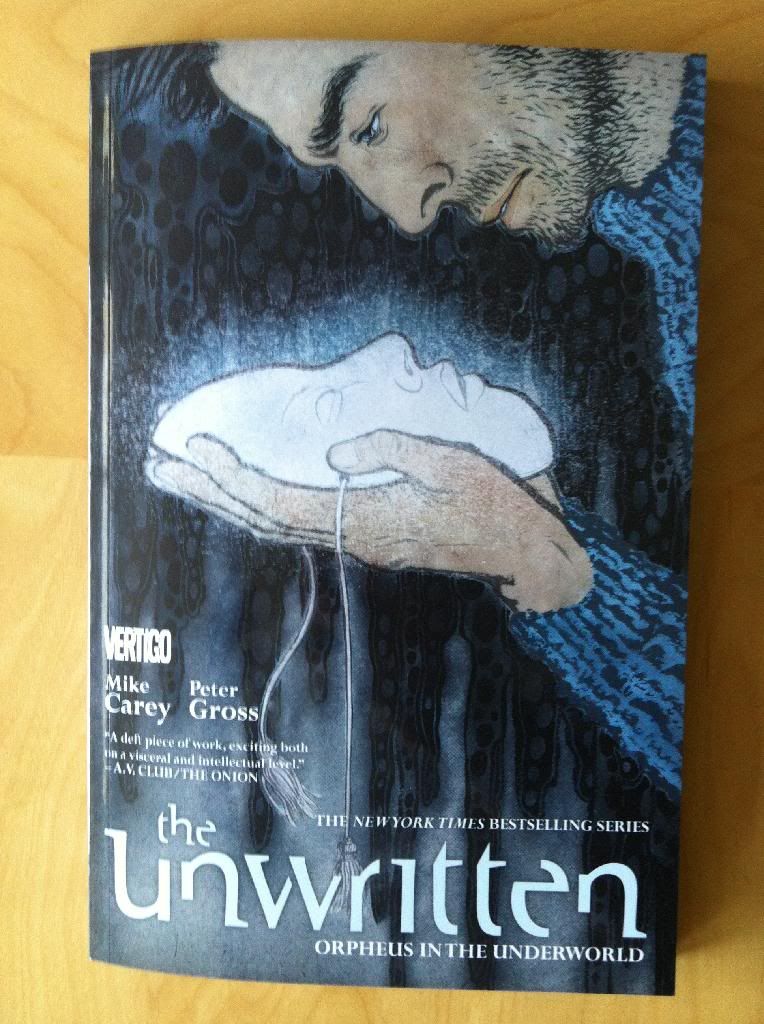
So I Read The Unwritten: Orpheus In The Underworlds

A 250 word (or less) review of The Unwritten: Volume 8
Mike Carey, Peter Gross, Dean Ormston, Chris Chuckry; Vertigo Comics


This review contains *SPOILERS* for previous chapters of The Unwritten. Click here for a clean review of earlier collections.

The Unwritten is the ongoing saga of Tom Taylor, the grown up inspiration/embodiment of a beloved childhood fictional wizard, who used the literal magic of stories to unseat the cabal who had been controlling the world by manipulating fiction. Orpheus in the Underworlds picks up after this in a time when Leviathan, the living embodiment of human imagination, is gravely wounded and the barrier between the real and fictional worlds is breaking down. The focus of The Unwritten: Volume 8 is the story of Tom harnessing the power of story to travel to the Underworld so that he can rescue Lizzy Hexam, his fallen comrade and lover, and bring her back to the world of the living. It's a chapter that reunifies many of the ongoing plot threads and advances the story of a surprising number of Unwritten characters. Orpheus in the Underworlds really feels like the Unwritten is gearing up for another epic long haul. That said, this chapter, with its return-from-the-dead subject matter also plays a risky game: part of what I like most about the Unwritten is the stakes... and bringing characters back from the dead hurts this aspect of the series. I am also dubious of the crossover (kind of?) with Fables hinted at: crossovers are not what I want from The Unwritten. Orpheus in the Underworlds has a lot to like and shows a lot of promise moving forward, but also makes me worry that maybe the series has overshot its organic ending...


Word count: 248

Previously:

Monday, 3 June 2013

So I Read The Unwritten: The Wound

A 250 word (or less) review of The Unwritten Volume 7
By Mike Carey and Peter Gross; Vertigo Comics


This review will contain numerous unavoidable *SPOILERS*. For a *SPOILER* free review of The Unwritten go here.


The Unwritten is a comic series about the power of literature and fiction to shape societies. The series centers around Tom Taylor, the real life inspiration for a Harry Potter-esque boy wizard novel series, as he learns to tap into the power of the Leviathan, the personification of humanities collective imagination. The previous collection, Tommy Taylor and The War of Words, felt like the end of an act: Pullman was defeated, the cabal was damaged, although the victory was tempered by the apparent demise of Lizzy Hexam and wounding of Leviathon. In short, it was the end of many of the comics established storylines. The Wound picks up a year after the events of the previous six collected volumes and picks up with Tom and Pulitzer Prize winning Vampire, Savoy trying to heal an injured Leviathon and save Lizzy Hexam. The Wound also introduces us to "Didge" Patterson, an Aborigines detective from Queensland, who is investigating a Tommy Taylor cult and Daniel Armitage, a former member of the Cabal, looking for a new life, as they are brought into the crazy world of Tommy Taylor.  In many ways The Wound is the start of a new story set in The Unwritten. I was concerned that The Wound would feel like a tacked on sequel to a series that should’ve ended, but I’m pleased to report that this collection feels like a natural progression of the story. If you’ve enjoyed the comic thus far, The Wound should please too.

Word Count: 247


Friday, 24 May 2013

Spinal Tapestry 3: Reading Rainbow

Or the under-appreciated art of comic book spines

Book spines are, I think, the most overlooked component of book design in collected editions of comics. Whether because of all the emphasis placed on cover pages or the comic industry's infatuation with staple bound invertebrate single issues, comic spines don't generally get the love they deserve. Which is a shame, because in most settings, be they home bookshelf or retail bookshelf, the comic spine is the only part of the comic visible. Ignoring this portion of the comic's exterior hurts a print comics value as an art object (which I think is one of the key value-added features of the print format) and probably has an adverse effect on a comics retail performance. Paying attention to it can make comics look great and stand out from the crowd.

When dealing with long comics series in collected editions, I think one of the key design choices that can really improve the look and visual impact of a series is a unifying design. By tying individual books together with common elements, a series gains an identity and becomes instantly recognizable as an aggregated whole. Generally, one of the keys to this seems to be choosing a few colours to give the comics a harmonious relationship. By wildly varying spine colours, you can pretty much ruin the look of a series.


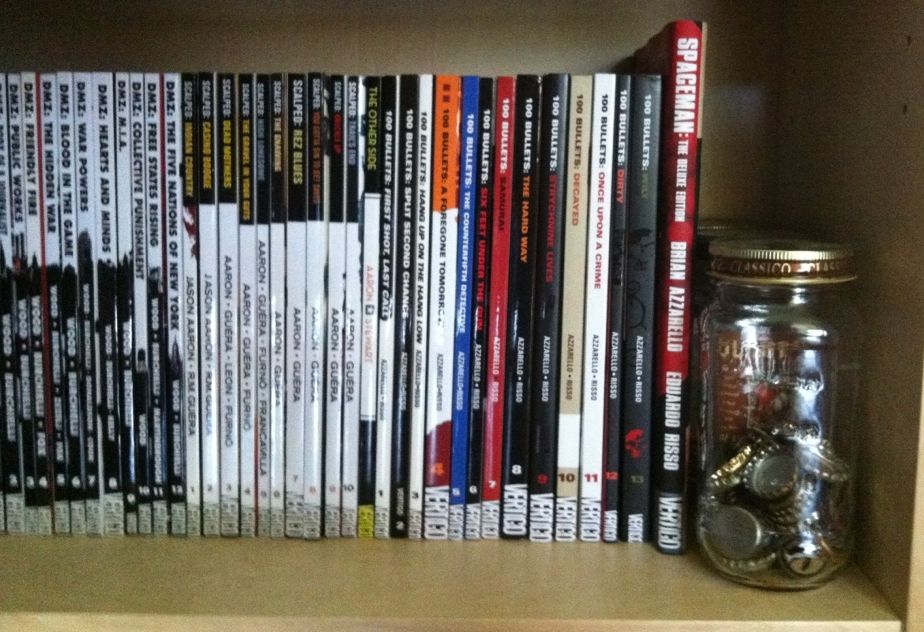
100 Bullets, by Brian Azzarello and Eduardo Risso,  is a fantastic crime comic about the opportunity to avenge injustice wrapped in a grand conspiracy. The interior of the comic is gorgeous, absolute brutality drawn with precise elegance by Risso, and the covers of the series (including these collections), by Anthony Johnson, are perfect. That said, the spines of this series are terrible. It seems the choice was made to make the spines of the 100 Bullets collections entirely dependent on cover art, which makes the spines lack identifiable common elements or common colours. When put next to the clean, unified design of Scalped, or the brilliant design of DMZ, 100 Bullets looks like a mess of random comics instead of a lovingly appointed series. And I think it's shelf presence suffers for that.


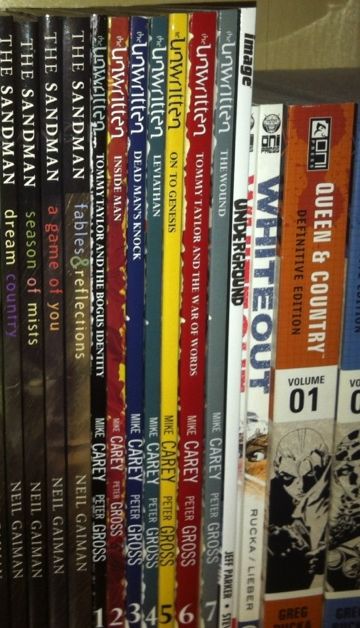
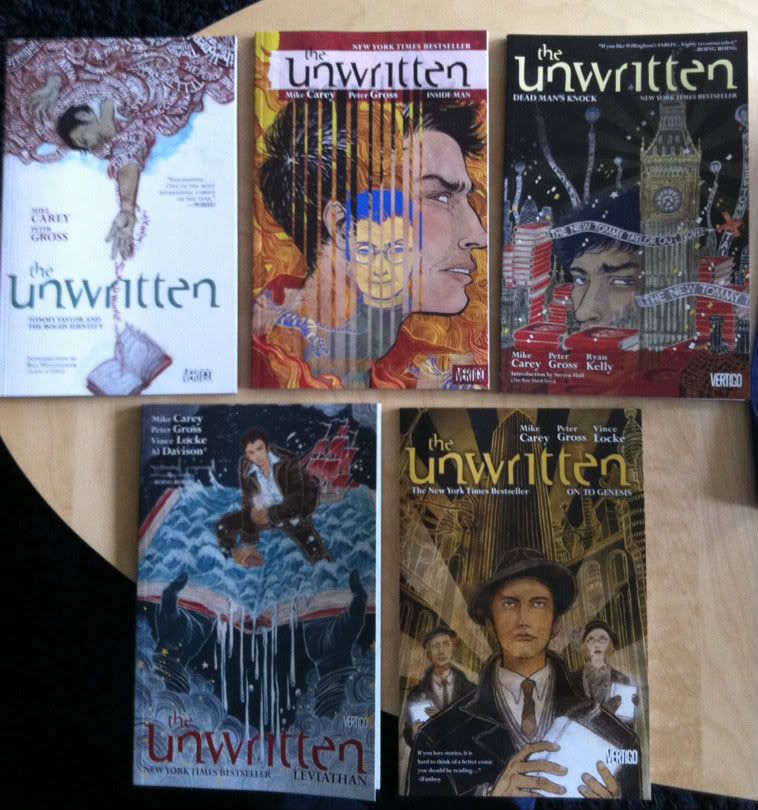
The Unwritten, by Mike Carey and Peter Gross, is a great comic about the power of literature to affect society and people with the bourgeoning power to tap into it. The Unwritten is also another comic with great interior art and superb covers, by Yuko Shimizu, but poor spine design. The Unwritten makes that fairly common mistake of giving each edition its own colour to make a rainbow effect. The problem is that this breaks up any cohesion over the entire series and doesn't really tell us anything about the identity of the Unwritten. Varying colours like this is almost never the best choice.


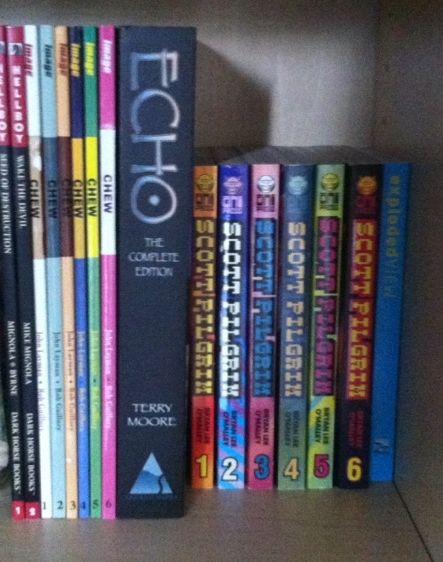
But like all rules there are exceptions. Scott Pilgrim and Chew are two comics that absolutely break what common sense suggests is good book design. They use bright, obnoxious colours that change and clash between books. And while they do maintain common elements between books (Chew's cutout and Scot Pilgrims weighty logo), their overall look is just garish as hell. The thing is, this WORKS for these comics. Chew, by John Layman and Rob Guillory, is an insane comic about people with mental food powers solving ridiculous food crimes: the plot is crazy, the art is bombastic and cartoony, and the aesthetic of the book is frankly pretty garish. So a cover spine design that clashes between issues and uses bright, cartoony colours completely sells the identity of the book. Similarly  Scott Pilgrim, by Brian Lee O'Malley, also has a cartoony look and bombastic style. Scott Pilgrim is a comic about being brave enough to love while being an adrift 20-something, and has a style influenced by manga and 1990's video games that is just really inviting and fun. The spines of the Scott Pilgrim books, with their garish bright colours, manga-ish book size, and pixelated logo font absolutely evoke the visual identity of the book. What I am saying, basically, is that these comics, by having insane cartoony spines,  are able to convey their visual identity instantly. And that is, I think, the core of book design.

Previously:
Spinal Tapestry 1
Spinal Tapestry 2

Wednesday, 13 March 2013

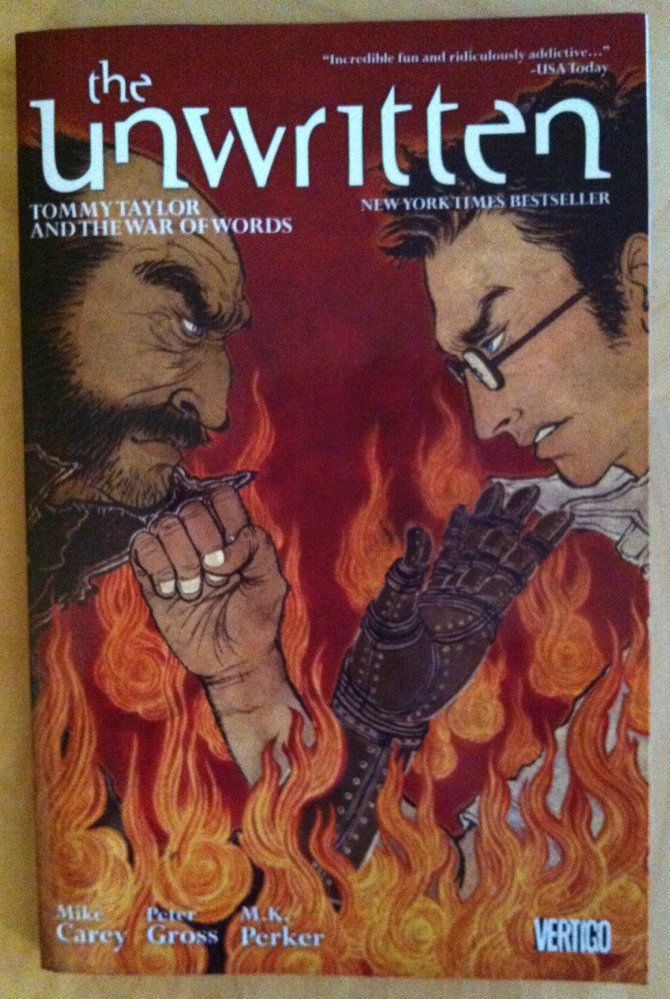
So I Read The Unwritten: Tommy Taylor And The War Of Words


A 250 word (or less) review of the sixth trade of The Unwritten
By Mike Carey, Peter Gross, MK Perker, Dean Ormston, Vince Locke, Michael MW Kaluta, 
Gary Erskine, Rick Geary, Bryan Talbot, and Gabriel Hernandez Walta; Vertigo Comics

(This review contains mild *SPOILERS*. To read a *SPOILER* free review of The Unwritten: go here.)


The Unwritten is a comic about how stories shape human societies and the struggle to control this power through literature. Specifically the comic series focuses on Tom Taylor, the real life inspiration for a Harry Potter-esque boy wizard, and his fight to destroy a Cabal who have been manipulating the publishing industry for centuries. Tommy Taylor And The War Of Words tells the story of Tom Taylor taking the fight directly to the cabal and represents the climax of many of the comic’s ongoing storylines. The core story is action-packed and the explanations and resolutions provided in this collection are overall quite satisfying. Carey and Gross also tell the origin stories of many of The Unwritten’s villains and supporting characters interspersed between main chapters. Much like the main chapters, these origins are well written and really pay off ideas established elsewhere in the series. To keep the dramatic main plot ticking away while still telling elaborate origin stories, Carey and Gross resorted to double publishing The Unwritten during the time span collected in Tommy Taylor And The War Of Worlds. This publishing strategy necessitated fill-in and finishing artists for Peter Gross. The resulting art is still very nice and overall manages to closely match Gross’ style but occasionally enters this uncanny valley territory of looking ever-so-slightly off… it’s a little like a peripheral vision distraction. Still, Tommy Taylor And The War Of Words is a great comic in a great series. I have no idea what comes next.

Word count: 248

Previously:

Saturday, 2 June 2012

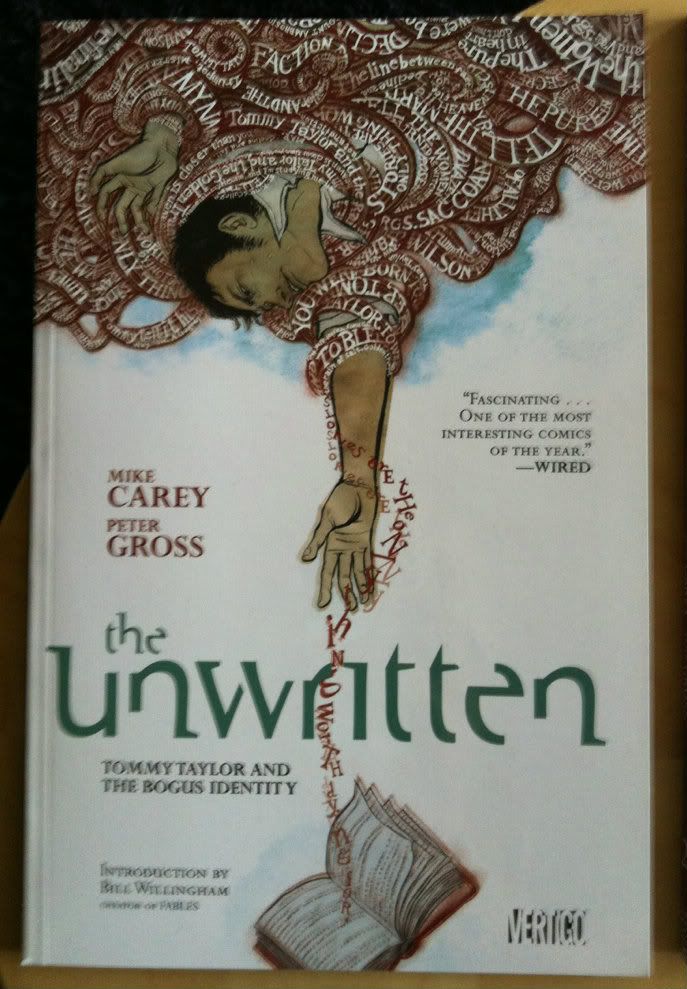
So I Read The Unwritten


Art by Yuko Shimizu
A 250 word (or less) review of Trade Paperback collections 1-5 of The Unwritten
By Mike Carey and Peter Gross, Vertigo Comics

The Unwritten, created by Mike Carey and Peter Gross, is a work of fiction that manages to provide both a compelling story and a meaningful meditation about a broader cultural concept. The protagonist of The Unwritten is Tom Taylor, a man who, as a boy, provided the namesake and inspiration for a series of young adult novels about a child wizard (who bears a remarkable similarity to Harry Potter).  The story follows Tom as he learns he may in fact be the novel’s title character made flesh and centers on a conflict against a secretive cabal that has clandestinely manipulated society for centuries by controlling literature. This engrossing mystery/suspense plot is used as a vehicle to explore how literature affects society by informing the worldview of the collective cultural unconsciousness and how we construct stories to define ourselves.  Suffice it to say Mike Carey’s writing is very smart. Peter Gross’ pencils are pretty great as well, providing a clean and expressive style that is a perfect match for the script. The issue covers by Yuko Shimizu are pretty amazing: easily some of the best covers in comics and are well worth a look. The Unwritten is also a feat of compressed storytelling as there is a truly remarkable amount of content per page (at one point that the creative teams makes a choose-you-own-adventure style comic that simultaneously tells multiple storylines). There is also a subplot about a rabbit who says horrendously vulgar things while trapped in a children’s’ storybook. 

Word count: 249