Showing posts with label Avengers Assemble. Show all posts

Friday, 25 April 2014

Atoll Comics Round 14

Or changes to my Top-Ten comics

Due to poverty and an urge to buy better comics, I have decided to be super-selective about which superhero comics I read. Harnessing the Awesome Power of Maths, I have determined that I can afford to read 10 ongoing titles. So I get to read 10, and only 10, titles published by either Marvel or DC as well as one trade paperback a week of my choosing.


A complication of this is that I am forced to drop an on-going title if I want to try reading a new on-going title, an act of very tough love. Being financially responsible is the worst.

I will be adding Secret Avengers and dropping Avengers Assemble.


Why Secret Avengers: The short version is that I read Zero, a really gripping Super-espionage comic, which featured work by Ales Kot and Michael Walsh, and it was really good! And seeing the pair of them working on a Super-espionage team comic with wonder-colourist Matt Wilson seemed like something worth trying. And man! What a fun comic! The first issue of the Kot/Walsh/Wilson era was filled with zany hijinks including space battles, a spa day, and Hawkguy-Hawkeye complete with Hawkblocking (and Spider-slipping). Despite the Zero pedigree, a comic with its share of fun but also some deeply disturbing shit, Secret Avengers actually felt more like Fraction/Ba/Moon's Casanova, another super-espionage comic with groovy overtones, a personal favourite comic of mine. (This might be largely due to Michael Walsh having a similar style to Fabio Moon or that MODOK reminds me a lot of Ruby-Berserko.) The point here is that Secret Avengers is a fun, crazy espionage comic that should be an accessible place to get your team-book fix if you are not really digging the more continuity heavy Avengers books. Pa-Zow!


Why not Mighty Avengers: It's another beloved comic that has sadly bit the dust. At its best, this comic was exactly what I wanted from a team book: it played with the marquee characters in a continuity light, fun way. While it was solid throughout, Science Bros, the opening arch of the DeConnick era, is, for my money, the best damn open-and-close team comic I've ever read. Magically, it was also great for new readers: it was, after Hawkeye, the first Marvel comics some of my friend's read and they all understood and enjoyed Science Bros. Which is a pretty big accomplishment. People looking to write an accessible, fun comic for new and established fans ought to delve into Science Bros like architects because there is gold in those crypts. What I don't understand is why this is the Avengers title that was axed: it offered an understandable landing pad for new readers who know that The Avengers are a thing and want a comic to try, but are not versed in continuity malarky. I get that the main Avengers titles are geared towards core readers (because they should be!), but it's nuts that Marvel can't offer a Avengers Assemble style, new reader friendly book in it's publishing line. But yeah, sad it's gone, and if you haven't yet, check out Science Bros.


Friday, 16 August 2013

Examining The Enemy Within Crossover

Or on The Enemy Within as a Crossover and reading orders
(Marvelling at Captain Marvel 13-14, Assembly on Avengers Assemble 16-17, and Examining The Enemy Within 1-shot)
by Kelly Sue DeConnick, Scott Hepburn, Jordie Bellaire, Matteo Buffagni, Gerardo Sandoval, Andy Troy, Nolan Woodward, Pepe Larraz, Matt Wilson, and Clayton Cowles; Marvel Comics


The Enemy Within is the recent Crossover between Avengers Assemble and Captain Marvel. The crossover is mostly the climatic act of the ongoing Captain Marvel storyline that sees Carol Danvers beset by rogues from her past and the machinations of the shadowy Yon-Rog. Problems go from personal to global, and Captain Marvel, with the help of the Avengers, must save the world from an enemy within Carol's past. The entire thing feels substantiative and worthwhile and is an absolute must read for anyone who has been following Captain Marvel.

As much as I hate crossovers, I really enjoyed the Enemy Within. (Crossovers force me to buy additional comics or skip stories, and when I agonize over which comics fit in my budget, having a title forced on me is kind of abrasive.) But The Enemy Within is made of books I was already reading, the entire crossover is written by Kelly Sue DeConnick, the regular writer for both series, and features art that is pretty consistent with both books established looks (Jordie Bellaire's colours being pretty core to the look of Captain Marvel and Scott Hepburn being a good fill in for Filipe Andrade). The crossover also does a good job matching the tones of its constituent comics: the Captain Marvel half is faithful to that books mien with themes of camaraderie and heroism with a female focus built around character and drama, while the Avengers Assemble half fits very well into the Comic-book-as-ACDC-song philosophy and will leave you Thunderstruck by heroes as they Shoot to Thrill, villains as they do Dirty Deeds Done Dirt Cheap, and the action as things progress down The Highway to Hell (Which is to say pretty straightforward action with some really clever, fun, and humorous superheroic goodtimes). Fans of both Captain Marvel and Avengers Assemble should enjoy the crossover.

In many ways The Enemy Within was an ideal crossover for me. But I don't really want to belabour that -I tried and it really ended up being an uninteresting post- and instead would rather focus on one of the neater thematic aspects of the comic I noticed: the way in which the story functions as a commentary on continuity in relation to Captain Marvel.

This post is going to be super *SPOILERS* intensive, so you should read it only when you are up-to-date on Captain Marvel up to issue #14.


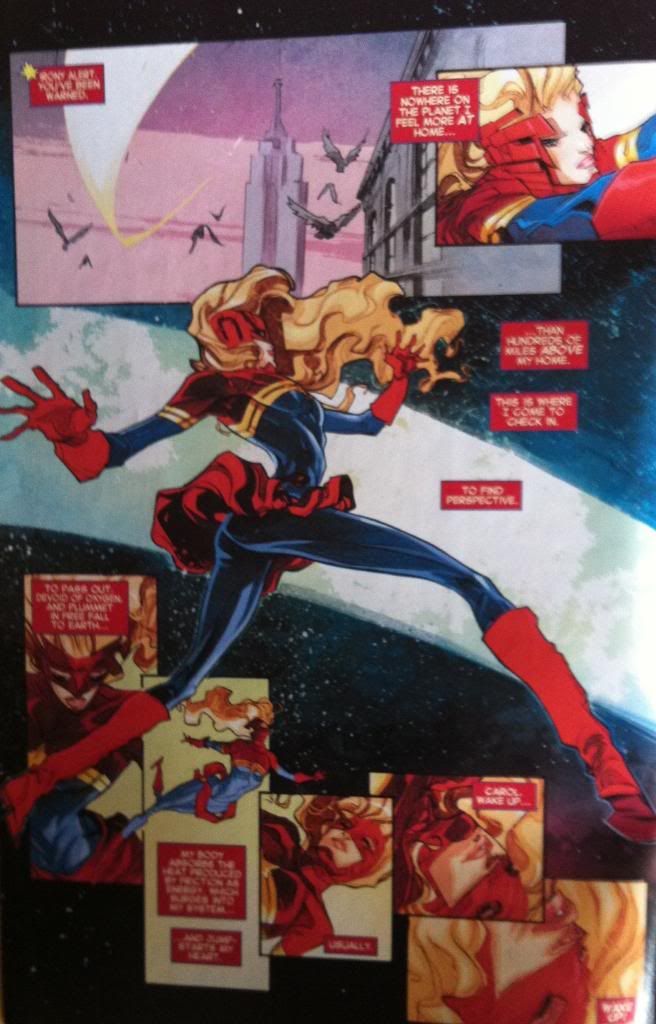
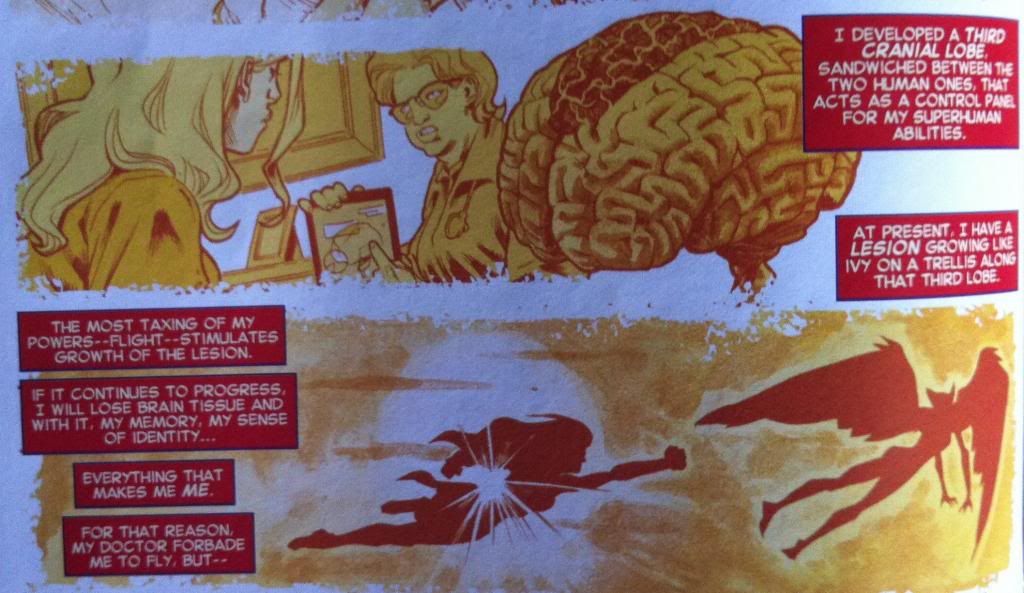
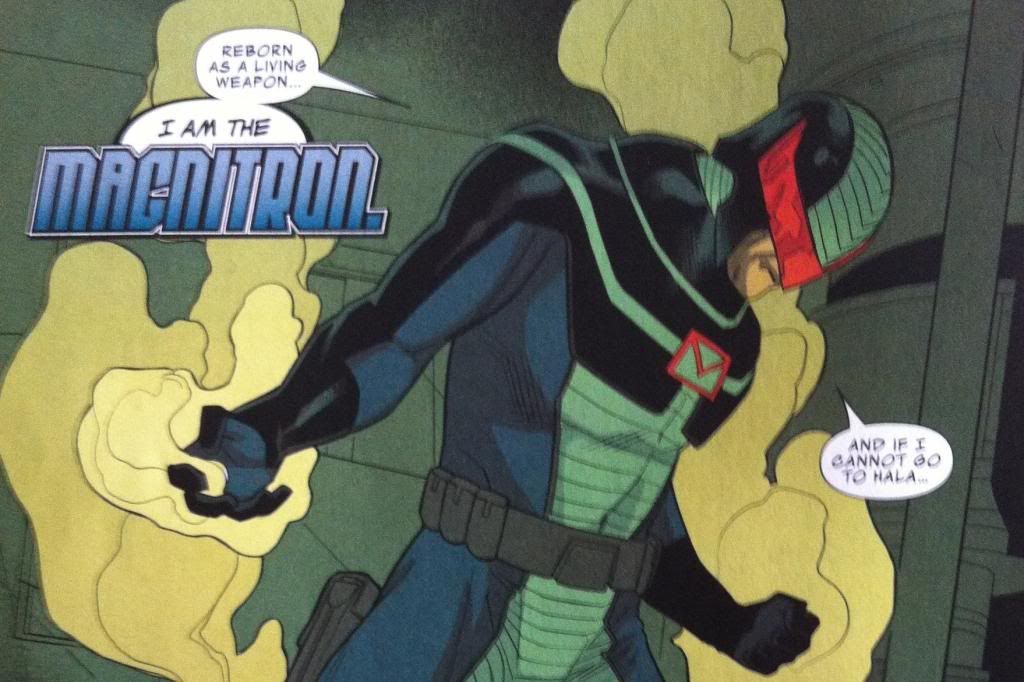
The Enemy Within is to a certain extent built around the ongoing narrative of Captain Marvel. The earliest issues of the comic say Captain Marvel sent travelling through time, visiting moments in female aviation and eventually the site of her own origin, the explosion of the Psyche-Magnitron that granted her powers. This was a cool semi-reinterpretation of Carol Danvers origins that tied her to a tradition of female pilots and heroism. However, the time travel, re-exposure to the Psyche-Magnitron blast, and her own alien-hybrid physiology combined to produce a brain lesion that grows whenever she uses her powers. As a result Captain Marvel is under orders not to fly or over exert herself at the risk of exasperating her condition and possibly causing brain damage, erasing her memories and personality. So, in a way The Enemy Within is about Carol fighting for her history and identity, which is, to a certain extent, fighting to maintain her continuity.


Which makes sense. Carol Danvers as a person would obviously not want her mind obliterated. But beyond that, the continuity, the history, of Captain Marvel makes her pretty cool: a superpowered former fighter jock who is a veteran avenger, has ties to alien empires, and is an unrepentant nerd. In my view she is one of the core Avengers, to the point where I think she should be as key a player as Iron Man, Captain America, and Thor. (It's kind of my hope that by the time that Kelly Sue DeConnick is done with Captain Marvel everyone sees her as being as important as I do.) So, in a lot of ways, the things that make Captain Marvel so marvellous, and more than a super powered sexy-lamp,  are tied to her history and personality. So it makes sense for Carol as a fictional character to fight for control over the good aspects of her history.

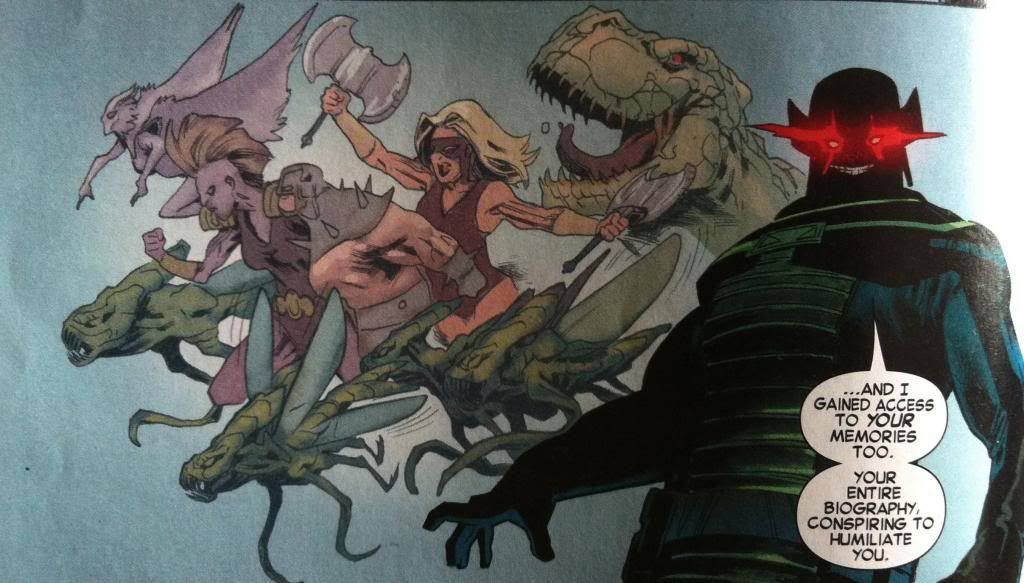
The Enemy Within is also a story built around how Captain Marvel is embattled by her continuity. From a story perspective she is kept grounded by her history: flying and being too amazing comes at the price of wiping out her past. But it goes beyond this. The Enemy Within has Captain Marvel and the Avengers fighting monsters from Carol's past over and over again in a pretty pointed contrast to how Superhero comics often recycle villains and storylines over and over. Moreover, Yon-Rog, a villain present at Carol's superpowered origins, uses a keepsake fragment of the Psyche-Magnitron, another element of Captain Marvel history, to superpower himself. And he uses his new-found power to create a nostalgia-driven mirror version of his homeworld and remake Earth as he would want it. So in a lot of ways The Enemy Within is a story where Carol is literally trying to overcome her past, to defeat a vaguely patriarchal figure yearning for the good-old-days, and to overcome the negative aspects of her continuity.


Again this is a rather pointed observation about the nature of continuity because to a certain extent Carol is also limited by it. To some people Captain Marvel will always be a Miss, a lady-derivative version of a character, himself an object in trademark acquisition, that wears an impractical bathing suit costume. She is a character who has so often been under-utilized as lady set dressing to de-dudify The Avengers. She has also had a lot of considerably shitty things happen to her at the hands of writers: she was raped and impregnated by her own child (kind of), was made into an alcoholic, she had her powers stolen by Rogue, had loved ones killed, was granted amazing cosmic powers just to be stripped of them, was dumped on the shitty side of Civil War, and a lot of other pretty gross things. A lot of profoundly creepy and awful things have happened to Carol Danvers that are probably all better left forgotten and not head canon. So, in many ways, moving Captain Marvel forward as a really fantastic character involves overcoming these less savoury aspects of her past. Which is kind of, in this literallized sense, what Captain Marvel has to do in The Enemy Within.


Which is all a pretty telling commentary on the nature of continuity and history to comic book characters. On the one hand, their history contains a lot of great elements that are key to our love of characters while simultaneously containing a lot of terrible and limiting baggage too. Therefore, there is this tension between the nostalgia of the characters we love and the need to see them move beyond that, to be something new and modern and more than they were. Especially with female characters like Captain Marvel whose histories are doubley complicated by creepy dude writers and the problematic attitudes towards women in the past and present. Moving these characters forward means redefining them to a certain extent and pissing off some people (largely nostalgic Yon-Rogger dudes). Or, to put it differently, to fly and punch through the sky, Captain Marvel has to beat her past and be willing to risk the uncertainty of a future without the certainty of her history and nostalgia, to risk being something new.

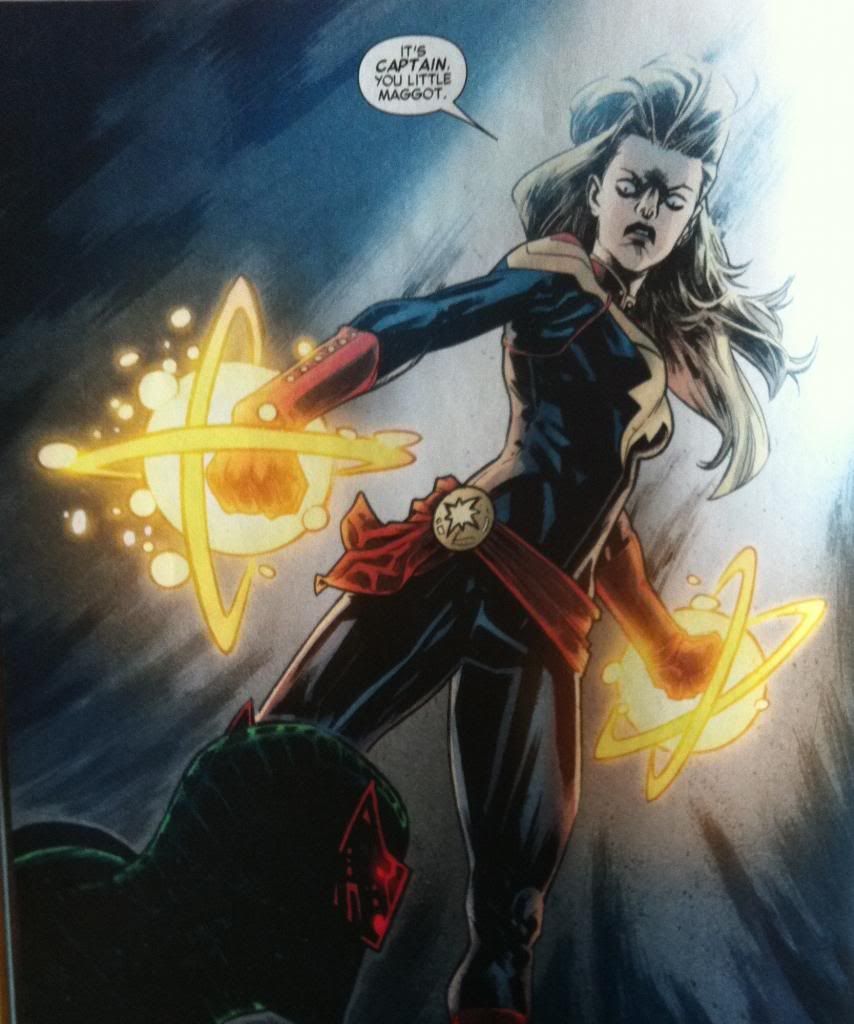
Which, when everything is said and done is basically how The Enemy Within ends: Captain Marvel sacrifices herself, flies and pushes beyond the limitations of her medical condition, potentially forfeiting her past and identity to take away the power of Yon-Rog (himself a manifestation of her conitinuity). It's brilliant and courageous and sad and triumphant and leaves us in a place of uncertainty about who Carol is.  And I for one, could not be more excited to find out.


(Or at least that's my take on it.)


(Oh and something I am just dying to know is why his chest logo looks so much like a certain email provider logo. Is it just an "M"-in-a-square based coincidence? Is it a commentary on how awful a full inbox is? Is it a subconscious response to the chore of correspondence?)

Previously:
Marvelling At Captain Marvel #12: Demarcating reality and fantasy
Marvelling At Captain Marvel #10: A dramatic contract
Marvelling At Captain Marvel #9: How your brain tells time
Marvelling At Captain Marvel #7: Saving a reporter in distress... AND ITS A MAN!
Marvelling At Captain Marvel #1: An alternate reading order that I liked more
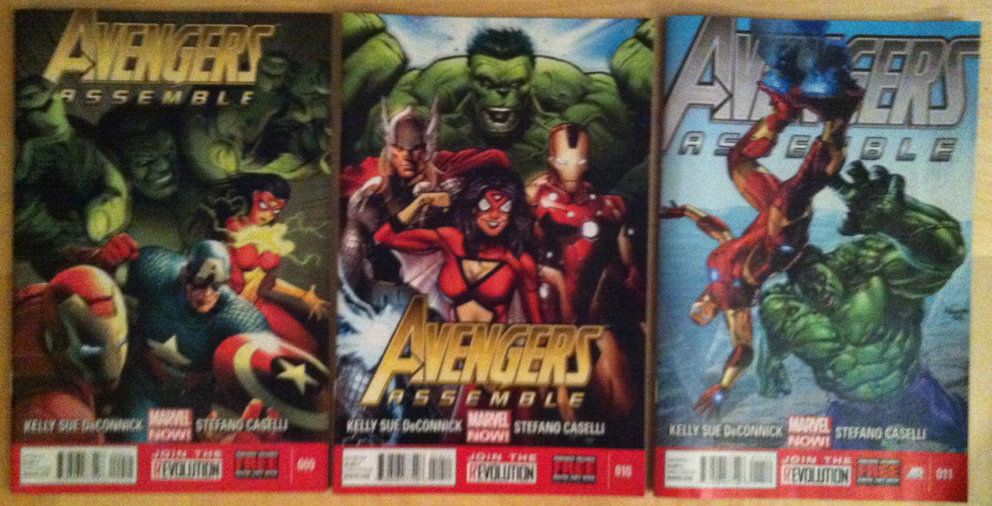
Assembly on Avengers Assemble #9-11: Characterizing relationships


Friday, 25 January 2013

Assembly on Avengers Assemble 9-11

Or an analysis of characterization in Avengers Assemble
By Kelly Sue DeConnick and Stefano Caselli


Avengers Assemble is the continuity light version of the Avengers franchise meant to be accessible to new readers. It utilizes a rotating cast of favourite Avengers going on missions to save the world in shorter self-contained stories. It's basically a very pretty, very well written straight forward Superhero comic designed to be an introduction to Superhero comics.

It's not what I would typically read.

If you pay attention to the ten Superhero comics I'm reading at any given time you'll notice that I tend to go for the more polarizing and original... the ones that are not strictly Superhero comics. I like to read things that are new, that contain the characters and themes I love but also do something more that changes it up or elevates the material.  The fact that Avengers Assemble is intentionally a straight forward Superhero comic would generally make it a comic that I would skip in the interest of reading something else.

But Avengers Assemble is ridiculously well executed. The writing is excellent and the art is perfect for the script. It's also a comic that focuses on making each character in the ensemble distinct.

When it comes to team Superhero books I'd say there are two key ingredients to success: fun/exciting character moments and a clever and functional central plot. I'd even go so far as to say a well negotiated compromise between these two story elements is the formative norm of a good team book. There are certainly different approaches to this, and most writers/comics end up somewhere on a spectrum between a character driven story or a story driven by the overall plot. Typically this balance falls towards the plot end of things with characters each distinct within themselves, but with poorly defined relationships. This approach can certainly lead to some great comics, but kind of at the expense of wholly realized characters.

Avengers Assemble puts characterization first in a way that is atypical in Superhero team books and this, I think, is what makes the comic remarkable and worth reading.

*SPOILERS* will exist beyond this point.

Every person in real life is, if not unique, then certainly distinctive. If fiction is to mimic real life then every character portrayed in a group also has to be distinct and defined. Avengers Assemble does a really good job of this: the entire cast of the ensemble felt realized and distinct from every other member of the cast.


(Rather than go page to page and annotate every single character moment, I'm just going to list the overall sense of each character).

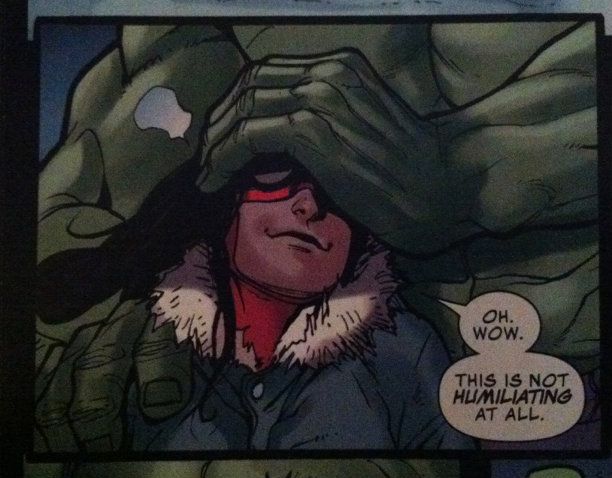
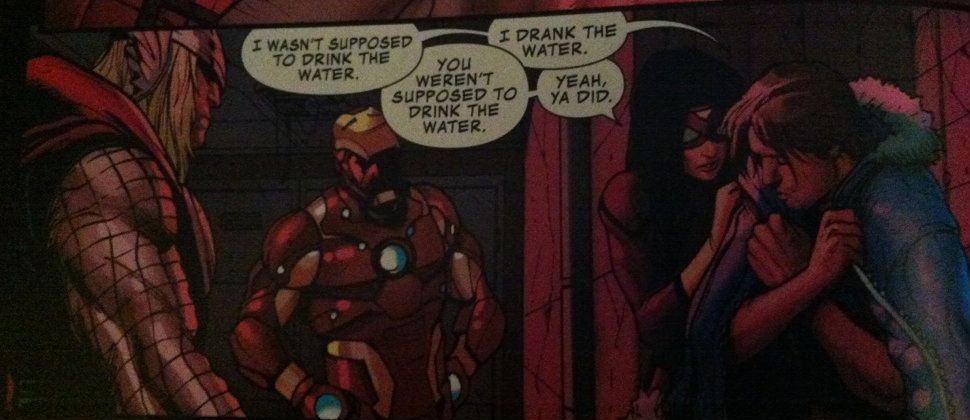
Iron Man: Tony is brilliant but insecure, which makes him competitive and show-offy. As a result he is fairly likeable and good with people, but also somewhat childish and a bit of an egotistical dick (This is all conveyed rather effectively in the scene where he proposes "the bet" to one-up Banner). He cares a little too much about getting others approval.
The Hulk: Banner is smart, timid, maudlin, and maybe possessed of a bit of an inferiority complex (does pessimistic futurist talk; rises to bet). This makes him awkward and self-conscious in group settings and the kind of person who gets teased, I think. He just wants to be respected. As Hulk is he is simpler and more excitable, kind of a weird fusion of man and child.
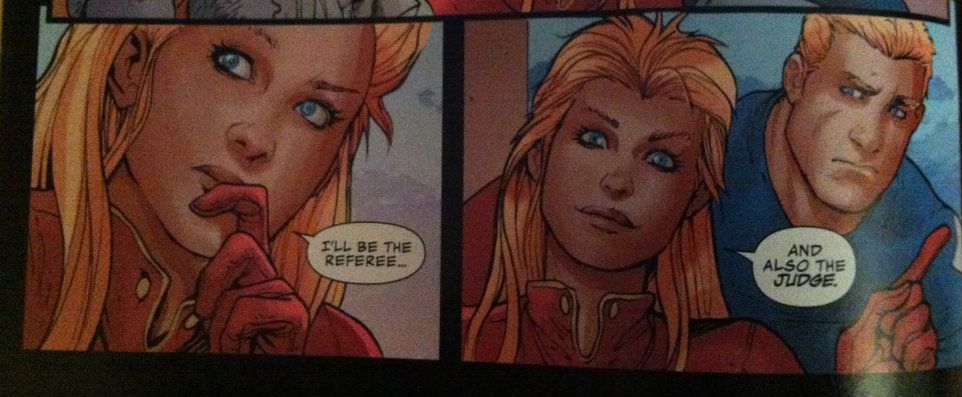
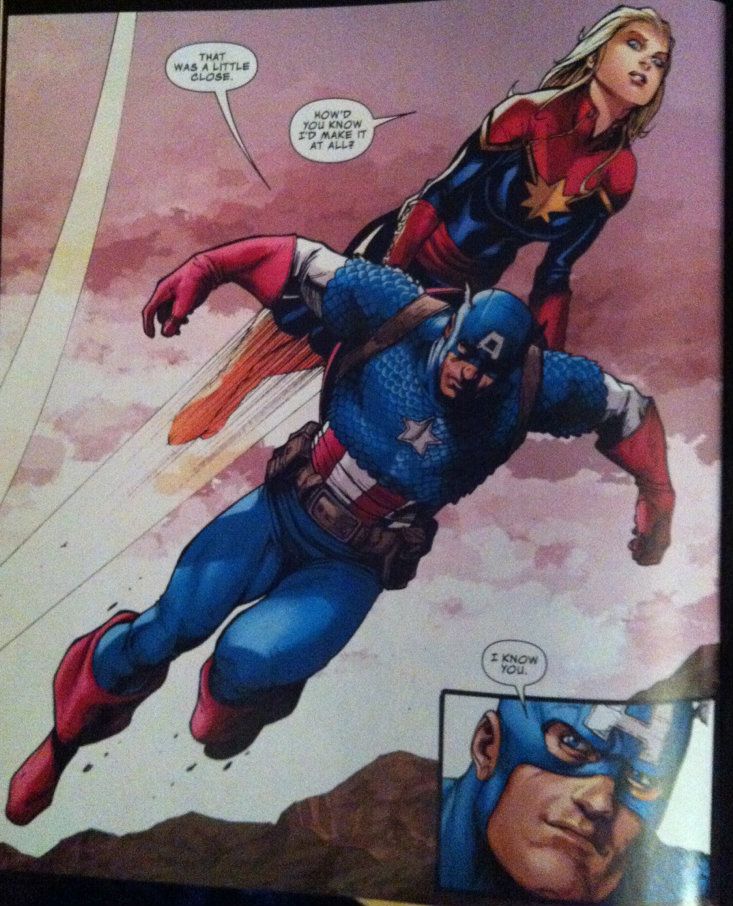
Captain Marvel: Carol is at once competent and mature (won't participate in "the bet") while still having a sense of fun (quips with Tony, enforces losing conditions of bet). She is also a bit of a control freak (wants to be referee and judge). 
Captain America: Steve is a serious guy. He knows who he is and is secure in it which means he isn't reliant on validation from others. This makes him a bit terse and plain spoken. Steve is a guy who is comfortable being silent. He carries himself with maturity and good deal of poise. He does not participate in "the bet", and clearly disproves of it.
Spider-woman: Jessica is awkward and unsure of herself and how she fits in. I got this mostly from artwork and how she gravitates towards Hulk as a fellow outsider. Also she tends towards self deprecation a bit, which has always struck me as a mechanism for breaking down the awkward. She is also pretty funny, if you like her brand of humour (which I do). She clearly wants to be part of the group but feels that she isn't.
Thor: Is probably the least defined the the central cast. But even then we get a character who is kind of aloof and burdened with weird cultural expectations and references.


Avengers Assemble does this level of characterization quite well, but it's the next thing it does that is especially cool. In real life people aren't defined purely by character traits and moods. For better or worse we are all somewhat defined by our relationships; especially within group dynamics. This is where most ensemble comics break down and where Avengers Assemble truly excels.


Iron Man and The Hulk: Tony and Banner, like a lot of really smart academics I know, are super competitive with one another in a really childish way. However, when things get complicated, their underlying respect, common ground, and admiration shine through. They have a complicated relationship built around their similarities and mutual insercurities.
Captains Marvel and America: Carol and Steve just get each other. They know where they each stand and have a comfortable association built on just being on the same wavelength. Also, so much trust. The kind of friendship where silence is comfortable. I suspect they would do okay as roommates.
Spider-woman and The Hulk: Jessica seems kind of drawn to both Banner and the Hulk. I read it as a projection of her own self-doubts, lack of confidence, and feelings of kind of being an outsider. She sees those traits in Banner/Hulk and responds to them. Kids on the outside gots to stick together.
Thor and Everyone: Thor is the worst defined character in the book, and his relationships with other characters also suffer a bit. The result is he seems, well, aloof and apart from his fellow Avengers. Given that he is a centuries old Norse god, this kind of characterization actually makes a good deal of sense. So maybe it was intentional? I'm not sure.
Iron Man and Captain America: There isn't a huge amount of interaction to go on, but well, have you ever had a coworker or classmate who, despite being admirable in a number of ways, just kind of rubbed you the wrong way? Well, I get that kind of take on Steve and Tony in Avengers Assemble.
Hulk and Everyone (but Spider-woman): Hulk is hulk. Dangerous, childish, hard to get along with. The Avengers seem to view him a bit as a liability and thing instead of a full fledge person and equal.
Captain Marvel and Iron Man: Carol and Tony are friends. Friends in that there-are-things-I-like-about-you-but-we-should-never-be-roomates way. They clearly see things in one another they like and enjoy, but are clearly very different people who I'm sure get on each others nerves frequently. Also the teasing. 
Captain Marvel and Spider-woman: Oddly, these two don't have a well defined relationship in Avengers Assemble. I think they share one spat of dialogue, but its pretty plot drivey and, from a character perspective, more to do with Spider-woman and Hulks relationship.


I think one of the more remarkable aspects of the strong character work in Avengers Assemble is that its all integrated into a self-contained Superhero adventure comic. All this characterization is built into a three comics that explain the formation of the team, lay out the motivation of the plot, introduce a threat and a villain, contain the requisite punching, and conclude in a satisfying way. This kind of economy of storytelling is really impressive.

Another thing that's probably a worthwhile take away from this arch of Avengers Assemble is that solid character work can make a read incredibly satisfying without resorting to EXTREME STAKES to make the story meaningful. When reading these comics I became invested in the characters and their relationships and cared more about their emotional consequences than the threats they faced in this comic. Not to say that the plot stakes weren't interesting or considerable (they were!), but this is a mainstream Superhero comic, the good guys are gonna win eventually (possibly with a noteworthy and temporary character death along the way). By making the characters and their relationships important readers get an additional series of consequences to worry about that are far more likely to pay off in an interesting way. I think I'd like to see more of this kind of storytelling in Superhero comics, it's a nice change.

But seriously, I would read a Kelly Sue DeConnick penned Rescue Me style comic about the Avengers hanging out in the Tower between missions and their daily personal lives in a heartbeat. 


Friday, 23 November 2012

Atoll Comics Round 4


Or Changes to My Top-Ten Comics

Due to poverty and an urge to buy better comics, I have decided to be super-selective about which superhero comics I read. Harnessing the Awesome Power of Maths, I have determined that I can afford to read 10 ongoing titles. So I get to read 10, and only 10, titles published by either Marvel or DC as well as one trade paperback a week of my choosing.

A complication of this is that I am forced to drop an on-going title if I want to try reading a new on-going title, an act of very tough love. Being financially responsible is the worst.

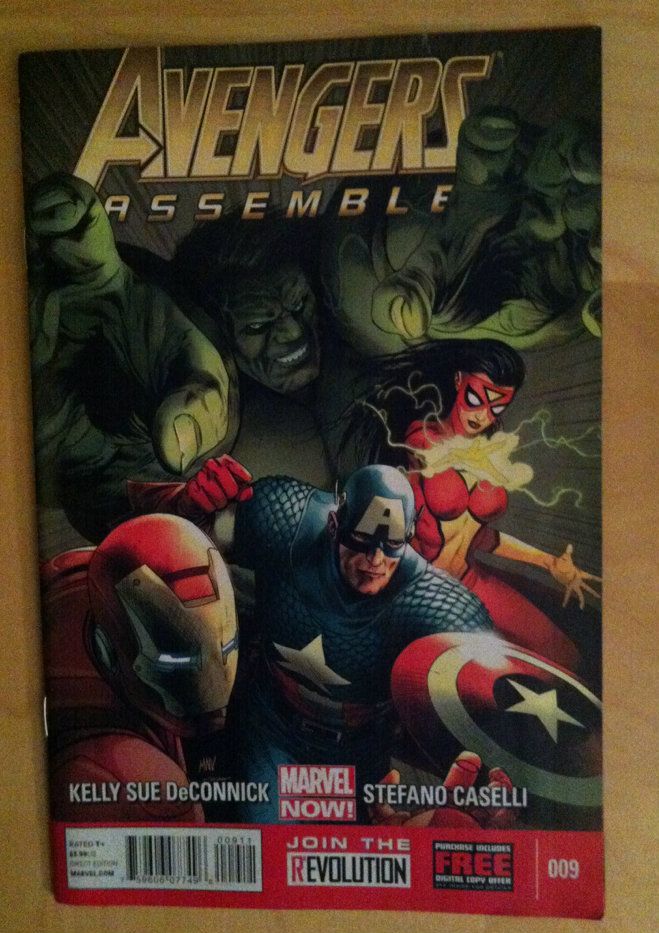
I will be adding Avengers Assemble to my ten comic list and dropping The Invincible Ironman.

Why Avengers Assemble?


From what I've been given to understand Avengers Assemble is meant to be an accessible (particularly for Avengers movie watchers) and lighter book with a rotating cast of Avengers. Part of the premise, I think, is that different teams are made depending on the parameters of their missions and then action occurs. So you know, not the typical comic I'd want to read. The only reason I find such a casual comics premise attractive is based purely on execution, which in turn is based on the creative team of Kelly Sue DeConnick and Stefano Caselli. The Internet has taught me that DeConnick has a character first approach to writing and this strength really shines through in an ensemble. (Which is great because many team books suffer from poorly defined, mono-voiced characters.) DeConnick actually writes her first issue (AA9) almost like a superhero sitcom (which I would watch the hell out of) and bases her team around a friendlt bet which is kind of brilliant. Caselli is, for lack of anything more substantiative to say, a very talented artist with his own distinct style. The man can draw a mean action sequence but can also pull off the "acting" required by DeConnick's script. These two creators seem to be clicking, and if Avengers Assemble #9 is any indication, they seem to be creating a pretty much perfect comic book.

Why not The Invincible Ironman?


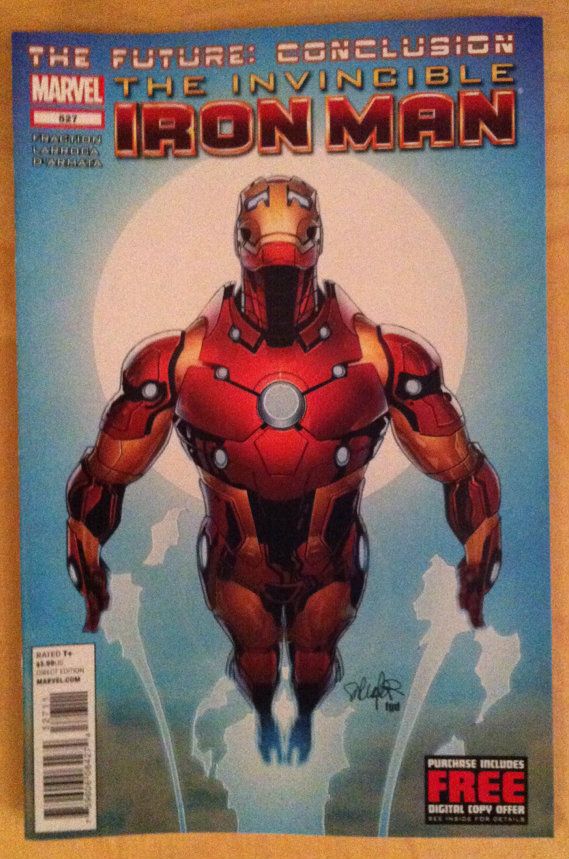
The Invincible Ironman was a great comic by Matt Fraction and Salvador Larroca. Fraction writes a perfect Tony Stark and confronts him with flawlessly derived challenges while Larroca draws the hell out of robotic things. The run of these two creators (who did the entire uninterrupted run) will stand, at least to me, as the definitive take on Ironman. Sadly, all good things must end and this title has been cancelled upon the altar of Marvel NOW. So I can't be reading it anymore.

(I think i'll be giving the new Ironman title a skip. I love Kieron Gillen and think he will write the hell out of Tony (if only based on David kohl and Emily Aster of Phonogram), but Greg Land is not one of the artists whose work I'm interested in if I'm only going to read ten comics.)