Showing posts with label Jason LaTour. Show all posts

Wednesday, 3 August 2016

Deep Sequencing: Spider Bastards

Or a look at the use of girds in Spider-Woman #9 and Southern Bastards Vol. 3
by Dennis Hopeless, Javier Rodriguez, Alvaro Lopez, and Travis Lanham; as well as Jason Aaron, Jason Latour, Chris Brunner, and Jared K Fletcher, respectively.


One of the most basic units in comics storytelling is a grid: a regular collection of panels put into rows. It is sequential art distilled down to its essence, a series of sequential pictures that depict a story through time. Regular girds can be pretty interesting because of how they create a rigid, confining story space. But these comics, Spider-Woman and Southern Bastards both use artwork that use and subvert panel grids to create interesting and innovative comics. And I'd like to explore some cool examples.

There will be *SPOILERS* below for Spider-Woman #9 and Southern Bastards Vol. 3


This page incorporates a grid and uses it in some very interesting ways. The foundation of this page is a six panel grid depicting a single image of a man on his knees being menaced. Because the six panel grid is here, the comic can violate the grid to generate extra emphasis. The first panel of the page, where the man is struck in the face with a gun butt, takes advantage of this and usurps the first panel in the gird, is RED!, and is enlarged so it overlaps the gutters. This makes the panel explode off the page in a burst of violence. Then the reader moves into the six panel grid with its single large image. This is important because it stretches the moment, making the main image feel like it takes six-comic-time units instead of one. The gridification of this image is also important because it splits the central of the page into a top and lower half. This means that when the reader encounters the text and character in the heart of the page, the kneeling man is constrained in the bottom middle panel below the horizontal divide. This makes him feel trapped, powerless, and cowed. It's a really smart use of the constricting aspects of a grid. Finally the final read panel, the red panel in the centre right, is jammed over the gird in a way that breaks the pattern. This makes this panel feel unexpected, impactful, and cruel as the depicted gut shot. This is a fantastic page. 


I'm also pretty impressed how this page uses its grid elements. While this page is not as strictly a regular panel grid, it does have four grid like panels in the bottom left corner. Here a henchman, partially responsible for beating the kid in the bed into a comma is trying to talk out his guilt. What I love here is how as the guy talks and talks and talks and trails off into inanity the lowest panels of the grid get cut off by the bottom of the page. It's the panels trailing off visually as the character trails off in the story. Which is great stuff.


This page here also uses a grid in a spectacularly complicated way. Superficially this page is a regular twenty panel grid, where the story is played out in a linear, simple way. But this page is anything but simple or linear! Instead this page is more like a series of interlocking linear comic strips that are layered onto a grid to weave together three interlocking narratives. The top row of panels show Spider-Woman kicking a Wendigo out of a window. This top row carries around the corner and down the page showing a comic strip of the Wendigo falling, startling a Mountie, and fleeing into the beautiful Canadian wilderness. Meanwhile the first panel in the top row also leads smoothly into the second row of panels which present a slightly out of kilter replay of the top row of panels with a narrative focus on Spider-Woman. This creates a sense of chaos and flurry of activity over these first few moments, but also helps split the Wendigo and Spider-Woman narratives. Much of the third row of panels focuses on Spider-Woman seeing the Wendigo escape. The left corner of the page subverts the grid, and has two overlaid panels that show the startled Mountie and skier as Spider-Woman appears and steels their weapon and skis. Put all together the page shows a chaotic fight, the Wendigo escape, Spider-Woman pursue, and bystanders react in a way that shows simultaneous action in an easy reading way. This is a pretty incredible page. 

Previously:


Friday, 2 October 2015

Deep Sequencing: Red Runnin' Rebs

Or a look at the use of red in Southern Bastards Vol. 2
by Jason Aaron, Jason Latour and Jared K Fletcher; Image Comics


Southern Bastards Vol. 2 is a brutal comic that tells the backstory of Coach Euless Boss: the high school football coach who runs Craw County with an iron fist. The comic fleshes out the man showing a glimpse of the determination, poverty, and pain that drove him to become the impressive, perhaps even monstrous, force of Southern Bastards. It's a really compelling story. 

It's also comic that does some really effective things with the colour red.

There will be *SPOILERS* for Southern Bastards Vol. 2 below.


On the most basic level the colour red is used to distinguish things happening in the present day from the memories of Euless Boss. Present day events are depicted in the muted, slightly desaturated tones that capture the stark, vaguely rustic feel of Southern Bastards. The memory sequences are done in a muted red-sepia that is distinct from the main part of the comic. This choice maintains a common aesthetic across the comic, but also keeps everything neat and tidy from a reader's perspective.


The thing about the colour red though, is that it's a pretty emotionally charged colour. It isn't just red. It's red! The colour of blood, pain, passion, and anger! Which imparts the memory sequences in Southern Bastards with a certain violent emotional palette. An angry emotional pitch that throttles up and down with the intensity of the red in the story: a muted palette in the quiet moments and a brilliant scarlet in the most painful, most striking, perhaps the most defining moments of Boss' story. It's an involving choice that, I think, really imparts the core of anger that forged Boss.


The other thing about the colour red is that it's the team colour of the Runnin' Rebs. This does a whole bunch of pretty nuanced things. For one thing it ties the Euless Boss memories thematically to the football team which is at the heart of his story. Boss' history is indelibly stained in the colour of his team. This choice is also interesting in how Boss continues to clothe himself in Runnin' Reb red: it's like he is clothed in his backstory. Which to me translates to Boss proudly displaying the adversity he's overcome and a sense that Euless Boss is still marked, still traumatized and controlled by his painful past. This is using colour to really develop character, which is properly cool comics.

Previously:
Deep Sequencing: Southern Bastard Faces

Southern Bastards Vol. 1
Southern Bastards Vol. 2

Wednesday, 30 September 2015

So I Read Southern Bastards: Gridiron

A 250 word (or less) review of Southern Bastards Volume 2
By Jason Aaron, Jason Latour and Jared K Fletcher; Image Comics


Southern Bastards is an ongoing comic. To read about the first chapter go here.

Southern Bastards is a deep-south crime comic. In the first chapter Earl Tubbs travelled back to his hometown in Craw County, Alabama to set some of his dead father’s affairs in order. Seeing the town overrun by organized crime, Tubbs went about stirring up some trouble. Which got Tubbs dead at the hands of Euless Boss, the crimeboss and football coach of the high school football team. Southern Bastards: Gridiron picks up just after the Tubbs murder and focuses on the backstory of Euless Boss and how he went from being the poor son of the biggest bastard in Craw County barred from the football team to the team's coach and the man who runs the whole damn place. One of the true marks of a quality story is how strong the villain is: one-dimensional, simple antagonists can make for decent backdrops, but complicated characters with detailed goals and motivations make for a much richer story. Southern Bastards Vol. 2 turns Euless Boss from a menacing concept to a well rounded, compelling character with the strength to be the star of his own story. Which has me far more invested in the coming conflict as Earl Tubbs' daughter is finally coming back to Craw County to discover just what happened. A storm is coming to Southern Bastards, and I can’t wait to see it erupt.


Word count: 225

Previously:

Friday, 27 March 2015

Deep Sequencing: Southern Bastard Faces

Or a look at the many, realistic looking faces in Southern Bastards Vol. 1,
by Jason Aaron, Jason Latour, and Jared K Fletcher; Image Comics


Southern Bastards, a comic about Crime in a small Southern town, is a great comic. It's visceral and brutal and surprisingly human and utterly believable. It is also a comic that I think does something really, really important with character design that I wish more comics, television shows, and movies would do: it has believable looking people.

There will be *SPOILERS* for Souther Bastards: Vol. 1.


Now I enjoy seeing attractive people do attractive things as much as anyone. Everyone gets drawn into the charisma of pretty people. But the fact of the matter is that really conventionally attractive people are a subset of the population. Take any sufficiently large group of people and you will find pretty people, but also some unattractive looking people. and a lot of people that exist somewhere in between. This becomes even more true when you start looking at people with older age demographics, because age makes people wider, saggier, and less conventionally attractive through time. Basically, a truly representative group of humanity includes people who are good looking, but also people who are less immediately attractive too.


This seems like a fact that is missing from most visual media. You open most comics, particularly mainstream Marvel and DC comics, or turn on the television and you are generally confronted by fictional worlds filled with beautiful, conventionally attractive people. Hordes of pretty people wearing the cutting edges of fashion living in unbelievably expensive and gorgeous apartments living fabulous lives. Modelesque superheroes saving cities of glamorous civilians from alien hordes and sexy young singles just trying to figure it out in front of a legion of gorgeous extras. In fiction-land everyone is young and beautiful, and when they aren't it is a noteworthy story point. Normal looking people need not apply.


The trouble with this, aside from how toxic a message it is, is that it is fundamentally unbelievable. Beautiful fiction-land doesn't look like reality, the demographics don't add up. Attractive people can do anything, be as smart or kick ass as anyone, but the idea of an entire detective department being 20-something underwear models with perfectly styled hair and impeccable fashion is as unrealistic as a person with the super power to fly. A downtown coffee shop where everyone looks like members of a fashion catalogue photo-spread has as much basis in reality as adamantium claws. Portraying large groups of people as exclusively conventionally attractive people is completely unrealistic and totally ruins my suspension of disbelief.


It seems to be getting worse too. I am not an especially old human, but even I can recall a time when on television or in comics people looked more demographically reasonable. Sure, there were still very pretty people, often in key roles, but around them you had your grizzled middle-aged detectives, your harried looking mothers, your goofy looking neighbours, or just your average looking extras. The fictional worlds of our visual media used to look so much more like the actual world (I mean, at least as far as attractiveness goes) and as a result used to be so much more believable. Sadly, it seems much of our media has abandoned this.


Southern Bastards does a lot of things very, very well. But the thing that made it feel so fresh to me as a reader and so utterly believable is that it showed a diversity of faces. People in Southern Bastards LOOK LIKE PEOPLE, with all the wrinkles, weight, age, and imperfections that real groups of humans have. There are still attractive people, cute teenagers and handsome youth, but there are also elderly people, fat people, middle-aged people, all of them wearing clothes that are consistent with what actual people of their economic situation would wear. It makes everything look so much more authentic, and it makes the more fantastic elements of the story, the crime, violence, and murder, also feel real and authentic. It's a perfect choice.

And one that I really, really wish we saw more often in comics.

Post by Michael Bround 

Previously:
So I Read Southern Bastards: Here Was A Man

Wednesday, 25 March 2015

So I Read Southern Bastards: Here Was A Man

A 250 word (or less) review of Southern Bastards Vol. 1
by Jason Arron, Jason Latour, and Jared K Fletcher; Image Comics


Earl Tubb has gone back to his hometown, Craw County, a small town in Alabama, to sell his father's house. A town he swore he'd never go back to. A town run by Euless Boss, the coach of the football team and the master of a small criminal empire. A town where his father used to be the law. If Earl can just keep his head down, do what he came for and leave, he can be out of there as fast as possible. Trouble is, Earl isn't one to walk away from trouble when he finds it, and in Craw County he doesn't have to look far to find it. Southern Bastards is a fantastic crime comic set in the American South. It plays with the familiar tropes and shape of a crime story told in a visually visceral style and smothers it in the smoky barbecue sauce of small town Southern Culture. Which, it turns out, is a fantastic marriage of plot and setting. Southern Bastards: Here Was A Man functions as a single story and operates within the longer series more as an introduction and impetus than the the main plot. Which is good, because as well crafted as Here Was A Man is, the familiar story of two angry white men in the South is less interesting than the direction the series appears to be going. So while Here Was A Man is good comics, Southern Bastards looks like its going to be amazing. 

Word Count: 245

Post by Michael Bround

Wednesday, 17 April 2013

So I Read Scalped

A 250 word (or less) review of Scalped the complete series
by Jason Aaron, RM Guerra, Davide Furno, Jean Paul Leon, Francesco Francavilla, Danijel Zezelj, Jason LaTour, Vertigo Comics


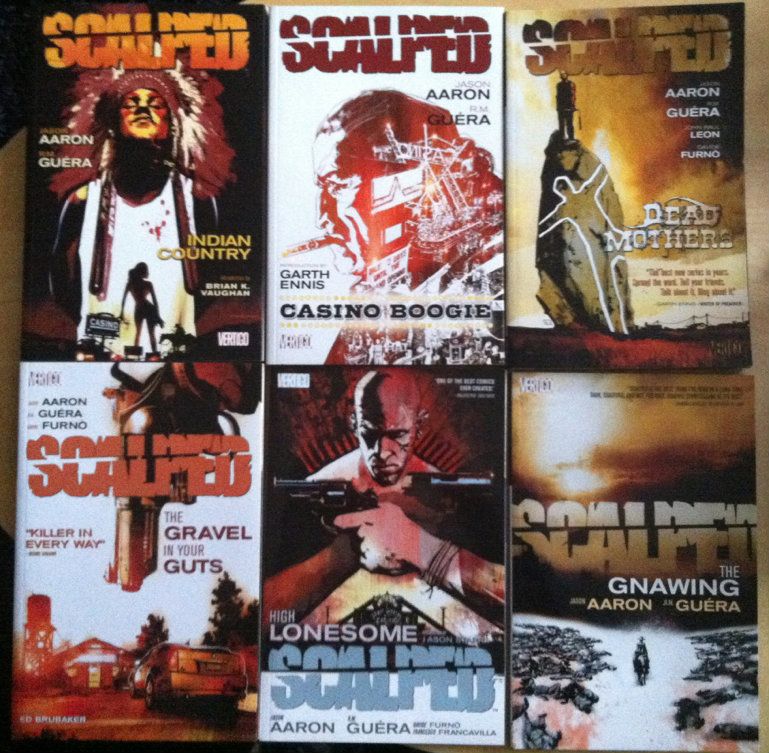
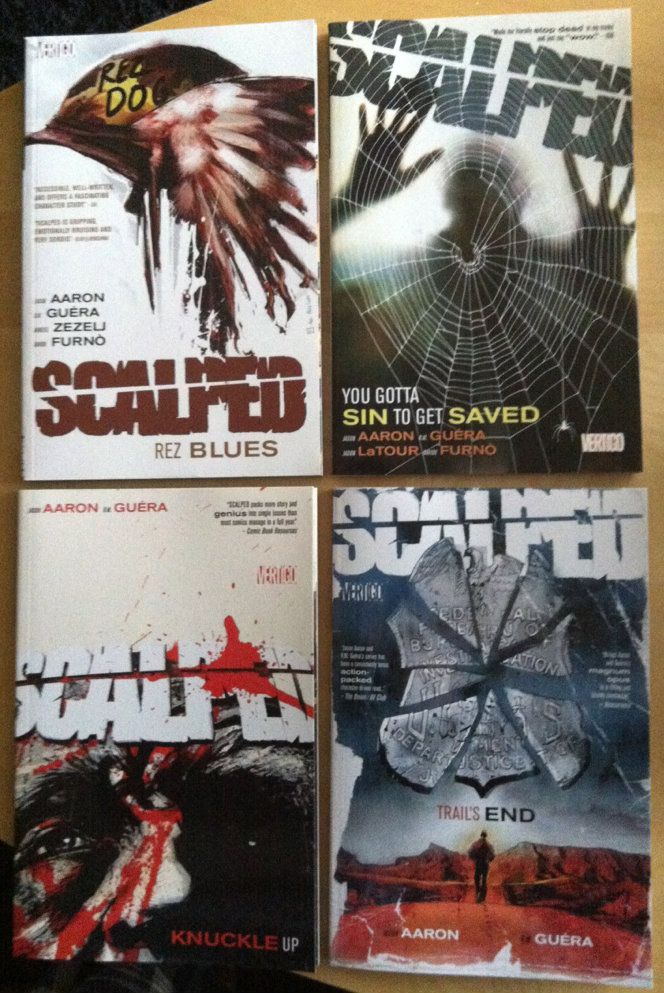
Scalped is the most hand-shaking, chill inducing, dry-mouthed comic I've ever read. At one point it actually gave me the sweats. What I'm trying to say is that it's a suspenseful, horrifying, and exciting read. Scalped is a story about crime on an American Indian reservation. It's an intricate comic of revenge and betrayal built out of a tower of dominoes on a foundation of broken promises. Did I mention this comic actually made me sweat? Scalped is also a surprisingly empathetic comic. While it certainly isn't politically correct, (it's an American Indian crime drama called Scalped) it showcases just how badly we as North Americans have fucked over the aboriginals of this place as well as the strength, dignity, and value of the cultures and traditions we have tried so hard to eradicate. Scalped demands we pay attention to this horrible reality (1). Incidentally, the use of American Indians in a crime comic is genius: these are desperate people fucked over by their government, white society, and their own leaders trying to make it any way they can. The hopelessness is palpable. The art by RM Guerra (and the rest) in Scalped is perfect: it's masterfully drawn, compelling ugliness rendered in a hundred shades of brown. It's art as desperate as the characters, as brutal as the action, and as dry and dirty as the badlands. Scalped is one of the completest comics I have ever read and it fucking blew me away. Everyone should read it.


Word count: 248


1: Last winter (2012) a first nations group in northern Ontario declared a state of emergency because it's inadequate housing was insufficient to provide shelter for winter conditions. They were ignored by their provincial and federal governments until negative publicity and international outcry forced them to act. As a Canadian I am horrified and ashamed by this. I am disgusted that I seem to be in the minority in this.