Showing posts with label Faith Erin Hicks. Show all posts

Wednesday, 22 June 2016

Deep Sequencing: Nameless and Speachless

Or a look at deliberate pause panels in The Nameless City
by Faith Erin Hicks and Jordie Bellaire; First Second Publishing


I recently listened to an interview podcast featuring Faith Erin Hicks talking about The Nameless City. (The Podcast was "Off Panel" and it's my favourite comics interview podcast right now.) While on this podcast Hicks remarked that she has "pages and pages of characters staring at each other", and that with her comics "you get about 50 pages of plot and 150 pages of people staring at each other." This is clearly an exaggeration, but I thought this was an interesting statement worth taking a look at. 

Upon an exhaustive review of The Nameless City the comic contains 1146 story panels and about 156 are what I would call "stare" panels (give or take a few). Which means that about 13% of comic panels in The Nameless City is devoted to "staring". Which isn't an insignificant amount of storytelling space, which makes me think this is a deliberate and important choice. And taking a look at it, it's pretty clear that Hicks is using these panels to shape storytelling and I think, to provide key characterization information to the reader. 

There may be *SPOILERS* for The Nameless City below.


The first, and I think most obvious role of the "stare" panels in The Nameless City is that it stretches moments. In comics panels are, among other things, units of time: each sequential panel marks a potential storytelling moment. The more panels a given action or situation is allotted, the longer that moment takes to read and the longer the moment feels to the reader. Straight forward, right? The inclusion of the "stare" panels can, and often does, function to add an extra moment to a given situation which can increase the perceived significance of the moment. Because in a comic, space is time is money and effort. It can also alter the flow of the story in significant ways. Like in the top situation the inclusion of the middle "stare" panel provides that awkward, queasy moment of silence and inaction that lends the declaration of cowardice some actual weight. Or, in the second selection, the inclusion of the middle "stare" panel creates an awkward pause that stretches the moment providing character information (the father and son don't really know each other) but also creates this great, awkward comedic beat. In both these cases removing the "stare" panel changes the pacing in a way that hurts the storytelling of the story.


Another important role of the "stare" panels is to inject emotion directly into the comic. The term "stare" panel is something of a misnomer, since the majority of them involve some pretty delightfully extreme emoting. Characters frown, or smirk, grimace, smile, horror, and make very nuanced, very particular expressions in these panels. These panels serve to blare emotions at the reader like in the above selection where Kai, the guy, is sending us WORRY/HORROR!. This gives us his emotional state of mind and sets the reader with the expectation that what Rat, the young woman, is doing is bad and a big deal. Other story media have the tenor of the actors voice or sound/music design to drive emotional context, and I think these emotive "stare" panels serve that same purpose in The Nameless City.


Beyond just being good storytelling, I think these "stare" panels do a lot to inform the reader about the characters of Kai and Rat. Specifically, I think the way these panels function as a pacing tool is important for Kai. Kai is a newcomer in a strange city who is inexperienced and a bit trepidatious about his new surroundings. He is also a thoughtful guy who seems to care about the consequences of his actions. What "stare" panels of him do is create these story pauses where we get to see Kai think. This means that when he is confronted with something new, rather than instinctually reacting to it, he stops and "stares" while he deliberates what to do next. Therefore the reader gets to experience the process of being Kai as he navigates his new home. This is the comic using a pacing tool to constantly demonstrate a fundamental aspect of one of the characters. Which is pretty cool.

(It's also maybe significant that the number of "stare"panels decreases sharply when Kai "does the thing" near the climax of the story. Resolution through layout.)


The "stare" panels are also really important for the character of Rat. In this case, I think the emoting aspect of these panels is super important for my conception of the character. Rat comports herself as a tough, streetwise person who is somewhat blasé about the feelings of others. But I get the sense that a lot of this is an act, a persona she puts on, and I get this sense largely from the emoting "stare" panels. These panels give this unguarded look at Rat as she reacts to hurting Kai's feelings, or having her prejudices confronted, or spotting a friend. It shows readers that despite the Rats tough persona, she does in fact care about those around her. Which means that my conception of Rat as a character is born out of the tension between what the character says about herself and how she emotes when no one but the reader is looking. Which is an extremely nuanced piece of storytelling that is achieved by "stare" panels.

Which is all, I think, a case for why "stare" panels comprise 13% of the comic panels.

Wednesday, 23 October 2013

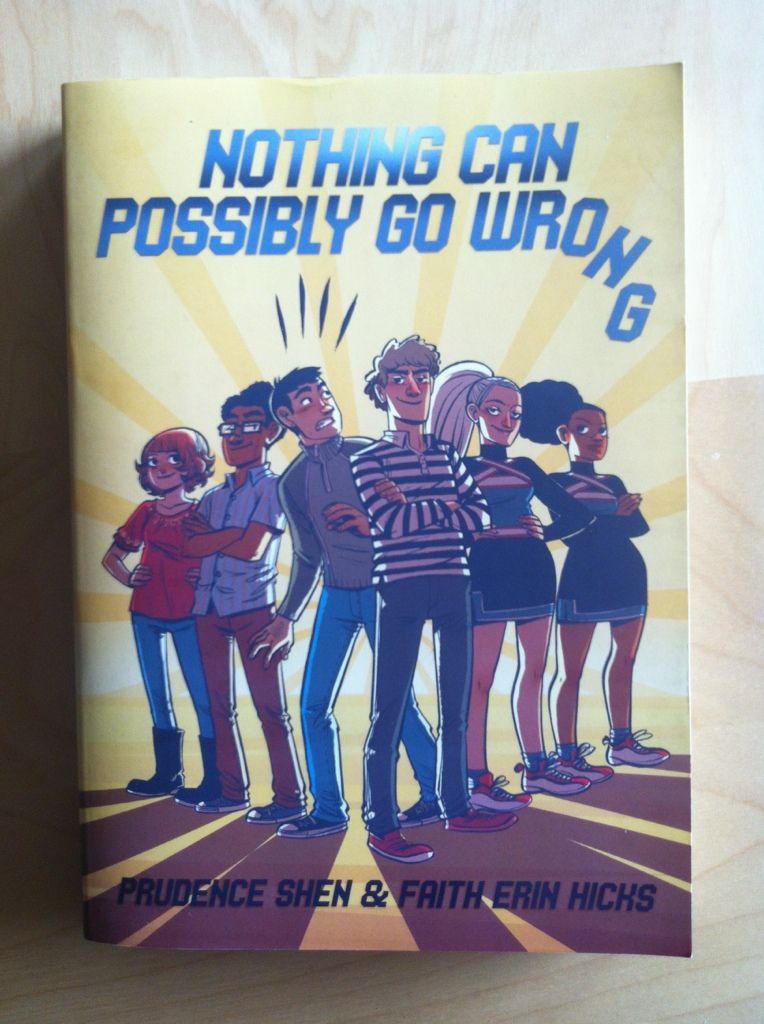
So I Read Nothing Can Possibly Go Wrong

A 250 (word or less) review of the Nothing Can Possibly Go Wrong Graphic Novel
By Prudence Shen and Faith Erin Hicks, First Second Books


Nothing Can Possibly Go Wrong starts as a story about highschool politics when Charlie, captain of the basketball team and affable jock, gets caught in a dispute between Nate, the intense leader of the Robotics club, and Holly, the ruthless head Cheerleader, as they declare war over extracurricular funding. What follows is a game of dirty politics as Nate and his long-suffering teammates attempt to win a school election against Charlie, the unwilling pawn of the merciless cheerleaders. Can Nate and Charlie stay friends despite a vicious election? Will the Robotics team make it to their competition? Will the Cheerleaders get their new uniforms? Will all the family and high school drama work itself out? Oh, and there are fighting robots eventually. Nothing Can Possibly Go Wrong is a fun, accessible comic that I think should appeal to just about everyone. The story is involving, the humour is infectious, and Faith Erin Hicks artwork is, as always, fantastic and endless fun. I am profoundly (profoundly!) over high school, and I still found Nothing Can Possibly Go Wrong perfectly winning.  And if Shen and Hicks can win me over, then I bet they can win you over too. Fighting robots!


Wednesday, 29 May 2013

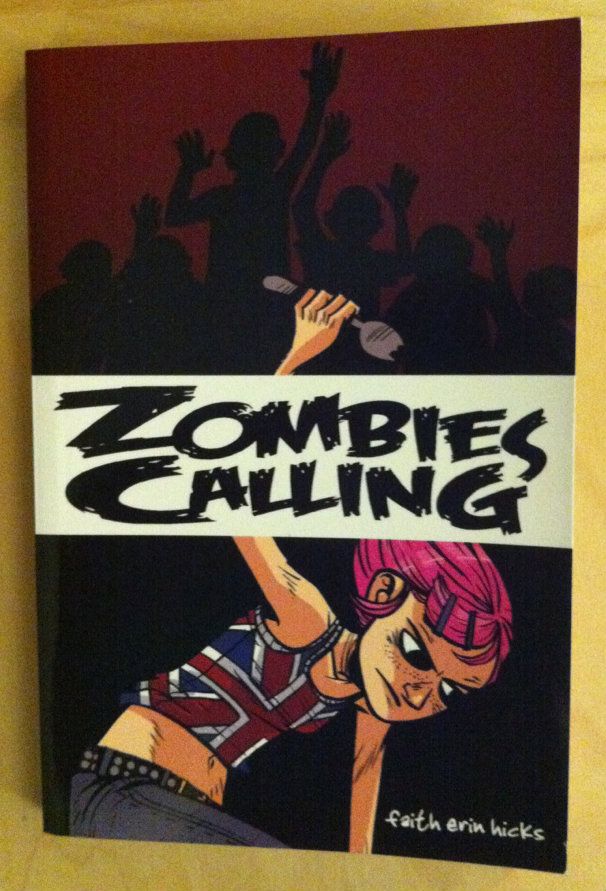
So I Read Zombies Calling

A 250 word (or less) review of the Zombies Calling graphic novel
By Faith Erin Hicks, SLG Publishing


Zombies Calling is a silly book. It tells the story of Jocelyn, a dorky and naive young Canadian university undergraduate and her flatmates, the gothy Sonnet and the dudebro-y Robyn, as they try to survive university and an adorable zombie apocalypse. Luckily for the group Jocelyn is an expert on zombie fiction and plans to use her knowledge of “The Rules” of the genre to survive. It's overall a quirky, fun, and humorous read. Have I mentioned the zombies are adorable? The book also explores some deliberate themes about the zombifying effects of modern, for profit, diploma mill, university education and the awful terror that is student loans. As a graduate student I can relate to these themes, since I already view undergrads as filthy, shambling, mindless creatures. Overall I'd recommend Zombies Calling: it's a cute, fun comic that with an accessible story and inviting artwork. Also, if the "London University" decimated by zombies in the comic is standing in for Western Univeristy (the worst part of Canada) than this comic might actually be the greatest ever. If not, Zombies Calling will likely at least stand as the most adorable and Canadian zombie apocalypse ever depicted.

Word count: 196

Friday, 5 April 2013

Variety Is The Spice of Comics Pt. 3: Getting Your Friend's Hooked.

Or how variety in comics is amazing and generally a good idea.

I spend a disproportionate amount of time trying to get friends to try reading comics. Most of this stems from the fact that I really, really enjoy reading comics and want to share that experience with the people I care about (as any good geek should). Part of this is maybe also motivated by the fact that I don't really have any comic friends, so it would be cool to convert a friend or two. But on a far more mercenary level, I think convincing a friend to read, and to maybe even buy comics is important for comics as an industry.


Comics, as we try to avoid thinking about, are a commodity. Comics creators are a kind of artisan that produce a specialized commodity for a niche consumer. Publishing companies, some merely facets of giant multinational media empires, act as merchant/distributors and bring the commodity to a retailer (a comic shop/bookstore/web ap/whatever) who then sells the product to consumers. As much as creators, publishers, and retailers are all important cogs in the comics machine, there would not be a comics industry without consumers. (I mean, I'm sure some people would still make and share comics they made for fun... but business-driven professional comics require someone to eventually buy them.) To a certain extent, the pool of comics consumers, the market for the weird, amazing commodity that is comics, dictates how much comics can viably be made and supports the people that actually make the things we care about.


In that light, bringing in new comics readers increases the size of the comics market and, as such, increases the amount of money available to comics which thereby increases the amount of comics that can/will be produced and the amount of money that eventually reaches creators (who are great).  I know that in the years since a friend of mine slipped me a disk of bootleg comics in an Integral Calculus class I have spent THOUSANDS of dollars on comics and as such I have contributed to the continuance and manufacture of more comics. The way I figure it, every friend of mine I can convince to read and purchase comics represents money that is being fed into the comic machine that would otherwise not be there.


(And yes, my friends often liken me to a drug dealer.)


So back to convincing my friends and loved ones to try reading comics. I have found that most people are not interested in reading superhero comics. It's not that Superhero comics are stigmatized, really, it's that they are a known (or presumed to be known) quantity. Everyone thinks they know what Superhero comics are and has an opinion concerning whether or not they would like to read them. (And I would argue that everyone who is interested in reading superhero comics basically already is, and if they aren't, it isn't very hard for them to change that.) As a result, I have found that the trick to convincing people to try reading comics is to present them with the kind of smart, mature, well-written and beautifully drawn non-superhero comics that most people don't know or appreciate exist.


Almost universally, I have found that Y The Last Man is a perfect first comic to spring on the kind of people I am friends with. The comic has a very accessible and addictive script: it has a compelling central mystery and rolls out a relentless series of cliff hangers that keeps readers glued to the series. Moreover from a writing perspective, the comic manages to present extremely well realized, likeable characters, a snappy sense of humour, and a maturity and level of discourse that civilians are frequently surprised to find in comics. Paired with this is really accessible art: on the one hand it looks nice and services the story well and on the other it has a low panel count in conventional layouts and really doesn't experiment too much. Y The Last Man is also kind of the perfect length for a first comic reading experience. It's not so long that new readers burn out, but still long enough that they get to experience a fair amount of comics before reaching the end. Basically, Y The Last Man is a perfect storm of comics for new people. 


That said, in my experience everyone has a different taste in media and wants slightly different things from the experience of it. Part of what makes Y The Last Man such a powerful gateway comic, beyond its execution, is that it manages to straddle a lot of genres and emotional responses simultaneously. Everyone I have ever lent it to has enjoyed it, but frequently for slightly different reasons... and from those responses come critical information about what comes next. And this is where variety (and hence the title of this blog entry) comes in.

(That didn't take a long time to get to at all...)

One of the more successful comic conversions I've had is a coworker I'll call subject A (one that has actually resulted in a comics purchase!). With  this person I started with Phonogram which yielded pay dirt with The Singles Club but not Rue Britannia (which was too myopic for her). I then leant her Y The Last Man which she DEVOURED as fast as I would lend it to her. She then tried and enjoyed Scott Pilgrim, the output of Faith Erin Hicks, and Chew. She finally tried Julia Wertz's The Infinite Wait and Other Stories and was blown away and went and bought her first comic in Drinking at the Movies (well second comic, she gift-exchange-stole The Manhattan Projects: Science  Bad. at our work Xmas party). She is currently slowly working her way through the Runaways and Octopus Pie (which she quite enjoys). Basically, she likes fun, humorous  not super-intense comics that she can relate to.


A similar success story comes from a guy on my soccer teams... who I will call Subject 2. He too devoured Y The Last Man when I leant it to him. From there I tried giving him Chew... which he thought was too ridiculous and silly. So I leant him Criminal, which he apparently likes a lot and is slowly reading in fits and starts. While I am still figuring out what Subject 2 is really into, it seems he likes intense, realistic, page-turning comics.


Which is all proof that not everyone wants to read the same kind of comics. Moreover, it is evidence that the people who are not interested in Superhero comics immediately may be interested in other comics, and that finding what comics they like is mostly a matter of finding what genre of fiction they enjoy. And this is where variety comes in: the more KINDS of comics that are being made, the more likely a new reader will be able to find a comic that fits their media needs exactly (or the more likely I will find that perfect comic to force on my friends). 


To take this idea a step further, maybe the way we can expand the audience, and therefore the market, for comics is not by making better and better and better superhero comics, but by making ALL KINDS of different comics. That way everyone can find the comic they want to read. And who knows? Maybe that will lead to them trying a comic. 


And then another.


And another.


Previously:
Variety is the Spice of Comics Pt. 1: Pony Up
Variety is the Spice of Comics Pt. 2: Year in Review

Wednesday, 20 June 2012

So I Read Friends With Boys


A 250 word (or less) review of Friends With Boys the Graphic Novel
By Faith Erin Hicks, First Second Books


Friends With Boys, by Faith Erin Hicks, is a great example of really well executed all ages fiction. The book follows Maggie McKay, a homeschooled teenager as she switches to a public high school. Along the way she has to deal with being surrounded by new people, making new friends within an alien social system, negotiating her relationships with her many brothers, and reconciling herself to her mother’s absence. Also: she is haunted. Friends With Boys deals with the idea of loneliness and isolation amongst other people: key characters are cut off from family, friends, or peers and the book hinges on the restitution (or not) of these broken relationships. As such, I’d say Friends With Boys is instantly relatable to anyone who has experienced shyness when confronted with a new social group/situation. Hicks writing, while suitably dramatic at key moments, is humourus and pleasant throughout. Her artwork, which has a manga-esque quality to it, is expressive and inviting as well. I get the impression that Hicks, when creating Friends With Boys, was trying to make the kind of book she wished existed when she was a younger reader. In the protagonist Maggie McKay, I feel Hicks succeeded in creating the kind of relatable female teen protagonists that is typically lacking in comics and fiction. If I had a daughter I would encourage her to read this. Of course, if I had a son I would encourage him to read it too: it’s a great comic for anyone.

Word count: 248