Showing posts with label Becky Cloonan. Show all posts

Friday, 21 November 2014

Deep Sequencing: By Kiss or Proximity

Or an examination of smooching in By Chance Or Providence
By Becky Cloonan.


When you follow too many comics people on twitter, you end being a huge snoop on some pretty interesting conversations. Which you know, makes you feel like an eavesdropping creep, but can also deliver some interesting tidbits about the comics industry or comics craft. And this entire post is predicated on seeing a conversation between creators.

Specifically, I "overheard" Kieron Gillen complimenting Beck Cloonan on her skills at drawing people kissing (or specifically that he wanted Cloonan to art-direct his own smooches). To which Becky Cloonan replied that "it's the "almost kiss" that is the most important part to draw". Which I thought was an instructive and interesting point worth exploring. And I realized that I recently read By Chance Or Providence and that there was a lot of pretty intense smooching in that comic and that I remember all of it being really well drawn.

And then I thought, that By Chance Or Providence is the comic with maybe the most passionate kissing I could think of.

So I went looking for images depicting people actually kissing and panels depicting the moment just before (or just after) to essentially explore the difference between the two shots and to test Becky Cloonan's theory about drawing kisses using her own artwork.


And I found something surprising.

There are almost no panels of people actually kissing in that comic.

Instead there are panels depicting people "almost" kissing, that are these perfect depictions of yearning and passion and which create the emotional feeling of kissing.

And that it is these "almost kiss" panels that make me remember a comic that has a lot more passion and smooching than comics that depict more actual kisses. Actually, the "almost kiss" panels are so well done that I actually remember there being more passion than is directly portrayed in the comic. It is really, really effective stuff.

So, I guess the Cloonan Theory of Smooching holds up to scrutiny.

And you should definitely read By Chance or Providence.

Post by Michael Bround

Wednesday, 19 November 2014

So I Read By Chance Or Providence

A 250 word (or less) review of By Chance or Providence
by Becky Cloonan;


By Chance or Providence is a book collecting the independent comics of Becky Cloonan. Specifically, the book collects critically acclaimed comics Wolves, The Mire, and Demeter in a beautiful hardcover edition. While each comic stands alone, they all share common thematic elements of supernatural horror stemming from forbidden romance and are all set in medieval-ly Europe. In Wolves we see the story of an exiled werewolf hunter, in The Mire a squire is sent with an important message to a haunted swamp, and Demeter sees a young woman with a fear of the sea and a secret, fear for her lover. For me, the appeal of the comics collected in By Chance or Providence is that they are triumphs of storytelling. While the overall plot of each chapter is somewhat familiar, each story is delivered with such skill and nuance that every chapter is a remarkably satisfying read. Becky Cloonan has long been a favourite artist of mine, but these comics really highlight her skills both as a sequential storyteller and as a really gifted writer. By Chance or Providence is also pretty neat in that the comic feels like that special home project of a master craftsmen, like the gorgeous guitar a luthier makes for their private use. It's.... really, really great. While By Chance and Providence might be tough to track down, you can still get its constituent chapters digitally through Comixology or in print from Cloonan's store. You owe it to yourself to check this out.

Word count: 249

Friday, 18 April 2014

Deep Sequencing: Demo-nstrating Black and White Comics

Or some neat uses of black and white in Demo: Volume 2
By Brian Wood and Becky Cloonan; Vertigo Comics


Demo: Volume 2 is this great collection of single issue character studies that use supernatural phenomenon as metaphors for people struggling with everyday problems. It's a comic where dealing with child abuse involves time travel, for instance. It's pretty great comics. It's also a black and white comic that does a really good job using the one available colour to emphasize key parts of the composition. And since it's always a nice to have an excuse to gawk at Becky Cloonan art, I thought I'd take a look at some of the nifty tricks and smart black and white choices in Demo:Volume 2.

There will be mild *SPOILERS* for Demo Vol. 2 in the below post. You are warned.


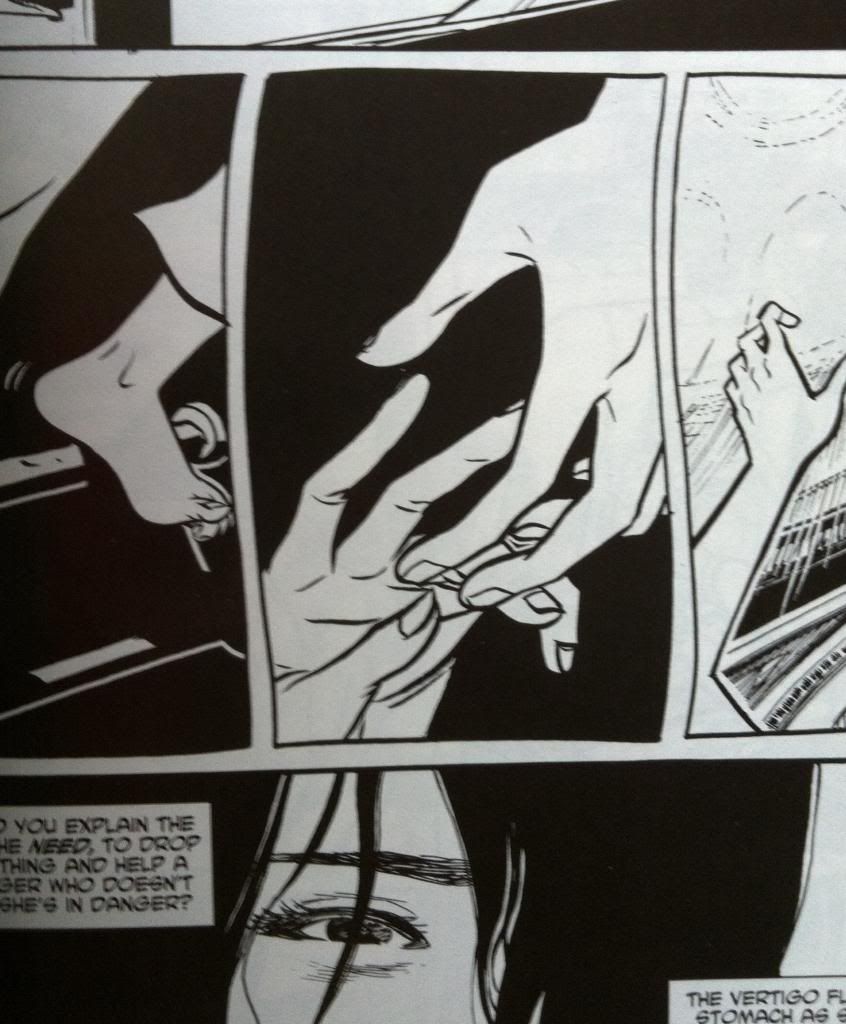
As far as my inexpert, armchair enthusiast sense has been able to determine, the key to making black and white comics pop, is using the two colours to colours to create contrast and draw the eye to the key portions of the composition. Like, the above selection has white hands reaching out to each other on a totally black background that makes the panel focus in completely on the hands. In that moment in the story, and in that panel, those outstretched hands are the most important thing in the universe, and the colouring of this panel is designed with just that purpose in mind. Simple, but effective.


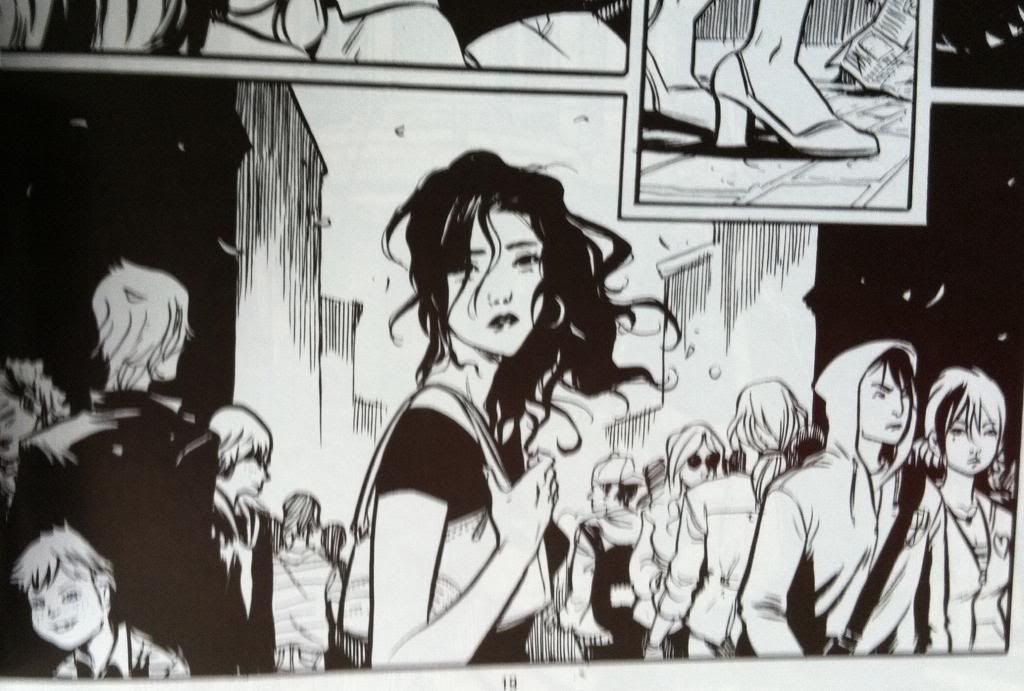
But the first story in Demo: Volume Two has a bunch more really smart tricks that take advantage of the sharp contrast of black and white to make the comic work optimally. This chapter of Demo tells the story of a woman who keeps having a dream about someone, another woman, falling from a great height in some sort of large church. The dreaming woman is convinced her dream is prophecy and goes on a quest to save the falling woman regardless to the personal costs to herself. It is very much a comic about introspection and obsession and being so inwardly focused that the broader picture is missed. And the way the woman is coloured, with her black shirts and black hair entirely plays into this theme: in every scene she is in, no mater how crowded or complex the background, her dark blocked colouring makes her the focus of the panel. It's as if the artwork is driving us to become as obsessive and focused as the woman in the story. It's really great.


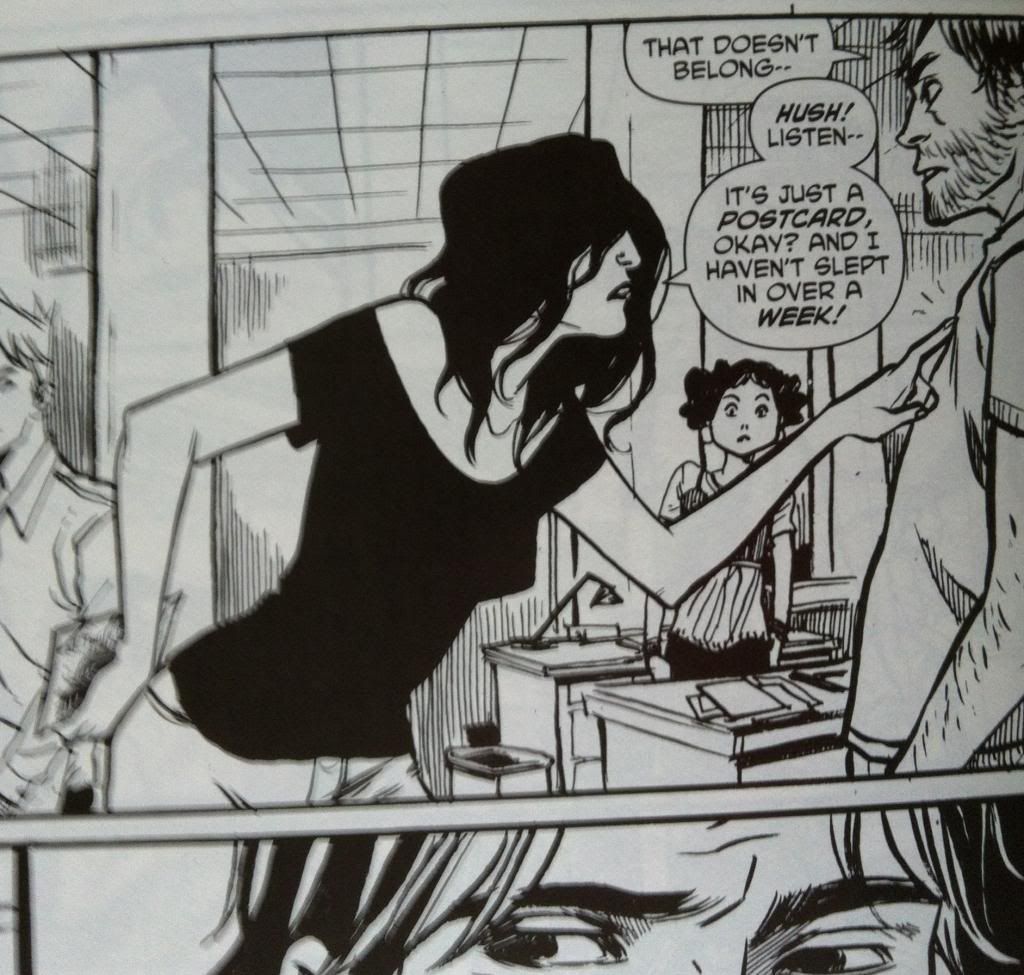
Another cool bit of colour use in this chapter has to do with another key character in this chapter. This man in the above panel is also pretty important to the story,  and so he also gets the heavu black treatment that makes him jump out of the surroundings in the same way as the woman-with-the-black-hair. In this way, even in a comic with no colour, the most important characters are instantly emphasized in a way that draws the readers attention.

Demo, particularly Demo Vol.2 is a really great comic that is absolutely worth taking a very close look at.

Previously:
Demo
Demo: Volume 2

Wednesday, 16 April 2014

So I Read Demo: Volume 2

A 250 word (or less) review of Demo: Volume Two
By Brian Wood and Becky Cloonan; Vertigo Comics


Demo: Volume Two is the continuation of Brian Wood and Becky Cloonan's series of one-shot comics about people with unusual powers or traits trying to somehow navigate ordinary life, with the supernatural aspects of the comic operating as a kind of metaphor for real life struggles. Demo: Volume Two shares this overall premise with the first volume of Demo comics, but is so much sharper (which is saying something since Demo is really good comics in the first place). The first series of Demo is almost like a comics laboratory with Brian Wood figuring out his voice for single-issue character studies and Becky Cloonan experimenting with radically different styles of artwork. Demo Vol. 2 is like the thesis resulting from all that experimentation. As a result, Demo: Volume 2 is almost its own thing: the stories are masterfully constructed and the artwork is exclusively drawn in Cloonan's mature, brilliant style. There is actually a bit of a thematic shift between volumes as well, with the stories becoming less supernatural, and more grounded in a kind of plausible unreality that adds to the veracity of every story. Demo: Volume 2 is really an excellent comic that is worth reading on its own, even before the first Demo series. If nothing else, it’s an excuse to read a beautiful comic drawn by Becky Cloonan.


Word count: 222

Previously:

Monday, 13 January 2014

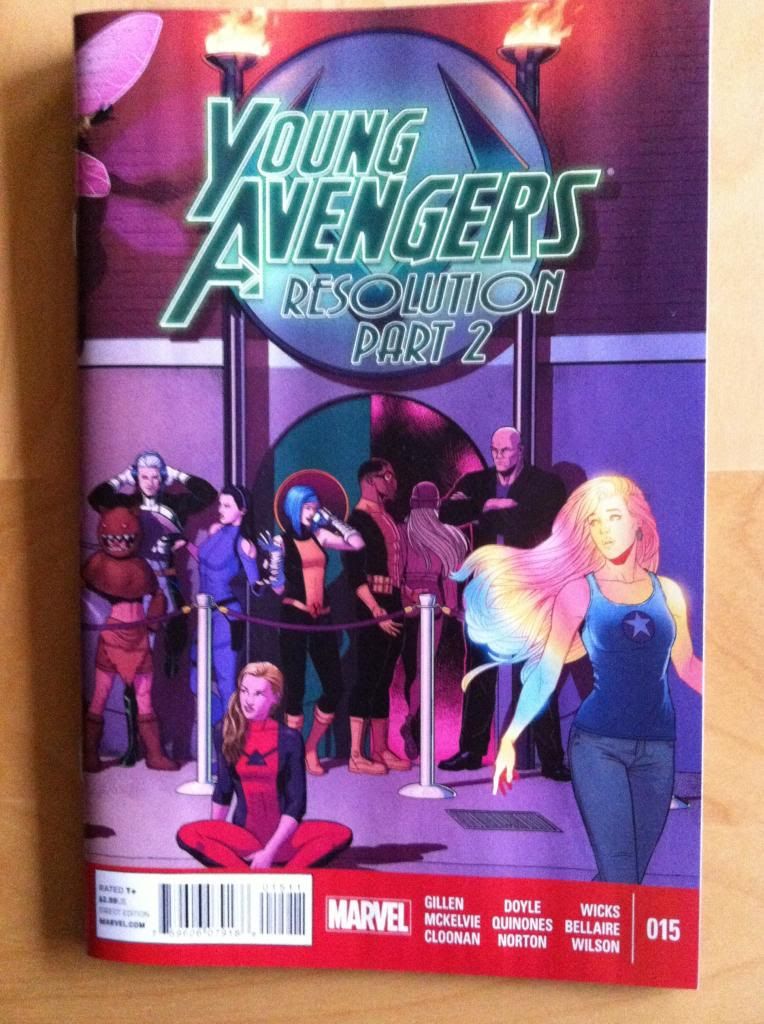
Favouring The Young Avengers #15

Or how colour is used to emphasize separation in Young Avengers #15
by Kieron Gillen, Jamie McKelvie, Becky Cloonan, Ming Doyle, Joe Quinones, Jordie Bellaire, Maris Wicks, Matthew Wilson; Marvel Comics


Young Avengers #15 is the final, goodbye issue of Young Avengers. It's pretty much a pitch perfect issue that, along with #14, does a really great job providing closure to the various character-plots of the series in a fun and VERY Young Avengers way. YA#15 is a testament to everything I love about the series and a perfect note to go out on.

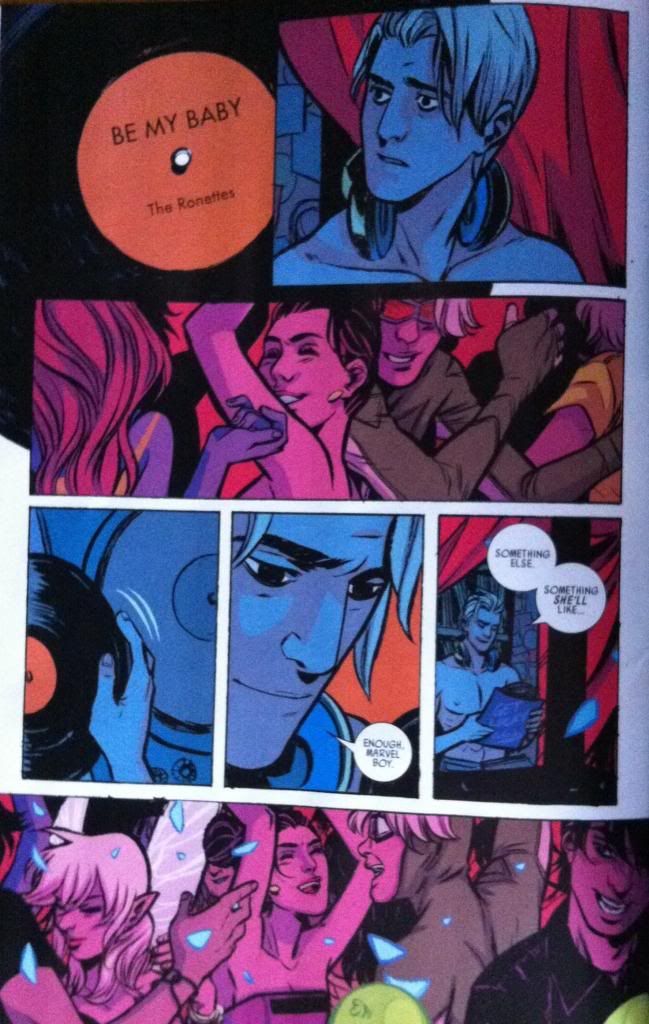
Young Aveners #15 is also a comic that features a Noh-Varr section, with art by Becky Cloonan and Jordie Bellaire, with some really clever colouring. Colouring is an aspect of comics that I find really fascinating and important, but given the subtlety of it, pretty difficult to talk about. That said, YA#15 features colouring that is obvious in its intelligence and effectiveness.

There will of course be *SPOILERS* for Young Avengers #15 in this post.


Actually, before I get to the colouring of this section of YA#15, I'd like to point out how great the pencils by Becky Cloonan are. The characters are alive with emotion, the story telling is crisp and clear, and the entire composition lives every moment in a really evocative way. The Noh-Varr section of the comic may be short but it really highlights the tremendous acting, compositional chops, and the ineffable magic of Cloonan's artwork. It's always a pleasure to read comics drawn by Becky Cloonan.

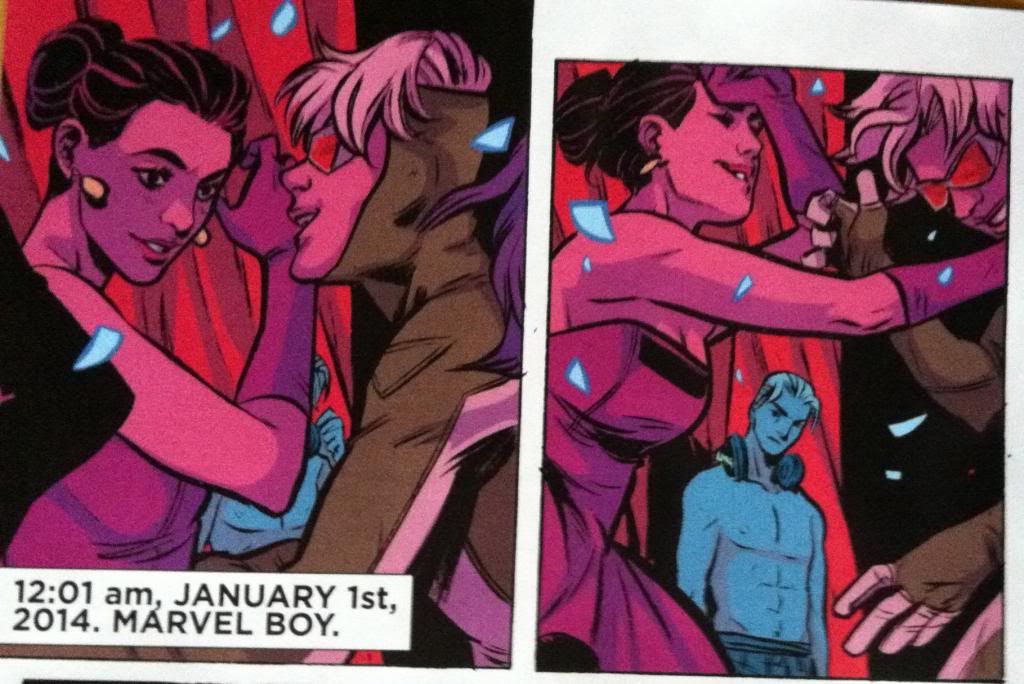
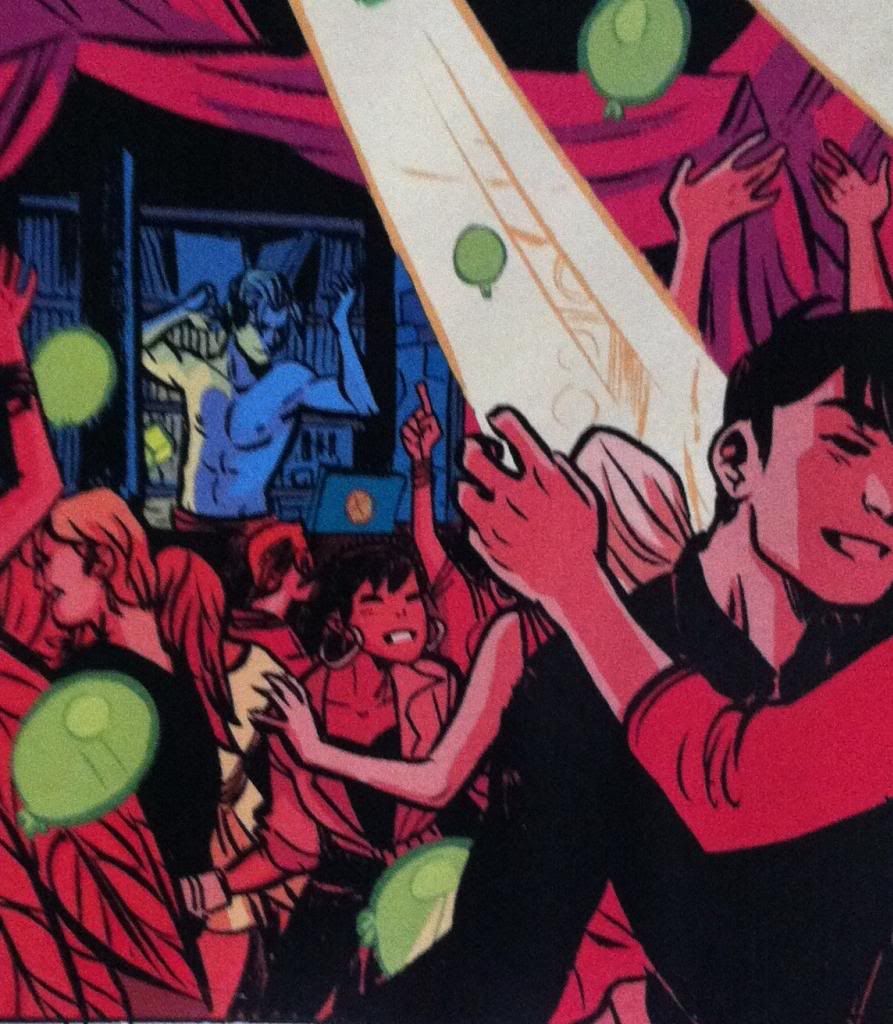
The plot of the Noh-Varr portion of YA#15 is essentially that Marvel Boy is ruminating on how his relationship with Hawkeye ended and meditating on the bittersweet flavour of love lost. This is all played out while Noh-Varr is behind the mixing table DJing and watching Kate having fun and being beautiful on the dance floor. As such, much of the dramatic weight of this sequence is the physical and emotional separation between Kate and Noh. This is accomplished in a bunch of ways: from the very discrete ideological demarcation between DJ and crowd (cerberal-observant/emotional-active) to the way the pencils separate the two groups physically and contrast Noh-Varrs aloneness in the booth to Kate's position in the people of the dance floor. But I think one of the most effective ways the separation between the two characters is emphasized is through the way the sequence is coloured.


The brilliance of the colouring is that it colours Noh-Varr in a different way than Kate and the dancing crowd and this contrast in colour emphasizes the separation between characters. Simple stated, Noh-Varr is colouring in a cool, shadowy blue, while Kate and the dancing crowd are bathed in a red glow that permeates every aspect of their colouring. Now, this fits very well into the plot of the series as the dancers are all lit by the dancefloor lighting which is the in-story source of the red glow, while Noh-Varr working in the DJ booth is not lit-up and therefore living in the shadows. So this colour separation makes perfect story sense. But it also makes really great emotional sense too: the cool blue of Noh-Varr fits his melancholy (he is literally blue!) while the hot, passionate red captures the fun and energy of the dancers. This difference in colouring, then, manages to emphasize both the physical separation (booth/dancefloor), the emotional difference (sad/celebrating), and the story distance between the Kate and Noh-Varr in a seamless way that brilliantly enhances the composition and storytelling. It's great colouring and great comics.


Previously:
Favouring The Young Avengers #14
Favouring The Young Avengers #13

Favouring The Young Avengers #12 (pt. 2)
Favouring The Young Avengers #12 (pt. 1)
Favouring The Young Avengers #11
Favouring The Young Avengers #10
Favouring The Young Avengers #8
Favouring The Young Avengers #7


Wednesday, 16 January 2013

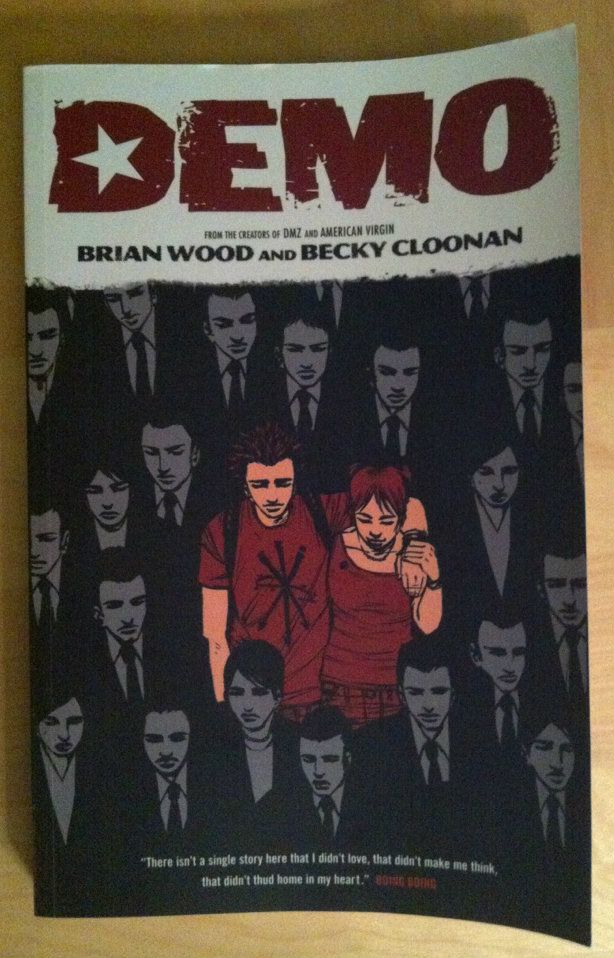
So I Read Demo


A 250 word (or less) review of Demo volume one.
By Brian Wood and Becky Cloonan, Vertigo Comics


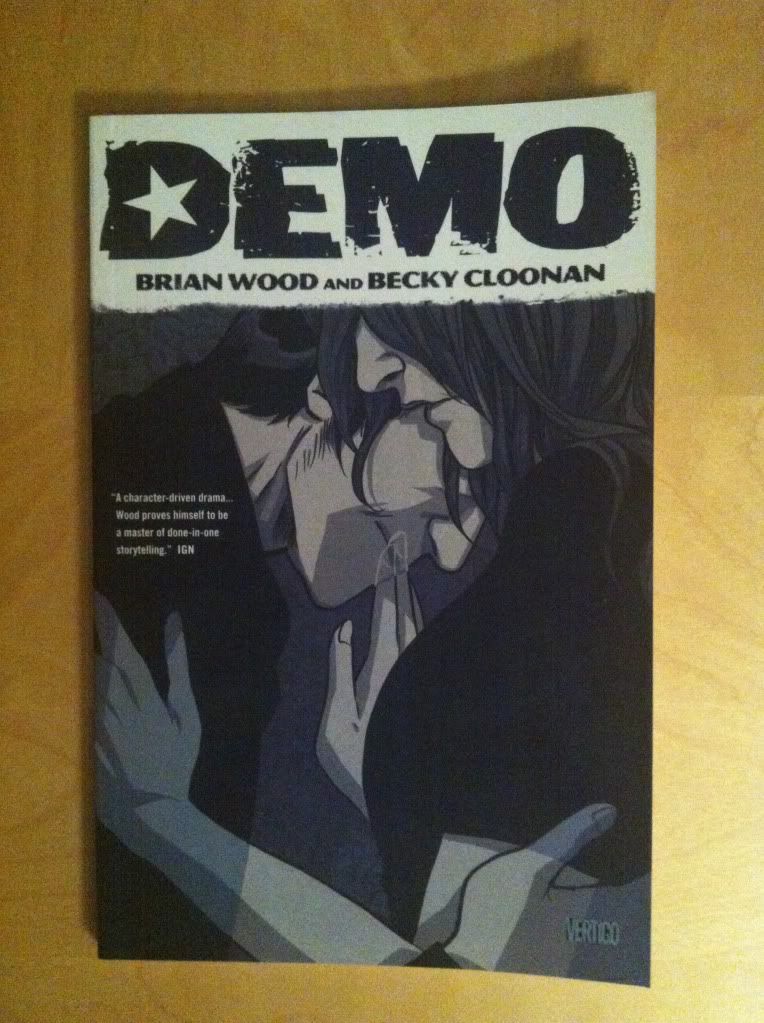
Most mainstream comics are about super heroes: people with special powers who fight some form of evil or injustice for a variety of reasons. Their powers are generally a blessing or sometimes a blessing-that-is-also-a-curse, but at the end of the day are mostly a mechanism for having adventures and punching things. Demo is a book where people have superpowers that are metaphors for how shitty life can be. The comic is basically an anthology of stories about people dealing with realistic life challenges, but with a super powered/supernatural bent that operates as a thematic device. Think a story about a teen whose words can literally hurt others or about a girl whose mother uses drugs to control her out-of-control powers. It's a pretty poignant collection of short stories that really capture the emotional flavour of profoundly difficult life moments. Demo will make you feel feelings. Brian Wood’s writing is sharp and empathic and Becky Cloonan's art conveys tremendous mood and emotion. Actually, Cloonan pulls off a neat trick in this book: she alters her art style between chapters, sort of fluctuating between manga and American influences, to give each story an individual style and sense of identity. She is a remarkably talented artist. Demo is a great book that sort of straddles the line between super hero books and literary comics and is worth checking out. Just be ready to feel feelings.

Word count: 232