Showing posts with label Christopher Sebela. Show all posts

Wednesday, 23 March 2016

Deep Sequencing: Welcome Backflip

Or a look at the use of multiple-image motion use in Welcome Back Volume 1
by Christopher Sebela, Jonathan Brandon Sawyer, Claire Roe, Carlos Zamudio, Juan Manuel Tumburus, and Shawn Aldridge


Welcome Back is a comic about reincarnating murderers locked in an endless cycle of death. Except one of these murders has grown accustomed to her new life and wants to escape the cycle and her nemesis has other plans for her. It's a comic with a fun premise that delivers a nifty little action story.

It's also a comic that does something fun with a comic cliché.

There will be *SPOILERS* for Welcome Back Volume 1 below.


An inherent limitation of comics is that they use static images to tell a kinetic story. The usual way way around this is to use carefully selected images of the action to capture the essence of the action being depicted. This works really well for most things. But there are some motions that don't translate particularly well to static images: the motions are too complex to easily translate to a single representative snapshot. Things like sweet backflips, generally need a few images to capture the component movements, for instance. One solution to this problem is to depict multiple snapshots of a motion within a single panel to provide the context to sell the motion and to create a sense of immediacy to the action. It's a cliché comics trick that gives the world all of the sweet backflips. 

The above selection from Black Widow #1 (by Samnee, Waid, Wilson, and Caramagna), while lacking sweet backflips, is a good example of this. 


Welcome Back Volume 1 has a fun take on this storytelling approach. The hook of Welcome Back is that the characters in the comic are (mostly) reincarnated killers, including the little girl above who is the protagonist's reincarnated father. In the above the sequence, girl-father leaps across a motor vehicle accident during a car crash in a complex motion that is broken up into multiple images in a single panel. This allows the full complexity of the character action to be appreciated and conveys that these sweet moves occur in an instant. The novelty of this sequence is that the various snapshots of this motion show girl-father's past lives as historic-type warriors and assassins. Which makes this motion sequence also function to showcase the premise of the comic: it provides a clever visual representation of the whole reincarnated killer deal. It's also, like, a super fun comics moment with the juxtaposition of the cute girl-father with the carnage of the car crash. It's interesting stuff. 

I also think this sequence illustrates the cleverness and slightly deranged sensibility of Welcome Back and serves as a pretty good litmus test for whether you might like to read the comic. 

Monday, 22 April 2013

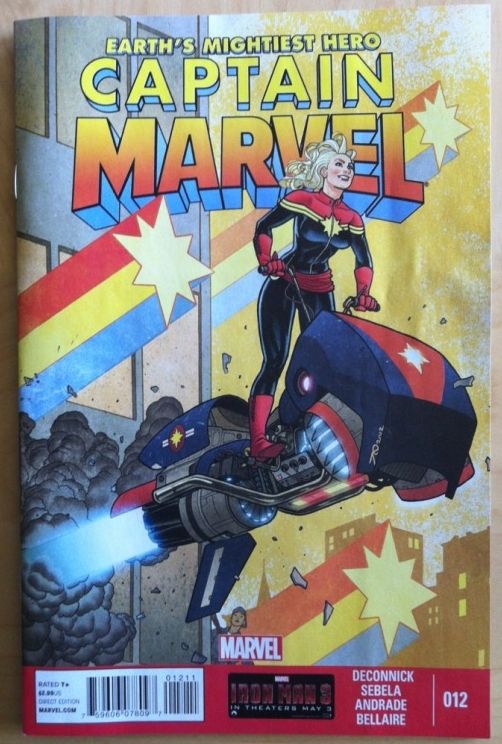
Marvelling at Captain Marvel 12

Or some thoughts on why Captain Marvel #12 is such an affective comic.

This one has *SPOILERS*, particularly if you are reading Captain Marvel in trades, so read at your own risk. 


My original plan was to write something short and punchy about how Filipe Andrade uses anatomy to create the impression of speed and movement in Captain Marvel. But the more I looked at the comic, the more I realized that there was something cool going on in the way the comic is structured and that to enforce that structure, a bunch of really nifty techniques were being used by the creative team.

Captain Marvel #12 continues the ongoing narrative about a grounded by illness Captain Marvel trying to defeat a winged assailant,  negotiate her Super Heroics without flying, and follow her doctors orders. And doing none of those things particularly well. To tell this story, broadly speaking, Captain Marvel #12 splits itself between two narrative lines: the Superheroic and the mundane. And the way these two sections of story are established and contrasted is pretty interesting.


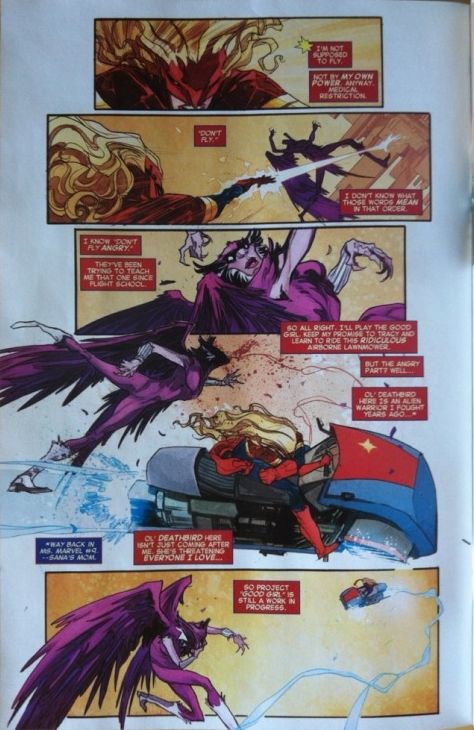
The Superheroic part of Captain Marvel #12 is pure, unadulterated cape comic excess. Captain Marvel fights Deathbird in an issue long grudge match while riding a "ridiculous airborne lawnmower".  It's a fight that takes place almost entirely in the skies over Manhattan and involves all of the brutality, gleeful disregard for physics, and quippy trash talk the genre demands. Basically, it feels like the fantastical ideal of Superhero comics. It's saccharine and it's great.

It is also meticulously crafted. Every layer of craft in this section is devised to advance and establish this as fantasy. From a plot perspective the entire fight scene takes place in the air, a realm inaccessible to mundane people. The script is over-the-top and campy, in that classic superhero way, including amazing lines like "I'm not flying angry...I'm falling pissed off!" and "Finally found a use for that [Jetbike] I can get behind...A BASEBALL BAT!/You gonna talk now, Bird, or am I going for a Grand Slam." From an art perspective the fight scene takes place in a largely backgroundless void (little sense of place) and features figures whose bodies contort in exaggerated poses and stretch in unnatural ways. This gives these scenes a dreamlike, surreal feeling that further rejects the rules of mundane life. Even the colours work towards this effect: Captain Marvel and Deathbird have bright primary coloured costumes and fight on a background of an uncanny orangey-golden-glow. Basically, this entire section sounds and looks and feels like a Superheroic dream.


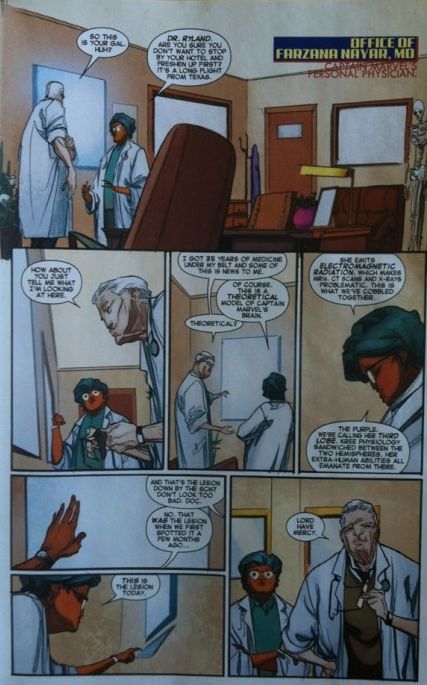
All of that Superheroism contrasts with Captain Marvel #12's mundane medical scenes. In this half of the comic, Carol's Personal Physician Dr. Nayar has a consultation with a Dr. Ryland about the lesion in Carol Danvers' brain. They meet in a doctors office, and have a calm professional discussion about what to do about her ailment. It's a solid portrayal of medicine as the gray vaguely-bureaucratic machine that sees trained professionals make informed decisions about the treatment for sick people. Which, despite the exotic nature of Carol's brain lesion, is such a profoundly mundane human problem: we are alive and therefore sometimes we get sick and this limits us. And for what it is, this section of the comic is great.

When contrasted with the Supeheroic portions of the comic from a craft perspective, this section of the comic is brilliant. The plot of this section breaks down to two doctors discussing a patients ailment, and the dialogue makes brilliant use of jargon-jargon-jargon to ground everything in the mundane rules of reality and Science. Furthermore, this scene takes place entirely in a doctors office or hospital with a meticulously dawn background that firmly establishes this scene with a realistic sense of place. The rest of the artwork also works towards this: characters are drawn with realistic proportions and anatomy and thoughtfully bored expressions, while the colours are familiar earth-tones with a hint of pastels. It's a portion of the comic that sounds, and looks, and feels like a real place and situation. It is, in many ways, the very opposite of Superhero comics.


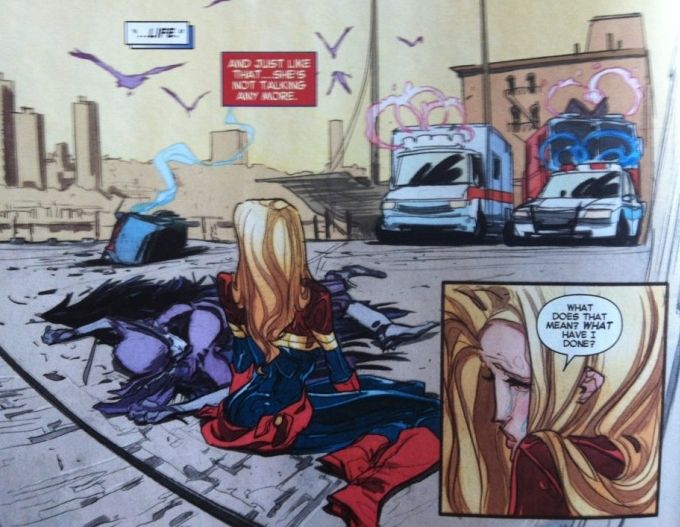
Together these two sections work to create, what I think, is the thematic core of Captain Marvel #12. By so starkly contrasting the fantasy elements of the story with the mundane, inescapable reality of the medical establishment,  the comic creates a tension between the dream (Captain Marvel fighting through the skies) and the reality (Carol Danvers is sick). And as the comic ends and the fantasy of Captain Marvels sky combat collides with the reality of her illness, that tension is resolved by the fact that our biology, our reality can't be escaped by wishing. And in that, I think, is the theme of this comic: our dreams are ultimately beholden to, and perhaps limited by, reality. It's a poignant idea, executed brilliantly by all involved.

Monday, 25 February 2013

Marvelling at Captain Marvel #10

Or writing about a writer's contract with their readers.

There be *SPOILERS* in this one. So go read Captain Marvel #10 before reading this post. 


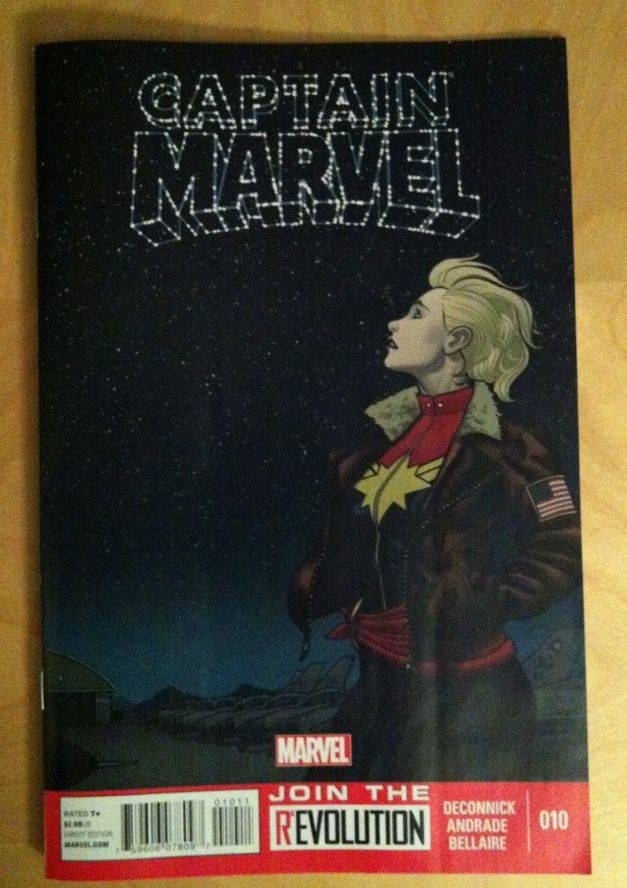
Captain Marvel #10 is another great comic from the creative team of Kelly Sue DeConnick, Christopher Sebela, and Filipe Andrade. It picks up where #9 left off with the revelation that Carol Danvers has a lesion in her brain that may be catastrophically exacerbated through the use of her powers. As a result, Carol is literally grounded by sound medical advice. Captain Marvel #10, then, is a comic about Carol dealing, or rather failing to deal, with the revelation of her condition. It's a comic about willfully ignoring weakness, pushing past limitations, and the consequences of hubris. It's a comic about falling.

(Captain Marvel #10 is also a super well constructed comic that functions both as an individual story and as a part of an ongoing narrative. It's also beautifully drawn.)


Captain Marvel #10 also does something really effective in how it lays out the story and sets up its themes.


The first page of the comic depicts a dream Carol is having about her love of flying to the edge of the atmosphere, passing out, and free-falling back to Earth. In the dream this is presented as a kind-of-game-of-chicken with gravity where the object of the game is to wake up before she hits the ground. It's a pretty great summary of Carol as a character: she loves to fly, is happiest when using her powers, and is stubborn enough to challenge gravity. This sequence also simultaneously introduces her powers and illustrates that Carol enjoys taking risks. The dream further manages to be a pitch perfect moment following the revelation of the brain lesion in the previous issue: I feel it reveals Carol's fear and establishes flight as something important to her; something that would be very difficult for her to lose.  Perhaps most importantly, though, the opening dream sequence beautifully sets up the themes of the comic.

Let me explain. There exists between writers and their audience a... kind of unspoken contract. Readers enter into a manuscript with a certain set of expectations based on all kinds of things: the cover art, the genre, the author's previous work, etc. The author may make further contracts with the audience within the body of the text that also set up additional reader expectations. Something like the brutal murder of The Comedian in the opening pages Alan Moore and Dave Gibbon's Watchman tells the audience that the comic is going to be mature and brutal and that the audience should get ready for an unforgiving read. In a conventional reading sense, the success of the book can be judged by how well the author manages to live up to, or at least address, the contract they establish with their readers. 


(That isn't to say satisfying expectations is the only good way to structure a story-some of my favourite reads, like Fraction and Moon's Casanova: Gula, are about subverting or breaking the contract with the reader- but I think nearly all good fiction is at least aware of the contract that has been made and is interacting with it. Besides, this is supposed to be a short essay on CM#10)

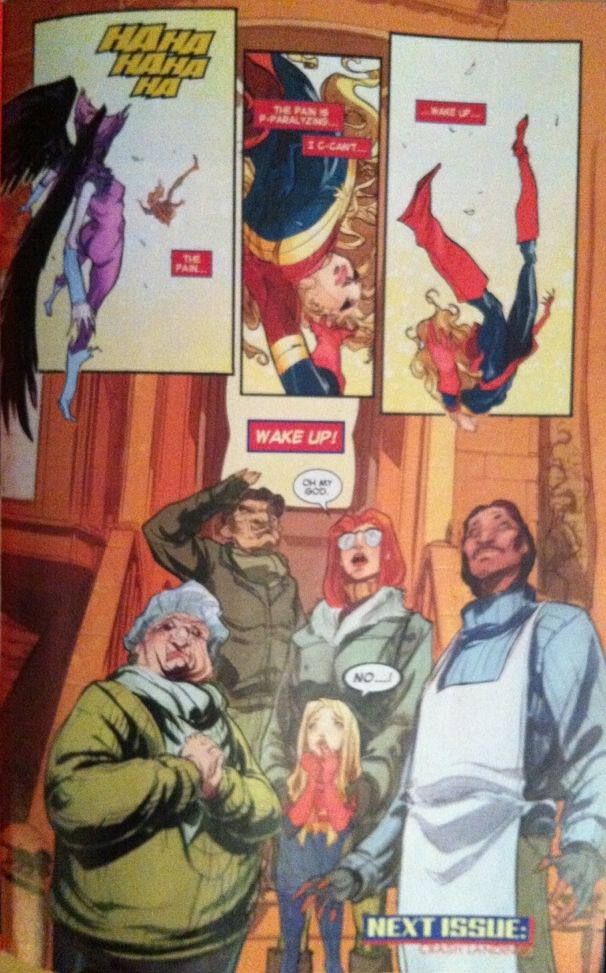
The introductory dream sequence in Captain Marvel #10 works beautifully to establish a contract with the reader. It tells us, whether we realize it consciously or not, that this is a comic about flying too high and falling or pushing too hard and suffering the consequences. With this established CM#10 becomes less a reading experience about discovering the next unexpected story development, and more a comic about waiting for the inevitable disaster and dreading the consequences. I think it ratchets up the tension in a really effective way and changes every brash action on the part of Carol Danvers from her-just-being-stubborn into a stepping stone to disaster. It makes every symptom of her brain condition another second clicking off a timer strapped to an explosive that we know will go off. And when Carol inevitably overuses her powers by flying and is sent plummeting back to the ground in a brilliant parallel to the first page dream sequence, it feels EARNED. Which I think is part of why Captain Marvel #10 is such a satisfying reading experience.


So I guess what I'm trying to say is that Captain Marvel #10 is a great comic that, by explicitly stating its intensions early, manages to create palpable tension and a genuinely solid conclusion. I'd go so far as to say that CM#10 is a lesson in how establishing and satisfying a the contract with the reader makes for an especially satisfying read.

Did I mention I really, really like this comic?

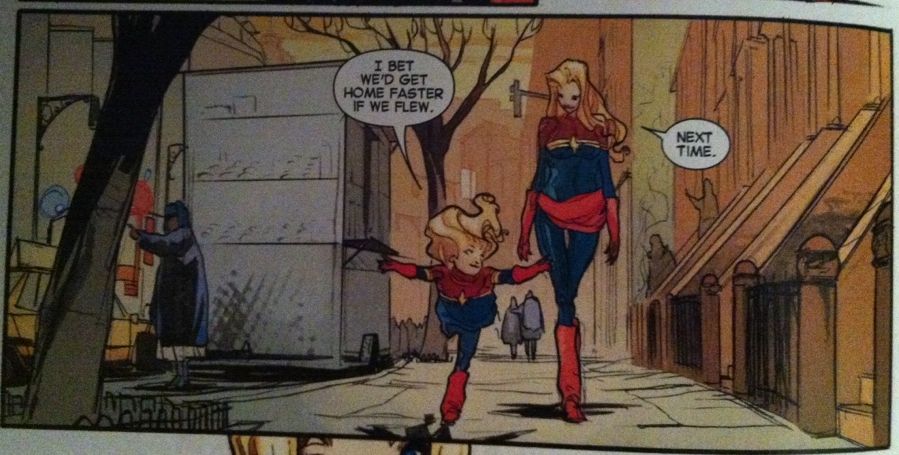
Also, this has to be one of the more beautiful single panels in a comic I've seen: