Showing posts with label Antony Johnston. Show all posts

Wednesday, 20 April 2016

Deep Sequencing: Space Crime Scene Investigation

Or a look at the use of setting in The Fuse Vol. 1 and Mercury Heat Vol. 1
by Antony Johnston, Justin Greenwood, Shari Chankhamma, and Ryan Ferrier, as well as, Kieron Gillen, Omar Francia, Nahuel Lopez, Digikore Studios, Kurt Hathaway, respectively


In my day job I have often meet accomplished clinician-scientists who have built careers on studying people with diseases caused by rare mutations. These researchers find interesting, serendipitous comparisons between people that uncover novel facets of biology and also potentially treat people with rare diseases. I think the same principle can be applied to comics: finding comics with some unifying aspect and contrasting how they approach that commonality can be informative. (A classic example is the different approaches to scripting a beach scene between Moore and Ennis.) And I think The Fuse and Mercury Heat are a pretty ideal pair to examine.

The Fuse and Mercury Heat are both Science Fiction comics that revolve around Space Police solving a murder. The Fuse takes place on an orbiting, power-collecting space station and is functionally a detective procedural that provides a social commentary and satisfying mystery. Mercury Heat takes place on Mercury, in a space colony built around exporting solar energy to Earth, and skews toward an Action-Sci-fi adventure with policing elements. While these comics are distinct from a plot/theme perspective, The Fuse and Mercury Heat have similar enough settings that comparing the two comics is interesting. Moreover, I think The Fuse does a much more effective job utilizing it's setting than Mercury Heat and I think it's instructive to examine this in more detail.

Before I do that, though, I'd like to just point out that I enjoyed both of these comics quite a lot. I think The Fuse is maybe the better social critique of the two, and is certainly the better police-comic with a much more granular and engrossing mystery. However, I also think Mercury Heat is a better work of Science Fiction: some of it's ideas, like everyone being freelance contractors working for a central-sorting AI-application, are kind of brilliant. My point is both comics have their strengths and both are worth reading; I just happen to think The Fuse makes better use of setting than Mercury Heat. 

There will be *SPOILERS* for both Mercury Heat Vol. 1 and The Fuse Vol. 1 below.


The cold open in Mercury Heat is that a man is stranded on the surface of Mercury. Mercury is noteworthy because dayside of the planet surface is inhospitably hot while the nightside of the planet experiences temperatures which are unendurably cold. The trick to surviving on Mercury, depends on living in the twilight/dawn region that exists between the two extremes and which, due to Mercury's very long day, moves at something like walking speed. So this man stranded on Mercury is trying to outrun the dawn and avoid frying to death. Except he can't and he dies by solar immolation.

The issue here is that this isn't at all clear from the artwork in Mercury Heat. The camera is focused in so far that as a reader I never get the sense of impending dawn or that the doomed man is running on the surface of the planet. Or really, that the comic is taking place on Mercury at all since what is shown is a non-descript Sci-fi setting. Which is, in my opinion, a shame because I think this could have been a grand, hook the reader kind of moment that doesn't quite work because the setting isn't used effectively.


The issues with communicating setting continue past the opening sequence of Mercury Heat. While the comic takes place inside some sort of Mercury-based space colony, I still can't really describe what that entails or what it looks like. Most of Mercury Heat portrays its world as a series of generic looking space-corridors and while there are some establishing shots (I've tried to gather the best I could find above), they fail to provide good information on what the Mercury Colony looks like, or what the lives of its denizens might be like. Like, I cannot tell you if Mercury has a surface city, a buried city, or as is the case in a few Sci-fi things I've read, a moving city that paces the twilight/dawn zone. Which is a shame, because it deprives Mercury Heat a sense of place, some degree of believability, and fails to capitalize on the awesome fact that it takes place on Mercury.

(I'm willing to concede that the narrow focus and sheer corridor-ness of Mercury Heat *could* be a meta-commentary/nod to other Sci-fi works that, constrained by budget, also go heavy on the corridor and light on the awesome space setting. I'm pretty sure the tight outfit and undesirable "personality type" of the protagonist (among other things) are an unspoken commentary/satire of the Sci-fi girl-with-a-gun trope, so it's not impossible that Team Heat is Doing A Thing. Or that what I'm examining here as an omission may actually be a deliberate creative choice.)


The Fuse, in contrast does a much better job establishing its setting. The comic also opens with a murder, although this sequence is much more mundane and takes place in a fairly nondescript communal space that could literally be anywhere. Immediately following this, however, The Fuse gives us a double page spread showing us the entire space station. This gives the reader an immediate sense of place and established that the reader is in a fantastical, space world. The juxtaposition of the mundane murder with the space station also helps establish one of the thematic cores of the series: despite the futuristic and exotic setting, the denizens of The Fuse are beset by the same squalor, corruption, and immorality as humanity always has been. This contrast between the Sci-fi promise of the premise and the mundane reality of the story really drives home the social commentary of the comic.


The Fuse builds on this setting and continues to make use of the contrast between fantastical and mundane elements. The comic takes us to what is recognizably an inhabited city inside the space station, or a wealthy suburb inclosed beneath a space-dome. It shows us a vagrant camp built into an out-of-the-way bit of station infrastructure. The comic takes the reader to a gravity-free observatory where station inhabitants can watch Earth (and where they explain the super-clever origins of "The Russia Shift). These are settings that manage to incorporate the space-elements of the station and merge them with recognizable, contemporary elements which convey information to the reader about things like economic class, but also carefully maintain the juxtaposition of the mundane and futuristic. It is very effective comics that really makes the most of the setting a socially conscious police procedural in space.


Mercury Heat does have one sequence that makes great use of its setting. In one of the final chapters, the comic's protagonist finds herself marooned on the surface of Mercury and, like the poor soul in the opening sequence, forced to outrun the dawn to survive. In this instance the camera pulls back to give the reader a view of rugged, craterous Mercury and the context to appreciate the predicament of the protagonist. The sequence feels dangerous and suspenseful and great, in large part, I think, because of the large scale portrayal of setting. It is also, I think, one of the most enjoyable sequences in the comic, and I hope, a sign that setting is going to be a more active element of Mercury Heat going forward.


Wednesday, 28 October 2015

So I Read The Fuse: Gridlock

A 250 word (or less) review of Fuse Vol. 2
by Antony Johnston, Justin Greenwood, Shari Chankhamma, and Ryan Ferrier; Image Comics


The Fuse is an ongoing comic, to read about the first chapter go here.

The Fuse is a police procedural comic that takes place on The Fuse, an orbital power station with a nebulous sovereignty, bitter inequality, and fermenting discord. The current volume centres around the death of Starlight, the star gridlocking racer of a popular sport on the verge of lucrative syndication. It is up to murder detectives Klem Ristovych, a longterm veteran of the station, and Ralph Dietrich, a recent emigre from Earth, to solve a case that will see them run afoul of the power company, drug dealers, TV producers,  and FLF, a group agitating for Fuse independence. The Fuse: Gridlock is another really satisfying instalment in the series: it continues to be a complex police procedural that uses its Sci-fi trappings and sense of humanity to tell an intriguing mystery and provide insightful social commentary. This current chapter is also significant because it manages to build off the initial great premise of the series and create intriguing new directions for the longterm story. I am now deeply invested in the both the individual episodes of the comic, but also the overall story direction of the series. If you are at all a fan of detective stories or space stations, The Fuse is a comic you really ought to be reading.

Word count: 210

Previosuly:
The Fuse Vol. 1

Wednesday, 4 March 2015

So I Read The Fuse: The Russia Shift

A 250 word (or less) review of The Fuse Vol. 1
by Antony Johnston, Justin Greenwood, Shari Chankhamma, Ed Brisson; Image Comics


I love a good Police Procedural. There is just something about the formula of bedraggled arbiters of justice solving a mystery and bringing the law down on criminals that I just find endlessly watchable. I am also a huge fan of Science Fiction and am of the opinion that most genres can be improved by setting them in space. The Fuse #1 is a detective story set on an orbital power station. Ralph Dietrich, a new detective fresh off the shuttle from Earth, stumbles straight into the crime scene of a murdered vagrant Cabler. Dietrich and Klem Ristovych, a wily veteran murder detective of the Russia Shift, attempt to close the case and find themselves investigating an even larger crime that goes all the way to City Hall. The Fuse: Russia Shift, for what it is, is perfect. The procedural elements are flawless: the mystery is compelling with enough twists to keep it interesting and the detective are charismatically uncharismatic to an ideal. Even more importantly, unlike many police procedurals, The Fuse manages to transcend genre limitations and offer a really empathy filled story that doesn't punch down. Also, it is in space! So if you want to read a really enjoyable genre comic that tells a pitch perfect police procedural story and sets it in a fun Sci-fi setting than The Fuse is a must read. 

Word count: 227

Post by Michael Bround


Friday, 19 December 2014

Deep Sequencing: Lost In The Shadows

Or how a momentary lapse in storytelling can lead to a lot of confusion in Umbral: Out of the Shadows
By Antony Johnston, Christopher Mitten, and John Rauch; Image Comics


Umbral is a pretty great fantasy comic that totally scratches a particular genre itch I have. The comic is creepy, swashbuckling, and filled with one of the saltiest, cussiest protagonists in comics (which as the descendent of sailors, I appreciate deeply). The comic also has a great style and a wonderfully atmospheric approach to colours that makes it look unique and makes for an interesting read. I really enjoy it and think that it's a comic worth checking out, particularly if you are an epic fantasy fan looking for a comic to try.

Umbral: Out Of Shadows is also a comic with a good example of just how easy it is to lose storytelling clarity.

Now, I don't usually like to write about what I don't like about comics because I think its overdone on the internet and often it boils down to "I don't like this choice" or is just ragging on a comic that is obviously bad. However, I really like Umbral and think its a good comic and I think the mistake they made is interesting and instuctive and worth taking a closer look at.

There will be *SPOILERS* for Umbral Vol. 1 in this post.


Before I throw Umbral under the bus, I'd like to point out just how good the majority of the comic is. Take a look at this page here and how clear and atmospheric it is. The long tall establishing panel on the left sets the story and sells the feeling of height, the top right panels show the characters dangling into the page in a way that really captures their precarious position, and the orientation of the archers in the bottom two panels really nails the storybeat of archers firing down on the dangling characters. Add in some really wonderful atmospheric purple-shaded colouring and lettering that really helps guide the reader through the page and this is great comics.

This is really representative of the level of quality in the majority of Umbral.


<PAGE TURN>


This is where storytelling really breaks down for me in a way that left me considerably confused and caused me to miss an important moment in the story.

As I read these pages originally this is how I interpreted them: Rascal (the girl with the magic stone) is confiding with the head of her Thieves Guild. She tells him about the madness at the palace, the appearance of monstrous shadows, and about the magic artifact she has stolen. Her guildmaster asks for it himself and then, from off stage right, a shadow monster enters the room to menace the pair. In my initial reading of these panels there are three characters at play: Rascal, the guildmaster, and the shadow. 

The intended story of these panels is that Rascal confides in her guildmaster only to have him, the guildmaster, transform into the shadow monster. In the intended story, there are only two characters in play: Rascal and guildmaster/shadow. Which I did not get until several pages later...

And I think I had problems with these panels because of a number of storytelling choices made in this sequence. For instance we do not see any sign of the guildmaster transforming into the shadow on panel; we see the human guildmaster and then shadow, and nothing in between. There is also the fact that in the first panel in this sequence the guildmaster is to the left of Rascal, yet the speech bubble from the shadow initially comes from the right side of the page. This whirling perspective is confusing in this instance. And then there is the form of the lettering: shadows have special speech captions, and the guildmaster uses the human one, and there is no continuity in the contents of the captions to tie them together. Essentially, my issue here is there is no bridging information that tips the reader off that the guildmaster is really a shadow and this caused me to be confused.

Imagine if the sequence had the guildmaster in the first panel have a little bit of purple-shadow-colour at the edge of his hair and clothes and his speech was in a shadow-bubble. Then, in the second panel, if the speech bubble was on the left of the page. I feel like this would be much clearer for readers.

Which really emphasizes how fine a line creators have to walk to maintain clarity. The difference here for me was a matter of colouring and lettering, and those are relatively small things. Small things that made a big difference in how I understood this sequence. 

But yeah, Umbral is a mostly a really good comic! You should read it! 

Wednesday, 17 December 2014

So I Read Umbral: Out Of Shadows

A 250 word (or less) review of Umbral Vol. 1
By Antony Johnston, Christopher Mitten, and John Rauch; Image Comics


Fantasy seems to be an under represented genre of fiction in comics. When I think of how much geeks love their magic and swords and the popularity of certain fantasy properties in other media, it seems there should be a demand for fantasy comics. I know I'm interested in reading more. Umbral is an epic fantasy horror comic that seems well suited to capitalize on this trend. It tells the story of Rascal, a wonderfully salty-tongued thief, who is friends with the crown prince of The Kingdom of Fendin. On the eve of the eclipse, the two conspire to steal The Oculus, a mysterious magical artifact, from the royal vaults. Unfortunately the eclipse is also when mysterious demons attack the palace in pursuit of the same Occulus, thrusting Rascal into a world of magic, demons, and terror. Umbral hits this great balance of filthy-mouthed swashbuckling fun and oh-shit creepy madness. I really enjoyed it. Out Of Shadows is also a really great example of a straightforward, throw you into the action opening chapter: Rascal and company are tossed right into it and spend the issue running for their lives. This approach got me invested in the story, but leaves a lot of plot and world building for future issues. This is a chapter, not a complete story. I found the art to be mostly pretty great: it’s evocative and pleasantly nightmarish. There are some confusing storytelling issues at key moments. Overall I think Umbral is a great fantasy comic option.

Post by Michael Bround

Word count: 250

Wednesday, 7 November 2012

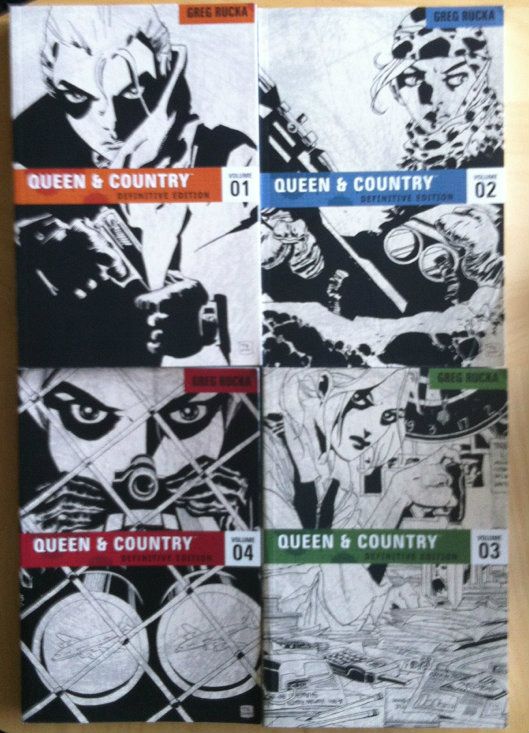
So I Read Queen and Country


Or a 250 word (or less) review of all four Queen and Country Definitive Edition omnibuses
By Greg Rucka and Steve Rolston, Brian Hurtt, Leandro Fernandez, Jason Shawn Alexander, Carla Speed McNeil, Mike Hawthorne, Mike Norton, Chris Samnee, Antony Johnston, Christopher Mitten, and Rick Burchett; Oni Press.


Queen and Country is basically an adeptly made espionage Thriller/Procedural. The series depicts members of the British SIS' most elite operatives, called Minders, and the extraordinary missions they are sent on for, well, Queen and Country. Which is the source of the series’ thrills: the missions in Queen and Country are pretty suspenseful and exciting. Even better, the missions and portrayals of espionage in the series are fairly believable which grounds the material and increases the tension. Queen and Country also puts a great deal of emphasis on the bureaucracy, politics, and personal cost of spying. It's this procedural content that adds a layer of strong characterization and ongoing drama to the series. This adds to both the integrity of the story and the depth of the characters… which in turn feeds back into the tension. Greg Rucka, who writes nearly the complete series, is excellent and the artists who rotate to draw the various missions are all quite talented and, at the very least, competent story tellers (although your millage may vary from one to another). Overall, Queen and Country is a very skillfully produced series. There are two canonical prose novels that occur between trades where VERY IMPORTANT THINGS HAPPEN. I was unaware of this when I read the comics and regret not reading them in correct order. Be forewarned that you should probably read these books as you read the comics to get the full experience. Also: the Definitive Edition omnibuses are great value. Check the series out.

Word count: 250.