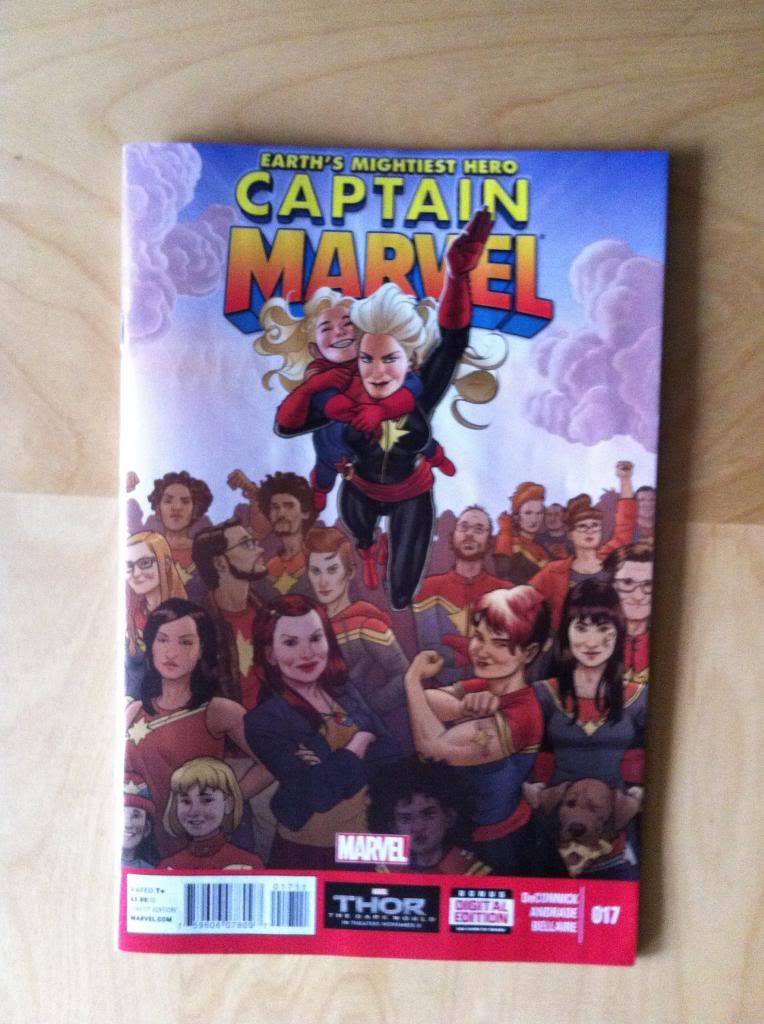
Or a roundup of cool features from recent issues of Captain Marvel
by Kelly Sue DeConnick, Warren Ellis, David Lopez, Marcio Takara, Laura Braga, Lee Loughridge, Nick Filardi, and Joe Caramagna; Marvel Comics
Captain Marvel is another comic I can count on to always be good. It's also a comic that is frequently pretty seamless: it features amazing dialogue, fantastic acting artwork, and clear functional storytelling. It's a comic that does all of its constituent jobs well, but often in a way that is quietly great. Less elaborate flourish, more solid workmanship. Which makes writing about the comic a little difficult sometimes.
That said, Captain Marvel does feature some pretty clever choices, so I've rounded up some of my favourite comics moments recently in Captain Marvel here.
There will be *SPOILERS* for Captain Marvel #10, #11, and #12 specifically
Captain Marvel #10 makes good use of infringing on comic gutters for fun storytelling effects. The more obvious of these choices is for emphasis: we see Spider-Woman break panel borders with her body and see her energy blasts surge over boundaries and seemingly out of the page. This makes her the focal and emotional centre of the page and makes her blasts seem especially powerful and important. It's a straightforward approach but it makes this page exciting and interesting.


Captain Marvel #10 has more adept and interesting games to play with the gutter spaces between panels. The story of the issue has amoral (or maybe outright evil) genius Grace Valentine launch a quest of vengeance against Captain Marvel and her allies by mind controlling a horde of New York rats. So much of the story revolves around hundreds and hundreds of rats (a ratatouille of rats?) overrunning New York and invading the subleased Statue of Liberty apartment of Carol Danvers. In a really clever and adorable bit of comics, many of the gutters feature little rats peaking out from between the panels. On the one hand this is just kind of fun, but on another it really emphasizes the feeling of being infested with rodents. There are so many rats in Captain Marvel #10 that they are even appearing in the parts of the comic that it should be impossible for them to be in. It's a really effective and fun choice.


Captain Marvel #11 has a great two page sequence that does some interesting, comics rule breaking things. The sequence, which sees Carol Danvers drugged unconscious by the Toxic Doxy and then regain consciousness captive is delivered in a very effective way. After Carol is dosed with the drug, there is a break between the normal structure of the comic, which functions as a sort of visual shorthand for reality, and Carol herself. We see the background panels become repetitive and strrreettcchhhh as the moment drags out, while meanwhile Carol falls, along with some collapsing panels, out of the plane of the page and faints into a white, roiling zone perpendicular to the normal structure of the comic. Then we get a well placed page turn, giving a clear break between events, before returning to Carol as, golden coloured and still surrounded by the panels of fainting, she oozes back into the page and reality. Which on a purely visual level is pretty interesting.
It is also super evocative of the experience of being sedated to the loss of consciousness. I've only done local anaesthesia once in my life, but I can remember the way time stretched, growing dim and fuzzy, before suddenly I was thrown from reality and rendered oblivious before, even fuzzier, I slowly swam back to reality. The way this sequence dilates time, literally casts Carol out of the universe of the page, and then gives a clear, quick feeling discontinuity between story sections wonderfully encapsulates that experience. It's a really smart stretch of comics.


This double page spread from Captain Marvel #12 is also pretty cool. Obviously it has a giant Space Tardigrade, aka Space Water Bear, which is totally rad. More things in life should feature Water Bears, particularly giant Water Bears. It's also a cool spread because it quietly does a lot of smart comics things to make a pretty dense composition work really well. The page is double page spread which immediately imparts a sense of size and majesty to the Tardigrade and puts the rest of the events in relation to this noble space monster. The rest of the key storytelling items are arranged on the page in a long continuous curve starting at the Space Water Bear's eye catching mouth and sweeping across the page. This allows readers to quickly parse the story elements and experience them in a fast feeling order. This sweeping arc of smaller panels is also interesting in how it plays with panel position and size to impart motion and proximity in a clear way. While swinging across the page we see Carol's spacecraft start big and "close" and shrink as it travels "further away" while the space between panel moments increase as the ship accelerates. Conversely we see the HUD display of the enemy base/refinery grow larger as the ship dwindles, signifying that the spaceship and the story are approaching the base. It all comes off as a tremendously smooth and organic page, but when you break it down this sequence introduces a cool new setting, a new situation, and some stage direction very clearly. And, you know, giant Space Water Bear.
Captain Marvel is another absolute horse of a comic that does its normal comics business very well and sometimes also manages to make some really clever comics.
Post by Michael Bround
Previously:
Marvelling at Captain Marvel #9: a rhyme map of a rock and roll space opera
Marvelling at Captain Marvel #4: Joyous collaboration.
Marvelling at Captain Marvel #3: When joke and story telling collide
Marvelling at Captain Marvel 17: A meta-fandom salute
Marvelling at Captain Marvel 15-16: On tie ins
Marvelling At Captain Marvel #13-14: On The Enemy Within
Marvelling At Captain Marvel #12: Demarcating reality and fantasy
Marvelling At Captain Marvel #10: A dramatic contract
Marvelling At Captain Marvel #9: How your brain tells time
Marvelling At Captain Marvel #7: Saving a reporter in distress... AND ITS A MAN!
Marvelling At Captain Marvel #1: An alternate reading order that I liked more
Or a look at how the band brings the band together with panache in Captain Marvel #4
by Kelly Sue DeConnick, David Lopez, Lee Loughridge, and Joe Caramagna; Marvel Comics
Captain Marvel has been one of the most consistent mainstream comics in my top ten. I'm always looking forward to the next issue and once I get it, it's often one of the first in my stack I read. It is easily one my favourite comics.
But it's a little hard to express exactly why.
Captain Marvel is a fairly straight forward superhero comic: Carol Danvers, aka, Captain Marvel, fights villains and does inspiring heroic things. Team Captain Marvel have done a great job presenting interesting wrinkles and challenges to keep the superheroing interesting, but the comic isn't doing nifty things with genre like many of the other comics I'm currently reading. Similarly, Team CM, while great storytellers, also aren't really experimenting with the medium of comics in the way most of my other favourite books are. So it's a little hard for me to pin down exactly what it is about Captain Marvel that makes it stand out in a field of genre-bending, medium-experimenting comics.
Captain Marvel #4 might be the explanation I've been looking for.
There will be *SPOILERS* for Captain Marvel #4 in this post.
Captain Marvel #4 is, at first glance, a business story. It fleshes out the premise of the current storyline, introduces and solidifies the new supporting cast, and advances the plot to the point where the comic can begin telling the meat of the story. In most collections, this would be a down chapter, a necessary block of logistics for later chapters. This should be a forgettable chapter of comics.
But Captain Marvel #4 might be one of the best comics I've read in a while.
The crux of what makes Captain Marvel #4 a memorable comic for me is all about craft and collaboration. While the issue might not have the wildest plot, every single aspect of this comic is pitch perfect and allows the story to function brilliantly. This a fantastic example of a creative team firing on all cylinders.
David Lopez, the current main penciller on Captain Marvel is a solid storyteller and a fantastic acting artist. His characters emote dramatically, and just beam feelings off the page. A lot of this, I think, is that his characters are juuusssstt a little exaggerated in their expressions and gestures, and this really helps each snapshot convey optimal emotion. (This approach to acting makes me really wonder if Lopez has a background in animation.) Lopez's excellent character work helps make every character exchange pop, and makes everyone depicted in the comic feel unique and alive. It's great stuff.

Kelly Sue DeConnick, the writer in Team CM, is a wizard at dialogue. There is a certain brisk snappy rhythm to the words that is just... for lack of a better way to express it, fun. DeConnick writes really engaging characters. And, in a way that is really important for this issue, she gives each of her characters a unique voice which, when coupled with Lopez's excellent acting, allows each character to come into their own really quickly.

Lee Loughridge, the colourist in Team CM, pulls off a quietly great issue of comics. Captain Marvel #4 has a wide variety of settings which are swapped pretty rapidly. Loughridge does a fantastic job using different colours and shadow work to help distinguish these settings and keep them all straight. My favourite examples from this issue are his treatment of the various planets in the comic: from the sickly-yellow suffused lighting of Torfa, to the flat gey and harsh lighting of Ursor 2, to the warm, soft glowing orange of the Maniaciano Outpost of Ursor 4. Beyond keeping these settings distinct, it gives every planet it's own feel (Miasmic Torfa, post-apocolypticky Ursor 2, and gritty port-esque Maniaciano). It's a small, background portion of the comic, but it really makes everything clearer throughout the issue.
<PAGE TURN!>
When all of these collaborators and their individual elements come together, there are these great sequences in Captain Marvel #4. Like this sequence here: a great joke series with a pretty good 1-2-3 gag strip, and then an even better surprise punchline (ha!) after the page turn. It's great comedic timing, but more than that, fantastic sequential storytelling that displays the strengths of Team CM.

The cohesive work of Team CM also does a fantastic job establishing all of the characters in the current cast of Captain Marvel. This issue really highlights the traits of the alien cast and solidifies the voice of each team member as the story moves forward. We see Carol being earnest and headstrong, Tic being clever and common sensed, Gil being strong and angry and maybe not terribly thoughtful, Bee clowning around, and Jackie swash-buckling and generally being the best person ever. And we also see how all of these characters fit together: the gluey regard they all hold for Tic, the abrasive friction between Carol and Gil and the sparks of new friendship maybe developing between Jackie and Carol. Captain Marvel #4 with a great deal of quiet skill manages to take a group of new strangers and make them a team that we as readers understand. I think that's a pretty solid accomplishment.

Another aspect I really like about Captain Marvel #4, and the series as a whole, is how the story and its structure fit into the broader themes of the series. Beyond general heroism and smashing vaguely patriarchal figures (which you could argue this issue is building too with the Spartax Emperor), I feel like Captain Marvel has been about finding and building communities and picking yourself back up after failures. And I think Captain Marvel #4 speaks brilliantly to both of these themes. This issue shows Captain Marvel finding and building a new team, in a new community playing into the comics motif of finding your people. Meanwhile the structure of Captain Marvel #4 has Carol dropped into a new scenario she is ill-equipped to deal with, building a team, picking herself back up and trying again to address the problem in a new way.
And this is why I think so highly of Captain Marvel: even a down issue of character development and plot logistics is a pretty fantastic study in authorial collaboration and technical skill. This series is, in a way that I think is under-appreciated, quietly great comics.
Previously
Marvelling at Captain Marvel #3: When joke and story telling collide
Marvelling at Captain Marvel 17: A meta-fandom salute
Marvelling at Captain Marvel 15-16: On tie ins
Marvelling At Captain Marvel #13-14: On The Enemy Within
Marvelling At Captain Marvel #12: Demarcating reality and fantasy
Marvelling At Captain Marvel #10: A dramatic contract
Marvelling At Captain Marvel #9: How your brain tells time
Marvelling At Captain Marvel #7: Saving a reporter in distress... AND ITS A MAN!
Marvelling At Captain Marvel #1: An alternate reading order that I liked more
Or the tension between punchline and setting in Captain Marvel #3
by Kelly Sue DeConnick, David Lopez, Lee Loughridge, and Joe Caramagna; Marvel Comics
As a general rule I try not to write critical posts. I avoid comics that I don't think I'll like very much, and try to focus my time and money on the best comics I can. As a result, especially for my mainstream comics intake, I read a reliably fantastic collection of comics. When I write about these books, it's much easier to highlight especially interesting positives than trying to find problems to worry at. And when I do notice something about these comics that I don't especially like, it's usually something obvious like deadline rushed art in a crossover or awkward fill in art, neither of which makes for a particularly interesting bit of criticism (It is bad and I don't like it!). However there is a sequence in Captain Marvel that I think, given the collision between two different storytelling priorities, is worth taking a critical look at.
There will be *SPOILERS* for Captain Marvel #3 in this post.
Now, I really enjoyed Captain Marvel #3! In a time when I am becoming increasingly less interested in straightforward super heroics, Captain Marvel remains my example of the best conventional superhero comic being made. The comic is fun, aspirational, rock and roll action packed, has a sense of humour, and manages to provide sufficient character stakes to feel substantiative and dramatic. Kelly Sue DeConnick's dialogue wizardry makes every character interaction a joy to read and her approach to Captain Marvel as a confident, driven, professional whose personality is both her greatest asset and largest challenge is immensely relatable. (I think it's pretty common that the curiosity, competitiveness, or drive of a lot of very talented, successful people can make them simultaneously exceptional and pretty flawed people, and it's pretty great and humanizing that Carol displays this). I'm also really into the way Team Captain Marvel creates challenges that are beyond Captain Marvel's powers to directly address: be it Vol. 1's medical affliction or Vol. 2's diplomacy and plague challenges. A powerful hero who is fallible and has to struggle against broader challenges is great. David Lopez is a pretty fantastic new voice for the comic too: his modern, but very superhero-y style really fits the aesthetic of the comic and does a solid job storytelling. By any reasonable metric Captain Marvel #3 is a very good comic that is completely worth reading.
The thing is, there is one sequence in this comic that I think is super interesting because it is a compromise between two different aspects of comics.
So these two panels here, I think, represent the set up of a joke. The premise is that Carol will have to travel to a planet and act as a diplomat to convince a group of alien refugees to flee their new, toxic home and that Starlord doesn't think it will be an easy task. The set up for the punchline is that Carol has "got some moves", that her diplomatic skills are up the task. And then....

...we get this long, very well thought out storytelling sequence. We see your standard, new planet setting establishing shot, Carol dropping in like this whole thing will be easy, a panel introducing a big, tough looking new character, who then punches Carol in the face. This sequence is very good storytelling that quickly establishes a new setting, introduces a new character, and succinctly displays the thematic challenge of the story (that Carol's help isn't exactly wanted and that she is ill equipped for it.) However, I think, steps all over the joke that was set up on the previous page. By my estimation the punchline of the gag set up in those two previous panels is the punch to the face and because of storytelling clarity needs there are four panels between the set up and the delivery. And this, I think, waters down the effectiveness of the joke.

So there is this whole type of comic which is the short gag strip. Now the best of these, like the above new (ohmygodnew!) Perry Bible Fellowship comic, follow a certain idealized structure. (I mean, there are a lot of ways to skin a cake, but this is one common forumla that works quite well.) The idea here is that in three, immediately connected frames, a premise is etsbalished, a joke is set up, and then an unexpected and impactful punchline is deployed. And those two panels in Captain Marvel at least looked like they were a panel 1 and 2 in a three joke structure gag strip. And then there was a page turn, which set the stage for a great punchline reveal. Which did not materialize.
Instead we get premise, setup, setting. Which, while it is good storytelling to establish where the story is happening, maybe does not fully deliver on the joke setup.
In my opinion this collection of panels is the most direct delivery of the gag. We get premise, the joke setup, and punchline rapidly to maximum impact (ha ha). Of course, this collection of panels makes a pretty big compromise in storytelling: it delivers the joke but with no information about setting, characters, or the context of the punch. This is a pretty big omission and a lot to expect the reader to figure out on their own and, since storytelling is king, probably not the best course.
So after all maybe the actual layout is best: it maximizes storytelling clarity and still manages to deliver a pretty decent punchline on the gag. If the joke isn't in service to the story, than what's the point?
But I wonder if maybe there is some sort of compromise between the two that would provide the needed storytelling and still maximize the punchline. Maybe something like this?
Or maybe I'm completely wrong?
Regardless, Captain Marvel #3 is a great comic you ought to read and judge for yourself.
Previously
Marvelling at Captain Marvel 17: A meta-fandom salute
Marvelling at Captain Marvel 15-16: On tie ins
Marvelling At Captain Marvel #13-14: On The Enemy Within
Marvelling At Captain Marvel #12: Demarcating reality and fantasy
Marvelling At Captain Marvel #10: A dramatic contract
Marvelling At Captain Marvel #9: How your brain tells time
Marvelling At Captain Marvel #7: Saving a reporter in distress... AND ITS A MAN!
Marvelling At Captain Marvel #1: An alternate reading order that I liked more
Or the symbiotic relationship between comics, creators, and their fans.
By Kelly Sue DeConnick, Filipe Andrade, Jordie Bellaire; Marvel Comics
Captain Marvel #17 is one of those comics I can't stop thinking about. It features gorgeous artwork by Filipe Andrade and Jordie Bellaire and hits the rarified air of a comic worth purchasing for the art alone. The story is full of charm, humour, and jaw-droppingly perfect moments with the rich character work and relationships that are the foundation of the series. It's a really fun, really emotionally satisfying issue of comics. But the reason that I can't stop thinking about CM#17 is that it's this amazing meditation on the relationship between superheroes comics and their fans. And this is completely worth trying to unpack.
There will be *SPOILERS* for Captain Marvel #17 in this post.
I'm a fan of Captain Marvel, I think it's been a really great comic by A-list creators which has pretty consistently told really great stories. When not dealing with crossovers, team Captain Marvel have turned in some of the best issues of comics I've read. And I'm clearly not alone in this: Captain Marvel has a fiercely loyal fanbase, The Carol Corps. A group of readers who don't just read Captain Marvel but engage with it, create Captain Marvel fanart, cosplay as the Captain, knit Captain Marvel woolies, and permanently scar their body with tattoos from the series. A group of people who gather in online spaces, including the really terrific one curated by series writer Kelly Sue DeConnick, to share and celebrate Captain Marvel and the series creators.

Captain Marvel #17 explicitly deals with this aspect of fandom. The premise of the issue is that the folks of New York City, in return for Captain Marvel's efforts to save the city from Yon-Rogg (Events from The Enemy Within Corssover), are throwing a rally of gratitude for Carol Danvers. This is literally a comic where the fans of Captain Marvel gather to celebrate their hero and show their appreciation of events which had taken place in a comic book. These are in continuity characters doing what we as fans do online after every issue.

Inherent in the nature of superhero comics, particularly Captain Marvel, is an element of aspiration. These are stories about being better than mortal, about fighting for an ideal, and about helping people. As a result superheroic comics can be very inspirational to fans. (Or maybe they just attract people for whom inspirational stories resonate...) And Captain Marvel has managed to be a pretty inspirational comic to a lot of people. With themes of heroism, particularly heroic women and relationships, Captain Marvel has become a kind of rallying flag for a group of women geeks who are often ignored or treated poorly by comics. Moreover, The Carol Corps, inspired by Captain Marvel, the creators, and each other have leveraged their fandom into a force for good by donating to charities and disaster relief funds. It's pretty damn cool to see.

Captain Marvel #17 acknowledges the aspirational nature of the hero fan relationship as well. In this case the comic uses the relationship between Carol and Kit, her young fan and neighbour, as the lens to frame this. The ongoing comic and CM#17 explicitly show that Kit sees Captain Marvel as a hero and that she clearly looks up to her. Captain Marvel #17 also has a scene where Kit stands up to a bully picking on a cosplaying friend in a way that feels very much inspired by the heroism of Carol. It's a pretty great scene that I think really strikes at the ideal of fanspiration.

The reality of comics is that they are a business: people ultimately have to buy comics for comics to be made. Creators have to be remunerated for their labour, printing and publishing costs have to be covered, and, especially for Marvel and DC comics, profits have to be realized. A book like Captain Marvel has a mandate to sell at a certain level to justify its existence. Failure to find an adequate audience ensures the books cancellation. In an environment where every new series and number one comes with a burst in sales, Captain Marvel exists during a time when there may even be an incentive to cancel under-performing, or perceived to be under-performing, titles. What this means is that for Captain Marvel to have her amazing adventures, for the creators to tell her stories, fans have to buy her comic. Captain Marvel needs her fans to be our hero.

Captain Marvel #17 tackles this aspect of comics as well. The conflict of Captain Marvel #17 is that a young business professional, with dubious morals and Ayn Randian Objectivist worldview, is bumped from a magazine for a Captain Marvel profile and wants revenge. Since this is comic books she decides the reasonable response is to send a flock of missile drones to attack Captain Marvel appreciation day. Explosions happen, Carol is vulnerable, and her fans have a "I am Sparta-err-Captain Marvel" moment which confuses the drones targeting software. This gives Carol the moment she needs to collect herself and superhero the crap out of the missile drones. But, from a more meta-relevant perspective, Captain Marvel is literally being saved from the personification of Capitalist forces by her fans. Which, I think, is a pretty deliberate shout out to the fans of Captain Marvel who've helped keep the series alive.

I frequently get the impression that the creators of Captain Marvel, particularly Kelly Sue DeConnick, enjoy the interactions they have with The Carol Corps and non-affiliated fans. It seems, as an outside observer, that team Captain Marvel is touched by the fact that a strong enough fanbase came out and bought Captain Marvel that the series ran 17 issues and is being relaunched and also getting a spinoff series. (A feat which apparently resulted in a lost bet.) It also seems, as an outside observer, that the creative people who make Captain Marvel are amazed by all of the fan generated creative projects, the charitable generosity of the Carol Corps, and pleasant demeanour and inclusiveness of much of the Captain Marvel fanbase. (Which hopefully balances out the soul destroying nonsense of the human garbage scows that Team Marvel doubtlessly also have to deal with.) Collectively, it seems to me that the creative team behind Captain Marvel is somewhat inspired by their readers.

Captain Marvel #17, I think, rather explicitly states this point. In one of the closing scenes of the issue, Captain Marvel and Kit are hanging out in Carol's new home, the gallery of the Statue of Liberty (and how many kinds of awesome is that!?), to have a "Captain Marvel Lesson". Captain Marvel, suffering as she does from memory loss (Enemy Within), confesses to Kit that she is unsure how to teach her how to be Captain Marvel. It's at this point that Kit reveals that her plan was, all along, to teach Carol how to be Captain Marvel using a comic book she made. Or, to meta this up, Kit, the ultimate Captain Marvel fan, is going to teach Carol what it means be Captain Marvel using the lens of being a fan. Which I feel is a pretty obvious "thank you" from Team Captain Marvel, as well as a revelation that the Carol Corps has helped shape what Captain Marvel means to its creators and maybe even changed how they think about heroism a bit.
So, to try to integrate this whole thing, Captain Marvel #17 seems to suggest that this construction of Captain Marvel (character/book/community) has arisen from a kind of collaboration between creators, the character, and fans. This comic, I think, shows that while fans come to the comic for the character (and creators) and can draw on the book for inspiration, ultimately the creators rely on their fans and are in turn inspired by them. And the result of all of this is Captain Marvel and the Carol Corps and all of the fictional and real world goodness that's come out of this funny book. And that is pretty damn special and is why I can't stop thinking about Captain Marvel #17.
You really ought to be reading Captain Marvel and if you aren't, you should try out the nuCaptain Marvel book when it launches. It's gonna be a REAL comics party.
Previously
Marvelling at Captain Marvel 15-16: On tie ins
Marvelling At Captain Marvel #13-14: On The Enemy Within
Marvelling At Captain Marvel #12: Demarcating reality and fantasy
Marvelling At Captain Marvel #10: A dramatic contract
Marvelling At Captain Marvel #9: How your brain tells time
Marvelling At Captain Marvel #7: Saving a reporter in distress... AND ITS A MAN!
Marvelling At Captain Marvel #1: An alternate reading order that I liked more
Or the my complicated feelings about the Infinity Captain Marvel tie-ins.
By Kelly Sue DeConnick, Jen Van Meter, Pat Olliffe, Drew Geraci, Andy Troy; Marvel Comics.
I'd like to start off by pointing out that I LIKED these comics and found them enjoyable to read. The stories fit into the larger context of the Infinity event, focusing on the individual path of Captain Marvel as she pilots and fights and struggles her way through a space battle, all the while delivering some great character moments (and repeating some pretty nifty ones from Avengers). Basically, I got my monthly CM fix, saw some of the shape of Infinity (I am not reading the event itself), and, most importantly, had some fun while doing it. These are good comics.
(The fact that Captain Marvel #15 and Avengers Assemble #18 told very nearly the same story while each still feeling unique and great is, I think, a pretty solid testament to Kelly Sue DeConnick's skills as a storyteller. Also, her take on Spider-woman is the best: kind of charmingly insecure, loathsomely selfish, and delightfully glib.)
Beyond this point there will be *SPOILERS* for CM #13-16. Read on at your own risk.
But, as good as CM #15-16 are, I feel like they don't really pay service to the ongoing story of the Captain Marvel books. Immediately before these Infinity-tie-in comics we were concluding the Enemy Within event which ended with Captain Marvel essentially sacrificing herself to defeat Yon-Rogg, The Psyche Magnetron made incarnate. To really quickly sum up, Yon-Rogg was using the power of the Psyche-Magnetron to transform Earth into a replica of his homeworld Hala, and Captain Marvel was functioning as the power source for his plot via a link in her brain. Said link manifested itself as a tumour-like growth that spread whenever Captain Marvels used her powers, and threatened to, if pushed too far, burst and damage the tissues of Carol's brain. To save the world and defeat Yon-Rogg, Carol deliberately overused her powers to burst the lesion in her brain to rob Yon-Rogg of his power source. The price of this maneuver was potentially destroying her memories and very identity. And when we left Carol she was floating in space, obviously badly injured, maybe even dead. It was a tremendous cliffhanger.
Was she catonic? Paralyzed? Does she retain her memory? Is she vegetative, or functional? What is her new status quo? And perhaps most importantly, how does all of this affect her relationships with her friends which the series has spent months building?
As a reader I feel like the ongoing storyline of Captain Marvel demands a moment to establish its new status quo. Maybe even a full issue to tell us what the brain-injured Carol is capable of, what exactly she remembers, and most importantly, since its the emotional heart of the series, what Carol understands of her relationships to her friends and mentors and mentees. (Like, cliched as it is, I picture a hospital scene where we see Tracy trying to be too tough, Jessica being hurt and angry (she doesn't strike me as someone who takes rejection well), and the special disappointment instore for Wendy and Kit...) My point is that, for me at least, I care about these things so much more than space-battles in the context of this series and having to wait for all of this information because CM is obligated to have an Infinity tie-in (which was still an enjoyable comic!) feels like a let down.
But! But, but, but, but, but...
I also feel like it's a really good thing that Captain Marvel is obligated to have an Infinity tie-in and is playing such an integral part of the event (I think, I'm not actually reading Infinity itself). Because being an important component of an event, and being woven more and more into the fabric of the Marvel Universe, is evidence of Carol being important to Marvel on a whole. That this kind of attention reflects the fact that Carol Danvers profile is on the rise and that she is becoming, or has become, a key chunk of the Avengers equation. And I think that is wonderful.
Part of this is simpley that I'm a fan: I think Captain Marvel/Carol Danvers is an interesting character, with an interesting personality, neat powers, some cool history (if we ignore some dumb parts), and a pretty memorable, iconic look. Basically she has the sheer comics machinery to stand with Marvel's biggest characters. Which is important because Marvel needs to acquire, or acknowledge that it already has, marquee women characters. Unless superpowers are some sort of X-chromsome recessive genetic trait (like baldness or colour blindness), really ~50% of heroes ought to be women to at all reflect reality. But also because people, men as well as women, are interested in reading about female characters. Also also it's the right thing to do because everyone deserves to see themselves reflected heroically in comics. And I think Captain Marvel is poised to be as natural a part of the Avengers as Ironman, Captain America, and Thor.
Which, if you want to be mercenary, is also important to Marvel as a division of Disney as a profit making company. Geeky women will spend money on Marvel products, and if my chunk of the internet is any indication, they would buy into a Captain Marvel movie. And into that movies merchandise. (The sales in CM costumes alone!) One of the persistent ideas I hear about Disney's acquisition of Marvel and Star Wars was Disney trying to find properties to market to boys. But, I would make the argument that there are at least as many girls who fantasize about being superheroes as there are girls who dream about being fairytale princesses, and that if they could leverage some of Marvel's more interesting female characters (Carol Danvers) they might have a whole other angle to market intellectual property to girls (which again ~50% of humans/consumers are female). And I think Captain Marvel is currently the most marketable female Avenger to a wider audience.
(Well, Black Widow is too, but I would argue that she isn't a superhero necessarily and would work better in an espionage style movie than a more traditional style superhero like Captain Marvel. Although, I would watch the bejesus out of a Bourne Identity style Scarlet Johansson starring Black Widow film... maybe spun out of Captain America: Winter Soldier...)
So I guess as much as I think Captain Marvel deserves to be treated like Hawkeye or Daredevil (books with A+ creators given the freedom and light continuity duties to experiment), I'm glad that it's a book that has such a mandate to integrate into the broader Marvel Universe.
(This entire essay assumes that the tie-ins were mandated and not a deliberate choice to show that Carol is cut off from her support network by taking her away from her friends and dumping her in space.)
Previously:
Marvelling At Captain Marvel #13-15: On The Enemy WithinMarvelling At Captain Marvel #12: Demarcating reality and fantasy
Marvelling At Captain Marvel #10: A dramatic contract
Marvelling At Captain Marvel #9: How your brain tells time
Marvelling At Captain Marvel #7: Saving a reporter in distress... AND ITS A MAN!
Marvelling At Captain Marvel #1: An alternate reading order that I liked more