Showing posts with label Brian K Vaughan. Show all posts

Friday, 29 May 2015

Deep Sequencing: Technocolour Character Design IN SPAAAACE!

Or a look at how the character design competition has been won by Saga,
by Brian K Vaughan and Fiona Staples; Image Comics


Saga is visually tons of fun. There is just an endlessly imaginative and playful approach to the design of characters, technology, and location that just comes to life on the page. Sometimes it feels like Team Saga is just mashing together different things, seemingly at random, to create this constantly surprising parade of space oddities. Which is totally fine! The way Saga looks it's downright delightful.

The thing is though, the more Saga I read, the more I'm beginning to see a method to some of the madness in character design.

Specifically, I am really interested in the design of the Robots in Saga.

There will be *SPOILERS* For Saga Vol. 4


The Robot Royals have always been one of my favourite fixtures of Saga. There is something great about television headed robots wearing very old-fashioned looking military uniforms that is just iconic and fun. I think the crux of why I like these designs so much has to do with the amount of anachronism on display: the contrast between the retro-future monitor-heads and the 1800s-style jackets, trousers, and cavalry boots is just kind of delightful. Even without any other information, they are kind of the best.


Probably the main Robot character so far has been Prince Robot IV. In many ways he is prototypical to the Robot Royalty as he is usually depicted as a sleek-monitor-headed man wearing some variation on the old-fashion military uniform. He has the added elements of a black stipe on the sides of his head and a pair of rabbit-ear antennas that help make him stand out. Additionally he has a cracked screen, a visible mark of the physical and psychological scars he has suffered over the series. And, like the facial scar this crack is a fun play on, this disfigurement is another identifying feature that further differentiates the prince from other Noble Robots. Collectively he manages to look unique and somewhat removed from the mainstream of Robot society.


Princess Robot, the wife of Prince Robot IV has a subtly different and very clever design. She still has the grey humanoid body and monitor head, but hers is tweaked in ways that emphasize her role as an aristocratic woman. Specifically the two knob like projections on the side of her head create the illusion of ears while her sleeker, elongated monitor has a more traditionally feminine shape. Together these elements create a similar silhouette as hair piled into an elaborate bun, a style synonymous with aristocracy and pomp. This makes Princess Robot both recognizable as a character and cements her role in the story as a Noble Robot.


The son of Prince Robot IV is also an interesting bit of character design. Unlike the adult Robots, the infant and imagined child princeling has a round monitor head. This gives the character an instantly childlike look, his monitor approximating the rounder, chubby features of young human kids. It instantly sets him apart from his adult counterparts and cements his status as a wee one. Clever stuff.

Also, how great is it that the Royal Robots have literal Blue Blood? 


Saga Vol. 4 introduces us to the first Robot commoner, Dengo. It seems that Robot society is wildly unequal and is split between a wealthy aristocracy and a wretched commoner class who live in squalor in the shadows of the royal wealth. This class distinction is reflected in the design of the character. Instead of having a sleek, modernist monitor-head, Dengo has a more old fashioned looking television that is boxy and has large analogue controls on the front of it. His face is also, in a choice that is really effective, a black-and-white screen, as opposed to the coloured screens of the Robot Royalty. As readers we can instantly tell the difference in class by their heads: Dengo has an old fashioned TV like someone in his economic situation might, while the Royals have nicer monitors like a richer person would. The allusions inherent in this character design choice are amazing.


But it's King Robot who has maybe the greatest character design in all of comics. The King of the Robots just has a giant, whopping, high definition widescreen TV for a head. A modern flatscreen so big that it is introduced on a double page spread even! Just let that sink in. The highest class, most important Robot has both the largest monitor head, but also the most modern and expensive one. It is obnoxiously clever character design that conveys how important, arrogant (big headed), and wealthy the character is all at a perfectly executed first glance! It's pretty much the best.

So shut it all down folks, comic character design is over. It's done. It can't get any better.

Long live King Robot!

Post by Michael Bround


Previously:

Wednesday, 27 May 2015

So I Read Saga Volume 4

A 250 word (or less) review of Saga Vol. 4
by Brian K Vaughan, Fiona Staples; Image Comics


This review is for an ongoing series and may contain *SPOILERS*. To read about the beginning of Saga go here.

Saga is a comic about building families and trying to sort out how to be an adult. I mean, it's also a Space Opera about fugitive lovers from opposite sides of a galaxy spanning war filled with imaginative and awesome Science Fantasy amazingness who against all odds have a kid. But really, it's about making a marriage work, raising a kid, and making that transition into being a grown-ass person. While I may not have goat horns and a magic sword, as someone who is in their late twenties whose education is finally turning into a career, who is recently married, and whose spouse is currently pregnant with our first spawn (which is amazing and existentially awesome and scary), Saga is just a story that profoundly resonates with me. Saga Vol. 4 specifically deals with the reality of what comes just after: protagonists Alana and Marko are married, have their kid, a career, and a functional family thing and now have to fight to hold onto it. To fight against the slowly brewing forces of Robot Class Warfare, Space Empires, violent Bounty Hunters, but mostly against ennui and temptation and the fact that reality is kind of an unromantic drag. Saga Vol. 4 is a fantastic roller-coaster filled with imagination and fun and also a fraught meditation on this stage of life I've suddenly found myself in. It's scary and arresting and perfect. Please let everything work out. Please.

Word count: 239

Post by Michael Bround


Previously:


Wednesday, 29 October 2014

So I Read Pride of Baghdad

A 250 word (or less) review of pride of Baghdad graphic novel 
By Brian k Vaughan and Niko Henrichon; Vertigo Comics


I think one of the most difficult aspects of talking about the consequences of modern warfare to North Americans, especially to people in my demographic, is that very few of us have any experience with living in a war zone. So it is hard to imagine and empathize with the civilian cost of war. Pride of Baghdad attempts to make the everyday human cost of the Iraq War emotionally relevant to a Western audience. Specifically, the comic dramatizes the true story of a group of lions who escaped the Baghdad zoo during the American bombing campaign which were eventually, while starving, gunned down by US soldiers. Pride of Baghdad leverages the inherent likability, and in my case Lion King ingrained love, of cartoon, anthropomorphized lions to reach out and touch our hearts before tearing them out in the fires of war. It's a great, super effective and slightly manipulative comic worth checking out.

Word count: 153


Post by Michael Bround

Friday, 12 September 2014

Deep Sequencing: Space Lighthouses and Dramatic Turths

Or a look at how fiction captures truth in Saga Volume 3
by Brian K Vaughan and Fiona Staples; Image Comics


There is this idea of dramatic truth. The idea is that through fiction, which at its core is effectively entertaining lies, we can learn some true, transcendental thing about ourselves or the world. Regardless of whether this is accomplished through emulation or metaphor, fiction has the potential to exemplify aspects of our reality that we can see and feel and learn from. Even though the fiction in question might be completely, absurdly unrealistic, it can still be closer to some idealistic truth than a statement based on reality. In some ways the entertaining lies of our stories might be the best way to learn about ourselves, our relationships, or our world.

There is a scene in Saga Volume 3 that rings true to me in such a complete way that I want to share it with you.

Of course, this moment is built of considerable *SPOILERS* so proceed with that understanding.


I think I've mentioned it on the site a few times, but I've recently gotten married to the best person. Aside from calling her the best person, I have trouble articulating exactly what it is that makes her so special, why she is the person out of everyone I've met that I feel compelled to create a life with. I mean she is smart and hilarious and good looking and fun to be around and responsible in a way that I worry I will never be and patient in a way that I know that I am completely incapable of. She is an unbelievable dork and unpretentious in a way that is super attractive and which is constantly a mystery to me. But this really doesn't capture it: my spouse is so much more than a bunch of favourable check marks on a list, and really fails to catch that special spark that explains why I love her the way I do.

I just don't have the language to articulate it.


Saga, for the uninitiated, is about a pair of young lovers from opposite sides of an interplanetary war falling in love and starting a family. Alana is flightless, winged person from the planet Landfall while Mark is a magic horned person from the moon Wreath, which according to the politics of the galaxy is really not okay. As a result the pair are fugitives fleeing from monstrous forces sent by either side of the conflict: a robot royal prince, an amoral bounty hunter, and a jilted ex-fiancee. In Saga Vol. 3 our heroes Alana and Marko find a kind of home in the lighthouse of a famous writer, which is where the forces pursuing them eventually catch up to them. 

Chaos ensues! 

Bad things happen! 

And our pair of lovers and their infant daughter are cornered on the balcony of the lighthouse with no means of escape!

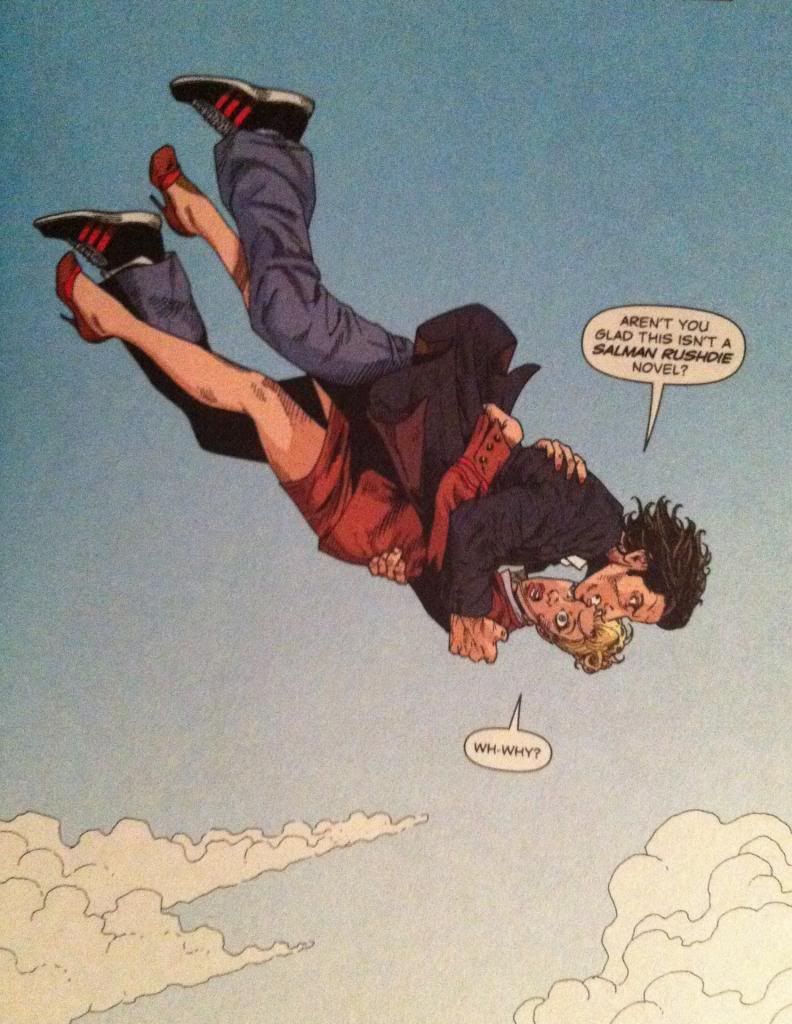
So Marko shoves his Alana and his daughter off the lighthouse balcony to their apparent demise!


And instead of falling to her death, Alana, who we had been told was flightless, manages to fly on her tiny wings saving herself, her daughter, and rescuing her husband Marko from his villainous Ex. 

It's a pretty badass, fist pumping moment! 

But it's what comes next that absolutely speaks to me:


When Alana lands and asks Marko how he knew she'd somehow manage to fly after he maybe threw her and their daughter to their deaths, he simply says that it's obvious that his wife can do anything.

And that perfectly encapsulates how I feel about my own wife; that is the magic, dramatic truth about what makes her so special, why I love her so much.

If I were to push her off the balcony of a space lighthouse with a hypothetical infant in her arms, she would find a way to fly. Because she is completely fucking unstoppable.

Saga is a great comic and I love my wife.

Previously:


Wednesday, 10 September 2014

So I Read Saga Volume 3

A 250 word (or less) review of Saga Vol. 3
By Brian K Vaughan and Fiona Staples; Image Comics.


Saga is a comic about lovers, from opposite sides of a Space War, who fell in love, had a kid, and try to build a family while on the run from bounty hunters and soldiers and ex-fiancees. While there is a lot of pretty cool lasers and swords space action, the comic is really about the construction of families: how two potentially very different people come together in love, drag in others, maybe make a new person, and build this special, de novo community. And then, against the ridiculously long odds of life, fight to maintain this delicate, most important thing. I fucking love this comic. I mean, with Brian K Vaughan's wizardry for story and Fiona Staples endlessly beautiful and emotive and funky art, Saga is amongst the most well crafted comics I read. But that's not why Saga Volume 3 fucking destroyed me. The reason why this comic, more so than earlier chapters, absolutely gutted me, is that I just got my butt married and have spent the months around reading this comic pondering about the construction of family-things and my own little community. And so, I think, I was perfectly primed for this beast to gore me. Which speaks to both the quality of the comic, of course, but also the deeply personal experience of fiction. But yeah, Jesus fucking wept guys, give Saga a try. I guarantee you'll enjoy it, and if you’re living in the same headspace as me, it might just kill you dead.


Word count: 250

Previously:

Friday, 14 February 2014

Deep Sequencing: On The Air

Or some of my favourite quotes from comic books
By G Willow Wilson, Warren Ellis, Jonathan Hickman, Brian Clevinger, Matt Fraction, Alan Moore, Brian K Vaughn, Kelly Sue DeConnick

One of the things I love about Air is that it has this absolutely perfect line of dialogue right off the bat that really establishes the tone and feeling of the series. It also did a really great job piquing my interest as a reader and establishing G Willow Wilson as a writer with some serious chops. Even now, months after I finished Air, I think of the quote in question whenever I consider the series. It's really a remarkable and effective bit of writing.


Which got me thinking, what are some of the other comics quotes that have really stuck with me months or even years after I finished reading a given comic? What are the bits of writing that reflect some ideal truth or moment that are worth sharing and being appreciated by other people?

And so in celebration of Air's quotable moment, here is a completely unscientific info graphic of memorable comics quotes that immediately occurred to me when I decided to write this post:


Despite the very random nature of this list, there are a couple things in common between these quotes that have stuck with me. A lot of them are at the beginning of a comic collection, series, or issue and solidifies the tone of the issue or series. Actually, most of these quotes go beyond that for me and shape the overall understanding of the larger story. Like the hospital quote from Casanova let's us know that Gula would be a much darker, harder comic than Luxuria. Or the Ex Machina quote, from the final issue, reflects the way that last issue alters the fabric the entire preceding series. Which maybe speaks to just how important writing is to comics: as much as amazing art elevates the best comics, great writing can latch on with the strength of the most brilliant visual. Hurray for writers.

(Also, dramatically dropping Pa-Zow! in everyday situations is more fun than it should be.)

What are some of your favourite quotes?

Wednesday, 6 November 2013

So I Read Saga Volume 2

A 250 word (or less) review of the second Saga collection
By Brian K Vaughan and Fiona Staples; Image Comics


This review will contain unavoidable *SPOILERS*. For a *SPOILER* free review of Saga please go here.


I love comic books. Absolutely love them. There are these moments of narrative clarity, pure  unadulterated story telling in comics that I just find joy inducing. It's kind of a difficult emotion to articulate, but if you want to see what sets off this primal glee, Saga Vol. 2 is an excellent example. Saga Vol. 2 continues the story of Marko and Alana, star crossed lovers from different extraterrestrial species on opposites sides of a war, and their baby Hazel as they try to maintain their freedom in a bombastic Space Opera setting. The current collection picks right up at the cliffhanger ending of Volume 1 and just keeps racing along with our heroes contending with the arrival of Markos’ parents, the predations of Freelance Bounty Hunter The Will, and the pursuit of Prince Robot IV. Saga Vol. 2 also continues the tradition of swagger, humour, surprise, action, and family drama that made the first collection of Saga such an infectious read. This comic still looks amazing, with its own distinctive and wicked awesome style. Basically, this comic has top-notch creators blasting out some of their best work. But even that doesn't really capture it... Saga Vol. 2, despite its excellent pedigree, manages to be more enjoyable than it should. I really love this comic. It's difficult to articulate exactly why, so just go read it.

Word Count: 226

Previously:

Friday, 21 June 2013

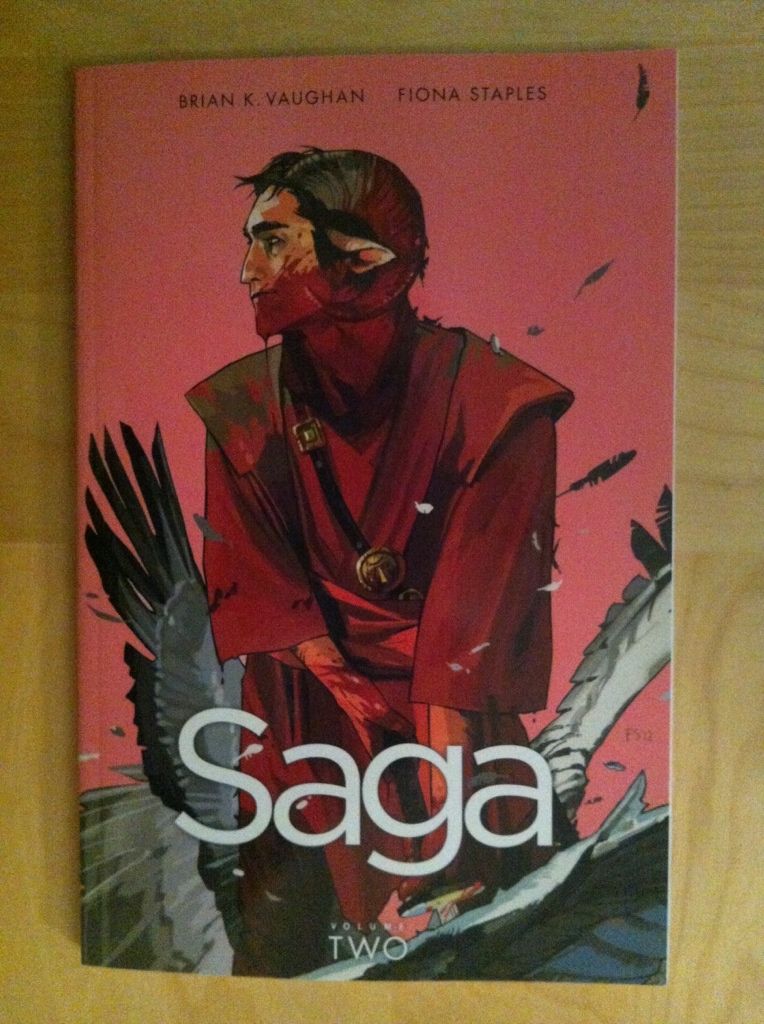
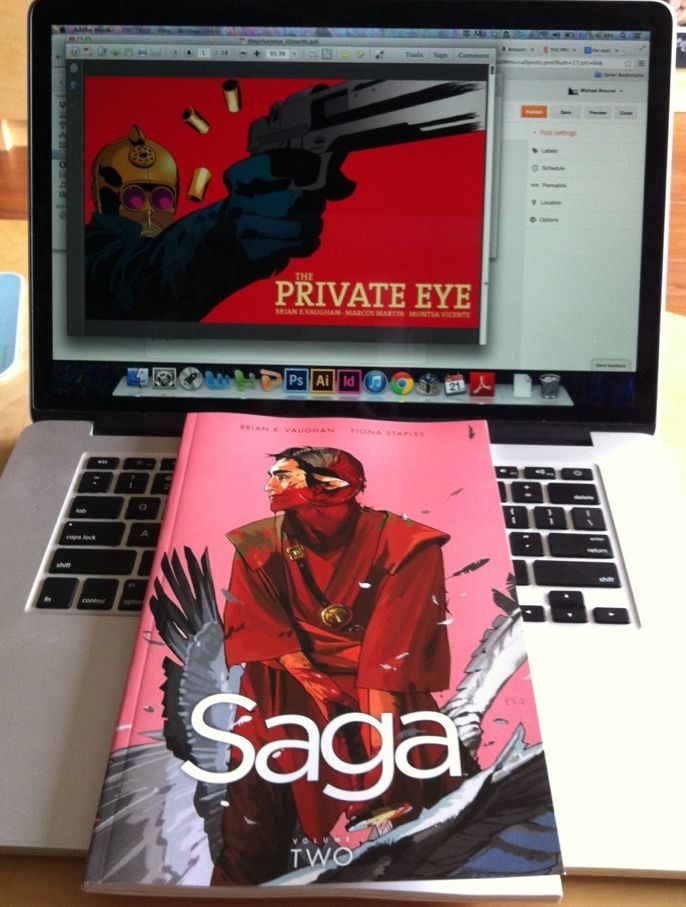
The Perplexing Case Of How I Got Saga Vol. 2 Before The Private Eye #2

Or some thoughts about the differences between completely independent digital comics publishing and print comics consumption.


I really like Brian K Vaughan comics. He is a very talented writer who collaborates with some great artists, and as a result, great comics happen. Currently, Brian K Vaughan is involved in two comics: Saga with artist Fiona Staples and The Private Eye with artist Marcos Martin. Both are gorgeous comics, with neat concepts, and are absolute obligate comics to read. They are also published, and therefore consumed, in completely different ways. 

Saga is a print comic being published by the creator-ownederish Image Comics and is being distributed in comic book and book stores both in a monthly magazine format as well as periodic trade paperback collected editions. The Private Eye, in contrast, is a purely creator owned affair being published monthly digitally and sold exclusively in a pay-what-you-want manner through the creators web storefront. From a consumer perspective, what this means is that we have to buy these comics in completely different ways. In my case the plan is to buy the collected Saga volumes as they arrive in stores and purchase The Private Eye digital files as they are made available online.

Or at least this is the theory.

In reality, it hasn't quite worked out that way. And I think this might be interesting.

My Saga consumption is more or less going to plan. I strategically avoid the Saga issues as they come out for budgetary reasons (while also fanatically evading Saga spoilers online) and then buy the trades on the weeks they came out. And it's easy to do. I am a weekly comic store customer: every single week I make a trip to my local comic book store and buy whichever of my ten-and-only-ten ongoing series comics have hit the stands as well as a trade for the week. It is a habitual process honed through the years and is now just a scheduled, expected part of my life. (And I am nothing if not a creature of habit.) Basically, Saga takes advantage of the existing comic book distribution system and is bootstrapped to our existent comic book fan behaviour. Which, is to say, it doesn't require us to do anything differently.

Where my consumption plans fall apart, a bit, is with The Private Eye. Despite very much wanting to buy The Private Eye as soon as it is published online, it took me more than a month to actually purchase the comic. This wasn't because I missed the announcement of The Private Eye #2, I follow an unhealthy amount of comics-related social media and noticed its release. The trouble is that getting The Private Eye #2 requires a non-habitual, special effort. Which, fair enough, is a fairly tiny one. But what I found was that I had difficulty prioritizing making the web transaction, when I thought of it I was always busy with work, or making dinner, or going to the comic book shop. Buying The Private Eye #2 became that thing-I-have-to-do-later that never actually gets done. 

I think there are essentially two reasons for this. The first is that by using a non-standard comics service, The Private Eye removes itself from habitual consumption habits. This requires people to effetively make a very small, special trip to their store which can be hard to remember and easy to put off. Procrastination is not a rational mode. The second reason I think I put off The Private Eye is a lack of reminders. The comics internet made a justifiable fuss when The Private Eye #2 was released,  and then went mostly silent about the comic. Moreover, neither Brian K Vaughan nor Marcos Martin maintain a social media presence. And I think this contributed to my not thinking about the comic in moments when I actually had the time to make the short transaction. Of course this might all be me being an inflexible consumer who spent the month of May frantically trying to prepare for the biggest test of my life.... 

Regardless, all I know is that I had Saga Vol. 2 before The Private Eye #2, despite the latter's one month head start. 

(Also, Paypal is actually the worst. I spent half-an-hour grappling with it to do a non-member credit card transaction from Canada... it was very buggy. And Paypal will not let me connect my credit card to my account for... reasons I guess? I used up my entire lunch break based comic reading time actually getting the comic!)

Friday, 29 March 2013

Viewing The Private Eye

Or some thoughts on Brian K Vaughan and Marcos Martin's digital comic, The Private Eye


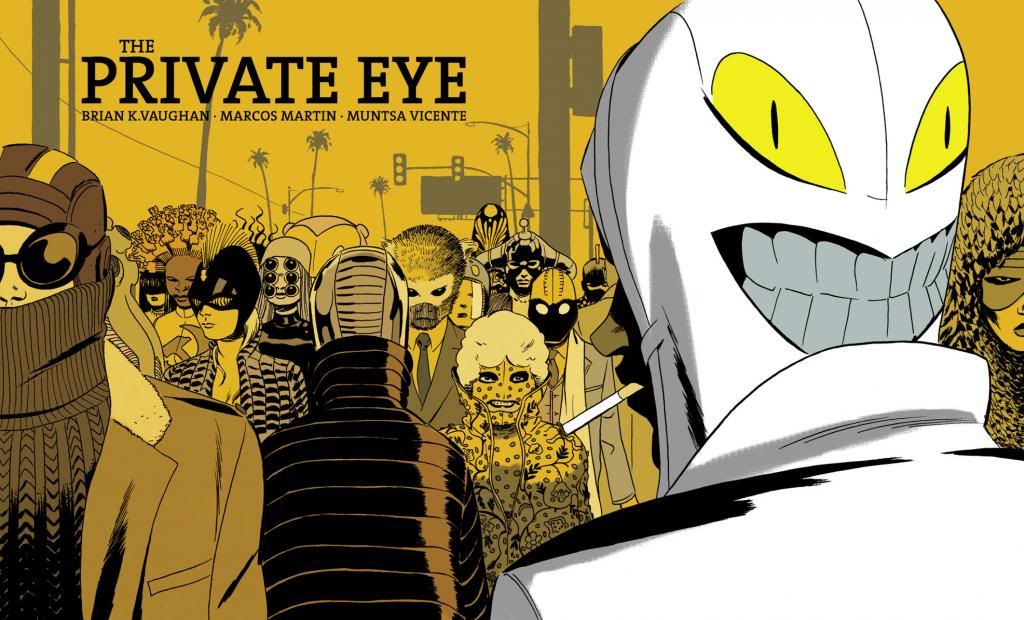
The Private Eye is the new digital comic being made by Brian K Vaughan and Marcos Martin. It's digital only and available from The Panel Syndicate under a pay-what-you-want-scheme. (They suggest $1, but if you are especially poor/cheap you can get it for $0). The premise of the comic is that everyone in the world has a secret identity and wears a disguise to protect their privacy in a post internet world. The title character, Patrick Immelman, is a Paparazzi private eye, an investigator who bores through disguises to reveal a persons true identity. From a story perspective The Private Eye reads like a classic detective story built around a wonderful high concept and a timely discussion about privacy. The artwork in The Private Eye is sumptuous: a kind of kinetic, high resolution, pop-art infused, delight. (Before you decide I'm a dink for saying "sumptuous" go and LOOK at it.) Basically, The Private Eye is as good a comic as you would expect given it is written by Brian K Vaughan and drawn by Marcos Martin.

Go buy it, if you haven't already.

I think the first point to make is holy crap BKV and Marocs Martin. I first heard that BKV and Martin were collaborating about the time Marcos Martin left Daredevil to focus on creator owned works. I have been periodically and surreptitiously Binging this project since. All of a sudden we get teaser images and THE NEXT DAY the comic is available. Not only that, but the comic is available in a variety of formats under a PAY WHAT YOU WANT scheme. And of course the comic is amazing. Which I guess is just further proof that Brian K Vaughan and his collaborators are fucking rockstars.

I guess my next thought, which seems to be the general trend, is to remark on the self-published digital nature of the comic. I can see the obvious appeal of this kind of approach for established comics pros with the cache and name recognition of BKV and Marcos Martin: they retain complete control, don't have to worry about physically shipping and retailing items,  and can use social media to advertise their comics. Minus web-hosting  bandwidth, and Paypal's cut, the creators realize 100% of the profits. Given I bought the comic HOURS after it was made available speaks to the effectiveness of this. (Also, how refreshing is it that Vaughan and Martin just published their comic rather than launching yet-another Kickstarter? I mean, I feel like it's getting a little out of hand.) 

All that said, I'm kind of bummed that The Private Eye is not meant to ever be a print comic. I love print. I enjoy the reading experience of actual paper in a bound volume. I enjoy displaying print comics in a way where I can enjoy the sight of them whenever I want to. I like being able to lend my print comics to friends and to share things I like with them and to try to convince them to give comics a chance. (Sharing a .pdf feels awfully close to participating in piracy.) I am not convinced that digital ONLY is better than making media available in multiple formats to cater to readers consumption preferences. Although, I am a dinosaur about these things. But dinosaurs are awesome... so... I hope this doesn't become a trend.

Another point of interest, I think, is that The Private Eye comes to us in files DRM free, which means that 1) we actually own the files (as opposed to us licensing the files from the publisher) and 2) we can take these files and duplicate them and give them to whomever we feel like. Of course, setting up an elaborate pirating ring for The Private Eye is stupid, since the option to buy it for free exists from the creators. 

Combining this DRM free, highly piratable file format with the ability to straight up take it from the creators actually leaves me with a few questions. Like, did they do this because they know the people who want to pirate it will pirate it... so why not embrace that? Or is it that they want as many people to read the first issue as possible to build up a buzz for future issues and projects from The Panel Syndicate? Or, is it because the comics from the Panel Syndicate have a dual purpose?

This is wicked cynical, but I wonder to what extent The Panel Syndicate functions as a showcase for BKV and collaborator's ideas for other media? If you didn't know this, Brian K Vaughan's main career these days is writing for film and TV including a stint at Lost and, most recently, a new series based on Stephen King's Under The Dome.  Now, if I were a writer for film and television a completely self-published, pay-what-you-want (to recoup costs), and highly pirate-able comic publishing platform would be what I'd want to showcase my ideas for potential clients: it beautifully illustrates the concepts and costs a fraction of actually filming something. I mean, I have no proof of this and no problem with it if it's true. I'm just curious is all.

Mostly, though, I'm just excited for the next chapter of The Panel Syndicate.

Friday, 8 March 2013

Sexy Saga

Or a wonky essay on television headed robot royalty having intercourse.


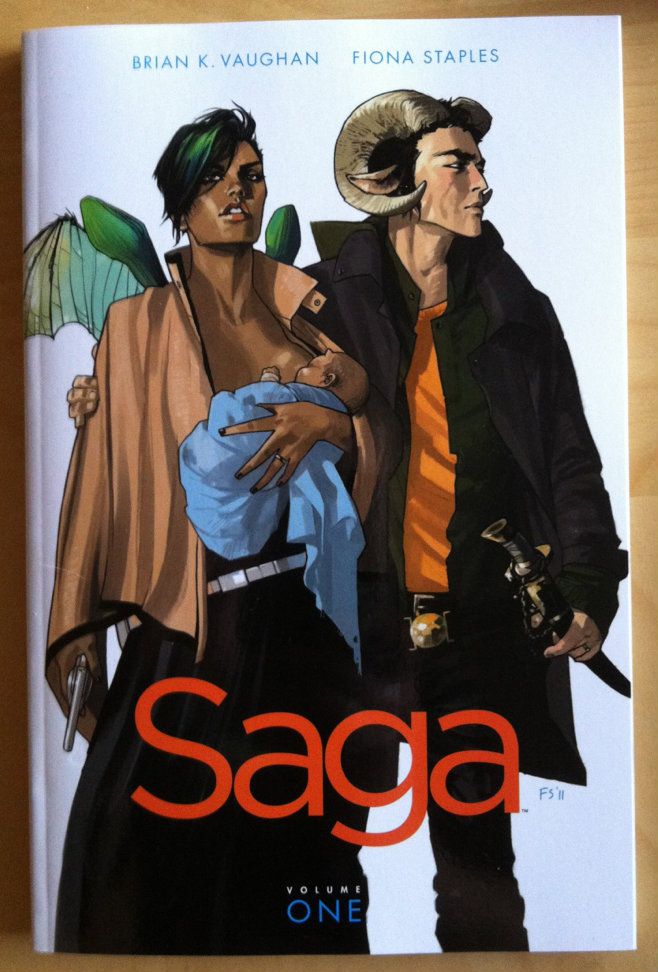
Saga, by Bryan K Vaughan and Fiona Staples is pretty incredible and is a great example of why everyone should read comic books. It's smart, fun, and beautiful; an absolute rockstar book.

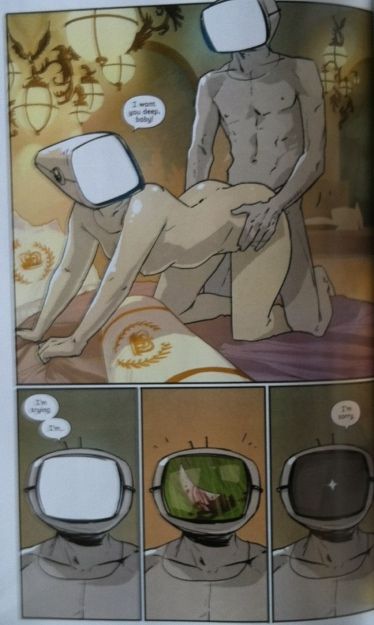
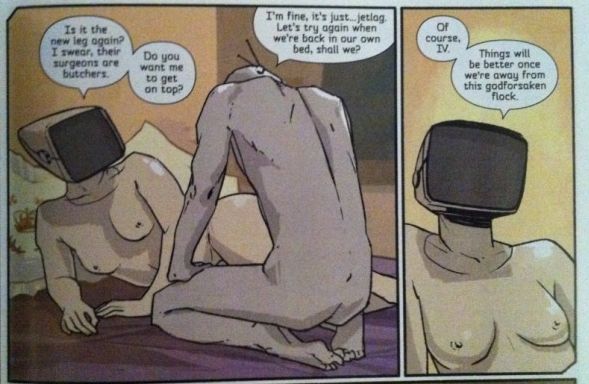
Anyway I noticed something in it, that as far as I can ascertain by googling, no one has discretely pointed out yet. And for posterity I'd like to point out that during the scene where the TV headed robot royalty are having graphic on panel sex that they are "turned on".


I mean, this scene is after it is established that the TV headed robot royalty normally have dark screened heads. So, when our robot royals are having the sex their screen faces are emitting white light it isn't their default expression/display. Furthermore, when Prince Robot IV loses his erection his screen darkens, and then his wife's screen also darkens when it is apparent that the sex isn't happening. So they are no longer "turned on".


So yeah, really clever minor jokey thing about the robot royals being "turned on".

But this great little art descision pun aside, this is a pretty great scene for a bunch of additional reasons too.

Prior to this scene in Saga: Volume 1, I kind of felt that I had a handle on what the series was going to be. It felt familiar when placed in the context of other Science Fiction. I mean prior to this you could categorize Saga as something like:  "Shakespearianish literal star-crossed lovers in an epic intergalactic conflict." And then bam, we have naked TV-headed robots fucking. It's a great statement that, no, no we do not have Saga hammered down, and that this book won't be so easily classified and understood. Because once we think we've put it in a familiar box, we'll get something crazy like TV headed robot royalty having sex.

This scene is also pretty great as an introduction to Prince Robot IV, one of the main antagonists of the comic. It brilliantly sets him up right from the get go as more than a one dimensional villain. Instead of being a simple murder robot, he is a person with desires, emotions, and family. He is a man (kind of) that is only interested in pursuing the protagonists as a means to get back to his pregnant wife which is an understandable motivation and a smart concept: Prince Robot IV must destroy what Markos and Alana have to get that very same thing. But beyond that, visually putting him in such a human/intimate/familair position at first glance means that we will always picture him as a person, as a complex character, in all of his future interactions. TV-headed royal fucking, it's a great way to introduce a character.

The next reason this scene is great takes a bit of explaining. 

I think we as a society have a really peculiar and maybe unhealthy approach to portraying sex in our media. We relentlessly censor it and push it the margins of most of our media. In happy media with functional people sex is almost always pushed out of focus: a couple kisses passionately and we fade out, because to actually show it would be immature, puerile, or icky. Which oddly has the affect of making a lot of the sex in a lot of our media pretty dysfunctional: it's frequently only displayed or discussed in raunchy, shock comedies or when its transgressive, or when someone is being murdered, raped, or both. Or it's porn, which you know is fine, but even then so much of that is just grim-faced, emotionless, orifice stuffing... that I find a lot of it uncanny valley creepy. Which all sort of results in very little fun, companionate sex in media and a lot of weird, violent, or, at least to me, vaguely off putting fucking. 

Which is pretty messed up right? I mean, sex is pretty central to the human experience: the vast majority of us are fundamentally wired to enjoy it and it's how we go about reproducing which is kind of important to us as a species. It perpetually strikes me that the fact we consider it more private and shameful and censorable than murder and violence and rape is all kinds of fucked up. And I think the fact there are so few portrayals of people having stable, emotionally satisfying sex in our media is wicked sad.

So, a big part of why I find this scene so amazing is that it portrays that kind of comfortable sex that happens between people in a stable, loving relationship. Prince Robot IV and his wife are partnered people, who clearly have a strong emotional connection as well as a comfotable familiarity  And as a result a healthy sex life. And here they are having vanilla sex, not for puerile thrill, but because they have been apart and love one another. Hell, they are also trying to procreate, which even if you object to fornication or sex-for-fun, is kind of the point we can all agree on about sex. Contrasted with the majority of our portrayals of sex in our media and this is extremely healthy and normal sex. Just, you know, between TV-headed robot royalty. And the fact that such bizarre creatures are having one of the few (and in comics only that I've read), examples of stable, coupled sex is frankly kind of amazing and brilliant.

Wednesday, 6 March 2013

So I Read Saga: Volume 1

A 250 word (or less) review of the first collected Saga volume
By Brian K Vaughan and Fiona Staples, Image Comics


My girlfriend loves Parenthood, a television show with the thesis that parenting is difficult and family is important. For a variety of reasons I don't especially care for this show. Saga is a comic about how parenting is difficult and family is important but with winged alien soldiers, magic space satyrs, television headed robot royalty, graphic sex, and space violence. And it is absolutely perfect. Saga is the story of a child of starcrossed lovers from opposite sides of a generations/ages/centuries old galactic war between the winged people of the planet Landfall and the magic horned/antlered people from its moon Wreath. Hazel, the newly born alien hybrid baby of Landfaller Alana and Wreathan Markos is seen as an abomination by both sides of the conflict and so this new family is hunted by the Landfaller forces, lead by Prince Robot IV, and by the Wreathans using freelance bounty hunters. It's all the chaos and love of new parents splashed with the insanity of a crazy space opera world. The writing from Vaughan is characteristically excellent (clever, snappy, and exciting) but with this confident swagger quality to it that's just so rock and roll. Staples art is, if anything, more amazing: this hyper-realistic painted style that is simultaneously vaguely surreal. It's remarkable and beautiful stuff. I have been anxiously waiting for this trade since this series inception with, based on its pedigree, bated breath and inflated expectations. This book still blew me away. Read it.


Word count: 244