Showing posts with label Scott Wegener. Show all posts

Wednesday, 21 October 2015

So I Read Atomic Robo: The Savage Sword of Dr. Dinosaur

A 250 word (or less) review of Atomic Robo: Vol. 8
by Brian Clevinger, Scott Wegener, and Nick Filardi, and Jeff Powell, Red 5 Comics


Atomic Robo is a comic about the atomic powered robot created by Nikola Tesla who now conducts Action Science as the director of Tesladyne. In Atomic Robo The Savage Sword of Dr. Dinosaur, Robo and his team head to South America to find the ruins of Science City, Marconi's secret Nazi space program base, but instead find themselves at the mercy of the nefarious (and fantastic) Dr. Dinosaur and his new subterranean Rock Men army. Meanwhile, Majestic 12, a shadowy Cold War organization devoted to weaponizing Tesla's inventions mount an assault on Tesladyne's headquarters. Atomic Robo Vol. 8 is another episode of wacky, sci-fi adventure hijinks in an excellent series of wacky, sci-fi hijinks. It definitely skews towards the sillier end of the Atomic Robo spectrum, but it's still great fun. I mean, anytime the primary protagonist of a comic is Dr. Dinosaur, a fictional time travelling dinosaur bent on erasing mammal kind using Science and Crystals, it is pretty much guaranteed to be terrific times. That said, while the main story in Atomic Robo Vol. 8 stands alone pretty well, the Majestic 12 B plot is building on elements introduced in a previous chapter and clearly setting up future stories so I wouldn't make Vol. 8 my first collection of Atomic Robo comics.

Word count: 214

Previously:
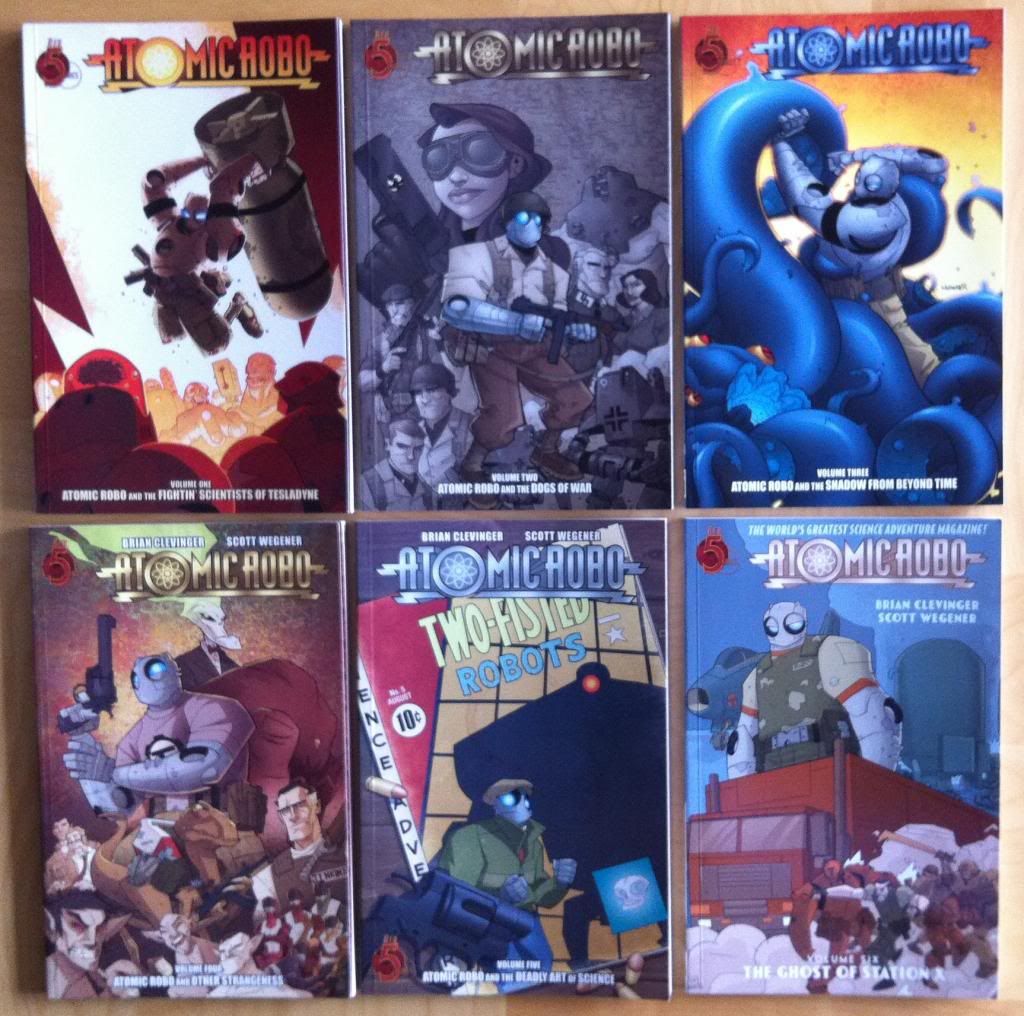
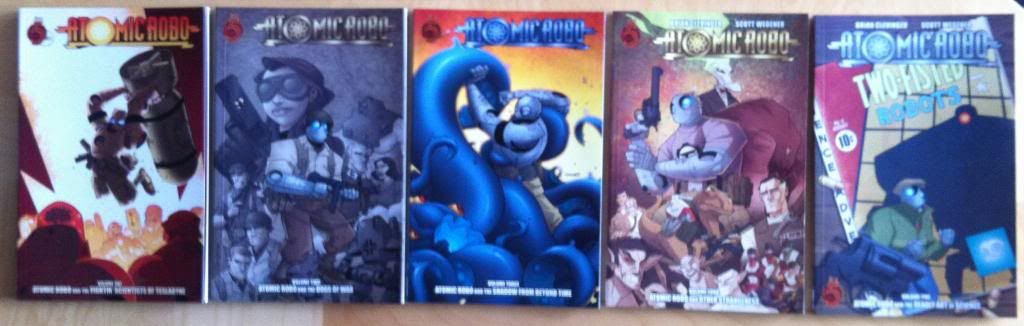
Vol. 1: Atomic Robo and The Fightin' Scientists of Tesladyne
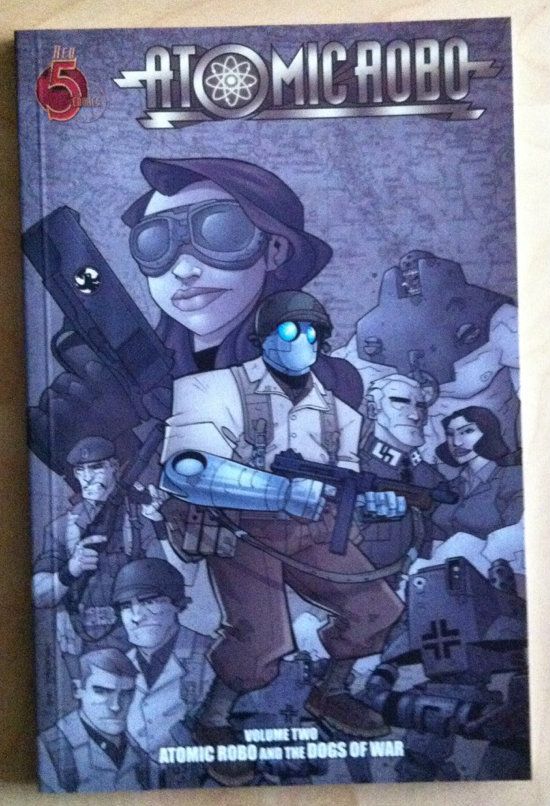
Vol. 2: Atomic Robo and The Dogs of War
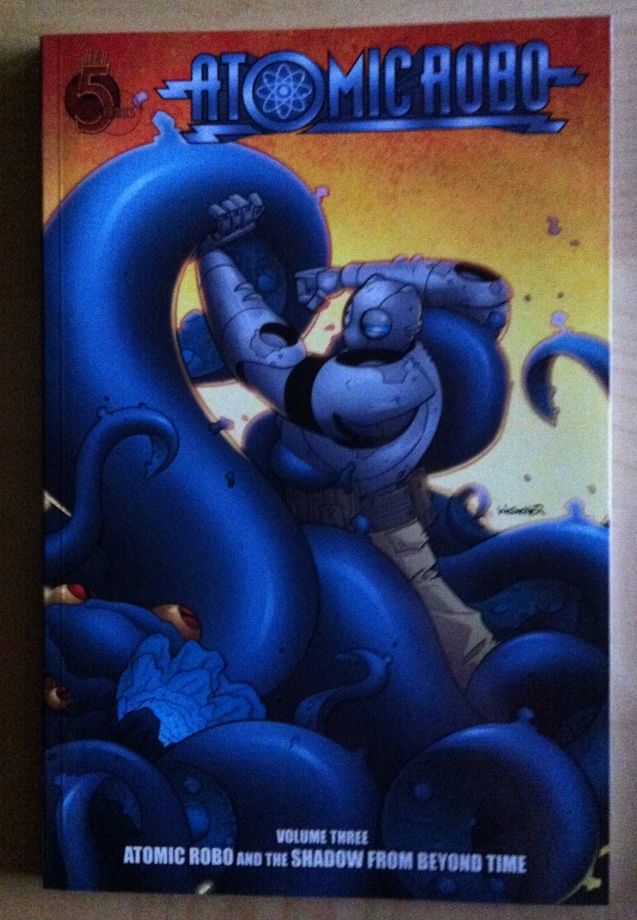
Vol. 3: Atomic Robo and The Shadow From Beyond Time

Vol. 4: Atomic Robo and Other Strangeness
Vol. 5: Atomic Robo and The Deadly Art of Science
Vol. 6: Atomic Robo and The Ghost of Station X
Vol. 7: Atomic Robo: The Flying She-Devils of the Pacific

Friday, 26 December 2014

Deep Sequencing: An Atomic Robo Timeline pt. 5

Or a graphical timeline of the first 7 collected volumes of Atomic Robo

by Brian Clevinger and Scott Wegener, Red 5 Comics


Atomic Robo is the fantastic, funny comic about, well, Atomic Robo, the adventuring Action Scientist invented by Nicola Tesla. It's an infectiously fun to read comic that is also constructed in really smart, really unorthodox ways. One of these interesting creative decisions is how Atomic Robo uses time.

A lot of comics, particularly the more superhero-y comics have a weird relationship with time. For the most part time in these comics time is squishy, where publication order does not equate to narrative order and Batman is perpetually the same age despite having stories clearly set in multiple decades. In these comics time is less about an exact measure of time than a... kind of inconvenient medium that events pass through.

Atomic Robo, which is a comic about an ageless robot going on Science Fantasy adventures, has really rigorously annotated time settings. Nearly every story not only has the year it is set in, but even the month and day. As a result, the Atomic Robo comic works like a kind of time capsule of human history during the century (and counting) of Robo's life. It makes for neat settings for stories and a fun look at cultural differences through time. 

But beyond being a nifty setting device, this thorough chronicling of time demands a 100 year long giant graphical timeline. So, I've made one, and will update it whenever I finish another Atomic Robo comic. 


This is Version 2.2 of my Atomic Robo Timeline. The added entries are for the year 1951.

There will be mild *SPOILERS* in the timeline. Also, there is an up-to-date text based timeline on the Atomic Robo website. So this might be kind of redundant.

Timeline legend:
Vol. 1: Atomic Robo and The Fightin' Scientists of Tesladyne
Vol. 2: Atomic Robo and The Dogs of War
Vol. 3: Atomic Robo and The Shadow From Beyond Time

Vol. 4: Atomic Robo and Other Strangeness
Vol. 5: Atomic Robo and The Deadly Art of Science
Vol. 6: Atomic Robo and The Ghost of Station X
Vol. 7: Atomic Robo: The Flying She-Devils of the Pacific


Previously:

Wednesday, 24 December 2014

So I Read Atomic Robo: The Flying She-Devils Of The Pacific

A 250 word (or less) review of Atomic Robo Vol. 7
by Brian Clevinger and Scott Wegener, Red 5 Comics


Geek media and fandom have a problem with how they treat women. Simply put, geek culture is pretty awful to women a lot of the time. Taking steps to rectify this and make geek culture more inclusive for non-dudes is important and morally good. But as a straight-white-dude myself, I'm often left unsure how I can contribute to the discourse. (I usually air on the side of listening and coaching my own behaviour.) It seems that Clevinger and Wegener are also motivated to make comics less toxic to female readers and have responded by making a comic about totally rad jetpack wearing lady sky pirates. Which I think is a thing we can all get behind. Atomic Robo: The Flying She-Devils Of The Pacifc is set just after World War 2 and tells the story of Atomic Robo being rescued and taken in by the Flying She-Devils, a group of renegade women aviators who have become jetpack pirates in the wake of the war. The She-Devils and Robo run afoul of a lurking post-war Japanese threat and Sky Action occurs. Atomic Robo Vol. 7 is an exciting story of war in the skies full of humour, courage, camaraderie, sacrifice, and explosions. And also a group of well defined, cool female characters. She-Devils of The Pacific basically proves that you can make a fantastic, rad comic featuring mostly female characters that pretty much everyone can enjoy. I mean, this should be obvious, but if you need proof, here it is.


Monday, 14 July 2014

Deep Sequencing: Atomic Robo Timeline pt. 4

Or a graphical timeline of the first 6 collected volumes of Atomic Robo
by Brian Clevinger and Scott Wegener, Red 5 Comics


Atomic Robo is the fantastic, funny comic about, well, Atomic Robo, the adventuring Action Scientist invented by Nicola Tesla. It's an infectiously fun to read comic that is also constructed in really smart, really unorthodox ways. One of these interesting creative decisions is how Atomic Robo uses time.

A lot of comics, particularly the more superhero-y comics have a weird relationship with time. For the most part time in these comics time is squishy, where publication order does not equate to narrative order and Batman is perpetually the same age despite having stories clearly set in multiple decades. In these comics time is less about an exact measure of time than a... kind of inconvenient medium that events pass through.

Atomic Robo, which is a comic about an ageless robot going on Science Fantasy adventures, has really rigorously annotated time settings. Nearly every story not only has the year it is set in, but even the month and day. As a result, the Atomic Robo comic works like a kind of time capsule of human history during the century (and counting) of Robo's life. It makes for neat settings for stories and a fun look at cultural differences through time. 

But beyond being a nifty setting device, this thorough chronicling of time demands a 100 year long giant graphical timeline. So, I've made one, and will update it whenever I finish another Atomic Robo comic. 


This is Version 2.1 of my Atomic Robo Timeline. The added entries are for the years 1951, 1952, and 2011.

There will be mild *SPOILERS* in the timeline. Also, there is an up-to-date text based timeline on the Atomic Robo website. So this might be kind of redundant.

Timeline legend:
Vol. 1: Atomic Robo and The Fightin' Scientists of Tesladyne
Vol. 2: Atomic Robo and The Dogs of War
Vol. 3: Atomic Robo and The Shadow From Beyond Time

Vol. 4: Atomic Robo and Other Strangeness
Vol. 5: Atomic Robo and The Deadly Art of Science
Vol. 6: Atomic Robo and The Ghost of Station X


Previously:


Friday, 11 July 2014

Deep Sequencing: The Ghost of Station X-Plosions

Or simple layout choices that make for more exciting explosions in Atomic Robo and The Ghost of Station X
by Brian Clevinger and Scott Wegener, Red 5 Comics


Atomic Robo is, I think, best known for being an excellent adventure comic filled with action and humour and a bent towards being respectful and friendly to a large and diverse audience. The thing is, Atomic Robo is also a really well put together comic built around some pretty intricate, high concept stories and with some really deft artwork. And I want to take a look at a sequence I think is especially well put together in Atomic Robo: And The Ghost of Station X.

There is will be very mild *SPOILERS* in this post for Atomic Robo Vol. 6. Be aware.


So this page here I think is really, really well done. At first glance this page is deceptively simple, Atomic Robo shoots a helicopter he is perched on, falls to the ground, then does a jumping punch thing with an explosion. Comics! But the thing is, this page has a really efficient layout that makes excellent use of the way our eyes naturally track around the page to enhance the motion and emotion of every panel in the composition. 


Every panel transition in the composition is designed to take advantage of the movement from panel to panel to capture the moment. In the first two panels, the direction of Robo's gunshot is right along the left-to-right eye path, so we get to fly along the bullets trajectory into the helicopter rotors. The second to third panel transition takes advantage of the carriage return of crossing the page to follow the path of Robo falling from the damaged helicopter. Then the third to fourth panel transition goes down the page and matches the path of the helicopter crashing. And finally, the fourth to fifth panel transition follows the angled onomatopoeia to trace the path of Robo performing his leaping tackle, framed by the explosion. In each of these instances, the eye path matching/guiding enhances the speed and emotional weight of every shot, drop, crash, and explosion in the composition. Individually every choice is great comics. 


The other cool thing about this page is that these same elements that increase the weight of every moment in the sequence also help the reader see the key moments more quickly. This speed of navigation makes this page not only full of emotionally charged action, but also very quick feeling action. It's a fantastic action page and really, really smart comics. Atomic Robo, it's great stuff.

Previously:


Wednesday, 9 July 2014

So I Read Atomic Robo And The Ghost of Station X

Or a 250 word (or less) review of Atomic Robo: Volume 6
By Brian Clevinger and Scott Wegener, Red 5 Comics


Atomic Robo is an interesting comic. You could aptly describe it as an all ages, fun adventure comic with a really snappy sense of humour. But you could also describe Atomic Robo as a meticulously crafted comic with some pretty challenging Sci-fi elements and complex plots. And while I would suggest that Atomic Robo is always both, different storylines can sometimes exemplify the more humour based-adventure aspects of the comic or the more daring, high concept nature of the comic. Atomic Robo and The Ghost of Station X is one of the most elaborate and unflinching chapters in the Atomic Robo saga so far. In the comic Robo and Action Scientists of Tesladyne are simultaneously recruited to solve the mystery of a missing building in Bletchley Park (of Alan Turing fame) and to send a last ditch mission to save NASA astronauts in orbital danger. What they discover will have dire repercussions for Robo, Tesladyne, and perhaps all of humanity. Atomic Robo and The Ghost of Station X, while still containing the charm and humour of the series, is a very mature comic displaying some really masterful craftsmanship. If you are looking for a serious, thoughtful Science Fiction comic (that still somehow manages to remain pretty much kid friendly), Atomic Robo Volume 6 would be an excellent choice. It's really great comics.


Word count: 221

Previously:
Atomic Robo and The Deadly Art of Science 

Friday, 16 May 2014

Deep Sequencing: An Atomic Robo Timeline pt. 3

Or  an update to my graphical timeline of the first 5 Atomic Robo collected editions.
By Brian Clevinger and Scott Wegener; Red 5 Comics


Atomic Robo is the fantastic, funny comic about, well, Atomic Robo, the adventuring Action Scientist invented by Nicola Tesla. It's an infectiously fun to read comic that is also constructed in really smart, really unorthodox ways. One of these interesting creative decisions is how Atomic Robo uses time.

A lot of comics, particularly the more superhero-y comics have a weird relationship with time. For the most part time in these comics time is squishy, where publication order does not equate to narrative order and Batman is perpetually the same age despite having stories clearly set in multiple decades. In these comics time is less about an exact measure of time than a... kind of inconvenient medium that events pass through.

Atomic Robo, which is a comic about an ageless robot going on Science Fantasy adventures, has really rigorously annotated time settings. Nearly every story not only has the year it is set in, but even the month and day. As a result, the Atomic Robo comic works like a kind of time capsule of human history during the century (and counting) of Robo's life. It makes for neat settings for stories and a fun look at cultural differences through time. 

But beyond being a nifty setting device, this thorough chronicling of time demands a 100 year long giant graphical timeline. So, I've made one, and will update it whenever I finish another Atomic Robo comic. 


This is Version 2.0 of my Atomic Robo Timeline. Basically, I thought my old timeline was kind of ugly and rushed, so I spent some time making one that is a lot easier to read/better looking. (There was also a hilarious mistake in the old version: Professionalsim!)  The added entries are for the years 1930, 1931, 2011, 2021.

There will be mild *SPOILERS* in the timeline. Also, there is an up-to-date text based timeline on the Atomic Robo website. So this might be kind of redundant.

Timeline legend:
Vol. 1: Atomic Robo and The Fightin' Scientists of Tesladyne
Vol. 2: Atomic Robo and The Dogs of War
Vol. 3: Atomic Robo and The Shadow From Beyond Time

Vol. 4: Atomic Robo and Other Strangeness
Vol. 5: Atomic Robo and The Deadly Art of Science


Previously:


Wednesday, 14 May 2014

So I Read Atomic Robo And The Deadly Art Of Science

Or a 250 word (or less) review of Atomic Robo Volume 5
By Brian Clevinger and Scott Wegener; Red 5 Comics


Atomic Robo remains my favourite mostly-all-ages adventure comic: there is just something about a hilarious sass-mouthed robot (invented by Nikola Tesla) doing Action Science that is endlessly fun. Atomic Robo and the Deadly Art of Science is set in 1930 and follows a young, inexperienced Atomic Robo as he grows bored assisting an elderly Tesla and forces himself under the wing of vigilante/gunfighter Jack Tarot. Together, with Tarot's beautiful daughter Nightingale, they must solve a string of inexplicable Science and occult thefts. One of the coolest aspects of Atomic Robo is that the entire story universe takes place in a very granular, linear timeframe. This gives the series access to a variety of settings and a character that actually develops and matures. I mention this because the magic of Atomic Robo and the Deadly Art of Science comes directly out of this: the pulp detective story set in the great depression is super fun, and young Robo, with his naiveté and boundless enthusiasm is hilarious and charming. The result is that Atomic Robo Vol. 5 is (bearing in mind that I’ve really enjoyed all of Atomic Robo to this point) an especially enjoyable chapter.  It’s actually, despite being the fifth volume, also one of the most accessible chapters and therefore might be a good volume to see if Atomic Robo is a comic worth further exploring.


Word count: 226

Previously:

Friday, 11 October 2013

Deep Sequencing: An Atomic Robo Timeline Pt. 2

Or  an update to my graphical timeline of the first 4 Atomic Robo collected editions.
By Brian Clevinger and Scott Wegener; Red 5 Comics


Atomic Robo is the fantastic, funny comic about, well, Atomic Robo, the adventuring Action Scientist invented by Nicola Tesla. It's an infectiously fun to read comic that is also constructed in really smart, really unorthodox ways. One of these interesting creative decisions is how Atomic Robo uses time.

A lot of comics, particularly the more superhero-y comics have a weird relationship with time. For the most part time in these comics time is squishy, where publication order does not equate to narrative order and Batman is perpetually the same age despite having stories clearly set in multiple decades. In these comics time is less about an exact measure of time than a... kind of inconvenient medium that events pass through.

Atomic Robo, which is a comic about an ageless robot going on Science Fantasy adventures, has really rigorously annotated time settings. Nearly every story not only has the year it is set in, but even the month and day. As a result, the Atomic Robo comic works like a kind of time capsule of human history during the century (and counting) of Robo's life. It makes for neat settings for stories and a fun look at cultural differences through time. 

But beyond being a nifty setting device, this thorough chronicling of time demands a 100 year long giant graphical timeline. So, I've made one, and will update it whenever I finish another Atomic Robo comic. 


This is the first update for the timeline. The added entry is for the year 1999.

There will be mild *SPOILERS* in the timeline. Also, there is an up-to-date text based timeline on the Atomic Robo website. So this might be kind of redundant.

Timeline legend:
Vol. 1: Atomic Robo and The Fightin' Scientists of Tesladyne
Vol. 2: Atomic Robo and The Dogs of War
Vol. 3: Atomic Robo and The Shadow From Beyond Time

Vol. 4: Atomic Robo and Other Strangeness


Previously:

Wednesday, 9 October 2013

So I Read Atomic Robo And Other Strangeness

A 250 word (or less) review of the fourth Atomic Robo collection.
By Brian Clevinger and Scott Wegener, Red 5 Comics


Atomic Robo and Other Strangeness tells is the fourth chapter of the ongoing comic about Nicola Tesla's greatest invention and sass-mouthed automoton, Atomic Robo. The current chapter depicts a short period of Atomic Robo's life in the 90's, as the director of Tesladyne, a research and development company specializing in Action Science. Specifically, the comic tells the semi-unrelated stories of a Vampire dimension invasion during a job interview, a trip to Japan to visit a Sentai-inspired super team, a battle of wits with a certain time-travelling Dr. Dinosaur, and the appearance of a ghost in Tesladyne. Atomic Robo and Other Strangeness, while not as intricate or story driven as the previous two collections, makes up for this by just being completely hilarious and fiercely fun. This is a comic that clearly shows two very talented and passionate creators just having an absolute ball telling stories about things they love. It is completely infectious. Atomic Robo and Other Strangeness also features, without a doubt, the greatest portrayal of the Scientific method in all of comics as well as some surprisingly astute and informative meditations on things such as time travel and palaeontology  which I enjoyed immensely. Basically, Atomic Robo and Other Strangeness is yet another ridiculously fun comic, in a series of ridiculously fun comics.


Friday, 12 July 2013

Deep Sequencing: An Atomic Robo Timeline pt. 1

Or a graphical timeline of the first 3 collected volumes of Atomic Robo


Atomic Robo is the fantastic, funny comic about, well, Atomic Robo, the adventuring Action Scientist invented by Nicola Tesla. It's an infectiously fun to read comic that is also constructed in really smart, really unorthodox ways. One of these interesting creative decisions is how Atomic Robo uses time.

A lot of comics, particularly the more superhero-y comics have a weird relationship with time. For the most part time in these comics time is squishy, where publication order does not equate to narrative order and Batman is perpetually in his early thirties (or I guess mid-twenties in the new52). In these comics time is less about an exact measure of time than a... kind of inconvenient medium that events pass through.

Atomic Robo, which is a comic about an ageless robot going on Science Fantasy adventures, has really rigorously annotated time settings. Nearly every story not only has the year it is set in, but even the month and day. As a result, the Atomic Robo comic works like a kind of time capsule of human history during the century (and counting) of Robo's life. It makes for neat settings for stories and a fun look at cultural differences through time. 

But beyond being a nifty setting device, this thorough chronicling of time demands a 100 year long giant graphical timeline. So, I've made one, and will update it whenever I finish another Atomic Robo comic.

There will be mild *SPOILERS* in the timeline. Also, there is an up-to-date text based timeline on the Atomic Robo website. So this might be kind of redundant.

Timeline legend:
Vol. 1: Atomic Robo and The Fightin' Scientists of Tesladyne
Vol. 2: Atomic Robo and The Dogs of War
Vol. 3: Atomic Robo and The Shadow From Beyond Time


Previously:

Wednesday, 10 July 2013

So I Read Atomic Robo And The Shadow From Beyond Time


A 250 word (or less) review of Atomic Robo Vol. 3
By Brian Clevinger and Scott Wegener, Robot 5 Comics


Atomic Robo And The Shadow From Beyond Time is the third chapter in the ongoing adventures of Nicola Tesla’s sentient robot invention as he participates in Action Science. Part of the hook of the character is that he was “born” in the 1920s and, gifted with a prodigious lifespan, has had decades spanning adventures.  Atomic Robo And The Shadow From Beyond Time makes one extremely clever use of this long-lived character premise. Let me explain. In Atomic Robo And The Shadow From Beyond Time, Atomic Robo combats a Lovecraftian horror/alien entity that exists outside of time, able to intersect with our linear universe at multiple instances. As such we see a story crafted around Atomic Robo encountering the entity during different decades of his life as part of a broader plot in a way that is really, really smart. Like, mind-bogglingly smart for a comic about a wise-cracking robot adventurer. Atomic Robo And The Shadow From Beyond Time is the chapter of Atomic Robo that solidified for me just how well written and cerebral this fun, swash-buckling adventure comic is. Of course, Atomic Robo ATSFBT is as bombastic and fun as preceding Atomic Robo chapters. For instance, the alien/horror entity LITERALLY sprouts from the head of HP Lovecraft and Carl Sagan shows up to say inspiring things and do action Science in some of the most absurd/amazing panels in all of comics. This comic is also properly funny, which is another hallmark of the Atomic Robo franchise. Check it out.

Friday, 15 February 2013

Deep Sequencing: Atomic Robo And The Dogs Of War

Or a closer look at Atomic Robo And The Dogs Of War
By Brian Clevinger and Scott Wegener, Red 5 Comics

Comics are essentially words and pictures arranged to sequentially convey a story narrative. As such they have a kind of visual language. In North America the sequence of art and events flows from left to right and from top to bottom. Like the words in this blog, but, you know, beautiful pictures that tell a story instead of barely articulate prose.

Typically this visual language manifests as some variation of grid or grid-like layout punctuated by the odd full page image for impact or double page splash for double-impact. This is, in a hugely oversimplified sense, the default storytelling approach. And as such, it's a big comfortable pipeline for narrative information flow for people who are used to sequential art in comics.

The thing is there are some pretty spectacular and interesting things that happen when creators ignore the standard approach and try something else.


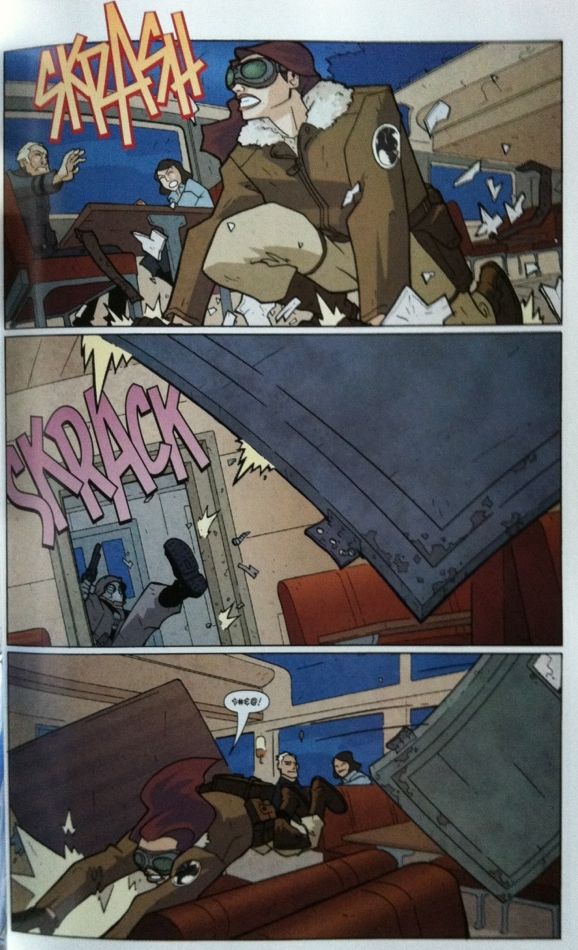
Atomic Robo And The Dogs Of War, by Brian Clevinger and Scott Wegener, is a fun adventure comic about a sass mouthed Robot fighting evil Nazi Science during World War II. It's a pleasant comic to look at throughout, but it's especially interesting in chapter 3 which sees Atomic Robo and British agent the Sparrow collide in their attempt to capture evil Nazi Scientists aboard a train.

Mild *SPOILERS* exist beyond this point.

See, rather than use the standard left-to-right top-down grid, Clevinger and Wegener tell the first half of this chapter by breaking the page into thirds that are happening concurrently. That is to say on any given page the top panel occurs at about the same time that the second panel and third panel occur. Each third of the page has its own character focus, and from page to page tells a discrete sequential story that follows the Nazi Scientists, Robo, and Agent Sparrow respectively. It's a fairly simple seeming approach for telling separate simultaneous storylines, but its super effective.


And of course, this all gets even more clever as the three simultaneous, and yet separate story lines, collide with characters and elements from previously isolated narratives barge into the other narratives. It's a really clever and great way to pay off the separated storyline approach before returning to more conventional comic storytelling.


Which I guess is all my way of saying that Clevinger and Wegener are good at comics. I think Atomic Robo is a remarkable comic that manages to be an accessible, all ages friendly adventure comic that also manages to be funny. And I think that, in a way that maybe doesn't get its due, Atomic Robo is remarkable in execution, in both the conventional and unconventional craft the creators display in telling their stories about a sass mouthed Robot fighting Nazis.