Or an economic argument for giving credit to colourists (circa 2014)
Colourists are an integral part of comics. When colouring is done well, colouring works with the pencils and inks to enhance the artwork and contribute to the final look of a comic. When done exceptionally well colouring can add a sense of style or mood or atmosphere that can be a major storytelling component of the comic. Colouring can do things, add effects, that other components of comics can't. Colouring matters.
As such Colourists should absolutely be credited creators on every title. Their contribution to the final product is just to obvious and important to not give them the credit they deserve. It is absolutely the right thing to do.
Sadly, we live in a world where morals often take a back seat to money and where many of the comics being published are made by corporations. Corporations, being economic group-entities that exist solely to create profit, are amoral sociopaths that, regardless of the good intentions of the people who work for them, only really care about what will make them money. But the thing is, I've done some maths, and I think there is economic value in crediting Colourists even for the largest most profit-focused publishing companies.
Now, some readers are going to read Batman regardless of which creators get assigned to the title. But another group of readers care about the creators working on titles. Like, I know that a book written by Matt Fraction or Kelly Sue DeConnick are probably going to be books I enjoy or that a book drawn by David Aja or Jamie McKelvie is going to look amazing regardless of who is writing the scripts. Having these creators on titles, on the cover of titles, and advertised in press releases makes me more likely to pick up a title. From a corporate perspective, involving and advertising these creators is money well spent.
Even for less well known creators, the way writers and artists are advertised pays dividends. I learned that Ales Kot is a hell of a writer or that David Lopez is fantastic at making his characters just burst with life. I am now more likely to try comics by either of these creators after learning how talented they are. It is, essentially, an investment in the future.
So I thought to myself it would be interesting to actually do the maths on who colours my comics. To that end I went through all of the comics I've talked about so far in 2014 and plotted the colourists for my mainstream and creator-ownederish comics of the year. For the sake of focus, I just left out any black and white comics I read this year.

When I do this I get the above graphs for Mainstream comics (Left) and Creator-ownederish comics (Right). The black regions are comics that are coloured by the same artist doing the pencils. They are already credited and also usually work on one (or maybe a couple) comics at a time. The grey region are colourists who work on only a single title I am reading right now and whose names were largely unfamiliar to me when I started this process; they do not yet have a track record with me that I would actively read a comic because of their participation. The green region represents creators who I'm only reading one book by presently, but who have a track record with me personally such that their participation on a comic would make me more likely to try it. The other coloured regions are colourists who colour multiple books I am currently reading: Matt Wilson (Blue), Jordie Bellaire (Orange), Lee Loughridge (Red), Betty Breitwieser (Purple), Chris Chuckry (Dark Blue), and Dave Stewart (Dark Blue). To kind of put things in perspective the graph on the left has a total of 18 titles and the graph on the right has a total of 37 titles.

If I stick everything together on a single graph you get this. Aren't graphs fun! But for reals, look at how unevenly distributed the Colourists I read are. 6 Colourists work on about 1/3 of the comics I read this year and 2 of them account for more than 20% of them. Add in the colourists who are also creators I actively seek out and nearly half the comics I read are by Colourists who I actively seek out. And these numbers are even higher if you don't count comics coloured by pencilling artists.
At this point, and the maths back this up, I am actively seeking out series by my favourite colourists. For me, certain Colourists have such a track record for doing great work and for working on quality, exciting projects that they are serious draws for me as a reader. When I first tried that fantastic comic Zero, written by Ales Kot and drawn by a series of talented artists, it was the presence of Jordie Bellaire as series colourist that put it over the edge for me and convinced me to actually try the comic. I tried Nu52 Wonder Woman largely because the addition of Matt Wilson meant it was worth a longer look. (Modern edit: I literally tried Vision only because Bellaire was the colourist, and was delighted to find one of my favourite new comics.) Having a high profile colourists attached to a project is a great way to get me interested in it.
And here is another reality: Colourists can work on more titles than other creators. Generally speaking, a penciller will work on one comic title at a time, while a writer might work on something like four titles at a time. Which means that if I am following these types of creators, that's what, at most four titles per creator. Colourists, by the nature of their work, tend to work on more comics at once, which means that if I am following a colourist, that is maybe up to 6 to 10 titles I'd be interested in trying at a time. This number is even larger when you factor in their past body of work. By raising the profile of Colourists and actively advertising their presence on books, there is a whole other angle to try and attract creator centric readers.
And really, advertising and obviously crediting and advertising Colourists doesn't substantially change the cost of a comic. Colourists have already been paid, whether by a page rate or by a share of ownership in the project. They are a very real draw for some readers, and like writers and pencillers are value invested in the price of a comic. To not leverage this value by crediting and advertising the presence of a top talent colourist is not capitalizing on money spent making a comic. To not advertise and help build the profile of lesser known Colourists is to not invest in the future value of the Colourist. There is money to be made here!
And you know, it's also totally the right thing to do.
Or a look at the murky depths of supporting books for ethical/moral reasons.
There is this peculiar thing happening in the world of comics that I've been noticing more and more, and I have absolutely no idea how to feel about it.
There seems to be a push inside comics for more diversity. It seems that DC and Marvel, perhaps bolstered by the successes of alternate publishers, are making an apparent effort to publish more stories staring women or people of colour. Tied to this is also a rising trend in hiring people who are not white dudes to write and draw and colour some of these comics. Which among other things has resulted in Marvel preparing to publish a Black Panther comic written by Ta-Nehisi Coates and drawn by Brian Stelfreeze, which as a reader, is pretty rad and interesting.
Now, first of all, I think it's great that comics are trying to be more inclusive and diverse. I think it is morally good and important for everyone to see themselves reflected in fiction, and I think it is ethical to give talented people with different backgrounds a fair chance to write comics. (For instance, a world where Lauren Beukes isn't being given every opportunity to write comics is a world where merit doesn't exist.) I am also a big fan of this movement for mercenary reasons: as a reader it's great to see new artists with different perspectives tell their stories and bring their unique experiences to comics. It makes for a richer comics landscape filled with stories that would never occur to me. This also, I think, has the potential to make comics more accessible to non-white-dudes who might be interested in reading comics, which could grow the audience and make comics a healthier industry. Which again is pretty great for purely selfish reasons. So I am all for the diversity push.
I mean, if nothing else, we are getting a Black Panther comic made by Ta-Nehisi Coates and Brian Selfreeze.
The thing is, this movement toward diversity has resulted in some weird behaviour on the part of progressive readers that I think warrants some examination.
Specifically, I am interested in the notion that there is a moral responsibility to "support" pro-diversity comics. That the "right thing to do" is to preorder Black Panther, or that there is a moral quandary over whether we should "support" Red Wolf, a comic starring a Native American superhero, or to boycott it because its writer is allegedly a conservative creep. That the success or failure of comics with progressive or anti-progressive characters or creators is somehow a moral battleground that we as readers have a duty to enter into.
Which is kind of crazy!
I mean, regardless of the intentions of the editorial boards of Marvel and DC, we are talking about intellectual properties owned by multinational corporations. I'm a firm believer that corporations beyond a certain scale become semi-tame sociopaths that behave solely to maximize share price. So the apparent reality of these amoral money machines leveraging the activistic passions of progressive readers to establish readerships and market comics is super weird. It's kind of like ideological blackmail advertising... or like companies evolving a memetic pathogen-vector that uses guilt and empathy to invade our wallet. It is cynical and bonkers and gross.
So while I applaud the existence cool new comics by interesting creators, I think the idea of a moral obligation to buy a product owned by Disney or Time Warner is bizarre.
But at the same time, I can't help but wonder if this is how it is supposed to work. Large corporations exist to do a single thing: create share value. The fact that the comics publishing wings of Disney and Time Warner see sufficient incentive to make progressive gestures is reflective of the fact that there is a large group of comics readers clamouring for more diversity. And given that corporations are amoral money bacteria, the easiest way to make them dance is to well, give them money and buy things. So maybe the most expedient way to see more inclusive storytelling in comics is to just play the game and "support" diverse comics.
At the end of the day, I can't really say where I fall between these two extremes: it is weird and gross to have morality commodified, but working within that framework might be an effective way to keep the inclusive storytelling coming. I just don't know.
What I do know is that I'm going to focus on reading interesting comics by talented art teams, which means that I will most likely be trying a few of these new progressive comics.
And that definitely includes Black Panther by Ta-Nehisi Coates and Brian Selfreeze.
Or a look at the knowledge hidden in the Harley Quinn variant covers
Comic covers are important business. When comics are solicited to the public and the retailers who actually drive the publishers, covers are often the only artwork we see. Later, when actually in stores, covers are the identifier and chief visible advertisement to curious readers. In this way covers are really the public face of comics and when done well, can be a driver of reader and retailer interest.
Despite thinking covers are important and worth discussing, I've always steered clear writing about them because I've lacked a good angle of attack to discuss them in a meaningful way. Fortunately DC comics has decided to give me an in! Apparently February is Harley Quinn variant cover month so we have a variety of Harley Quinn covers by a variety of artists. And so we have this really great collection of covers that have a similar theme to directly compare. Whats more, these alternate covers are also paired with the regular covers for most of these titles, so we have a second level of comparison too. This is what we in the Science Bizz call a rich dataset and one I'd like to try to analyze.
On my first pass of the Harley Quinn sample population I wanted to pull out some examples of what I thought were good covers and some examples of poor covers. To do this I needed some criteria for what makes a good cover. This is what I came up with:
1. The cover is visually appealing and eye catching. If it doesn't look good it's game over.
2. The cover is intriguing, it makes me want to pick up, read, and buy the comic.
3. The cover fits the narrative tone of the interior of the comic. Mismatching isn't good.
4. Since these are variants: The cover represents the title and Harley Quinn equally well.
Using this metric there are four comic covers that I think are particularly good and I think represent the best of the pack.
The Harley Quinn/Batgirl variant (left) I think is the best combination of the four criteria. The cover has bold colours, clear composition, and just pretty Cliff Chiang artwork that bursts with character. The cover also does a great job setting up an intriguing story: the idea of Batgirl having a madcap adventure with Harley Quinn that ends with her telling Harley to "Smile" looks fun to read. The cover also does a great job representing both titles catching both the youthful, tech-savvy tone of Batgirl with the iphone photo, and the rudeness and fun of Harley Quinn. It succeeds the most on all fronts out of the titles considered and works really well as a Batgirl cover and a Harley Quinn variant. Also Cliff Chiang art!
That said, when compared to the actual Batgirl cover (right) for February, the variant is less of an obvious winner. Cameron Stewart delivers a bold cover that, while ever so slightly less graphically appealing, just oozes intrigue. Why does Batgirl's new community of Burnside hate her? Why is she fleeing? As a new Batgirl reader I am very intrigued! While the Harley Quinn variant is very nice, I think the main Batgirl cover is the better cover.


The Harley Quinn/Detective Comics variant (left) is my favourite for how it looks. The composition is bold, the colouring is dramatic and manic, and the NANANANA graphic in the back is eye catching and makes the whole cover pop. I would stop and look at this comic just for how it looks. Add in the best gag of the pack: Harley Quinn is NANANANANANA Batgirl! because she has baseball bats! and you have a great, eye catching cover. Dave Johnson is a wizard. Where the cover maybe fails a little is in matching the tone of Harley Quinn, who seems to be more of a light hearted character right now. This cover is great, but feels more Jokery than Harley-y. But damn does it look good.
The normal Detective Comics cover (right) is also damn cool looking. The colours are wild and exciting, the image is visceral, and the graphic of "reconstruct" over motorized destruction is intriguing. I would pick this comic up too. Detective Comics has two very good covers in February.
The flash (top left) and Aquaman (top right) variants are just totally fun. They might not be as graphically or compositionally interesting as the previous covers, but they just set up such fun premises that I'm hooked by them anyway. Who wouldn't want to read a comic about Harley Quinn trying to race The Flash using a cheetah chariot or getting in trouble for weaponizing dolphins? These covers are both by Amanda Conner one of the writers in the actual Harley Quinn creative team, which makes me legitimately interested in reading Harley Quinn: if the actual comic is this gonzo and fun then I am missing out! These covers are great advertising for the main series.
How do these covers compare to the normal Flash (bottom left) and Aquaman (bottom right) covers? Well, the Flash one has pterodactyls which is pretty rad, so it gets dinosaur points. So I'll call that one a wash. The Aquaman cover is pretty boring though and... real talk, that character is supposed to be Aquaman's mother and that is totally bonkers! Common sense maths would suggest she is probably at least in her 60s, which her white hair would seem to confirm, so why does she have the body of a 20-yearold woman who has impossible breasts? Even if we ignore the sexism problems, it is super distracting and suspension of disbelief ruining. It makes no sense! Point variant cover!
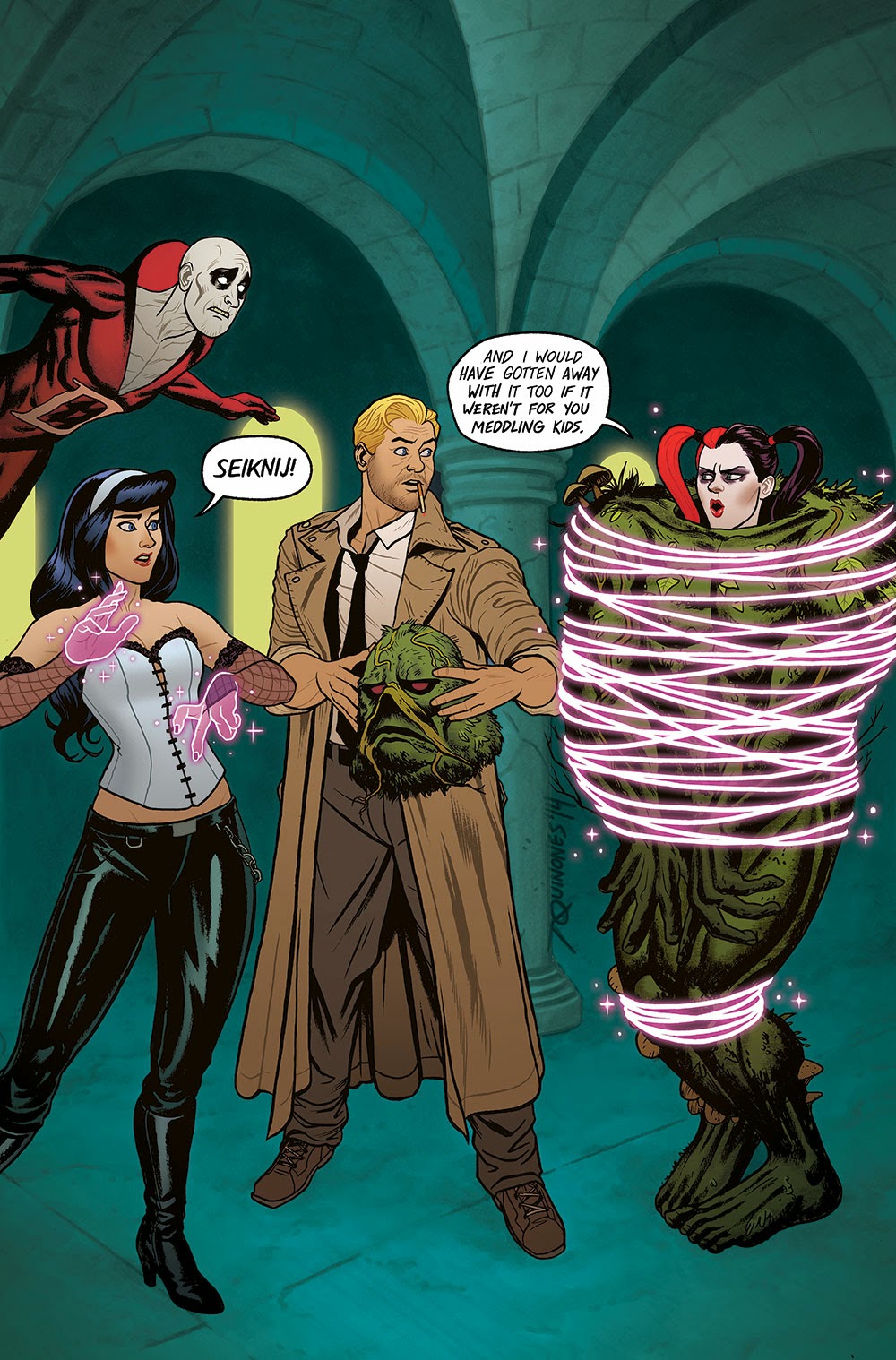
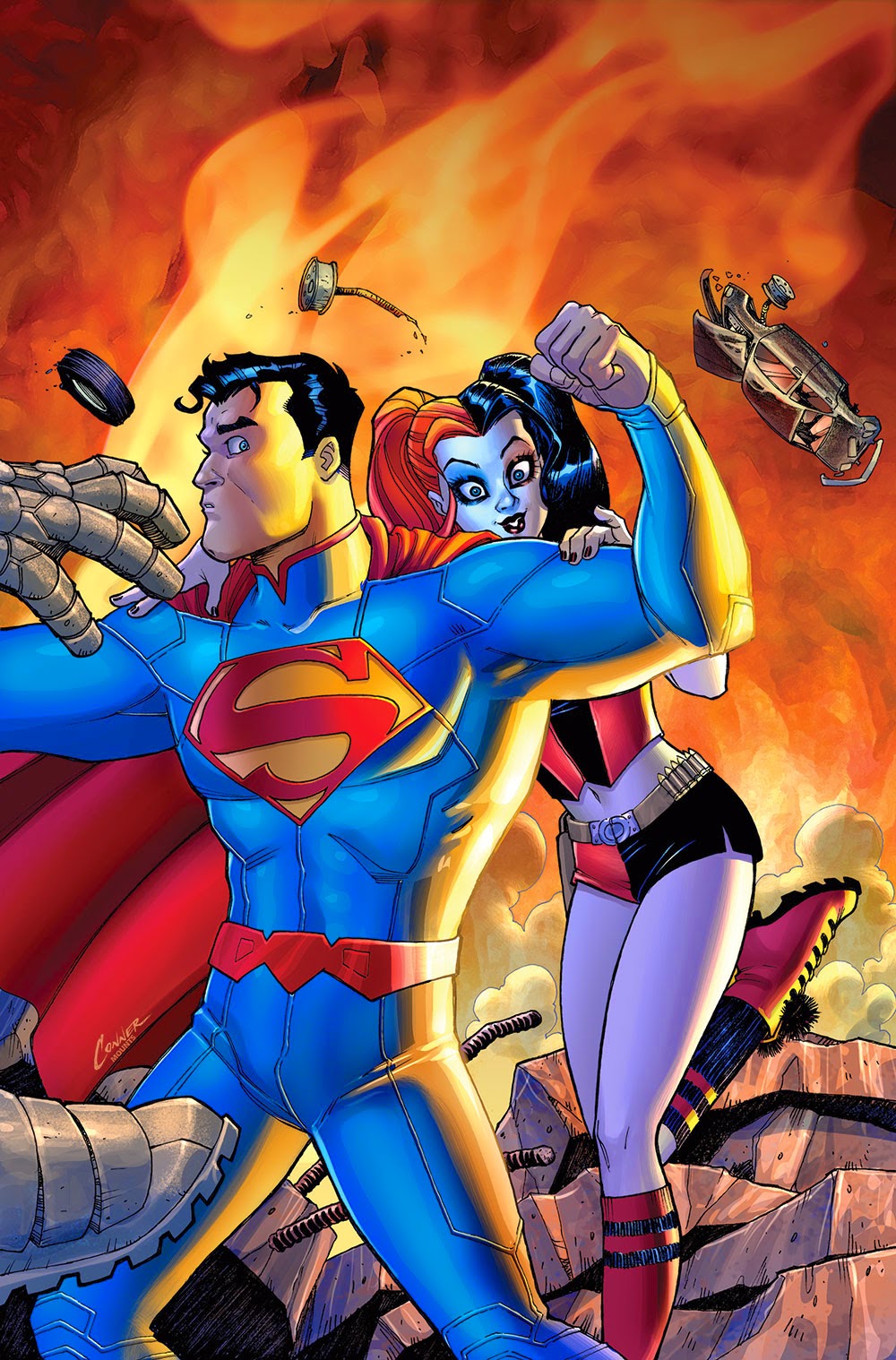
And then there are a bunch of Harley Quinn variant covers that don't really illicit a strong reaction from me. They mostly look like pretty normal comic book fare to me and wouldn't make me pick up their comics, but also aren't terrible or offensive. I mean, the Conner Superman variant is kind of fun, and the Justice League dark one is clever in a tumblr reblog sort of way, and the Sinestro variant is a very pretty illustration, but I'm not really intrigued or compelled by these covers. Similarly, some of these covers aren't my favourite style and lean too far into the sexualizing Harley Quinn direction for my tastes, but I'm not horrified by them either. In a few cases, like the Teen Titan cover, the fun-slapstick covers seem to tonally mismatch with the comics they are on based on dark, disturbing normal covers which isn't great. Your mileage and opinions, of course, may vary.


These are two of the covers I think are actually actively bad. The Green Lantern Corps variant (left) I think is kind of unattractive and not very eye catching. I think this has to do mostly with the colouring which has a really bright background and magic trick box thingy, but really dark muddled colours on the characters. Which for me makes the whole cover just look kind of messy and indistinct and, worst of all, forgettable when compared to many of the other covers. The Batman variant cover (right) is just off putting. There is this weird mix of infantilization and sexualization going on with Harley Quinn here that is totally creepy and makes me less likely to pick up this comic. If for no other reason than I'd rather not have other humans see this comic in my possession.


This Catwoman cover (left), though, is the worst of the variants in my opinion. The anatomy of the characters depicted is weird with Catwoman's legs doing unrealistic things in unrealistic proportions and both women's breasts are ginormous and weird looking. The composition is also really weird: the picture shows Catwoman breaking Harley Quinn's mallet with a kick, but I didn't get that right away because of how static the characters look and how posed their faces are. It's really weird to me. Add in some super glossy colouring and a distractingly granular background and you have a cover that is kind of bad looking and boring. I'd never pick up this comic based on this cover.
Which is even more crazy when you look at the normal Catwoman cover (right) which is fantastic! It is a striking piece of art with its smart use of black and white space, dramatic tilt, and intriguing, suspenseful picture. This is a cover that demands attention and teases a story worth reading. It is night and day better than the variant cover it is being paired with in February. These two covers make a great contrast between a cover done well and a cover done poorly.
And as a control, here are the Harley Quinn covers which are both very nice and effective. The story of the issue, which according to the solicit, is about Harley Quinn getting overwhelmed with her various identities and tasks and having a mental break. Which both covers capture quite well.
So there you have it, the good, the okay, and the ugly of the Harley Quinn variant cover month.
Or a look at this years reviewed comics and their genre distribution
It is New Years time, which means the time has come to take stock of what I've read and reviewed in 2014. I feel like I do a pretty good job listing favourite comics during the regular business of Atoll Comics, so with these year end posts what I like to do is take a look genre distribution in the Mainstream (Marvel/DC) comics and how it compares to the genre diversity of all the other comics publishers. This is because I think one of the most interesting and important differences between Marvel/DC and other comics publishers is the spectrum of stories that they publish. So just like last year, I am going to assign genres to all of this year's Top-ten mainstream comics and reviewed Creator-Ownederish comics.
The genres:
Comics don't automatically get assigned genres, and are infrequently sorted by genre in stores. Instead, they tend to get sorted by format (monthlies, tradepaperbacks, original graphic novels etc). So I'm going to assign my own genres to all these comics. For convenience (and ease of graphing) I'm also going to lump a bunch of genres together. To keep us all on the same page these are the genres I'll be using and a short definition of what I mean by them.
Adventure: An action packed story with elements of travel, journey, and discovery. Usually a bit light hearted. Think Indiana Jones.
Autobiography: A truthful, or semi-truthful account of the authors life. Think... well any autobiography.
Comedy: A sizeable percentage of the story is devoted to making the audience laugh or subverting the premise for comedic/absurd reasons. I'm using this in both the humour and satirical sense. Think: Superbad or Dr. Strangelove.
Crime: A story about criminals and those that live outside the law. Usually has heist and/or thriller elements. Think Drive or Lock Stock and Two Smoking Barrels or even Ocean's 11 (the original please).
Cultural: I'm using this as a catch all for a story that integrally features a commentary on some sort of cultural construction. Think District 9 and apartheid or The West Wing and presidential politics.
Drama: A story whose action is built around emotional tension and consequences. Think Sophie's Choice.
Espionage: About spies. Think James Bond
Fantasy: A story involving a supernatural element like magic. I'm going to use it in the context of historic, epic, or mythic elements. Think Lord of The Rings
Historic: Set in the past: actual or alternate. Think Gladiator or Band of Brothers.
Horror: Stories that endeavour to scare, frighten, or creep out its audience. Think The Shining, or if you're me ET.
Mystery: A story that is constructed around solving a mystery or crime. I'm also going to lump police and law procedurals into this category. Think Law and Order.
Other: Something that defies easy classification. Like, well that's kind of the issue isn't it.
Science Fantasy: A story with fantastical technologies or a story set in the future with fantastical elements without regard for Scientific plausibility. Think Star Wars or Firefly.
Science Fiction: A story that features some sort of societal or technological thought experiment. Think 1984 or I Robot
Slice-of-Life: About the lives of characters in a texture of their everyday life kind of way. That's a terribly nebulous definition... but it works? Think Forest Gump.
Superhero: People with super natural abilities have adventures of some sort. Think Avengers.
Thriller: Excitement! Suspense! Action! Danger! Think Die Hard.
Travelogue: A story that revolves around travelling to a new place and trying to convey the reality of living or visiting that place. Think Lonely Planet.
Urban Fantasy: A story set in the present with modest supernatural elements. Think Buffy The Vampire Slayer or Ground Hog Day or American Gods.
War: A story set during a war and about people involved in the event. Think Band of Brothers or Full Metal Jacket.
Western: A story about the Wild West, cowboys, etc. These stories have their own kinds of genre tropes and narrative feel which goes beyond the subject matter which I think justifies them as having their own genre. Think True Grit or The Good, The Bad, and The Ugly.
Mainstream (Marvel & DC) comics I've read in 2014:
So here are all the comics that have been in my Top Ten at some point during the last year. How this is going to work is each title is worth 1 point towards further analysis. Since many titles don't clearly sit in one genre, their 1 point can be broken up and assigned to multiple genres. So for a book with two genres, each genre will get 1/2 a point. Pretty straight forward, right?
So with this scoring system in place these are the books I've read this year and the genres I think they most belong to:
Avengers: Superhero (Analysis)
Avengers Assemble: Superhero (Analysis)
Batgirl: Superhero (Analysis)
Batman: Superhero
Black Widow: Espionage
Bucky Barnes: The Winter Soldier: Espionage, Science Fiction (Analysis)
Captain Marvel V2: Superhero, Science Fantasy (Analysis)
Daredevil: Superhero (Analysis)
FF (2): Superhero, Adventure (Analysis)
Hawkeye: Superhero, Thriller (Analysis)
Moon Knight: Superhero, Thriller (Analysis)
Ms. Marvel: Superhero (Analysis)
Rocket Racoon: Science Fantasy
Secret Avengers: Espionage, Comedy (Analysis)
She-Hulk: Mystery (Analysis)
The Movement: Superhero, Cultural (Analysis)
The Young Avengers: Superhero (Analysis)
Wonder Woman: Superhero, Fantasy (Analysis)
Which gives me the following genre breakdown for Mainstream comics:
Creator-ownederish comics I've read in 2014:
In the same period of time I read all or some of the following creator-ownederish comics. Again, each title is worth 1 point, and this point can be chopped into parts for titles that span multiple genres. Oh, and I've included links to all the reviews that have been published. Here's the list:
Air: Urban Fantasy, Cultural (Review)
Atomic Robo: Adventure, Comedy (Review)
Bad Houses: Slice-of-Life (Review)
Bandetta: Adventure (Review)
Big Questions: Other (Review)
Blacksad: Mystery (Review)
Blankets: Autobiography (Review)
Burma Chronicles: Autobiography, Travelogue (Review)
By Chance or Providence: Historic, Horror (Review)
Chew: Mystery, Comedy (Review)
Demo: Superhero, Drama (Review)
East of West: Science Fantasy, Western (Review)
Exit Wounds: Slice-of-Life (Review)
Fatale: Crime, Horror (Review)
Finder: Science Fiction, Other (Review)
Ghost: Superhero, Horror (Review)
God Is Dead: Fantasy, Horror (Review)
Goliath: Historic (Review)
Incognito: Crime, Superhero (Review)
Lazarus: Science Fiction (Review)
Leaving Megalopolis: Superhero, Horror (Review)
Mara: Science Fiction (Review)
Multiple Warheads: Science Fantasy, Travelogue (Review)
Nextwave: Agents of H.A.T.E.: Superhero (Review)
Pretty Deadly: Western, Fantasy (Review)
Pride of Baghdad: Historic, War (Review)
Prophet: Science Fiction (Review)
Pyongyang: Autobiography, Travelogue (Review)
RASL: Science Fiction, Thriller (Review)
Rat Queens: Fantasy (Review)
Saga: Science Fantasy (Review)
Satellite Sam: Historic, Mystery (Review)
Scenes From An Impending Marriage: Autobiography (Review)
Secret: Espionage (Review)
Sex Criminals: Comedy, Cultural (Review)
Shenzhen: Autobiography, Travelogue (Review)
Snowpiercer: Science Fiction (Review)
Stumptown: Mystery, Thriller (Review)
The Manhattan Projects: Historic, Science Fiction (Review)
The Massive: Thriller, Cultural (Review)
The Property: Slice-of-Life (Review)
The Sixth Gun: Western, Fantasy (Review)
The Unwritten: Urban Fantasy, Cultural (Review)
Three: Historic (Review)
Transmetropolitan: Science Fiction, Cultural (Review)
Uber: Historic, Superhero, War (Review)
Umbral: Fantasy, Horror (Review)
Unknown Soldier: Historic, Cultural (Review)
Zero: Espionage, Science Fiction (Review)
Which gives us the following genre breakdown:
And if we compare the genre distribuitions between Mainstream (DC/Marvel) and Creator-Ownederish (basically everything else), we get the following:
This is the third year I've done one of these roundup/genre analysis posts. Go here for 2013, and 2012 can be read here. What this means is that I can pool my genre distributions (correcting for any repeat titles and redundancies) to increase the sample size of the analysis and maybe cut down on sampling bias a little.
Over the past 3 years of mainstream comics I get the following genre distribution:
Over the same period this is the distribution for all the Creator-ownederish titles I've reviewed:
As always there are a ton of caveats with this kind of analysis. I read what I read, what I like and what I'm curious about, which means that the data isn't exactly an objective sample of what is being published. For instance, I am sure that the Superhero genre is under-represented in this year's Mainstream comics data since I just seem to be drawn to the more off-beat comics offerings from the Mainstream publishers. That said, I feel like this little analysis does a reasonable job of capturing a few interesting trends worth unpacking.
In past years the trend I've seen is that Mainstream comics have been overwhelmingly Superhero comics while non-Mainstream comics have a much wider genre distribution. You can see this trend reflected in the cumulative graphs. I still think this is a really interesting effect, in that it seems that Mainstream publishers are really focused on delivering Superhero comics to the exception of pursuing other genres. Creator-ownderish comics publishers seem to be interested in publishing all kinds of comics. Whether this is a result of them pursuing an underserved market, avoiding the Mainstream Superheroic stranglehold, or just creator interest is an open question. The trend is definitely there.
I've always felt this was important because Superhero comics are not for everyone. Pretty much all of the people know Superheroes are a thing and that they can read about them in comics. What is less appreciated by the non-comics reading public, in my experience, is that comics can also be serious Crime or Sci-fi, Autobiography or Literary Fiction stories too. Comics could probably reach a wider audience by catering to wider interests. Non-Mainstream comics appear to being doing that, and I think it's a really good, really healthy thing for comics.
What is interesting in the 2014 data is that the share of non-Superhero comics in the Mainstream category has grown significantly. Nearly half of the Mainstream comics I read this year were at least partially non-superheroic. Or put another way, the genre distribution of the Mainstream comics I read in 2014 is far more diverse. Now, due to sampling bias this might not be representative, but I'm really enjoying the genre variety in my Mainstream comics. I wonder if this is a sign that Mainstream comics, mainly Marvel, is trying to attract more new readers through genre diversification or if they are trying to attack the growing marketshare of non-Mainstream comics. It will be interesting to see if this trend continues in 2015.
Post by Michael Bround
Previously:
Comics in review 2013
Comics in review 2012