Monday, 15 October 2012

The Imposter Imposition

Or why geek exclusivity is stupid.


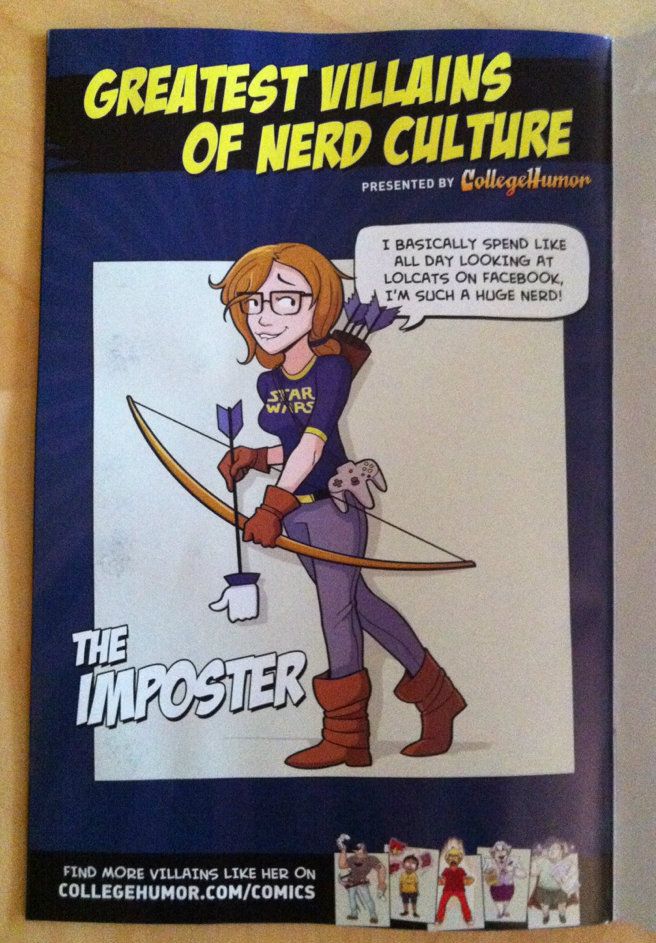
While looking over this weeks comics purchases I noticed a perplexing advertisement on the back of my issue of batman. It depicts one of "The greatest villains of nerd culture" called "The imposter". You see, she is one of those ladies who have jumped on the geek bandwagon, but isn't really a nerd at all. She is a POSER, not a real geek like you are me. You can tell this because she likes lolcats (because there aren't any geeks who like cats or the Internet) and because she is a girl, I guess.


Frankly this joke is profoundly sexist and stupid. We live in 2012 where the visible examples of geeky women in our culture are legion; we can stop doubting they exist and interrogating them as to the veracity of their geekyness. Also: as a culture that years and years ago was a collection of awkward dudes, aren't we glad that there are women out there with common interests who we might be able to meet at geek events? Also also: geek media companies, don't you want to sell things to the 50% OF HUMANITY that is female? I seriously don't grok this kind of sexist resistance to lady geeks.

But I have issues with the add beyond the rampant sexism (which others are far more qualified to write about). Specifically, I have issue with the idea that being a geek is/should be exclusive.

I get that we all want to be special: to be unique and different from all those non-squares with their sports and dancing. And I get that self identity is important, even if it is just being a geek, and, depending on when you decided/discovered you were a geek, that it might not have been cool and came with a stigma. (Hell, I get it, I went to a high school that was a rampant football jockocracy .... which is weird since I'm Canadian.) But here's the thing, being a geek is COOL now and, along with increased social cache and annoying sitcoms, people WANT to be geeks now which means that there are going to be more geeks. And since being a geek is really just weird enthusiasm for the consumption of certain kinds of media and products and not dependent on any sort of geek formal hierarchy it's not as if you can stop them.

And why would you? What possible effects on your enjoyment do self identified geeks who haven't attended the four year diploma program at the institute of geek technology have? How does being inclusive hurt you?

I'd argue it doesn't. Geek media needs an audience to make money and needs to make money to be made in the first place. The bigger the potential audience for this kind of media (self identified geeks) the more of this media can and will be made. All of these new geeks are buying the things we love which is supporting our favourite creators, media properties, and the corporations who make our geeky consumables which just ensures MORE of what we love. And even if some of these geeks are just pretending to be geeks they are still paying for geek media which STILL supports the production of our favourite media. Even "The Imposter" helps geek culture.

I guess a potential worry is that an influx of new geeks might change geek culture. Maybe a bunch of wishy-washy not-geeks might create a powerful block of consumers and geek media might change to better accommodate them. Maybe corporations will water down our geek interests to appeal to even MORE people and make something unrecognizable to what we love. To this I would suggest that corporations have ALWAYS been trying to make media that appeals to a wider audience (re The Avengers) and that while new and different media might be made to appeal to  new geeks, we aren't going to suddenly lose what we have been enjoying. Rather, its just going to be MORE media that is made which just adds to the menu of options for all of us to enjoy. More geek consumers equates to more media and more options, not the loss of existing options.

And if you don't like some of this media, fine, just don't read/watch/buy it. Seriously.

So, can we forget all of this boys club exclusivity nonsense already and just go about enjoying what we like and encouraging other people to do the same?

Friday, 12 October 2012

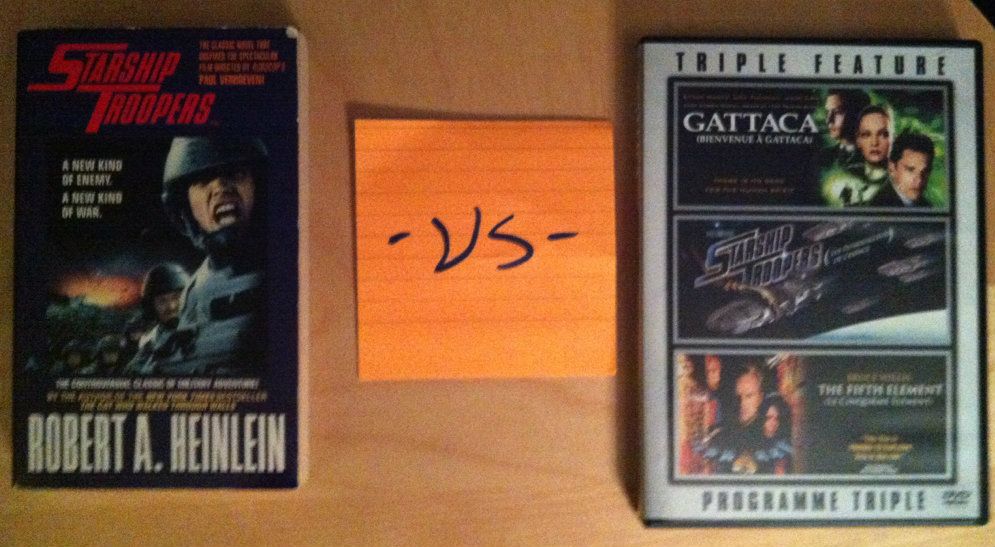
Starship Troopers vs Starship Troopers

Or a comparison between source and adaptation

One of the interesting consequences of having so many different flavours of media these days is that things have a tendency to be adapted between formats. Comics become movies which are adapted to novels which inspire TV shows which spin into new comics. Each media transition often involves different people with different objectives, goals, and creative tastes. Each flavour of media has its own individual strengths and weaknesses. While the core story can never really be completely divorced from its creators or media, I think it's a fun game to compare different versions of the same story and see which I like best.


Today I will discuss and compare the classic Robert A Heinlein novel Starship Troopers with the Paul Verhoeven action film adaptation Starship Troopers.

There will be many *SPOILERS* in this article.


My analysis after the cut:


Wednesday, 10 October 2012

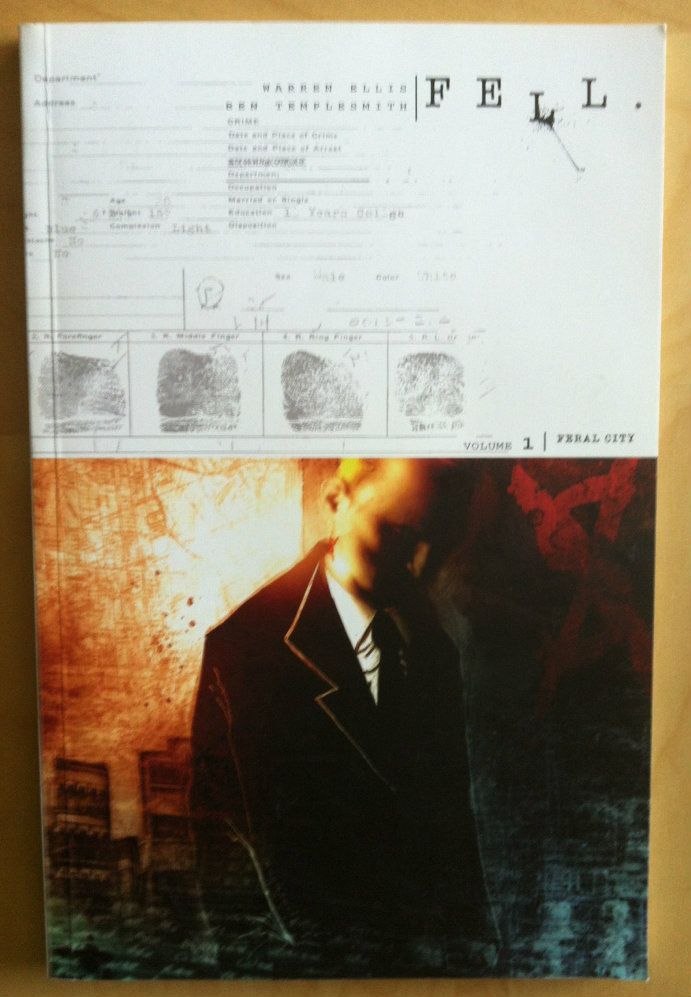
So I Read Fell: Feral City


A 250 word (or less) review of the first Fell trade paperback.
By Warren Ellis and Ben Templesmith, Image Comics


Fell is the fever dream of a deranged mind. In the book disgraced police detective Richard Fell is sent to the hellish urban landscape of Snowtown: a lawless and moldering city apparently populated by twisted psychotics and policed by a department with only three and a half detectives. The book is essentially a police procedural in the most fucked up city imaginable and where every crime is an extreme example of brutal and deviant behaviour. And yet, this is still a book with tremendous humanity. Warren Ellis refuses to let the reader forget that all the horrible shit in this book is happening to human beings who matter which gives the book some serious gravitas and emapthy. The artwork, by Ben Templesmith, is absolutely perfect for this book. The characters are thin and knobby and sickly and the colors are muted and have this hazy, muddy quality that really fits the books mood of isolation and horror. The final product is simply an awesome and awful creation that is poignant and beautiful and ugly and sick and leaves me flushed and shaking after every chapter. It’s the perfect articulation of modern nightmares, and if that is something fascinating to you, I'd say this is a comic you should definitely read. Just not in a public park at night.

Word count: 218

Previously:
So I Read Ignition City

Monday, 8 October 2012

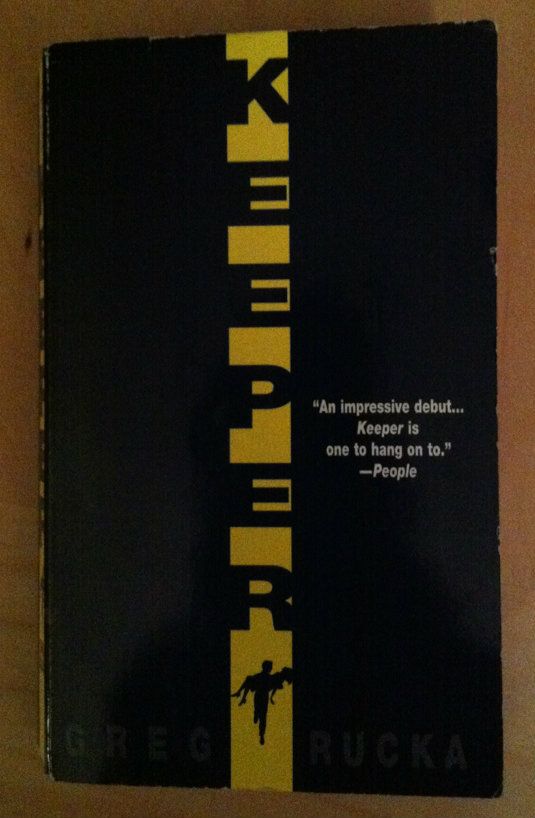
Keeper Is A Good Book

Or why you should read Keeper by Greg Rucka


Since this is mosty a comics blog, I'm sure you're all aware that Greg Rucka is a comics writer of some renown and considerable skill. He is also, incidentally, a novelist of mystery/thriller  books. Since I enjoy his comics I thought I'd give his novels a spin. I started with his first: Keeper.


Now, I feel like I should lay out an aside here: I seldom  read Mystery/Suspense novels. I'm pretty much happy reading Sci-fi novels forever, spiced with the odd excellent Fantasy novel and occasional Literary Classic. So I'm not what you would call well versed in the Mystery/Suspense genre. I did go through a brief Tom Clancy and Robert Ludlum phase in high school which to this day leaves me with certain perceptions about the genre that involves vaguely jingoistic patriotism and might-makes-right attitudes... which are not-so-much for me. (Hurrah for America may lose some of it's kick when translated into Canadian.)  What I'm saying is this was an unusual voice of reading for me.

Keeper follows professional body guard, and flamboyantly named, Atticus Kodiak, as he provides personal security to a women's health provider (a doctor who provides, among numerous  health services, abortions) and her daughter (who is afflicted with Downe Syndrome)  from death threats leveled at her by anti-abortionist extremists. It's a properly thrilling book with smart pacing, some good mystery elements, and a great deal of maturity. Keeper was a difficult book to put down.


Keeper is also progressive as hell.

The hero of the story is protecting an abortion provider from a villainous Pro-life movement populated by charlatans, mysogynists, and thugs who are just awful people. As someone with a liberal bent, it's pretty refreshing to read a mystery thriller that I don't find politically problematic. If you're anything like me and trepidatious about Mystery/Thrillers, this one is okay.

I'd recommend this book to anyone who likes Rucka's comics work: a lot of his best qualities are on display in this book.  Conversely, if you like this book, I'd suggest you give Rucka's comics a shot since his creator ownederish comics share a lot with Keeper. I'd also suggest this book to anyone interested in finding a smart, liberal-friendly airplane or commute book.

Friday, 5 October 2012

Atoll Comics Industry

Or the Darwinistic practices of DC and Marvel Comics

The original premise of this blog was to save money by only reading ten ongoing comics and four graphic novels/trade paperbacks a month. Setting these rules forced me to drop a lot of books and focus on my favourites. As a result I read fewer comics (at least Marvel and DC comics) but greatly enjoy every comic I read. It's like my reading habits have undergone a comic book evolution.

Something I've realized recently is that Marvel and DC are conducting similar experiments in Comics Darwinism.


A core tenant in the Theory of Evolution (not a theory) is that species adapt through time in response to selective pressures. Which is fancy Science talk for saying that living things compete with each other for resources and, well, survival. This can be as simple plants fighting one another for light or animals trying to avoid being eaten or animals attempting to eat those other aforementioned animals. Individual organisms that are able to outcomplete other members of their species for resources will tend to outlive, and therefore, outbreed their relatives. They have more offspring and then their offspring have more offspring, and so on, until eventually the entire species more closely resembles that first successful organism. This is "Evolution". The same process happens on a species level: species that are well adapted to a particular environment can get more resources and therefore outcompete other species and take their spot. The species that are not very good at competing decline and in extreme situations  may eventually go extinct. This process of competing for resources is "Natural Selection".


DC Comic's New 52 is a a sales gimmick, a reboot, a simplification, and I would argue an example of comics Natural Selection. As part of their current publishing strategy DC is committed to publishing 52 titles; no more, no less. Nested in this approach is that whenever DC wants to lunch a new title they have to give another, underperforming ongoing series the ax  Which is to say, comics are allowed, or even encouraged to fail. DC comics has therefore created selective pressure for their books to succeed or be replaced by newer, faster, younger premises that are then given a chance to find an audience. DC has essentially enacted the publishing equivalent of natural selection by only allowing comics with a stable or growing audience (resources) to survive. In theory such a Darwinistic approach should ensure that DC only publishes the best comics (as judged by market forces).

But natural selection isn't the only process by which species adapt and change over generations. Survival of the fittest selects for survivors and breeders and not any of the numerous other things that might be desirable to humans. For instance people enjoy things like giant cows that contain a lot of meat. Such cows tend to be slower than smaller cows and therefore much more susceptible to, say, wolves and wouldn't occur naturally. Similarly people want to have ginormous tomatoes which require more resources to grow and seed than normal tomato plants and also wouldn't do particularly well in a natural setting. The solution for people who want this ungainly organisms is another Evolutionary process called Positive Selection. This is essentially taking two remarkable individuals who exemplify some desirable thing and mating them. For instance ranchers wanting huge cows would take two really big cows and breed them, and then breed their largest babies, and their largest babies and so on. Eventually they would get a weirdly big cow. This process of positive selection underlies pretty much all of the food we eat and why we have so many breeds of dogs.

Marvel Comics seems intent on exploring Positive Selection in its publishing strategy. Marvel is pursuing a publishing strategy where they ship fewer titles, but ship each ongoing series about twice as often. This means that instead of replacing its weakest books with new titles, Marvel is reinvesting its creative resources into its most successful books as a way to increase sales. In this way, it seems like Marvel is trying to positively select for popular intellectual properties or titles/characters that have cross media appeal. Taken to an extreme, this approach would let Marvel maximize the value of any given property and, in the process, create a streamlined lineup of its best possible titles.

To a certain extent I think both approaches have merit. DC's 52 book natural selection approach certainly encourages commercial success and Marvels positive selection for popular books provides hungry fans with more of their favourite content and ensures increased sales for Marvel. In an ideal world where comics consumption is limited only by interest (people would buy more books if only there were more that interested them), these strategies would globally increase sales by either increasing the overall quality of comics or by catering to existing interests.


Trouble is, I don't think we are living in this ideal world.


I figure comics are facing a scarcity of resources:the amount of comics a person consumes is generally limited by their own finances rather than their interest in comics. That is to say, people have a comics budget and that defines the number of comics they buy. I can't imagine that even if ALL of DC's 52 comics were dynamite that anyone would buy every series. Similarly, if Marvel put out four outstanding titles every day, no one would follow even a single title completely. And honestly, Marvel's double publishing strategy does nothing to address the limited resources of consumers... it just places readers in a position of awkwardly trying to raise their budget or to drop half their Marvel reading list. Basically, I think that although these Darwinist strategies are sound for creating better/commercially viable comics, they fail to address the real issue facing comics: a scarcity of consumers.


I think a more apt strategy for DC and Marvel to increase revenues is to attract new readers. I think the biggest problem facing comics is how inaccessible they are: you have to go to a comic store or website to get them, and you'll only do that if you are already actively interested in purchasing comics. People who have no experience with comics don't know they want them will never get them. Besides trying to sell comics outside the direct market, I think DC and Marvel have to find an effective way to advertise to new audiences. I'm convinced part of the solution is to put some big chunk of content online for free (whether it be old and good or newly created for such a purpose). The other solution, as I see it, is to diversify. One of the tenets of evolutionary biology is that success can be attained by niche filling. A pigeon is successful as a species for very different reasons than a mosquito, a rat, or a human. This is because these organisms are all radically different and occupy very different environments. DC and Marvel, for all of the very talented people who work at each, are ultimately publishing variations of masked vigilante punches villain. While this is awesome and fun and appeals to a great many people, perhaps more people could be attracted by telling all kinds of different stories in the comics medium. For instance, I think the diversity of storytelling at Image Comics is one of its greatest strengths (and maybe why Image finds audiences outside of comics). So yeah, I'd recommend that the Big Two diversify and come up with an effective strategy to attract more readers and therefore money/resources.


Otherwise, it'll just a be a desert with Batman in it.


(Also, prices could be dropped a touch to make comics more competitive with other types of media. Just sayin'.)

Wednesday, 3 October 2012

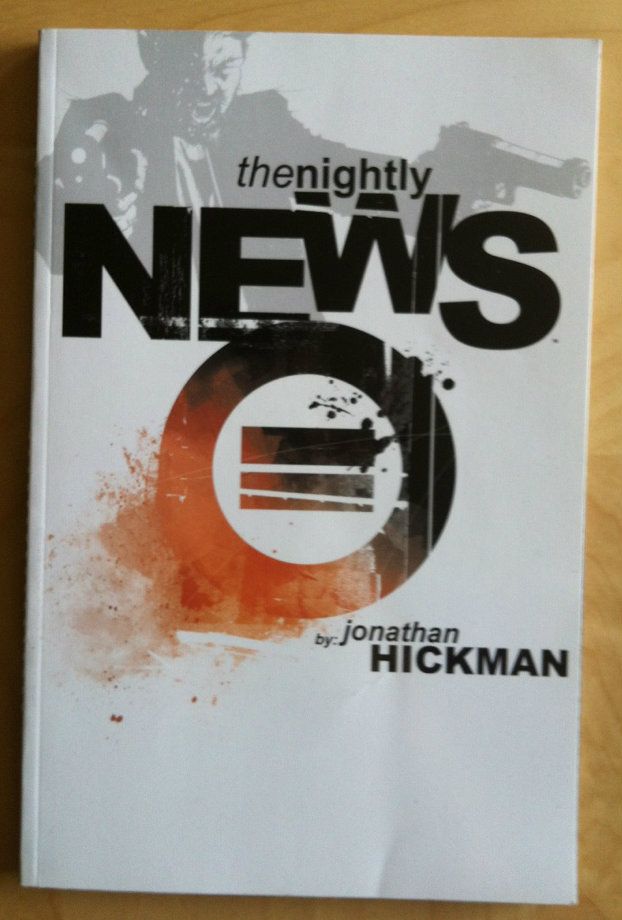
So I Read The Nightly News

A 250 word (or less) review of The Nightly News Graphic Novel,

By Jonathan Hickman, Image Comics


 As an aspiring Scientist I read a lot of Research articles. Occasionally I'll read about an experiment that is just exceptionally elegant, insightful, and brilliant. You know, the kind of brilliant that's just "wow... fuck me that's smart". The kind of brilliant that, as much as it's a showcase of great Science, is also a challenge to everyone else to do better. I can't help but wonder if The Nightly News has that effect on other comic book creators. Regardless, I think it’s one revolutionary book. The Nightly News is a book about a pseudo-cult who, directed by The VOICE, commit acts of vengeance/terrorism against members of the news media. It's brutal and unflinching but also darkly funny and very very smart. It's also disorienting, with A LOT of information, misinformation, and much between the two. Visually The Nightly News is very unconventional. Instead of a normal approach of sequential pictures arranged in some variation of grid, The Nightly News is this glaring white canvas overlayed with story artwork, graphic design elements, iconography, and infographics. The visual and written information onslaught plays to the thematic discussion about propaganda, the news media and education, by appropriating their methodology. The Nightly News is a book with a message: beware the media (it's power, corporatisation, and abuses), be wary of education, be aware that, as a member of the public, you are being constantly conditioned to behave in certain ways. The Nightly News, in no uncertain terms, cries THINK FOR YOURSELF. Read it.

Word count: 250

Previously:
So I Read The Red Wing

Monday, 1 October 2012

Utility Belts And You

Or the fashion accessory that is just begging to happen.


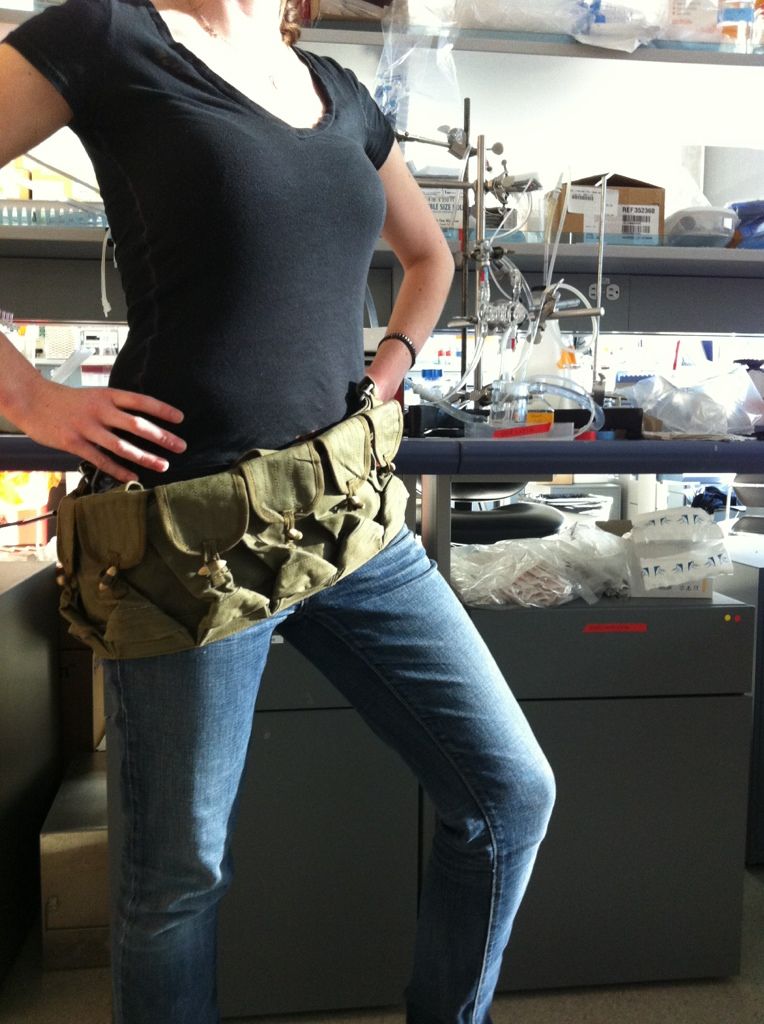
I recently wrote a thing about mainstream geek popularity, geek consumerism, and hypothetical pro-geek corporate manipulation. While thinking about the relationship between pop culture and fashion and geekyness, I observed one of my coworkers using the stretchy fabric belt on her empire-waisted-frock to hold her iPhone. It occurred to me that what she really needed was a utility belt.

A complaint that women in my life frequently make is that the majority of their clothing lack pockets with any sort of capacity. Not to say that there aren't pocketed options, but it seems the majority of dresses, skirts, and fashionable trousers tend to eschew storage capacity in favour of tightness and aesthetics. As a result many women are forced to rely on purses or jamming there phones/media players under belts, into undersized pockets, or, in the case of one my coworkers, inside their bras. A utility belt could be a solution to this problem with its many pockets and possible applicability to a number of looks/outfits.

Of course, for a female garment to become widely adopted by mainstream consumers it has to fashionable. Fortunately, I think conditions are brewing where this may be possible. Geek culture is going mainstream with an increase in self identifying geeks and the accumulation of cultural cache. This means that there are more openly geeky women who are willing to use fashion to express their geekyness. Pair this with a growing interest in cosplay, which shares a Ven diagram with lady geeks and utility belts and I think you have the potential for utility belts to be worn in regular life by female geeks (if it isn't happening already).


This represents at best a cultural beachhead, but I think it's an important one. As geekyness becomes more and more mainstream, comic books and fashion forward cosplayers could become trendsetters. What they wear could be what everyone wears the next year (and what Hipsters wear a decade later). And to a certain extent geeks already are informing fashion: designers are already mining comics and Sci-fi for inspiration.

There's another consideration: utility belts actually look GOOD. When my lovely coworker agreed to rock my army surplus pouch belt (bought for an Orson Randall Ironfist Halloween costume) I thought the result would look funny instead of awesome... but throw in a Han-Solo-roguish-angle and IT WORKS. Imagine how good it could look after a fashion designer got a hold of the idea and made some more minimalist and chique utility belts in black. I think this could actually happen, and if it did the idea could catch on in the mainstream.

So there it is, utility belts are a highly functional fashion accessory that can/does look good and with the trendiness of geekdom has the potential to break through to the mainstream. 


Let's make this happen.

(And then maybe my lab manager can turn off her phone's infuriatingly obnoxious ringtone and put it on vibrate.)